


 by Tom Gurney
Tom Gurney BSc (Hons) is an art history expert with over 20 years experience
Published on June 19, 2020 / Updated on November 3, 2026
Email: tomgurney1@gmail.com / Phone: +44 7429 011000
Quadrille at the Moulin Rouge by Henri de Toulouse-Lautrec: Introduction
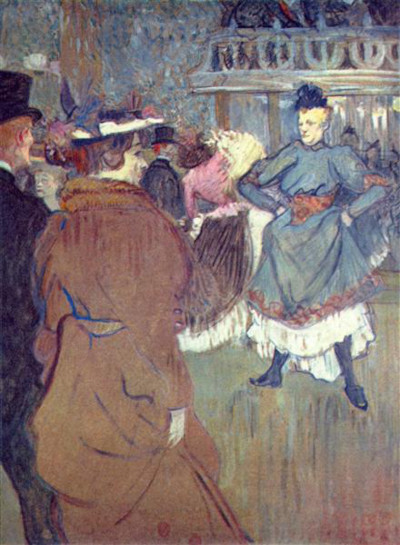
A dancer stands across the room from a couple whose backs dominate the foreground. Her hands gather the sides of her skirt, and her feet point out beneath pale petticoats. In Quadrille at the Moulin Rouge, Henri de Toulouse-Lautrec makes the relationship between watching and performing as conspicuous as the dance itself. We encounter the dancer through other people's presence.
The National Gallery of Art dates the painting to 1892 and records oil on cardboard, 81 × 59.8 centimetres, accession 1963.10.221. Its current title is Quadrille at the Moulin Rouge. The longer title preserved in this page's address, The Departure of the Quadrille, should not be treated as proof of an exact moment when a particular group is leaving or beginning its performance. [1]
At a Glance
- ArtistHenri de Toulouse-Lautrec.
- Current museum titleQuadrille at the Moulin Rouge.
- Date1892.
- Mediumoil on cardboard.
- Dimensions81 × 59.8 cm.
- CollectionNational Gallery of Art, Washington, Chester Dale Collection.
- Accession1963.10.221. [1]
This work across Henri de Toulouse-Lautrec’s career
Contents
- A view interrupted by spectators
- The dancer's wide stance
- Other figures complicate the scene
- The floor gives the figures distance
- A room built with visible marks
- From a private collection to Washington
A view interrupted by spectators
The nearest woman occupies much of the left half of the picture. Her brown coat presents a broad, almost continuous area of colour, edged and folded with darker blue lines. We see her mostly from behind, with a pale section of profile turned towards the dancer. Her position makes the room feel occupied before we begin to inspect its entertainment.
A man stands farther left, cut by the picture's edge. His dark coat and top hat add another barrier between our viewpoint and the dance floor. The cropping gives the impression that the room continues beyond the frame. It also prevents the pair from becoming a self-contained portrait group with comfortable space around every outline.
These foreground figures determine the available view. They leave an opening towards the right, where the dancer's body appears more fully. Our attention has to pass beside them rather than through an empty central corridor. Lautrec turns the act of looking into a physical arrangement of bodies, coats and gaps.
The dancer's wide stance
Across that opening, the dancer stands with feet separated and arms extending out from her waist. The hands hold the skirt at either side, broadening the outline. The repeated outward directions of elbows, fabric and shoes give her figure a strong presence despite its position farther into the room.
Her dress is largely blue-green, gathered above a pale lower layer. A warmer band around the waist and coloured trim near the hem interrupt that cooler mass. The contrast helps us read the costume as several related parts, with the skirt extending sideways and the petticoats continuing down towards the feet.
The figure's face is small but sharply marked. The eyebrows and mouth appear more emphatic than a smoothly modelled portrait would require. They help establish a public-facing presence across the floor. They do not, however, tell us what she feels about the spectators or supply a secure personal identity.
Her stance creates a moment of display rather than a blur of movement. The pose is open enough for the costume to become part of the performance. Yet the painting does not give us a sequence of steps. Its force comes from the arrangement held before us: the body spread across space, facing a room in which people are also looking elsewhere.
Other figures complicate the scene
Behind the nearest couple, another dark-hatted man appears in the middle distance. Nearby, a woman in pink introduces a bright patch among the more muted colours. Her raised pale fabric creates a different shape from the broad skirt of the dancer at the right.
These secondary figures prevent the painting from settling into a simple exchange between one performer and one audience. Several bodies occupy different depths, and their attention does not converge into an entirely clear narrative. The room contains simultaneous activities, some only partly available to us.
The overlaps are crucial. One head appears beside another person's shoulder; a hat interrupts the background; costume and clothing meet without much empty space between them. The crowded passages make the clear space around the right-hand dancer feel more pronounced. Her visibility is something the composition creates amid competing presences.
Small differences of colour help separate these people. Pink, black, pale flesh and blue-green establish changing accents across the room. Their distribution encourages the eye to move between figures rather than remain fixed only on the nearest or largest body. The painting's social density is made through such shifts of attention.
Watch: Toulouse-Lautrec
Choose an artist introduction, a film about graphic design or a closer look at At the Moulin Rouge.
The floor gives the figures distance
The broad lower-right area contains relatively little descriptive detail. Streaks of brown and green suggest a floor extending from the foreground towards the dancer. Its openness gives her stance room to register and establishes distance from the coat that fills the left side.
That area is not an empty neutral background. The direction of its strokes and its warmer colour form a surface against which shoes and hems become legible. The floor carries our eye into the room while also reminding us of the cardboard and paint from which the image is made.
The contrast between a broad foreground coat and a broad area of floor is one of the picture's organising decisions. Each takes up substantial space, but one blocks our view and the other opens it. The dancer stands where that opening leads. Her position gains emphasis through the unequal distribution of obstruction and access.
A room built with visible marks
At the upper right, an architectural structure introduces columns and a projecting horizontal edge. It gives the room a more rigid framework than the costumes and bodies below. Repeated upright elements also create a rhythm that contrasts with the dancer's curved skirt and outward-pointing limbs.
The surrounding background is described through broken patches of cool colour and exposed warm surface. Oil paint does not have to cover the cardboard evenly to establish a convincing interior. Here, differences in density allow bodies, floor and architecture to remain distinguishable while sharing a visibly worked surface.
This handling is particularly effective around the foreground coat. Its large brown area could flatten the picture completely, yet the folds, outline and relationship to the distant figures keep it readable as clothing. Lautrec allows a shape to function both as an object in the room and as a major area of colour on the support.
From a private collection to Washington
The museum's provenance traces the painting through Louis Bouglé, Bernheim-Jeune and Wildenstein to Chester Dale, who bought it in 1928. It entered the National Gallery through Dale's bequest in 1963. That history establishes the painting's later ownership, rather than explaining the intentions of the people represented within it. [1]
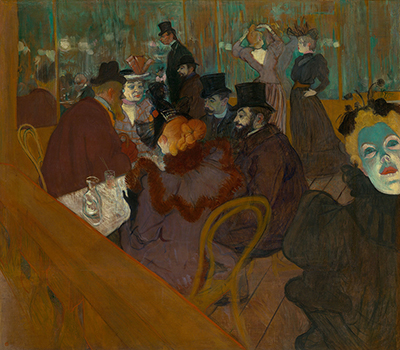
Compare At the Moulin Rouge: The Dance to see how differently the same venue could be organised as a picture. Here the tall format, foreground coat and open floor make access to the performer unusually important. We stand among spectators, looking towards a figure who holds the room through the spread of her costume and the clarity of her stance.
Toulouse-Lautrec artworks directory
Browse 84 identified works and publications in this researched selection. Dates and titles follow the individual records; this is not a complete catalogue of the surviving oeuvre. Print impressions remain attached to their designs. Some listed works do not have a dedicated article. The Drawings guide also contains nine illustrated studies consolidated from former articles.
Discussion
Look again at the images and ideas explored in Quadrille at the Moulin Rouge by Henri de Toulouse-Lautrec. These editorial prompts invite your observations.
Reader Insights
How does the foreground coat control your view?
What directions do the dancer’s elbows and feet establish?
How does the open floor separate spectators from performer?
Join the Conversation
Share a detail, comparison or question about Quadrille at the Moulin Rouge by Henri de Toulouse-Lautrec below.
References
- National Gallery of Art, Quadrille at the Moulin Rouge, 1963.10.221: title, 1892, oil on cardboard, dimensions, Chester Dale provenance and 1963 bequest. Visual discussion is based on the illustrated painting. View source.
- Autoportrait, 1880 (in French). View source.
- ALBERTINA: Der Schimmel Gazelle,GE123DL. View source.
- Franka Blok, Portrait of Vincent van Gogh, 2024. View source.
- Art Institute of Chicago: Moulin Rouge, La Goulue. View source.
- Art Institute of Chicago: At the Moulin Rouge. View source.
- Jane Avril, 1893. View source.
- Au Salon de la rue des Moulins (in French). View source.
- Colta Ives, Toulouse-Lautrec in The Metropolitan Museum of Art, 1996. View source.
- Maurice Joyant (in French). View source.
 Henri de Toulouse-Lautrec.jpg)