



 by Tom Gurney
Tom Gurney BSc (Hons) is an art history expert with over 20 years experience
Published on June 19, 2020 / Updated on October 14, 2023
Email: tomgurney1@gmail.com / Phone: +44 7429 011000
Woman at a Window: Introduction
A woman stands in a bare room, looking through a small opening beneath a much larger expanse of glass. Her head inclines slightly; the folds of her green dress spread towards the floor. Beyond her are trees, pale sky and the upright mast of a vessel whose hull we cannot see. Caspar David Friedrich painted Woman at a Window in 1822. The oil on canvas, 45 centimetres high and 32.7 centimetres wide, belongs to Berlin’s Alte Nationalgalerie, inventory A I 918. Birgit Verwiebe’s museum account identifies the woman as Friedrich’s wife, Caroline, looking from his Dresden studio towards the opposite bank of the Elbe. [1]
The picture gives us a position inside that studio without letting us share Caroline’s view completely. We can see the floor at her feet and the broad sill beside her, but little of the river beyond. The tall window promises a larger prospect than the painting delivers. Friedrich makes that difference between the size of the opening and the smallness of the visible landscape the centre of an unusually concentrated interior.
At a Glance
- Date · 1822
- Medium · Oil on canvas
- Collection · Alte Nationalgalerie, Staatliche Museen zu Berlin
- Accession · A I 918
- Dimensions · 45 cm high × 32.7 cm wide
Contents
- Introduction
- The room and its working window
- Caroline’s posture
- A river inferred from fragments
- A prepared figure in a constructed space
- What viewers found in 1822
- Annotated Details
- Image Details
- Before Caroline stood at the window
- Another studio view from the same building
- What another harbour window lets in
The room and its working window
The window is built in two distinct parts. The glazed upper section admits light across almost the whole width of the recess. Below it, opaque panels close off most of the prospect at standing height, leaving a central opening. Its right-hand leaf swings inward, presenting a pale edge and an angled surface to the viewer. Caroline stands to its left. The open leaf becomes a diagonal within a room otherwise dominated by straight uprights and level divisions.
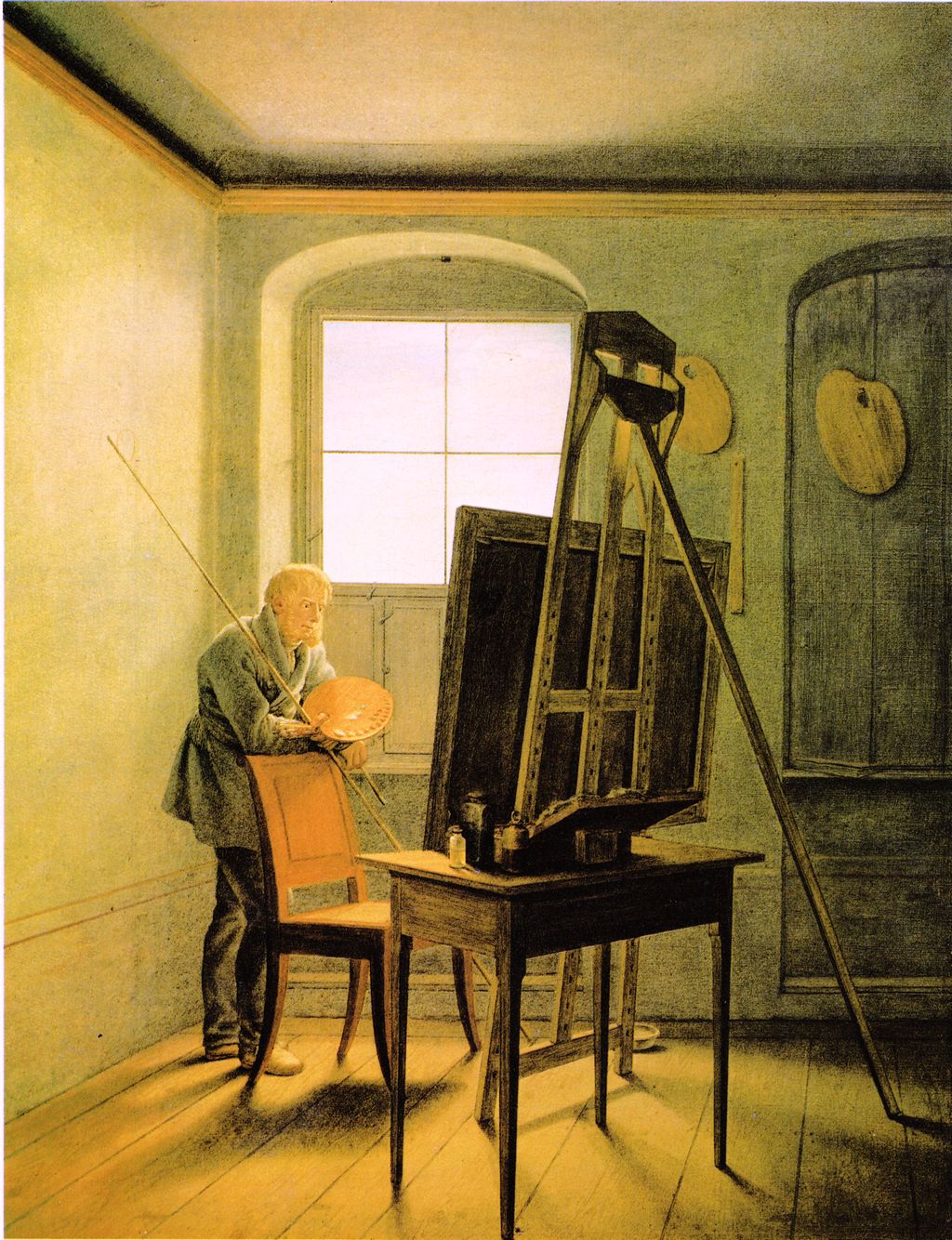
This is an artist’s working arrangement. Sabine Rewald explains that the lower wooden shutters could exclude direct light. Comparing the window with Georg Friedrich Kersting’s 1811 portrait of Friedrich at work, she reports the scholarly conclusion that Friedrich transferred the same specially constructed window to his later studio. The family moved in 1820 to An der Elbe 33, now Terrassenufer 16. Rewald also argues that the painted window is enlarged and the nearer boat brought closer than the actual embankment allowed. Its apparent immediacy is composed. [2]
The distinction helps us read the studio. A wall and a window can look like neutral documentation, yet their proportions regulate everything we see. Here the vertical format gives the glass great height above Caroline. The lower shutters keep the outside from becoming a continuous landscape behind her. Daylight enters high up, while the human figure occupies the smaller opening below. Light and outlook have been given different routes into the room.
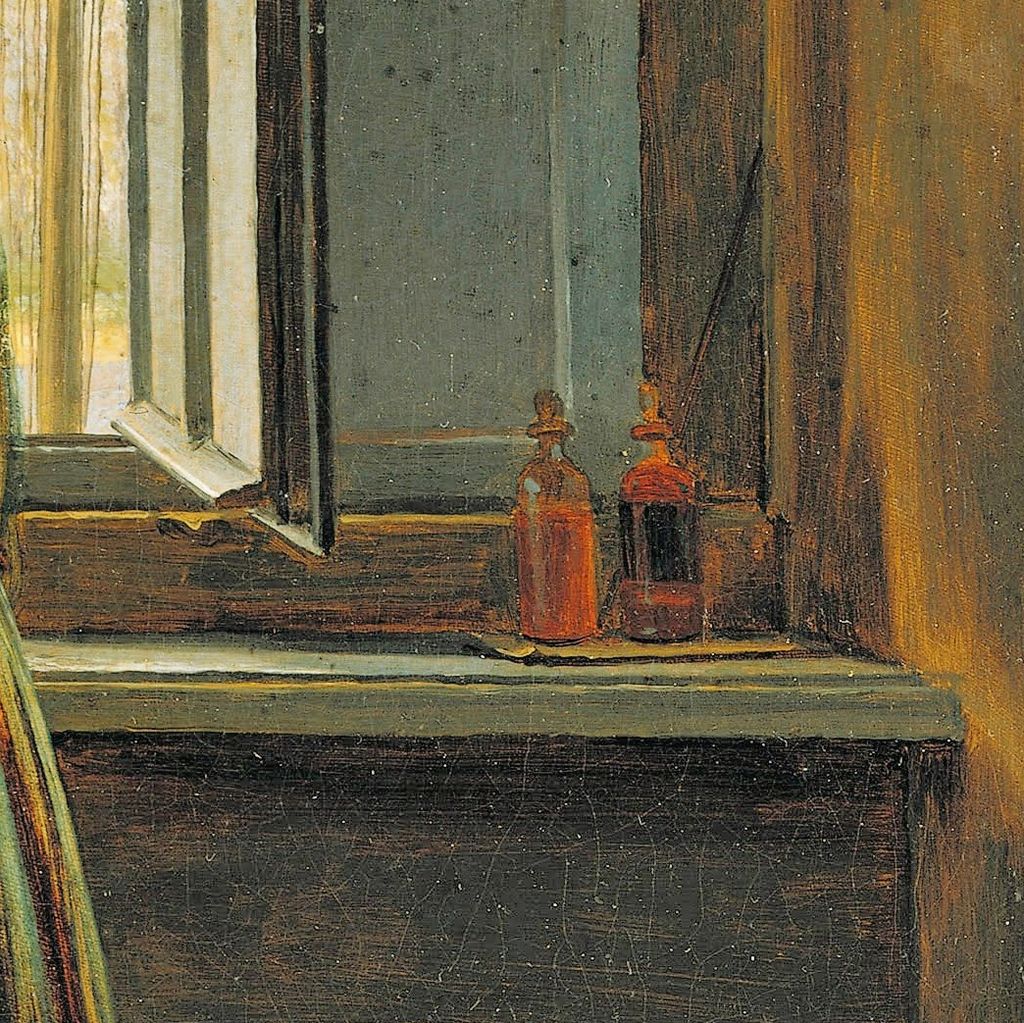
Two little bottles stand together at the far right of the sill, apart from Caroline and beyond the swung-open leaf. Their rounded stoppers and reddish glints catch the eye after the larger blocks of wall and woodwork. No easel or canvas explains the room’s purpose within the painted field. These modest objects make its use more tangible without filling it with equipment. Their small scale also gives the breadth of the sill something familiar to measure against.
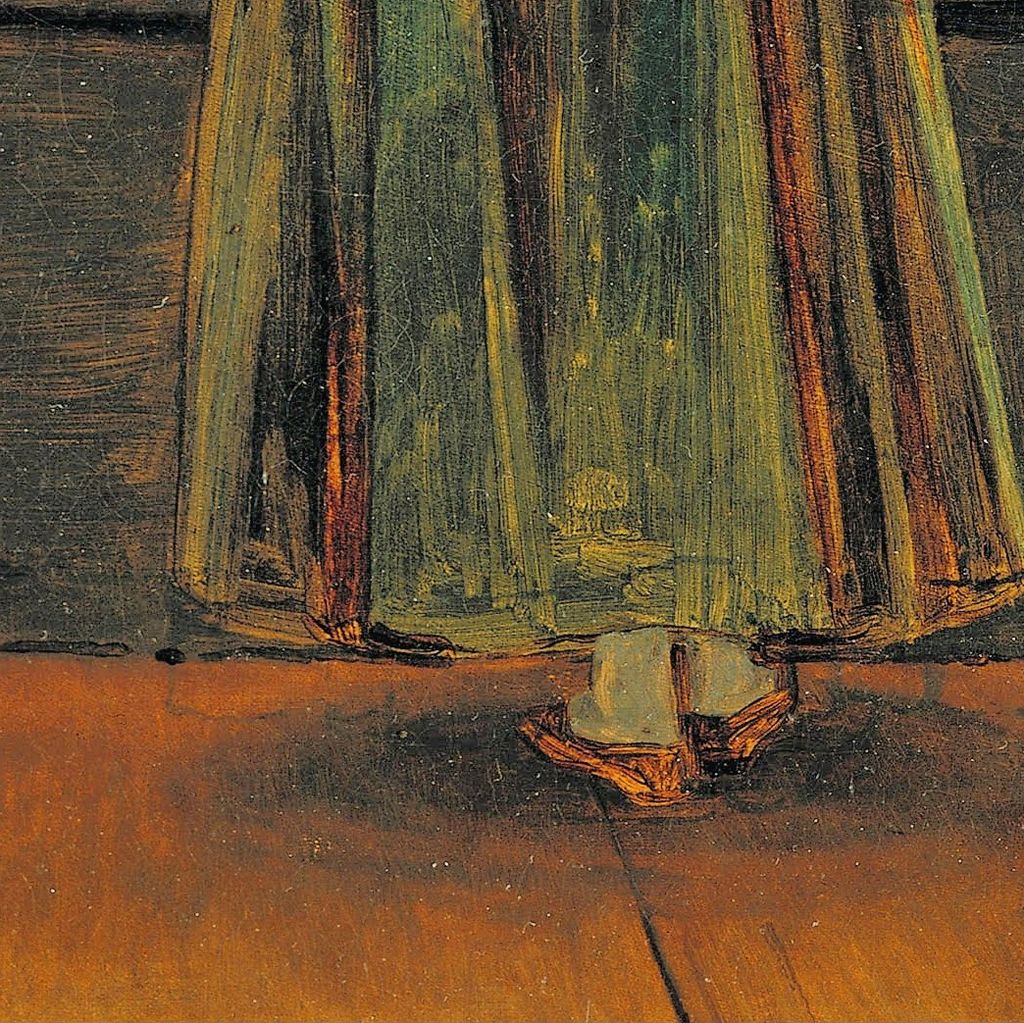
The floor occupies only a shallow strip, but it establishes our distance from the window. Its warm boards lead towards Caroline’s shoes, while the dark panelling beneath the sill stops the movement of the eye. She stands where the floor’s depth meets the flat wall. This makes the figure seem approachable within the room even as the window carries her attention elsewhere. The observer’s implied place is behind her, a few steps from the light.
Caroline’s posture
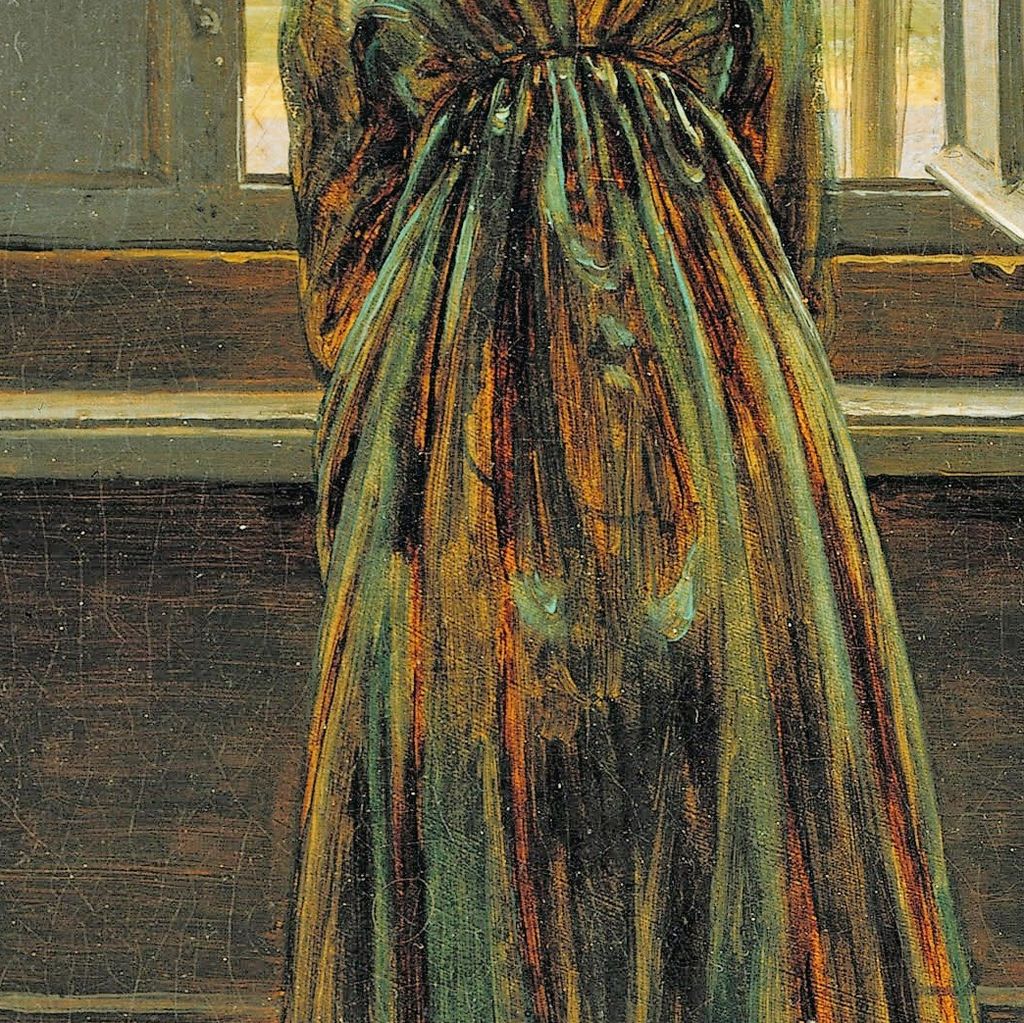
The narrow waist of the dress, set high beneath the shoulder blades, is the point around which the cloth gathers. From there the folds descend in long, slightly spreading lines. They echo the surrounding uprights without becoming rigid. The shoulders slope; the head tilts away from the mast’s straight axis. Those small departures from the architecture make the body’s stillness feel sustained rather than mechanically posed.
Her arms remain close to her sides, and her hands are largely unavailable to us. The painting offers no object held in the hand and no task whose completion would explain the pause. Even the slight inclination of the head leaves alternatives open: she might be looking down towards the water or farther across it. We can describe the position of her body with confidence while the precise object of her attention remains uncertain.
Caroline’s name should not become a substitute for that uncertainty. The Met’s exhibition presentation uses the more cautious identification “probably” Caroline Bommer, whereas Berlin names her directly. [3] Neither formulation supplies a facial expression. The sweep of the hair and the close-fitting bodice make her a particular bodily presence, but they do not tell us whether she is contented, restless or absorbed in something passing outside.
The green dress is also the most varied painted surface in the room. Bright yellow-green ridges alternate with brown and near-black folds; small warmer accents appear within them. Against the broad, quieter wall planes, the cloth gathers changes of light into a compact area. The illuminated nape and the edge of the collar sit just below the pale landscape. They bring outdoor brightness into contact with a body that remains mostly within the room’s shade.
A river inferred from fragments
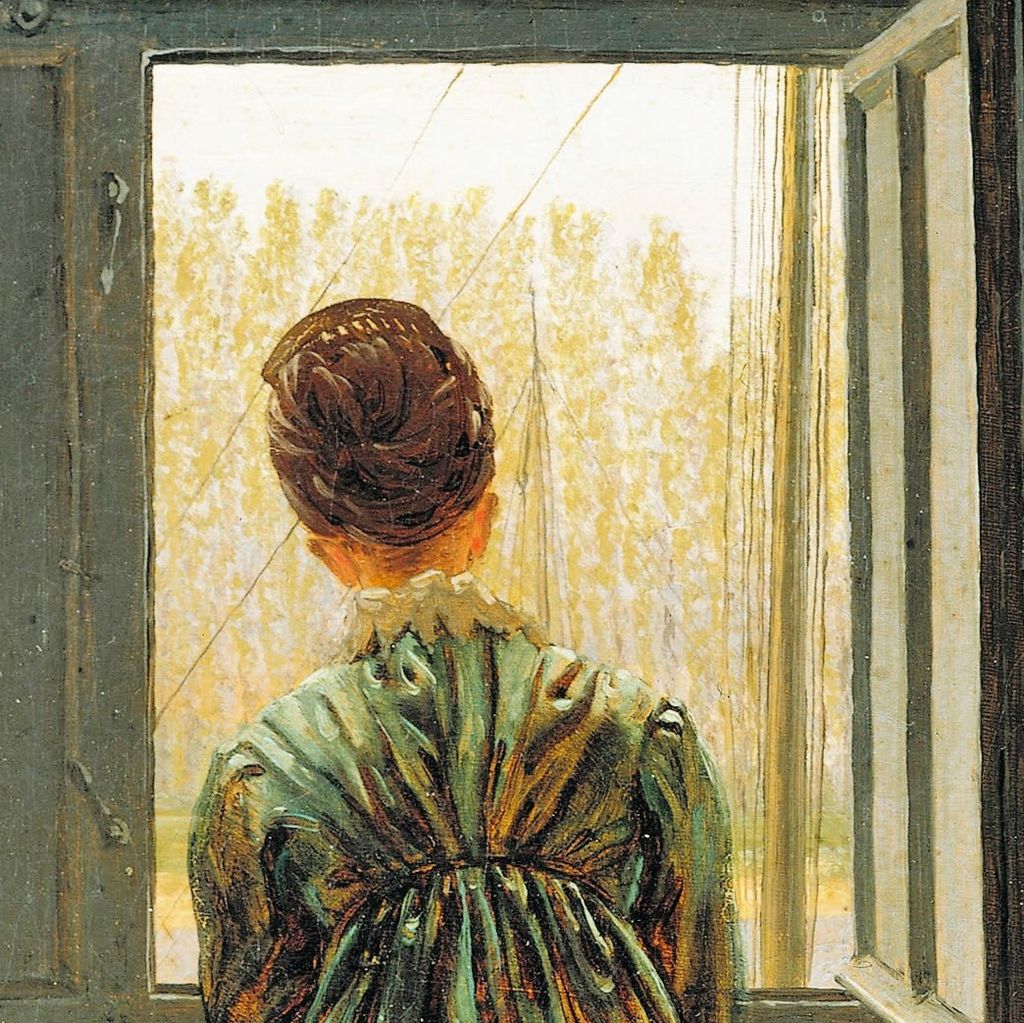
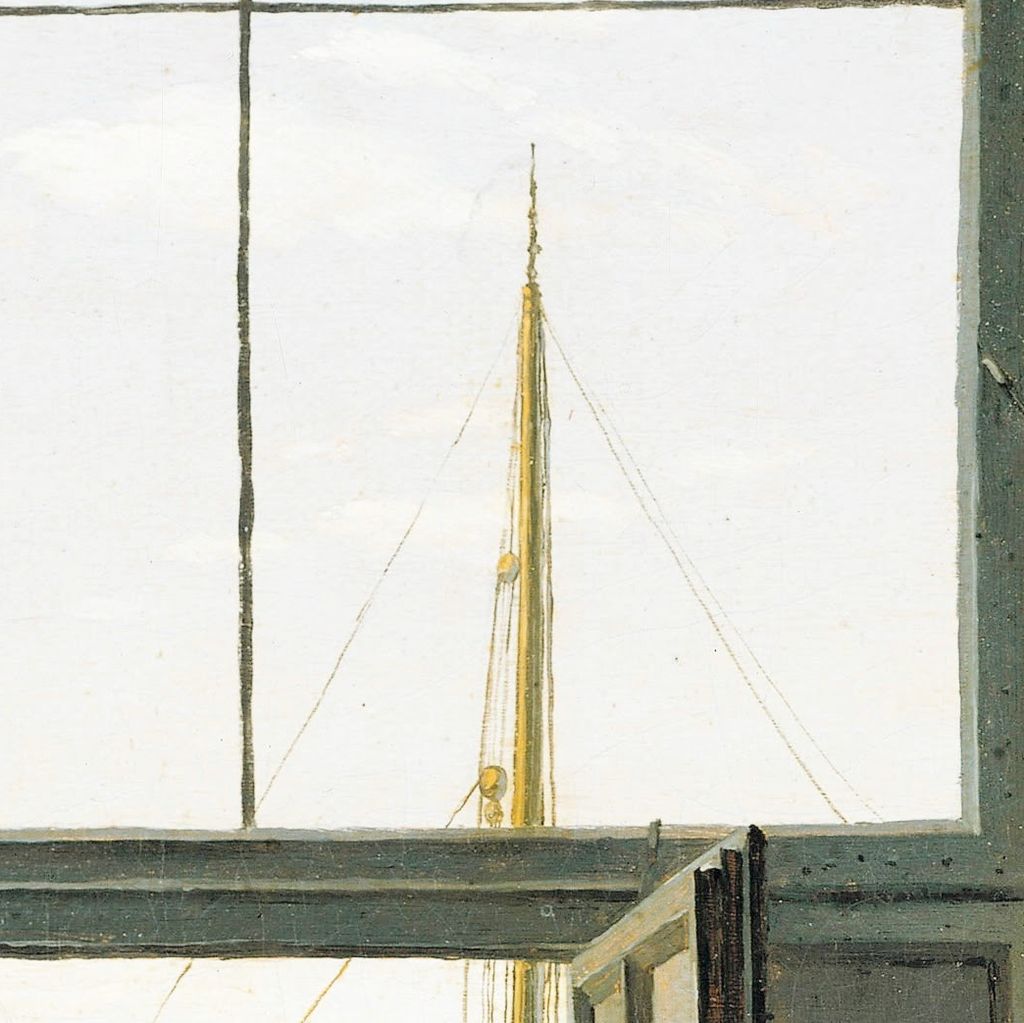
The large mast is visible above the horizontal division of the window and continues into the lower opening beside Caroline. Fine rigging stretches away from it. We mentally join those lines into a vessel, although the picture does not give us the deck, the hull or the place where the boat meets the water. A few thin marks consequently suggest an object much larger than the fragment actually shown.
The mast’s warm colour distinguishes it from the dark window bars. At first, both belong to the same pattern of verticals; closer attention separates the outdoor structure from the indoor one. The rigging adds another kind of line, light and oblique against the sky. It crosses a space that the thick window surround holds firmly in place. The studio’s geometry and the vessel’s geometry overlap without becoming indistinguishable.
Below, the distant trees form a delicate screen behind Caroline’s head and shoulders. Their narrow stems and small touches of foliage look quite different from the smooth panels that flank the opening. Above, the sky contains so little incident that the mast acquires unusual prominence. The outdoor view thus divides into contrasting textures: branching, finely broken growth below and a broad pale field overhead.
The sill prevents us from looking down to the river directly beneath the window. Caroline, standing nearer the opening, could see more than the painting allows us to see. This is a practical difference in viewpoint before it is a metaphor. It makes the visible fragments convincing as parts of a continuing world: the boat must extend downwards, the bank continues sideways, and the sky extends beyond the frame. The picture asks us to complete those continuities while keeping us inside.
A prepared figure in a constructed space
A related sheet in Berlin’s Kupferstichkabinett is catalogued as Sketch for “Woman at a Window”, around 1818, inventory SZ CD.Friedrich 8. The medium is brush in brown on tracing paper. [4] The date is approximate, but it places the recorded study before the finished painting. In the drawing the woman turns more nearly in profile, with her hands visible to the left and a shawl falling from her shoulders in layered folds. Hatching follows the contours of her neck and clothing, and the bun and braids are worked out strand by strand. The page ends partway down her skirt. The canvas gives the figure a fuller rear view, exposes the waist of the dress and carries the outline right down to her shoes. The drawing concentrates on the body and clothing. In the painting we can see exactly where the woman stands in relation to the wall and window.
Berlin’s 2024 exhibition texts explain the wider function of Friedrich’s tracing sheets. Infrared examination overturned the earlier assumption that such drawings had simply been copied from completed paintings: he used a stylus to transfer their contours to a prepared canvas, and some sheets retain transfer marks on the reverse. [5] The labels cite specific transfers for other paintings. For this work, the different angles of the two figures make the tracing paper evidence of preparation, with the exact part the sheet played in laying out the oil still open.
What the finished work makes visible is the precision with which a figure can be fitted into an architectural scheme. The shoulders spread across the bottom of the opening; the head is clear of its left edge; the dress broadens towards the lower border while the slim mast gains definition in the space left clear above her. These relations give each part room to remain legible. The apparent simplicity depends on the placement of several shapes whose outlines nearly meet.
What viewers found in 1822
The supplement to the 1822 Dresden Academy exhibition catalogue lists the work as number LXXXII, The Artist’s Studio, and describes it as painted from nature. [6] That early title directs attention first to the place and the conditions of observation. The title used today names the person and the feature around which the place is organised. The two descriptions fit the same painting: the room is specific enough to recognise, and the woman’s posture determines how we experience it.
The anonymous reviewer in the Wiener Zeitschrift für Kunst, Literatur, Theater und Mode identified the figure as Friedrich’s wife and recognised the far-bank poplars. The studio and its outlook would have been convincing and attractive, the writer thought, if Friedrich had avoided another figure seen directly from behind. The notice faults both the lighting and the pose, and complains that the artist repeats such figures too often. [7] Verwiebe also records that the turned-away woman inspired Friedrich de la Motte Fouqué to write a sonnet. [1] The same withheld face could frustrate one observer and invite another’s imaginative response.
Later interpretations have remained divided. Rewald records Christian readings of the dark interior and bright beyond, accounts of a woman longing to escape domestic dependence, and an opposing reading of maternal contentment. [2] These are interpretations of Caroline’s situation, not a statement by Caroline. Their disagreement is useful: the picture’s controlled light and posture sustain an emotional response without fixing the emotion’s name.
The picture remained in the Friedrich family and was shown again in the Nationalgalerie’s 1906 Centenary Exhibition in Berlin. On 25 July that year the museum acquired it from Johanna Friedrich of Greifswald, the daughter-in-law of the artist’s brother Johann Heinrich. [1] The painting entered the public collection during the exhibition year that brought Friedrich’s work back to wide attention. [5]
Friedrich’s figures seen from behind look across very different kinds of spaces. In this painting, the working window sets the limits of the view. Its shutters, glass, open leaf and sill determine how much world enters the room and how much remains concealed. Follow the mast down until the structure interrupts it, then look back to the small tilt of Caroline’s head. The painting holds both kinds of attention together: the wish to understand a space and the awareness that another person is already looking into it.
Before Caroline stood at the window
Friedrich had already made a pair of sepias of his studio windows around 1805–06. The Vienna sheets let a viewer compare two openings in the earlier Dresden studio and two directions along the Elbe. In the left-hand view the bridge helps locate the stretch of river. In the right-hand view the eye has fewer landmarks of that kind. The viewer is free to attend to a different part of the embankment and water. Taken together, the sheets show that a window could be an instrument for choosing a view rather than merely a convenient frame around it.[8] [9]
There is no standing observer in either opening. The frame and sill are enough to suggest a place for us in the room. In the 1822 oil, the presence of a person already looking changes the relation. Caroline stands nearer the opening and makes the view appear to belong to someone before it belongs to us. She also occupies part of the field we might otherwise use to look outside. The difference between a landscape glimpsed directly through an empty aperture and a view partly held by another person's body is one of the changes Akane Sugiyama examines in comparing the earlier right-hand sepia and the oil.[8] [9]
This earlier practice matters to the interpretation of the picture as an interior. The dark room and bright beyond were available as a subject years before Friedrich put Caroline at the opening. The oil carries a history of decisions about how much of a river to reveal, as well as the particular circumstances of a household after its move. It is possible to recognize those decisions while still attending to what is new about the place of the figure. The person makes a familiar problem of viewing into a relationship between two observers, one visible and one implied.[2] [8] [9]
Another studio view from the same building
Dahl's views of Dresden offer a close geographical comparison because he lived in the same house from 1823. In the Met's account of his window views, Dahl deliberately sought a different treatment of the river from Friedrich's. He could look out at the familiar prospect and organize an image around what happened in the air above it. In a work by Friedrich the opening can be a conspicuous physical limit on the view. A Dahl view can start from the same kind of domestic vantage and allow more of the outdoor field to occupy the picture.[2] [3]
This difference is worth noticing even when the actual river is hard to find in the 1822 canvas. Shared access to an outlook does not determine which part of an experience will become the subject. Friedrich's painting makes the viewer look past a person, a shutter and a sill in order to reconstruct signs of the river. A direct view of the sky can dispense with that route and concentrate on an interval of changing light. The proximity of the two painters makes the difference particularly instructive. The address helps explain the opportunities they had in common, while the finished pictures show how they made different use of those opportunities.[2] [3]
What another harbour window lets in
Martinus Rørbye's View from the Artist's Window, dated about 1825, gives another point of comparison. Rewald places the scene in the artist's parents' house on Amaliegade in Copenhagen, with the harbour beyond. The sill holds pots and containers, and a cage hangs in the window. The plants are at visibly different stages of growth. They ask for attention before the spectator looks to the vessels and docks, so the exterior is approached through a group of domestic objects with their own claims on the light.[10] [11]
The Copenhagen interior has no standing figure at the sill. Some of the things Friedrich concentrates in Caroline's body are distributed across several objects in Rørbye. The height of a pot, the fine lines of the cage and the places where light catches a vessel let a spectator compare small distances inside the room. Beyond them, the harbour continues at a much larger scale. In Friedrich, the woman provides a particularly legible measure of where the opening begins and how high it goes. In Rørbye, the collection of objects makes a more gradual passage from the edge of the room towards the view outside.[1] [10] [11]
The Met brought these works together in its 2011 exhibition on the nineteenth-century window motif. That setting offered a different set of comparisons from the 1822 Dresden exhibition, where Friedrich's catalogue entry described a particular studio. A spectator comparing harbour windows can see the choice to place a body in the opening as part of a wider repertoire of interior painting. The early review's frustration with the woman's turned back records a different expectation about access to the scene. Read together, the two occasions make it possible to follow both what the motif could offer and what one early observer felt it withheld.[3] [6] [7] [10]
Annotated Details from Woman at a Window
Use the numbered details to trace the forms and light in this work.
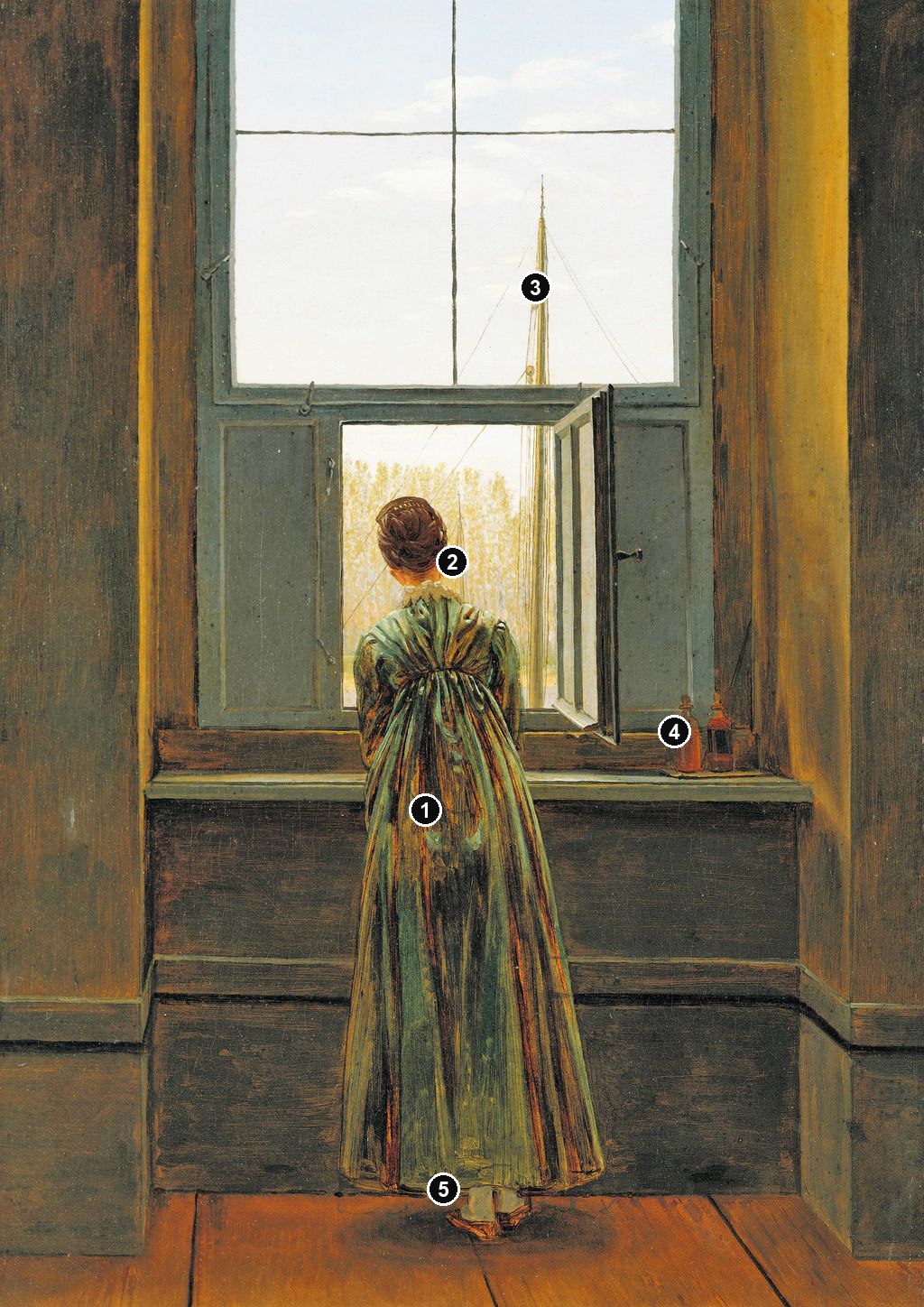
Details from WOMAN AT A WINDOW
The detail crops show parts of the work at a larger scale.
The woman's posture
The woman leans slightly forward. The folds of the green dress narrow beneath the tied waist.
The open lower window
The open shutters and sill frame the figure and the bright view outside.
The mast beyond the glass
A thin mast and rigging rise across the pale upper panes.
The bottles on the sill
Small vessels stand at the right edge of the sill.
The floor and threshold
Long boards lead from the viewer's position towards the woman and the window.
Frequently Asked Questions
Discussion
Reader insights are welcome, especially close-looking observations about how the bare room, window frame, back-turned figure and small outdoor signs shape the painting's sense of longing.
Reader Insights
How does the window reveal the outside while keeping it partly out of reach?
What changes because Caroline is identified, yet still shown from behind?
Where do verticals and horizontals make the room feel ordered and still?
Does Woman at a Window feel most powerful as a private image, a Romantic window motif, or a quiet version of Friedrich's Rückenfigur problem?
Join the Conversation
Share a source-grounded close reading of Caroline's pose, the studio, the Elbe view, the window geometry or the painting's 1822 reception.
References
- Birgit Verwiebe, Frau am Fenster, Alte Nationalgalerie, Staatliche Museen zu Berlin, A I 918, current object essay and collection details.
- Sabine Rewald, Rooms with a View: The Open Window in the 19th Century, Metropolitan Museum of Art, 2011, catalogue no. 7, pp. 36–39, especially the studio, altered proportions and interpretation history.
- Metropolitan Museum of Art, Rooms with a View, exhibition picture gallery, Woman at the Window, 2011.
- Friedrich anniversary chronicle, Sketch for “Woman at a Window”, around 1818, Kupferstichkabinett, SZ CD.Friedrich 8.
- Alte Nationalgalerie, Caspar David Friedrich: Unendliche Landschaften, German exhibition texts, 2024, “Figurenumrisse,” PDF p. 5, and “Die Jahrhundertausstellung 1906,” PDF pp. 2–3.
- Verzeichniß der am Augustustage den 3. August 1822 in der Königlich Sächsischen Akademie der bildenden Künste zu Dresden ausgestellten Kunstwerke, supplement p. 7, no. LXXXII, digitised text with facsimile.
- Anonymous, “Über die Dresdner Kunstausstellung im Herbst 1822,” Wiener Zeitschrift für Kunst, Literatur, Theater und Mode, no. 129, 26 October 1822, p. 1042, digitised text with facsimile.
- Akane Sugiyama, Woher stammen die Fenster?, Aspects of Problems in Western Art History 20 (2022), pp. 37–49, on the 1805–06 pendants.
- Akane Sugiyama, Wanderer unter dem Regenbogen, discussion of the right-hand sepia and the 1822 oil.
- Sabine Rewald, Rooms with a View: The Open Window in the 19th Century, Metropolitan Museum of Art, 2011, catalogue entries 15, 42 and 43.
- Statens Museum for Kunst, View from the Artist's Window, Martinus Rørbye, KMS7452.


