



 by Tom Gurney
Tom Gurney BSc (Hons) is an art history expert with over 20 years experience
Published on June 19, 2020 / Updated on October 14, 2023
Email: tomgurney1@gmail.com / Phone: +44 7429 011000
The Abbey in the Oakwood: Introduction
The Abbey in the Oakwood is one of Caspar David Friedrich's most concentrated images of death, memory and sacred ruin. A small funeral procession moves through a winter landscape toward the broken remains of a Gothic abbey. Bare oaks rise around the ruin like dark witnesses. Snow lies on the ground. The sky is dim and cold. Nothing in the painting offers easy consolation, yet the scene is not simply bleak. Friedrich gives ruin, procession, trees and light a slow, ritual force.
The painting was made in 1809/10 and belongs to the Staatliche Museen zu Berlin, Nationalgalerie, inventory number NG 8/85. [1] It was shown in Berlin in 1810 with its pendant, Monk by the Sea, and the pair was bought by King Friedrich Wilhelm III of Prussia. [2] That relationship matters. The Abbey in the Oakwood should be seen as its own painting, but also as one half of a paired meditation on human finitude, nature and spiritual uncertainty.
The image is often described through its Gothic ruin, and that is unavoidable. Yet Friedrich's painting is not a general essay on picturesque ruins. The broken abbey is animated by a specific visual drama: a coffin and mourners approach an empty doorway, while winter trees and grave markers gather around the site. The ruin is not decorative background. It is the place where human death, religious memory and natural time meet.
At a Glance
- ArtistCaspar David Friedrich
- TitleThe Abbey in the Oakwood
- Date1809/10
- Mediumoil on canvas
- Dimensions110.4 x 171 cm (height first)[4]
- CollectionStaatliche Museen zu Berlin, Nationalgalerie, inventory number NG 8/85. [1]
- Related workpendant to Monk by the Sea, 1808-1810, Nationalgalerie, inv. NG 9/85. [1] [2]
- Key motifsGothic ruin, funeral procession, winter oaks, snow, graves and sacred memory
- Image status in sourcePublic Domain Mark 1.0 listed by cdfriedrich.de. [1]
Contents
- Object Facts
- Annotated Details
- Ruin, Procession and Winter Landscape
- The Gothic Abbey and Sacred Memory
- The Leafless Oaks
- Pendant to The Monk by the Sea
- Conservation and Material History
- Eldena, Ruins and Friedrich's Repeated Motifs
- Close-Looking Notes
- Why the Painting Resists Simple Melancholy
- The church that continues behind the facade
- Eldena before and after the imagined window
- Two pictures from adjoining pieces of linen
Object Facts
The Abbey in the Oakwood is an oil painting on canvas measuring 110.4 by 171 cm (height first)[4]. [1] Its size closely matches Monk by the Sea, which measures 171.5 by 110 cm and shares the Berlin Nationalgalerie collection. [1] [2] The two paintings were presented together at the Berlin Academy exhibition of 1810, where they were bought by King Friedrich Wilhelm III. [2]
The object facts already point toward the painting's meaning. Friedrich did not make a small cabinet picture of a ruin. He made a large, horizontally oriented image whose scale gives the scene a public seriousness. The viewer faces the ruin and procession almost frontally, as if standing outside the sacred enclosure and watching a rite move into it.
The cdfriedrich.de object record identifies the work with the Nationalgalerie and lists it as Public Domain Mark 1.0. [1] It also places the painting among related images of Eldena Abbey, a ruin near Greifswald that returned repeatedly in Friedrich's art. [1] That connection is important because the ruined abbey is not an interchangeable Gothic fantasy. It belongs to Friedrich's long attachment to northern German places, memory and decay.
The painting's date also matters. Around 1809/10, Friedrich was testing how landscape could carry the gravity usually associated with religious or history painting. The Abbey in the Oakwood does not illustrate a biblical scene. It does not show a saint, miracle or dramatic historical event. Instead, it makes a winter landscape, ruined architecture and a funeral procession bear the weight of mortality and faith.
Annotated Details from The Abbey in the Oakwood
This annotated close reading follows six visible details in Friedrich's winter ruin painting: the ruined Gothic window, the bare oaks, the funeral procession, the foreground burial ground, the enclosing winter grove and the pale sky above the ruin. The notes keep the Monk and Abbey pendant relationship source-bound and avoid reducing the work to generic Gothic melancholy.
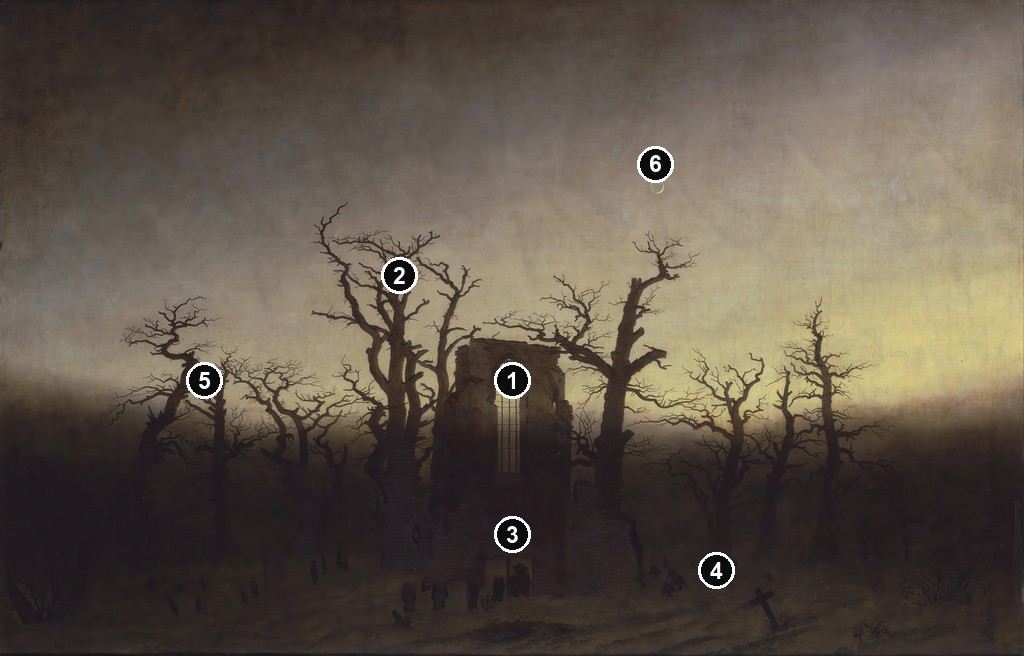
Details from THE ABBEY IN THE OAKWOOD
These details use the metadata-clean high-resolution Abbey image prepared for this page.
Ruined Gothic window
The surviving window gives the ruin its vertical centre, turning a broken church wall into the painting's strongest architectural sign.
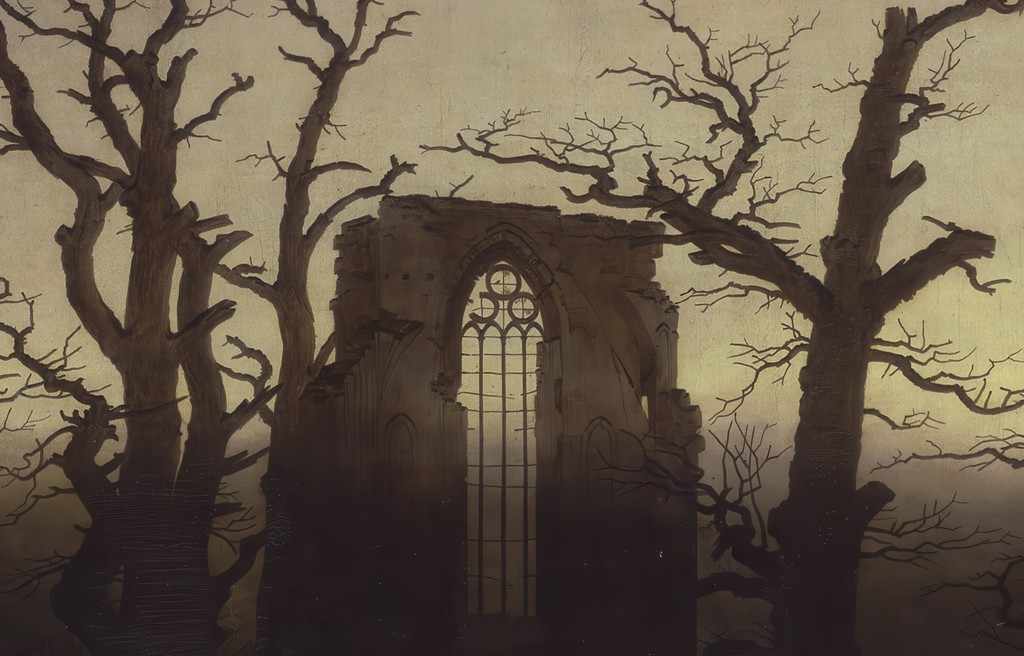
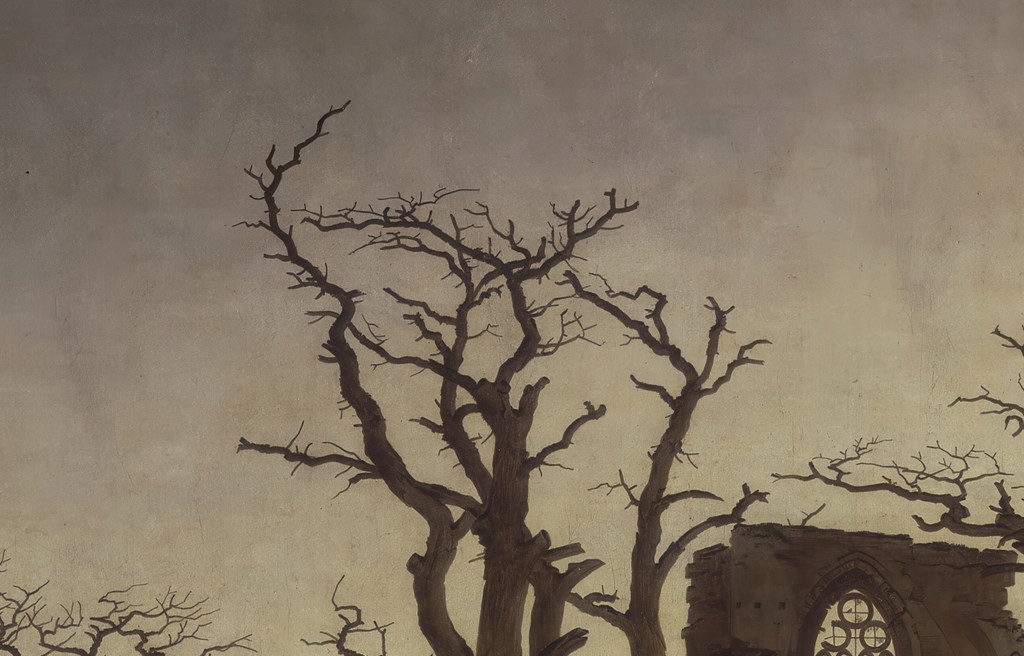
Bare oak trunks
The leafless oaks rise around the ruin like dark ribs, making the church and the winter wood feel interlocked rather than separate.
Funeral procession
The small figures move toward the ruined church, keeping the scene specific to burial and ritual instead of a general ruin view.
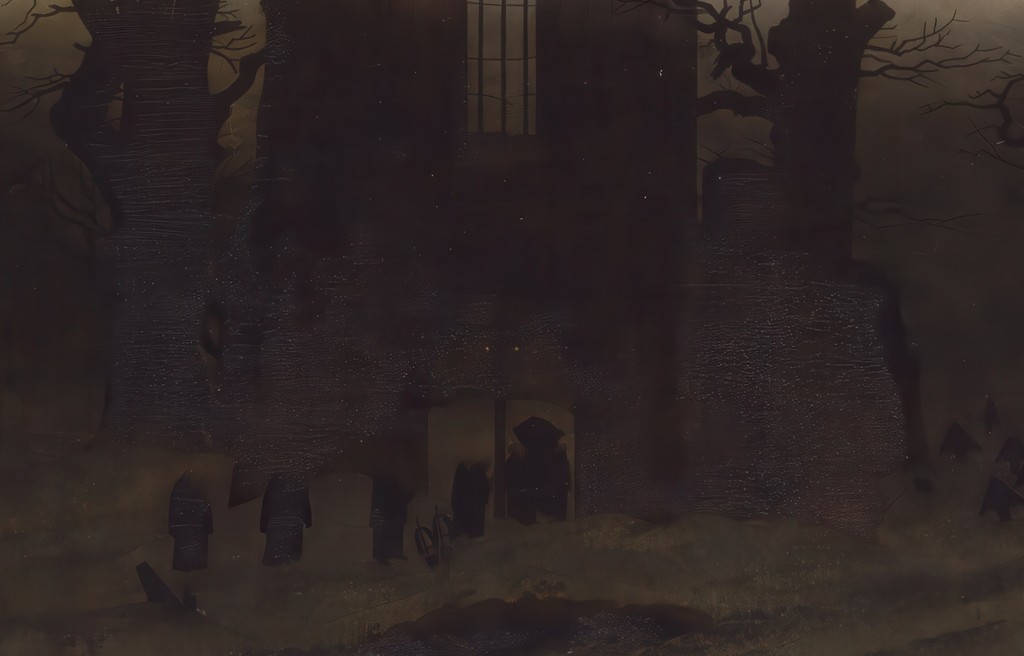
Foreground graves and cross
The low graves and tilted cross bring the burial ground forward, so death is not only implied by the ruin but marked across the foreground.

Enclosing winter grove
The trees at the side close the space around the abbey, creating a dense winter setting rather than an open picturesque landscape.

Pale sky above the ruin
The pale upper sky and small moon-like opening hold back total darkness, setting faint light above the ruin and burial scene.

Ruin, Procession and Winter Landscape
The funeral procession is small, but it gives the painting its human event. A coffin is carried toward the ruined abbey, accompanied by dark figures who move through the snow. They are not individualized portraits. Their smallness makes them part of a larger ritual. We notice them as human presences, then almost immediately measure them against the scale of the ruin, trees and winter sky.
Friedrich keeps the action quiet. There is no theatrical grief, no dramatic gesture, no crowd pressing around the coffin. The procession advances with a solemn, almost silent rhythm. Its destination is the broken entrance of the abbey, where architecture still marks a sacred threshold even though the building has lost its original completeness.
Snow transforms the landscape into a space of stillness. It muffles the ground and visually separates the dark figures, crosses and trunks from the pale earth. Winter also gives the scene a seasonal meaning: life has withdrawn, leaves have fallen, and the world seems held in suspension. But Friedrich does not make winter merely symbolic. It structures how the painting is seen. Dark verticals rise out of whiteness, and the procession becomes a line of movement through a nearly frozen field.
The sky reinforces the scene's restraint. It is not a triumphant heavenly opening. It is dim, cold and subdued, with light gathering behind or above the ruin rather than bursting through it. That ambiguous light keeps the painting from collapsing into despair, but it also refuses simple reassurance.
The painting is therefore not just about death as an event. It is about the conditions around death: ritual, place, memory, architecture, season and the surviving natural world. Friedrich lets all of these elements act together.
The Gothic Abbey and Sacred Memory
The abbey ruin is the painting's central architectural form. Its broken walls and pointed openings retain the memory of a sacred building, even though the structure is no longer whole. The ruin therefore carries two meanings at once. It marks loss, because the building has decayed. It also marks persistence, because enough remains to shape the procession's path and the viewer's imagination.
Friedrich's use of Gothic architecture belongs to a wider Romantic interest in medieval ruins, but The Abbey in the Oakwood is more severe than picturesque nostalgia. The ruin is not shown as charming. It is black, skeletal and partially absorbed by the trees around it. Its empty window tracery and fractured walls make the absence of the lost building visible.
The funeral procession turns that architectural absence into a present rite. The mourners move toward a church that can no longer function as an intact church, yet the ruin still gathers sacred meaning. It frames the coffin's passage. The open doorway becomes a threshold between the living and the dead, between historical religion and present grief.
This is why the painting should not be reduced to a Gothic mood piece. Friedrich is not simply borrowing ruin imagery because it looks mysterious. He is asking what remains when sacred forms are broken but not forgotten. The abbey no longer shelters a congregation in the ordinary sense. Still, it continues to receive the dead, to organize memory and to hold a place in the landscape.
The ruin also changes the viewer's relation to time. A living procession moves through snow toward a building damaged by centuries. Trees grow around and through the site. Graves mark earlier deaths. The painting compresses different times into one image: the present funeral, the medieval past, the seasonal cycle and the slow time of decay.
The Leafless Oaks
The oaks are not background scenery. They dominate the painting's vertical rhythm. Their trunks and branches rise around the abbey, echoing and competing with the broken architecture. In places, tree and ruin almost merge, as if nature has become another form of Gothic structure.
Leafless trees appear often in Friedrich's art, and here they intensify the winter mood without reducing it to a single meaning. They suggest age, barrenness and mortality, but also endurance. The trees have lost their leaves, not their presence. They stand around the ruin with a severity that feels almost ceremonial.
Their scale is important. The figures in the procession are very small, while the oaks rise high above them. This makes the human rite feel fragile. The mourners carry the dead, but the trees and ruin remain. Friedrich does not use that contrast to mock human life. He uses it to place human ceremony within a wider natural and historical order.
The branches also shape the sky. They break the upper space into dark, irregular patterns, preventing the viewer from reading the sky as an easy zone of transcendence. Any hope in the painting has to pass through ruin and winter. That is part of the image's discipline.
The oaks give the painting its title as much as the abbey does. The ruin is "in the oakwood," not merely placed beside trees. The sacred site and the grove form one environment. Death is not enclosed within architecture; it is held within a landscape.
Pendant to The Monk by the Sea
The Abbey in the Oakwood was shown with Monk by the Sea at the Berlin Academy exhibition in 1810. [2] The relationship is not a minor display fact. It changes how both paintings should be read.
Monk by the Sea is almost entirely stripped of architecture and narrative. A solitary figure stands before shore, sea and sky. The Abbey in the Oakwood gives the viewer more recognizable symbols: a coffin, mourners, graves, trees and a ruined church. One painting faces the open edge of nature; the other stages death within a ruined sacred site.
The pair was bought by King Friedrich Wilhelm III, and the same year Friedrich was appointed a member of the Berlin Academy of the Arts. [2] This early history shows how forcefully the paintings entered public life. Their solitude and darkness should not be mistaken for private obscurity. They were public statements about what landscape painting could become.
The pendant relationship also helps restrain interpretation. If The Monk by the Sea is read alone, it can be reduced to isolation before infinity. If The Abbey in the Oakwood is read alone, it can be reduced to Gothic melancholy. Together, they create a broader structure: elemental nature in one painting, sacred ruin and funeral passage in the other. The relation between them deepens both works without making them identical.
Early reception of the pair is often discussed through Kleist, Brentano and Arnim, especially because Kleist's 1810 article on Friedrich's seascape drew on material from Brentano and Arnim. [2] That reception context belongs primarily to Monk by the Sea, but it also matters for the pair's public impact. The literary responses show how startling Friedrich's reduction of landscape seemed to early viewers. They should be treated as reception history, not as a final key that unlocks every detail of the Abbey painting.
Conservation and Material History
The Staatliche Museen zu Berlin conservation project studied and restored Monk by the Sea and The Abbey in the Oakwood together between 2013 and 2016. [3] The project describes the Nationalgalerie as custodian of perhaps the most famous pair of paintings from German Romanticism. [3]
The technical evidence is important because Friedrich's visual severity depends on fragile material means. The Berlin project reports that he used very fine primed canvas for both paintings and applied paint in one or two very thin layers. [3] That delicacy made the works unusually vulnerable to damage, aging and earlier restoration interventions.
By around 1900, both paintings had already deteriorated considerably, according to the conservation account. [3] From 1906 onward, they underwent repeated restoration campaigns of uneven quality. The project notes losses of original material, discolored retouching, overpainting, darkened varnish layers, transport damage and lining-related problems. [3]
For The Abbey in the Oakwood, such material history affects more than surface appearance. The painting depends on subtle contrasts: snow against dark figures, trunks against sky, ruin against winter light. If varnish darkens or retouching alters those relationships, the emotional and spatial balance changes. Conservation research therefore helps modern viewers understand how much the painting's solemn clarity depends on fragile physical survival.
The 2013-2016 project aimed to secure remaining original material, estimate the original state of the paintings as closely as possible and reconstruct their legibility. [3] That last word matters. The restoration was not just a technical repair. It was an effort to make the paintings readable again as Friedrich's severe, thinly painted images.
Eldena, Ruins and Friedrich's Repeated Motifs
cdfriedrich.de links The Abbey in the Oakwood with several related works showing or invoking the ruins of Eldena Abbey, including drawings, paintings, sepia works and watercolors across Friedrich's career. [1] Eldena was near Greifswald, Friedrich's birthplace, and its ruins became one of his recurring motifs.
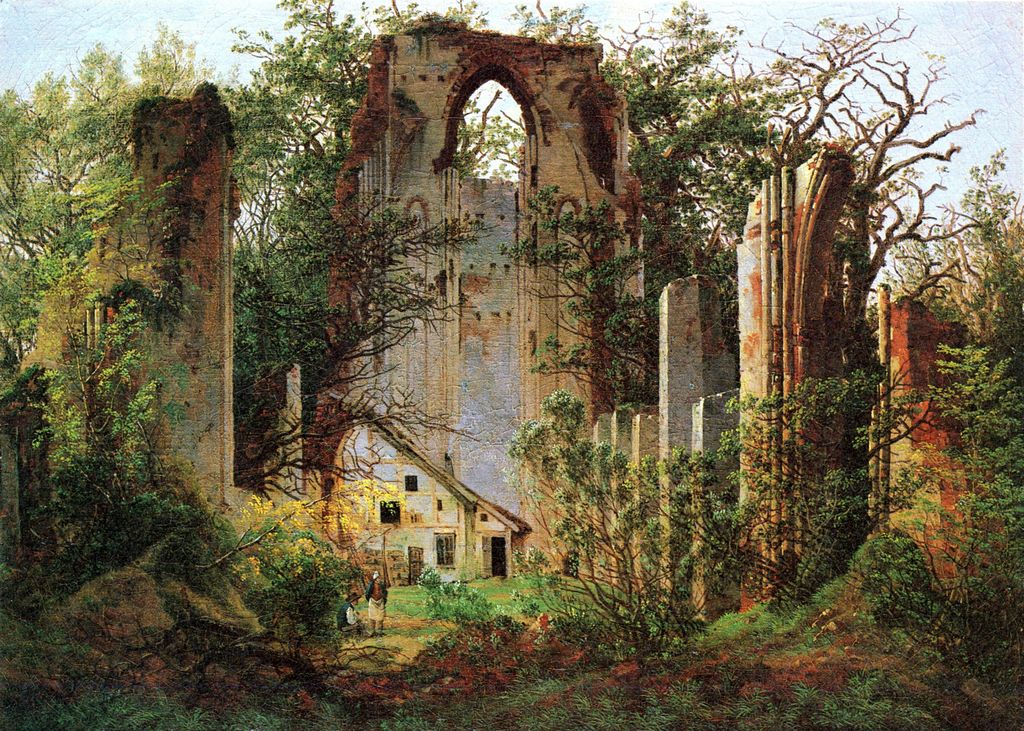
This recurrence helps explain why the Abbey painting feels specific rather than generic. Friedrich returned to ruin imagery because it allowed him to bring together place, memory, sacred architecture and mortality. Ruins in his work are rarely mere scenery. They are structures through which time becomes visible.
The Eldena connection also ties the painting to biography without turning it into simple autobiography. Greifswald and its surroundings mattered deeply to Friedrich, but the painting does not need to be read as a direct confession. It is better understood as a transformation of remembered and studied places into a larger meditation on death and sacred remains.
The related ruin works also show that Friedrich could vary the motif across media and mood. A drawing of ruins is not the same as a large oil painting with a funeral procession. A sepia image of a cemetery beside church ruins does not carry the same public weight as the Berlin canvas. The repeated motif gains force through difference.
Seen this way, The Abbey in the Oakwood becomes a central work in Friedrich's long engagement with ruins rather than a one-off Gothic scene. It concentrates many of his recurring concerns into one image: northern place, broken sacred architecture, winter, procession, death and the endurance of landscape.
Close-Looking Notes
Begin with the doorway. The broken abbey opening is the visual destination of the procession, but it is also a void. The mourners do not move toward a complete church interior. They move toward an absence framed by surviving stone. That makes the threshold feel both sacred and uncertain.
Next, look at the scale of the figures. The coffin and mourners are essential to the scene, yet Friedrich keeps them small. Their size prevents the painting from becoming anecdotal. We register the funeral, but we do not read it as the private story of named individuals. It becomes a ritual act placed inside a larger landscape of memory.
The crosses and grave markers are worth noticing because they repeat the vertical rhythm of trees and ruined architecture. Friedrich does not isolate human signs from natural forms. He lets them stand among trunks, branches and broken masonry, so that the cemetery feels absorbed into the oakwood.
Finally, look at the light. The painting is dark, but not completely closed. The pale winter atmosphere around the ruin leaves room for ambiguity. It does not announce redemption, but it also prevents the scene from becoming merely blank despair. Friedrich's discipline lies in holding those possibilities together.
Why the Painting Resists Simple Melancholy
The painting is undeniably mournful, but it should not be reduced to sadness. Friedrich gives mourning a structure. The procession moves. The coffin is carried. The ruin receives. The trees stand. The snow covers and clarifies. The painting is not a vague mood; it is a staged passage.
Nor is the ruin simply picturesque decay. It is a damaged sacred form that still organizes human action. The mourners move toward it because it continues to matter. That persistence prevents the image from becoming purely nihilistic. The church is broken, but not meaningless.
The same restraint applies to symbolism. The oaks, snow, graves and Gothic openings invite interpretation, but no single symbol explains the whole work. Friedrich's strength lies in relation rather than code. Each element gains meaning through the others.
This is why The Abbey in the Oakwood remains powerful beside Monk by the Sea. The Monk painting exposes a solitary figure before sea and sky. The Abbey painting places human death within a landscape of memory. Both are severe, but neither is generic melancholy. They are precise visual arguments about how human beings face what exceeds them: nature, time, death and the uncertain persistence of faith.
The church that continues behind the facade
At first the ruined church can look like a solitary wall. Its tallest opening catches the sky, and the masonry at either side of it has a relatively distinct outline. The conservation team's infrared images give a more extensive view of the architecture. Kristina Mösl and Francesca Schneider identify the remains of the west front and portal near the viewer, the choir farther back and a line of columns connecting them through the nave. A visitor who can discern little beyond the tall wall in visible light can use the technical image to see how far Friedrich worked out the structure below the paint.[5]
That depth makes the direction of the procession more intelligible. The figures carry the coffin through a specific opening. In the underdrawing, the conservators identify a crucifix at the portal and a further monk preparing candles at the altar. The acts of entering and preparing take place at different distances inside the building. Seen on the wall, the small lit points survive more readily than the architectural sequence between them. Once a viewer knows what lies between the portal and the altar, the transition from outdoors to the site of the ceremony can be followed even where the paint gives very little information at first glance.[4] [5]
Friedrich also described the relation between fog and visibility in a letter associated with the work. The upper masonry was to remain legible while forms nearer the ground became increasingly uncertain. That account gives a reason to distinguish the original atmospheric design from losses and changes to the surface. The difficult view into the building belongs in part to Friedrich's conception. The conservators also report that ageing and material loss have obscured parts of the architecture. An infrared image answers a question about what he drew. The letter helps explain why even a well-preserved version would have asked the eye to look through an increasingly difficult lower field.[1] [3] [5]
Eldena before and after the imagined window
The ruin at Eldena supplied Friedrich with an identifiable architectural form. In the Berlin Abbey he opened the upper window that was blocked at the site and introduced a portal that was absent there. Those changes have separate consequences for the scene. The opening above lets the sky enter the wall and gives the upper masonry a comparatively delicate structure. The portal below gives the people a point of passage. Friedrich altered both levels of the facade to accommodate different kinds of movement through the picture.[4]
The Alte Nationalgalerie compares this treatment with the more literal appearance of the same site in Friedrich's later Ruins of Eldena Abbey near Greifswald. There the blocked window and adjoining hut remain conspicuous. The wall belongs to a place with visible signs of later use. In the earlier painting, the openness of the tracery gives the ruin a different relation to the sky and the invented portal organizes the funeral. Knowing both versions prevents the recognizable outline from settling the question of what Friedrich actually found at the site. The two works show the range of decisions available once a familiar wall has become a subject.[4] [6]
The physical site changed as well. Verwiebe records that work at Eldena around 1830 exposed the window and suggests that the Prussian crown prince may have influenced the intervention. The later appearance of the ruin therefore resembled parts of Friedrich's earlier imagining more closely than the site had when he painted it. The proposed involvement of the prince remains tentative. The sequence of changes matters independently of his role. A present-day comparison with the masonry has to take account of both Friedrich's alteration of the view and the subsequent alteration of the ruin.[4]
Two pictures from adjoining pieces of linen
X-radiography and examination of the fabric showed that the supports of the Abbey and the Monk were adjoining pieces from one roll. Mösl and Schneider take that evidence as an indication that Friedrich planned a pair from an early stage. It adds a physical connection to the familiar evidence of the 1810 exhibition and royal purchase. Two objects can be displayed together for reasons that arise after they are finished. In this case, the connection is present in the supports, well below the two very different compositions that spectators first encountered.[5]
The canvas was already primed when Friedrich began to draw on it. A cross-section from the snowy ground of the Abbey shows successive priming layers, traces of drawing and a paint layer containing smalt, beneath surface coatings from different periods. A tiny sample can distinguish changes that the eye would otherwise meet together as colour and tone. Its evidence is local. It shows how the foreground was built at that point and gives the conservators information they can compare with examination of other parts of the picture.[3] [5]
The matched supports make the difference between the paintings' spatial designs particularly clear. The seascape gives much of its width to broad bands, with an isolated person at a low edge. The church scene uses a similar width to spread out trees and graves around a narrow point of entry. A spectator moving between them has to change the way of looking. Following the shoreline is a lateral movement. Discovering a nave behind a wall is a movement into depth. Their physical kinship makes that change of orientation more striking, because it happens across two surfaces prepared from the same fabric.[1] [2] [5]
Related Friedrich Works
Monk by the Sea is the essential companion. The two works were shown together in 1810 and remain linked through the Berlin collection and conservation history. [2] [3] The Monk painting is more radically empty, while the Abbey painting gives death a ritual and architectural setting.
The Cross in the Mountains (Tetschen Altar) offers another way Friedrich made landscape carry religious meaning. It includes an explicit cross and altar-like frame, while The Abbey in the Oakwood works through ruin, procession and memory.
Oak Tree in the Snow belongs near the Abbey because it also uses winter, tree form and stillness to give natural imagery emotional weight.
A Walk at Dusk offers a later, quieter meditation on walking, winter and inwardness.
The biography and paintings pages give broader context for Friedrich's repeated use of ruins, graves, trees, thresholds and solitary human figures.
Frequently Asked Questions
Discussion
Reader insights are welcome, especially source-grounded observations about the work, its context and its visual structure.
Reader Insights
How does the broken doorway shape the procession's destination?
Where do trunks and branches echo the Gothic architecture?
What changes when the Abbey is read beside Monk by the Sea?
Reader insights are welcome, especially close-looking observations about the ruined abbey, funeral procession, winter oaks, snow, grave markers and relation to Monk by the Sea.
Does the ruined church in The Abbey in the Oakwood feel more like a place of loss, a place of hope, or both at once? The painting's force may come from the fact that it does not make the choice easy.
Join the Conversation
Share a source-aware observation or question about this page.
References
- Abbey in the Oakwood, cdfriedrich.de, Caspar David Friedrich anniversary Chronicle Source
- Monk by the Sea, cdfriedrich.de, Caspar David Friedrich anniversary Chronicle Source
- Caspar David Friedrich Project: Monk by the Sea and The Abbey in the Oakwood: technical analysis, conservation, restoration, Staatliche Museen zu Berlin Source
- Staatliche Museen zu Berlin, Abtei im Eichwald. Museum object record
- Kristina Mösl and Francesca Schneider, Romantic Icons: A Technical Study of the Underdrawing for Caspar David Friedrich's Monk by the Sea and Abbey in the Oakwood, pp. 125–133.
- Alte Nationalgalerie, Infinite Landscapes exhibition texts, comparison of the two treatments of Eldena.


