* As an Amazon Associate I earn from qualifying purchases.
by Tom Gurney Tom Gurney BSc (Hons) is an art history expert with over 20 years experience
Published on June 19, 2020 / Updated on October 14, 2023
Email: tomgurney1@gmail.com / Phone: +44 7429 011000
Caspar David Friedrich Quotes: Introduction
In February 1809, Caspar David Friedrich defended the right of a painter to walk on his own feet. Some twenty years later, he advised painters to close their eyes and picture what they meant to paint. The first image was a joke at the expense of a critic. The second describes how an idea takes shape and reaches someone else. Both come from Friedrich’s writings, which range from verse sent to friends and family to letters about specific paintings and notes on the work of other artists. Their occasions matter as much as their memorable phrasing. The English excerpts here are fresh translations from the German. [1][2]
At a Glance
Friedrich’s sources · Letters, verse and comments on paintings
Contemporary reception · Kleist’s 1810 review of Monk by the Sea
— Caspar David Friedrich, verse letter to Heinrich Friedrich and Joachim Praefke, 1800–03 [1][3]
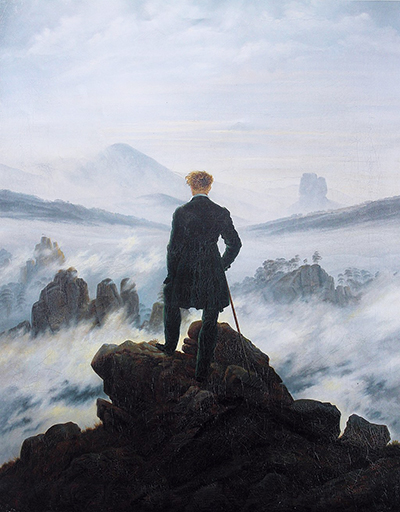
Friedrich sent these lines to his brother Heinrich and his friend Joachim Praefke. The anniversary project dates the undated letter to around 1803. The 2024 critical edition gives a wider range, 1800–03, and files the text among the poems as Ein Brief in Versen, a letter in verse. The passage opens at a run through the streets and ends with the pleasure of reaching green fields. In the German, the short lines carry that sense of haste, and the freer and purer air comes as the reward for making it beyond the streets. [1][3]
The museum project uses the verse to introduce Wanderer above the Sea of Fog, a painting made well over a decade later. The pairing brings out two different experiences of going outdoors. The letter hurries towards open ground, while the painting holds the walker still above a view he can only partly see. In the verse Friedrich makes the pleasure of the outing explicit. In the painting, the man's turned back leaves his feelings open. [1][3][4]
Walking on his own feet
to walk on his own feet
— Caspar David Friedrich, letter to Johannes Schulze, 8 February 1809 [1]
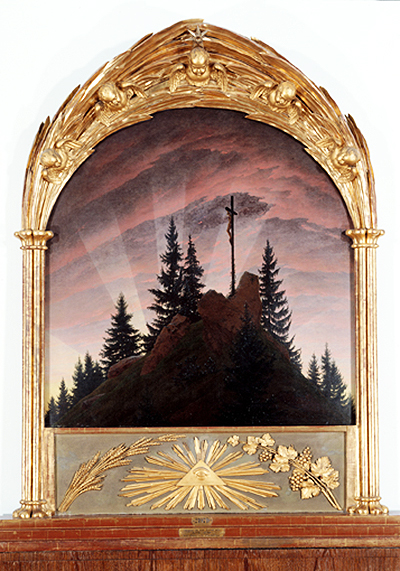
Friedrich sent Schulze his reply to Basilius von Ramdohr, who had attacked The Cross in the Mountains, also called the Tetschen Altar. A crucifix stands among firs on a rocky summit, and Christian Gottlob Kühn carved the gilded frame to Friedrich’s design. The painting brought the forms of landscape into a work intended for devotion, a use that Ramdohr contested. Friedrich wrote his reply in the third person and asked Schulze whether he should put it into print. The manner of the letter can sound like a champion defending a painter from the outside, even as Friedrich tells Schulze he wrote the piece himself. [1][5]
Walking on his own feet is what this mock defender calls Friedrich’s supposed presumption. He likens inherited rules to crutches, then imagines artists approaching a common centre from different directions. Two painters might even meet coming from opposite sides because their starting points and temperaments differ. The point takes concrete form when he refuses Ramdohr’s demand that every landscape show several distinct planes. In the altarpiece, the rock and the trees rise directly against the light. A conventional sequence of foreground, middle ground and distance would give the eye a route into a larger landscape. Here the cross is where the ascent stops. [1][5]
— Caspar David Friedrich, letter excerpt dated after August 1809 in the 2024 edition [1]
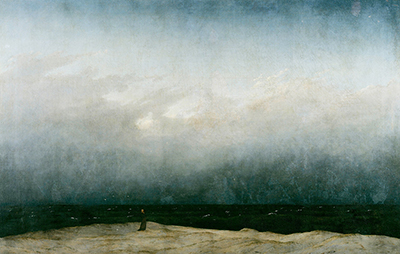
A later letter excerpt survives in a copy by Amalie von Beulwitz. The 2024 edition places it under Johannes Schulze. The anniversary chronicle treats the addressee as possible and dates the text to 1809–10. Friedrich starts with a seascape, usually identified as Monk by the Sea, and describes the shore, rough water, the air and a man in dark clothes. He then marks the point where description gives way to thought. His address to an unnamed listener asks how much one can hope to know of what lies beyond human experience, even after hours of reflection. He closes his account of the seascape with a person’s tracks disappearing in the sand. That last image is an event in the letter. In the painted scene, the tiny figure and the breadth of sea and sky give the question a scale of their own. [1][6]
the mystery of the grave and of the future
— Caspar David Friedrich, in the same letter excerpt [1]
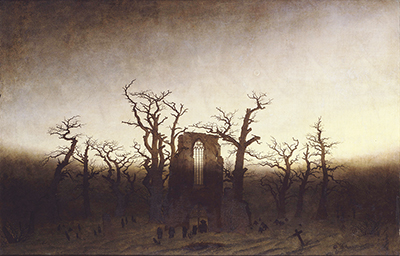
The next painting in the letter is still in progress and is generally identified as Abbey in the Oakwood. Friedrich writes that what he intends to depict, and how he means to do it, remain a riddle even to him. His description is remarkably specific about how the picture will look. He names the bare church ruin, old oaks, dusk and a waxing moon. Near the ground, fog makes forms increasingly hard to distinguish. The two passages in the letter move in different directions. The seascape gives rise to thoughts after the act of describing it. The abbey begins with a question about faith and knowledge and moves towards a description of fading light, by which he could give that question a visible form. The pair was shown together at the Berlin Academy exhibition in 1810. [1][6][7]
What Kleist wrote about the monk
as though one’s eyelids had been cut away
— Heinrich von Kleist, Berliner Abendblätter, 13 October 1810 [8]
Kleist’s phrase describes the experience of standing before the painting. Clemens Brentano and Achim von Arnim had prepared a draft in which several people exchange opinions. The surviving manuscript, held by the Freies Deutsches Hochstift, changes from Brentano’s hand to Arnim’s and back. Kleist shortened the draft, removed the exchanges and published a version with a first-person speaker. The newspaper printed the initials ‘cb.’, and Kleist later issued a statement taking responsibility for the published text. [8][9]
Kleist describes the frame as the only foreground. At an actual shore, there is the memory of having walked there, the knowledge that one must go back, and the sound of water and birds. In his account of the painting, the viewer supplies much of that experience and finds that the picture offers very little to hold on to. The cut eyelids make looking involuntary, as if the spectator had lost the ordinary means of breaking off a view. Friedrich’s letter uses a shore to ask about what lies beyond knowledge. The review asks what happens to a viewer who expects a painted shore to furnish somewhere to stand. [1][8]
Closing the eye and bringing the picture into the light
Close your bodily eye so that you first see your picture with the eye of the mind.
— Caspar David Friedrich, Observations on Viewing a Collection of Paintings, about 1830 [2]
The long manuscript now known as the Observations includes judgments on pictures Friedrich had been able to see in Dresden. The editors of his complete writings note that he left the painters unnamed, which makes individual pictures hard to identify. Amid those judgments he also gives advice to painters. The sentence about closing the eye is the first half of one such instruction. Friedrich goes on to ask the painter to bring the picture out of the dark so that it can act on other people, working from outside them inwards. His choice of direction matters. The painter begins with something seen inwardly and makes a picture that another person can see with open eyes. The picture can then set something in motion within that person. [1][2]
A painter should paint both what he sees before him and what he sees within himself.
— Caspar David Friedrich, Observations, about 1830 [10]
The repeated verb sieht, or sees, gives the same weight in the sentence to what is before the painter and what is within. Friedrich follows it with a more severe instruction. The painter who sees nothing inwardly should leave the outward scene unpainted. The two passages take up different moments of the work. One asks what a painter has to bring to an observed scene. The other follows the emerging picture out of the studio to a viewer. In the early letter about the altarpiece, Friedrich had already given a picture’s effect on its viewer a place in judging its quality and had held that a fully achieved work joins that effect to skill in its execution. [1][2][10]
Beauty at the easel
At the easel, though, you must feel what is beautiful.
— Caspar David Friedrich, Observations, about 1830 [11]
The first part of this remark invites anyone who wants to know what beauty is to ask the men who theorise about it. Friedrich allows that their answer might be useful at the tea table. He then moves the reader from the tea table to the easel, where the painter has choices to make about a particular picture. The joke gives the advice its force. At the easel, knowing what to call beautiful leaves open what shape to give a tree, how far to lift a horizon or when to stop working on a passage of paint. The short instruction belongs to a manuscript full of such judgments about actual works. It also casts a different light on the image of crutches in the 1809 letter. In the later manuscript he makes a similar demand for judgment through the distance between two pieces of furniture. [1][11]
What Friedrich leaves to the viewer
In his Observations of around 1830, Friedrich writes that one of an artist's greatest merits may be to awaken thoughts, feelings and sensations in the viewer, even when they differ from the artist's own. The Hamburger Kunsthalle discusses this passage through the German term Stimmung, which can mean mood or atmosphere. A painter can give a scene conditions that prompt a response. Friedrich's qualification leaves room for the viewer to bring a different disposition to the encounter.[12]
Kunsthalle Mannheim's Evening of 1824 gives this distinction a visual form. The sky fills most of the canvas, and the narrow band of ground gives little indication of what a viewer ought to attend to first. The colours and cloud shapes can command attention before the scene acquires any particular meaning. Friedrich's remarks about looking within and bringing an image into the light concern the making of a picture. His remarks on what the picture might awaken concern the later encounter with another person. The two passages put room for invention on both sides of the painting.[2][10][12][13]
A visitor's account of the studio
In a letter from 1810, Johanna Schopenhauer described Friedrich's pictures after visiting him in Dresden. In Sabine Rewald's translation for the Met, Schopenhauer praises his fidelity to small details and observes that air often occupies more than half of his compositions. She also notices how often the middle distance drops away. Her description records a viewer trying to name the unusual organisation of the landscapes while accounting for the feeling they produced in her.[14]
Those observations give a different point of entry from the newspaper discussion of The Monk by the Sea. The account published under Kleist's name dramatises what it feels like to stand in front of the seascape. Schopenhauer considers what the paintings share, including the precision with which Friedrich could render details even while leaving large areas to the air. Reading the two accounts together shows how a contemporary response could move from the arrangement of the canvas to an account of its effect. Friedrich's later remarks about what a viewer brings to a work help explain why those accounts can coexist.[6][8][12][14]
Frequently Asked Questions
Where do these Friedrich quotations come from?
They come from letters, a verse letter and his comments on paintings. The references give the German sources and editions.
What did Friedrich write about Monk by the Sea?
In an 1809 letter he described the shore, the sea, the man in a black robe and the birds before turning to what a viewer might think about the scene.
Did Friedrich write the review of Monk by the Sea?
The 1810 newspaper piece discussed here was published by Heinrich von Kleist, drawing on a text by Clemens Brentano and Achim von Arnim.
What did Friedrich say about closing the eye?
He urged the painter to attend to an inward image, then bring what he had seen into the light of the picture.
Why do translations of Friedrich’s words differ?
Word choices can vary between translations, especially where a German phrase carries more than one shade of meaning.
Discussion
Reader insights are welcome, especially source-grounded observations about Friedrich statements, quote translations and reception language.
Reader Insights
Check the Source
Which quote needs the clearest edition or translation note?
Read the Method
How do the inward-vision statements change a painting page?
Separate Voices
Where does reception language clarify Friedrich, and where can it distort him?
Which short Friedrich statement best helps you read a specific painting without reducing it to a slogan?
Join the Conversation
Share a source-grounded note about a Friedrich quote, translation or reception statement.
References
Caspar David Friedrich, Sämtliche Briefe und Schriften, edited by Johannes Grave, Petra Kuhlmann-Hodick and Johannes Rößler, C.H.Beck, 2024. Publisher’s excerpt, pp. 17–18, letter no. 6 (cross-reference to p. 194), nos. 15–16, pp. 44–51. View source
Friedrich, Observations, passage on the bodily eye. German text in the anniversary chronicle, dated about 1830 and following Friedrich/Eimer (1999), p. 35, corrected against the manuscript. View source
Anniversary digital story, Wanderer über dem Nebelmeer. German text of the verse on leaving town in the opening section. View source
Anniversary chronicle, Wanderer above the Sea of Fog. Hamburger Kunsthalle painting HK-5161, about 1817. View source
Anniversary chronicle, Das Kreuz im Gebirge (Tetschener Altar). Dresden painting and carved frame, with the context of the Ramdohr dispute. View source
Birgit Verwiebe, Monk by the Sea, anniversary chronicle. Painting, letter context and its tentative dating and attribution to Schulze, with a separate published English translation by Steven Lindberg. View source
Anniversary chronicle, Abtei im Eichwald. The letter excerpt and the Nationalgalerie painting, NG 8/85. View source
Heinrich von Kleist, Empfindungen vor Friedrichs Seelandschaft. Facsimile and transcription of the Berliner Abendblätter, issue 12, 13 October 1810, pp. 47–48, in the Mendelssohn-Gesellschaft’s newspaper archive. View source
Freies Deutsches Hochstift, Brentano and Arnim’s draft response to Friedrich’s seascape. Manuscript account and publication history. View source
Friedrich, Observations, passage on painting what one sees within. German text in the anniversary chronicle, citing Hinz (1984), p. 129. View source
Friedrich, Observations, passage on feeling what is beautiful. German text in the anniversary chronicle, citing Friedrich/Eimer (1999), p. 37. View source
Tom Gurney is an art history expert. He received a BSc (Hons) degree from Salford University, UK, and has also studied famous artists and art movements for over 20 years.
Tom has also published a number of books related to art history and continues to contribute to a number of different art websites. You can read more on Tom Gurney here.



 by Tom Gurney