



 by Tom Gurney
Tom Gurney BSc (Hons) is an art history expert with over 20 years experience
Published on June 19, 2020 / Updated on October 14, 2023
Email: tomgurney1@gmail.com / Phone: +44 7429 011000
The Cross in the Mountains (Tetschen Altar): Introduction
The Cross in the Mountains, usually known as the Tetschen Altar, is one of Caspar David Friedrich's most consequential early paintings. A crucifix stands high on a rocky mountain, turned toward the setting sun. Evergreen firs rise beside it. Rays of light spread through the evening sky. Around the painted landscape is a carved and gilded frame on a plinth, designed as part of the whole object rather than as a neutral border.
Friedrich made the work in 1807/08. The painting belongs to the Galerie Neue Meister, Staatliche Kunstsammlungen Dresden, inventory number Gal.-Nr. 2197 D. [1] cdfriedrich.de records the format as oil on canvas with a carved and gilded picture frame on a base, measuring 110 by 115 cm, with Caspar David Friedrich as painter and Christian Gottlob Kühn as the carver of the frame. [1] The object was acquired in 1921 from Count Franz von Thun und Hohenstein of Tetschen, a history that explains why the work became known as the Tetschen Altar. [1] [2]
The painting is famous not only because it is beautiful or devotional, but because it crossed a boundary. Friedrich made a landscape function as an altar image. Around 1808, that was a serious provocation. Religious painting was expected to place sacred figures, biblical narrative or church tradition at the centre. Friedrich instead placed the crucifix within a mountain landscape and made the natural world carry much of the image's spiritual force. [2] [3]
The controversy that followed became known as the Ramdohr dispute. Basilius von Ramdohr publicly criticized the painting, and Friedrich responded by explaining both his artistic principles and aspects of the painting's symbolism. [2] [3] The dispute should not be flattened into a story of one critic failing to understand genius. It was a substantial argument about sacred art, landscape painting, artistic hierarchy and what kind of image could sustain religious devotion.
At a Glance
- ArtistCaspar David Friedrich
- Frame makerChristian Gottlob Kühn
- TitleThe Cross in the Mountains (Tetschen Altar)
- Date1807/08
- Medium and formatoil on canvas, carved and gilded picture frame on a base
- Dimensions110 x 115 cm. [1]
- CollectionGalerie Neue Meister, Staatliche Kunstsammlungen Dresden, inventory number Gal.-Nr. 2197 D. [1]
- Key contextfirst shown in Friedrich's Dresden apartment over Christmas 1808, where it generated controversial reactions. [3]
- Main issuea landscape was elevated into the role of a religious devotional image
Contents
- Object Facts
- Annotated Details
- A Landscape Made as an Altar Image
- The Cross, Firs, Rock and Sunset
- Christian Gottlob Kühn's Frame
- Commission, Tetschen and Display
- The Ramdohr Dispute
- Friedrich's Own Symbolic Reading
- Landscape Painting and Religious Feeling
- Close-Looking Notes
- From the Wayside Cross to the Altarpiece
- How the Frame Directs the Eye
- An Altarpiece in a Room
Object Facts
The Cross in the Mountains (Tetschen Altar) is a combined painted and framed object. The canvas shows a mountain landscape with a crucifix, fir trees and a dramatic evening sky; the carved and gilded frame gives the whole work an altar-like presence. [1] [4] The object should therefore not be treated as a painting that merely happens to have an ornate frame. The frame belongs to the work's meaning.
cdfriedrich.de identifies the work as The Cross in the Mountains (Tetschen Altar), dated 1807/08, held by the Galerie Neue Meister in the Staatliche Kunstsammlungen Dresden. [1] The same source names Friedrich as painter and Christian Gottlob Kühn as the carver of the frame. [1] The SKD multimedia guide likewise credits Kühn as woodcarver and Friedrich as painter and designer. [4]
The title has two parts because the work has two histories. The Cross in the Mountains describes the image. Tetschen Altar records the work's later association with Tetschen, where Count Franz von Thun und Hohenstein acquired it for his castle. [2] The Dresden source record notes that the work entered the Galerie Neue Meister in 1921 from the Tetschen count's ownership. [1]
The work was initially intended, at least according to the cdfriedrich.de German object text, for Gustav IV Adolf of Sweden, an opponent of Napoleon; that intended destination may have given the painting a patriotic dimension as well as a religious one. [2] At completion, however, it was acquired by Count Thun-Hohenstein for Tetschen. [2] This history matters because the painting was not simply an abstract meditation on Christianity. It emerged from a precise moment of European politics, patronage, display and religious debate.
Annotated Details from The Cross in the Mountains (Tetschen Altar)
This annotated close reading follows six visible details in Friedrich's altar-like mountain image: the crucifix, the rock mass, the evergreen firs, the rays of evening light, the cloud and mountain bands, and the arched painted field. The notes keep the painted image distinct from the separate carved frame and base, which belong to the work's full object history.
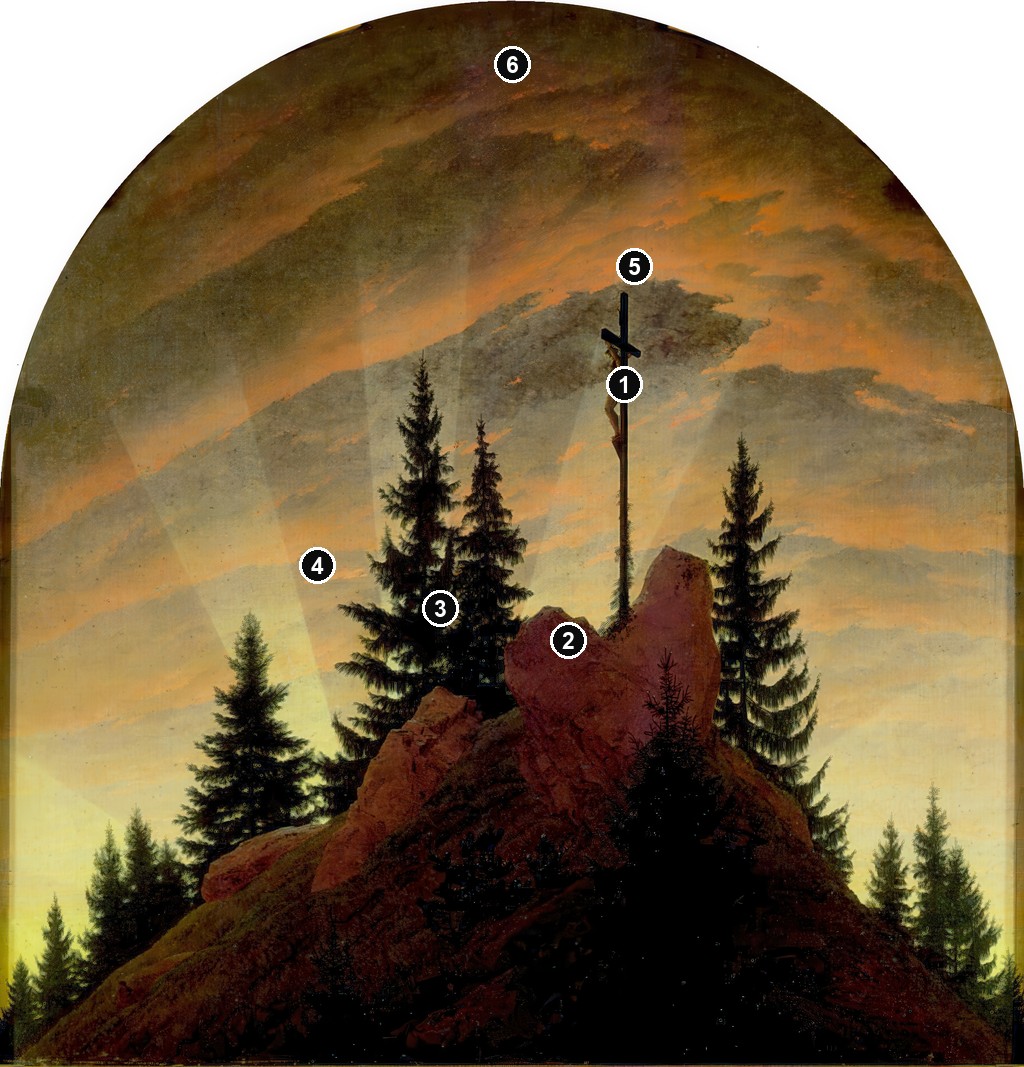
Details from THE CROSS IN THE MOUNTAINS (TETSCHEN ALTAR)
These details use the high-resolution Cross in the Mountains image while preserving the Dresden Public Domain Mark wording and the page's careful distinction between painted image, frame, Tetschen provenance and Ramdohr reception.
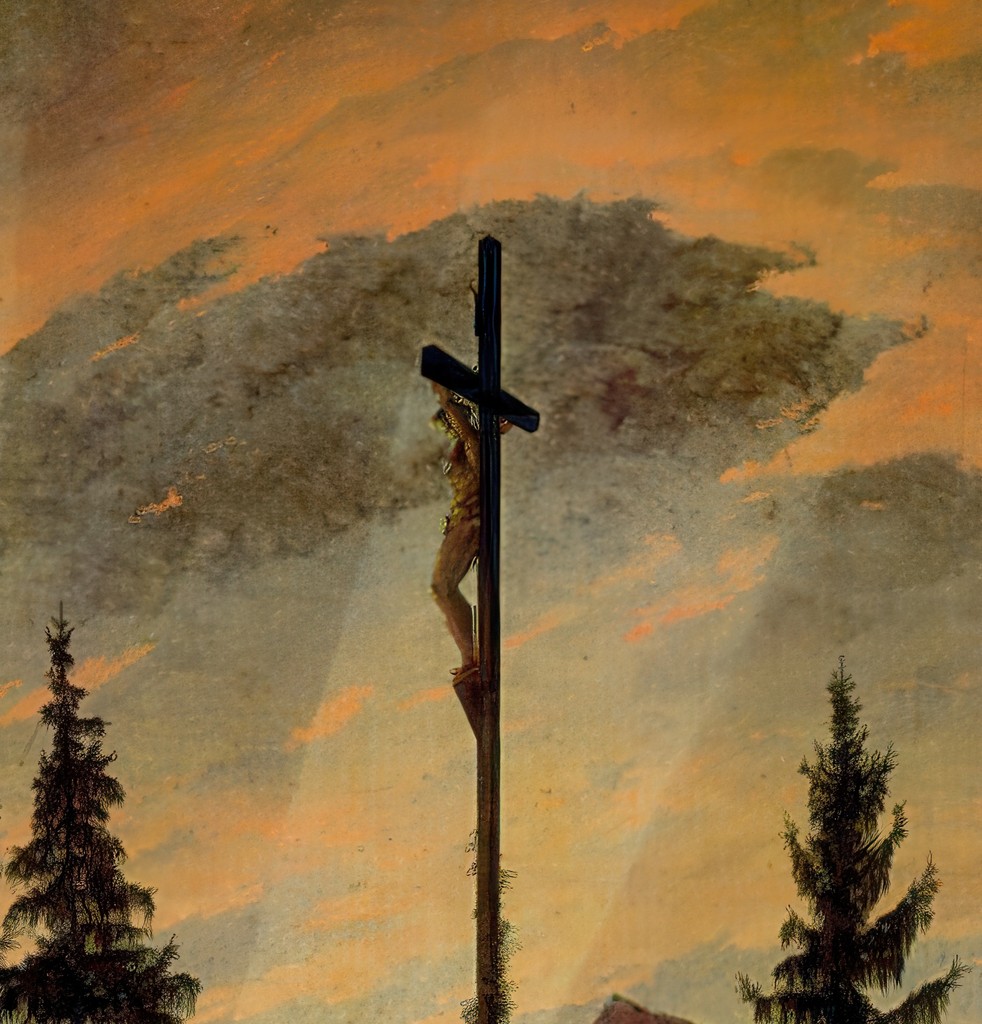
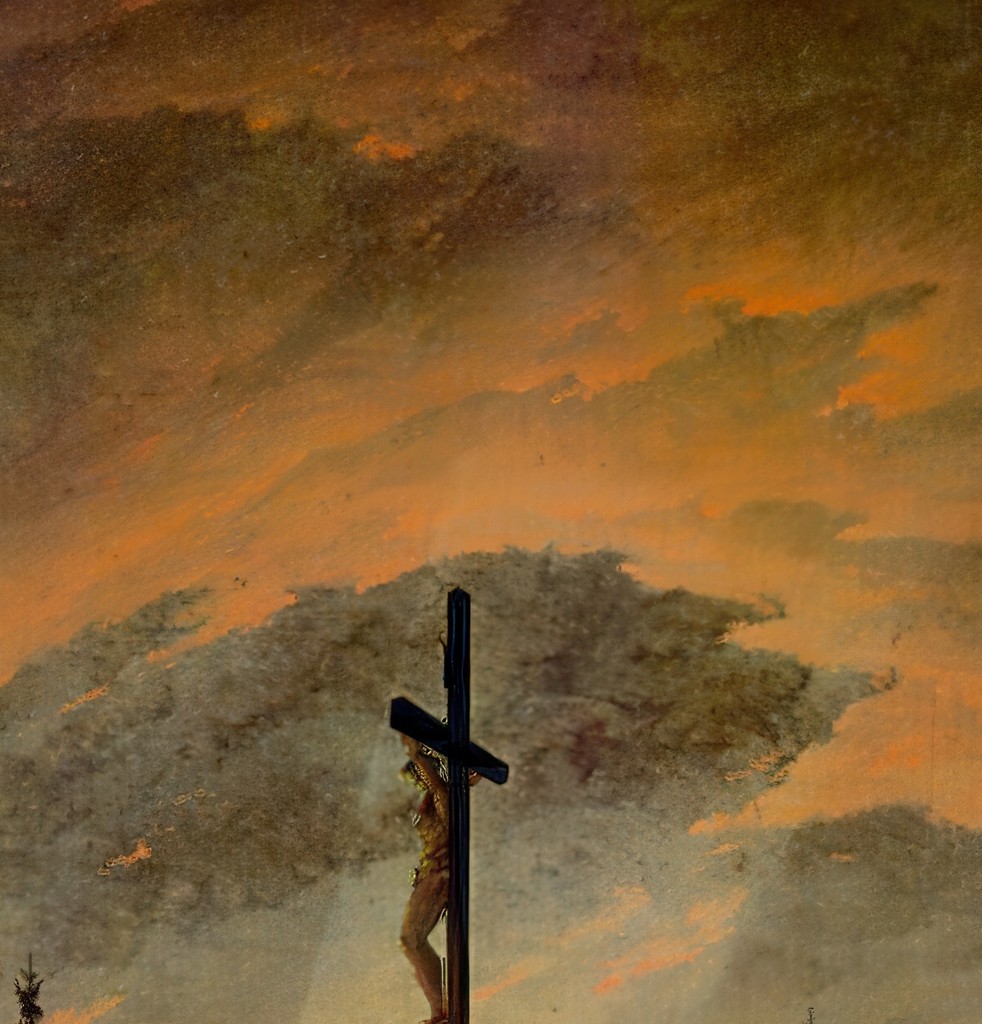
Crucifix at the summit
The crucifix stands high and narrow, turned toward the glowing sky rather than presented as a conventional foreground devotional figure.
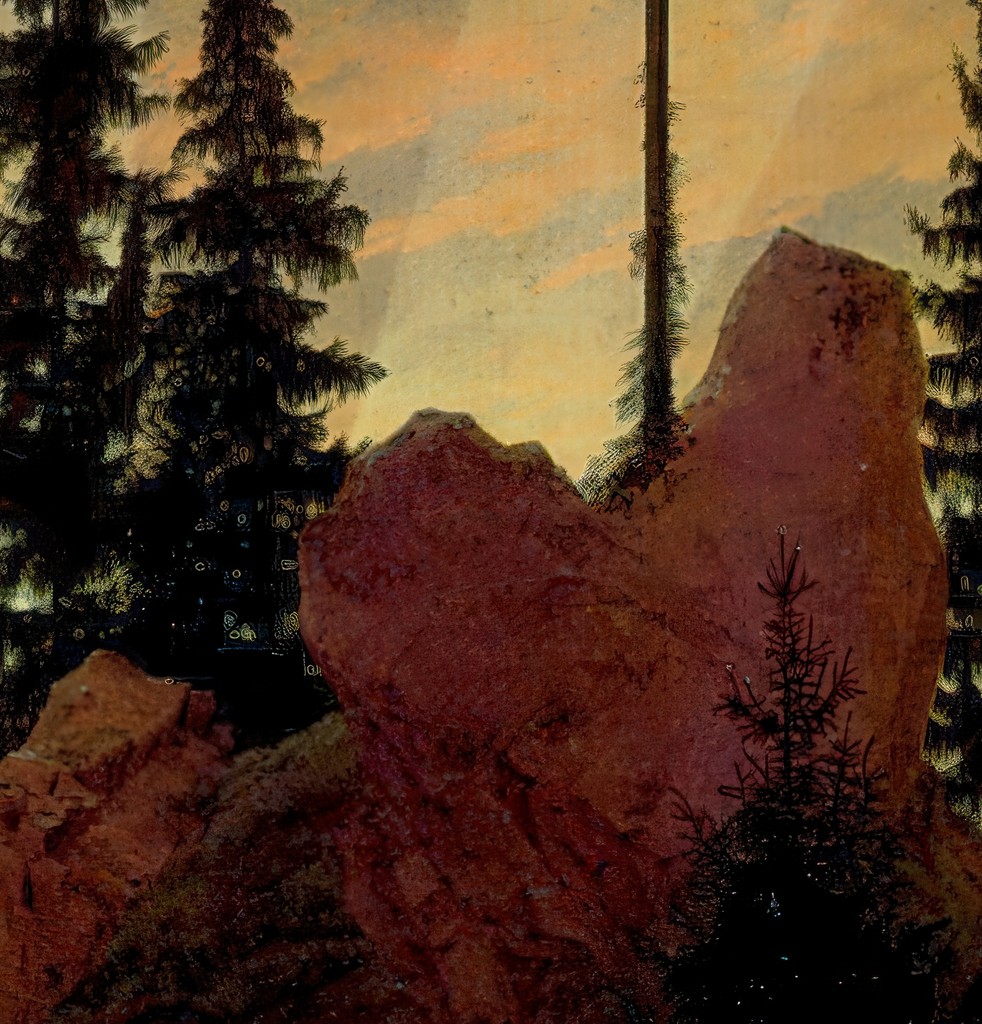
Rocky support
The steep rock gives the cross a firm elevated base; Friedrich's own explanation makes this rock more than picturesque mountain scenery.
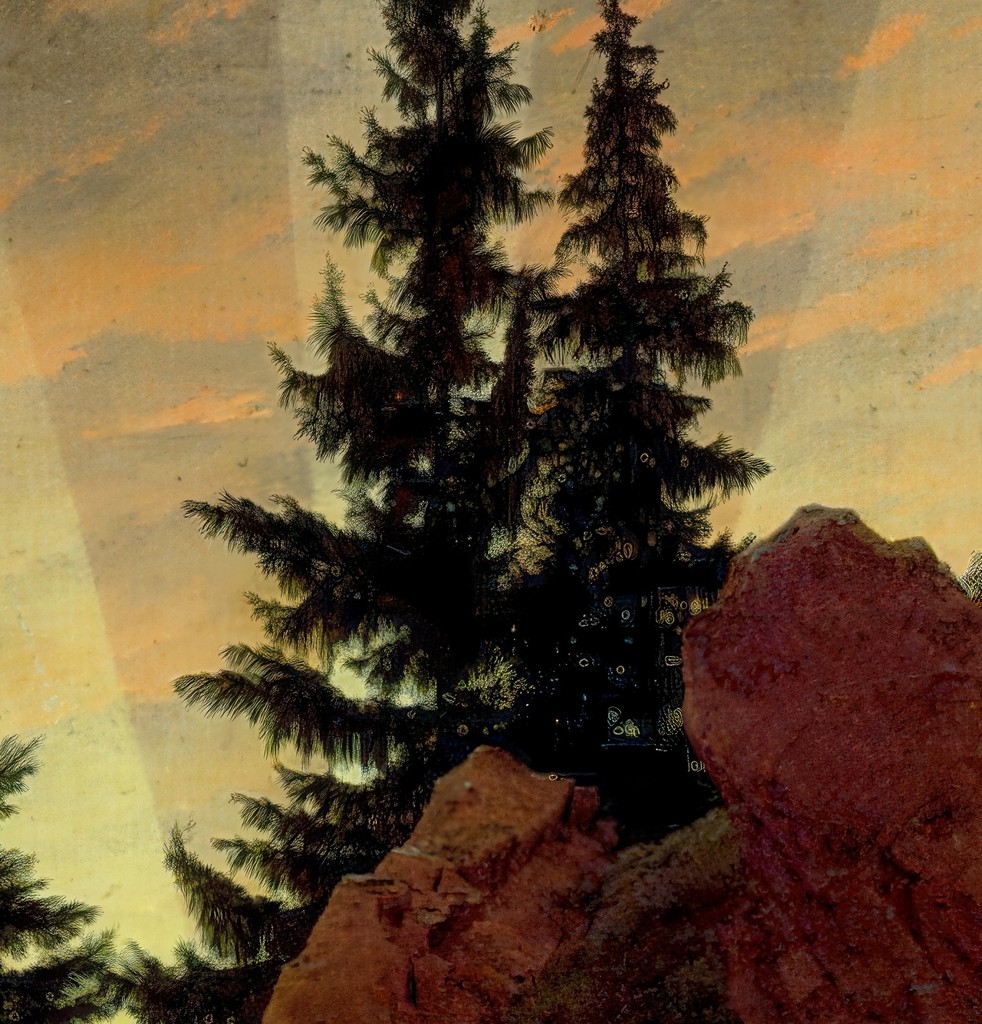
Evergreen firs
Dark firs gather beside the cross, carrying Friedrich's stated hope symbolism without replacing the central Christian sign.
Rays of evening light
The evening rays spread behind the mountain, making light part of the devotional structure rather than a generic sunset effect.
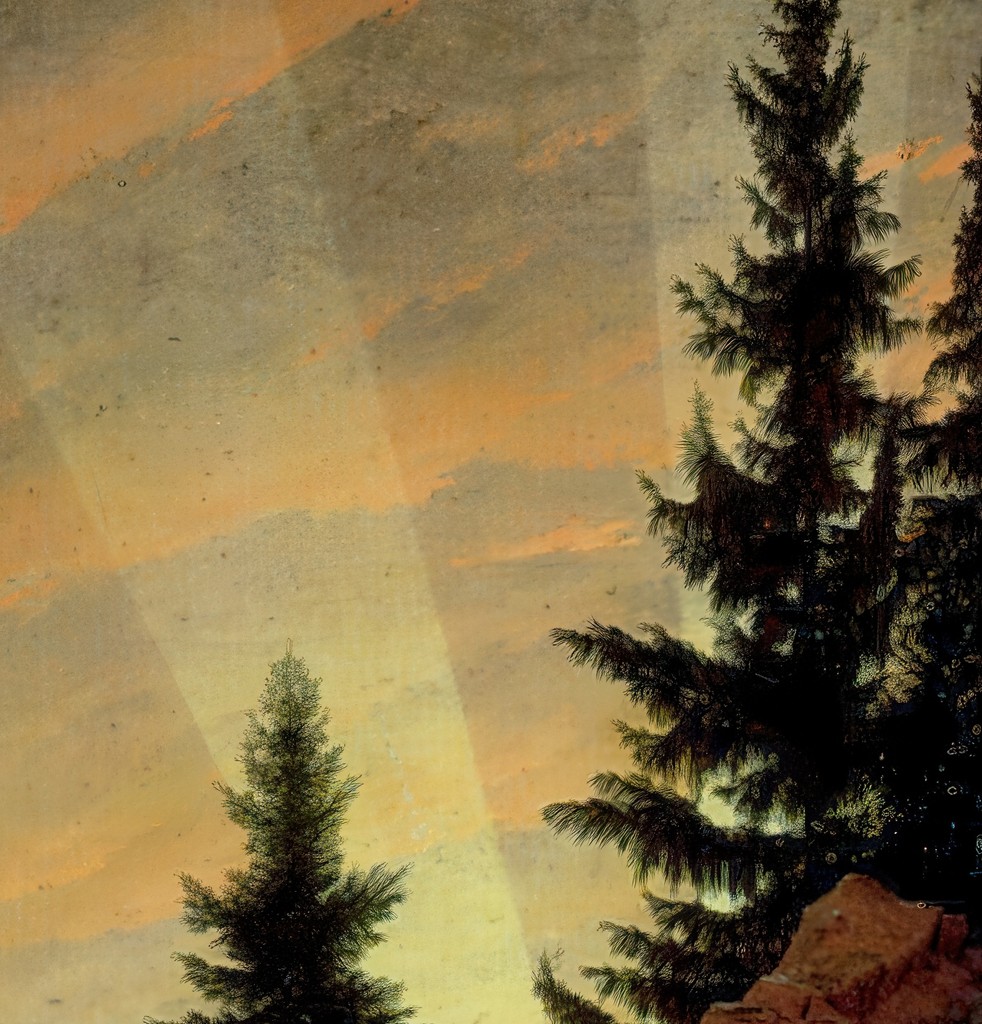
Cloud and mountain bands
Layered cloud and distant mountain forms hold the cross inside a larger landscape order, so the sacred sign and natural setting work together.
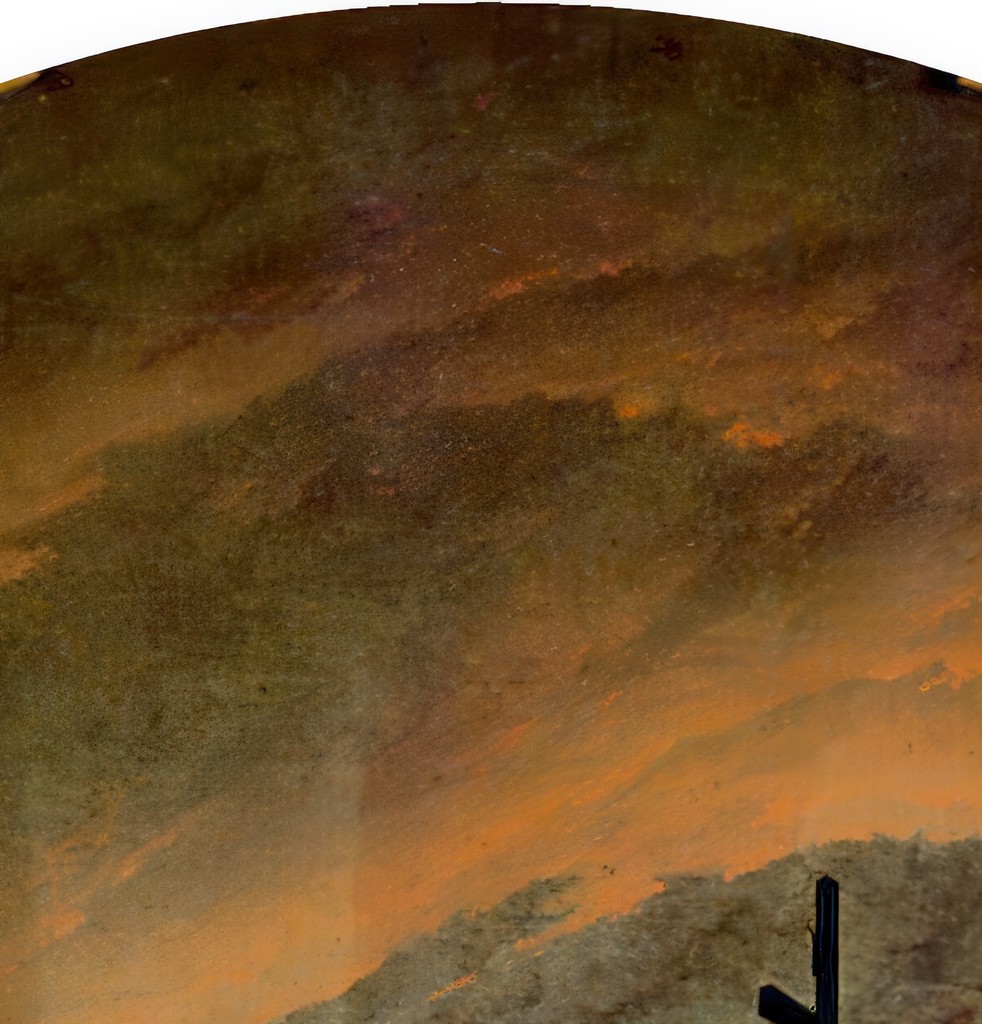
Arched painted field
The upper curve gives the painted landscape an altar-like contour; the full carved frame and base should be read from the work's object record, not inferred from this cropped view alone.
A Landscape Made as an Altar Image
The great audacity of the Tetschen Altar is that it makes a landscape behave like a devotional image. The crucifix is present, but it is not placed in the foreground as a conventional figure of worship. It stands high on a rocky summit, turned toward the setting sun. The surrounding mountain, firs and light are not neutral scenery. They become the visual setting through which the sacred meaning is produced.
cdfriedrich.de describes the work as a programmatic major work from Friedrich's early period and stresses its break with inherited artistic rules and conventions. [2] The point was not merely that Friedrich painted a cross in nature. The more radical act was to raise a spiritually concentrated landscape image to the status of a religious devotional picture. [2]
This crossed a line in the artistic hierarchy of the time. Landscape painting had long been able to carry moral, poetic or religious associations, but it was not normally granted the authority of an altar image. Friedrich's work challenged that separation. The mountain did not illustrate religion from outside. It became part of the religious image.
The SKD guide makes the same issue accessible through the language of the frame and the whole object. Friedrich no longer sought God only in church ritual, but also in nature, and he conveyed a deeply religious love of nature through his art. [4] That statement should be handled carefully. It does not mean the painting rejects Christianity or replaces it with vague nature worship. The crucifix remains central. What changes is the way Christian devotion is mediated: through landscape, light and the experience of nature.
The resulting work asks viewers to see mountain landscape as a place of revelation. The cross rises from rock. The light comes from the setting sun. The fir trees flank the sacred sign. Nature is not background to theology; it is the medium through which the image thinks theologically.
The Cross, Firs, Rock and Sunset
The painted image is built from a small number of charged elements. The cross stands on a jagged rock, high above the viewer. The figure of Christ faces away from us toward the low sun rather than outward toward the beholder. [4] This turn is important. The crucified Christ is not displayed as a conventional frontal devotional figure. The image asks us to contemplate the cross in relation to light, height and landscape.
The rock gives the cross its foundation. In Friedrich's own explanation, made in response to his critic, the rock could symbolize firmness of faith. [2] That interpretation is valuable because it comes from the artist's response to controversy, but it should not make the painting a simple code. The rock also has visual force. It rises steeply, creating a difficult ascent and separating the sacred summit from ordinary ground.
The evergreen firs are equally important. Friedrich associated the evergreen firs with the faithful person's hope in Christ. [2] Their meaning depends on both botany and composition. Unlike leafless trees, evergreens retain life through winter. In the Tetschen Altar, they stand beside the cross as signs of persistence, framing the crucifix without replacing it.
The sunset produces one of the painting's most debated effects. The SKD guide notes that the rays spread upward from low on the horizon and bathe the clouds in the intense red of evening. [4] The light is beautiful, but it is not simply decorative. It turns the moment of decline, the sinking sun, into a visual field of radiance around the cross.
The direction of Christ's body toward the light gives the scene additional complexity. Viewers do not meet the crucified figure face to face. Instead, they see the cross within a landscape of retreating light. The image therefore does not present Christian meaning as a simple frontal declaration. It makes meaning appear through distance, elevation, orientation and atmosphere.
This is why the painting should not be reduced to generic religious landscape. Friedrich's choices are precise: high cross, backward-facing Christ, firs, rock, sunset, carved frame, altar format. Each element participates in a deliberately unusual devotional structure.
Christian Gottlob Kühn's Frame
The frame is not accessory furniture. It is part of the work. cdfriedrich.de describes the object as oil on canvas with a carved and gilded picture frame on a base, and names Christian Gottlob Kühn as the carver. [1] The SKD guide explains that Friedrich designed the frame himself and that it was made by his friend, the sculptor Christian Gottlob Kühn. [4]
This matters because the Tetschen Altar is a fusion of painting, sculpture and devotional format. The SKD guide suggests that today one might call it a Gesamtkunstwerk, a total work of art, because the three-dimensional sculptural frame and the painted image create a unified artistic impression. [4] The frame draws on medieval carved altarpiece traditions, in which sculpted and painted elements could work together. [4]
The frame also carries Christian symbols. According to the SKD guide, its decorative elements include five cherubim in the arched upper section, the evening star, palms, ears of corn, grapes and the eye of God in a nimbus. [4] These motifs are traditional and explicitly religious. Palms refer to martyrdom, while corn and grapes point toward the Eucharist. [4]
This traditional frame complicates the apparent radicalism of the painting. Friedrich's landscape image was controversial because it gave nature a devotional role that challenged convention. The frame, by contrast, supplies familiar Christian signs. The SKD guide proposes that Friedrich may have used the frame partly to soften or mediate the revolutionary quality of the painted image by surrounding it with more traditional motifs. [4]
That proposal is useful because it shows the object balancing innovation and tradition. Friedrich did not simply abandon Christian iconography. He rearranged its visual hierarchy. The frame keeps the work connected to church tradition, while the painting pushes religious meaning into landscape, light and nature.
Commission, Tetschen and Display
The name Tetschen Altar comes from the work's connection with Count Franz von Thun und Hohenstein and Schloss Tetschen. cdfriedrich.de states that the completed painting was acquired by the count for his castle at Tetschen and placed in one of the private rooms, not in the chapel. [2] This point is important because the work's altar-like format does not mean it functioned straightforwardly as a chapel altar.
The distinction between altar form and actual use sharpens the painting's complexity. The object announces sacred purpose through its frame, title history and imagery, but its known Tetschen placement was domestic and private rather than liturgical. [2] Friedrich had made an altar-like work that raised questions about devotion, display and the role of landscape in religious experience.
The earlier intended dedication to Gustav IV Adolf of Sweden, noted by cdfriedrich.de, adds another layer. [2] Gustav was an opponent of Napoleon, and the intended destination may have carried a patriotic aspect. [2] The Tetschen Altar therefore belongs not only to art history and theology, but also to a Europe shaped by Napoleonic conflict and shifting political loyalties.
The work's first public controversy began before its Tetschen life. In 1808 Friedrich exhibited Cross in the Mountains in his Dresden apartment over Christmas, where it generated strong reactions. [3] This private-apartment display is striking. The painting was not introduced only through institutional exhibition. It entered debate through a carefully staged encounter in the artist's own space.
That context helps explain why the work became famous. It was not simply admired, bought and absorbed into tradition. It provoked argument because it made visible a change in what painting could claim for itself.
The Ramdohr Dispute
The Ramdohr dispute is central to the Tetschen Altar's history. Basilius von Ramdohr publicly criticized the painting later known as the Tetschen Altar, and Friedrich responded with a letter explaining his motivations and artistic principles. [3] Others also defended Friedrich, turning the painting into a public case about landscape and sacred art. [3]
The dispute illustrates a clash between categories. Ramdohr's objection was not merely personal dislike. The broader issue was whether landscape painting, associated with secular art, could legitimately take on the function and seriousness of sacred art. [3] Friedrich's painting made that problem unavoidable by appearing as an altar image while giving the mountain landscape such a powerful role.
The dispute also made Friedrich more visible. cdfriedrich.de states that the boundary crossing provoked a fundamental confrontation through which the artist and the work became famous, entering art history as the Ramdohr dispute. [2] Controversy did not simply damage the painting's reception. It helped define the work's historical importance.
Friedrich's response is just as important as the criticism. In answering Ramdohr, he supplied one of his rare explanations of an artwork's meaning. [2] Such statements need careful use. They do not remove all ambiguity from the painting, but they give unusually direct evidence for how Friedrich wished some elements to be understood.
The best way to treat the dispute is therefore neither to dismiss Ramdohr nor to let him dominate the work. His criticism marks the historical pressure point: a landscape had crossed into sacred territory. Friedrich's response marks the artist's attempt to defend that crossing as deliberate, meaningful and principled.
Friedrich's Own Symbolic Reading
Friedrich's own explanation of the Tetschen Altar is one of the most important pieces of evidence for the painting. cdfriedrich.de reports that, in response to his main critic, Friedrich explained aspects of the image: the rock symbolized firmness of faith, and the evergreen firs stood for hope in the crucified Christ. [2]
These statements are valuable because Friedrich was often reluctant to provide explicit verbal keys to his art. In this case, public controversy pushed him to articulate a reading. The painting therefore stands at a rare intersection between image and artist commentary.
Even so, the symbolism should not be handled mechanically. If the rock equals faith and the firs equal hope, the painting still remains more than a list of meanings. The force of the work lies in how those meanings are made visible through composition. The rock is steep and elevated. The firs are dark and persistent. The cross is turned toward the sunset. The frame surrounds the image with traditional Christian signs. The meaning arises from the whole arrangement.
The symbolic reading also shows that Friedrich was not painting generic inward feeling. He was working with Christian signs, devotional form and a specific argument about religious art. The Tetschen Altar may feel deeply Romantic, but its Romanticism is disciplined by theological, pictorial and material choices.
Landscape Painting and Religious Feeling
The Tetschen Altar belongs to a broader transformation in Friedrich's art: landscape becomes a vehicle for religious feeling without becoming simple illustration. The Met's recent exhibition framing of Friedrich emphasizes his importance for a modern understanding of landscape as a site of spiritual and emotional encounter. [5] The Tetschen Altar shows that transformation at an early and controversial stage.
In older sacred art, the viewer might expect an episode from Christian narrative, a saint, a martyrdom, a devotional figure or a symbolic programme anchored by recognizable church tradition. Friedrich retains the cross, but shifts emphasis toward nature. The mountain, trees, light and sky become integral to the sacred experience.
That shift explains both the painting's power and its risk. If nature carries religious force, then landscape painting can claim a seriousness previously reserved for other genres. But if landscape painting claims that seriousness, viewers trained by older hierarchies may see the result as inappropriate or confused. The Ramdohr dispute grew from precisely that pressure. [3]
The frame again matters here. It prevents the painting from drifting into pure landscape by giving it the objecthood and symbolic enclosure of an altar. At the same time, the painted image prevents the frame from settling into conventional devotion. The two parts hold each other in productive tension.
Close-Looking Notes
Begin with the direction of the crucified Christ. The figure does not face outward toward the viewer. Christ turns toward the setting sun, so the devotional focus is displaced into the landscape itself. [4] That decision changes the encounter. The viewer does not simply look at a sacred figure; the viewer looks at a sacred figure oriented toward light beyond the summit.
Next, look at the way the rock rises. It does not form an easy stage. It is steep, jagged and elevated, lifting the cross above ordinary access. Friedrich's own symbolic reading of the rock as firmness of faith helps explain why the foundation matters, but the visual effect is just as important. [2] The rock makes faith appear difficult, heightened and exposed.
The firs create a second vertical rhythm. They stand beside the cross, dark and evergreen, answering the crucifix without competing with it. Friedrich's explanation of the evergreens as hope in Christ gives the motif a direct Christian meaning. [2] Visually, they also keep the painting from becoming a lone-cross silhouette. They bind the sacred sign to the mountain environment.
Finally, consider the frame and painting together. The frame's cherubim, palms, grapes, corn and eye of God bring older Christian symbolism to the edge of the image. [4] Inside that frame, the painted landscape remains startlingly unconventional. The viewer is therefore held between familiar church language and Friedrich's newer religious landscape. That tension is the work's central achievement.
A Specific Work, Not Generic Spirituality
The Tetschen Altar can be misunderstood if it is described only as a spiritual landscape. That phrase is not wrong, but it is too broad. The work is specific in its materials, patronage, frame, symbolism, controversy and historical moment.
It is specific as an object: oil on canvas with a carved and gilded frame on a base. [1] It is specific in authorship: Friedrich painted and designed the work, while Christian Gottlob Kühn carved the frame. [1] [4] It is specific in collection history: it came from Count Thun-Hohenstein of Tetschen to Dresden in 1921. [1] It is specific in reception: Ramdohr's criticism and Friedrich's reply made it a public argument about landscape and sacred art. [2] [3]
This specificity is what gives the painting its force. Friedrich did not merely put a cross in the mountains because nature felt holy. He made a formally concentrated landscape into a devotional object, surrounded it with a traditional symbolic frame, allowed it to enter a fraught public debate and used it to defend a new seriousness for landscape painting.
That is why the Tetschen Altar remains one of the key works of early German Romantic painting. It does not dissolve religion into mood. It asks whether painting can remake the conditions under which religious feeling is seen.
Its importance also depends on how physically unusual the object is. The viewer encounters not only a painted mountain cross, but a framed devotional construction with a base, carved symbols and gilded surfaces. [1] [4] That material presence keeps the work anchored in a specific historical experiment: Friedrich was testing what an altar-like landscape could be, not merely composing a pious scene.
From the Wayside Cross to the Altarpiece
The finished painting gives the impression that rock, firs and cross belong to a single place. Holger Birkholz's reconstruction of its development begins with a much smaller encounter. In 1799 Friedrich drew a wayside cross in a rocky crevice. The motif eventually grew into a pyramidal summit with a cross at its highest point, a configuration Birkholz connects with the Honigstein in Saxon Switzerland. A sepia drawing of about 1806 brought the principal elements together. The oil painting followed after further changes to the trees, the light and the shape enclosing the image.[6]
The trees give a particularly clear view of Friedrich's method. Birkholz identifies the tallest tree as a study dating from 1804, retained in the same position in the sepia and oil compositions. Friedrich used it again in View over the Elbe Valley. Several other trees were replaced when he moved to oil, including specimens taken from more recent studies. A tree drawn on one occasion could thus serve as a fixed point while the artist revised the surrounding landscape. Its presence in another painting also makes a specific botanical form available for comparison across two different pictorial settings.[6]
The slimmer trees in the oil painting change the relationship between the grove and the rock. Their narrow tips leave more space for the sky between them and make the ascent of the contours easier to follow. Visible rays, added in the oil version, carry the movement farther up and out. The shift from a round arch to the pointed shape of the frame gives that same movement a destination beyond the painted summit. Looking across the two versions makes it possible to see how much of the final painting's upward pull came from decisions taken after the basic composition was already in place.[6]
How the Frame Directs the Eye
Seen from below, the lower carved symbols offer a point of entry before the viewer reaches the hill. The vine and wheat carry the familiar associations of Eucharistic wine and bread, and the eye in the triangle establishes a further Christian reference.[1][4] Inside the frame, religious meaning has to be read through a more distant cross and through the physical disposition of rock, evergreens and light. The two kinds of imagery ask the eye to work at different speeds. The carved motifs can be recognized individually, while the painted scene discloses its connections as the viewer follows one form into the next.
The frame's point can also be compared with the cross beneath it. The cross sits on the uneven mountain, with the figure on it turned toward the light. The point of the arch gives the whole object a more regular upward shape. As the eye moves from the irregular edges of the rock and trees to the shaped outline of the frame, a view of wild terrain begins to acquire the visual order of a devotional object. Kühn's carving gives that order a physical edge. From an angle, the frame occupies space in the room where the viewer stands, while the hill retains its position at a distance within the picture.[1][4][6]
An Altarpiece in a Room
The painting's early settings sharpen the distinction between an altarpiece's form and its use. Friedrich's sister Catharina Dorothea Sponholz asked about the altarpiece in October 1808, before it went on public view. Her letter suggests that the description circulated within the family before the exhibition and before the work acquired its familiar Tetschen name.[6] Viewers first encountered it in Friedrich's apartment at Christmas. The castle subsequently provided another domestic setting for the framed work. The Dresden collection now catalogues it under the title that connects it to that later location.[2][3][7]
In the apartment, a visitor could encounter the elaborate carving and the painted light together, at the scale of a single object. The image itself supplies neither a church interior nor a gathering of worshippers. Its devotional character therefore depended in part on the visitor's encounter with its form, including the frame's invitation to look upward from the carved base. The apartment exhibition made that encounter available to people who could then debate its terms in public. The difference between the intimacy of the room and the reach of the published argument helps explain how a painting with so few figures could become the centre of a dispute involving artists, critics and readers.[3][6]
The later name can encourage viewers to imagine a chapel and work backward from it. The surviving sequence gives a different order for approaching the object. The idea began with drawn observations and developed through a sepia and an oil painting. A letter already called it an altarpiece while Friedrich was making it. Its first exhibition took place at home, and its association with Tetschen followed the sale.[2][3][6] The religious title belongs to the work's conception and early reception even though its recorded settings were domestic.
Related Friedrich Works
Monk by the Sea offers a later comparison in radical reduction. It removes explicit church architecture and places a solitary figure before shore, sea and sky, yet it shares the Tetschen Altar's ambition to make landscape carry spiritual pressure.

The Abbey in the Oakwood brings sacred architecture back as ruin, funeral procession and winter grove. Read beside the Tetschen Altar, it shows Friedrich moving from altar-like landscape to ruined church and mortuary ritual.
Morning in the Riesengebirge is an important comparison for mountain, cross and sunrise imagery, though it is a different work and should not be confused with the Tetschen Altar.
The Watzmann shows Friedrich's sustained interest in mountains as forms of height, distance and imaginative pressure.
The biography and paintings pages give wider context for Friedrich's early career, religious landscape practice and later reception.
Frequently Asked Questions
Discussion
Reader insights are welcome, especially close-looking observations about the cross, firs, rock, sunset, carved frame, Ramdohr dispute and the work's altar-like format.
Reader Insights
How does Christ's turn toward the light change the devotional encounter?
Where do the carved symbols support or challenge the landscape image?
Was Ramdohr objecting to style, category, theology or all three?
Does the Tetschen Altar feel more like a landscape, an altar image or a deliberate fusion of both? The painting's historical force lies in how difficult it makes that distinction.
Join the Conversation
Share a close-reading note or a source-grounded comparison with Friedrich's other religious landscapes.
References
- The Cross in the Mountains (Tetschen Altar), cdfriedrich.de, Caspar David Friedrich anniversary Chronicle Source
- Das Kreuz im Gebirge (Tetschener Altar), cdfriedrich.de, Caspar David Friedrich anniversary Chronicle, German-language source. Source
- Friedrich exhibits Cross in the Mountains in his apartment over Christmas - generating controversial reactions, cdfriedrich.de, Caspar David Friedrich anniversary Chronicle Source
- Cross in the Mountains, SKD Multimedia Guide, Staatliche Kunstsammlungen Dresden Source
- Caspar David Friedrich: The Soul of Nature, Metropolitan Museum of Art exhibition page Source
- Holger Birkholz,
A Perfect Work of Art: The Tetschen Altarpiece, Dresden Friedrich exhibition catalogue, p. 238, https://www.sandstein-kultur.de/reader/98-831_CDF-engl/34/ - Staatliche Kunstsammlungen Dresden, Online Collection,
Das Kreuz im Gebirge (Tetschener Altar), Gal.-Nr. 2197 D, https://skd-online-collection.skd.museum/DigitaleVorlage/241967


