



 by Tom Gurney
Tom Gurney BSc (Hons) is an art history expert with over 20 years experience
Published on June 19, 2020 / Updated on October 14, 2023
Email: tomgurney1@gmail.com / Phone: +44 7429 011000
The Stages of Life: Introduction
An elderly man approaches a group beside the sea. Two children play between a standing man and a seated woman, while sailing vessels occupy the water beyond them. Caspar David Friedrich’s The Stages of Life brings different generations together within a single evening. The Museum der bildenden Künste Leipzig dates this oil painting to around 1834. In the museum’s interpretation, the people, ships and dusk evoke the recurring passage of time. [1]
That reading begins with an unusually persuasive visual rhyme: five people on the shore and five sailing vessels on the water. Yet a sixth boat lies ashore in the foreground. The apparent simplicity of the arrangement opens into a more complicated image of lives lived together, remembered places and journeys whose beginnings and endings are difficult to separate.
At a Glance
- Date · ca. 1834
- Medium · Oil on canvas
- Collection · Museum der bildenden Künste Leipzig
- Accession · G 1217
- Dimensions · 73 cm high × 94 cm wide
Contents
- Introduction
- The Leipzig painting
- Five people and the directions of their attention
- Which members of Friedrich’s family?
- Five ships afloat, another boat ashore
- The Swedish flag
- Evening in a single image
- From private ownership to Leipzig
- Annotated Details
- Image Details
- When a ship study resembles a painting
- A working harbour and an unmarked shore
- What an idle boat does to the comparison
The Leipzig painting
The museum’s current collection entry gives the German title Lebensstufen, the inventory number G 1217 and dimensions of 73 centimetres high by 94 centimetres wide. The Friedrich anniversary chronicle dates the same composition to around 1835 and lists G 5161, with measurements of 94 × 72.5 centimetres. These records identify the familiar Leipzig painting, although their catalogue details differ. The holding museum’s current entry provides the facts used here; around 1834–35 conveys the approximate dating shared across the records. [1] [2]
The horizontal canvas allows the shore to spread across the lower part of the scene without enclosing the sea. Above the figures, the masts and sails establish a second zone of activity. Their slender lines remain readable against the sky, even where the hulls become small and indistinct. We can move between an intimate gathering and a much wider maritime space without losing sight of either.
The setting gives the gathering an edge. The figures have come as far as the land permits, and the water begins just beyond their small area of shared ground. There is no interior to shelter them and little architecture to claim attention. Their relationship to one another becomes the foreground’s principal event. The sea extends that event into a distance where human actions become increasingly hard to distinguish.
Five people and the directions of their attention
The old man stands nearest to us, his back turned, his weight supported by a stick. His dark clothing gives his body a compact, upright shape. Farther into the picture, the younger man’s tall hat extends his silhouette upwards. The seated woman and the children form a lower group to the right. These different heights make age visible through posture and position before any allegorical explanation is supplied.
The standing man turns back towards the older figure while indicating the children. Across from him, the woman bends towards their play. Their gestures connect the ends of the group through its youngest members. The Metropolitan Museum’s 2025 exhibition label emphasizes this attention to the children as an indication of generational continuity. It also describes the painting’s disciplined coastal curves and level horizon as the setting for a human drama. [3]
Calling that drama quiet does not mean that nothing happens. Hands are raised, bodies turn, and the children’s small flag becomes something to hold and reach towards. The adults answer movement with movement. The old man appears at the threshold of their exchange, close enough to join it but still separated from its busiest part. The interval between him and the others supplies the gathering with a gentle tension.
The picture also offers more than one way of looking. We approach behind the old man, sharing the direction of his movement. The younger man’s turn brings attention back towards that approach. The children attend to something close at hand; the woman attends to them. No single gaze controls everyone else. This distinguishes the scene from a group arranged solely to contemplate a distant view. The people inhabit the shore through their mutual attention as well as through their outlook onto the sea.
Which members of Friedrich’s family?
Jan Nicolaisen’s essay for the Leipzig collection reads the old man as Friedrich and the remaining figures as his three children and a nephew. The Met’s label presents the identifications more tentatively: Friedrich, a nephew named there as Karl Heinrich, the children Gustav and Agnes, and either Friedrich’s wife Caroline or his eldest daughter Emma. The woman’s identity therefore varies even between institutional interpretations. [1] [3]
There is more behind the nephew interpretation than a resemblance imagined in a small face. In a 1976 study, Helmut Börsch-Supan connects the painting’s provenance in the family of Friedrich’s brother Heinrich with Heinrich’s son Karl Heinrich Wilhelm, the artist’s godchild. He also points to letters as evidence of their relationship. This collecting history supports a family reading, although it cannot settle every figure’s identity. [4]
The alternatives matter most when we consider the seated woman. If she is Emma, the older man stands before three of his children and a nephew. If she is Caroline, the scene includes parents, children and another relative. Either reading places the children within a network of care. Neither requires us to treat the gathering as a record of a particular outing at a particular hour.
A family interpretation gives the scene personal force, but the figures remain effective before their names are known. The old man’s support, the standing adult’s turn and the seated woman’s inclination make relationships legible through bodies. Their faces are small or concealed. Friedrich gives us enough to recognize generations while withholding the facial detail that would ordinarily make an identification feel immediate. The landscape holds a possible family memory in a form that other viewers can enter.
Five ships afloat, another boat ashore
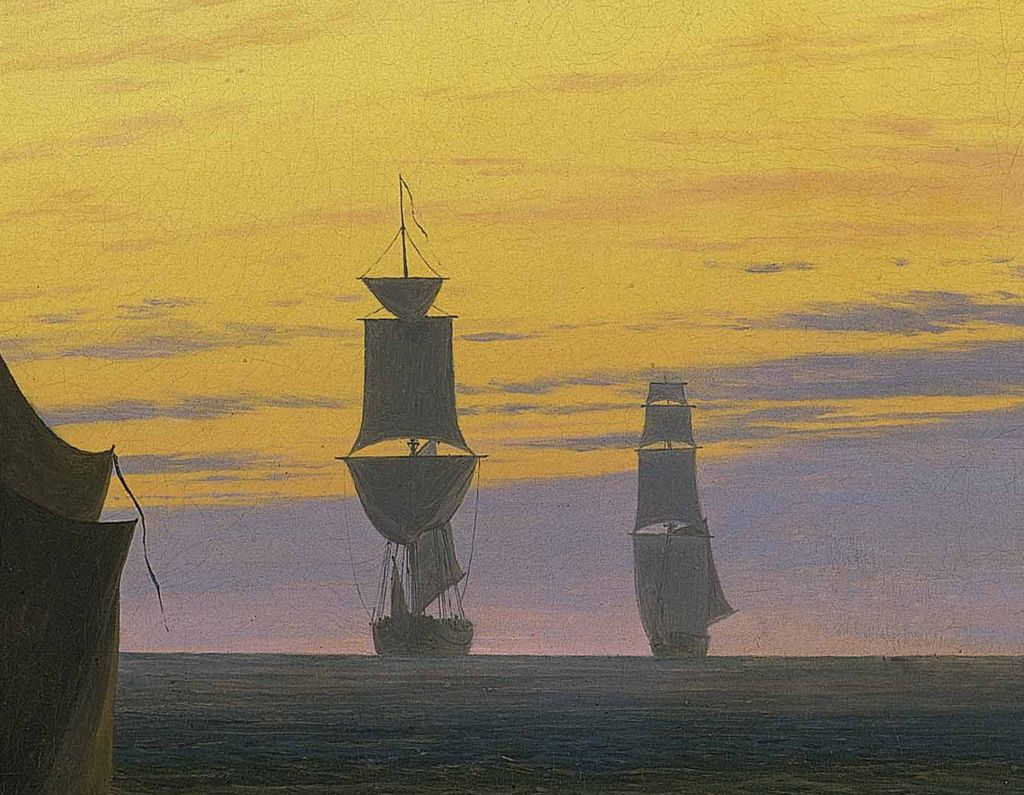
On the water, the large central ship dominates the smaller craft nearer the coast and the more distant vessels towards the horizon. Its mast rises above the human group, while the spread of rigging and partially gathered sails gives it a complexity absent from the distant silhouettes. The change in size makes the sea measurable. We encounter successive distances through vessels that remain recognizable as related kinds of object.
Five figures and five sailing vessels encourage a comparison between human ages and a voyage. The additional boat on land complicates an exact correspondence. The Met’s label expressly counts six vessels when this foreground craft is included and warns that the people do not align neatly with them. A reading that assigns a single ship to each named person has to account for this extra presence. [3]
Börsch-Supan offers a more specific account of the ships afloat. He distinguishes three large cargo vessels, whose work can evoke adult responsibilities, from two smaller boats near shore, which he associates with the playing children. He connects the central ship approaching land with the old painter approaching death. The Met’s later attention to the beached boat reminds us of what such a five-part scheme leaves outside its central analogy. [3] [4]
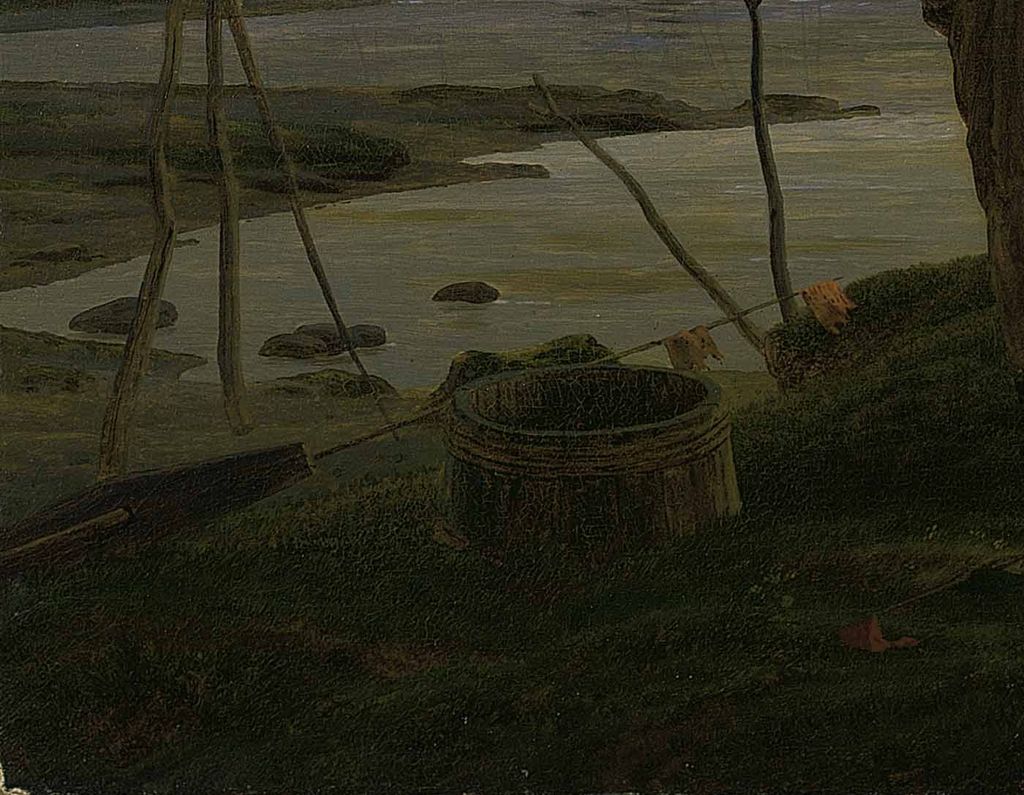
The beached boat also belongs to a different kind of space. It shares the foreground with the people, outside the active routes suggested by the sails. Its grounded form brings the maritime subject back to the earth beneath the figures. We can see a relation between rest and movement without deciding that the boat must stand for a particular death or a particular person.
Nor does distance supply an uncomplicated timeline. A vessel far away could be departing, returning or passing across the view. The nearest boat is not automatically the youngest life, and the largest ship need not represent the oldest person. These possibilities make the voyage metaphor richer. The picture offers the visible conditions of a journey—shore, water, vessels, changing distance—while leaving its human meaning open to more than one direction.
Our eye can follow the ships out towards the horizon and then return to the children. In the opposite direction, we can begin with their play and encounter the scale of the sea that lies before them. The composition supports both movements. Experience and anticipation occupy the same evening, rather than following one another in a fixed row.
The Swedish flag
The children’s blue-and-yellow flag introduces a specific historical attachment into this otherwise spare gathering. Nicolaisen interprets it as a political statement connected with Friedrich’s origins in Greifswald, which belonged to Sweden during his childhood. A remembered affiliation thus appears in the hands of the youngest generation. [1]
Its smallness is essential to its visual effect. The flag does not dominate the sky or fly above the large ship. Held close to the ground, it belongs to the children’s activity and asks for attentive looking. The colour marks out their shared centre without turning them into figures formally presenting a national emblem to the viewer.
Within that activity, an inherited identity can become a plaything. The old man, commonly interpreted as Friedrich, approaches children who hold a sign of the country associated with his early life. This offers a way of reading memory as something passed between generations. It remains a reading of the arrangement, rather than proof of a statement Friedrich made about the painting. The specific flag keeps the subject attached to a particular history even as the ages and ships invite broader reflection.
Evening in a single image
The sky changes gradually from cooler upper tones to warmer light near the horizon. The dark foreground and pale distance hold the figures and vessels at different levels of clarity. Nothing in this light compels a sudden event. Instead, the slow transitions allow our attention to dwell on small movements and on the intervals between objects.
Dusk makes the life-stage analogy persuasive because it is itself a passage. Yet the presence of children keeps the evening from becoming only an image of an ending. Their activity persists beneath a sky in which the day is fading. A single hour can contain someone’s recollection and someone else’s beginning.
Friedrich had explored human ages in sequences long before this canvas. Peter Prange’s catalogue essay for the Hamburger Kunsthalle discusses the seven sepia drawings exhibited in Dresden in 1826: their progression incorporates seasons, a graveyard, a cave and angels. [5] The separate article on Seasons, Times of Day and Ages of Life follows those series and their evidence in detail.
Here the ages coexist. We do not turn from childhood to maturity and then to old age across separate sheets. The children remain visible when we look at the elderly man. The ships likewise occupy one continuous stretch of water. Friedrich makes simultaneity the painting’s distinctive resource: the old and young can belong to one place while encountering it through different expectations.
From private ownership to Leipzig
The painting was visible in the major Friedrich display at Berlin’s German Centenary Exhibition of 1906. The anniversary project’s account identifies it among the works shown there and in a surviving installation photograph. Its later fame therefore has a concrete exhibition history before its entry into Leipzig’s collection. [6]
Leipzig acquired the painting in 1931 from Sophie Siemßen of Greifswald. [1] That purchase is distinct from its appearance in Berlin twenty-five years earlier. The distinction matters because modern recognition and museum ownership did not occur in a single event. A privately held picture could enter a major public exhibition before becoming part of a permanent civic collection.
The Leipzig museum later used The Stages of Life prominently in its exhibition Caspar David Friedrich and the Düsseldorf Romanticists, held in 2021–22. The exhibition compared Friedrich with contemporaries whose more dramatic narratives helped displace his work in nineteenth-century taste. [7] Against that context, this painting’s small gestures and broad, untroubled water become particularly striking. Its human action asks for sustained attention to relations rather than a climactic incident.
The old man has not reached the children, the flag remains raised, and the sails stand against a light that is still changing. These suspended actions keep the picture alive as we look. Its generations share a shore for a moment, with the sea extending beyond the limits of any one life.
When a ship study resembles a painting
The Hamburger Kunsthalle holds a small drawing called Ship Studies, with several vessels viewed at different angles. The sheet once seemed a promising source for the vessels in the Leipzig painting, especially for forms seen approaching the shore head-on. Peter Prange traces that suggestion to the 1964 Heidelberg exhibition catalogue and explains why it was abandoned. Helmut Börsch-Supan identified other preparatory drawings for the ships in the painting. The Hamburg drawing still provides a useful comparison because its earlier attribution as a source shows how easily a familiar view of a vessel can be mistaken for a direct link between two works.[8]
In a drawing devoted to ships, one orientation can be tested against another on the same page. A bow seen head-on gives the draughtsman a narrow outline and makes the way the rig rises above it particularly evident. A vessel seen more nearly from the side offers a longer hull and a different distribution of sails. In the finished oil those differences also affect how close a ship appears to the people on shore. The vessels offer a range of scales and orientations before a spectator assigns a meaning to their number. The rejected source leaves that visual comparison available while making a specific claim about the making of the painting less secure.[1] [3] [8]
That distinction is important for a painter who could return to observed material after many years. A ship study can document what Friedrich knew about a particular kind of boat without establishing where he used that knowledge. In The Stages of Life, a form that looks convincingly maritime can help hold the water at a particular distance from the shore. It can also invite a reading about arrival, departure or the passage of a lifetime. Which drawing supplied the form is a historical question with a different kind of evidence from the one that supports those readings.[1] [3] [8]
A working harbour and an unmarked shore
In Greifswald Harbour, held by the Alte Nationalgalerie, the boats occupy a view that leads towards a recognizable city skyline. The port makes arrival imaginable as a practical matter. In The Stages of Life, a similar sense of marine traffic is available without a comparable built destination across the water. The figures and the vessel drawn up on the beach give the edge of the shore some of the weight a quay or city would have in a harbour painting. Their presence suggests that the water is used even where the canvas gives very little information about the infrastructure of that use.[1] [3] [9]

The difference affects the way a spectator can understand the distance. A town at the far end of a harbour offers a place towards which vessels might be travelling. The Leipzig horizon is a firm boundary in the image and a much less definite end to any journey. A spectator can follow the water out to it, but a ship visible against that line might continue beyond anything the painting shows. The attention that returns to the people on land thus returns to something more immediate than the distant ships offer. They supply a gathering point for the eye as readily as they supply possible participants in an allegory.[1] [3] [9]
What an idle boat does to the comparison
Friedrich revisited the relation between a boat and the shore in his late Seashore by Moonlight. The anniversary catalogue traces that scene to a drawing made at Sassnitz in June 1826. It also notes that Friedrich left out several of the maritime objects visible in his study, including two wooden rowboats and anchors. A grounded sailing vessel remains in the painted scene. Its condition and position imply an interruption of travel even though the work gives little evidence about the people who brought it there.[10]
The modest boat on the beach in The Stages of Life offers a quieter version of that separation between a craft and a voyage. It has a relation to the people and their ground while the vessels offshore occupy the field available for movement. Whether a reader counts the grounded craft with the others changes the apparent numerical match, as the Met's exhibition label observes. The difference of position remains visible whichever count is used. Across the two late oils, Friedrich could use a craft that has ceased moving to give a coastline a particular kind of human presence, even when the main subject lies elsewhere.[1] [3] [10]
Annotated Details from The Stages of Life
Use the numbered details to trace the forms and light in this work.
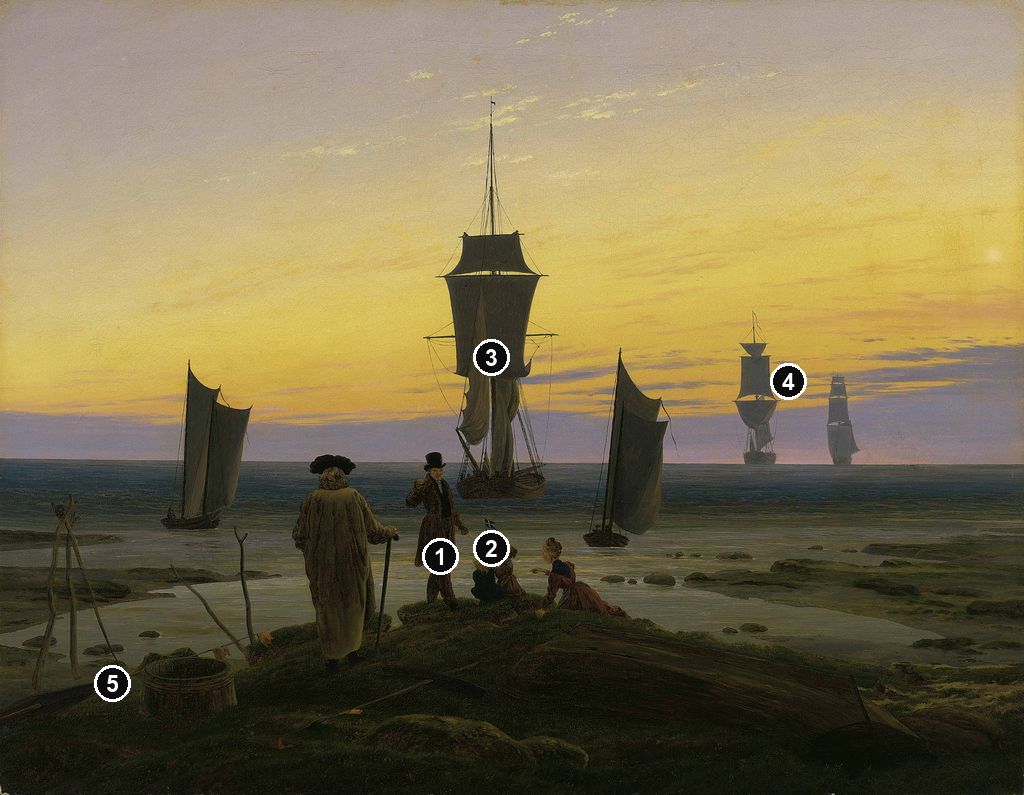
Details from THE STAGES OF LIFE
The detail crops show parts of the work at a larger scale.
The foreground group
Five people stand or sit on the shore. The older man's broad coat fills the space nearest to us.
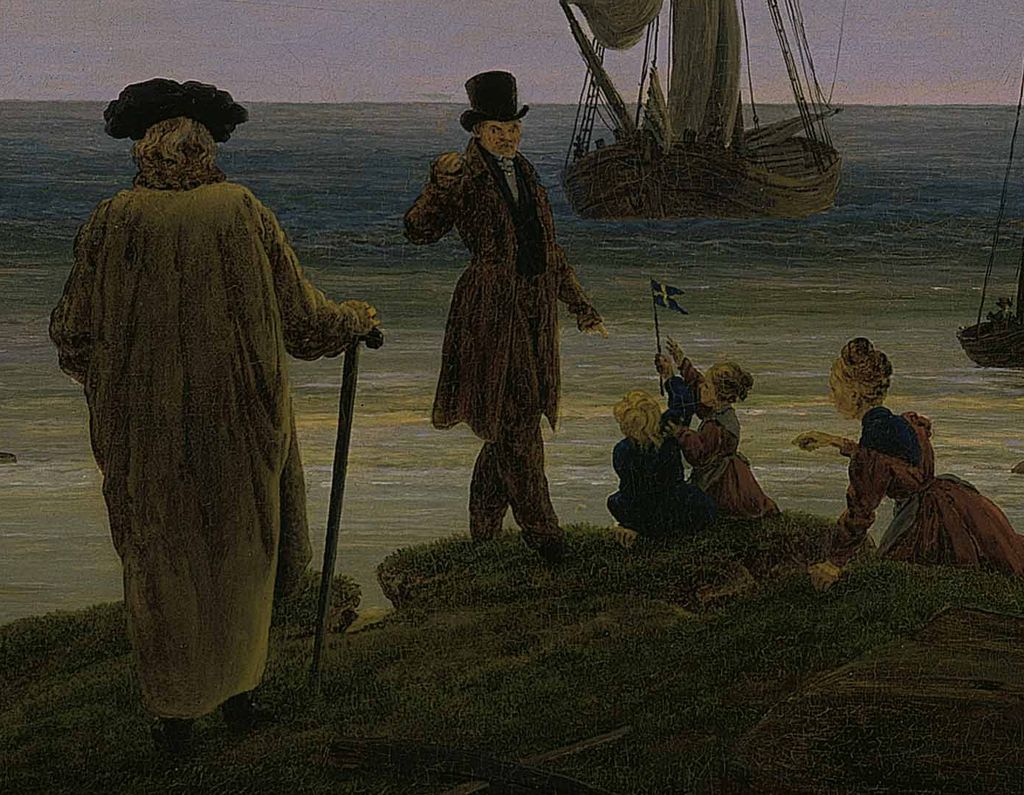
The children's flag
A small blue and yellow flag rises between the children near the centre of the group.
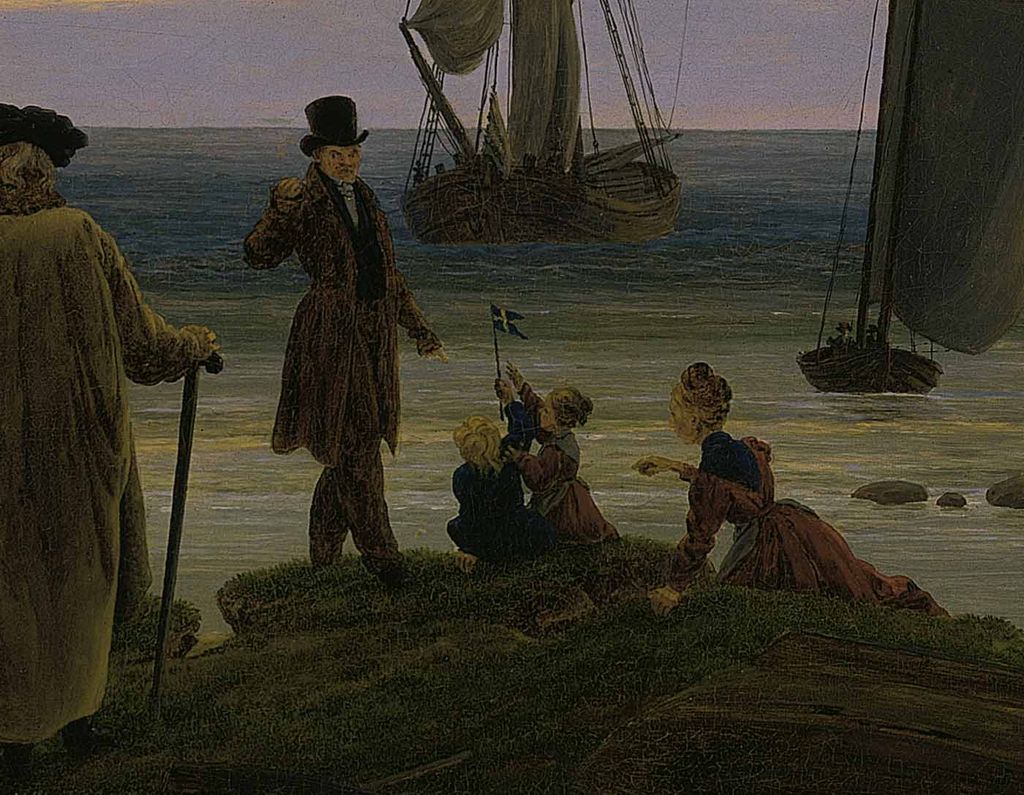
The nearest large ship
The tall mast and dark sails rise behind the figures. The hull approaches the shoreline.
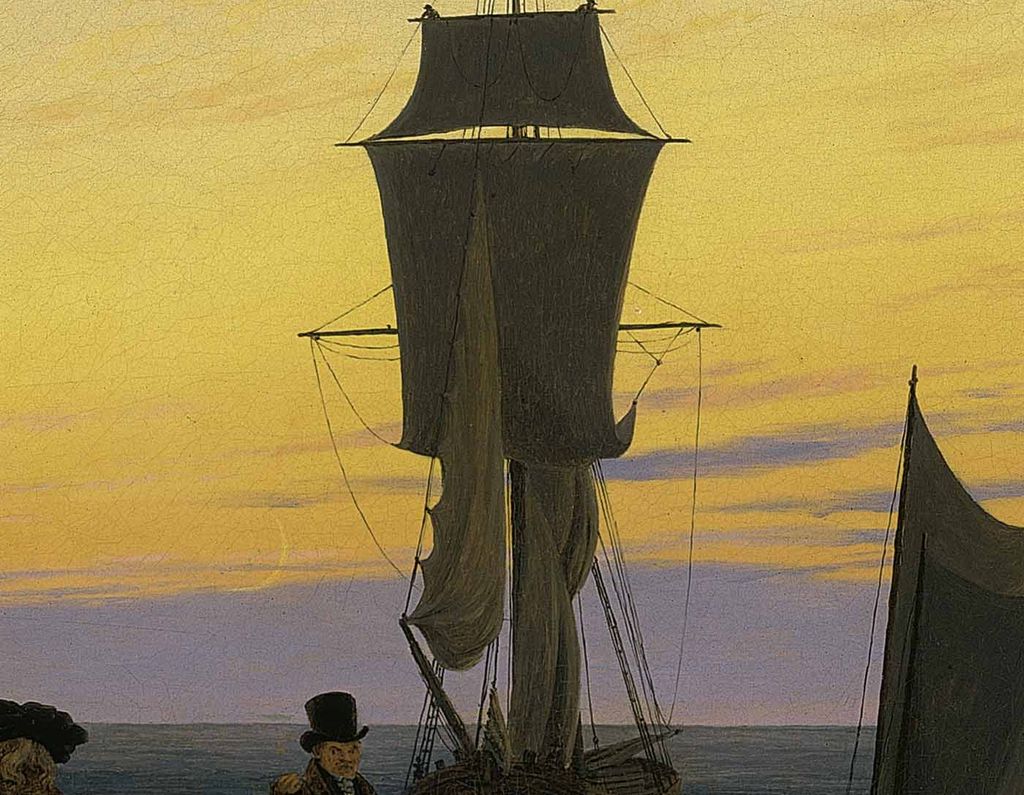
Ships near the horizon
Two distant sailing ships stand in the pale interval between the water and the clouds.
The shore and small craft
Ropes, upright spars and a basket-like form occupy the rough ground at the lower left.
Frequently Asked Questions
Discussion
Reader insights are welcome, especially close-looking observations about how the figures, ships, shore and sky create a meditation on time.
Reader Insights
Where does the painting make time visible without narration?
How do the ships change the meaning of the figures on shore?
Which figure readings feel persuasive, and which need more evidence?
Does The Stages of Life feel more like a family memory, a religious meditation, or a visual structure for time?
Join the Conversation
Share a source-grounded close reading of the figures, ships or horizon.
References
- Jan Nicolaisen, Museum der bildenden Künste Leipzig, Lebensstufen, current collection record and essay, G 1217, around 1834.
- Friedrich anniversary project, The Stages of Life, around 1835, listed as G 5161.
- Metropolitan Museum of Art, Caspar David Friedrich: The Soul of Nature, exhibition labels, 2025, p. 27, The Stages of Life.
- Helmut Börsch-Supan, “Zur Deutung der Kunst Caspar David Friedrichs”, Münchner Jahrbuch der bildenden Kunst 27 (1976), pp. 199–222, especially p. 214.
- Peter Prange, Hamburger Kunsthalle, Frühling (Folge: Die Lebensalter, Blatt 2), catalogue essay, inv. 41121.
- Staatliche Museen zu Berlin and the Friedrich anniversary project, Caspar David Friedrich and the German Centenary Exhibition of 1906, sections 4–5 and installation photograph.
- Museum der bildenden Künste Leipzig, Caspar David Friedrich und die Düsseldorfer Romantiker, exhibition archive, 9 October 2021–9 January 2022.
- Peter Prange, Schiffsstudien, Hamburger Kunsthalle, inv. 41124, on the proposed and subsequently rejected connection to the Leipzig oil.
- Alte Nationalgalerie, Greifswald Harbor, A II 356, comparison of the harbour and its vessels.
- Friedrich anniversary chronicle, Seashore by Moonlight, on the Sassnitz study and the painted foreground.


