



 by Tom Gurney
Tom Gurney BSc (Hons) is an art history expert with over 20 years experience
Published on June 19, 2020 / Updated on October 14, 2023
Email: tomgurney1@gmail.com / Phone: +44 7429 011000
Caspar David Friedrich Drawings: Introduction
On a page of his Karlsruhe Sketchbook, Caspar David Friedrich drew a fir tree with enough care to distinguish its needles. More than three weeks later, he turned the little book around and used the facing page to sketch a view across the countryside. The tree and the view sit beside each other, drawn at different speeds and from different distances. A finished drawing such as View of Arkona with Rising Moon, a metre wide, asks for a different kind of attention. Its dark headland and small boats hold their places across a long stretch of shore and water, and the rising moon gives the whole sheet a common light. [1][2]
Friedrich used drawing to record what he saw on walks around Dresden and farther afield. He also made large, finished works on paper for exhibition, and these helped establish his reputation before his major oil paintings. In the 1830s he was still finding new uses for pencil and brown wash. The surviving works give us several ways to follow his eye, from the edge of a leaf or a boulder to the position of a figure in a landscape and the gradual disappearance of detail at dusk. [1][3]
At a Glance
- Media · Graphite, watercolour, ink and sepia wash
- Sketchbook example · The Karlsruhe Sketchbook, 1804
- Finished drawing example · Eastern Coast of Rügen with Shepherd, 1805–06
Contents
- Introduction
- How Friedrich filled a sketchbook
- What a mountain study records
- When a drawing became a picture for exhibition
- How long an observation could stay in use
- What the back of a sheet can tell us
- How a figure moved from paper to canvas
- Looking closely at a late wash
How Friedrich filled a sketchbook
Friedrich was working on this habit of close observation by 1799, soon after he settled in Dresden. In an early sketchbook now disbound, he drew the crowns of two pines with small strokes and hooks, leaving enough space between the marks for the foliage to read as open. He added a note beside each trunk to indicate that the trees stood at a distance. The annotations preserve something about his own position, while the abbreviated lines suggest how much of the crowns he could see from there. Below the trees Friedrich drew washing on a line. A few loose strokes give the hanging shirt its folds. On the same page, he could observe how the outline of a distant tree breaks up and how a piece of cloth hangs much closer at hand. [3][4]
The names of the surviving books can be misleading as place names. The Karlsruhe Sketchbook owes its name to the family in Karlsruhe that once owned it. Its drawings were made chiefly around Dresden between April and June 1804. At 18.4 by 11.8 centimetres the book was small enough to carry on a walk, and 33 of its pages contain drawings. In 2024 the prints and drawings collections in Berlin, Dresden and Weimar acquired it jointly with the Ernst von Siemens Kunststiftung. Six sketchbooks survive in their bindings, including four in Oslo, and many other sheets are now dispersed. [1][4][5]
The fir-tree opening shows what a surviving binding can tell us. The detailed tree is dated 5 May. The later view across the facing page runs in the opposite direction, so that turning the book to read one study makes the other appear upside down. The Met’s curators also identify a cluster of slender trees and a dandelion in the space beneath the fir, probably added around the time of the landscape sketch. A sequence of encounters emerges from an opening that could look like a single session if each little drawing were viewed in isolation. The Dresden Sketchbook, kept at Dresden’s Kupferstich-Kabinett, spans the years 1807–12. Beside the concentrated weeks recorded in the Karlsruhe book, it shows how differently the period covered by a bound volume could vary. [1][6]
What a mountain study records
In July 1810 Friedrich walked through the Riesengebirge, or Giant Mountains, with the painter Georg Friedrich Kersting. Hamburg’s Two Studies with Rocks and Trees, made on 12 July, holds two views in opposite orientations on the same sheet. Turn the drawing around and the lower study comes into its own. In the other view a tiny figure sits high on a boulder. The Met identifies him tentatively as Kersting. His size is enough to make the height of the rocks legible, even where Friedrich has left the vegetation only lightly indicated. [1][7]
The sheet also retains tests of colour in its corners. Friedrich used watercolour outdoors to capture how the rocks were lit and added regular parallel strokes over the washes to describe their structure. Looking from a pale plane of stone to a shaded face, you can see the respective work of the wash and the strokes. The wash establishes the broad difference between light and shade. The strokes bring out the way the rock breaks and changes direction. The open spaces around the studies let the eye follow those decisions without having to read a continuous landscape. [7]
On some other sheets, Friedrich indicated his eye level with a mark along the horizon. He sometimes numbered successive mountain ridges to record their relation to one another. An outline alone might tell you which ridge rises in front of the next. The numbering makes the recession explicit even where the pencil gives each ridge much the same weight. In the Hamburg sheet the small figure supplies a measure of scale. In a view without a figure, the marks for horizon and distance can tell us where Friedrich placed himself in relation to the land. [4][7][8]
When a drawing became a picture for exhibition
A rock arch in the Uttewalder Grund, a gorge in Saxon Switzerland, offers a comparison within drawing itself. Friedrich recorded the formation on 28 August 1800. The study survives at the Kunsthalle Mannheim. In a larger sepia of about 1801, now in Museum Folkwang, Essen, he retained the heavy rock across the passage and added two figures beneath it. Their arms draw attention to the walls that close in around them. The small gesture makes the space readable as somewhere a person can stop, look up and measure the rock against their own body. Friedrich moved from a study of a specific formation to a finished picture in which the act of looking belongs to the scene. [9]
In Friedrich’s finished sepias, brown ink applied with a brush could produce a wide range of tones, from dark silhouettes to pale washes across paper. Two drawings that Weimar keeps from the 1805 competition associated with Goethe show the ambitions of the medium. The collection describes both Pilgrimage at Sunset and Autumn Evening by the Lake as grey-brown brushwork over graphite. The underlying pencil and the wash served different purposes. Pencil could establish the positions and contours of forms, while broad passages of wash could bring the forms together under the light of a particular hour. Recognition for the two drawings helped bring Friedrich to public attention. [10][11][12]
The coastal works show how much he could vary within that approach. In the Albertina’s View of Arkona with Rising Moon (about 1805–06), the fence above the shore and the boats offer traces of activity on a coast without figures. Follow the pale reflections from the moon towards the foreground and the spaces between the darker forms become easier to read. At the Dresden Academy exhibition in 1806, critics took notice of precisely this handling of moonlight and water. The picture also circulated through an aquatint by Benedikt Piringer, published in 1809. The Albertina preserves the drawing and identifies Piringer as the maker of the later print. [1][2]
The Met’s Eastern Coast of Rügen with Shepherd (1805–06) is almost as wide as the Arkona sheet. It puts much of its incident along the bottom of the paper and leaves a great expanse of sky above. Within that low band a shepherd leans on his crook, his head lowered, with sheep and a dog nearby. Look from the compact group to the thin line of the distant coast and the figure seems to occupy a small piece of an enormous view. The Met records opaque white watercolour as well as brown ink and wash over graphite. These two large drawings make room for solitude in different ways, through the light on an unpeopled shore at Arkona and through a single person’s absorption on the eastern coast. [1][2][13]
How long an observation could stay in use
In 1804 Friedrich drew around the Elbe floodplain west of Dresden, including views of avenues, slopes and the river. In The Grosse Gehege near Dresden (1832), a boat under a square sail is easy to miss amid the broad sky and the reflective patches of the flooded ground. The boat and the rhythm of the trees have counterparts in the small Karlsruhe Sketchbook. Seen alongside the painting, the book makes a gap of almost three decades visible. Friedrich had preserved particular things worth drawing, including how a sail sat on a boat and how a row of trees receded. In the painting those details are subordinate to the expanse around them, yet they give the eye a way to judge how far across the flooded ground it is looking. [5][14]
He also returned to old drawings when making new works on paper. In Dresden’s Stony Beach with Anchor and Half-Moon (about 1835–37), the section of shore goes back to a view he drew near Ruschvitz on Rügen in 1818. A dark anchor on the gravel makes a close foreground detail out of an otherwise open view. Farther back, rocks of different sizes sit between the viewer and the water, where the light from the crescent gathers at the right. The old study supplied part of a coast that Friedrich could now draw as it appeared under a moon. [15]
What the back of a sheet can tell us
A drawing catalogued as a separate object may have begun as one page of a book. Petra Kuhlmann-Hodick and Johanna Ziegler point to the large number of surviving sheets drawn on both sides in their Dresden exhibition catalogue. They estimate that roughly half of Friedrich's surviving drawings may have come from sketchbooks. The first Berlin sketchbook, which dates to 1799, is now disbound. Its pages can be examined as individual objects, while their original relationship helps recover the sequence in which Friedrich encountered and recorded his subjects.[4][17]
One sheet from that book shows the foliage of two pines. The catalogue describes the small hooked marks Friedrich used to record the trees' open contours and identifies one pine again in the 1807 View over the Elbe Valley. It occupies the left edge in both, at a distance. The brevity of the marks is part of their usefulness. They let Friedrich record where the tree lets the sky through without having to draw a separate outline for every cluster of needles. The position in the later oil gives this small observation a particular task. A tree partly cut off by the edge of the canvas can suggest that the landscape continues to the side of the view.[17]
The bound Karlsruhe book preserves relationships between drawings that are harder to recover from loose sheets. Berlin's account dates the work in it to April through June 1804, around Dresden. At the time of the 2024 joint acquisition by Berlin, Dresden and Weimar, the institutions recorded four surviving books in Oslo and one in Dresden besides this one. Those surviving volumes are only part of the evidence for Friedrich's sketchbook practice. The loose sheets and the marks on their reverse sides are also part of the record.[5][17][18]
How a figure moved from paper to canvas
The Berlin Kupferstichkabinett holds a small study on tracing paper of a seated man seen partly from behind, leaning forward to the left. The Nationalgalerie connects it with Moonrise over the Sea, where the man's body forms part of a group of three people looking towards the ships. The sheet records a pose in a compact set of contours. The painting gives those contours a position on the rocks and a relationship to two other figures, the horizon and the light on the water.[19][20]
The direction of that transfer was once disputed. Some scholars understood the tracing sheets as records taken from the finished oils. The Nationalgalerie's 2024 exhibition explained how infrared reflectography made contours beneath the paint visible and how traces on the backs of some sheets helped show that Friedrich had used a stylus to transfer outlines onto primed canvas. The procedure explains how the position of a shoulder or the bend of a knee could be established before the paint gave the figure clothing, colour and weight.[19]
For Man and Woman Contemplating the Moon, the drawing identifies the woman through the turn of her head and body. In the oil, the extended arm is given a destination at the man's shoulder. The surrounding dark cape and trees make the little patch of sleeve easier to find. A tracing can account for the shape of the pose, while the relationships that make it a gesture are clearest in the finished composition. Comparing the studies with the paintings brings those distinct decisions into view.[19][20]
Looking closely at a late wash
The Louvre’s Cemetery in Moonlight with an Owl (1834) uses brown ink and wash over pencil on a sheet just 19 centimetres wide. The French sculptor David d’Angers, who owned the drawing, described the bird perched on a gravedigger’s shovel beside an open grave. Those details emerge gradually among the darker washes. The moon catches the eye sooner and gives the small scene a much greater sense of distance than the size of the sheet might suggest. In the Albertina’s closely related version, the same kind of close look reveals a vulture instead. A small change in the bird alters what a viewer might imagine happening at the grave. [1][16]
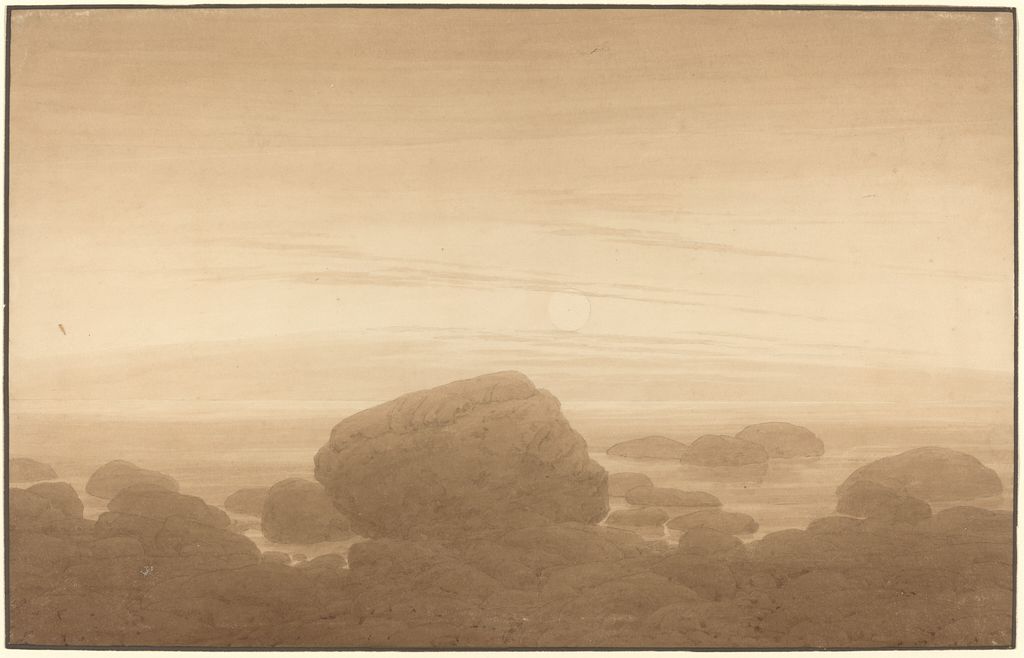
Start with the whole sheet when looking at a Friedrich drawing in a collection catalogue. In the Karlsruhe opening, the margins and the orientation of the book tell you which marks belong together. In the mountain study, the edges preserve traces of mixing and testing colour. In the Arkona wash and the Louvre cemetery, the relationships between pale and dark areas across the paper are part of the image itself. Once you have seen those relationships, a detail such as the fir’s needles, the lines on a rock face or the outline of an owl has a place in the drawing as well as a shape of its own. [1][2][7][16]
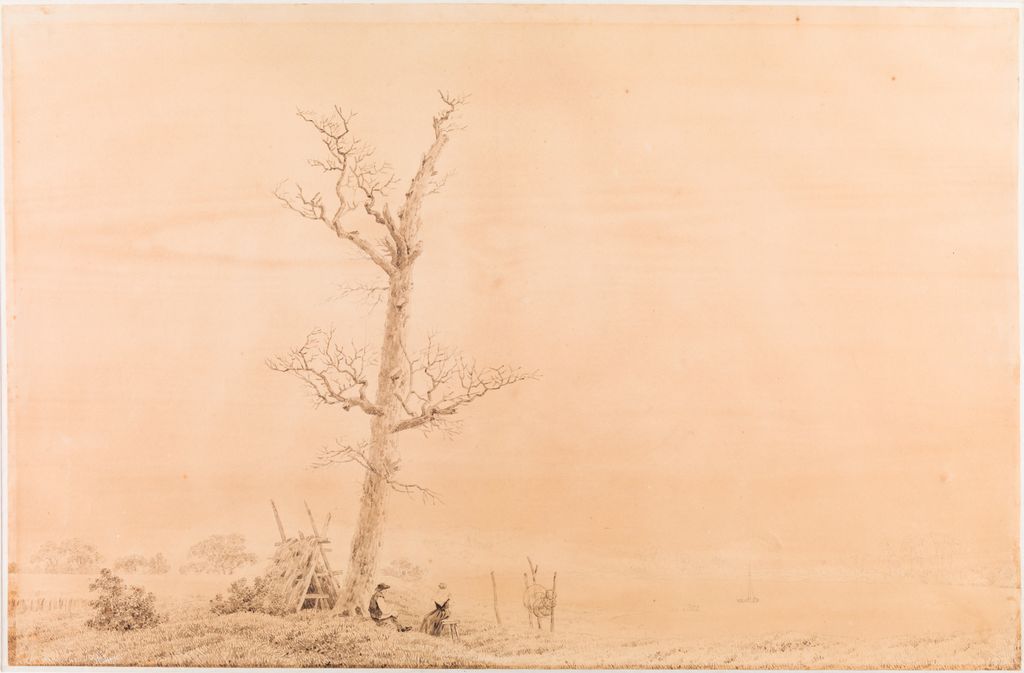
Autumn Evening by the Lake, one of the sepias Friedrich sent to Weimar in 1805. Klassik Stiftung Weimar, KK 515.
Frequently Asked Questions
Discussion
Reader insights are welcome, especially source-grounded observations about how Friedrich's drawings, sketches and studies help explain the paintings.
Reader Insights
Which kind of drawing best reveals Friedrich's working method?
How do trees, rocks or ruins change when they move from study to painting?
Where does a work on paper feel more direct than a finished oil painting?
Which Friedrich painting most clearly reveals the presence of drawing beneath or behind the finished image?
Join the Conversation
Share a source-grounded observation about Friedrich as a draughtsman.
References
- The Metropolitan Museum of Art, Caspar David Friedrich: The Soul of Nature, exhibition texts, entries for the Karlsruhe Sketchbook, the Rügen drawings, the Giant Mountains study and the Louvre cemetery. View source.
- Albertina, Vienna, Blick auf Arkona mit aufgehendem Mond, inv. 17298. View source.
- The Metropolitan Museum of Art, Caspar David Friedrich: The Soul of Nature, early works, “Breakthrough” and “The Great Beyond.” View source.
- Staatliche Kunstsammlungen Dresden, Caspar David Friedrich: Where It All Started, exhibition catalogue extract, with contributions on studies and drawing annotations by Petra Kuhlmann-Hodick, Johanna Ziegler and Werner Busch. View source.
- Stiftung Preußischer Kulturbesitz, “The ‘Karlsruhe Sketchbook’ by Caspar David Friedrich remains in Germany,” acquisition announcement and sketchbook history. View source.
- Klassik Stiftung Weimar, “Weimar zeigt erstmals das Dresdener Skizzenbuch von Caspar David Friedrich,” Dresden sketchbook date and collection. View source.
- Peter Prange, Zwei Studien mit Felsen und Bäumen (die untere um 180° gedreht), Friedrich anniversary chronicle, Hamburger Kunsthalle inv. 41100. View source.
- Hamburger Kunsthalle, Kunst für eine neue Zeit, exhibition chapter “Zeichnerische Naturstudien.” View source.
- Birgit Verwiebe, “An der Grenze der Sichtbarkeit. Verborgene Wesen und Gestalten in Bildern Caspar David Friedrichs,” Jahrbuch der Berliner Museen 65 (2024), pp. 77–78 and figs. 13–14. View source.
- Klassik Stiftung Weimar, Wallfahrt bei Sonnenuntergang, inv. KK 514. View source.
- Klassik Stiftung Weimar, Herbstabend am See, inv. KK 515. View source.
- Klassik Stiftung Weimar, Caspar David Friedrich, Goethe und die Romantik in Weimar, exhibition announcement and account of the 1805 awards. View source.
- The Metropolitan Museum of Art, Eastern Coast of Rügen with Shepherd, 2002.260. View source.
- Staatliche Kunstsammlungen Dresden and anniversary partners, Air and Light by Caspar David Friedrich, digital story on The Grosse Gehege near Dresden. View source.
- Markus Bertsch, Stony Beach with Anchor and Half-Moon, Friedrich anniversary chronicle, Dresden inv. C 1937-418. View source.
- Musée du Louvre, Le cimetière sous la lune avec un hibou, RF 35803 recto. View source.
- Petra Kuhlmann-Hodick and Johanna Ziegler, Dresden exhibition catalogue excerpt on Friedrich's drawings and sketchbooks.
- Staatliche Museen zu Berlin, Friedrich's Karlsruhe Sketchbook at the Kupferstichkabinett, 2024.
- Alte Nationalgalerie, Infinite Landscapes, gallery texts, “Outlines of Figures.”
- Staatliche Museen zu Berlin, Kupferstichkabinett, Sitzender Mann, halb vom Rücken gesehen, nach links vorgeneigt, SZ CD.Friedrich 13.