



 by Tom Gurney
Tom Gurney BSc (Hons) is an art history expert with over 20 years experience
Published on June 19, 2020 / Updated on October 14, 2023
Email: tomgurney1@gmail.com / Phone: +44 7429 011000
Hunter in the Forest: Introduction
A soldier has come as far as the edge of the trees. His helmet catches a little light, and his cloak makes a dark patch against the snow. Over his head, the conifers rise so high that some of their crowns meet the top of the canvas. Down in the foreground, a raven perches on a cut stump. A Berlin reviewer in 1814 imagined it singing the soldier's death song. Caspar David Friedrich leaves the man upright and on his feet, facing a stretch of woodland he can scarcely see into. [1][2][3]
The German title is Der Chasseur im Walde. The anniversary chronicle calls it The Chasseur in the Woods in English and dates it to around 1813. The Metropolitan Museum of Art exhibited it as The Chasseur in the Forest, dated 1813–14. Both records identify the painting as an oil on canvas in a private collection. At about 66 centimetres high and 47 wide, the canvas is modest in size. The impression of great height comes from the proportion of the trees to the figure and the small amount of sky that Friedrich leaves above them. [1][2][3]
At a Glance
- Date · ca. 1813
- Medium · Oil on canvas
- Collection · Private collection
- Dimensions · 65.7 cm high × 46.7 cm wide
Contents
- Introduction
- At the edge of the clearing
- The raven and the cut wood
- A French chasseur?
- How Friedrich built the forest
- Annotated Details
- Image Details
- A forest and a cave in the 1814 exhibition
- Two drawings from Krippen
At the edge of the clearing
The brightest stretch of snow starts near the bottom of the canvas and narrows towards the soldier. Young conifers on either side make the open ground look broader near us than it is where he stands. Their arrangement is roughly balanced, but the tips of the branches reach different distances into the snow. Some branches catch pale flecks, while the older trees beyond gather into a much darker mass. The eye can follow the pale ground inward almost as if it were a path. At the far end there are gaps between the trunks, and these give a sense of depth, but they darken quickly. None gives a clear view of where the soldier might go. [1][3]
Look up from his shoulders and the forest changes character again. The red-brown lengths of bare trunk are narrow enough to follow individually near the ground. Higher up, overlapping boughs make the trees harder to distinguish. At the top, their pointed outlines stand out again against the cold, mottled sky. The vertical format lets Friedrich carry the eye through these changes while keeping it in much the same part of the forest. The breaks between the crowns give us glimpses of the sky, while the trunks below give very little idea how far the woods extend. Michael Thimann draws attention to the way Friedrich suppresses the usual succession of planes that would carry the eye through a landscape into the distance. [1][3][4]
We stand behind the soldier, with a stretch of snow between us and his back. His small gold-coloured helmet and blue cloak make his outline legible, and the hanging sabre identifies him as armed. His shoulders face into the wood, so we can follow the direction of his attention. From farther back, however, we can take in the two flanking groups of trees, the sliver of sky and the bird behind him. The difference matters. Tadeusz J. Żuchowski argues that the viewer can contemplate the landscape in a way the soldier confronting it cannot. Friedrich lets us share the man's direction of sight while giving us room to see the predicament he is in. [1][3][5]
The raven and the cut wood
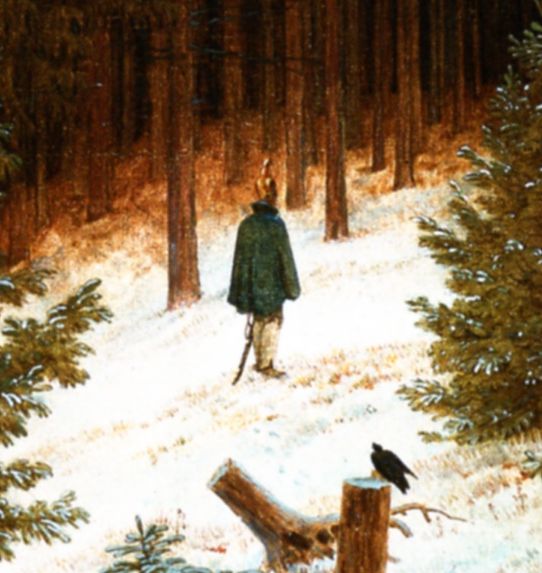
The raven sits below and a little to the right of the soldier. Its head and back make a compact dark shape where the pale ground helps to pick them out. The two cut stumps sit well forward of the standing trees. Their irregular outlines and the low growth near them break up the snow just where the opening seems widest. They also show that people have worked in this wood. Someone cut trees here, and young evergreens are growing around the clearing. That evidence of earlier activity makes the man's present solitude more conspicuous. [1][3]
Bertsch notes that viewers of Friedrich's time could associate both the raven and the cut stumps with death. In the account of the painting's first owner, Prince Malte von Putbus, the man is a rider who has already lost his horse and the raven calls out his approaching death. The horse belongs to the prince's reconstruction of what happened before this moment. On the canvas there is a man on foot, a bird on a stump and enough distance between them that we cannot tell whether he is attending to it. The prince's description gives the bird a sound and the encounter a past and a future. Friedrich lets a single small silhouette carry the suggestion of all three. [1][2][3]
A French chasseur?
Chasseur literally means hunter in French and was also used for light infantrymen or cavalrymen. Friedrich's helmeted figure, with his cloak and low-slung sabre, makes the military sense pertinent. The French identification comes into focus in the painting's early reception. In December 1814, a Vossische Zeitung reviewer of the Berlin Academy exhibition described a lone French chasseur in the snowy wood and imagined the bird singing his death song. The Met catalogue reports that the picture was shown in Berlin that October under a title it translates as Snowy Fir Forest. The exhibition title directed attention to the setting. The newspaper gave the figure an allegiance. [1][2][4]
The picture's earlier exhibition history is less secure. The Met catalogue and the anniversary chronicle place it at the patriotic exhibition that opened in Dresden on 24 March 1814, after French troops had left the city. Thimann treats the Dresden showing as probable, and the printed Dresden list describes Friedrich's landscape entries in general terms. A review of the show, published that June, praises a winter fir wood by Friedrich in which a knight makes his way into the depths. The reviewer imagines him drawn to serious contemplation by the stillness of the distance and the dead trunk in the foreground. If the Dresden review describes this painting, it shows how differently two early viewers understood the encounter. The Dresden writer reads the dead wood as an invitation to reflect. The Berlin writer hears a death song. [1][2][4][6][7][8]
Żuchowski compares the short blue cloak and Roman-style helmet with related figures in two of Friedrich's paintings from the end of the Napoleonic era. The recurring costume helps establish a family of figures across the works. His study finds that the uniform leaves the soldier's nationality unresolved. Bertsch sees good historical reasons for taking the French interpretation seriously, and Thimann also considers a reading centred on a soldier's isolation in the face of death. An audience thinking about Napoleon's defeats could see the conifers as closed ranks of defenders. The same crowding of trunks and branches makes the forest threatening even when the man's allegiance is left open. [1][4][5]
How Friedrich built the forest
The Met catalogue connects the trees to Friedrich's drawings from the summers of 1812 and 1813. A pencil study called Glade in the Fir Trees, dated 14 June 1812, has an uneven rise of trees across the sheet. In the painting the groups in the foreground are much more evenly disposed around the opening, the crowns of the mature trees are stretched upwards, and there are more closely spaced trunks. Those changes make the forest both taller and harder to see through. On a separate pencil drawing made at Krippen on 20 July 1813, Friedrich wrote an appeal for German men to prepare for renewed fighting above a group of conifers. The inscription shows how directly he could associate a stand of trees with the conflict in a work made at the time. [1][2][3][9]
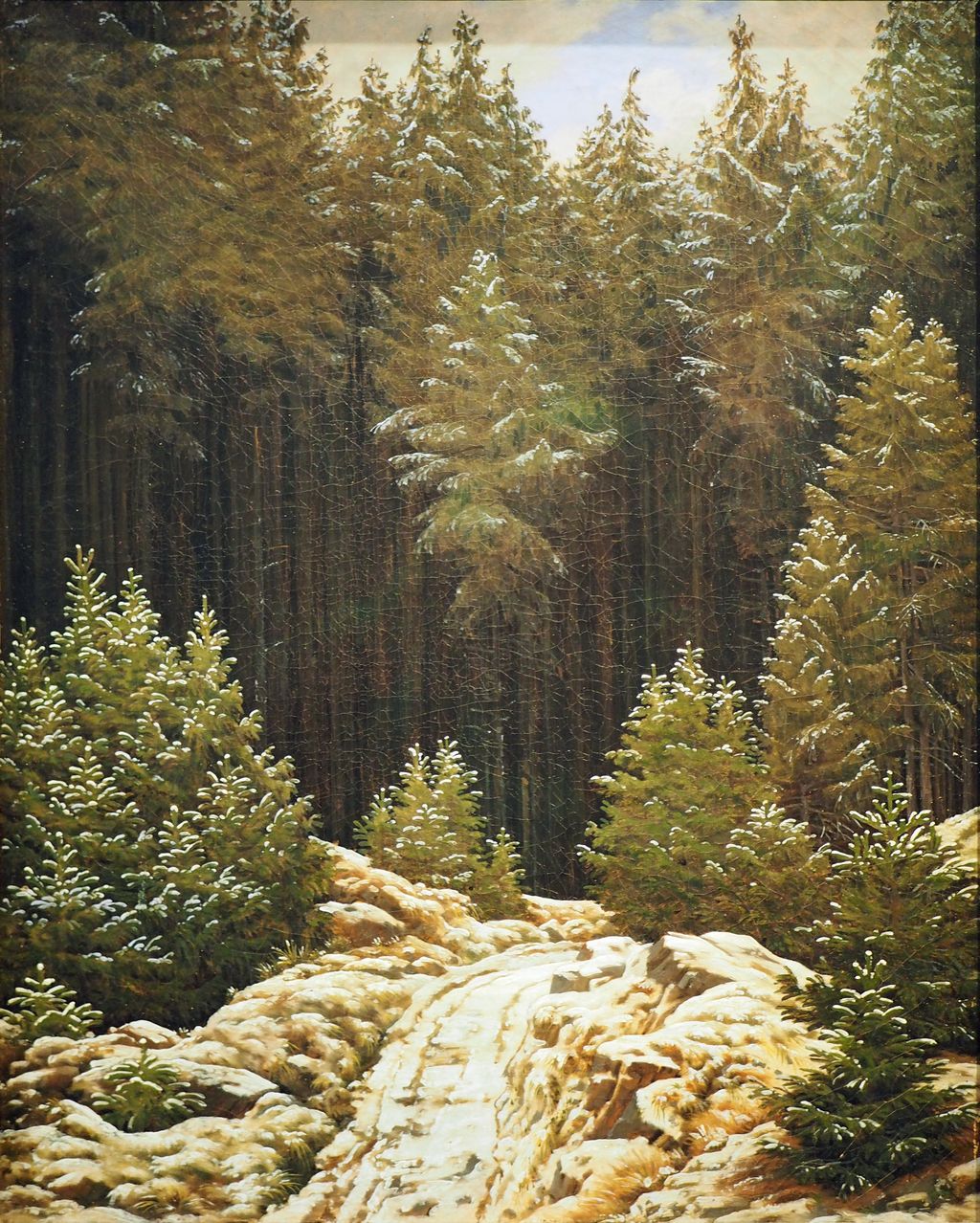
Friedrich returned to a comparable arrangement in Early Snow, painted around 1827 and now in the Hamburger Kunsthalle. The later, wider canvas again sets snowy young trees against a dense wall of taller conifers. Clara Blomeyer observes that with neither a man nor a raven to interrupt it, the gaze in Early Snow goes straight into the forest. A snow-laden tree stands out near the centre. In Hunter in the Forest, the upright soldier catches the eye at about the point where the snow leads into shadow, and the bird draws it back towards us. Between the two is the stretch of open snow that gives us a clear view of the soldier, even as his own view ends in shadow. [1][3][10]
A forest and a cave in the 1814 exhibition
The Dresden anniversary chronicle places Hunter in the Forest alongside Tombs of Those Fallen in the War of Independence at the patriotic exhibition. The pairing is instructive even with the uncertainty around the identity of the winter forest in the printed catalogue. Both paintings press dark forms against the upper part of an upright canvas. In the Tombs, a rock face fills that part of the picture and opens into a cave. The forest canvas gives the same area to upright trunks and overlapping branches. The cave has an entrance, and the two helmeted figures there give its size some definition. In the forest there is a succession of gaps between trunks, each promising less of a view than the one before it.[1][4][6][7][11]
Markus Bertsch traces the cave to Friedrich's studies from a walk in the Harz in 1811. The artist added graves and inscriptions, including the name of Arminius, the Cheruscan leader who defeated Roman forces in the Teutoburg Forest. Bertsch points out a small snake in the colours of the French tricolour on the tomb and reads it alongside the ancient name as a reference to the Napoleonic occupation. The cave painting therefore gives the viewer details that can connect the scene to a particular historical analogy. The evidence for the forest painting's political associations lies more in the exhibition context, the contemporary descriptions and the artist's drawings. The military figure contributes to the comparison, but the two pictures offer different ways of connecting that figure to the conflict.[1][4][7][11]
The titles under which the forest circulated also affect the encounter. A title that names snowy firs invites attention to the landscape before the small man comes into focus. Der Chasseur im Walde tells us to look for a soldier before we have even seen the painting. The English Hunter in the Forest can suggest a civilian pursuit to a reader encountering the work for the first time. The blue cloak, helmet and sabre explain the historical military usage of chasseur, while the Berlin review shows how quickly a contemporary viewer could go from identifying a soldier to giving him a nationality and a fate.[1][2][4]
Two drawings from Krippen
Friedrich's dated studies make it possible to set the inscribed woodland sheet beside another piece of work done at Krippen. On 19 July 1813 he drew a quarry, using watercolour over pencil. The following day's woodland sheet in Dresden is much smaller, only 111 by 58 millimetres, and uses pencil. The quarry sheet concentrates on the forms exposed in the rock. The woodland drawing has room for a group of trees and for words addressed to men who might take up arms. The proximity in place and date shows how closely sustained attention to local forms could coexist with a direct political statement.[1][9][12]
The oil painting lets us see what can happen when that statement stays on paper and the trees move into a larger composition. In the little Krippen drawing, the trees form a compact group that the writing can address or accompany. In the oil, a viewer has to move visually through several registers of growth. The youngest conifers stand at the edges of the clearing, the older ones crowd close behind the soldier, and the highest crowns are far above him. The trees can suggest closed ranks because their trunks are repeated at close intervals. They remain irregular enough that the eye keeps trying to find a way between them. The pressure of the image depends on that repeated attempt and on how quickly each possible opening gives way to darkness.[1][2][3][9]
The two studies from Krippen and the cave painting also show the limits of using one species or one setting as a fixed political sign. A rock face becomes the site of an invented tomb when Friedrich adds a name and other details. A cluster of conifers acquires a topical charge when he writes above it. The painted forest leaves the historical connections to be assembled from what the viewer can see and what the audience knew about the years of war. That is part of the reason the snow and dark trunks can sustain the painting's sense of danger even for someone who first encounters it under the English title.[1][4][9][11][12]
Annotated Details from Hunter in the Forest
Use the numbered details to trace the forms and light in this work.
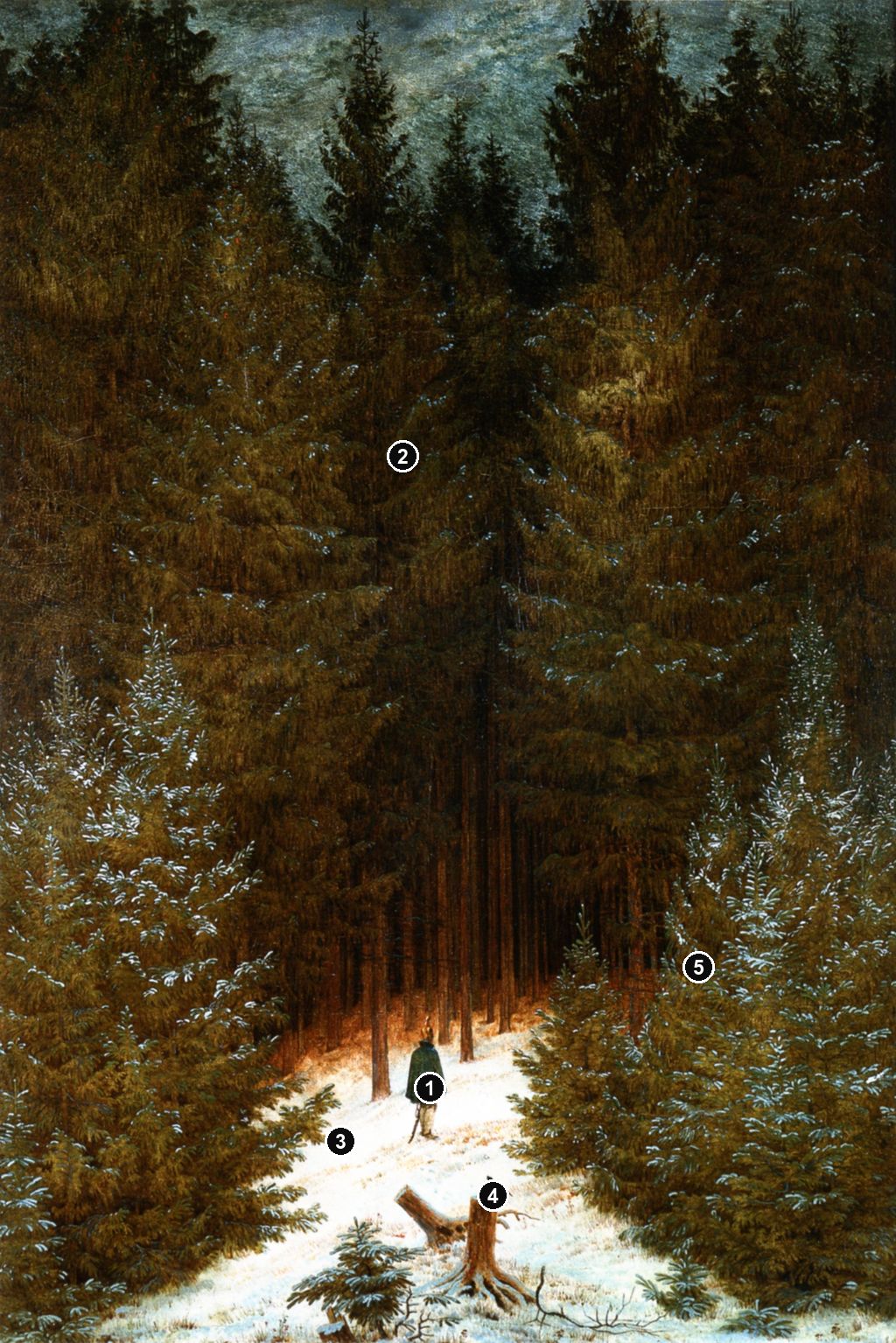
Details from HUNTER IN THE FOREST
The detail crops show parts of the work at a larger scale.
The solitary soldier
The soldier stands in a small opening with his back to us and the forest ahead.
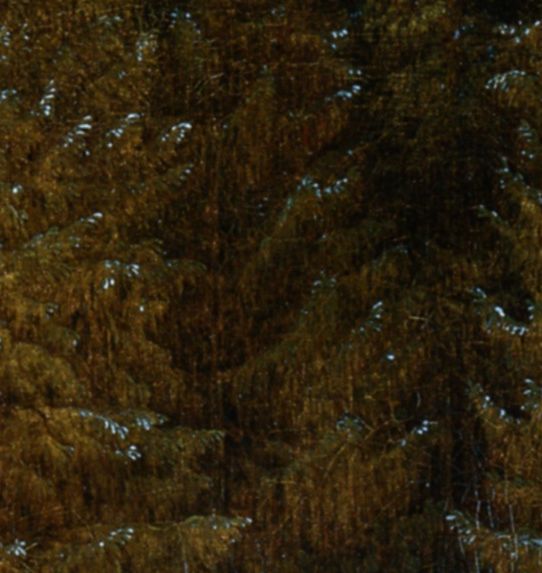
The wall of firs
Tall evergreens fill most of the canvas. Only a narrow opening remains above them.
The snowlit clearing
A wedge of snow separates the nearest branches and the dark ranks of trunks beyond.
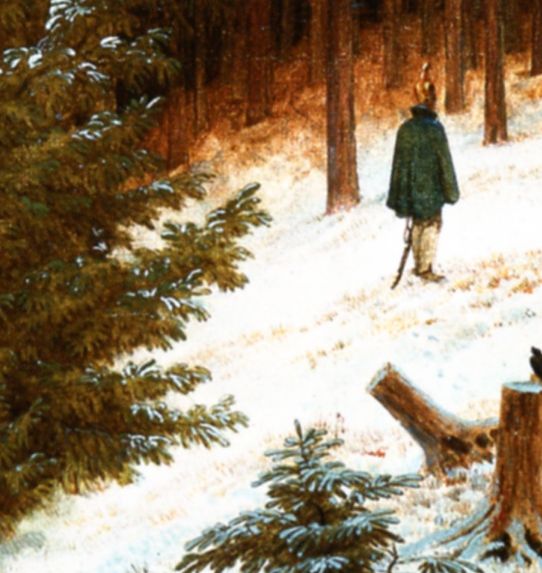
The bird on the stump
A dark bird perches above the cut surface of a stump near the front of the clearing.
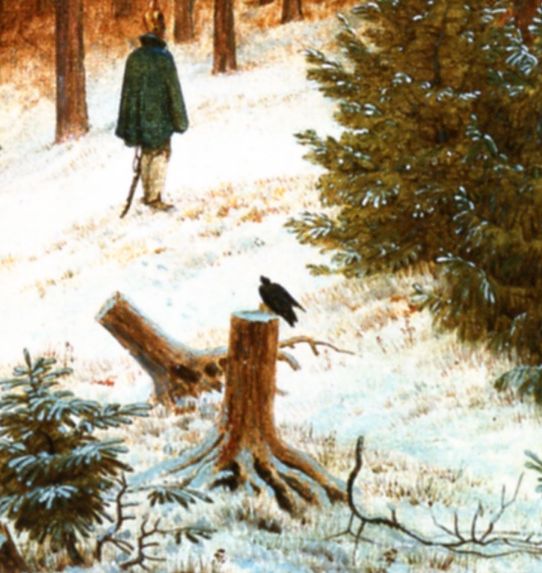
Snow on the low branches
Small patches of snow pick out the near branches, contrasting with the darkness deeper in the forest.
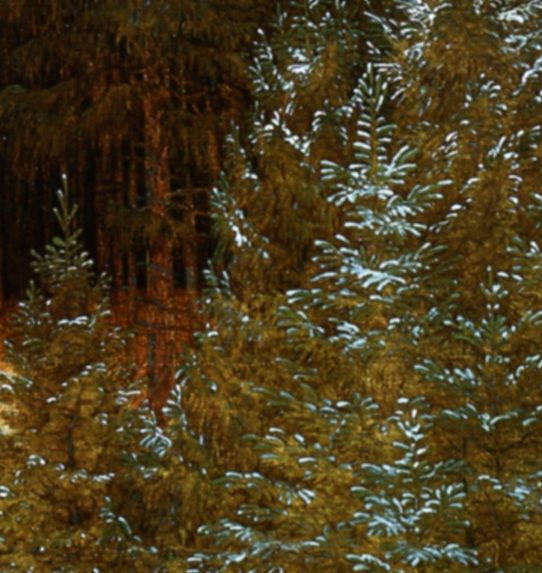
Frequently Asked Questions
Discussion
Reader insights are welcome, especially source-grounded observations about how the soldier, forest, snow, raven and political context shape the painting.
Reader Insights
How does the back-turned soldier change the viewer's place in the scene?
Where does the forest feel like shelter, and where does it become a barrier?
How much does the Napoleonic setting affect the way you see the painting?
Does Hunter in the Forest feel most powerful as a military image, a forest image, or a study of isolation?
Join the Conversation
Share a source-grounded close reading of the chasseur, the snow-dusted trees, the raven, the cut stumps or the relationship to Early Snow.
References
- Markus Bertsch, Der Chasseur im Walde, in Caspar David Friedrich. Kunst für eine neue Zeit, p. 174, including notes 1–8. German anniversary essay and English version
- Alison Hokanson, cat. 35, “The Chasseur in the Forest,” in Caspar David Friedrich: The Soul of Nature, The Metropolitan Museum of Art, 2025, pp. 172–73 and notes 1–3, with cat. 31 for the 1812 drawing. Met publication record
- The Metropolitan Museum of Art, Caspar David Friedrich: The Soul of Nature, exhibition checklist and reproductions, 2025. Exhibition objects
- Michael Thimann, “Bilder aus eiserner Zeit,” in Napoleon und Europa. Traum und Trauma, 2010, pp. 130–32, fig. 9 and notes 38–39. Heidelberg University Library
- Tadeusz J. Żuchowski, “The Paintings by Caspar David Friedrich with the Figure of the so-called Chasseur,” Artibus et Historiae 83, 2021, pp. 361–85. Journal abstract
- Royal Saxon Academy of Arts, exhibition catalogue of 24 March 1814, pp. 25 and 27, entries 288 and 328. Digitised catalogue transcription with facsimile links
- Friedrich anniversary chronicle, The Chasseur in the Forest and Tombs of Those Fallen in the War of Independence at the 1814 patriotic exhibition. Dresden exhibition entry
- “Kunst. Die Kunstausstellung in Dresden, am 24. März 1814,” Journal für Literatur, Kunst, Luxus und Mode, June 1814, pp. 360–61. Thuringian University and State Library digitisation, p. 360 and p. 361
- Staatliche Kunstsammlungen Dresden, Kupferstich-Kabinett, Wald. Krippen 1813, C 1919-87. Anniversary drawing record
- Clara Blomeyer, “Early Snow,” in Caspar David Friedrich. Kunst für eine neue Zeit, p. 180, Hamburger Kunsthalle HK-1057. Anniversary object essay
- Markus Bertsch, Tombs of Those Fallen in the War of Independence (Tombs of the Ancient Heroes), Hamburg exhibition catalogue, 2023, pp. 168–71.
- Staatliche Museen zu Berlin, Kupferstichkabinett, Steinbruch bei Krippen, 19 July 1813, SZ CD.Friedrich 18.


