



 by Tom Gurney
Tom Gurney BSc (Hons) is an art history expert with over 20 years experience
Published on June 19, 2020 / Updated on October 14, 2023
Email: tomgurney1@gmail.com / Phone: +44 7429 011000
Mountain Landscape with Rainbow: Introduction
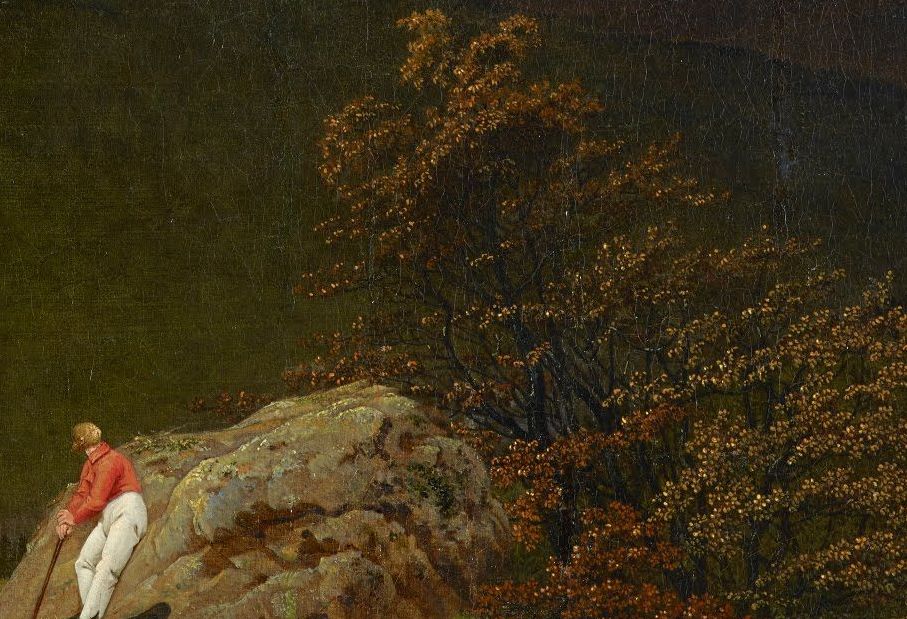
A black top hat lies in the grass beside a man in white trousers and a red jacket. He leans against a boulder with his walking stick planted at an angle, looking across a valley that is already hard to make out. Above him a pale rainbow stretches almost from edge to edge. In Caspar David Friedrich’s Mountain Landscape with Rainbow, the clothes and the grass catch enough light to be seen clearly, while the far mountain is little more than a silhouette. Museum Folkwang in Essen dates the painting to 1809/10. [1][2]
At a Glance
- Artist — Caspar David Friedrich
- German title — Gebirgslandschaft mit Regenbogen. [1]
- Date and medium — 1809/10, oil on canvas. [1]
- Dimensions — 69 cm high × 102 cm wide. [1][3]
- Collection — Museum Folkwang, Essen, inventory G 46. [1]
Contents
- Introduction
- Where the walker stops
- The Rosenberg from a pencil study
- A rainbow in low light
- The second rainbow painting
- The Hirschland collection and restitution
- When the arc became a path
- Annotated Details
- Image Details
- The same mountain without the walker
- Seeing the cliff edge and the arc at different scales
- The monitors in Rosenbach's performance
Where the walker stops
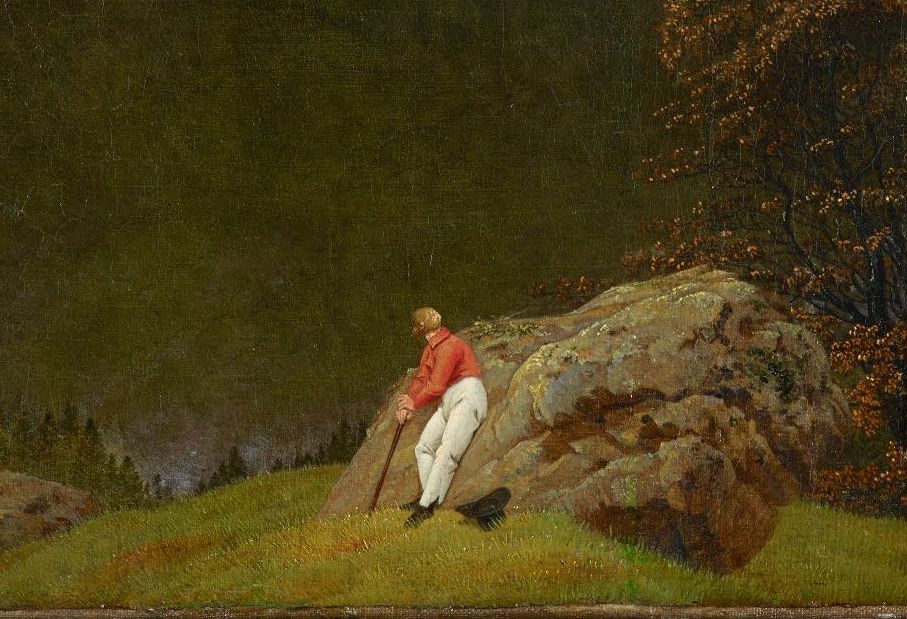
The walker has paused on a small grassy rise. His upper body rests against the stone, his knees bend, and the stick reaches down towards the lower ground on his left. The hat beside his shoes makes this look like a break in a journey. Friedrich leaves it on its side, close enough to the man to seem something he will pick up when he moves on. The top hat and fitted clothes led Markus Bertsch, writing for the Hamburger Kunsthalle’s Friedrich exhibition, to identify the walker as a townsman. There is no settlement in sight. His clothes carry that part of his story into the mountains. [1][2]
We see the angle of the man’s body better than the direction of his gaze. His legs and jacket turn partly towards us while his head turns away. Art historian Akane Sugiyama discusses him as a Rückenfigur, a figure seen from behind who helps establish the space of a picture. Here the angle of the shoulders leaves the face largely out of view. We can follow the turn of his head into the distance and still wonder where his attention has settled. The fog is down below, the mountain is directly across the valley, and the rainbow is high above both. [2][4]
Folkwang identifies the walker as a self-portrait, an interpretation Bertsch traces to earlier Friedrich scholarship. With the face turned away, the identification rests on more than a resemblance a viewer could recognise. The red jacket and white trousers draw the eye to the man, who stands just to the right of the painting’s vertical axis. The peak above him occupies the centre. From the man’s head to the summit, the eye crosses the slope and the space beyond it at an angle. [1][2][4]
Dark treetops are easiest to pick out near the foot of the valley, where a little mist shows between the walker’s rock and the far slope. The ground drops so steeply from the foreground that there is no visible route from the boulder to the mountain. Sugiyama draws attention to how the painting alternates between depth and flatness. The turn of the walker’s head and the layers of hills invite the eye into the distance, while the great arc can also be seen as a line drawn across the surface. It is hard to judge how far away the bow is, yet its sweep is immediately legible. [1][2][4]
The Rosenberg from a pencil study
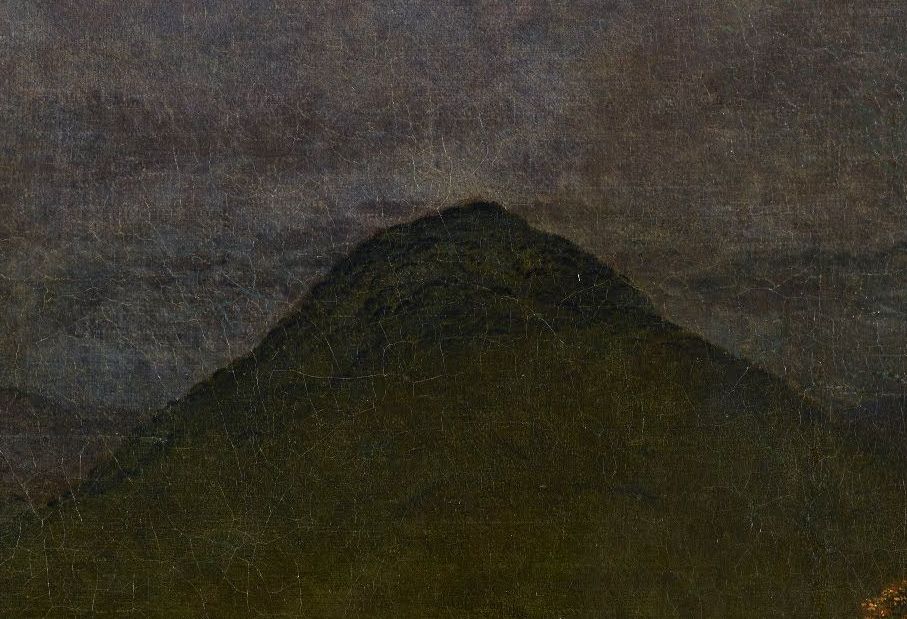
The distant peak has a source in Friedrich’s field drawings. On 12 May 1808 he studied the Rosenberg in Bohemian Switzerland. The sheet of Landscape Studies, dated 9 and 12 May and held by Dresden’s Kupferstich-Kabinett, carries four views. In the exhibition catalogue Bertsch identifies the second from the top as the closest match to the painting. It shows the Rosenberg from the Großer Winterberg. Friedrich marked the mountain with an instruction to make it taller. Bertsch suggests he may already have been considering how to give the summit greater emphasis in a painting. [2][5]
The drawn contour survives in the painted peak, rounded at the top and falling away on both sides. In the oil the summit rises high above the low ridges beside it. Its position at the crossing of the canvas diagonals gives it a fixed place in a view whose distances are hard to judge. The pencil study supplies a profile. The painting uses the space around that profile, especially the gap above the summit, to make its height register against the curve of the rainbow. [1][2]
The same Dresden sheet appears in the Hamburger Kunsthalle’s account of the later Wanderer above the Sea of Fog, where it is compared to a conical mountain to the left of the figure’s head. The two paintings assign different positions to the mountain and the man. In the later vertical canvas the walker fills much of the centre above the fog. In Essen, the small man leans near the bottom of a wide canvas, and the mountain holds the middle. The drawings gave Friedrich forms he could return to as he worked out a different arrangement for each scene. [1][5]
A rainbow in low light
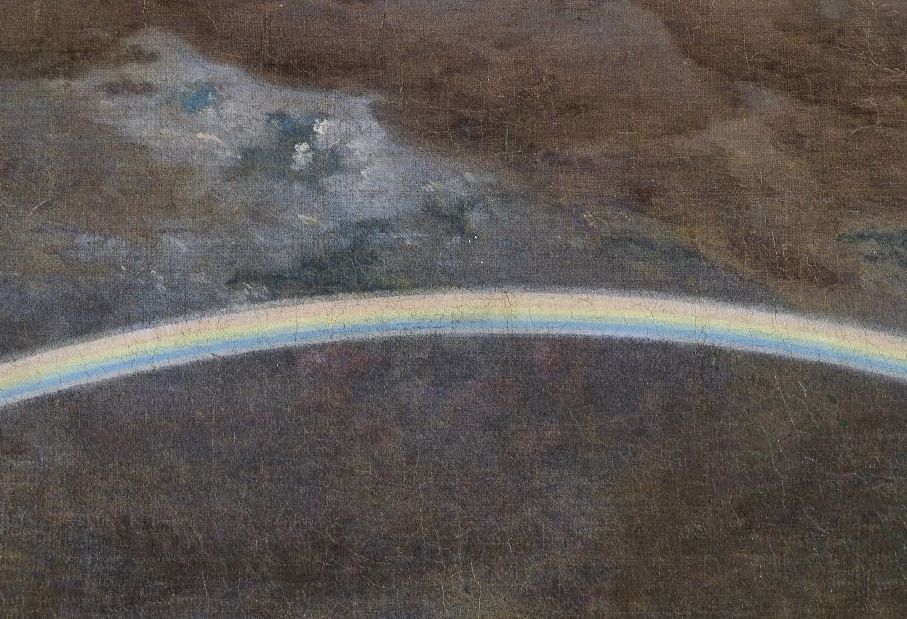
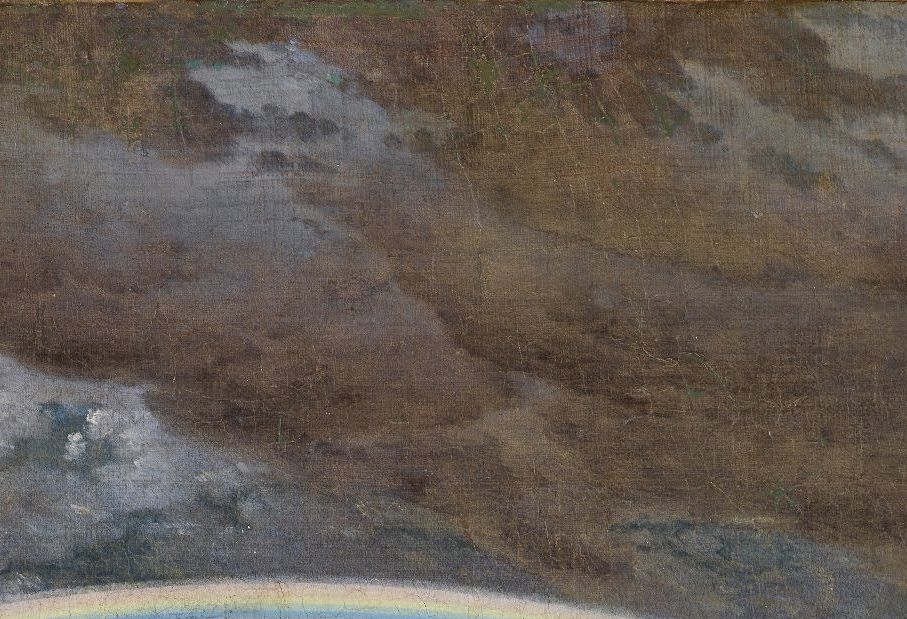
In the Essen painting, bands of blue and yellow are visible in the pale arc, especially where it passes above the summit. Its ends fade into the dark towards the sides. A break in the cloud above and to the left of the arc’s highest point looks silvery. Bertsch reads this as the shimmer of the moon and suggests that the bow could be lunar. He also singles out the bright patch around the walker, whose concentrated light seems to come from somewhere outside the frame. The jacket, trousers and boulder have a clarity that the higher sky and the opposite slopes lack. [1][2]
A lunar rainbow can look very pale because moonlight is weak. Its geometry follows the same rule as a solar rainbow. The observer sees the bow in the part of the sky opposite the light source. If the brightness above the painted arc indicates the moon’s position, that same moon would be in the wrong part of the sky to produce the bow as seen from the foreground. Sugiyama notes that the bright opening shows no clearly defined moon or sun and records an older proposal that a low sun could have lit the bow against a storm-dark sky. That reading too leaves the separate patches of light to be explained. [2][4][6]
Helmut Börsch-Supan thought the painting might have begun as a nocturne, with Friedrich adding the rainbow over the dark sky. He connected the possible earlier state to a description of a moonlit landscape in an 1809 letter by Helene von Kügelgen. Both the identification of the picture in the letter and the sequence of painting are proposals. In his account of the finished work, Börsch-Supan reads the bow as a sign of peace between humanity and God, and the hat on the ground as a gesture of humility. The interpretation takes seriously the two scales Friedrich brings together. A small act of uncovering the head can have a devotional meaning when set against an arc that spans the whole landscape. [7]
The second rainbow painting
Friedrich also painted Rügen Landscape with Rainbow (Shepherd’s Lament) around 1809–10. The Klassik Stiftung Weimar lists the canvas as lost, and Folkwang records it as missing since 1945. Its subject is associated with Goethe’s poem Schäfers Klagelied. Folkwang discusses it alongside the Essen canvas as a pair, and Börsch-Supan proposed that the mountain scene may have answered the Rügen painting. Sugiyama notes that Duke August of Saxe-Gotha-Altenburg referred to Friedrich’s rainbows in letters to the painter Therese aus dem Winckel. The wording leaves room for doubt about which picture drew the duke’s criticism. [1][4][7][8]
The Hirschland collection and restitution
Folkwang’s provenance entry tentatively places the canvas in the possession of the grand duke of Weimar from about 1810 and suggests that Goethe may have acquired it for Karl August. Its more detailed modern record places the work in the Essen collection of Georg Hirschland from 1932 and in Museum Folkwang’s custody as a deposit from November 1938. Hirschland was a Jewish banker and had helped build the museum through the Folkwang-Museumsverein. The museum acquired the work on 1 April 1939, in a forced transfer under Nazi persecution, with support from the City of Essen and the local Nazi Party leadership. [1][4][9]
Folkwang records restitution and a settlement with Hirschland’s heirs in 1950. The family then transferred the canvas to the museum as Georg Hirschland’s legacy. The Folkwang-Museumsverein describes how his widow Elsbeth gave six significant works in his memory, including this painting. The dates are specific to the objects. Another Friedrich from the Hirschland collection, Tree of Crows, was also sold under duress to Folkwang in 1939. The Louvre records that painting’s return to the family in the United States in 1946 and its eventual purchase by the Louvre in 1975. [1][9][10]
When the arc became a path
In 1979 Ulrike Rosenbach made the arc into a route for a performance at Museum Folkwang. For Die einsame Spaziergängerin (The Lonely Walker), she placed a greatly enlarged black-and-white reproduction on the floor and walked along the curve. Rosenbach later recalled the painting’s stillness and said she used its composition to plan the movement. The man in the red jacket has stopped walking by the time we see him. Rosenbach gives that movement back to the scene, tracing with her own steps the line that, in Friedrich’s landscape, hangs far beyond the man’s reach. [2][11]
The same mountain without the walker
The Städel identifies the Rosenberg as the motif of its late Mountains in the Rising Fog. The comparison gives us a third context for a form already familiar from the preparatory sheet and the Wanderer. At the Städel the mountain belongs to a range of shapes beyond a foreground ridge. The ridge extends across the view and gives the eye a relatively continuous surface to look beyond. At Essen the foreground comes to a much more local prominence around the walker. The opposite peak stands above a larger break in the terrain as seen from that small place.[2] [12]
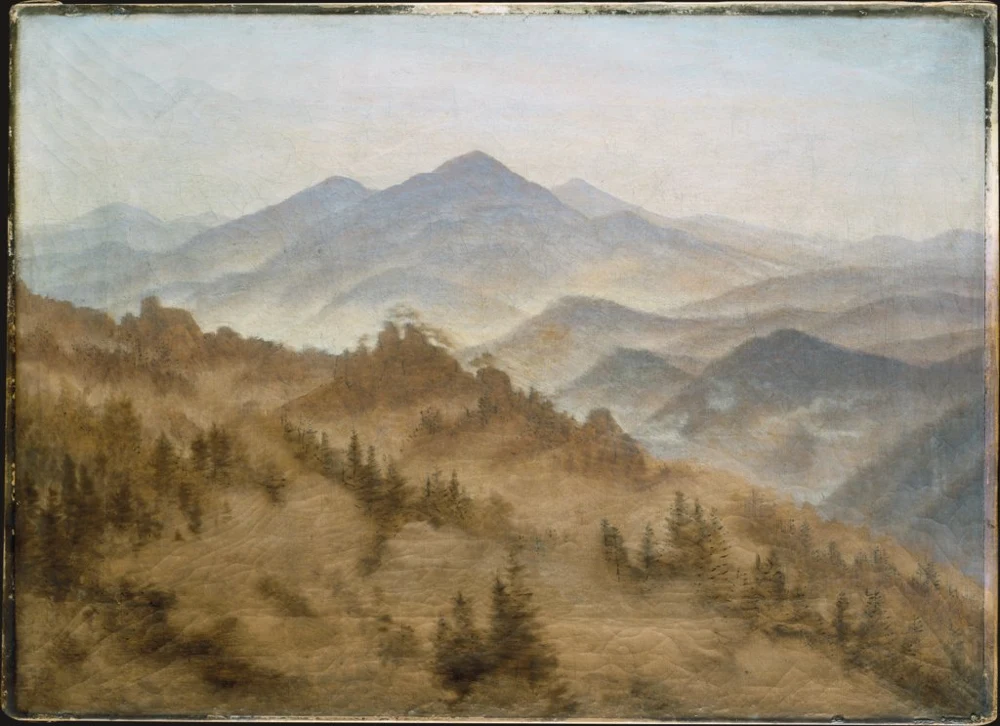
Put the two oils together and the strongest lines in the sky also do very different work. The rainbow offers a curve that the spectator can follow from one side of the painting towards the other. In the Städel landscape, clouds and fog have edges of uneven strength and can be followed for shorter distances before they merge into their surroundings. The late view allows the eye to return to the lower ridge for an orientation that may be hard to obtain farther back. In Essen, the large curve provides an orientation high above the mountain, even when the relation between the slope and the intervening air remains difficult to establish.[2] [12]
The difference matters to the identity of the place. Naming the mountain gives the painter's relation to the terrain a specific history. It leaves open the actual situation in which any of these skies might have been seen. Friedrich could use a recognized contour to support a highly distinct arrangement of terrain, figure and light. In the late landscape the conical form helps order the distance through fog. The higher and more emphatic peak in Essen helps relate the view down into the valley to the view up towards the arc. A form held in memory or on paper could retain its identity through changes in what it did for the whole picture.[2] [5] [12]
Seeing the cliff edge and the arc at different scales
The hat and the small area of grass establish a scale a spectator can use immediately. They also establish a kind of contact with the ground. Both the hat and the figure have recognizable places on the rise. As the eye follows the slope away from them, that immediate clarity recedes. We can still perceive darker stands of trees and a distant summit. We have much less information about how to get from the rise to the intervening terrain. Friedrich lets the local evidence of bodily scale remain strong even where it is hard to extend that measure through the view.[1] [2]
The rainbow introduces a separate problem of scale. Its apparent width can be compared with the width of the canvas, and its peak with the summit under it. Neither comparison gives the spectator the kind of distance one might estimate between the walker and his hat. The bow appears where the viewer can take its curve in as a whole, while its distance is hard to establish from the surrounding forms. That combination helps explain the particular uncertainty in the composition. The element most immediately grasped as a single shape is also one of the hardest to assign a place within the depicted terrain.[2] [4] [6]
A glance at the figure can bring the two experiences into contact. A man leaning and resting can turn his head through a limited angle, and the shift between what is near his feet and what crosses the sky would take some movement of his eyes. The composition lets a spectator perform that shift without knowing whether he looks at one of those features or something else entirely. The human scale of the man and the sweeping geometry of the arc are both plainly available. Their relation depends partly on the movement of attention between them.[2] [4]
The monitors in Rosenbach's performance
Rosenbach's own account links her 1979 performance to an invitation from Museum Folkwang director Zdenek Felix. She recalls responding to the stillness and contemplative character of Friedrich's painting and choosing to work with the bow. ZKM's record follows the performance from Essen to a simpler presentation at the Stedelijk Museum in Amsterdam in 1980 and to a reenactment directed by Rosenbach in 2023. This documentation gives the modern response a history of its own, with changes in presentation and a different performer in the recorded reenactment.[13] [14]
The floor reproduction was one of several things an audience could watch. ZKM describes a live camera moved by the performer with an iron rod, and two monitors showing the filmed hands. The closed circuit gave an audience a live detail of a body acting in the space. A spectator could look down at the whole curve and follow the walking figure, or look to a screen and see an enlarged fragment of the movement involved. The performance distributed a view across different surfaces and different scales. What Friedrich puts together in a single picture could now be approached through a moving body, a floor image and the camera's partial view.[13]
That change also affects the relation between stillness and duration. In front of the canvas a spectator can follow the curve and return immediately to the figure. In the performance the walk takes time, and the screen can draw the eye away from the route across the reproduction. The moving person has an activity that an audience can follow even when her gaze is hard to see. Rosenbach's stated interest in the painting's contemplative quality thus coexists with a deliberate redistribution of the spectator's attention. A viewer can encounter both the still shape of the bow and the physical effort of following it.[13] [14]
Annotated Details from Mountain Landscape with Rainbow
Use the numbered details to trace the forms and light in this work.
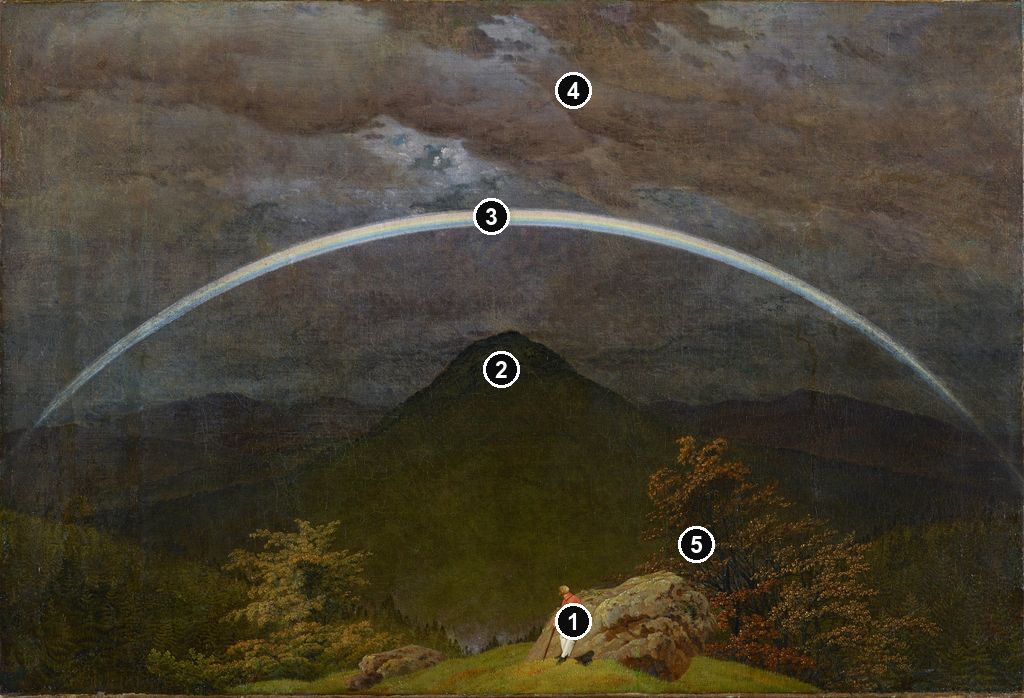
Details from MOUNTAIN LANDSCAPE WITH RAINBOW
The detail crops show parts of the work at a larger scale.
The watcher
A small figure in a red upper garment and light trousers leans near the foreground rock.
The central peak
A dark cone rises at the centre of the landscape below the high point of the arc.
The pale arc
A narrow arc crosses the dark sky. Subtle colour separates it from the clouds behind.
The clouds above
Patches of lighter sky interrupt the dense clouds above the arc.
Trees below the rock
The foliage catches enough light to remain distinct from the deeper valley.
Frequently Asked Questions
Discussion
Reader insights are welcome, especially close-looking observations about how the wanderer, dark mountain, possible moonbow and unusual lighting shape the painting's mood.
Reader Insights
How does the city-dweller's pause change the scale of the scene?
Does the possible moonbow feel natural, symbolic, or both?
How does the central peak organize the dark landscape?
Does Mountain Landscape with Rainbow feel most powerful as a mountain study, a solitary wanderer image, or a night vision built around a possible moonbow?
Join the Conversation
Share a source-grounded close reading of the wanderer, Rosenberg source, arc, lighting or Museum Folkwang provenance context.
References
- Museum Folkwang, Gebirgslandschaft mit Regenbogen, G 46, collection and provenance record
- Markus Bertsch, Gebirgslandschaft mit Regenbogen, Hamburger Kunsthalle exhibition catalogue entry, 2023, p. 134
- Museum Folkwang on Google Arts & Culture, Gebirgslandschaft mit Regenbogen
- Akane Sugiyama, Wanderer unter dem Regenbogen. Die Rückenfigur Caspar David Friedrichs, Freie Universität Berlin, ch. I
- Hamburger Kunsthalle, Wanderer über dem Nebelmeer, including Dresden’s 1808 Landschaftsstudien
- World Meteorological Organization, International Cloud Atlas, “Primary rainbow”
- Helmut Börsch-Supan, “Caspar David Friedrich’s Landscapes with Self-Portraits,” The Burlington Magazine 114, 1972, pp. 627–628
- Klassik Stiftung Weimar, Rügenlandschaft mit Regenbogen (Schäfers Klagelied), anniversary object record
- Folkwang-Museumsverein, institutional history and the Hirschland restitution
- Musée du Louvre, L’arbre aux corbeaux, RF 1975 20, provenance record
- Ulrike Rosenbach, interview on Die einsame Spaziergängerin
- Städel Museum, Mountains in the Rising Fog, inventory 1821, on the Rosenberg motif.
- ZKM, Ulrike Rosenbach, The Lonely Walker, 1979, documentation of the 2023 reenactment and earlier presentations.
- Ulrike Rosenbach, Interview on Caspar David Friedrich and The Lonely Walker, Hatje Cantz, artist's account.


