



 by Tom Gurney
Tom Gurney BSc (Hons) is an art history expert with over 20 years experience
Published on June 19, 2020 / Updated on October 14, 2023
Email: tomgurney1@gmail.com / Phone: +44 7429 011000
Winter Landscape: Introduction
A man pauses between bare oaks, looking towards a snowfield whose far edge almost disappears. Cut trunks punctuate the ground around him. One crutch is conspicuous against the snow, and the figure's bent posture suggests the effort of standing still. This is Caspar David Friedrich's Winter Landscape (Winterlandschaft) of 1811 in the Staatliches Museum Schwerin. The oil on canvas measures 33 centimetres high by 46 centimetres wide and is listed as G 621.[1] [2] [3]
At a Glance
- Date · 1811
- Medium · Oil on canvas
- Collection · Staatliches Museum Schwerin
- Accession · G 621
- Dimensions · 33 cm high × 46 cm wide
Contents
- Introduction
- The edge of the clearing
- The wanderer's crutches and red cap
- The probable companion in London
- What the London canvas reveals about the comparison
- The version in Dortmund
- Annotated Details
- Image Details
- Spring drawings in a winter scene
- Comparing versions in a public exhibition
The edge of the clearing
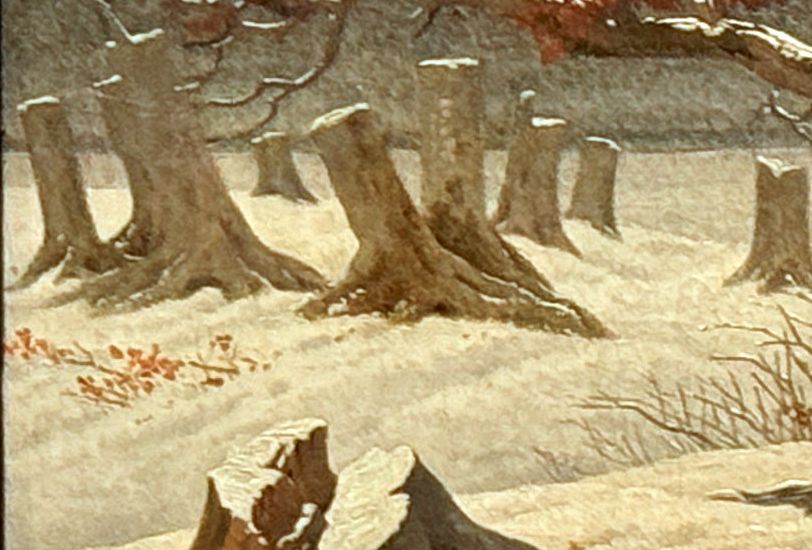
Friedrich makes the near ground legible one object at a time. The big trunks stand out against the snow, their angular branches carrying the eye into the air. The stumps have the opposite effect. Their dark tops keep drawing attention back to the surface, where smaller, less distinct marks measure the distance from the foreground into the field. The strongest verticals belong to trees that are already dead, while the living figure stands at an angle. Even before his circumstances become clear, his posture has a precariousness that the thick trunks lack.
The snow simplifies the field without smoothing away the evidence of what once stood there. The difference between a dead oak and a felled tree matters. Branches on the standing trees show how high and dense the growth once was. Cut stumps register human labour, though the people who did it are absent. The resulting openness gives the wanderer an extensive view but little to look towards. The museum's account connects the scene's quiet and desolate breadth with questions about the relationship between nature, human conditions and Christian belief.[1]
Dark and light also change function as the eye moves upwards. Dark trunks and stumps near the viewer give shape to the ground. The much broader grey of the sky does little to establish how far the field runs. Near the horizon the distinctions that work so well in the foreground become harder to make out. Looking with the man is therefore different from looking at him. His surroundings are clear enough to describe close by, yet the direction of his attention yields remarkably little information.
The wanderer's crutches and red cap
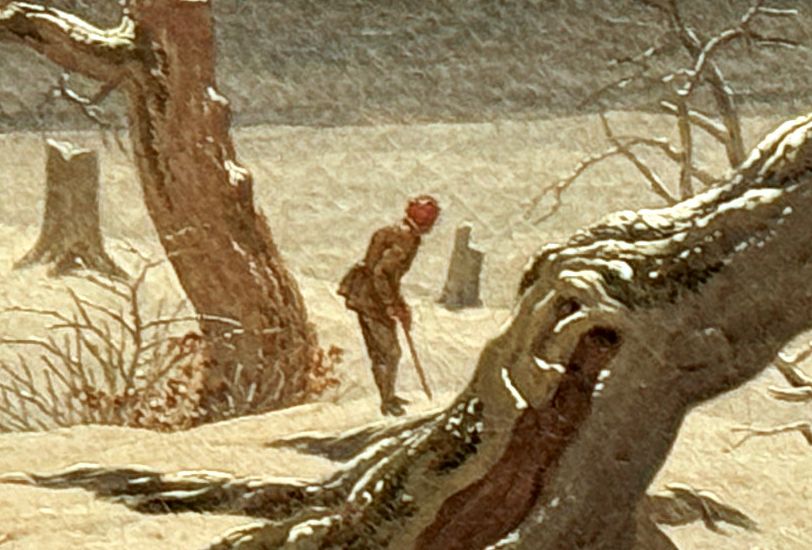
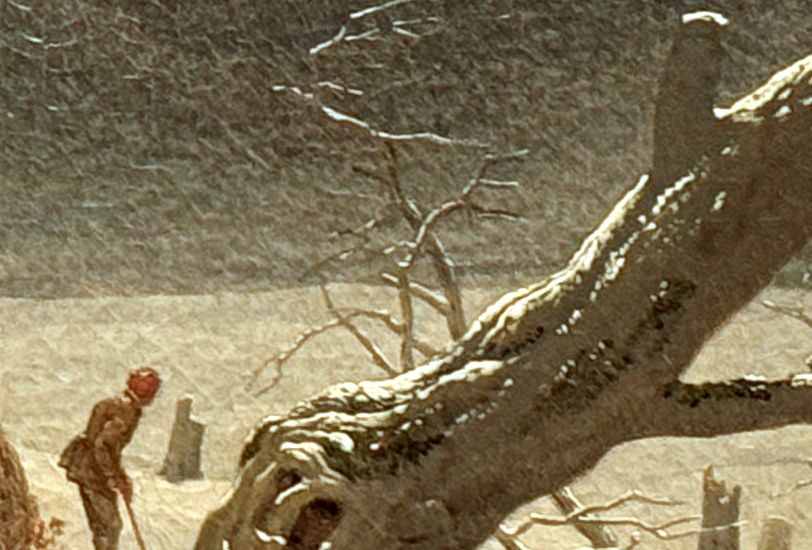
In his 2017 essay, the art historian Werner Busch calls attention to a detail best seen in the original or an enlargement. The man uses two crutches. The one projecting forward helps balance his inclined body, while the other follows his outline and reaches the ground near the heel of his right shoe. The nearer silhouette can give the impression of a single support. Seeing both makes the posture intelligible as a careful adjustment of weight.[3]
We see the figure largely from behind, which places us close to his line of sight. Yet his position is more specific than ours. He has travelled far enough to be among the stumps and has stopped where the field opens up. His supports and bent body give physical weight to a view the spectator can cross in seconds. The view offers neither a destination for him nor much sense of how hard it would be to go farther. His stillness could be a pause or the practical limit of his journey.
The small red cap is easy to miss at first. In a 2006 essay, Busch observes that it falls on the lower horizontal division of the canvas calculated by the golden ratio. He treats this isolated spot of colour as an alternative to reading the scene as entirely hopeless. The landscape offers the wanderer little outward encouragement, so any hope must emerge from how he faces his situation. The measured placement of a detail, in this reading, changes what the viewer can find in an otherwise sombre scene.[4]
Helmut Börsch-Supan approaches the work through Friedrich's recurring use of winter as an image of death. He describes the open snow and darkening sky as bringing the wanderer to the point of despair, and understands the prospect of renewal through a related composition. The two accounts direct attention to different things. Busch considers what the Schwerin canvas already offers in the red cap and its placement. Börsch-Supan follows the relationship between two paintings and asks what the second adds to the first.[5]
The probable companion in London
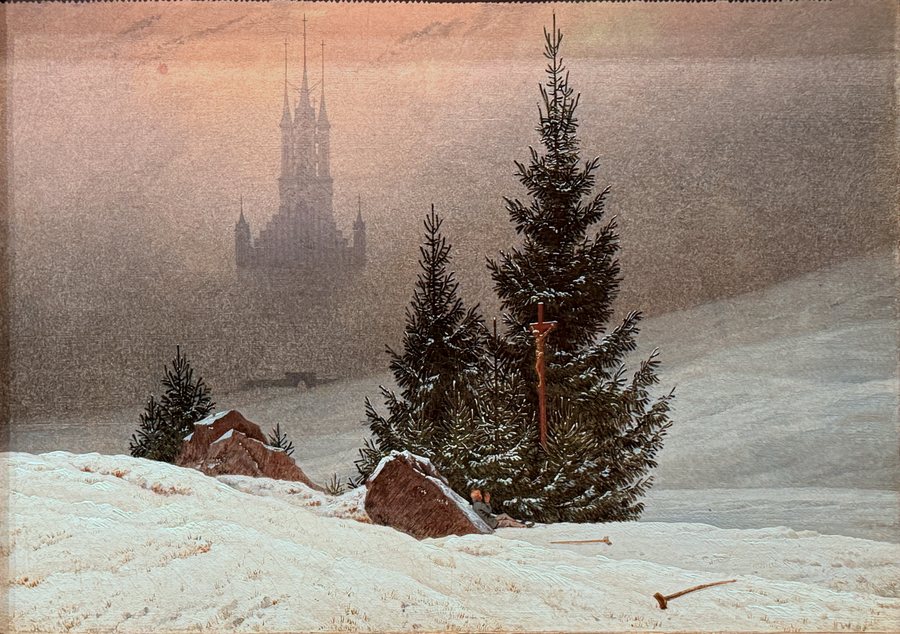
The National Gallery in London holds a separate Winter Landscape, NG6517, dated probably 1811 and measuring 32.5 centimetres high by 45 centimetres wide. It is often called Winter Landscape with Church to distinguish its composition. The Gallery considers it a probable pendant, or companion, to the Schwerin picture. In London, a man rests against a boulder and prays before a crucifix among evergreen firs. His crutches lie in the snow, and the spires of a Gothic church rise in the mist.[6]
The comparable scale of the two canvases encourages us to move between them. The upright firs in London answer the broken forms of the Schwerin oaks. The tall forms in Schwerin stand beside a field whose length is hard to gauge, while the spires in London give the distance an outline to look for. The figures make a particularly close comparison. One supports himself as he looks out, and the other rests against a rock and lifts his hands. The London painting changes what the man can do within the composition before any change in the season becomes apparent.[4] [6]
The relationship supports a reading of the pair as an encounter with mortality followed by the possibility of Christian consolation. In London, grass protrudes through the snow and the firs remain green. Börsch-Supan understands these details as signs that winter can pass, even though its cold has yet to leave the landscape. The pendant relationship is a persuasive account of how the two compositions work together. Their documented histories also have gaps. Leighton notes that the Leipzig collector Ludwig Puttrich owned the London painting by 1813 and apparently did not own the Schwerin picture.[5] [7]
What the London canvas reveals about the comparison
The National Gallery's 1989 study of its painting describes how the far church takes shape beneath the mist. Infrared examination found fine ruled guides and thicker lines resembling ink. The drawing materials could not be sampled. Smalt, a blue glass pigment that forms translucent paint in oil, was applied in small stippled touches that help the hills and sky merge. Cleaning recovered a small sun to the left of the church that earlier retouching had covered.[7]
Leighton also compared the handling of the paintings, noting slightly raised paint in the Schwerin foreground snow and similarities in sky brushwork. The London pigment analysis and infrared findings concern NG6517. The visual comparisons help explain why pictures with different effects can still feel closely related. In both, nearby snow has a material presence against a much less tangible distance. In Schwerin, that distance gives the gaze almost nowhere to settle. In London, a delicately planned church emerges from it.[7]
The version in Dortmund
Dortmund's Museum für Kunst und Kulturgeschichte holds a version of the composition with a church. For decades it was accepted as the original of that design. The London canvas resurfaced in Paris in 1982 and was bought by the National Gallery in 1987. Comparison revealed that the Dortmund picture lacks the London canvas's foreground blades of grass and its gateway below the church. Its church also has fewer architectural details, and infrared photography did not reveal underdrawing comparable to London's. Börsch-Supan treated the Dortmund work as a copy from Friedrich's circle. The National Gallery considers a copy by a pupil or imitator more likely, while allowing that it could be Friedrich's own replica.[5] [6] [7]
Returning to the Schwerin painting after looking at the church compositions brings the stopping point of its wanderer into focus. He stands where the trees cease to offer even a rough enclosure, with his red cap bright against the subdued field. Whether his pause is read as desolation or as the moment before a change, Friedrich locates it in a precise physical situation. The man has found somewhere to stand, and his gaze continues into a space where the picture offers very little to hold onto.
Spring drawings in a winter scene
The Met's 2025 exhibition paired the Schwerin oil with Friedrich's Study of an Oak and Tree with Roots, a sheet from the Dresden Kupferstich-Kabinett. Friedrich drew the trees near Neubrandenburg in late April 1809. One still has a little foliage on a surviving limb. The exhibition label identifies the trees as sources for the two prominent forms in the oil. The season in which Friedrich studied them and the season in which he placed them are therefore separately documented.[8]

The transfer makes a difference to how we see the trees. In the study, their irregular outlines distinguish them from other growth an observer might encounter in spring. In the painting, snow and the empty space behind them make those outlines conspicuous even at a distance. The roots and branches can be considered in relation to the wanderer's strained posture. A shape observed for its own particular growth acquires a second role because Friedrich has placed it next to a body that also needs support.[3] [8]
The Met also links the cut stumps to the depletion of woodland around Dresden. That interpretation gives a historical context to the difference between wood that has died standing and wood that has been cut. The spring drawing can establish the form of particular trees, while the winter foreground can bring attention to the removal of others. Snow gives those marks a pale field in which to remain visible. The open land is partly something the trees and stumps tell us has happened to this place.[1] [8]
Comparing versions in a public exhibition
The National Gallery archive records a Painting in Focus exhibition in London from 28 March to 28 May 1990. The Rijksmuseum preserves the bibliographic record of the accompanying catalogue, and the London object record also lists the Dortmund exhibition later that year. These occasions followed the rediscovery of the London painting and the publication of its technical examination. The identity of the probable companion to the Schwerin picture had become a question visitors could investigate through a new body of evidence.[6] [7] [9] [10]
The distinction between composition and object is particularly important here. A person reading a description of a man facing a cross and a church emerging from mist could recognize the scene in either the London or the Dortmund version. Closer comparison asks more specific questions about which lines survive below the surface and how much architectural or foreground detail the painter included. The presence of a feature in the composition and its precise execution are different kinds of evidence. A broad description can support the relationship to Schwerin while leaving the attribution of a particular version open.[6] [7]
For the Schwerin painting that distinction helps recover what the proposed pairing actually contributes. The church composition supplies a destination for attention that the open field with stumps withholds. That difference is visible independently of the details by which the London and Dortmund objects can be distinguished. At the same time, direct comparison of the two oils is more exact once the small blades of grass, the distant gateway and the way the church emerges have been accounted for. Identifying the likely companion changes what can be said about the passage from one winter scene to the next.[5] [6] [7]
Annotated Details from Winter Landscape
Use the numbered details to trace the forms and light in this work.
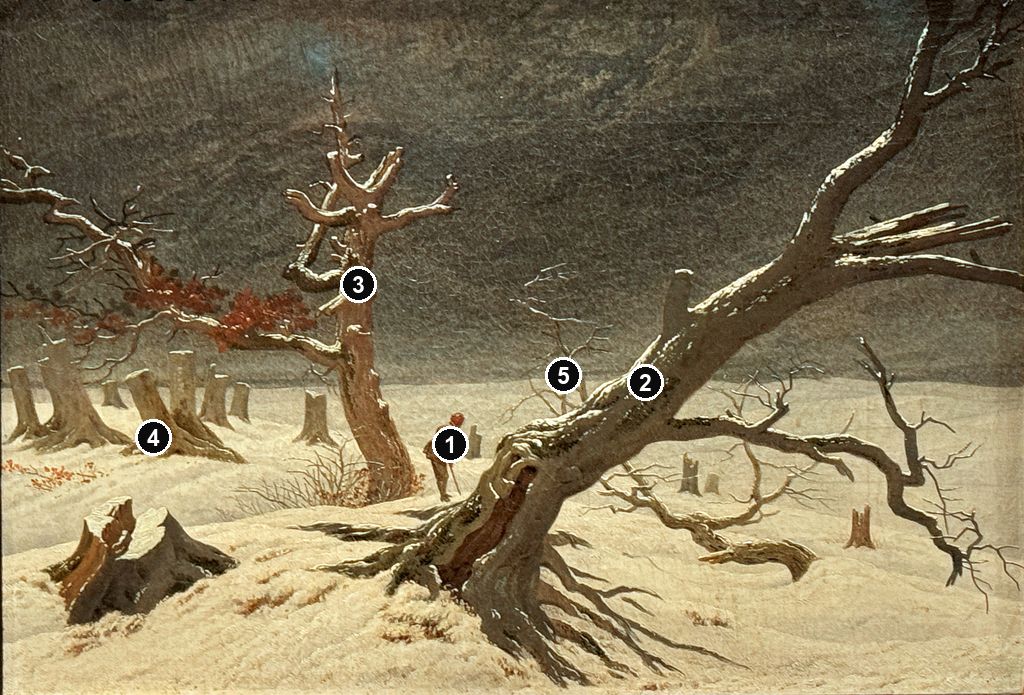
Details from WINTER LANDSCAPE
The detail crops show parts of the work at a larger scale.
The walker and his crutch
A small, bent figure moves across the snow beside the standing oak. One crutch stands out against the ground.
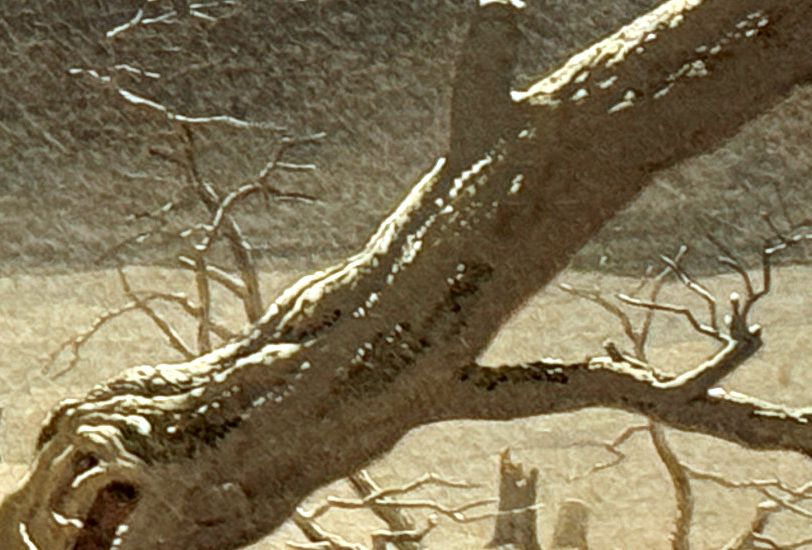
The fallen trunk
A heavy trunk rises diagonally from exposed roots towards the right edge.
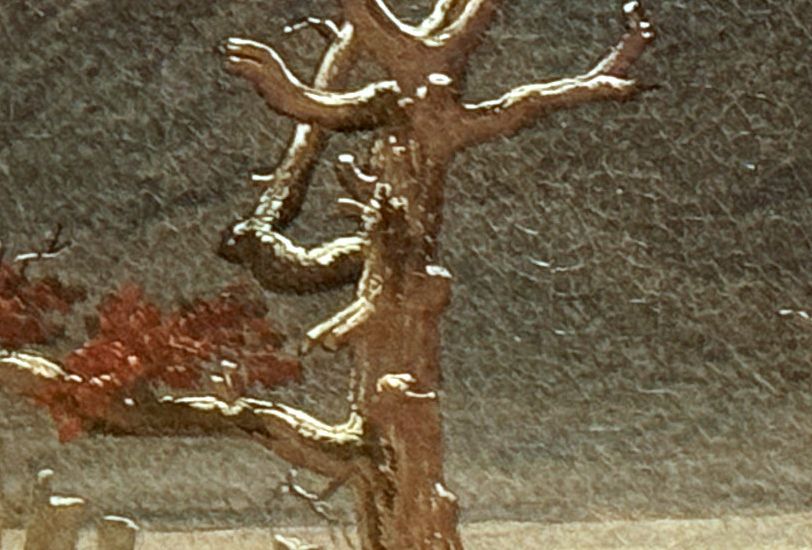
The standing oak
The bare oak has jagged limbs and stands close to the small walker.
The cut stumps
Low stumps recur across the left side and diminish towards the darker distance.
The line of the snow
The pale ground meets the dark sky along a shallow horizon.
Detail photographs from a photograph by Dguendel, CC BY 4.0. The frame was cropped out and the reproduction resized.
Frequently Asked Questions
Discussion
Which details make the small figure visible against the snow?
Reader Insights
Which details make the small figure visible against the snow?
How does the diagonal trunk change the way you enter the scene?
What changes when the Schwerin landscape is placed beside the London painting?
What changes when the Schwerin landscape is placed beside the London painting?
Join the Conversation
Share what you noticed in the Schwerin painting.
References
- Staatliches Museum Schwerin, Winterlandschaft, collection presentation on Google Arts & Culture.
- Staatliches Museum Schwerin/Ludwigslust/Güstrow, collection inventory, p. 20, entry G 621.
- Werner Busch, “Romantische Landschaftsmalerei: Zum unterschiedlichen Verständnis des Romantischen in nordeuropäischen Ländern”, in Die Romantik im Norden: von Friedrich bis Turner (2017), pp. 7–21, especially pp. 12–14.
- Werner Busch, “Friedrichs Bildverständnis”, in Caspar David Friedrich: Die Erfindung der Romantik (2006), pp. 32–47, especially pp. 37–38.
- Helmut Börsch-Supan, “Wasser, Wind, Winter”, in Von Friedrich bis Liebermann (1999), pp. 84–93, especially pp. 90–91.
- National Gallery, London, Winter Landscape, NG6517, object record.
- John Leighton, Anthony Reeve and Aviva Burnstock, “A 'Winter Landscape' by Caspar David Friedrich”, National Gallery Technical Bulletin 13 (1989), pp. 44–60. Full text.
- Metropolitan Museum of Art, The Soul of Nature exhibition labels, pp. 19–20, on the 1809 tree study and the Schwerin painting.
- National Gallery, London, Painting in Focus: Winter Landscape exhibition archive, NG32/182.
- Rijksmuseum Research Library, Caspar David Friedrich: Winter Landscape, record of the 1990 National Gallery catalogue.


