



 by Tom Gurney
Tom Gurney BSc (Hons) is an art history expert with over 20 years experience
Published on June 19, 2020 / Updated on October 14, 2023
Email: tomgurney1@gmail.com / Phone: +44 7429 011000
Walk at Dusk: Introduction
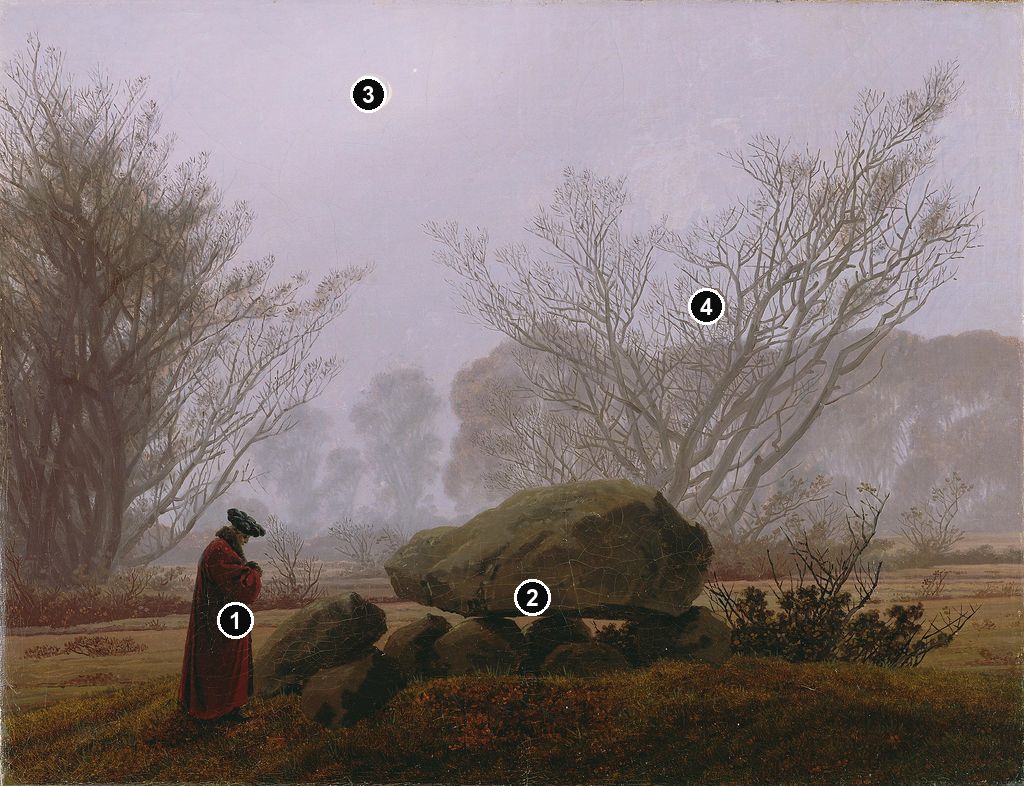
In Caspar David Friedrich’s A Walk at Dusk, a man has stopped beside an ancient stone tomb. His reddish cloak gives him a distinct presence in the brown foreground, yet he seems absorbed by something beyond ordinary conversation. Behind the tomb, bare branches spread across a grey-blue sky. Above them, a narrow crescent and a small point of light remain visible. The painting belongs to the J. Paul Getty Museum in Los Angeles, which dates this oil on canvas to about 1830–1835 and records its dimensions as 33.7 × 43.2 centimetres, accession 93.PA.14.[1]
Its small size rewards close attention. The figure, capstone, branches and celestial lights establish several different scales of experience within a single view. A passing walker confronts a monument that has outlasted its makers, while the evening sky continues above both. Friedrich gives this encounter weight through the arrangement of tangible things: the low, heavy stone, the bent head, the branching silhouettes and the distant trees dissolving into mist.
At a Glance
- Date · ca. 1830–1835
- Medium · Oil on canvas
- Collection · J. Paul Getty Museum
- Accession · 93.PA.14
- Dimensions · 33.7 cm high × 43.2 cm wide
Contents
- Introduction
- The walker and the pause
- A tomb drawn decades earlier
- Branches, mist and an uncertain season
- The crescent and the evening star
- The burial chamber as a place to stop
- The tomb under a different sky
- Dating and the Getty acquisition
- Annotated Details
- Image Details
The walker and the pause
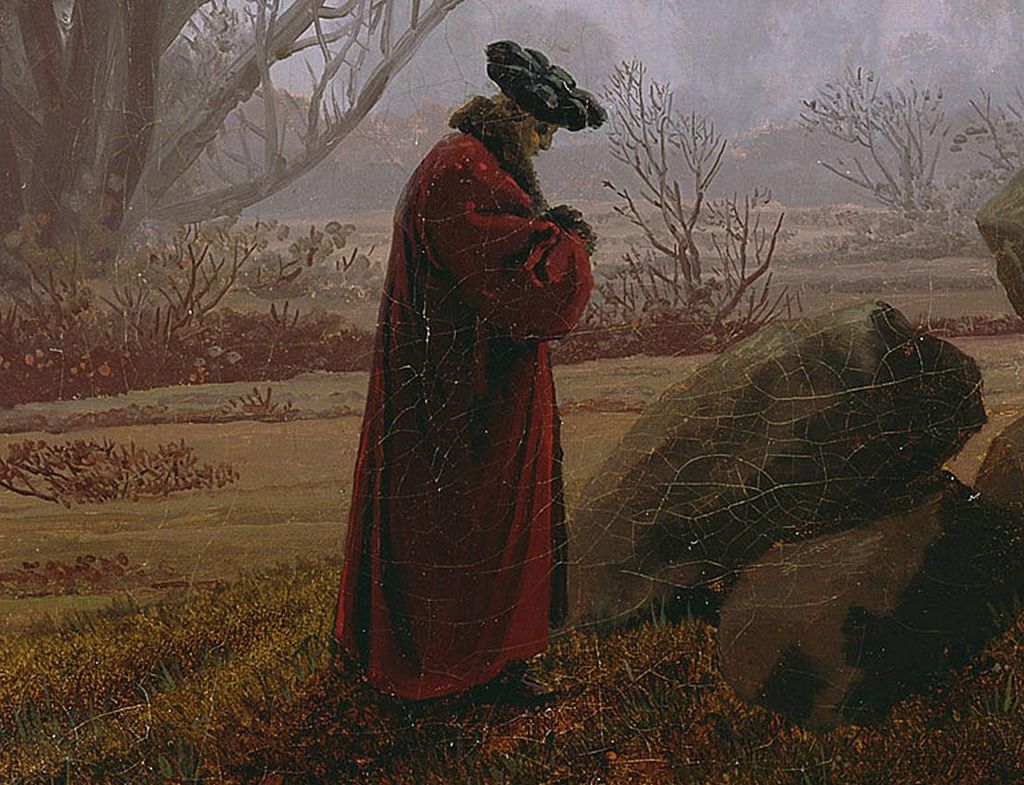
The figure occupies the lower left of the picture, standing clear of the large tree behind him. His dark hat has a pronounced projecting shape; beneath it, his head inclines toward his hands and the tomb. The cloak falls almost to the ground, creating a long, narrow accent beside the monument’s broad horizontal mass. His feet are comparatively inconspicuous. Although the title describes movement, the painted moment gives us an interruption of movement.
The Metropolitan Museum of Art’s 2025 exhibition label describes the hands as clasped in prayer and proposes that the man may be mourning a vanished age. It also retains the possibility that Friedrich represented himself.[2] These are interpretations with different levels of certainty. The bowed head and gathered hands are visible; a particular personal identity cannot be established by posture alone. Calling the figure Friedrich without qualification would turn a suggestive reading into a fact.
The uncertainty contributes to the encounter. We do not have a clear facial expression to explain what he thinks. Instead, the relation between his body and the stones carries the emotional meaning. He stands close enough to confront them, but a small interval keeps his body separate from their irregular surfaces. The downward inclination of his head answers the descending edge of the great capstone. His vertical presence makes the monument look broader and more settled into the earth.
The walker also determines the viewer’s distance. He is neither a minute speck in a vast panorama nor a foreground portrait commanding the whole canvas. We can register the colour and shape of his clothing without entering his thoughts. This balance allows us to attend to his act of reflection while still looking independently across the landscape. The scene offers company in contemplation, even though it depicts someone alone.
A tomb drawn decades earlier
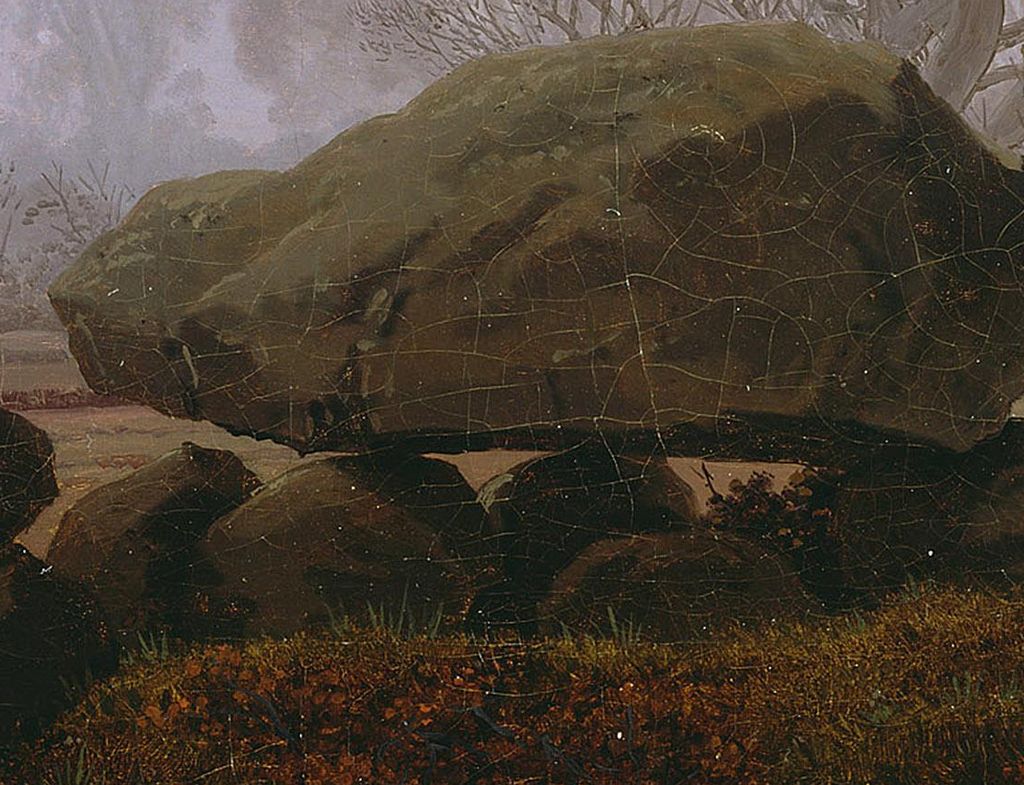
The structure beside the man is a megalithic tomb, or dolmen. Its broad upper stone rests over smaller supporting stones, leaving a dark interval underneath. It is therefore more than a collection of naturally scattered boulders. The capstone makes an emphatic, almost rooflike form, but its uneven edges and mottled surface keep it visually connected to the surrounding ground.
Getty’s Masterpieces of the J. Paul Getty Museum: Paintings connects this arrangement to a drawing Friedrich made in 1802 near Gützkow, south of Greifswald, and identifies the drawing’s collection as the Wallraf-Richartz Museum in Cologne. The entry also suggests that Friedrich used the study for the earlier Megalithic Tomb in the Snow in Dresden.[3] The interval of roughly three decades between the drawing and the Getty painting changes how we understand this landscape. An observed monument could remain available to Friedrich long after the original excursion, ready to take its place within a newly imagined setting.
The connection supports a specific account of his working process without making the entire painting a record of one visit. A study of stones supplies a durable configuration; light, vegetation, atmosphere and a figure can alter its effect. The painting’s evening encounter could consequently bring remembered observation into a composition shaped much later. Its sense of the past resides both in its subject and in the reuse of a motif from Friedrich’s earlier practice.
The 1994 Getty acquisition entry adds another drawing connection: a study for the bowed figure occurs on a sheet of figure studies in Dresden’s Kupferstich-Kabinett.[4] This matters because the man and the tomb need not have originated as one observed scene. Separate studies could be brought together to create the measured relationship we see. The figure’s restraint belongs to a constructed pictorial encounter, as well as to the emotional state it invites us to imagine.
In the earlier snow painting, as described in Getty’s Masterpieces, the tomb appears farther away amid dead and broken oaks.[3] Here, bringing the stone nearer and introducing the contemplative figure makes the meeting more immediate. The monument is no longer solely something we survey within a landscape. Someone has approached it before us. His presence makes the stones an object of attention and gives their endurance a human measure.
Branches, mist and an uncertain season
Two large trees frame the principal encounter. The tree at the left presses toward the edge, its dark trunk anchoring the walker’s side of the picture. The tree behind the tomb spreads more openly to the right. Its limbs rise in separate, jagged lines, with fine twigs extending into the sky. This branching network contrasts with the capstone’s solid, relatively continuous silhouette.
The trees create a loose opening toward the distance. Getty’s CONA description calls attention to this archlike effect and to the contrast between bare nearby trees and a distant band of trees in leaf.[5] The opening is irregular rather than architectural: no matching columns or symmetrical curve organize it. Nevertheless, the pale space between the branches encourages the eye to move beyond the foreground. Friedrich makes the nearest forms substantial while leaving the background difficult to possess.
Mist supplies the transition. The dark, clearly bounded objects close to us give way to overlapping tree shapes whose bases disappear. A broad tree mass rises behind the tomb, but the ground beneath it remains indistinct. Distance is therefore experienced as a gradual loss of edges. We can see that there is more landscape beyond the encounter without being able to trace a continuous route through it.
Descriptions of the season vary. The Getty collection essay calls the scene winter, while CONA describes an autumnal meadow with winterlike bare trees; the Met’s 2025 label also uses autumnal.[1][2][5] The visible contrast is more secure than an exact seasonal assignment. Bare branches stand against fuller growth, and brown earth occupies the foreground without a covering of snow. The painting brings different appearances of nature into an expressive relationship. Its meaning does not depend on fixing a particular month.
The crescent and the evening star
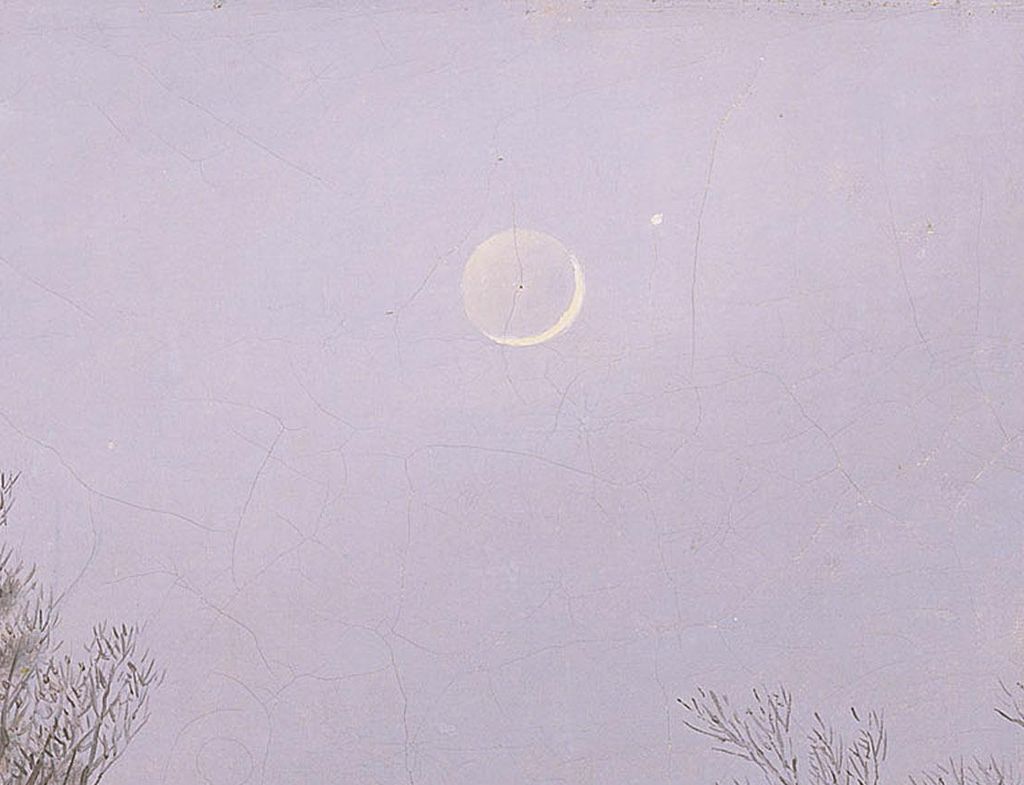
The moon sits high in the opening, left of centre. Its illuminated rim is thin, but the rest of the disc remains faintly perceptible. Nearby, a much smaller point punctuates the sky. The Met identifies that point as Venus, the evening star.[2] This distinction matters: the celestial pairing is more precise than a general scatter of decorative stars.
Their scale reverses the emphasis of the foreground. The tomb commands space through size and weight; the crescent and Venus draw attention through their brightness and isolation. Nothing large competes with them in the upper sky. The eye can travel from the reddish figure to the capstone and then upward, exchanging the density of stone and earth for a few economical marks of light.
Getty’s published interpretation reads the waxing crescent as a sign of divine illumination and Christ’s promise of rebirth, counterbalancing the tomb’s association with death.[3] The Met label emphasizes a related idea: the survival or transcendence of death through memory.[2] Both readings arise from the juxtaposition of the ancient monument and a young moon, although neither turns the composition into a narrative with an explicit miraculous event.
The picture makes room for these meanings through its distribution of light. The moon does not illuminate every stone or reveal the walker’s face. Dusk continues to obscure much of the terrain. Hope, in this reading, remains a small but persistent presence within an uncertain world. The painter has given the celestial lights enough clarity to be found, while preserving the muted atmosphere that makes finding them significant.
The burial chamber as a place to stop
The Mecklenburg-Vorpommern archaeology office brings together Friedrich's studies of the tomb near Gützkow and the recollection of his former drawing teacher, Johann Gottfried Quistorp. Quistorp accompanied Friedrich to the site and remembered lying on the capstone while the artist drew. He described the space below as already filled with earth almost to the slab. The office also identifies a possible second capstone in some of the drawings and records that the monument was subsequently broken up and its stones reused. Those observations give a physical history to the structure that Friedrich returned to in paint.[3][6]

Quistorp's position on top of the stone gave the early drawing a measure of its dimensions. The Getty walker supplies another measure, standing with his head above the capstone and his feet low among the shadows. The space under the slab is hard to see even at this distance. Friedrich lets the upper surface catch enough light for the eye to work out the basic arrangement before the bases of the stones merge into the ground. The archaeologist can use the early sketches to ask how the chamber was built and how it deteriorated. The late canvas makes the same partial view of the structure part of an encounter. The walker has reached the tomb, and his body gives us a way of imagining how close that encounter is.[1][3][6]
The earlier Megalithic Tomb in Snow makes the overhang easier to pick out by laying snow along the tops of the blocks. The white edges help distinguish the capstone from the supports and the rise in front. In the Getty picture the lighter plane of the slab and the shadows under it do much of that work. The stone appears closer and its mottled surface occupies more of the view, while the earth around it is less clearly bounded. Each picture gives the eye a way to identify the burial chamber without supplying the view one would need to draw a plan of it.[1][3][6]
The tomb under a different sky
In Megalithic Tomb in Autumn, about 1820, Friedrich placed a large boulder amid wind-bent plants, broken trees and unsettled clouds. Holger Birkholz discusses the work as the reception painting required by the Dresden Academy after Friedrich's appointment, and relates the force of the storm to the political climate after the Congress of Vienna. His reading depends in part on the way a stable mass of stone stands out among forms visibly under pressure.[7]
The late walker offers another way to gauge that stability. In the autumn canvas the bending vegetation makes the surrounding air seem active. In the Getty picture, the trees dissolve into mist at a distance and the man stands quietly beside the rock. His pause supplies a human interval against which the much longer duration of the tomb can be felt. The crescent adds a further interval, visible as a phase of a recurring cycle. The autumn picture gives the viewer the sensation of a change already under way, while the late evening makes change easier to detect by moving the eye between the ground and the sky.[1][2][7]
Dating and the Getty acquisition
The current date, about 1830–1835, is an approximate range rather than a documented year of completion. Getty’s 1994 acquisition entry and its Masterpieces entry used the narrower range around 1832–1835.[3][4] The museum’s present collection record takes precedence for the basic date and measurements; those earlier publications remain valuable for their account of drawings, interpretation and ownership.[1]
The painting’s recorded provenance is especially useful because it gives this quiet landscape a history outside the artist’s biography. The acquisition entry names the theologian Crusius in Dresden, followed by Dr H. Voith of Heidenheim, probably through descent from Crusius. It then records a private owner described in the auction catalogue as a descendant of Voith. The work appeared at Christie’s in London on 20 May 1993 as lot 352 and entered Getty’s collection among the acquisitions documented for that year.[4] The probable relationship in this chain should remain qualified; the sale date and lot number provide the firmer public anchor.
These records also help keep the painting’s late date in perspective. A familiar temptation is to explain every sombre detail through Friedrich’s declining health. Yet the tomb’s documented drawing source reaches back to 1802, and the figure too has a preparatory connection. The work develops material accumulated across a long practice. Its meditation emerges from those motifs and their placement: a living body beside an old burial structure, bare trees before misted growth, and a slender moon above the weight of stone. The encounter remains affecting because Friedrich lets us see these relationships before asking us to interpret them.
Annotated Details from Walk at Dusk
Use the numbered details to trace the forms and light in this work.
Details from WALK AT DUSK
The detail crops show parts of the work at a larger scale.
The walker
The bent head and gathered hands draw attention to the figure's pause beside the stones.
The megalith
A broad capstone rests above lower rocks. Dark vegetation gathers around its base.
The crescent
The pale moon is visible through a thin, softly coloured sky.
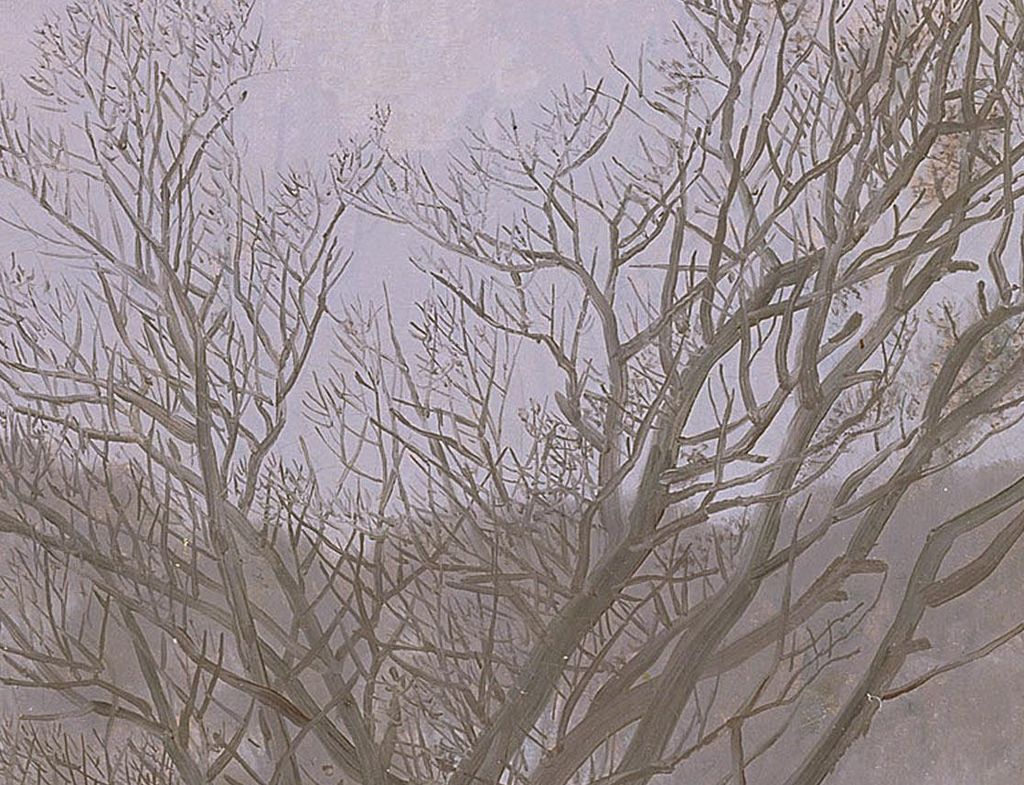
Bare branches and mist
Dark, finely branching limbs stand against less distinct trees further back.
Frequently Asked Questions
Discussion
Reader insights are welcome, especially close-looking observations about how the figure, tomb, moon and trees work together without becoming a simple symbol chart.
Reader Insights
How does the figure's stillness change the meaning of a painting titled as a walk?
Does the thin moon make the scene feel like an ending, a beginning, or both?
What changes when the bare foreground branches are set against distant growth?
Does A Walk at Dusk feel more like a personal memory, a meditation on death, or a quieter image of renewal?
Join the Conversation
Share a source-grounded close reading of the figure, tomb, moon or trees.
References
- J. Paul Getty Museum, A Walk at Dusk, collection record, 93.PA.14, current date, medium and dimensions.
- Metropolitan Museum of Art, Caspar David Friedrich: The Soul of Nature, exhibition labels, 2025, printed p. 29, entry for A Walk at Dusk.
- J. Paul Getty Museum, Masterpieces of the J. Paul Getty Museum: Paintings, entry 64, p. 117, signed PS: tomb drawing, comparison and interpretation.
- J. Paul Getty Museum, “Acquisitions/1993,” The J. Paul Getty Museum Journal 22 (1994), entry 28, p. 79, drawing connections and provenance.
- Getty Research Institute, CONA full record 700002225, A Walk at Dusk, descriptive note.
- C. Michael Schirren, Landesarchäologie Mecklenburg-Vorpommern, Hünengrab im Schnee and the history of archaeological preservation, January 2026.
- Holger Birkholz, Megalithic Tomb in Autumn, Hamburg exhibition catalogue, 2023, p. 278.


