



 by Tom Gurney
Tom Gurney BSc (Hons) is an art history expert with over 20 years experience
Published on June 19, 2020 / Updated on October 14, 2023
Email: tomgurney1@gmail.com / Phone: +44 7429 011000
The Sea of Ice: Introduction
The Sea of Ice is one of Caspar David Friedrich's starkest paintings. A ship lies crushed beneath jagged slabs of polar ice. Its broken timbers are almost hidden, pushed into the composition as if the human story has been overwhelmed by the frozen landscape around it. The ice rises in sharp, tilted sheets, forming a monument of wreckage without a monument's stability. No survivor appears. No rescue is visible. The painting shows catastrophe after the event, when action has ended and the forces of nature remain.
Friedrich painted The Sea of Ice in 1823/24. The work is an oil on canvas in the Hamburger Kunsthalle, inventory number HK-1051, acquired by the museum in 1905.[1] The Hamburger Kunsthalle records the dimensions as 96.7 cm high by 126.9 cm wide.[5] The painting is also known in some contexts as The Wreck of Hope, a title that points to the crushed ship and the broader failure of human ambition in the polar landscape.
The painting is rooted in observation, but not in direct Arctic experience. Friedrich did not see polar ice himself. [2] Instead, he drew on studies of ice floes from the frozen Elbe near Dresden during the severe winter of 1820/21. [1] [2] He transformed those local observations into a boundless polar scene several years later, enlarging ice fragments into monumental forms and setting a shipwreck beneath them. [1]
That transformation is the painting's central achievement. The Sea of Ice does not simply illustrate a disaster. It asks what happens when human exploration, measurement and hope meet a natural world that cannot be mastered. The wreck is there, but the painting does not give it easy narrative priority. The ice dominates. The human project is visible mainly through its defeat.
At a Glance
- ArtistCaspar David Friedrich
- TitleThe Sea of Ice
- Alternative title/contextoften associated with The Wreck of Hope
- Date1823/24
- Mediumoil on canvas
- Dimensions96.7 cm high × 126.9 cm wide.[5] [1]
- CollectionHamburger Kunsthalle, inventory number HK-1051, acquired 1905. [1]
- Key sourcesFriedrich's 1820/21 Elbe ice studies, polar expedition context, and later Hamburg interpretation. [1] [2]
- Main subjecta sailing ship crushed and largely buried by monumental ice floes
Contents
- Object Facts
- Annotated Details
- Ice as Structure and Violence
- The Hidden Shipwreck
- Elbe Ice Studies and Observed Material
- Polar Expedition Context
- First Exhibition and Reception
- Sublime Nature Without Secure Viewpoint
- What the Painting Withholds
- Color, Surface and Close Looking
- What a voyage journal could show
- Carus and the place from which ice can be seen
- The picture in the gallery and in a detail photograph
Object Facts
The Sea of Ice belongs to the Hamburger Kunsthalle, where it has been part of the collection since 1905. [1] The museum's Friedrich web material and cdfriedrich.de both identify the painting as one of the major works associated with Hamburg's Friedrich holdings. [1] [3] The work was painted in 1823/24, after Friedrich had already developed his mature language of solitary figures, shorelines, mountains, ruins, moonlit seas and constructed landscapes.
The painting's German title, Das Eismeer, can be translated as The Sea of Ice or The Polar Sea. Older and popular English usage has also attached the title The Wreck of Hope, which directs attention toward the ship. That title is useful if handled carefully. It names the human catastrophe that lies within the picture, but it should not make the wreck the only subject. Friedrich's painting is equally about ice as a structure, a force and a visual field.
The holding history also matters for reception. The painting entered the Hamburger Kunsthalle in 1905, just before Friedrich's broader early twentieth-century revival gathered force. [1] Its modern fame is therefore tied both to the object itself and to Hamburg's role in preserving and presenting Friedrich's most severe landscapes.
The ship is difficult to read at first because it is partly buried by ice. The visible hull, masts or timbers are not displayed like a marine-history illustration. They appear as fragments caught in a larger natural event. This is one reason the painting feels so severe. Friedrich makes human technology visible mainly as wreckage.
The cdfriedrich.de object text describes the central iceberg as a mass of mighty ice sheets burying a sailing ship beneath it. [1] That formulation is useful because it keeps the relation clear: the ship is not simply placed among ice floes; it is overwhelmed by them. The painting's drama is the domination of the human-made by the natural.
Annotated Details from The Sea of Ice
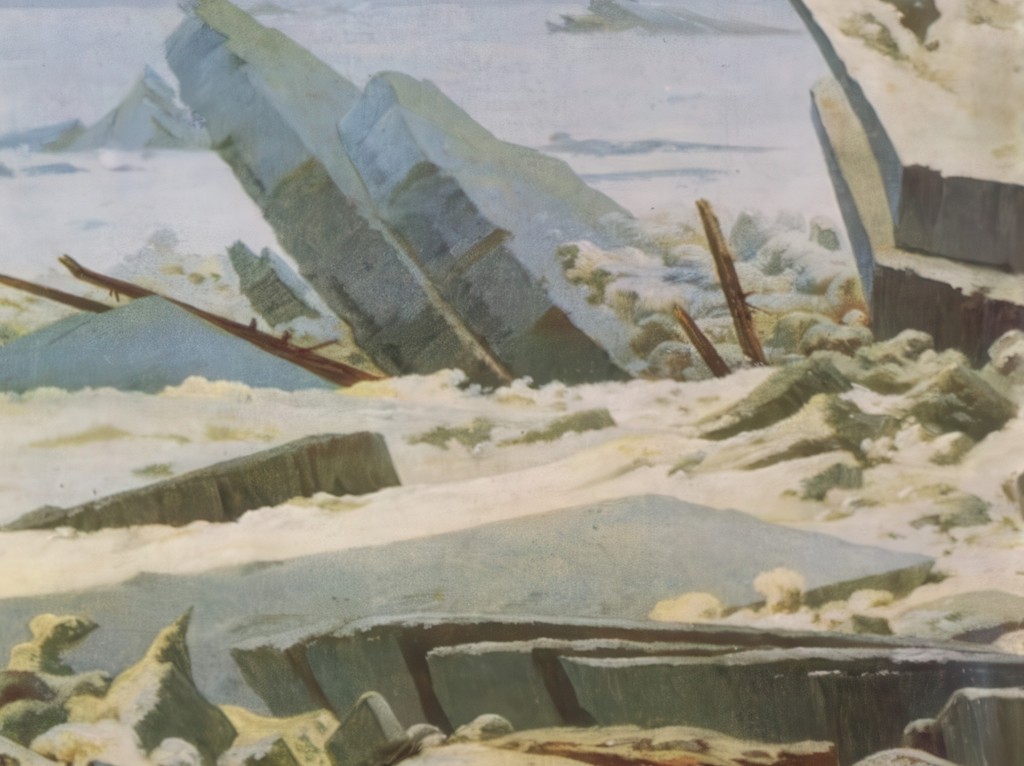
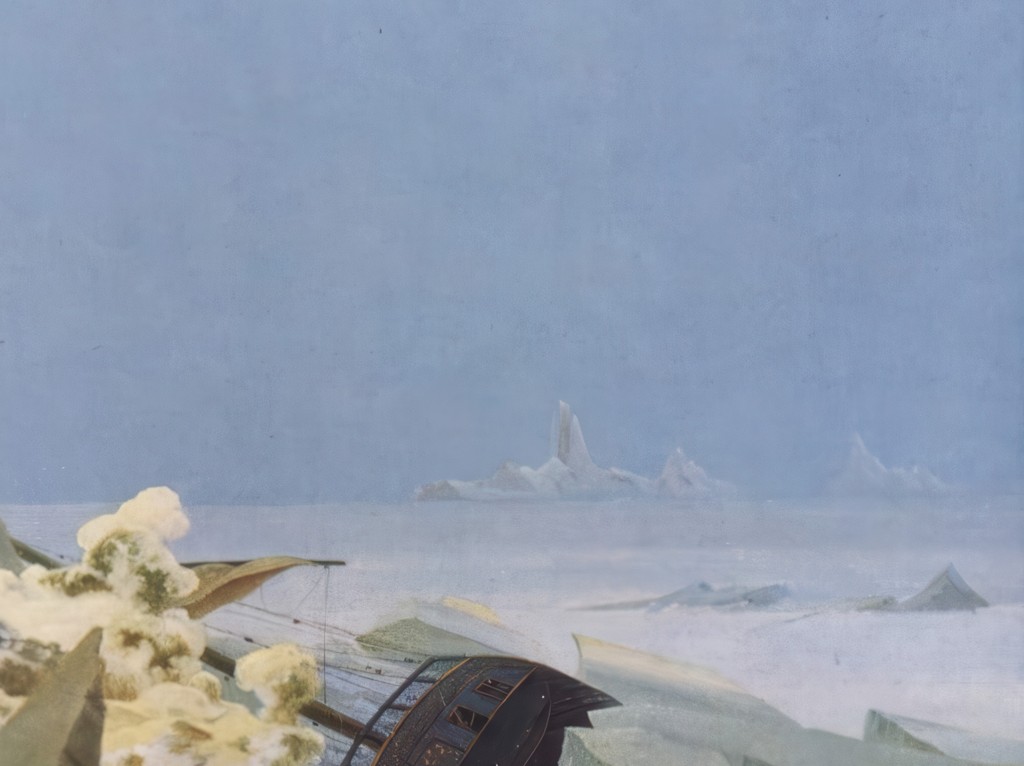
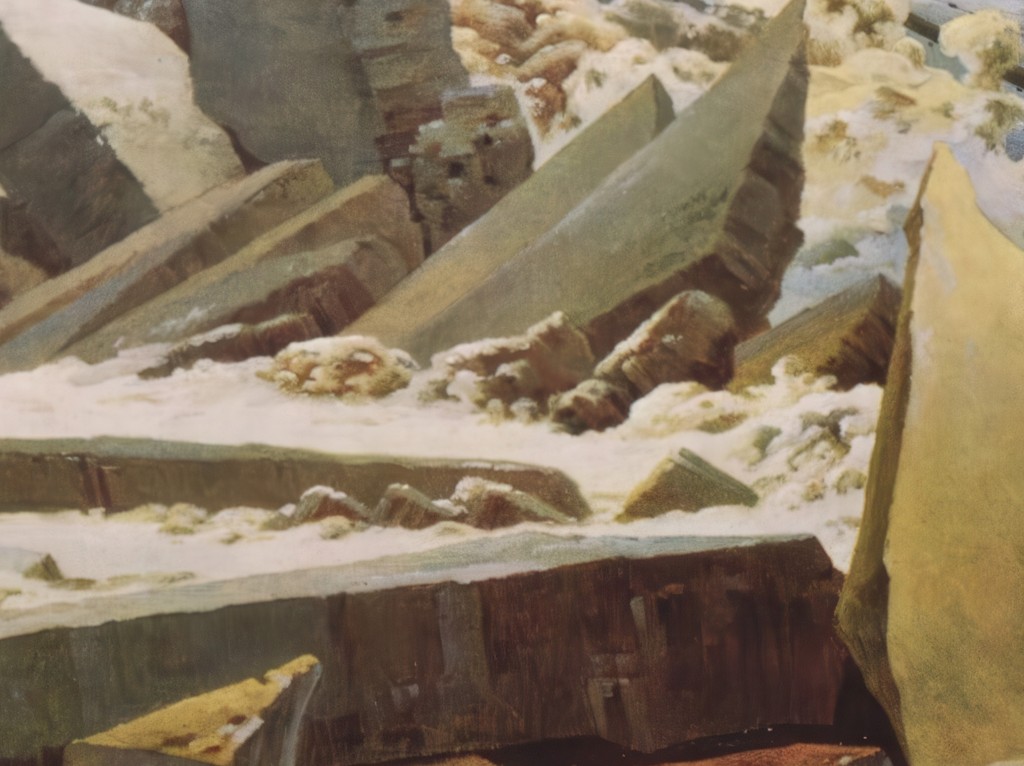
This annotated close reading follows six visible details in Friedrich's polar shipwreck painting: the central ice mass, the buried hull, the step-like foreground floes, broken left-side fragments, the remote horizon and the varied ice surfaces. The notes keep the wreck source-bound and avoid assigning the ship to a specific expedition.
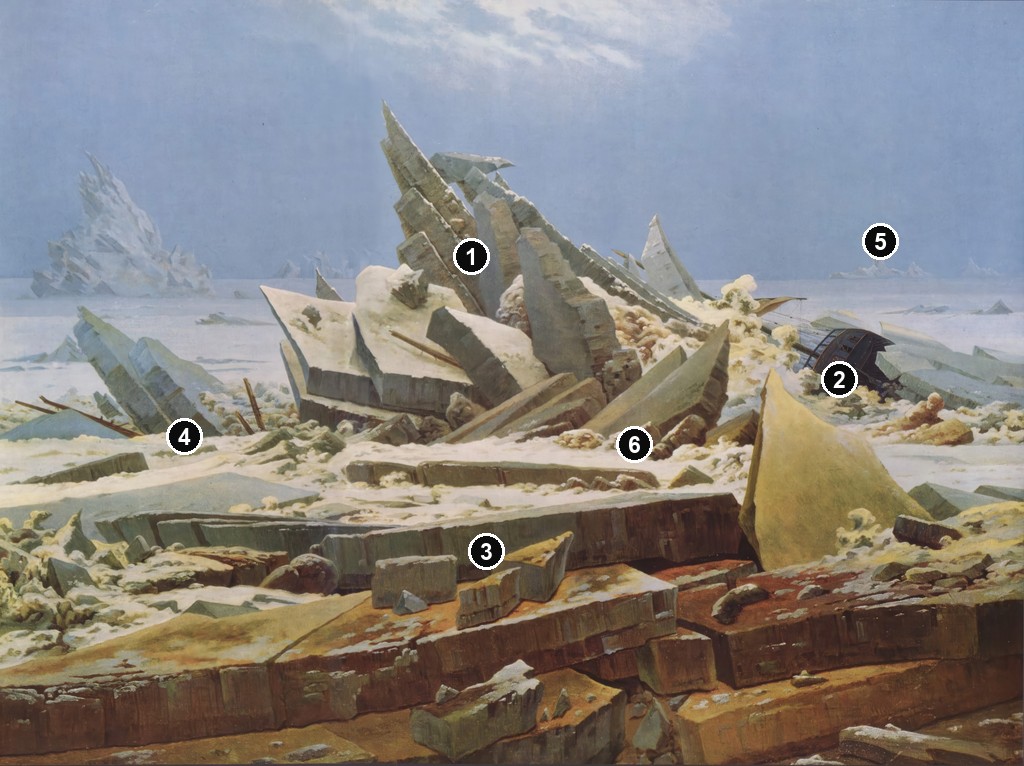
Details from THE SEA OF ICE
These details use the metadata-clean high-resolution Sea of Ice image prepared for this page.
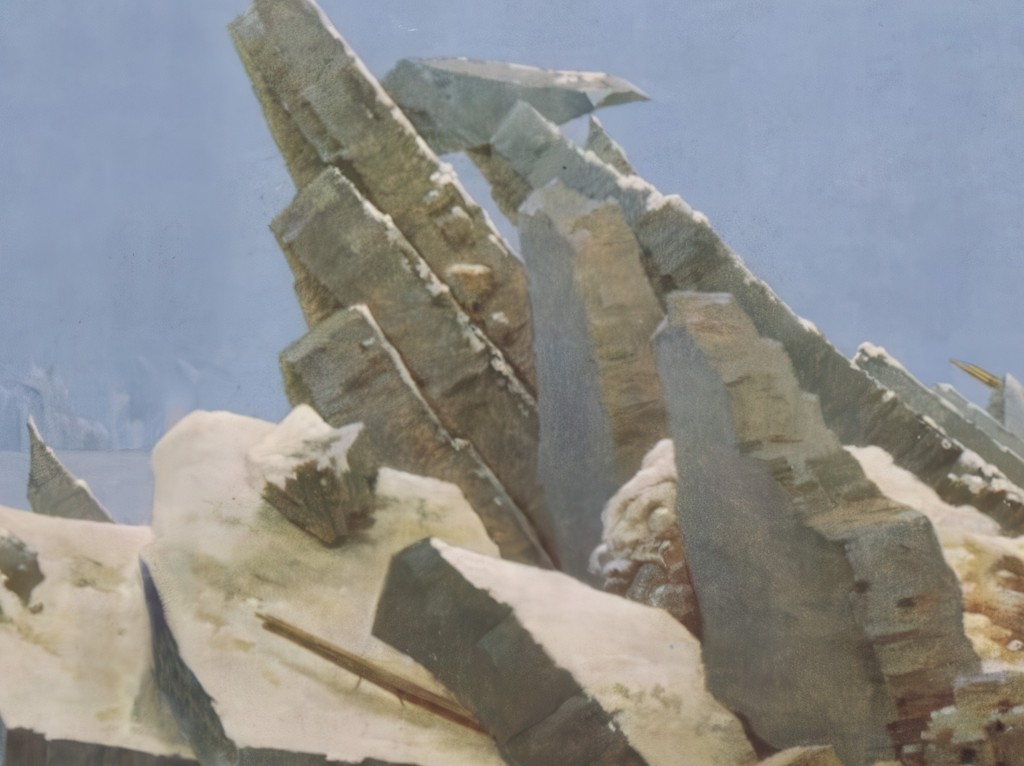
Central ice mass
The tilted slabs rise like broken architecture, making ice the painting's dominant structure rather than a background setting.
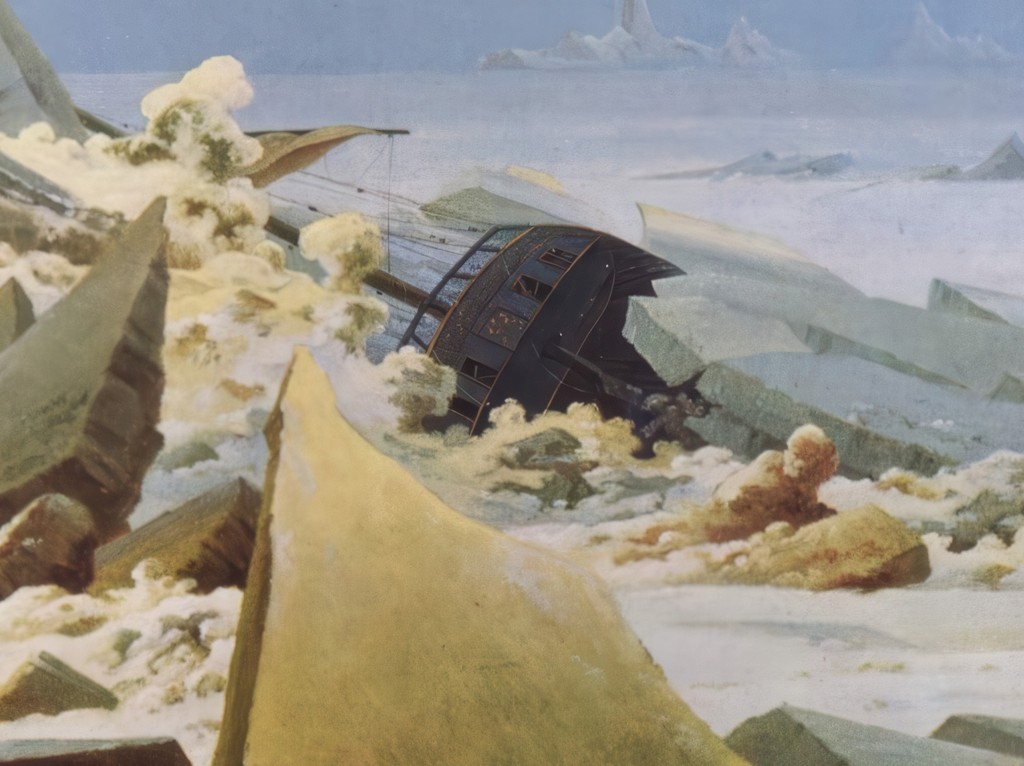
Buried hull
The ship appears as crushed fragments wedged into the floes, visible mainly through its defeat rather than as a clear maritime subject.
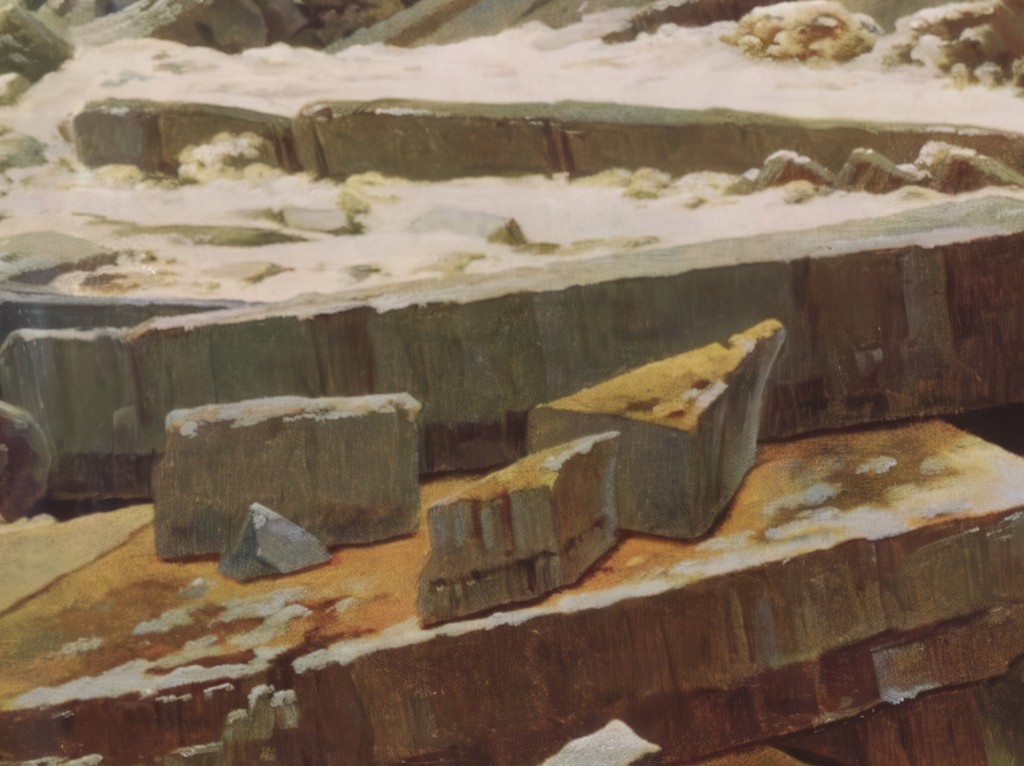
Step-like foreground
The foreground floes seem to offer a route into the picture, but their broken edges quickly make that imagined footing unstable.
Broken left-side fragments
Smaller fragments and timbers at the left extend the wreckage outward, turning catastrophe into a scattered field rather than a single event.
Remote polar horizon
The pale horizon and distant icebergs widen the scene beyond the wreck, keeping the catastrophe inside a larger polar expanse.
Surface and colour
Yellowed snow, blue-green ice and dark fractures keep the floes material and observed, even as Friedrich enlarges them into a severe vision.
Ice as Structure and Violence
The ice in The Sea of Ice is not background. It is the architecture of the painting. Large floes tilt upward from the foreground and middle distance, creating a jagged pyramid of frozen slabs. Their edges cut across one another, while smaller pieces spread outward toward the horizon. The effect is not smooth coldness, but pressure, fracture and collision.
Friedrich pushes the forms to monumental scale. cdfriedrich.de notes that although the finished painting connects to the Elbe ice studies at the level of motif, Friedrich took the proportions to an extreme and made them monumental. [1] This is crucial. The painting depends on exaggeration, but not on arbitrary fantasy. Friedrich began with observed ice and transformed it into a structure capable of carrying catastrophic meaning.
The ice also performs the work of violence without showing violence in progress. There are no waves crashing, no crew struggling, no moment of impact. The crushing has already happened. The painting shows the aftermath, which may be more disturbing because the ice now seems still. The catastrophe has become a landscape.
That stillness changes how the viewer reads time. A storm scene usually implies a before, during and after. Friedrich's frozen sea feels suspended. The ship's disaster has occurred, but the ice remains active as form. Its tilted slabs preserve the force of collision even in apparent immobility.
The viewer's eye moves from foreground fragments toward the central heap, then into the colder distance beyond it. Each movement is obstructed. The ice offers steps and ridges, but they do not lead safely into the picture. They lead toward wreckage, instability and a horizon that gives no comfort.
The Hidden Shipwreck
The wreck is essential, but Friedrich makes it hard to see. The ship does not occupy the centre like a heroic subject. Instead, it is wedged into the ice, its body crushed and partly concealed. The cdfriedrich.de gigapixel feature describes the wooden body of the ship as being slowly and inexorably buried by irrepressible forces. [2]
This hiddenness matters. If the ship were clearly displayed, the painting might become a conventional maritime disaster scene. Friedrich refuses that clarity. He makes the viewer discover the wreck inside the ice, almost as an afterthought. The result is a disturbing reversal: the human story is secondary to the natural structure that destroyed it.
The rigging and small ship details reward close looking. The gigapixel feature notes that in the original painting the ship's rigging is barely visible to the naked eye, and connects that detail to Friedrich's long familiarity with ships as a coastal-born artist. [2] This means the ship is not carelessly rendered. It is deliberately subordinated.
The title The Wreck of Hope becomes powerful in this context. Hope is not shown as a dramatic allegorical figure; it appears as a ship reduced to fragments. The painting does not need to name a crew or event. A vessel that should have carried people through the world has become a sign of failed passage.
The absence of bodies deepens the effect. Friedrich does not show suffering directly. He shows a world after human suffering has disappeared from view. The missing crew becomes part of the silence. The viewer confronts not the spectacle of death, but the evidence of erasure.
Elbe Ice Studies and Observed Material
The painting's polar world began with a local event. During the severe winter of 1820/21, the Elbe near Dresden froze, and Friedrich was fascinated by the ice floes. [1] [2] cdfriedrich.de notes that he normally worked outdoors with pencil and sketchbook, adding color later in the studio, but in this case he had painting materials with him by the river. [1]
Three irregularly cropped oil sketches of ice floes survive and are connected to this episode. [1] [2] They show Friedrich studying angular forms and color values in frozen water. [1] The gigapixel feature describes them as outdoor sketches that later became the basis for The Sea of Ice, with the floes scaled to monumental proportions. [2]
This working process prevents a false division between realism and imagination. Friedrich did not visit the Arctic, but he did not invent ice from nothing. He observed the physical behavior of frozen water at close range, then reimagined those forms in a polar setting.
The Elbe studies also explain the painting's close attention to ice as material. The floes are not generic white shapes. They have color, thickness, transparency, dirty edges, shadows and broken surfaces. Friedrich turned those qualities into pictorial drama.
Carl Gustav Carus, Friedrich's friend and fellow artist, wrote about the breaking of the ice on the Elbe in January 1821, describing floes thrust up near the shore and noting their yellowish and greenish-blue color. [2] The gigapixel feature uses that text to illuminate the kind of phenomenon Friedrich had before him. The final painting carries that experience far beyond Dresden, but its visual credibility begins there.
Polar Expedition Context
The Sea of Ice belongs to an age of Arctic fascination. cdfriedrich.de notes that in the years around the painting's creation, various expeditions were launched and many were stopped in pack ice. [1] The search for a Northwest Passage was not only a geographical project. It was also a symbol of ambition, technology, empire and the desire to push beyond known limits.
Friedrich's painting engages that context without becoming an illustration of one named expedition. The cdfriedrich.de object text explicitly cautions that he does not appear to have intended the painting to refer to a specific undertaking. [1] That caution is important. The wreck should be read within polar expedition culture, but not forced into a single historical event unless a source proves the connection.
The ship therefore stands for a type of human ambition rather than a documented vessel. It evokes the urge to advance into hostile regions, and cdfriedrich.de interprets the catastrophe as exposing the search for a Northwest Passage as an expression of human hubris. [1]
This reading must remain bounded. The painting does not need to be turned into a modern environmental allegory or a general warning against exploration. Its historical force lies in the nineteenth-century encounter between polar imagination, scientific ambition, maritime risk and Friedrich's own language of landscape.
The Arctic had a special visual power because it represented nature at an extreme. It was distant, difficult to reach and resistant to ordinary human control. Friedrich's painting uses that extremity to make the wreck feel almost inevitable. The ice is not a setting through which the ship passes; it is the force that stops passage altogether.
First Exhibition and Reception
The Sea of Ice was not immediately absorbed into comfortable admiration. The cdfriedrich.de gigapixel feature notes that the painting caused a stir during its first exhibition tour in 1825/26, and that its radical composition met with incomprehension and sometimes indignation. [2] That response is important because it confirms how strange the painting looked in its own time.
The difficulty is understandable. Friedrich offered viewers neither a conventional seascape nor a straightforward shipwreck narrative. There is no dramatic rescue, no heroic crew, no recognizable expedition scene and no moralizing figure pointing toward the lesson. Instead, the picture confronts viewers with a cold structure of broken ice in which the ship is almost absorbed.
Hamburger Kunsthalle's archive for the 2005 exhibition Watzmann trifft Eismeer notes that The Sea of Ice and The Watzmann were shown together in Hamburg and Berlin in 1826, and that both works represented distant, grand landscapes Friedrich had not seen with his own eyes. [3] The same archive text stresses nature's unmeasurable size, inaccessible distance and destructive force in these paintings. [3]
That pairing helps explain why The Sea of Ice belongs with Friedrich's mountain paintings as well as his seascapes. The work is not only maritime. It is a landscape of remoteness and extremity, a place where human scale fails. The wreck turns that failure into an event, but the real subject is larger than the ship.
The early incomprehension also helps prevent a modern misunderstanding. Because the painting is now famous, it can seem self-evidently powerful. In 1825/26, its visual logic was less obvious. Its modern authority partly comes from the fact that Friedrich risked a composition whose refusal of ordinary pictorial pleasure could be difficult for contemporary viewers.
Sublime Nature Without Secure Viewpoint
The Sea of Ice has often been discussed in relation to the sublime, but Friedrich complicates that tradition. The sublime usually depends on distance or safety. A viewer may feel terror or awe before a vast natural force, but from a position secure enough to reflect on the experience. Friedrich makes that position unstable.
cdfriedrich.de notes that the step-like ice floes in the foreground initially invite the viewer to enter the pictorial space imaginatively, but soon make it difficult to define one's position before the painting. [1] That is exactly the problem. The ice seems to offer a path, then denies safe footing.
There is no figure like the Wanderer to stand in for the viewer. There is no monk whose small body marks human scale. There are no spectators at the edge of the scene. Instead, the viewer faces an unpeopled frozen world in which the one sign of human presence has already failed.
This absence makes the painting less consoling than a conventional sublime scene. The viewer cannot enjoy nature's power from a stable human position inside the image. The painting's uncertainty comes from the fact that there may be no proper place from which to master the view.
The central ice heap also blocks visual movement. It rises like a barrier, not like a mountain that promises ascent. The eye cannot climb it comfortably. It is broken, slippery, angled and hostile. Friedrich makes visual structure itself resist possession.
What the Painting Withholds
The painting withholds almost everything that would make catastrophe easier to narrate. There is no visible crew. There is no body, lifeboat, flag or rescue party. There is no single dramatic instant of collision. The wreck is present only as aftermath, and even that aftermath is partly hidden beneath the ice.
This restraint makes the painting harsher. A visible survivor would give the viewer a human point of identification. A named vessel would anchor the scene in historical reportage. A clear storm would explain the disaster as a passing event. Friedrich gives none of these. He leaves the viewer with the result: a ship that has become debris inside a frozen world.
The absence of people also changes the emotional temperature. Monk by the Sea still contains a solitary human figure, however small. Wanderer above the Sea of Fog depends on the back-turned body at the centre of the composition. In The Sea of Ice, the human being appears only indirectly, through wreckage. The painting shows a world after human agency has failed.
Even the title The Wreck of Hope should be read through that withholding. It sounds narrative, but the painting does not narrate hope's final moments. It shows the remains after hope has been crushed, buried and frozen into the landscape. The emotional force comes from delay and discovery rather than spectacle.
This is why the work can feel both literal and symbolic. It is literal enough to show ice floes and a shipwreck. It is symbolic enough to make the wreck stand for a larger failure of human ambition. Friedrich holds those two modes together by refusing excess explanation.
Color, Surface and Close Looking
The painting's severity depends on color as much as form. The ice is not simply white. The gigapixel feature draws attention to frozen snow, translucent ice, light reflections, dark shadows and different handling across surfaces. [2] Friedrich used paint thickly in some places and more thinly in others, allowing a pinkish-red ground to show through in certain passages. [2]
The sky also contains subtle material effects. The gigapixel feature notes blue dots in the surface, coarser particles of the blue pigment Friedrich used for the sky, and identifies that pigment as smalt, made from ground blue cobalt glass. [2] These details matter because they show how the painting's cold atmosphere was built from specific materials, not from generalized whiteness.
The feature also describes traces of preliminary drawing visible where brown and white strokes meet. [2] This is useful for understanding Friedrich's discipline. The painting can appear wild and catastrophic, but it was carefully constructed on the canvas.
The modern condition of the work adds another layer. The gigapixel feature describes The Sea of Ice as exceptionally well preserved, with vibrant colors and paint layers that have largely adhered to the support, while also noting that the work is rarely loaned because even slight disturbance can stress or damage it. [2]
This material fragility is worth holding beside the image's subject. The painting shows hard, crushing ice, but the object itself is delicate. Its cold force reaches us through vulnerable paint, canvas, pigment and conservation care.
Modern Extremity and Human Limits
The Sea of Ice still feels modern because Friedrich makes catastrophe almost abstract without making it empty. The painting has no central hero, no rescue drama and no sentimental ending. It offers structure, wreckage and silence.
The Met's recent Friedrich exhibition describes the artist's broader achievement as transforming landscape into a site of spiritual, emotional and existential encounter. [4] The Sea of Ice is one of the most severe examples of that transformation. Nature is not a comforting mirror of the self. It is a force before which human projects are revealed as fragile.
The painting's modernity also lies in how it handles scale. The ship, an object of travel and human intention, is reduced to a partial sign. The ice, which has no intention, becomes the dominant form. This reversal gives the painting its unsentimental force.
The work can speak to later viewers interested in environmental crisis, exploration, technological hubris or polar imagination, but those modern resonances should not replace the painting's historical setting. Friedrich was responding to the visual, scientific and cultural world of his time: frozen Elbe studies, Arctic expeditions, the Northwest Passage, landscape theory and the limits of the sublime.
The painting remains powerful because it refuses to make catastrophe theatrical. It shows no moment of impact, no dramatic rescue, no moral caption. It leaves us with ice and the buried remains of a human vessel. That is enough.
What a voyage journal could show
William Edward Parry's account of the 1819–20 voyage appeared in London in 1821. Its title names the Hecla and Griper, gives the dates and describes the Admiralty's purpose of finding a passage between the oceans. The volume also includes scientific observations. The Alte Nationalgalerie cites the expedition as a possible stimulus for Friedrich. The book provides evidence for the kind of Arctic journey his first audiences could read about. It establishes no identification of the particular ship painted in Hamburg.[6] [7]
Both ships in Parry's expedition returned. During the voyage the crews wintered at Melville Island, where they used the long interruption for a range of activities, including producing a newspaper and giving theatrical performances. These details matter to the comparison because a printed account can tell how people occupied the time during which the ice prevented further movement. It can follow the preparations for wintering, distinguish one vessel from the other and record what happened when navigation became possible again. Friedrich gives a spectator scarcely any comparable information about the people who might have been aboard the damaged ship.[7] [8]
The imagined wreck makes the most visible evidence of the expedition its equipment. The narrow lines of the rigging can be made out near the broken hull, particularly in the museum's enlarged photograph. A spectator who has found those lines can work back to the scale of the vessel, but cannot reliably determine its name, route or the fate of its crew. Compared with a voyage journal, the painting gives the least information about events at the point where its ice gives the most vivid impression of material force. The uncertainty is part of how the picture works.[2] [7]
The difference also helps explain why a named ship can be an attractive interpretation. Finding a name supplies a beginning and an ending outside the frame. Once a viewer treats the rigging as evidence of a particular event, a published narrative can fill in the space the painter has left unoccupied. The return of Parry's ships provides a reason to keep the historical stimulus and the imaginary disaster distinct. The most secure connection to the expedition is through the wider attention given to Arctic navigation during Friedrich's lifetime.[1] [6] [8]
Carus and the place from which ice can be seen
The comparison with Carl Gustav Carus extends beyond his eyewitness description of the Elbe. He travelled to Chamonix in 1821 and looked across the Mont Blanc group from Montenvers. The Metropolitan Museum's catalogue records his attention to the changing colours of the ice and mountains. His later oil of that view, held by Museum Folkwang, makes the encounter part of the subject by placing two figures at the edge of the terrain. The Hamburger Kunsthalle used the picture to bring out a difference between Carus's glacier and Friedrich's polar scene.[9] [10]
In the Carus the figures give a viewer a way to locate the act of looking. However vast the glacier seems, someone has reached a point from which it can be observed. A spectator can compare those bodies with the near edge and follow the opening of the landscape beyond. In Friedrich's canvas the wreck gives a measure for the size of the broken slabs, but nobody can be seen occupying a stable position from which to inspect them. The painting allows a close look into the pile without establishing how a person might arrive at the place from which it is seen.[1] [9] [10]
Both painters knew how much variation ice could contain. Carus's travel account describes the colour across a distant view, and his Elbe account describes the appearance and thickness of individual floes from nearby. Friedrich's composition lets a spectator look into a structure that feels close while also seeing a pale distance. The two ranges of looking are brought together on one surface. The painting gives considerable precision to the edges of ice without making the place of the viewer equally precise.[1] [2] [9]
This comparison makes the move from Dresden to an imagined polar landscape more concrete. The study of near ice can supply an edge that appears freshly broken or a shift of colour through a thick slab. The picture as a whole still needs a decision about who could see such a thing and from where. Carus's travellers answer that question in part. Friedrich's ship, already caught in the mass, supplies a scale and the trace of a journey without providing a place for the viewer to stand.[1] [10]
The picture in the gallery and in a detail photograph
The anniversary project describes how Christoph Irrgang photographed the canvas on a grid of thirty-six exposures with overlaps. That method gives a digital viewer access to marks easily overlooked at the scale of the wall. The rigging becomes a particularly instructive test. At ordinary viewing distance the thin lines compete with the edges of the slabs. In enlargement they become a distinct set of marks that can be followed one at a time. The digital detail changes which kind of information comes first.[2]
The painting occupied a very different arrangement at the 1906 German Centenary Exhibition in Berlin. The surviving installation photograph shows it among other Friedrich paintings in two rows, with The Monk by the Sea and The Stages of Life nearby. In that room a spectator could compare the large central mass of ice with a sea defined by wide horizontal bands or with a shore on which the figures and boats remain visible. The arrangement made large differences of composition easy to discover. An enlarged view of the rigging offers an encounter with the opposite end of the scale.[11]
Together the photograph of the gallery and the grid of photographs of the object help distinguish two kinds of access. One preserves a setting in which the entire painting appeared in relation to other works. The other lets a viewer reconstruct a small passage at a scale the historical spectator would not have had. Neither determines how far away to stand when encountering the canvas itself. Returning from the detail to the whole makes it possible to notice the deliberate imbalance between the careful attention given to the ship's small features and the relatively little room they occupy.[2] [11]
Related Friedrich Works
Monk by the Sea offers a useful comparison in reduction. The Monk painting keeps a solitary figure before shore, sea and sky; The Sea of Ice removes the human figure and leaves only the wrecked trace of human effort.

Wanderer above the Sea of Fog places a person above a clouded mountain landscape. The Wanderer seems to hold a viewpoint, while The Sea of Ice makes any secure viewpoint difficult.
The Watzmann belongs close to The Sea of Ice as another remote, grand landscape Friedrich had not seen directly. [3] The Hamburger Kunsthalle's 2005 exhibition text presented the two works together as distant, monumental images of nature's grandeur and destructive force. [3]
The drawings page is important because the painting depends on Friedrich's practice of studying natural forms and transforming them later in the studio.
The biography and paintings pages give broader context for Friedrich's working method, northern imagination and repeated use of elemental landscapes.
Frequently Asked Questions
Discussion
Reader insights are welcome, especially close-looking observations about the crushed ship, the ice floes, Friedrich's Elbe studies, polar expedition context and whether the title The Wreck of Hope changes the reading.
Reader Insights
Which slabs feel like structure, and which feel like violence?
Does the ship feel central, or almost swallowed by the landscape?
How much should Arctic expedition context shape the painting?
In The Sea of Ice, does the wreck feel like the subject of the painting, or like a human trace swallowed by the ice? The answer changes whether the work appears first as a disaster scene or as Friedrich's vision of nature beyond human control.
Join the Conversation
Share a close-reading note or a source-grounded comparison with Friedrich's other severe landscapes.
References
- The Sea of Ice, cdfriedrich.de, Caspar David Friedrich anniversary Chronicle Source
- ZOOM IN The Sea of Ice, cdfriedrich.de gigapixel feature Source
- Watzmann trifft Eismeer, Hamburger Kunsthalle exhibition archive, German-language source. Source
- Caspar David Friedrich: The Soul of Nature, Metropolitan Museum of Art exhibition page Source
- Hamburger Kunsthalle, Caspar David Friedrich: Kunst für eine neue Zeit. Institutional source
- Alte Nationalgalerie, Infinite Landscapes exhibition texts, on the Elbe studies and Parry as a possible stimulus.
- William Edward Parry, Journal of a Voyage for the Discovery of a North-West Passage, London, 1821, digitized by the Biodiversity Heritage Library.
- Royal Museums Greenwich, William Edward Parry first North-West Passage expedition 1819–20, voyage and wintering history.
- Metropolitan Museum of Art, German Masters of the Nineteenth Century, p. 68, catalogue entry on Carus's Mont Blanc painting.
- Hamburger Kunsthalle, Chapters of Caspar David Friedrich: Art for a New Age, comparison of Friedrich's ice and Carus's glacier.
- Staatliche Museen zu Berlin and anniversary museum partnership, Caspar David Friedrich and the German Centenary Exhibition of 1906, installation photograph and display account.


