



 by Tom Gurney
Tom Gurney BSc (Hons) is an art history expert with over 20 years experience
Published on June 19, 2020 / Updated on October 14, 2023
Email: tomgurney1@gmail.com / Phone: +44 7429 011000
The Lonely Tree: Introduction
A shepherd leans against an oak beside a pool. His sheep have spread out over the grass, and far beyond them smoke rises above the roofs of a village. The shepherd is easy to miss because the tree holds the centre of the painting from the dark meadow to the pale sky. Caspar David Friedrich painted this landscape in 1822 as the morning half of a commission for the Berlin banker Joachim Heinrich Wilhelm Wagener. The oak stands apart from the other trees, but the longer you look at the painting, the more signs of company and work you find around it. [1][2]
At a Glance
- Artist — Caspar David Friedrich
- Museum titles — Der einsame Baum and The Solitary Tree [1][2]
- Date and medium — 1822, oil on canvas
- Dimensions — 55 cm high × 71 cm wide
- Collection — Alte Nationalgalerie, Staatliche Museen zu Berlin, W.S. 52 [1][2]
- Companion — Moonrise over the Sea, 1822, Alte Nationalgalerie, W.S. 53 [3]
Contents
- Introduction
- Beneath the oak
- The villages and the far ridge
- A landscape made from studies
- Morning and evening for Wagener
- From a green plain to a solitary tree
- Annotated Details
- Image Details
- The oak in snow and the oak in pasture
- Two mornings in different commissions
Beneath the oak
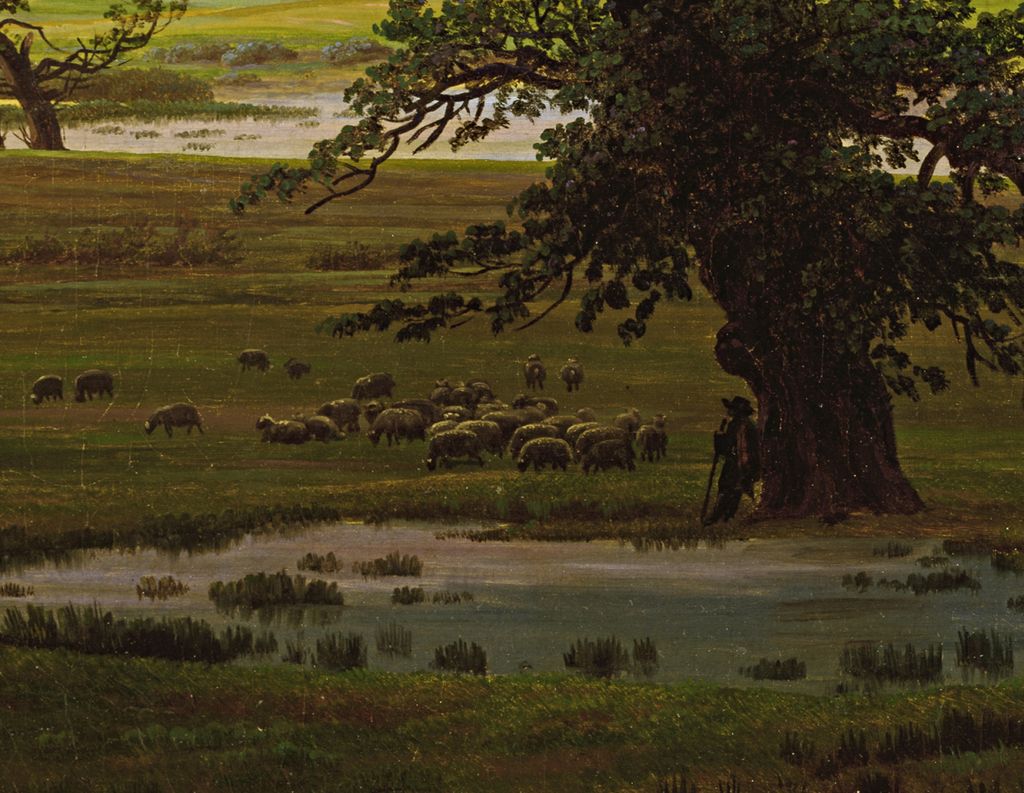
Look for the shepherd on the left side of the trunk. His outline is almost lost against the bark, and a branch hangs low above him. Once you see him, the sheep scattered to his left are easier to pick out. The trunk gives the shepherd somewhere to rest while he stays with his flock. It also gives us a measure of the tree's size. From the point where he stands, the branches seem to climb a very long way before the uppermost twigs reach the sky. [1][4]
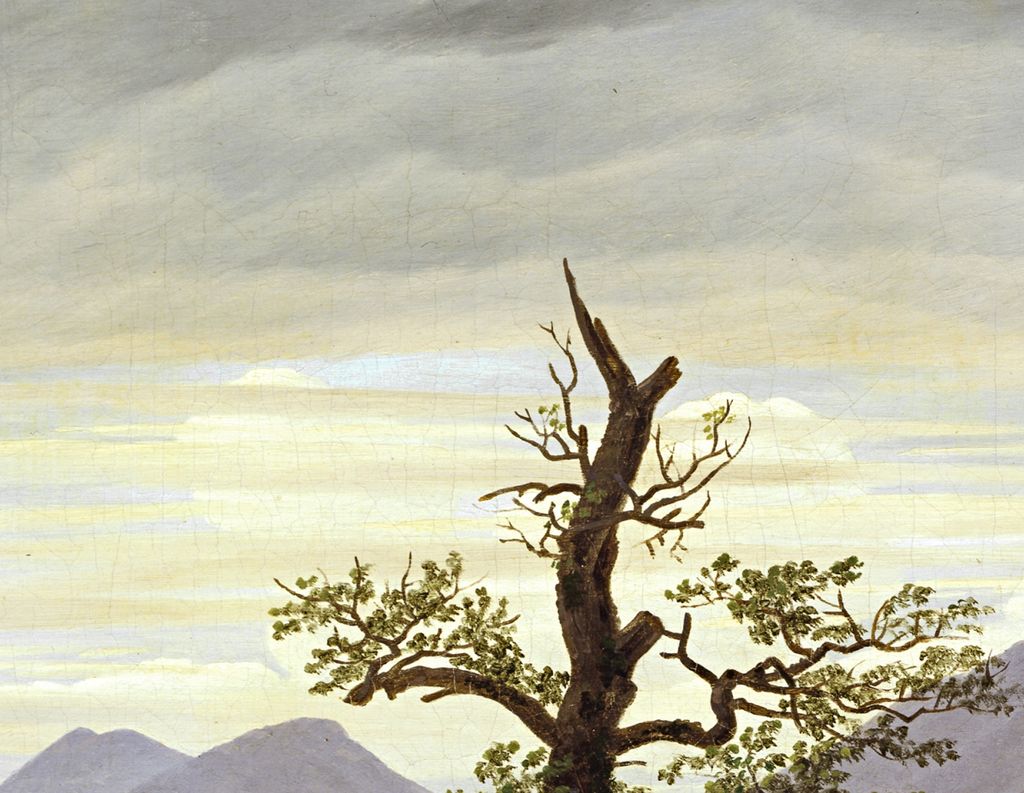
That climb changes the appearance of the oak. Its lower branches still carry dense foliage. Higher up, the leaves come in smaller clusters with clear spaces between them, and at the very top the wood is bare. Some of the tree's darker foliage merges with the ground and with the shaded trees farther off. Above the ridge, the bare twigs are sharply legible against the light. Friedrich makes the damage most visible just where the oak stands out most clearly. Birgit Verwiebe, writing for the Alte Nationalgalerie, reads this mixture of strength and decay as a way of joining earthly life to a realm beyond it. The shepherd's use of the tree gives that reading a footing in an ordinary act. Even an old tree with dead branches can still offer shelter. [1][4]
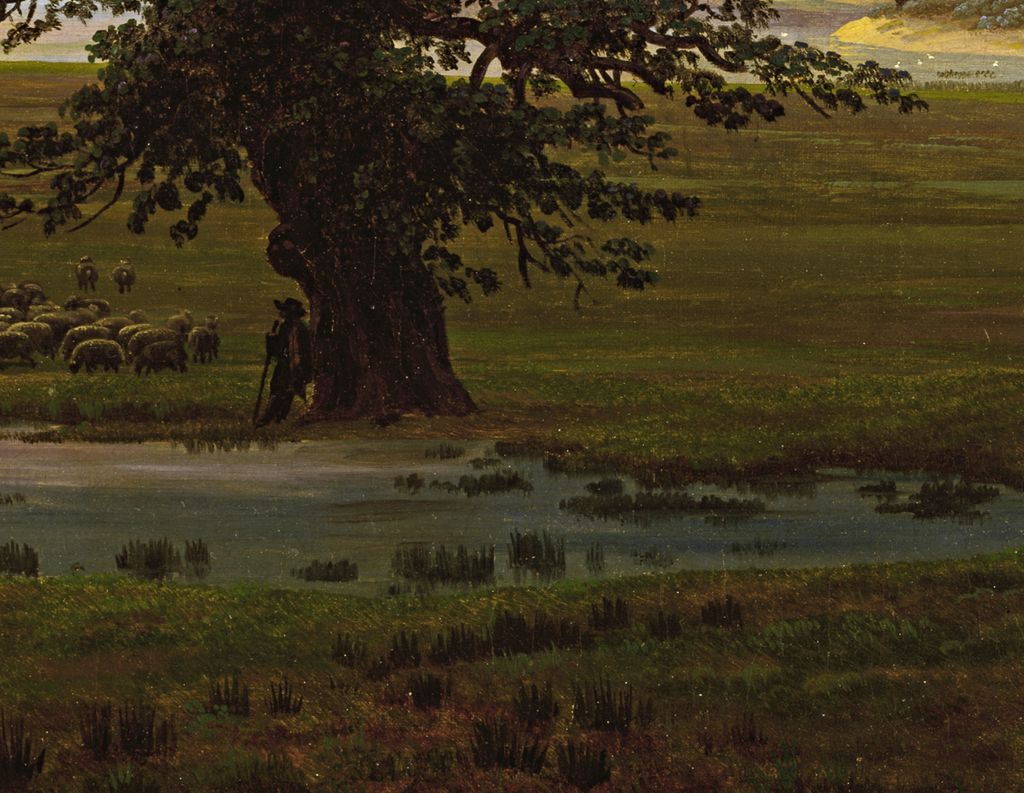
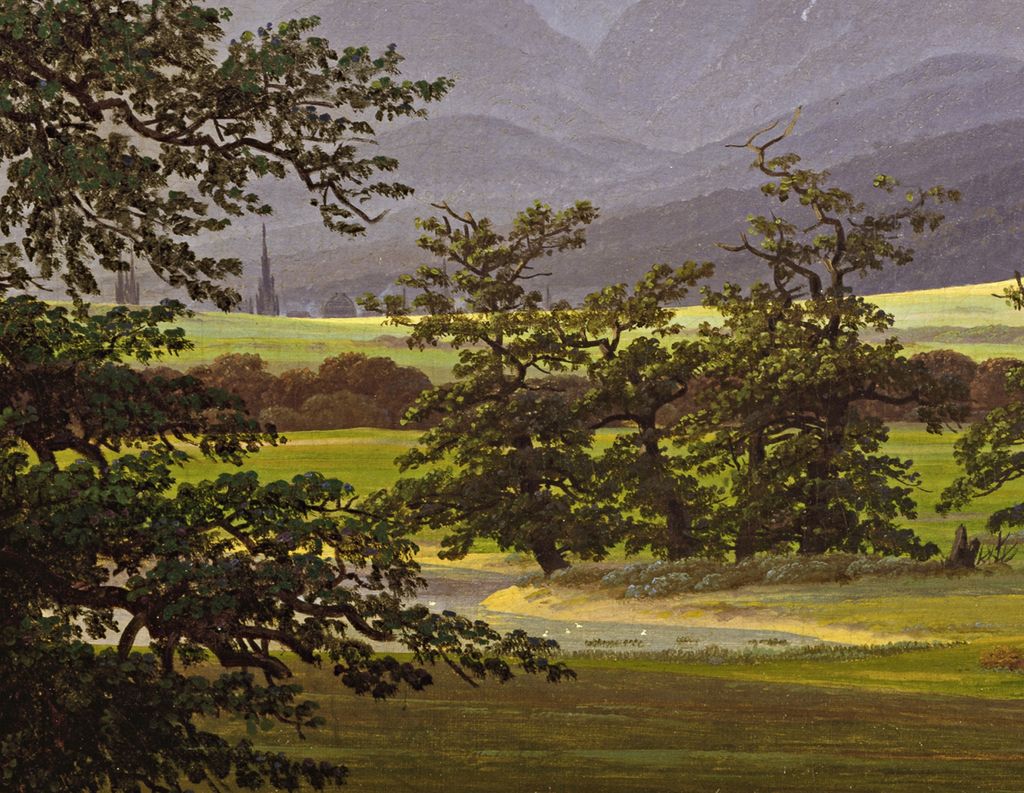
The pool below the oak catches the cool light of the sky. Around it the grass is still dark. Farther back, brighter greens and yellows stretch across the meadow in broken bands, with groups of trees interrupting them. Because Friedrich gives us a high viewpoint, we can see the surfaces of the pools as well as the successive strips of land. The foreground oak crosses those strips, so that the eye can move far into the picture and still judge that distance against a single nearby form. [1][4]
The villages and the far ridge
The signs of habitation take time to distinguish. At the foot of the mountains, pointed towers rise only a little above the intervening ground. Elsewhere pale smoke gives away the position of houses that almost disappear into the trees. The Met's exhibition catalogue draws attention to white waterfowl on a pond and reads the smoke as a sign of households lighting their fires at the start of the day. The scale of these details is part of their effect. Near the oak it takes a human figure to make the trunk look immense. In the distance it takes a tower or a plume of smoke to make a dark strip of land read as somewhere people live. [1][4]
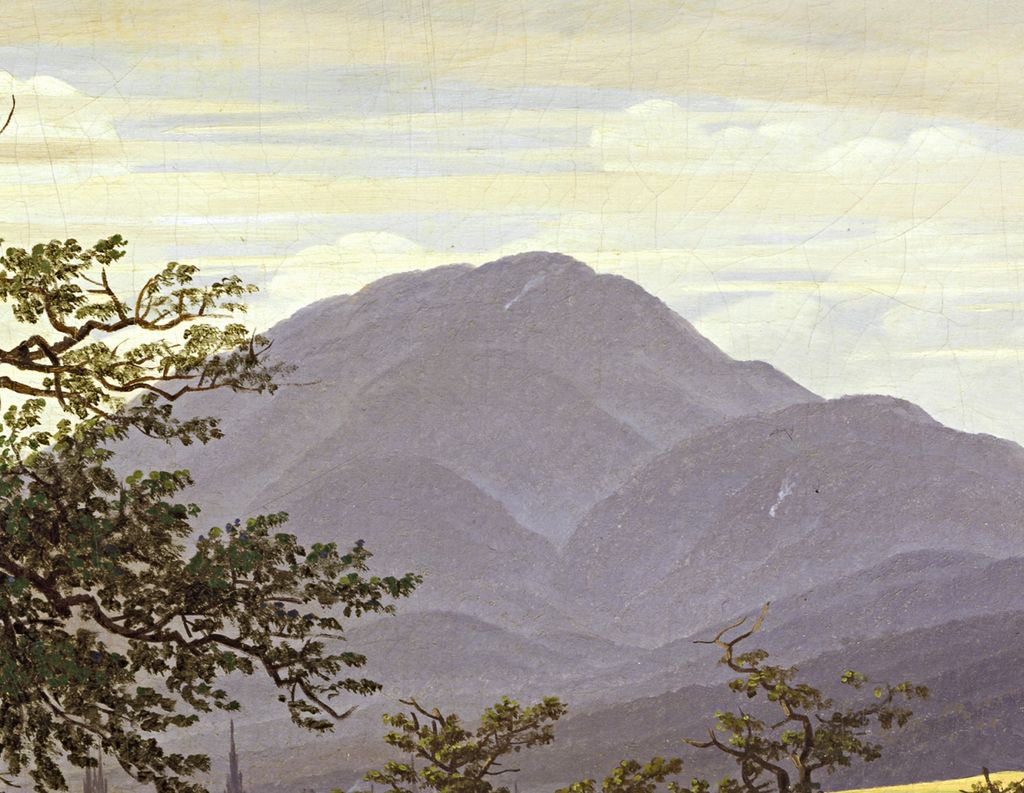
The morning light comes into the picture unevenly. The low sky is pale, and the clouds darken above it. On the ground a patch of brightness can end at a line of trees, while the next patch begins much farther back. The far ridge has a cooler, bluer colour than the land beneath it. These shifts let Friedrich open a broad distance on a canvas only 71 centimetres wide. The rising oak gives the sky a scale of its own. Its spreading branches follow some of the outward movement of the clouds, while the bare tips of the oak remain distinct against them. [1][4][5]
A landscape made from studies
The Alte Nationalgalerie identifies the distant mountains as part of the north Bohemian Jeschken range, associated with today's Ještěd in Czechia. Friedrich drew in the region in 1810, when he and the painter Georg Friedrich Kersting travelled on foot to the Giant Mountains. For the oak he drew on studies made between 1806 and 1810 in the Neubrandenburg area and in the mountains. The picture brings observations from different journeys into one view. The mountain profile helps to set the depth of the landscape, while the much nearer oak stands high enough to cut across it. [1][4][5]
One surviving sheet makes that process easier to see. Friedrich dated the pencil drawing now called Old Oak with Storks’ Nest 23 May 1806. Peter Prange places it near Neubrandenburg and identifies it as a source for the 1822 canvas. In the drawing, a few indications of ground and distant trees leave most of the paper empty around the irregular trunk. The storks' nest sits visibly at the top. In the painting, the bare extremities of the oak stand against open sky, and foliage and shadow tie the lower branches to the pasture. Friedrich put the shapes he had studied to work at the scale of a whole landscape. [1][5][6]
The canvas also preserves evidence of his working materials. A 2024 technical study reports that the weave of this painting matches that of three other Friedrich canvases, including the Berlin Oak Tree in Snow. The researchers compared maps of the thread density. The patterns were consistent with all four canvases having been cut from the same bolt, about 75 centimetres wide. That links two very different treatments of an oak, one surrounded by pasture and the other standing bare in snow. [7]
Morning and evening for Wagener
Wagener asked Friedrich for two times of day, and Friedrich reported both canvases finished in a letter to him dated 1 November 1822. The Nationalgalerie traces the pair to an exhibition at the Dresden Academy in April 1823, so they could only have reached Wagener after that showing. Both paintings entered the Nationalgalerie's founding collection through his bequest in 1861. [1][3][8]
On two canvases of the same size, Friedrich places the strongest dark shapes at different heights. In the morning painting the trunk carries that weight almost to the top. In Moonrise over the Sea, the figures and boulders hold it close to the shore, and most of the sky opens above them. The people give the two scenes different points of focus. The shepherd is occupied within the landscape, and the signs of activity continue into the distant villages. In the evening painting, the watchers direct attention beyond their immediate surroundings. The morning opens onto a day already underway, with some of its activity visible even far from the shepherd. [1][3][5]
From a green plain to a solitary tree
In the 1861 catalogue of Wagener's collection, Gustav Friedrich Waagen began the entry with Eine grüne Ebene (A Green Plain). The description then proceeds toward the village and mountains, followed by the old oak and the shepherd. Another name, Dorflandschaft bei Morgenbeleuchtung (Village Landscape in Morning Light), also puts the setting first. In the Nationalgalerie's 1876 catalogue, Max Jordan called the work Harz-Landschaft (Harz Landscape) and described the light as late evening. The present museum record identifies the ridge from Friedrich's Bohemian studies and connects the morning subject to Wagener's commission. It credits Ludwig Thormaehlen with the later title Einsamer Baum, which shifts attention to the tree itself. [1][3][6][9]
At the German Centenary Exhibition in Berlin in 1906 the painting was still known as Harz Landscape. In the exhibition catalogue, Julius Meier-Graefe described the succession of colours from shadowed grass and the faintly pink surface of the pool to the blue-grey mountains and the clouds above. In his review Ferdinand Laban also picked out the blue shadows and took the light for sunset. The two accounts show what caught their attention during the exhibition that renewed interest in Friedrich. The title by which we now know the painting directs the eye to its darkest and most definite form. Meier-Graefe's account gives us a way to look beyond it, following the changes in colour until the same sky that outlines the oak turns up again in the pool at its feet. [5][9]
The oak in snow and the oak in pasture
The Berlin Oak Tree in Snow gives a close comparison because it sets another large, solitary tree near a pond. In the winter canvas the branches spread against a much paler ground and sky, and the snow extends across much of the land around the trunk. In the earlier morning picture the oak belongs to a pasture that continues well beyond it. The dark trunk is easy to find at once, but the eye has many other forms to follow in the distance. The similarity of the principal motif makes it possible to see how differently Friedrich could distribute attention around it.[1] [7] [10]

The water also has a different part to play. The pond in the morning painting receives a slight change of colour from the sky and is bordered by ground that can be read as part of a working landscape. In the winter view the interruption of snow around the water changes the limited range of surfaces close to the tree. Neither pond needs to be large to affect the way we judge the rest of the ground. A small surface that reflects or interrupts the prevailing light can make a distant field and the base of a trunk feel more or less continuous.[1] [9] [10]
The fabric connection gives the comparison material specificity. The technical study finds a matching thread-density pattern in the canvases despite the difference in shape and the separation in date. The morning canvas spreads horizontally and the winter canvas stands vertically. A supply of prepared material could accommodate both choices. The same stock of cloth does not dictate whether a tree should occupy a broad place in the middle of a view or nearly fill the width of a narrower one.[7] [10]
Two mornings in different commissions
The Morning in Friedrich's Four Times of Day at the Landesmuseum Hannover gives the opening of a day a different task. The museum identifies a fisherman in a boat on a lake, with reddish light reflected in the water and mist over the surrounding terrain. The work belongs to a four-part sequence. Its low mountain line can be followed in relation to the ground and trees of the subsequent paintings. A person looking at the series has the option of considering the start of a day in relation to two intervening hours before reaching evening.[11]
In the Wagener morning, the oak supplies a much stronger upright than the Hanover fisherman or his boat. It makes morning visible on land through the relation of shelter, pasture and distant settlement. The most extensive water appears in the other half of the commission. The choice of two pictures gave Friedrich a way to make the change of hour coincide with a change in terrain. In Hanover the fisherman already gives water a practical use at the start of the series. Each morning can be compared with an evening, yet the composition puts that comparison to work in a different order.[1] [3] [11]
The similarities do help explain why the light in the Berlin oak painting could be read as evening when the pair's original circumstances receded from view. Pale light across a pool and darker land near the spectator can occur at either end of a day. A title or a letter supplies information about which hour the painter undertook to represent. A sequence gives the eye a related image against which to try that information. When the morning is encountered by itself, the pools, oak and scattered signs of work can hold attention before the hour has been decided.[3] [5] [9] [11]
Annotated Details from The Lonely Tree
Follow five details from the crown of the oak to the shepherd and the edges of the valley.
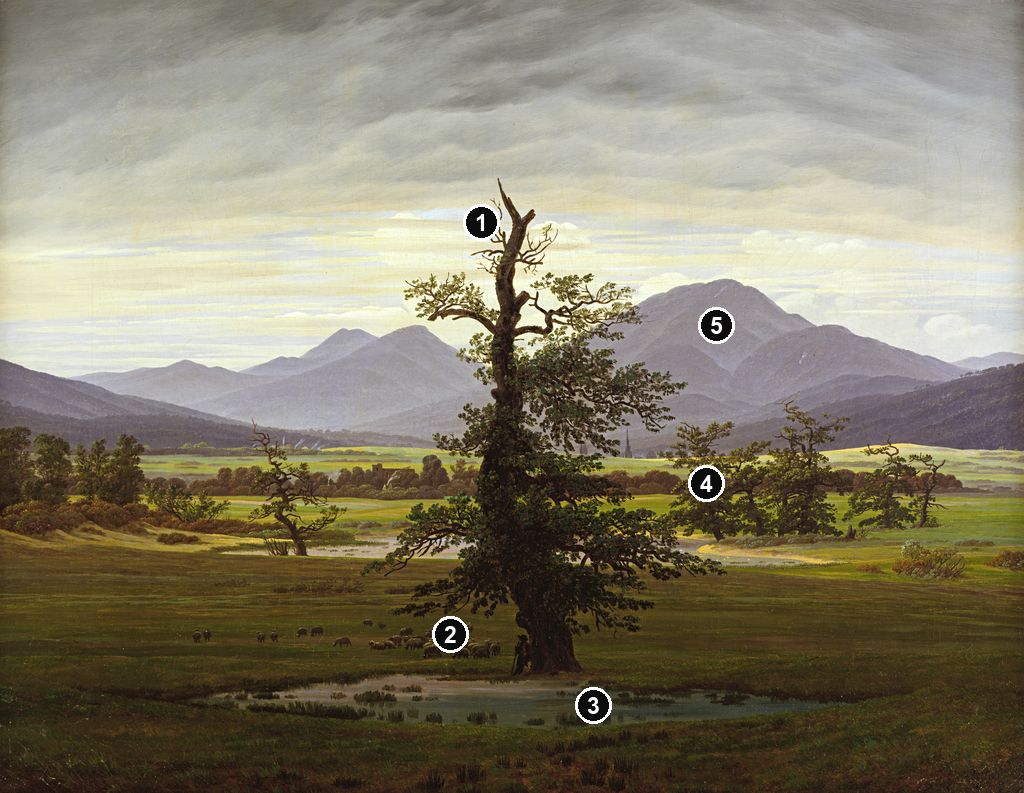
Details from THE LONELY TREE
The details show how Friedrich arranged a tall tree within the broad spaces of the morning landscape.
Broken crown
The broken trunk and thin branches stand out against the brightest strip of sky.
Shepherd and flock
The shepherd stands by the foot of the tree. Sheep gather nearby and spread into the meadow.
Water in the foreground
A shallow pool cuts across the foreground, catching light below the shadowed oak.
Fields behind the oak
Long horizontal strips of fields and meadow extend behind the trunk.
Distant ridges
Several mountain profiles overlap. Their cooler colours and softer edges give the valley depth.
Frequently Asked Questions
Discussion
Reader insights are welcome, especially close-looking observations about how the oak, meadow, shepherd and morning/evening pair shape the painting's mood.
Reader Insights
Where does the tree feel strongest, and where does it show age?
How do shepherd, flock, pools and towers change the sense of solitude?
What changes when The Lonely Tree is read beside Moonrise?
Does The Lonely Tree feel most powerful as a tree image, a morning landscape, or one half of the Wagener pair?
Join the Conversation
Share a source-grounded close reading of the oak, shepherd, landscape or Moonrise pairing.
References
- Alte Nationalgalerie, Staatliche Museen zu Berlin, Der einsame Baum, W.S. 52.
- Friedrich anniversary Chronicle, The Solitary Tree.
- Birgit Verwiebe, Friedrich anniversary Chronicle, Moonrise over the Sea, W.S. 53, with the archival reference for Friedrich's letter of 1 November 1822.
- Sabine Rewald, Caspar David Friedrich: Moonwatchers, Metropolitan Museum of Art, 2001, catalogue no. 6, pp. 38–39.
- Friedrich anniversary digital story, Caspar David Friedrich and the German Centenary Exhibition of 1906, including the painting, drawings and contemporary responses.
- Peter Prange, Friedrich anniversary Chronicle, Alte Eiche mit Storchennest, Hamburger Kunsthalle, 41097.
- Mechthild Most, Eva Wenders de Calisse, Jens Bartoll and Kirsten Hinderer, Zur Maltechnik Caspar David Friedrichs, 2024, pp. 20–22, fig. 20 and note 52.
- Nationalgalerie, Staatliche Museen zu Berlin, Acquisition Logs of the Nationalgalerie.
- Birgit Verwiebe, “Bestandskataloge – Galeriekataloge – Sammlungsführer”, in Die Sammlung der Nationalgalerie zum langen 19. Jahrhundert, pp. 23–40, especially pp. 23–30.
- Alte Nationalgalerie, Oak Tree in Snow, collection and catalogue account of the Berlin winter canvas.
- Landesmuseum Hannover, Tageszeiten: Caspar David Friedrich in Hannover and illustrated exhibition notes, including Morning, PNM 382.


