



 by Tom Gurney
Tom Gurney BSc (Hons) is an art history expert with over 20 years experience
Published on June 19, 2020 / Updated on October 14, 2023
Email: tomgurney1@gmail.com / Phone: +44 7429 011000
Caspar David Friedrich Paintings: Introduction
Caspar David Friedrich's paintings changed what landscape could do. Instead of treating mountains, coasts, ruins, trees, fog, moonlight and winter as attractive scenery, he made them carry questions about looking, faith, mortality, memory and inward life. A single figure seen from behind can turn a landscape into an act of attention; an empty shore can become a test of scale; a ruined abbey or a field of ice can make nature feel historical, spiritual and unstable at once.
At a Glance
- Page rolePaintings and works hub for Caspar David Friedrich.
- Active browse set37 paintings with linked essays.
- Main mediumOil painting, especially landscape painting shaped by drawing, walking and studio recomposition. [1] [2]
- Key placesGreifswald, Rügen, Dresden, Saxon and Bohemian Switzerland, the Giant Mountains, the Baltic coast and the Elbe. [3] [4] [5]
- Recurring motifsBack-turned figures, coasts, moonlight, ruins, crosses, trees, winter, graves, mountains, fog and ice.
- Best starting worksWanderer above the Sea of Fog, The Monk by the Sea, The Abbey in the Oakwood, The Cross in the Mountains, Chalk Cliffs on Rügen and The Sea of Ice. [6] [7] [8] [9] [10] [11]
Contents
- Introduction
- What a Friedrich Painting Does
- How the Paintings Develop
- Places and Motifs
- Paintings Friedrich made to be seen together
- Variants and the details that change
- Flagship Paintings
- Explore the Paintings
What a Friedrich Painting Does
A Friedrich painting is rarely only a view of a place. The picture may begin from a recognizable coastline, mountain ridge, forest, churchyard or window, but the finished image is usually a constructed experience. Friedrich drew outdoors and studied natural forms closely, then recomposed those materials in the studio so that each element answered the emotional and intellectual pressure of the whole painting. [1] [2]
That method explains why his best-known works feel both specific and strange. Wanderer above the Sea of Fog draws on Saxon and Bohemian mountain forms, but it does not behave like a simple topographical record. [6] Chalk Cliffs on Rügen belongs to the Baltic and Rügen world that mattered to Friedrich, yet the painting stages several kinds of looking rather than giving a neutral travel view. [10]
The paintings also ask the viewer to notice scale. Friedrich often makes the human figure small, turned away, isolated or partially absorbed into the surrounding world. The viewer does not simply look at that figure; the viewer is invited to look with, past or around it. This is why the Rückenfigur became so important to modern readings of his work. It is not a decorative pose. It is a structural device that places the viewer inside the problem of seeing.
Friedrich's religious and philosophical seriousness should be handled with equal care. Works such as The Cross in the Mountains (Tetschen Altar) make Christian imagery part of landscape, but not by turning nature into simple illustration. [9] The cross, mountain, light and frame all matter together. Other paintings, such as The Monk by the Sea, are more austere: shore, sea, sky and figure become enough to create one of the most severe images of modern looking in nineteenth-century art. [7]
How the Paintings Develop
The paintings develop out of Friedrich's biography without being reducible to it. Born in Greifswald in 1774, trained in Copenhagen and settled in Dresden from 1798, Friedrich worked between northern memory, academic discipline, walking practice and the artistic life of Saxony. [3] [4] His earliest mature reputation was built partly through drawings and sepias before the best-known oil paintings took their place at the center of his legacy.
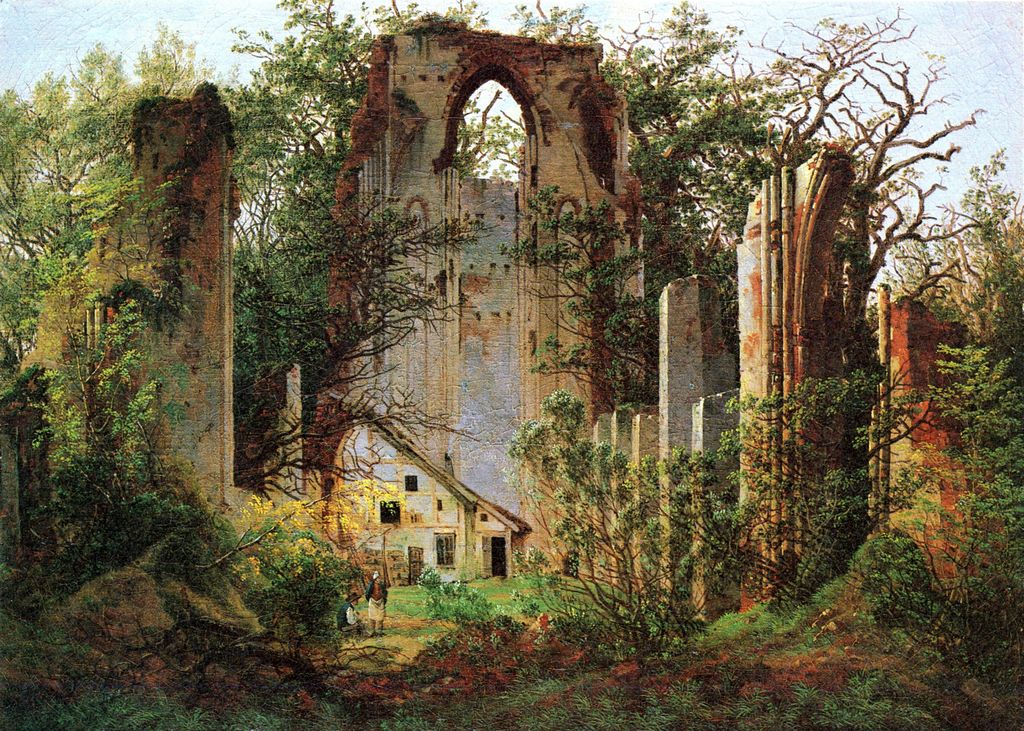
Around 1807/08, The Cross in the Mountains pushed landscape toward public religious controversy. [9] [12] Soon after, The Monk by the Sea and The Abbey in the Oakwood made emptiness, ruin, burial, horizon and atmosphere central to a new kind of pictorial experience. [7] [8] These paintings show Friedrich reducing narrative detail while intensifying the viewer's responsibility to look.
The 1810s brought some of Friedrich's most famous landscape structures. Wanderer above the Sea of Fog gives the back-turned figure a commanding yet unstable position over an expanse of fog and rock. [6] Chalk Cliffs on Rügen transforms a coastal motif associated with travel and Friedrich's Baltic world into a scene of edge, depth and multiple viewpoints. [10] Woman at a Window moves the problem of seeing indoors, where a figure at the window faces outward into a world the viewer can only partly share.
Later paintings continue that pressure rather than simply repeating a formula. The Sea of Ice, made in the 1820s, turns ice studies and polar imagination into a painting about wreckage and human limits. [11] The Stages of Life, usually dated to Friedrich's late career, returns to the coast with an image in which ships, figures and distance become a meditation on age and departure. Across the body of work, the paintings move from observed nature toward images that are at once personal, historical and open-ended.
Places and Motifs
Greifswald and the Baltic coast remained vital to Friedrich's imagination. They supplied shorelines, city silhouettes, flat horizons and memories of northern place. Rügen mattered as a landscape of cliffs, sea, trees and paths, but it should not be reduced to tourism. In Friedrich's hands, Rügen becomes a place where looking itself becomes precarious.
Dresden was equally important. It provided artistic institutions, exhibitions, colleagues and proximity to walking routes in Saxon and Bohemian Switzerland. The Giant Mountains supplied another register: higher, more remote, more severe. Friedrich's July 1810 journey toward the Schneekoppe with Georg Friedrich Kersting is one documented example of how travel, drawing and later painting were connected. [5]
Motifs recur because Friedrich keeps testing them under different conditions. Trees can suggest endurance, death, age or isolation. Ruins can be historical remnants, spiritual signs or frames for modern consciousness. Moonlight can soften a scene while making it more distant. Ice can become geological, meteorological and symbolic at once. Figures seen from behind can be companions, barriers or substitutes for the viewer.
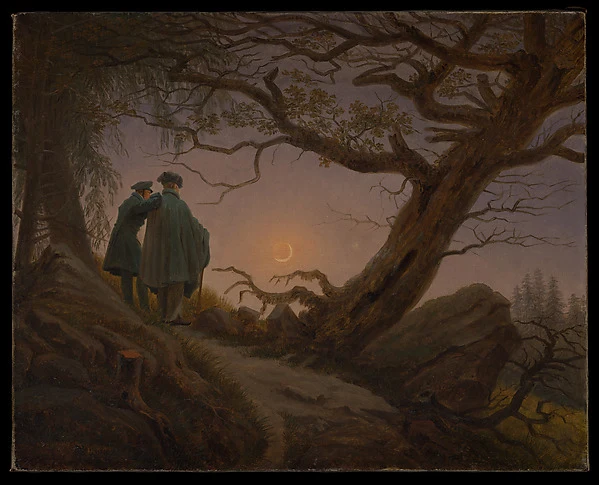
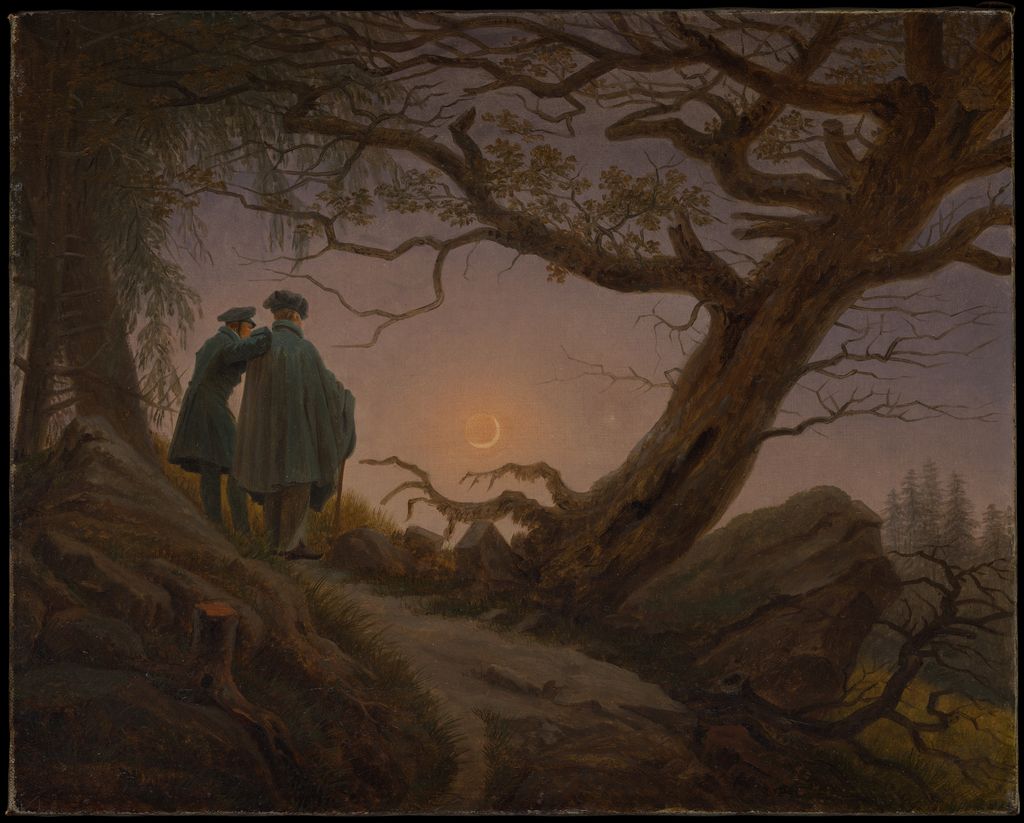
The repetition is never merely decorative. Friedrich returns to forms because they allow different kinds of attention. A moonlit pair in Man and Woman Contemplating the Moon does not ask the same question as the lone monk by the sea. A window interior does not ask the same question as a polar wreck. Yet all of them belong to a career in which landscape becomes a disciplined image of inward experience.
Paintings Friedrich made to be seen together
The Alte Nationalgalerie's 2024 exhibition opened with companion paintings. Its gallery texts distinguish pairs through which Friedrich could explore a change in viewpoint, time of day or season. View of the Elbe Valley and Megalithic Tomb in Snow show what that approach can do even when the two views are immediately recognisable as different landscapes. One gives the eye a broad prospect in which it can travel into the distance. In the other, a low rise hides part of the tomb and three bare oaks make the nearest ground the centre of attention. Seen together, the works invite a comparison of where the landscape opens and where it holds the viewer back.[13]
The pairing of The Monk by the Sea and The Abbey in the Oakwood makes the direction of attention especially important. In the first painting a person standing on the shore faces a view almost empty of objects. Horizontal bands divide the scene, but the eye has little to follow out into the water. The abbey gives it a doorway, a procession and trees whose verticals carry it upwards. At the Berlin Academy exhibition of 1810 the paintings were listed together as two landscapes in oil. They subsequently entered the Prussian royal collection. Their shared exhibition history helps explain why the contrast between their two ways of arranging a view has remained central to their reception.[7][8][13][14]
A later pair makes the progression of the day more explicit. Friedrich wrote to the banker Joachim Heinrich Wilhelm Wagener in November 1822 that The Lonely Tree and Moonrise over the Sea were complete. Both canvases measure 55 by 71 centimetres. The first looks across country by morning light. A large oak links the ground in front with the sky, and the person beneath it is small enough to be discovered gradually. In the second, three people sit on rocks looking towards ships and the light on the sea. The land painting lets the viewer move from tree to pasture to distant mountains. The seascape carries the eye past the seated group, using water and reflected light to connect foreground and horizon.[13][15][16]
The Wagener commission also gives the pair a different history from the 1810 exhibition works. Wagener showed the paintings in his gallery. His collection passed to the Prussian state in 1861 and became the basis of the Nationalgalerie. The paintings can still be read as two choices made for one patron, and as part of the history of the museum that now holds them.[14][15][17]
Variants and the details that change
Friedrich also returned to compositions without treating the resulting paintings as companions. The three versions of the moonwatchers, now in Dresden, Berlin and New York, keep an oak, a rocky path and a low moon. The Berlin version gives the man a female companion. It also lightens the sky and gives the bare branches a sharper silhouette. In New York the two men return while the lighter atmosphere persists. When the Met exhibited the three together in 2001, viewers could see the repeated oak at nearly the same scale and compare how much space each version gives to the pair, the branches and the sky. A repeated motif gives the comparison a starting point. The distribution of light and the relation between the figures tell us what Friedrich chose to reconsider.[13][18]
Flagship Paintings
Several works form useful entry points into Friedrich's painting. The Cross in the Mountains (Tetschen Altar) is essential because it shows Friedrich's early ambition to make landscape perform the work of sacred art. [9] The controversy surrounding its exhibition in his Dresden apartment in 1808 confirms that contemporaries recognized how unusual that ambition was. [12]
The Monk by the Sea and The Abbey in the Oakwood are best understood together, but without flattening either painting into the other. The Monk is a scene of radical horizon, emptiness and solitary presence. [7] The Abbey joins winter trees, ruin and funeral procession into an image of passage and historical decay. [8] Their relationship matters because it shows Friedrich thinking across works as well as inside single canvases.
Wanderer above the Sea of Fog has become Friedrich's most recognizable image, yet it remains more uncertain than its fame sometimes suggests. The identity of the figure should not be overclaimed; what matters for this hub is the way the painting structures viewing through the back-turned figure, mountain forms and fog. [6] Chalk Cliffs on Rügen and The Sea of Ice then show two very different extensions of that method: one tied to Baltic cliffs and figure relationships, the other to imagined polar extremity and wreckage. [10] [11]
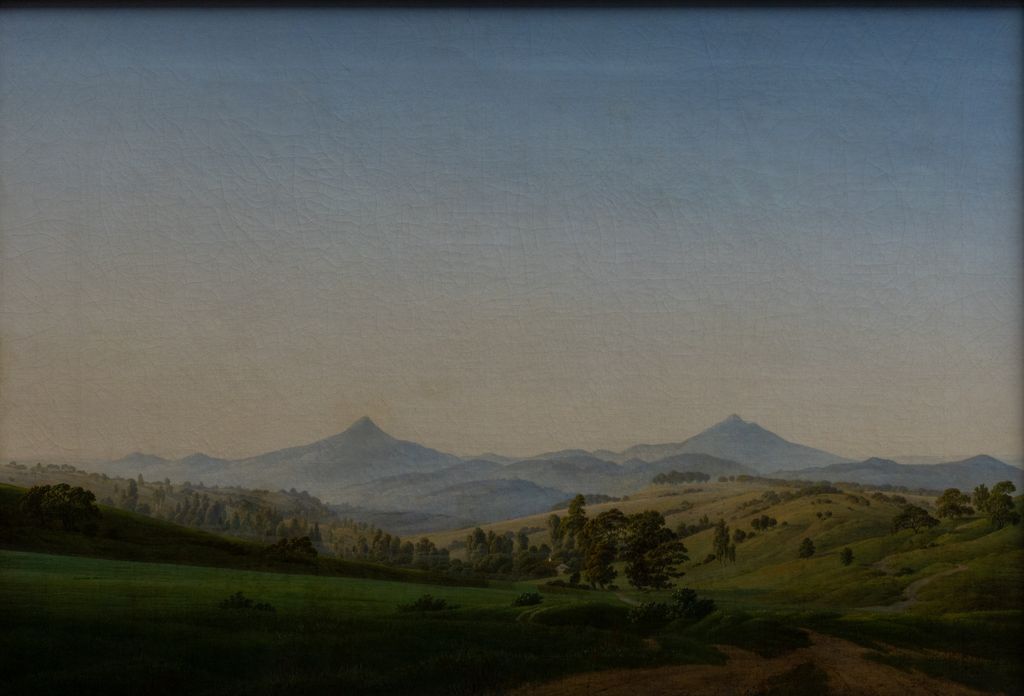
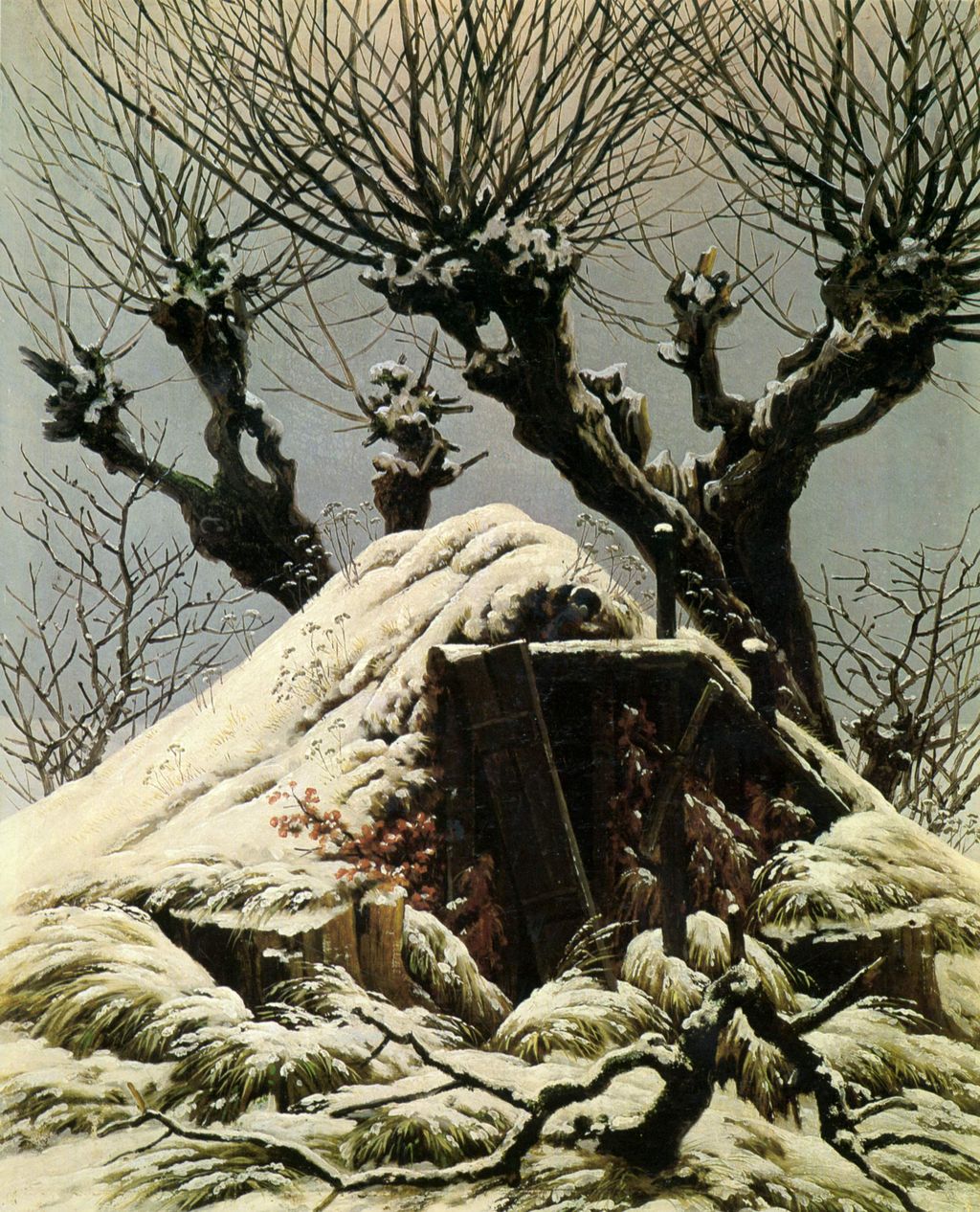
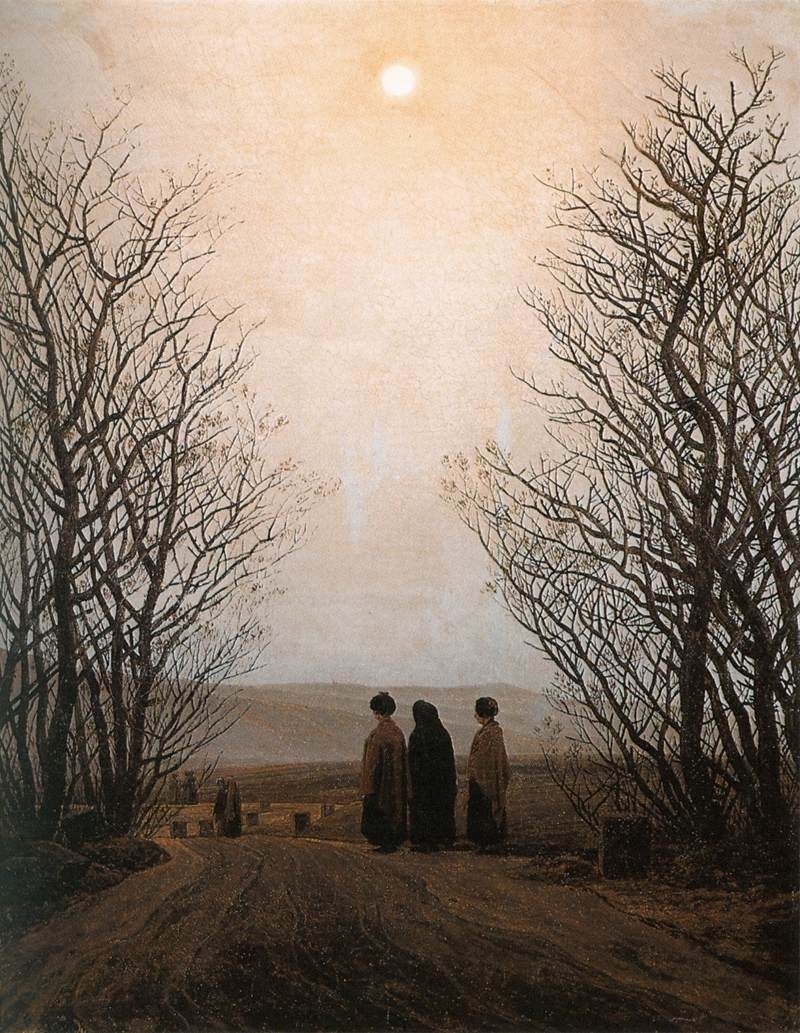
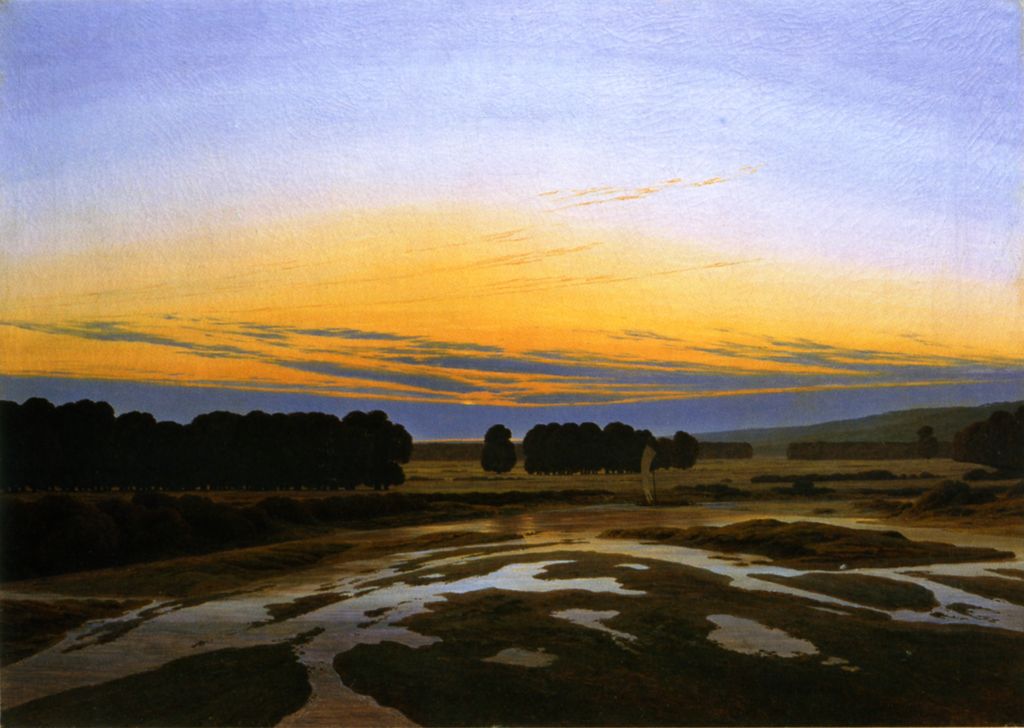
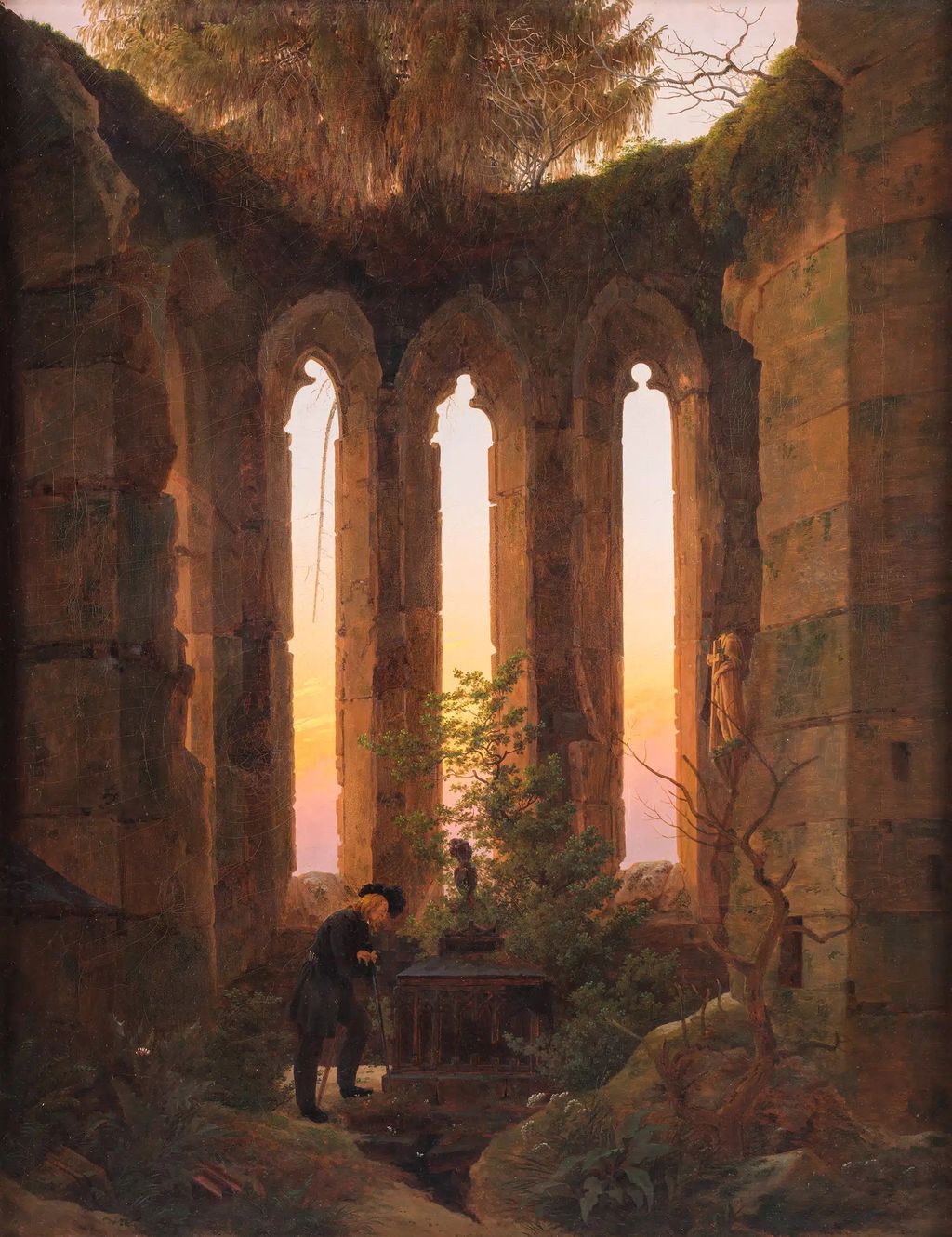
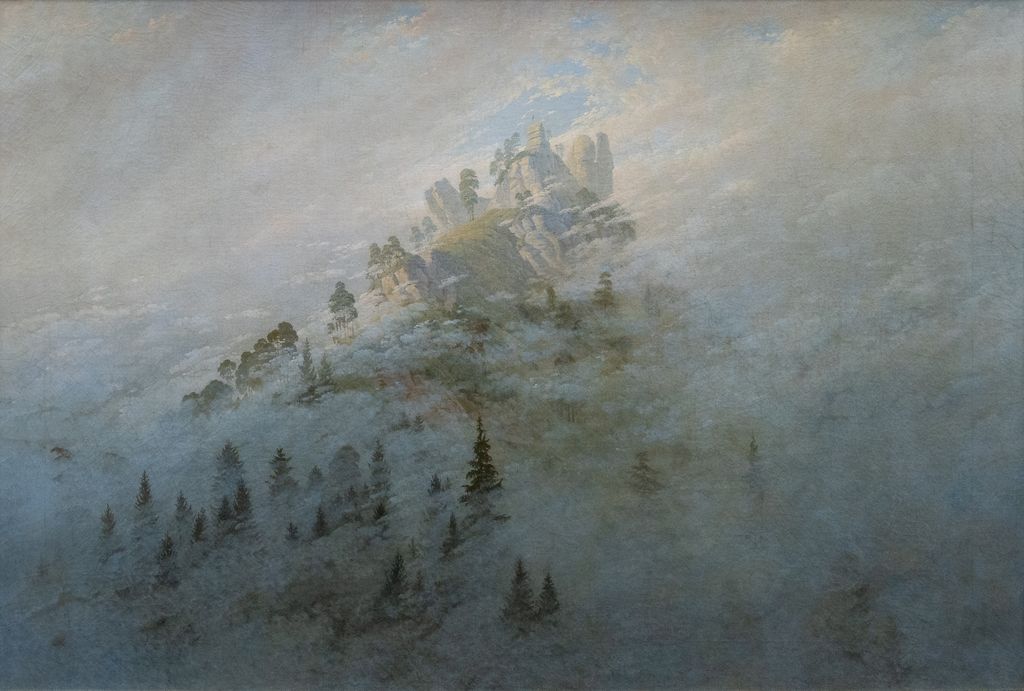
The grid below keeps the wider painting surface visible. Famous works matter, but Friedrich's career is not only six masterpieces. Smaller or less familiar pages such as Cairn in Snow, Oak Tree in the Snow, The Port of Greifswald and Morning in the Riesengebirge help show how consistently he returned to weather, place, trees, thresholds and distance.
Explore the Paintings
37 paintings



 Caspar David Friedrich.jpg)






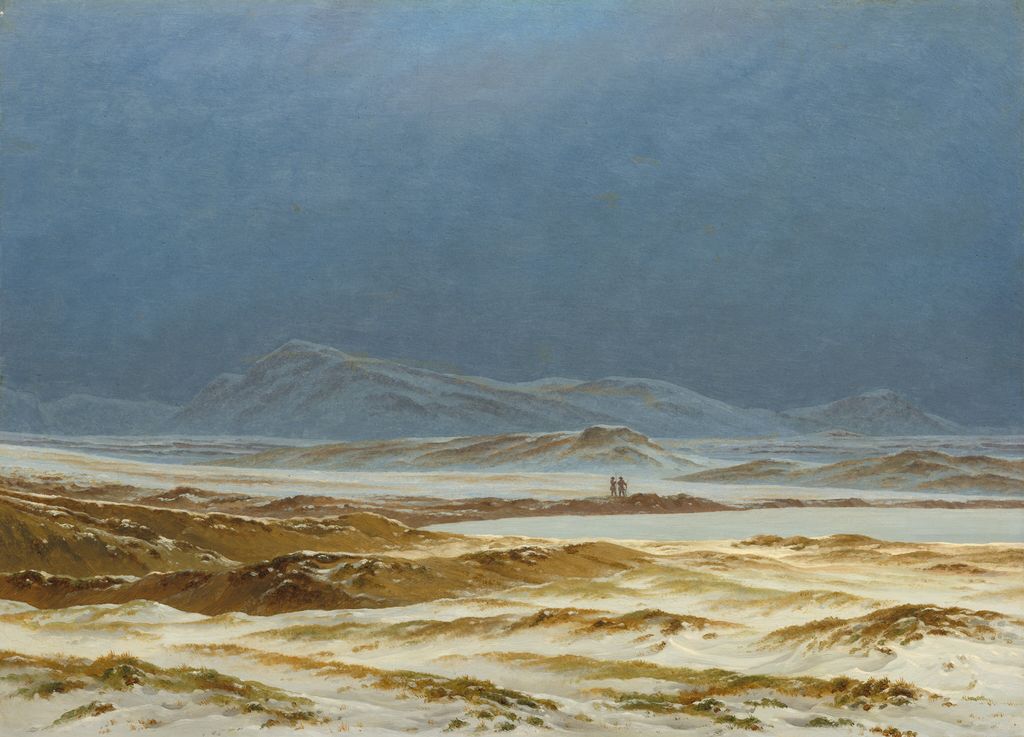

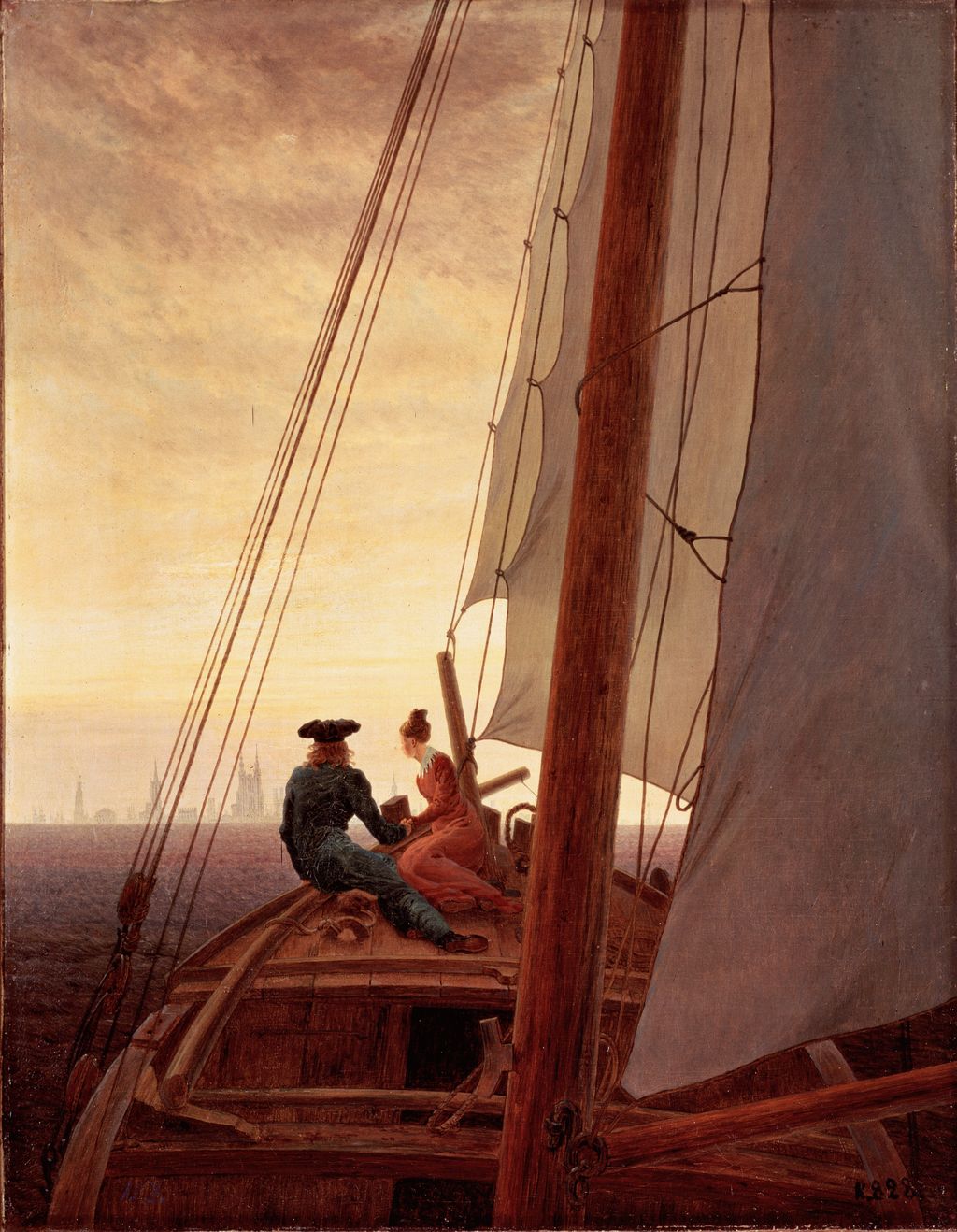
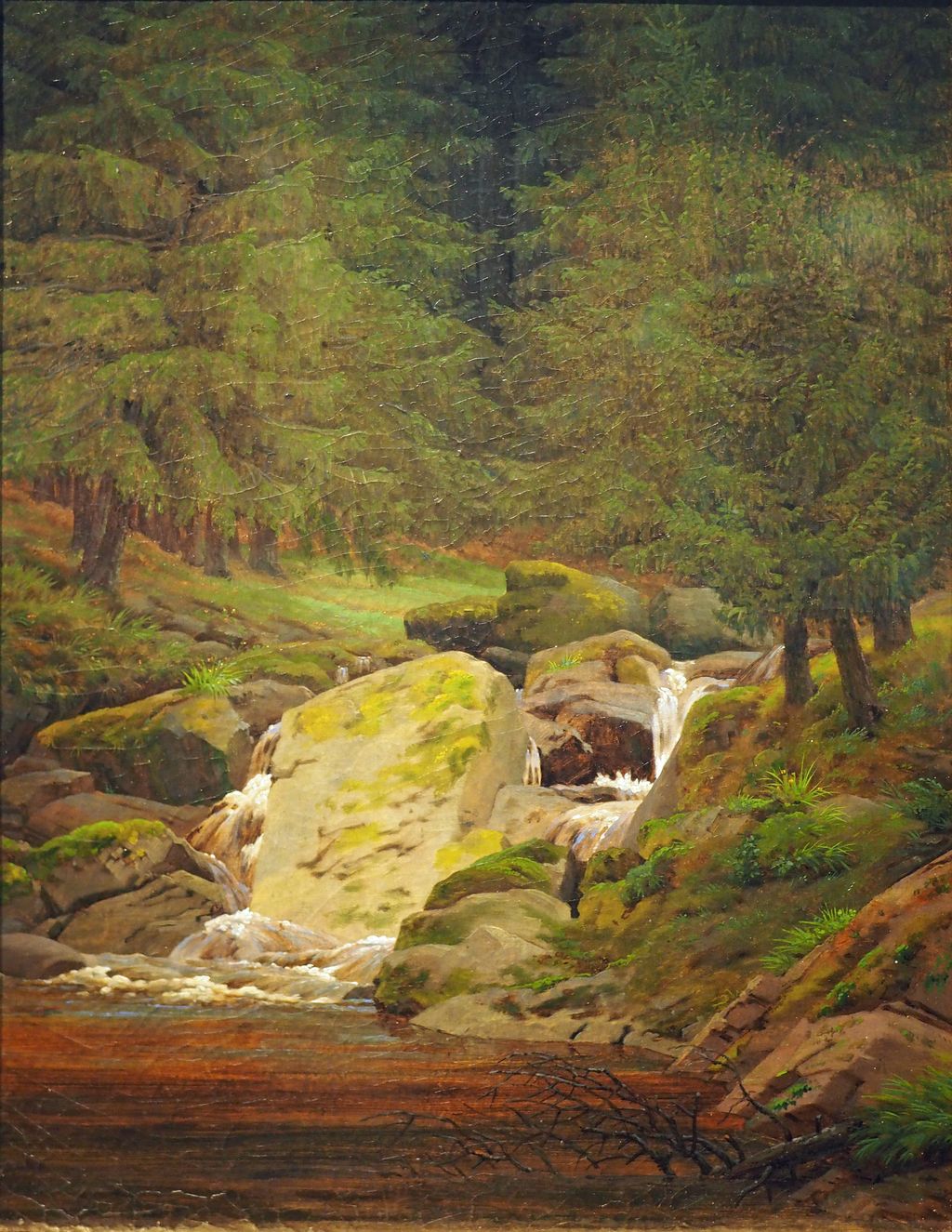
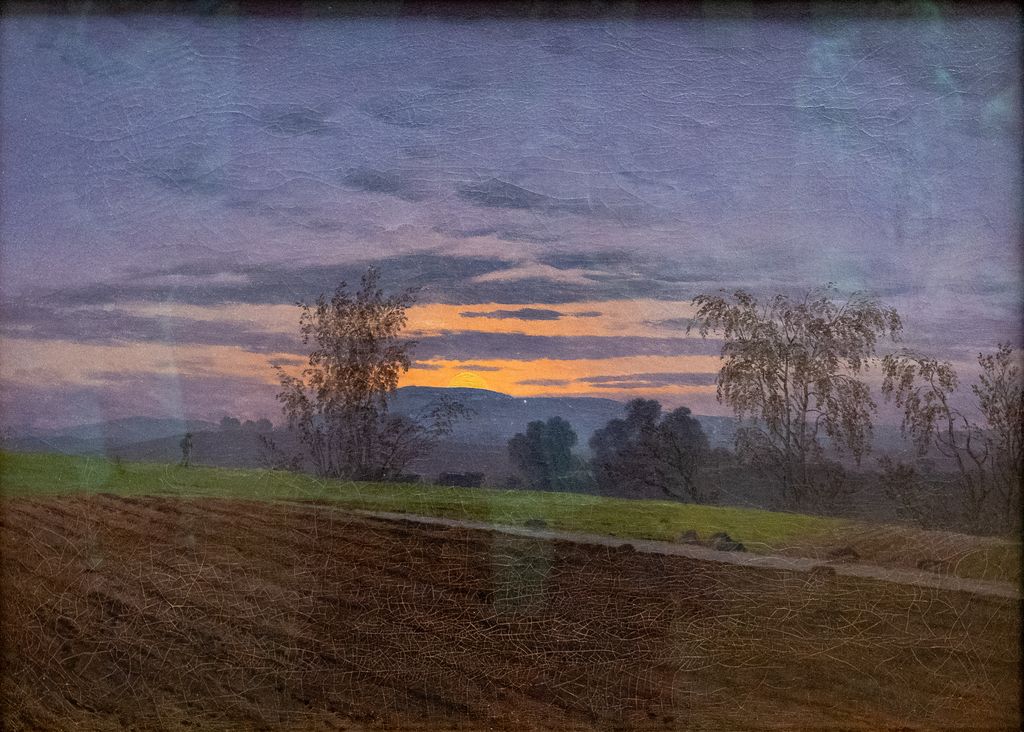




Frequently Asked Questions
Discussion
Reader insights are welcome, especially close-looking observations about how Friedrich turns specific landscapes, motifs and figures into painting structures.
Reader Insights
Which painting best introduces Friedrich's way of using landscape?
How do Rügen, Dresden, Greifswald or the mountains change the reading?
Where does Friedrich make the viewer's own looking part of the subject?
Which painting in the browse grid feels most like an observed place, and which feels most like a constructed inner landscape?
Join the Conversation
Share a source-grounded reading of one Friedrich painting or a comparison between two works.
References
- Chronicle: Works and Biography, cdfriedrich.de Source
- Caspar David Friedrich: The Soul of Nature, Metropolitan Museum of Art exhibition page Source
- Casper David Friedrich is born as the sixth of ten children in Greifswald on September 5, cdfriedrich.de Source
- Friedrich moves to Dresden, cdfriedrich.de Source
- The Giant Mountains, cdfriedrich.de Source
- Wanderer above the Sea of Fog, cdfriedrich.de Source
- Monk by the Sea, cdfriedrich.de Source
- Abbey in the Oakwood, cdfriedrich.de Source
- The Cross in the Mountains (Tetschen Altar), cdfriedrich.de Source
- Chalk Cliffs on Rügen, cdfriedrich.de Source
- The Sea of Ice, cdfriedrich.de Source
- Friedrich exhibits Cross in the Mountains in his apartment over Christmas - generating controversial reactions, cdfriedrich.de Source
- Alte Nationalgalerie, Infinite Landscapes, gallery texts, sections on pairs and versions.
- Birgit Verwiebe, The Rediscovery of Caspar David Friedrich at the German Centenary Exhibition of 1906 in Berlin, on the Berlin Academy and Wagener.
- Alte Nationalgalerie, Der einsame Baum.
- Alte Nationalgalerie, Mondaufgang am Meer.
- Alte Nationalgalerie, Collection history.
- Metropolitan Museum of Art, Caspar David Friedrich: Moonwatchers.