



 by Tom Gurney
Tom Gurney BSc (Hons) is an art history expert with over 20 years experience
Published on June 19, 2020 / Updated on October 14, 2023
Email: tomgurney1@gmail.com / Phone: +44 7429 011000
Morning in the Giant Mountains: Introduction
A woman has reached a summit in Caspar David Friedrich’s Morning in the Giant Mountains. With her right hand she grasps the upright of a crucifix, and with her left she reaches down to help a man over the last rocks. The two are small enough to escape notice at first. The cross cuts across the horizon into a brightening sky, while mountain ridges extend behind it and mist gathers between them. What looks from a distance like a still panorama contains the action of a single moment. [1]
The Stiftung Preußische Schlösser und Gärten Berlin-Brandenburg catalogues the work as Morgen im Riesengebirge (Kreuz auf dem Felsen), 1810, inventory GK I 6911. The oil on canvas measures 108 cm high by 170 cm wide in the collection overview. Morning in the Riesengebirge retains the German name of the range, and Cross on the Rocks translates the alternative title. The related anniversary essay dates the painting to 1810–11, consistent with a canvas begun after the mountain journey of 1810 and exhibited in March 1811. [1][2][3][4]
At a Glance
- Date · 1810
- Medium · Oil on canvas
- Collection · Stiftung Preußische Schlösser und Gärten Berlin-Brandenburg
- Dimensions · 108 cm high × 170 cm wide
- Accession · GK I 6911
Contents
- Introduction
- The climb at the edge of the panorama
- What Friedrich brought back from the mountains
- How Friedrich painted the mist
- The crucifix and the helping hand
- Two ways to place a cross on a mountain
- A single journey, different mountain settings
- From Dresden to Charlottenburg
- Friedrich’s other mountain mornings
- Annotated Details
- Image Details
The climb at the edge of the panorama
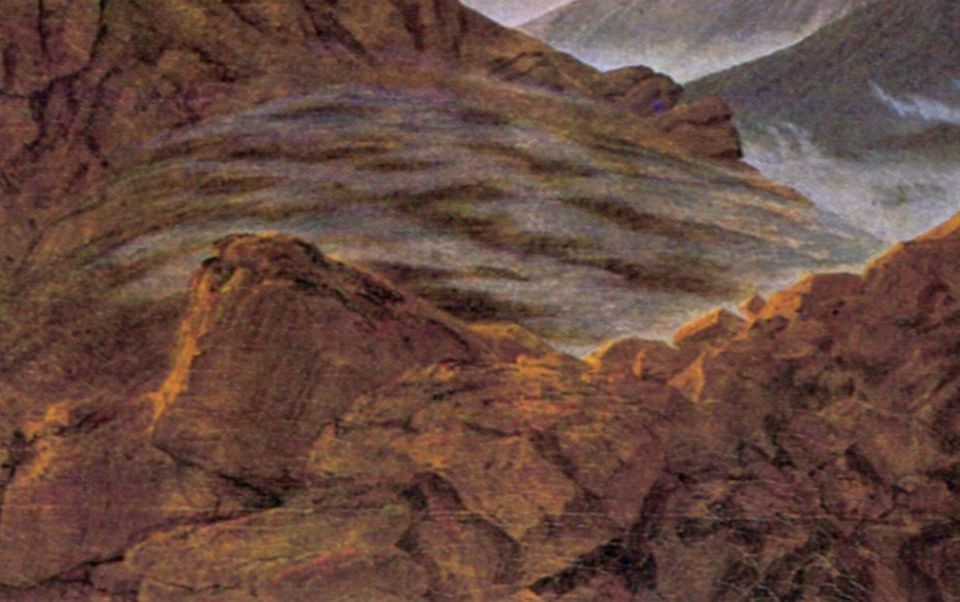
The foreground leads diagonally towards the jagged crag to the right of centre. Changes of angle break up the ascent. Broad surfaces catch the light in places, while fissures and shadowed faces mark the rock as uneven ground. Behind the outcrop, the ridges run across the canvas in a succession of overlapping profiles. The crag belongs to both movements. It caps the rising foreground and interrupts the long sweep of the ranges beyond. [1][3]
The figures make the last stretch of the diagonal legible as a climb. The man is still down among the darker rock faces, where his body is hard to distinguish. The light dress of the woman has a clearer outline. Her gesture extends in two directions at once. One arm reaches up to a fixed support while the other passes that support down to a person below. Once the clasped hands come into view, the summit changes from a point on the skyline to a ledge that one person has reached and the other is still trying to reach. [1][4]
The scale of the crucifix is easy to misjudge. Its position makes it the highest point of attention, but the two people give a sense of its size. Farther away, whole mountain flanks can appear as slight intervals of colour. Friedrich lets a narrow length of timber and the outline of a hand hold their own against that expanse. The sky gives the cross a clear field, and the distant ridges stay low enough that the eye can travel across the full width of the picture without losing sight of it. [1][2][3]
What Friedrich brought back from the mountains
Friedrich’s only walking tour of the Giant Mountains, also known as the Krkonoše, took place in 1810. He travelled on foot from Dresden with the painter Georg Friedrich Kersting. They passed through the Zittau and Jizera mountains and followed the ridge of the Giant Mountains to the Schneekoppe, or Sněžka, the range’s highest peak. Friedrich made close studies of trees and boulders alongside drawings of distant ridge profiles. The anniversary essay identifies Morning in the Giant Mountains as the first painting he produced after his return. [3]
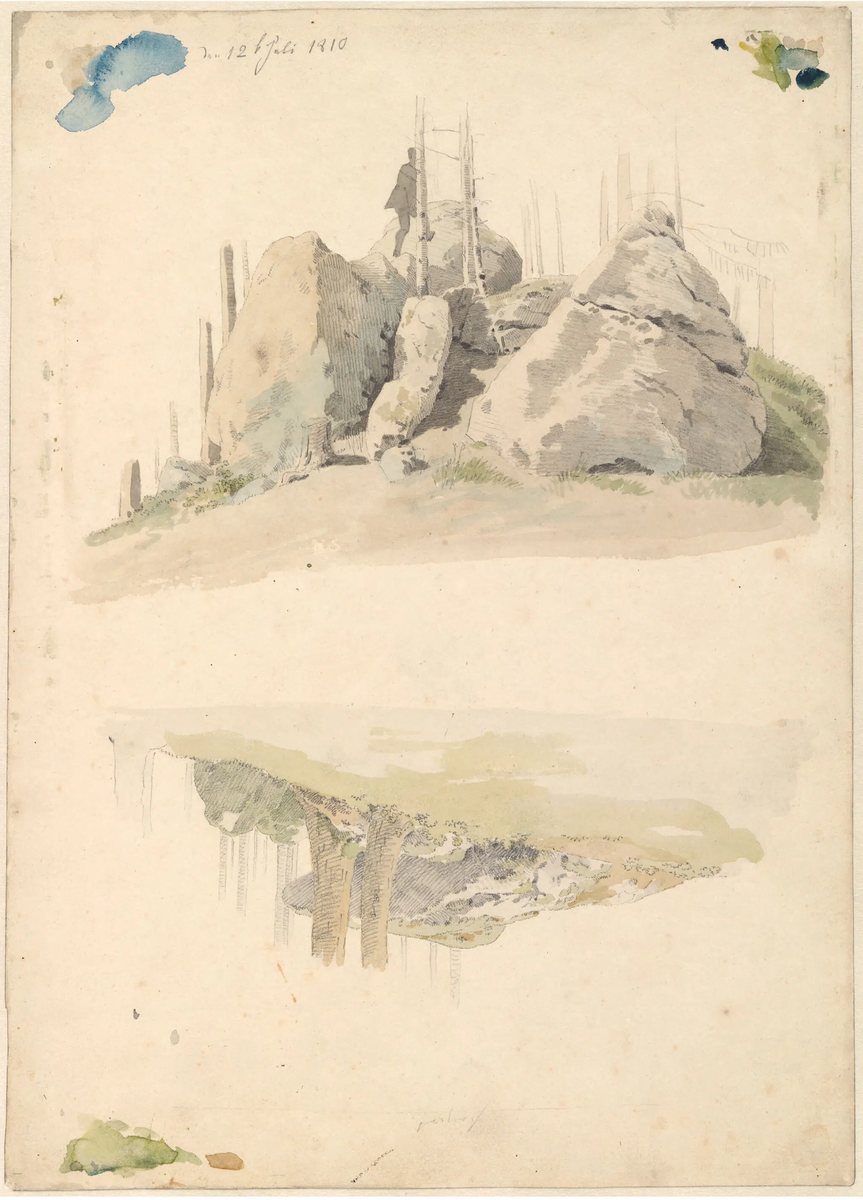
A pair of dated sheets shows how the two painters recorded the journey. Friedrich’s study of boulders at the Kochel waterfall, dated 17 July 1810, includes Kersting seated among the rocks. The following day, Kersting drew Friedrich. The drawings preserve each artist’s presence on the walk, and the waterfall sheet also shows the scale of the forms Friedrich stopped to study. Those forms mattered independently of the sweeping views for which the range was known. [5]
The way Friedrich used his studies can be seen beneath the paint. In an infrared image of the right foreground, fine lines at the foot of the summit rock run in parallel to establish the slopes. Larger stones have clearer outlines and short strokes on their shadowed sides. The conservators suggest that Friedrich drew this part directly on the prepared canvas. When they compared the distant ridges with a drawing of 1810, the contours of most of the ranges aligned after scaling, particularly in the middle and on the left. The close fit indicates that Friedrich used a transfer method to carry the profiles into the painting. How he enlarged the drawing remains open. [4]
How Friedrich painted the mist
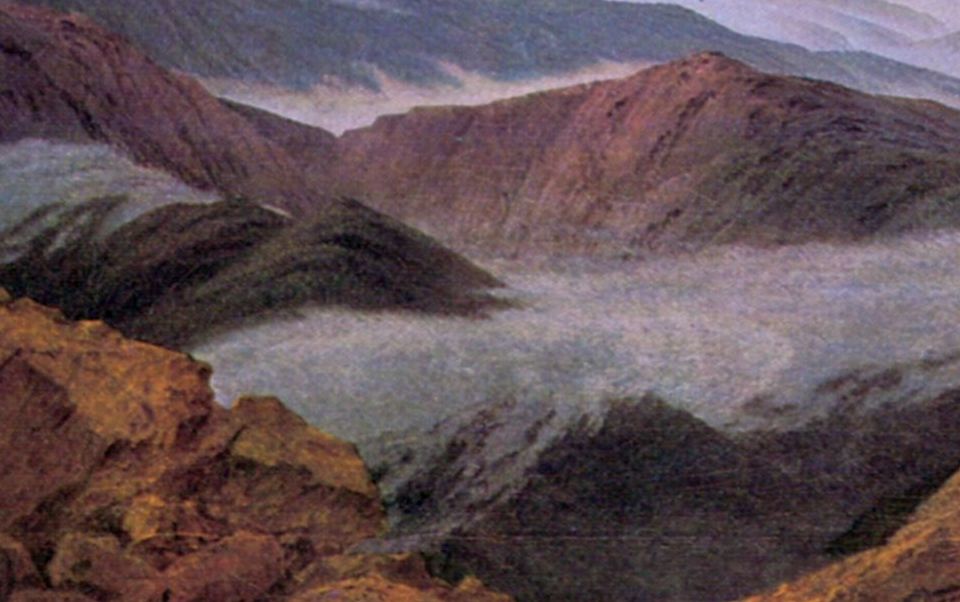
Look first at the mist near the foot of the rocks on the right. It partly conceals the stone, but warm light still appears through it. The conservation study found that Friedrich reduced areas of the brown rock colour so the light preparatory layer could contribute to the glow. Cooler grey-blue paint lies over parts of that warmth. The changing thickness of the mist gives the near ground a broken surface, with small intervals in which the stone comes back into focus. [4]
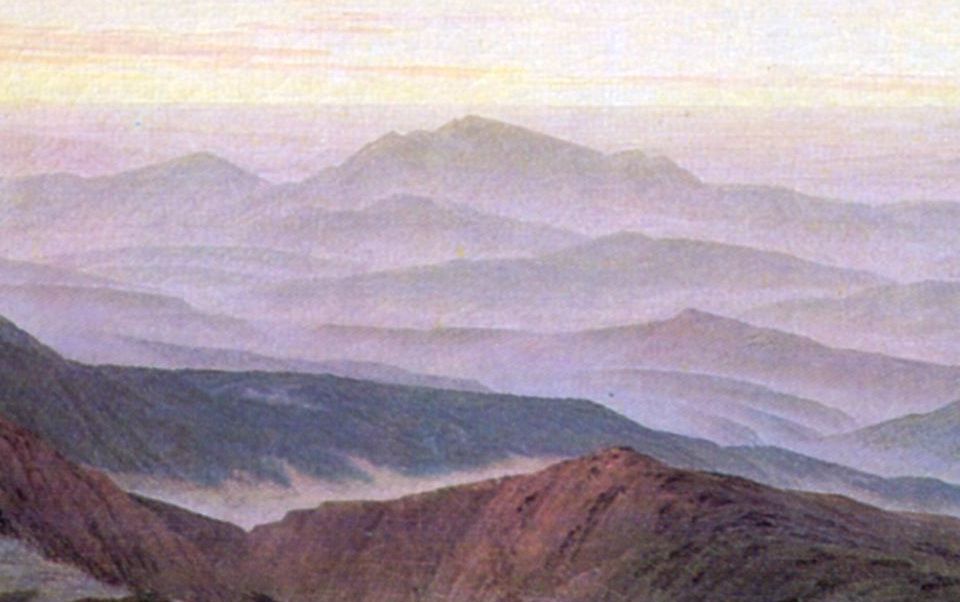
Farther away, the mist marks the gaps between the ridges. Friedrich shaped rising wisps with a semi-dry brush, giving them soft contours against mountains that remain in shade. Toward the horizon the differences between successive silhouettes become finer. The 1906 exhibition catalogue described the colour moving from grey near the front of the panorama to faint pink in the distance, with the yellow of the horizon giving way to pale blue above. Across the width of the canvas, these changes let the viewer register the distance in stages. [4][6]
The crucifix and the helping hand
Infrared examination also showed a change to the woman’s pose. Friedrich straightened her slightly and placed her hand on the upright above the horizon. That moved a small part of the figure out of the tonal complexity of the landscape and against the sky. A contemporary reviewer credited Kersting with painting the figures. The conservators found that the handling of the drawing beneath the paint, the revisions to the woman and the execution of the figures weigh against that attribution. [4]
SPSG curator Jessica Korschanowski reads the difficult climb as an image of a life spent following Christ. In that reading the woman’s grip on the cross gives the act of helping the man a religious meaning. She has also been interpreted as a personification of faith, and the man has been proposed as a likeness of Friedrich. The gesture supports a devotional reading even if the two figures are understood simply as climbers. The person who has found a hold passes it on to someone still below, while the morning light spreads across terrain neither can command. [1]
Two ways to place a cross on a mountain
The Tetschen Altar offers an earlier example of Friedrich using drawn observations to set a crucifix on a summit. Holger Birkholz traces its development from a sketch of a wayside cross to a sepia composition and then to the oil with its pointed frame. In that work, the steep contours of rock, slender spruces and carved arch carry the eye upward together. The field of view ends close to the summit. We can see the crucifix and the ridge on which it stands, while much of the hill below remains outside the frame.[11]

The Giant Mountains painting uses a much wider canvas. The summit on the right is only one part of the land that can be seen, and its dark sides continue into the surrounding terrain. The far ranges extend behind the cross and beyond it in both directions. Before the climbers become legible, the upright may register as a landmark against the bright sky. After their gesture comes into view, it becomes possible to read it as a piece of timber the woman can actually reach. The difference between the two paintings is clearest at that scale. The frame and trees in the Tetschen Altar lead the eye towards the cross, while here the foreground provides a route that people can climb.[1][4][11]
That route also changes how the light works. In the earlier oil, rays behind the summit give the illumination a shape of its own. In the mountain morning, light changes by degrees across surfaces at different distances. The ridge profiles and the translucent mist make the hour legible even far from the cross. The light on the woman's dress draws attention to the local action, and the horizon remains bright enough to keep her raised hand visible. Friedrich could make a small act at the summit stand out while allowing the morning to extend well beyond it.[1][4][11]
A single journey, different mountain settings
The Pomeranian State Museum points to surviving sheets from several days in July 1810 and links the expedition to both this painting and the later Ruins of Eldena in the Giant Mountains. The latter work brings the remains of a monastery near Greifswald into a mountain setting. The Baltic building and the inland range belong to places far apart. Their conjunction is a particularly visible example of a method that is harder to detect in the earlier oil, where the fit between the drawn ridge profiles and the painted distance is close enough to give the whole scene an appearance of continuity.[4][12][13]
In the early picture, close views of rocks and far views of ridges demanded different kinds of drawing. The infrared findings help distinguish those tasks. A transferred outline could fix a long contour against which Friedrich could judge the size of a succeeding ridge. In the nearer ground, the sketchier marks establish the inclination of a slope and the shading of individual stones. The resulting painting asks the viewer to make the same changes of scale. The eye can read the near rocks in terms of steps, footholds and the length of an arm. Over the valleys it has to work with overlapping lines and changes in colour. That shift helps give the journey a physical character even though only its last moment is shown.[3][4][12]
From Dresden to Charlottenburg
The painting was first exhibited in Dresden in March 1811. Friedrich Wilhelm III of Prussia saw it at the Berlin Academy exhibition in 1812 and acquired it that autumn. Korschanowski notes that some contemporary critics thought the symbolism weakened the landscape’s effect. The king praised its fidelity to nature. The two responses put different weight on details that Friedrich placed next to one another. Around the cross the foreground rocks are still broken and steep, and the far ridges still register the light and mist of a particular hour. [1][4]
From 1844 to 1865, visitors to the royal gallery at Schloss Bellevue could see the painting alongside The Monk by the Sea and The Abbey in the Oakwood, both earlier acquisitions by the king. It appeared at the Berlin Nationalgalerie’s 1906 German Centenary Exhibition as catalogue no. 536, Das Kreuz auf der Felsenspitze (Riesengebirge). That entry identifies the royal palace in Wiesbaden and gives the same height and width used in the SPSG overview today. The SPSG presents the painting with its Friedrich holdings in the Neuer Pavillon in the gardens of Schloss Charlottenburg. [2][6][7]
Friedrich’s other mountain mornings
The Alte Nationalgalerie’s The Giant Mountains (Das Riesengebirge, A I 1079) is a smaller canvas dated around 1830–35. Its orange and yellow sky belongs to evening, and a lone figure leaning on a rock can be made out in the foreground. The museum identifies a view below the Schneekoppe towards the ridge of the Ziegenrücken and the distant Ještěd. Friedrich also used that prospect for the background of Morning in the Mountains, the Hermitage painting of 1822–23 (GE 9772). In the latter canvas, a chasm and a hillside with grazing animals establish the foreground. Each painting gives the distant terrain a different approach. [3][8][9]
The 1808 Morning Mist in the Mountains in Rudolstadt also has a cross at the summit. It grew out of Friedrich’s study of the Honigstein massif near Rathen, before his Giant Mountains walk. Mist envelops much of that single mountain, and the eye has to search for the cross among its forms. In the 1810 canvas the crucifix stands clear against the sky, and the discovery comes lower down when the two hands meet. The meeting of the hands draws attention from the distant ridges back to the narrow shelf where the climbers find their footing. [1][10]
Annotated Details from Morning in the Giant Mountains
Use the numbered details to trace the forms and light in this work.
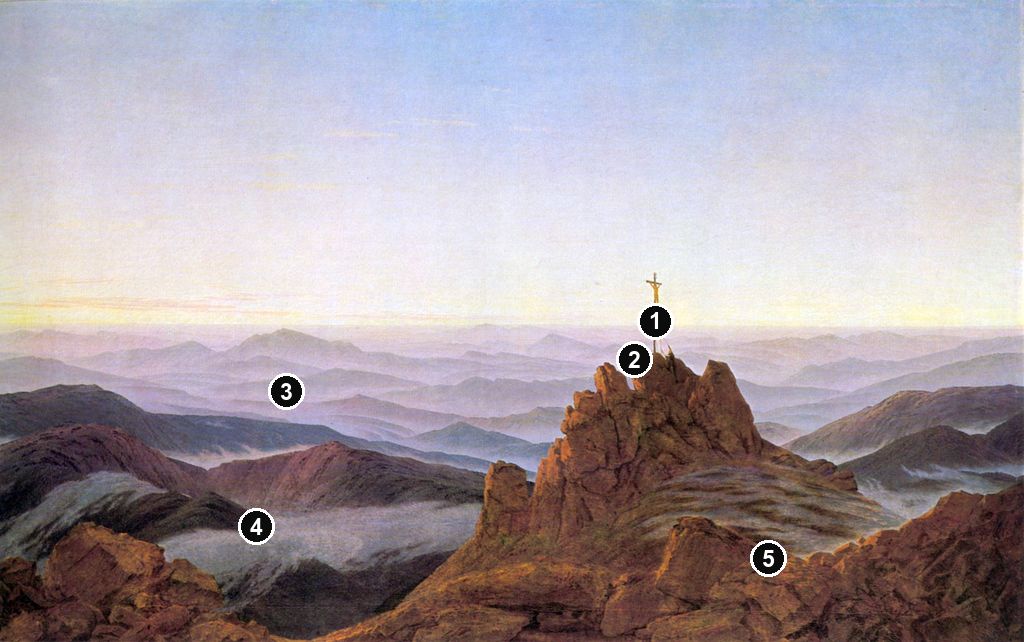
Details from MORNING IN THE GIANT MOUNTAINS
The detail crops show parts of the work at a larger scale.
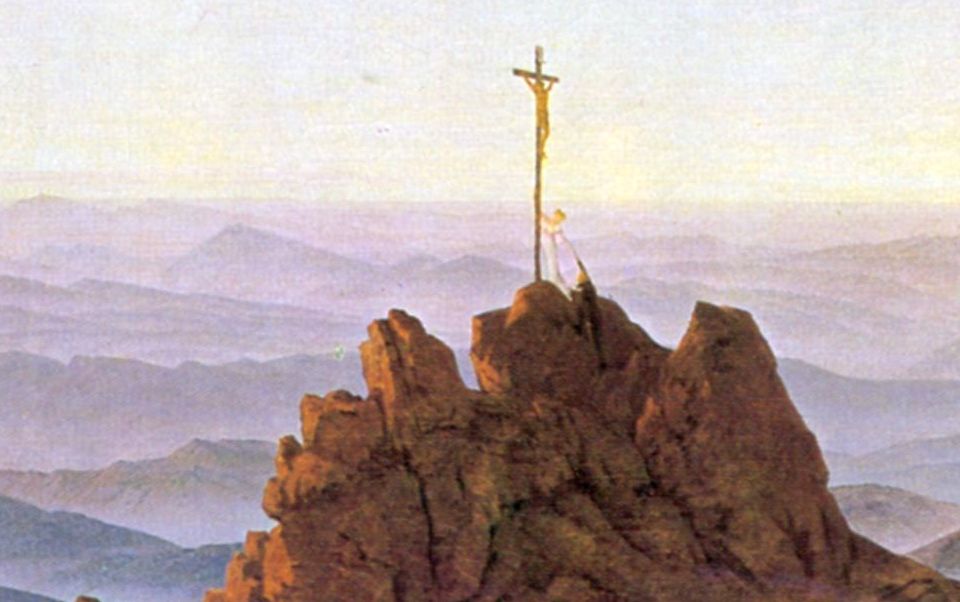
The cross at the summit
A thin cross stands at the summit. Its upright breaks the layers of ridges and light.
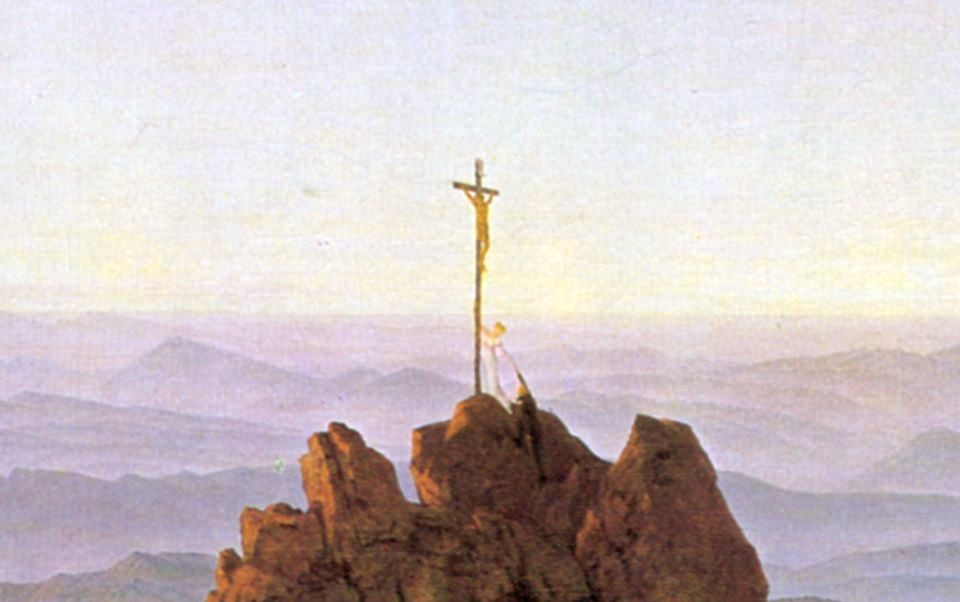
The climbers
Two small figures are visible near the rock summit below the cross.
Ridges towards the horizon
Successive bands of hills become paler and less sharply defined with distance.
Mist in the valley
Pale mist collects between the near ridges and the darker rock edges.
The near rocks
Sharp reddish surfaces and darker cracks make the foreground distinct from the distant ranges.
Frequently Asked Questions
Discussion
Reader insights are welcome, especially close-looking observations about how the cross, figures, mist, mountain ridges and morning light shape the painting's sense of ascent.
Reader Insights
How does the summit cross change the mountain from view into devotional landscape?
Where do the mountain layers create depth, distance or an almost sea-like rhythm?
What remains hidden as the morning atmosphere begins to open?
Does Morning in the Giant Mountains feel most powerful as travel memory, religious mountain image, or a bridge between Friedrich's cross and mountain paintings?
Join the Conversation
Share a source-grounded close reading of the cross, figures, mist, morning atmosphere, title mapping or relationship to Friedrich's later Giant Mountains imagery.
References
- Jessica Korschanowski, Stiftung Preußische Schlösser und Gärten Berlin-Brandenburg, Morgen im Riesengebirge (Kreuz auf dem Felsen), GK I 6911.
- Stiftung Preußische Schlösser und Gärten Berlin-Brandenburg, 250 Jahre Caspar David Friedrich, collection overview.
- Birgit Verwiebe, The Giant Mountains, anniversary chronicle, including note 1 on Morning in the Giant Mountains.
- Mechthild Most, Eva Wenders de Calisse, Jens Bartoll and Kirsten Hinderer, Zur Maltechnik Caspar David Friedrichs, 2024, pp. 4, 44, 50–51, 68–69 and 100–101.
- Staatliche Museen zu Berlin, Kupferstichkabinett, Georg Friedrich Kersting’s Caspar David Friedrich auf der Reise im Riesengebirge, SZ Kersting 1.
- Ausstellung deutscher Kunst aus der Zeit von 1775–1875, Königliche Nationalgalerie, Berlin, 1906, vol. 2, p. 170, no. 536.
- Birgit Verwiebe, Die Wiederentdeckung Caspar David Friedrichs mit der Deutschen Jahrhundertausstellung 1906 in Berlin, Alte Nationalgalerie, 2024.
- Staatliche Museen zu Berlin, Alte Nationalgalerie, Das Riesengebirge, A I 1079.
- Morning in the Mountains, in Sabine Rewald, ed., The Romantic Vision of Caspar David Friedrich, Metropolitan Museum of Art, 1990, pp. 60–63.
- Johannes Grave, Morning Mist in the Mountains, anniversary chronicle, Thüringer Landesmuseum Heidecksburg.
- Holger Birkholz, A Perfect Work of Art: The Tetschen Altarpiece, Dresden Friedrich exhibition catalogue, p. 238.
- Pomeranian State Museum, Sketches from the Giant Mountains, with dates of surviving expedition studies.
- Pomeranian State Museum, Wanderresidenz, on the Pomeranian and mountain motifs in the Eldena painting.


