



 by Tom Gurney
Tom Gurney BSc (Hons) is an art history expert with over 20 years experience
Published on June 19, 2020 / Updated on October 14, 2023
Email: tomgurney1@gmail.com / Phone: +44 7429 011000
The Watzmann: Introduction
A pale summit rises almost to the top of Caspar David Friedrich’s The Watzmann. Its slopes are sharply defined against the blue, even though a broad, dark ridge stands between the viewer and the snow. Closer still, a stack of weathered rock catches the light. A fir grows against one side of the stack, just below its highest ledge. You can follow the slope of that ledge and pick out individual trees, yet the distance from this foreground to the snow is hard to judge. Friedrich made the approach to the Watzmann out of studies from two different mountain ranges. [1][2]
The Alte Nationalgalerie in Berlin catalogues The Watzmann (Der Watzmann) as an oil on canvas of 1824/25, measuring 135 cm high by 170 cm wide, inventory F.V. 317. The mountain itself is in the Berchtesgaden Alps. Friedrich had never visited the Alps, and the rock that gives the foreground its profile came from a place he had drawn in the Harz. [1][2]
At a Glance
- Date · 1824/25
- Medium · Oil on canvas
- Collection · Alte Nationalgalerie, on loan from Deka
- Dimensions · 135 cm high × 170 cm wide
- Accession · F.V. 317
Contents
- Introduction
- The rock in the foreground
- Heinrich’s summit and the slopes below it
- Another Watzmann at Dresden
- What the first viewers looked for
- Martin Brunn, restitution and the Deka loan
- Annotated Details
- Image Details
- The Mont Blanc painting that Berlin lost
- Heinrich as a painter of the foreground
- Two immense landscapes in one exhibition
The rock in the foreground
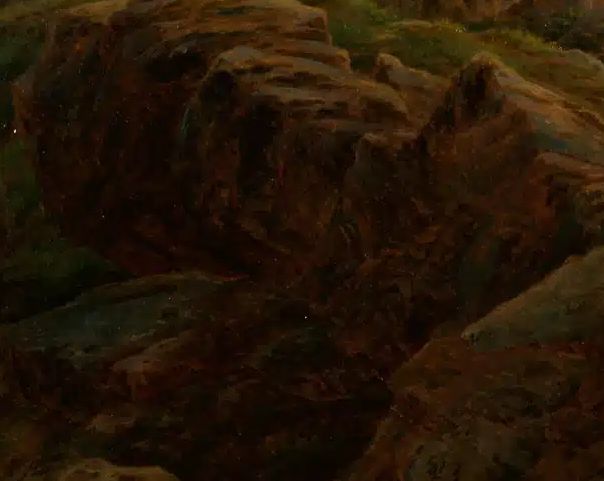
Start low in the picture, where shadows lie between irregular slabs and grass grows in bright strips along the stone. Near the middle, the upright formation shows a darker break running from its lower face up toward the projecting slabs. The top stone leans to the left. Downhill on the right, smaller rocks have a similar tilt. As the foreground slopes away, the lit planes of these rocks pick out a line through the grass and bushes. The dark clefts at the bottom of the canvas make it difficult to imagine following that line on foot. [1][3]
The central formation comes from two pencil drawings of the Trudenstein on the Hohnekopf, near the Brocken, which Friedrich made on 28 June 1811. The anniversary catalogue identifies them as nos. 643 and 653 in Christina Grummt’s catalogue of the drawings, and records their whereabouts as unknown. A reproduction of no. 653 shows a small person at the foot of the rocks. Sonja Scherbaum also draws attention to a vertical mark farther away with two short cross-strokes, a convention she identifies as a reference for human height. Both details make it possible to judge the size of the formation in the field drawing. [2][3]
In the oil painting the upright rock still has the distinct, irregular outline of a formation seen at close range. The fir beside it gives some impression of height, though a tree on a rock ledge can be stunted or young, and the nearby shrubs are also hard to judge. The oil includes neither the standing figure nor the drawn measure. Friedrich retained the distinctive shape of a particular rock and let its size become uncertain. From the foreground, the near stack and the distant peak even seem to answer each other across the intervening ridge, with the high point of each followed by a long descent to the right. [1][3]
Heinrich’s summit and the slopes below it
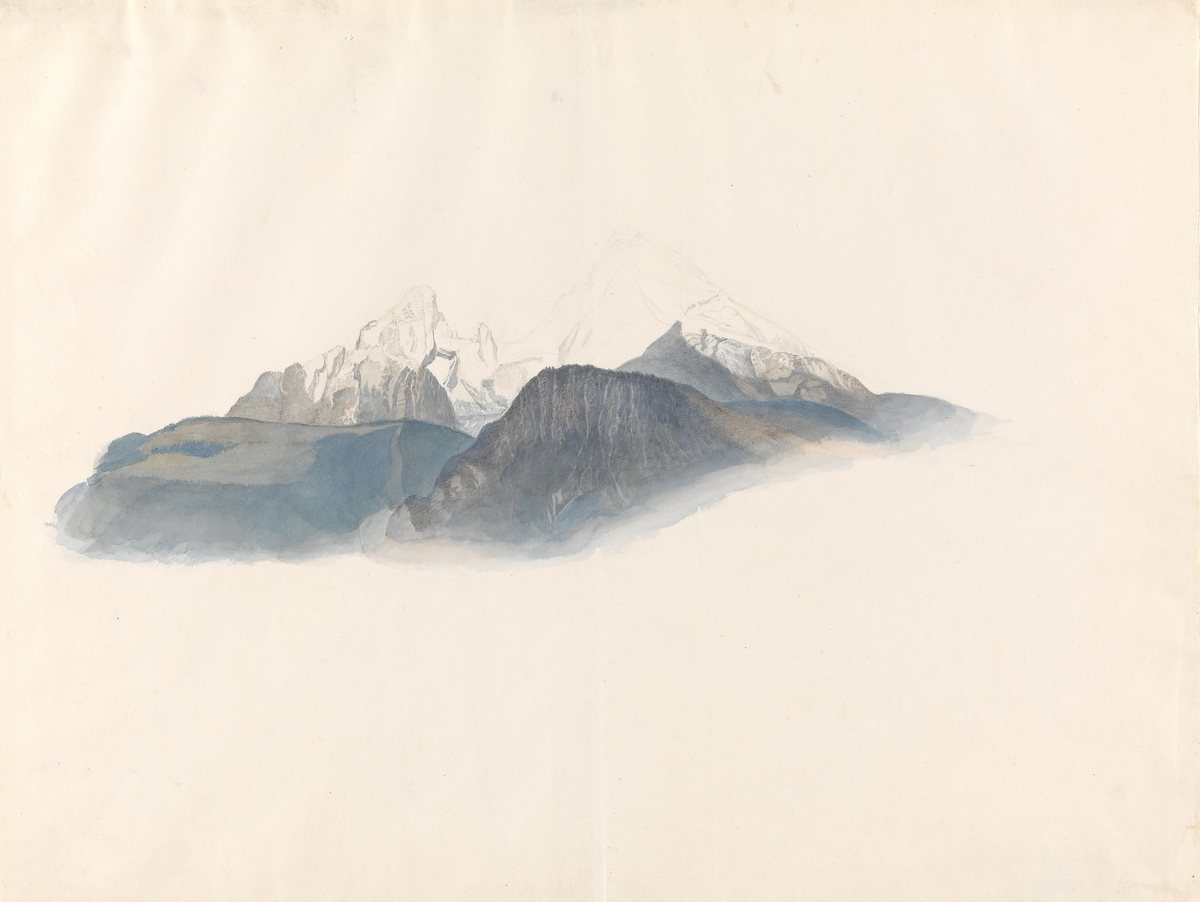
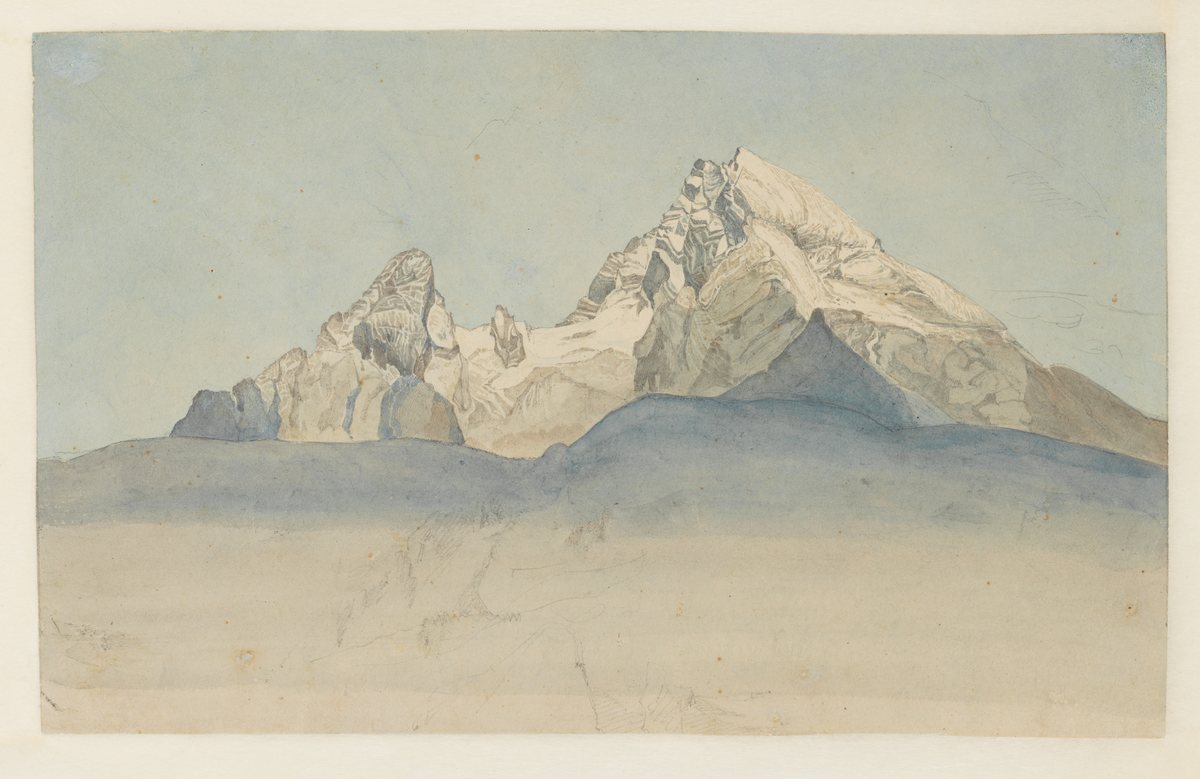
Friedrich took the summit profile from an on-site watercolor by his pupil Johann August Heinrich, now in the Nasjonalmuseet in Oslo. The Oslo museum lists the sheet, NG.K&H.B.15644, as pencil, watercolor and gouache on paper, dated 1820–22. Heinrich depicted the broad, snowy profile in close relation to the darker rock below it. Comparing the sheet with the oil, Scherbaum observes that Friedrich kept the shape of the snowy summit closely and tipped the rock formation immediately below it towards the viewer. That change helps bring the steep middle ridge into the path of the eye as it moves from the foreground up to the white peak. [2][3][4]
Heinrich made more than one study of the Watzmann. At the Metropolitan Museum of Art, a separate sheet from 1820–22, accession 2009.124a, b, has a watercolor of the mountain over charcoal on the front and a pencil sketch of Sankt Bartholomä on the Königssee on the back. The sketch links that sheet to the country around the mountain. The Oslo watercolor provides the specific comparison for the forms Friedrich carried into his painting. [2][4][5]
In the finished canvas, a low saddle leads from the darker peak on the left towards the higher, more brightly lit mass on the right. Small pinnacles interrupt the saddle. Violet shadows make some of the steep faces legible even inside the brightest area of the painting. Berlin curator Birgit Verwiebe identifies the Archenkopf and Grünstein in the ridges below, where thin mist and shifts from green to violet soften the edges. The summit has a much harder silhouette. Light and colour tell the eye which forms are nearer, but that lucid outline can make the farthest point seem almost close enough to touch. [1][2]
Another Watzmann at Dresden
Friedrich had already shown a large Alpine painting at the Dresden Academy exhibition of 1824. High Mountains, a view towards Mont Blanc, drew on a study by Carl Gustav Carus. The same exhibition included Ludwig Richter’s Der Watzmann, which Richter had painted in Rome after travelling through the Alps. The Neue Pinakothek’s account traces his approach to Joseph Anton Koch’s painting of the Schmadribach waterfall, which Richter had seen in Koch’s studio. In 1825, when Friedrich exhibited his own Watzmann at the Academy, some visitors would have had Richter’s version in mind. Verwiebe sees Friedrich’s picture as a likely response to it. [2][6]
Richter’s painting is a tall canvas, 121 cm high by 93.5 cm wide. The mountain rises above a valley where a hut offers shelter. A chapel higher up and open stretches of pasture give a sense of how far human activity extends. The forest, water and cloud help connect the valley to the peak. In Friedrich’s wider painting, the foreground is already high among the rocks, and the far slopes meet the sides of the picture before they reach any settled valley. Richter gives the eye a series of places it can imagine passing through. Friedrich lets it cross from one ridge to another while leaving the terrain between them hard to picture. [1][3][6]
What the first viewers looked for
The anonymous Dresden exhibition report in the Literarisches Conversations-Blatt of 1825 describes the painting by looking upwards. The writer begins with grass and small trees emerging between the rocks, moves on to the mist along the ridges, and ends with the clarity of the snow at the highest point. The handling of those successive tones drew praise. The solitude was unsettling enough that the writer wanted to see an eagle or a chamois. A creature might have made the height feel familiar for a moment, or given the eye a way to gauge the distance between two slopes. [7]
Other reviewers put the difficulty more sharply. Johann Gottlob von Quandt, who had praised Richter’s painting, questioned whether Friedrich had made the mountain’s size convincing. In Hamburg in 1826, Carl Töpfer missed a view down to the valley. He imagined seeing distant church towers and hearing their bells, signs that would have let a viewer feel how far above the inhabited world the painting had placed them. These reactions bring out a feature that can be easy to miss when looking only at the bright summit. The lower edge of the picture cuts off the very terrain that would make the elevation comprehensible. [3]
Verwiebe reads the mountain’s brightness and remoteness as an image of divine majesty, and relates the tapering composition to The Sea of Ice. The Hamburg Kunsthalle records that the two paintings were shown together in Hamburg and Berlin in 1826. In The Sea of Ice a hull is caught beneath piled slabs. Here the rock stack and distant snow share the same rising direction, with vegetation confined to the lower slopes and nothing moving against the snow. [1][2][8]
Martin Brunn, restitution and the Deka loan
Berlin’s provenance record lists Senator Karl Friedrich Pogge of Greifswald, followed by an estate or bequest entry for Adolf Gustav Barthold Georg von Pressentin of Rostock. The next named owner is the Berlin collector Martin Brunn. It dates the Nationalgalerie’s purchase from Brunn to 19 February 1937. Brunn was Jewish and sold under the pressure of Nazi persecution. He subsequently fled to the United States. In print that year, Nationalgalerie director Eberhard Hanfstaengl praised the way Friedrich had combined his own studies with another artist’s observations to create a mountain landscape that went beyond a record of the site. [1][2][8][9]
The museum traces the canvas through the Central Collecting Point at Wiesbaden from 1945 to 1956 and back to the Nationalgalerie in West Berlin in 1956. Berlin records restitution to Brunn’s heirs in 2003. DekaBank subsequently bought the painting and placed it on long-term loan, which Berlin records from 2004. The arrangement brought the picture back to the Alte Nationalgalerie under Deka ownership. The museum marked its return with an exhibition in 2004–05 that reunited the painting with Heinrich’s Oslo study and placed both within the wider tradition of Alpine painting. [1][4][8][9][10][11]
The Mont Blanc painting that Berlin lost
The Nationalgalerie acquired Friedrich's High Mountains in 1920 under Ludwig Justi. The canvas, now a wartime loss, was nearly the same size as The Watzmann. Birgit Verwiebe's account of the collection reproduces an old gallery photograph and discusses Justi's response to the acquisition. The photograph gives the Mont Blanc painting an identifiable place among the works the museum put on its walls. It also supplies a sense of its size relative to nearby paintings even though a visitor can no longer encounter it at full scale.[1] [12]
The Mont Blanc view establishes a working precedent for the Watzmann. In both cases, information about the Alps came to Friedrich through another artist's observation. Carus supplied material for the Mont Blanc subject. Heinrich's drawing supplied the identifiable summit in the surviving painting. The relationships matter because the person who saw the mountain and the person who arranged the finished landscape did different work. A drawing could carry a profile into the studio. An oil on a much larger support still required decisions about the height of the foreground, the scale of the intermediate slopes and the amount of sky left above the peak.[1] [2] [12]
The loss of the earlier work places a limit on comparisons between the two. A photograph can preserve the distribution of large forms, and an older description can preserve something a spectator found striking about the colour or atmosphere. Those records do not offer the same access to a painted edge as the surviving Watzmann. This asymmetry is worth keeping in view when the two paintings are treated as a sequence. The Mont Blanc work has a documented place in Friedrich's career and in the collection. The Berlin canvas remains the more direct evidence of what the artist could do with an Alpine profile at that scale.[1] [12]
Heinrich as a painter of the foreground
The Met also holds Heinrich's At the Edge of the Forest. Its account emphasizes a sober attention to natural features and distinguishes Heinrich's approach from that of his Dresden colleagues. The oil helps situate the mountain studies within a working practice of their own. Heinrich could make a modest stretch of terrain the principal subject, giving a viewer time to compare the arrangement of trees and the ground around them. That kind of looking is valuable evidence for the artist's interests apart from any use Friedrich made of an Alpine sheet.[5] [13]
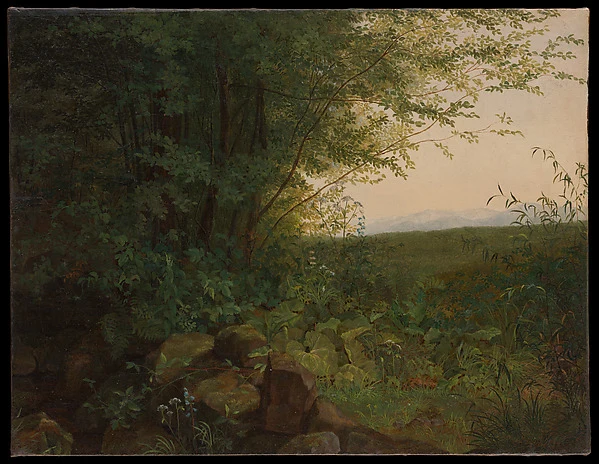
In The Watzmann, the initial place the eye finds is a foreground of scattered vegetation and exposed rock. The summit taken from Heinrich is much farther away. A spectator can therefore meet two sorts of observation in the same painting. The near ground calls for attention to what grows in the gaps and what can support it. The pale summit offers a contour that can be followed over a much longer distance. Heinrich's oil makes it easier to imagine the work of close scrutiny that a painter could give to the former kind of subject, even when Friedrich uses Heinrich's Alpine drawing for the latter.[1] [2] [13]
Two immense landscapes in one exhibition
The Berlin anniversary chronology records that Friedrich showed The Watzmann with The Sea of Ice at the first Hamburg Art Association exhibition in 1826. A visitor could encounter two different answers to the problem of giving shape to a place beyond ordinary experience. In the mountain view the bright peak stands well back, reached by looking across a sequence of darker forms. In the ice painting the brightest edges help define the great mass rising nearer the viewer. A comparison makes the size of the two principal forms feel different even where both occupy a conspicuous part of the canvas.[8] [14]
The different locations of those forms also change how the foreground is used. The open intervals around the Watzmann let the eye consider a succession of ridges. The jagged pile in the other painting contains the only conspicuous trace of a journey, a damaged vessel that can no longer move. The two pictures give a particularly sharp context for the early critics' wish for a more readily measured mountain. A visitor might look from one to the other and recognize how deliberately Friedrich varied the evidence available for reaching, crossing or judging an immense terrain.[3] [8] [14]
Annotated Details from The Watzmann
Use the numbered details to trace the forms and light in this work.
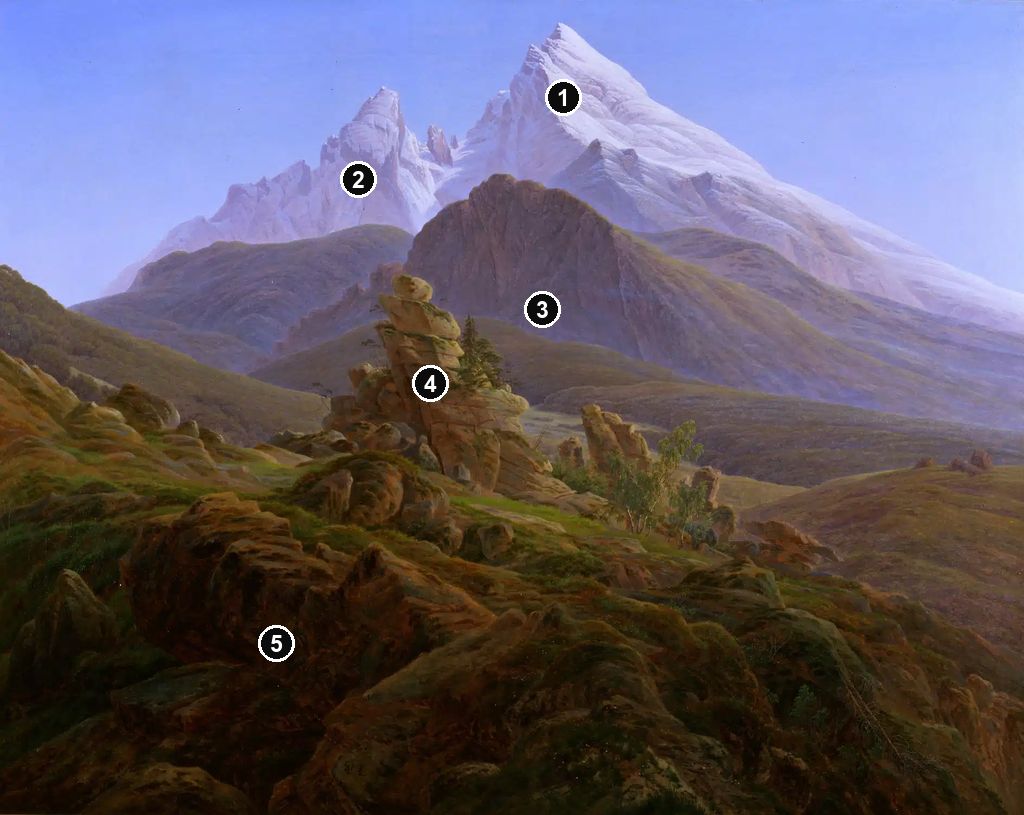
Details from THE WATZMANN
The detail crops show parts of the work at a larger scale.
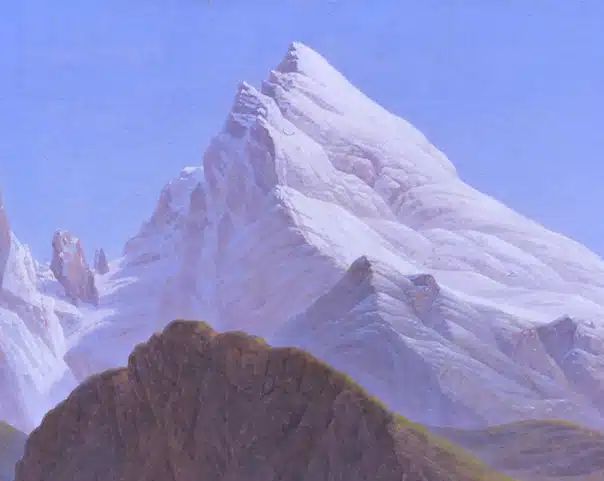
The snowy summit
The highest peak catches light above the darker mountain slopes.
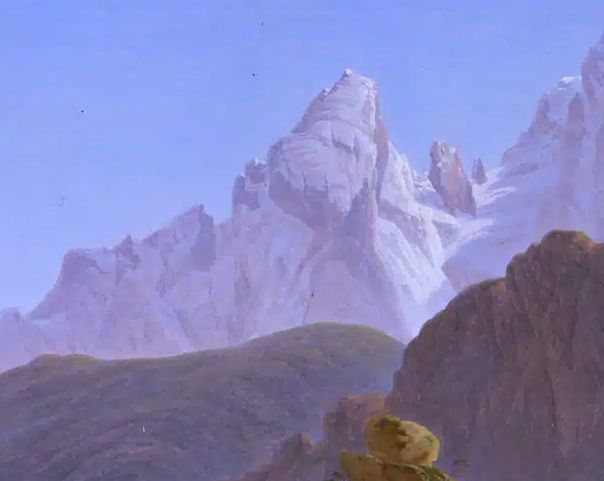
The secondary peaks
Jagged pale peaks rise to the left of the summit. Their faces are divided by contrasting planes.
The dark middle ridge
A darker rounded ridge sits across the line of sight between the foreground and the high mountains.
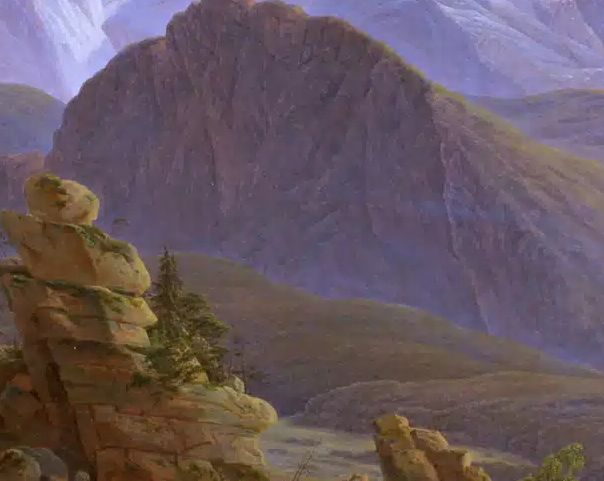
The foreground rock formation
A sharply defined tower of rock rises from the green foreground.
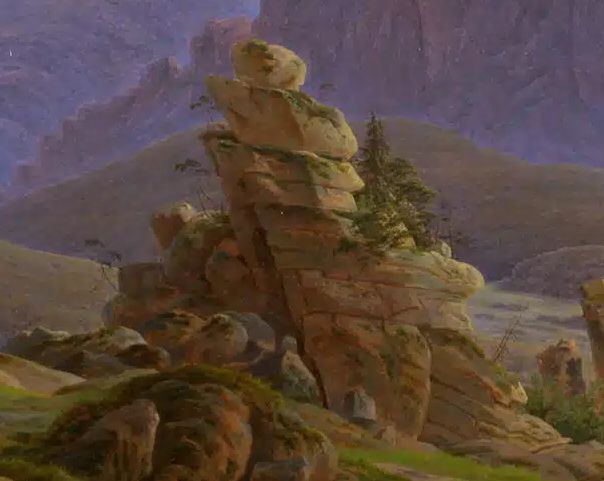
Rock and vegetation nearby
Dense shapes and patches of vegetation give weight to the near slope.
Frequently Asked Questions
Discussion
Reader insights are welcome, especially close-looking observations about how foreground rock, mist, snow and the absence of figures make this mountain feel remote and monumental.
Reader Insights
How does the composition move from foreground stone to the snow-bright summit?
Where do the mist bands separate the mountain into stages of distance and height?
How does the lack of figures change the way the mountain's scale feels?
Does The Watzmann feel most powerful as a mountain portrait, a constructed landscape, or an image of divine majesty?
Join the Conversation
Share a source-grounded close reading of the Berlin painting, its August Heinrich source model, Ludwig Richter context, Alpine absence or relationship to The Sea of Ice.
References
- Staatliche Museen zu Berlin, Alte Nationalgalerie, Der Watzmann, F.V. 317, object description and provenance.
- Birgit Verwiebe, The Watzmann, Caspar David Friedrich anniversary chronicle, with catalogue references.
- Sonja Scherbaum, “Evoking the Sublime in Landscape Painting,” Aesthetica Preprint 124, 2023, pp. 115–122 and figs. 4–5.
- Nasjonalmuseet, 2023 loans register, p. 97, August Heinrich’s Der Watzmann, NG.K&H.B.15644.
- Metropolitan Museum of Art, August Heinrich, The Watzmann and Sketch of Sankt Bartholomä on the Königssee, 2009.124a, b.
- Bayerische Staatsgemäldesammlungen, Neue Pinakothek, Ludwig Richter’s Der Watzmann, 1824, inv. 8983.
- Anonymous Dresden Academy exhibition report, Literarisches Conversations-Blatt, 1825, vol. 2, p. 888.
- Hamburger Kunsthalle, Watzmann trifft Eismeer, 2005 exhibition archive.
- Metropolitan Museum of Art, Caspar David Friedrich: The Soul of Nature, 2025 exhibition labels, pp. 22–23.
- Deka, Our Commitment to Art, section on The Watzmann.
- Freunde der Nationalgalerie, Caspar David Friedrich – Der Watzmann, 2004–05 Berlin exhibition archive.
- Birgit Verwiebe, Caspar David Friedrich and Berlin, Alte Nationalgalerie exhibition catalogue, 2024, on Justi's acquisition and the historic photograph of High Mountains.
- Metropolitan Museum of Art, August Heinrich, At the Edge of the Forest, object record and interpretation.
- Alte Nationalgalerie, Infinite Landscapes biographical chronology, on the 1825 Dresden and 1826 Hamburg exhibitions.


