



 by Tom Gurney
Tom Gurney BSc (Hons) is an art history expert with over 20 years experience
Published on June 19, 2020 / Updated on October 14, 2023
Email: tomgurney1@gmail.com / Phone: +44 7429 011000
Oak Tree in Snow: Introduction
A broken oak rises almost to the top of Caspar David Friedrich’s Oak Tree in Snow. High on the trunk, a few boughs reach into pale blue air. Lower down, the branches spread almost the width of the painting, with small clusters of rust-brown leaves still clinging to their tips. At the foot of the tree, a length of fallen wood curls up out of the snow. Friedrich painted this canvas in 1829. It belongs to the Nationalgalerie in Berlin. [1][2]
At a Glance
- Artist — Caspar David Friedrich
- German title — Eichbaum im Schnee. [1]
- Date and medium — 1829, oil on canvas. [1]
- Dimensions — 71 cm high × 48 cm wide. [1]
- Collection — Staatliche Museen zu Berlin, Nationalgalerie, inventory A II 338. [1]
Contents
- Introduction
- The broken crown and the low branches
- The fallen wood and the winter light
- Oaks in poetry and in Friedrich’s earlier paintings
- A tree as the whole subject
- From drawn branches to painted damage
- From Reimer’s collection to the Nationalgalerie
- Annotated Details
- Image Details
The broken crown and the low branches
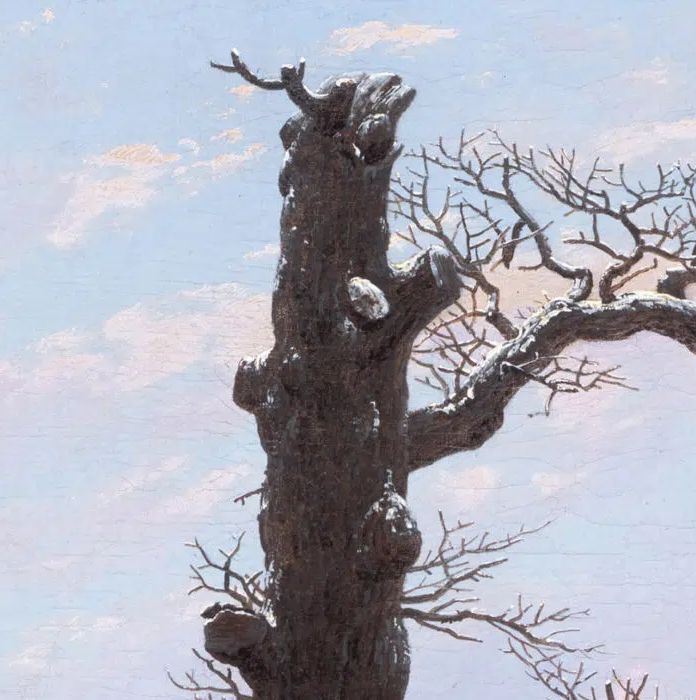
The trunk stands just right of centre and rises almost upright, with a slight bend above the base. Follow it up and the tree seems to narrow abruptly, as heavy limbs give way to knots, stubs and a few stray shoots. The top ends in a jagged break with a little fork silhouetted above it. A substantial bough still reaches out to the right just below the break. Its outer branches turn sharply at the joints, leaving wedges of blue between them. Birgit Verwiebe, writing for the Friedrich anniversary exhibition, reads the missing crown and apparently dead tip as signs of transience. [1][2]
The lower half has a different rhythm. A broad limb runs almost horizontally to the left with a strip of snow along its upper surface. It carries the eye towards the edge of the canvas, while on the right several thinner limbs step out from the trunk at different heights. Many of the boughs turn down before their twigs curve back up. Behind them runs a dark band of distant trees. Where the background darkens, narrow white traces of snow help pick out the branches. Higher in the picture, the fine twigs read as dark lines against the open sky. Where a branch crosses the top of the woods, the change of background can make its outline briefly seem to disappear. [1][2]
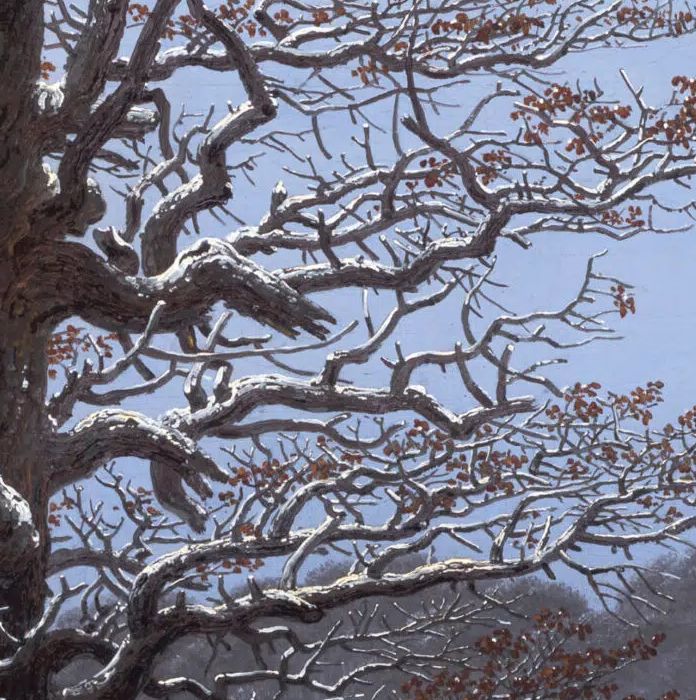
On a few of the lower sprays the leaves gather so thickly that they give a twig a ragged edge. Elsewhere they appear in isolated pairs or small groups. Their brown and orange tones show most clearly where one of the lowest right-hand branches extends across the pale ground. Verwiebe identifies the leaves as the previous season’s growth, held through winter until new foliage comes in spring. Above them, the broken summit is almost bare. Friedrich lets the eye move between these parts of the same tree and register how unevenly it has aged. [1][2]
The fallen wood and the winter light
The pale wood in front of the oak has been split and worn smooth in places. A thick section curves up from the left of the tree’s base, while another twists along the ground towards the lower right. Smaller projections stick up along its length. Beyond it, the dark surface of a small pond comes into view on either side of the standing trunk. Snow follows the irregular bank, and tufts of yellow-brown grass break through it in the foreground. From the exposed grain of the wood to the small branches at the pond’s edge, most of the scene’s detail lies within a few steps of the oak. [1][2]
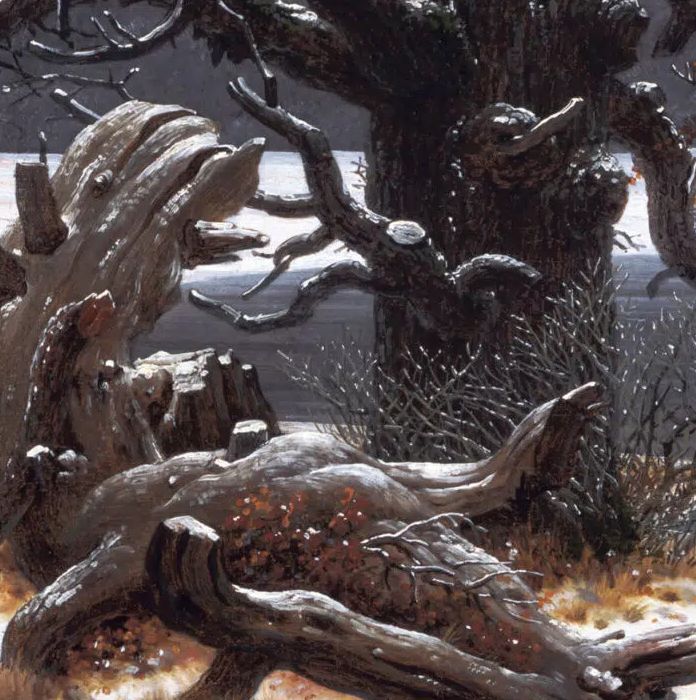
The fallen wood caught the attention of Carl August Böttiger when Friedrich exhibited the painting at the Dresden Academy in 1829. In his review, the archaeologist and writer compared the oak’s narrow rise to that of a cypress and remarked that the imagination could easily make a monster out of the decaying wood. In a study of Friedrich’s ambiguous forms, Verwiebe describes a dragon-like creature lying on its back and sees echoes of eyes and open beaks in other breaks and knots. A dark hollow suggests an eye, and the spreading limbs make the upturned wood look briefly as though it were struggling to right itself. As the eye follows the grain and splits, the shape resolves again into the remains of a trunk. [3]
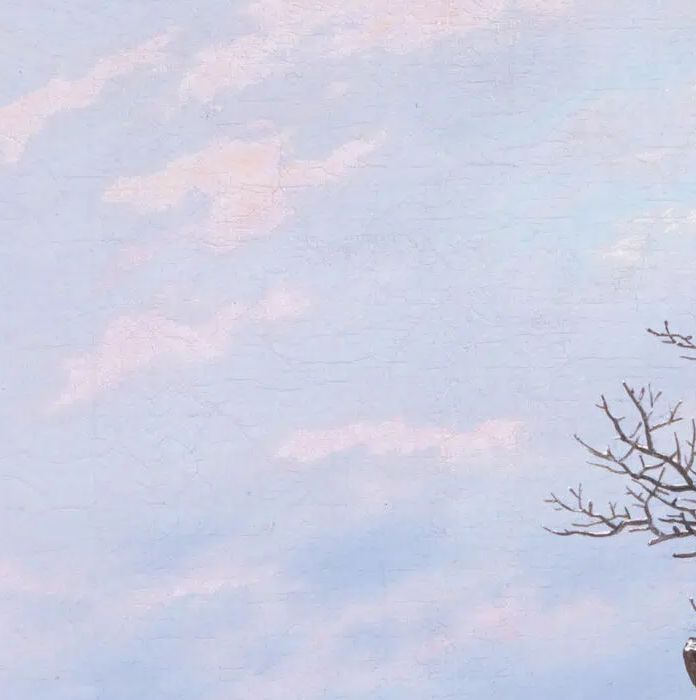
High above the dark pond and tangle of wood, thin clouds carry a touch of pink across the blue. The sky brightens the scene and makes even the smallest branches easy to follow. Verwiebe reads the blue as a sign of hope and connects the snowy ground with Friedrich’s own description of snow as “the great white sheet, the epitome of greatest purity, under which nature is preparing for a new life.” The brown leaves make the promise of spring tangible. They cling to branches that still have the capacity to put out new growth. The split wood, streaked with snow along its upper edges, makes visible what the next season cannot restore. [2]
Oaks in poetry and in Friedrich’s earlier paintings
Verwiebe places Friedrich’s interest in the oak alongside the Romantic reception of the poems James Macpherson published in 1762–63 and attributed to the bard Ossian. In those poems, she notes, oaks often accompany images of heroism. Goethe’s The Sorrows of Young Werther helped bring Ossian to German readers in 1774. Goethe incorporated passages from Macpherson’s Songs of Selma, in which a bare tree and long grass help a hunter recognise the grave of the warrior Morar. That passage gives an example of how a tree could carry a memory of the dead in the literature of Friedrich’s day. In the Berlin painting the damaged trunk and the fallen wood can suggest a history of survival and loss without a grave or an inscription. [2][4]

Friedrich had painted wintry oaks more than two decades before the Berlin canvas. In Dresden’s Cairn in Snow of 1807, several trees stand around a prehistoric stone tomb. Gerd Spitzer discusses the tomb and the old oaks together as possible signs of patriotic renewal under Napoleonic pressure. In The Abbey in the Oakwood of 1809–10, a ruined Gothic window rises amid the trees. The stone structures in these earlier works give the surrounding oaks a human history. In the 1829 canvas, the breaks in the wood and the loss of the crown do much of the work of suggesting what has passed. [2][5]
A closer comparison is Eiche im Schnee, the smaller oil at the Wallraf-Richartz-Museum & Fondation Corboud in Cologne. Berlin’s catalogue dates it to 1827, and the Metropolitan Museum of Art’s 2025 exhibition dated it to about 1827–28. Cologne’s canvas measures 44 cm high by 34.5 cm wide. The Met’s exhibition label describes its boughs and numerous twigs as nearly filling the picture and interprets the patch of blue sky as a sign of easier times to come. In the taller, relatively narrower Berlin canvas, the jagged trunk rises through a wide opening in the branches, with blue extending far to its left. For Verwiebe, that 1829 painting is the most concentrated version of Friedrich’s winter oak motif. [1][2][6]
A tree as the whole subject
Two other winter paintings help explain the scale of Friedrich's decision to give the oak almost the whole canvas. In 1828 he exhibited Bushes in the Snow and Spruce Thicket in the Snow in Leipzig. Gerd Spitzer cites a contemporary review that recognised how unusual it was to isolate a patch of tangled shrubbery and paint it with such care. The critic admired its fidelity to nature and wondered how long so restricted a subject could hold the eye. The Met's exhibition account identifies the setting of the pair as the Dresden Heath, where nurseries replenished depleted timber stocks. The two pictures give close attention to growth that might otherwise have passed for background.[6][10]
In the Berlin oak, the foreground gives us a few clues about the land around the tree, including the pond and the dark belt of distant woods. Most of the canvas is organised by the tree's own division into large limbs, small boughs and barely visible twigs. A viewer can follow that division from the lowest limb to the smallest sprays or take the pale sky as a starting point and work back to the bark. The open areas above the low branches make the damage to the crown especially clear. A bare patch of sky can thus tell us as much about the shape of the tree as a heavily painted limb.[1][2][10]
The Cologne oil gives the snow and sky a different relationship to the tree. In the smaller canvas, as the Met's label points out, the tracery of twigs extends nearly across the picture. In the Berlin canvas there is a longer interval between the spread of the lower limbs and the broken end of the trunk. The eye spends more time climbing through that interval. A patch of blue can offer a similar suggestion of seasonal change in both paintings, while the height of the Berlin picture gives the upper break a force of its own. The two compositions show how much Friedrich could change the experience of looking at a winter oak through the placement of its extremities alone.[1][2][6]
From drawn branches to painted damage
The surviving tree studies show what Friedrich looked for in damaged wood. On a pencil sheet dated 25 and 26 April 1809, for instance, he studied two trees near Neubrandenburg. The Met's label draws attention to the differing marks for knots, bark and foliage. The sheet is documented in connection with other paintings, including the 1811 Winter Landscape in Schwerin. It provides a comparison for the kind of observation at work in the Berlin oak. Where the fallen wood crosses the snow, dark fissures and pale exposed surfaces distinguish the break from the smoother lengths of a standing branch. Above it, the small leaf clusters make it possible to tell which parts of the tree held foliage and which are already bare.[1][3][6][11]
Those details help explain how Böttiger could see an animal in the decaying wood without losing sight of the tree. The marks describe something specific enough for the eye to trace, then the turn of a broken limb or the edge of a hollow offers another outline to follow. In the little snow paintings, the crisscrossing branches invite the same sustained attention even where there is no single trunk to organise it. In the Berlin oak, looking closely moves us repeatedly between the entire tree and parts that seem to have a character of their own.[1][3][10]
From Reimer’s collection to the Nationalgalerie
The Berlin museum records the painting in the collection of the publisher Georg Andreas Reimer from 1833 to 1842. Its provenance also records a gift associated with Carl Gustav Carus in Dresden. Carus had become a close friend of Friedrich after they met in 1817 and published his own Nine Letters on Landscape Painting in 1831. Reimer also collected Friedrich’s Monastery Graveyard in the Snow, another canvas in which old oaks stand in a winter landscape. The Nationalgalerie acquired that painting from Reimer’s family in 1912. The original was subsequently lost in the Second World War. [1][3][7][8][9]
Oak Tree in Snow entered the Nationalgalerie through an exchange with the Dresden dealer Friedrich Axt in 1921. The collection record dates the dealer entry to 15 November. The exchange took place during Ludwig Justi’s directorship, when the museum added seven Friedrich paintings to its collection. Those acquisitions followed the 1906 German Centenary Exhibition, which had brought together thirty-six of Friedrich’s paintings and fifty-seven drawings at the Nationalgalerie. [1][9]
Annotated Details from Oak Tree in Snow
Use the numbered details to trace the forms and light in this work.
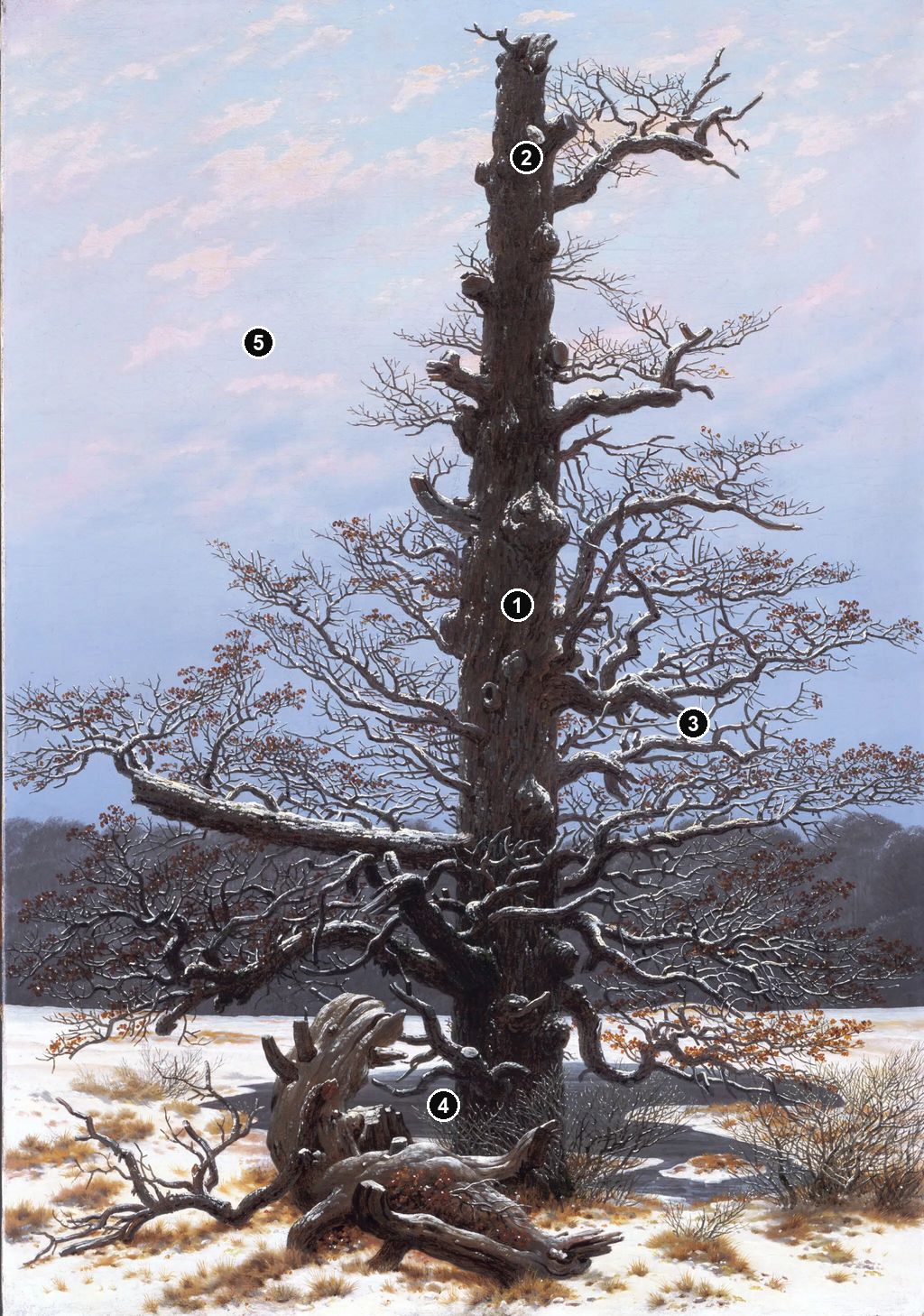
Details from OAK TREE IN SNOW
The detail crops show parts of the work at a larger scale.
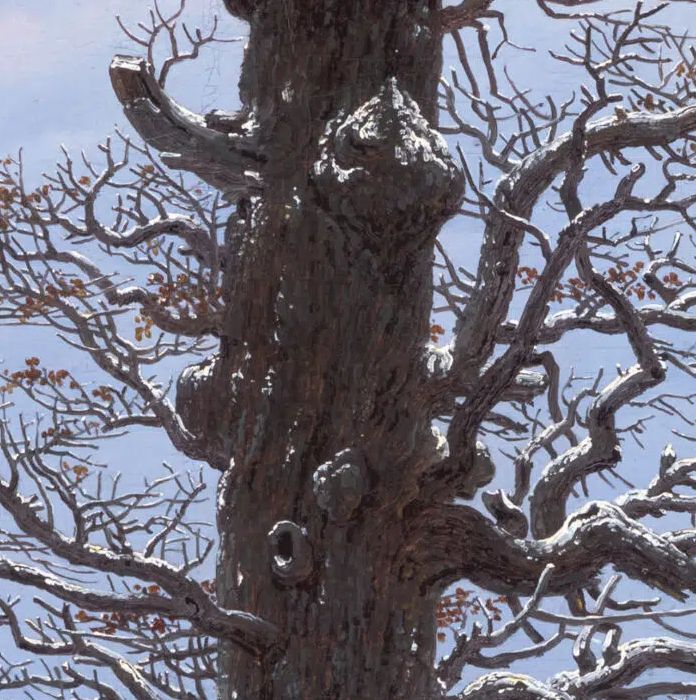
The upright trunk
The massive trunk remains dark against the cool sky, with snow caught along its uneven surface.
The broken crown
Near the top, rough breaks interrupt the trunk and a few branches extend to one side.
Leaves on the smaller branches
Brown leaves cling to the finest twigs in several parts of the tree.
Roots and fallen wood
Exposed roots and broken wood spread over the snow at the base.
Colour in the sky
Thin clouds and a cool blue sky are visible through the bare branchwork.
Frequently Asked Questions
Discussion
Reader insights are welcome, especially close-looking observations about how the oak, snow, fallen trunk, old leaves and blue sky shape the painting's sense of endurance.
Reader Insights
How does the tree's age change the emotional weight of the winter scene?
Does the snow feel like burial, purification, renewal or all three at once?
What changes when the old brown leaves become signs of waiting for spring?
Does Oak Tree in Snow feel most powerful as a symbol of age, survival, transience or winter renewal?
Join the Conversation
Share a source-grounded close reading of the oak, snow, fallen trunk, leaves, title mapping or relationship to Friedrich's other oak paintings.
References
- Staatliche Museen zu Berlin, Nationalgalerie, Eichbaum im Schnee, A II 338, expert collection record.
- Birgit Verwiebe, Oak Tree in Snow, anniversary chronicle, from the Hamburg 2023 exhibition catalogue, p. 282, translated by Steven Lindberg. The Friedrich passage is cited there from Friedrich/Hinz, 1974, p. 129.
- Birgit Verwiebe, An der Grenze der Sichtbarkeit. Verborgene Wesen und Gestalten in Bildern Caspar David Friedrichs, Jahrbuch der Berliner Museen 65 (2024), pp. 94–98, figs. 53–54 and n. 69 for Böttiger.
- Johann Wolfgang Goethe, Ossian passage in the 1774 edition of Die Leiden des jungen Werthers, Universität Bielefeld digital edition.
- Gerd Spitzer, Hünengrab im Schnee, anniversary chronicle, from the Staatliche Kunstsammlungen Dresden collection catalogue, and the chronicle’s Abbey in the Oakwood, NG 8/85.
- Metropolitan Museum of Art, Caspar David Friedrich: The Soul of Nature, exhibition labels, p. 20.
- Friedrich anniversary chronicle, Friedrich meets Carl Gustav Carus (1817) and Carus publishes Nine Letters on Landscape Painting (1831).
- Gerd-Helge Vogel, Künstler im Bannkreis Caspar David Friedrichs, Jahrbuch der Berliner Museen 65 (2024), pp. 104–146, especially p. 104.
- Birgit Verwiebe, The Rediscovery of Caspar David Friedrich at the German Centenary Exhibition of 1906 in Berlin, Caspar David Friedrich: Infinite Landscapes, 2024.
- Gerd Spitzer, Gebüsch im Schnee, Dresden collection essay, including the 1828 Leipzig exhibition and its contemporary review.
- Metropolitan Museum of Art, Caspar David Friedrich: The Soul of Nature, exhibition objects, including Study of an Oak and Tree with Roots, 25–26 April 1809.


