


 Caspar David Friedrich.jpg)
 by Tom Gurney
Tom Gurney BSc (Hons) is an art history expert with over 20 years experience
Published on June 19, 2020 / Updated on October 14, 2023
Email: tomgurney1@gmail.com / Phone: +44 7429 011000
The Dreamer (Ruins of the Oybin Monastery): Introduction
A man in a blue coat sits at the foot of a ruined Gothic window, one leg stretched along the sill and the other hanging down into shadow. Beyond him, firs rise against a yellow-orange sky. Caspar David Friedrich makes the opening almost the height of the painting, yet the entire scene fits on a canvas just 27 centimetres high and 21 wide. The State Hermitage Museum in St Petersburg dates the oil painting to after 1835 and records it as ГЭ-1360 (GE-1360).[1]
The man has taken the seat with the best view, but we see more of the ruin than he does. We face the stones that rise on either side of him and the narrow central support that divides the sky. He is free to look out past those forms. From farther back, we see how much of his experience depends on where he has chosen to sit.
At a Glance
- Date · after 1835
- Medium · Oil on canvas
- Collection · State Hermitage Museum
- Dimensions · 27 cm high × 21 cm wide
- Accession · ГЭ-1360
Contents
- Introduction
- A seat at the window
- What the Gothic opening frames
- Oybin from different sides
- An oil from Friedrich’s final years
- How a study of Oybin could become a different picture
- Carus and the view through two windows
- A window without a household
- From the Anichkov Palace to the Hermitage
- Annotated Details
- Image Details
A seat at the window
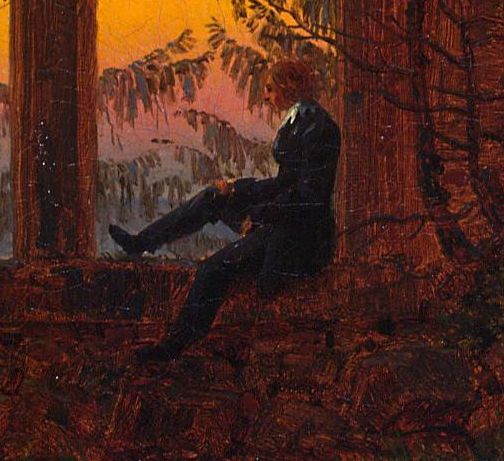
The 1990 Metropolitan Museum of Art exhibition catalogue describes the figure as a well-dressed wanderer watching the sunset. His dark blue clothing and small white collar distinguish him from the reds and browns of the masonry. The catalogue draws attention to the casual pose, with one leg supported by the sill while the other hangs down.[2] That arrangement makes the stone legible as a place to sit. The man seems to have settled there for some time, using the deep window ledge almost as he would use a bench.
His head turns towards the opening. Friedrich makes the direction of his attention clear and leaves his expression difficult to read. The German title Der Träumer and the Russian Мечтатель both call him a dreamer.[1][2] The title suggests how absorbed he is, while the tilt of the head and the way his weight rests on the sill give that absorption a physical form. The Hermitage reads the scene as a search for meaning and a desire to escape the constraints of the age. In the painting that desire could take the modest form of sitting apart for a while and looking out.[1]
The viewer’s eye has an easier first destination. Against the dark wall, the sky stands out before the coat or face comes into focus. The figure occupies the lower right of the opening, where the light is already weakening behind a fringe of branches. His collar catches just enough light to draw attention back to him. The painting lets the sky command the first look and then gives us time to discover the person who is already watching it.
What the Gothic opening frames
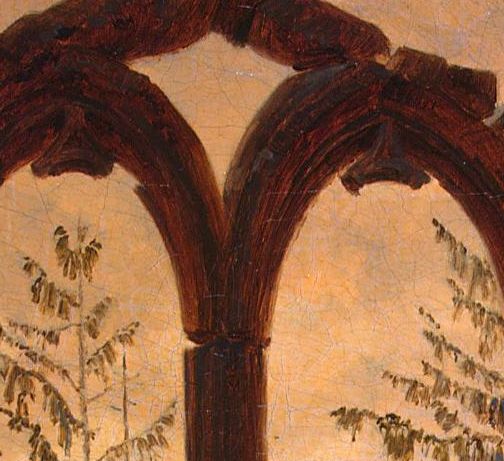
The opening is built around two pointed lights, the tall divisions of a single window. They meet on a slender central stone support. Above their junction, a smaller opening admits a patch of sky. The broken outline of the wall leaves more sky visible around the surviving stonework. Looking up through this succession of openings makes it possible to follow the original design even where the surrounding building has broken away.
The window provides the painting’s strongest symmetry. Its paired arches rise to comparable heights, with the centre support very close to the vertical axis. Within the two lights, the trees give the eye different things to follow. In the left opening, thin trunks rise almost straight from the bottom of the view. On the right, boughs reach in from the side, interrupting the bright space in layers. The figure adds weight to that busier side. The almost even division in stone makes the differences in growth and occupation easy to see.
The sky is strongest in colour low down, where yellow gives way to a cooler distance between the trees. Higher up, the orange fades and the sky becomes more muted. The masonry registers these changes in a different way. Its broad areas stay dark, but warmer patches pick out the uneven surfaces, especially at the edges of the window. Below, broken stone and patches of low growth interrupt any clear approach to the ledge. The man’s boots measure the depth of the ledge, with one silhouetted against the light and the other almost lost in the darkness below.
Oybin from different sides
Friedrich climbed Oybin, near Zittau in Upper Lusatia, with the painter Georg Friedrich Kersting on 4 July 1810, on their way to the Giant Mountains. They found a ruined fortress, a cemetery and the remains of a Celestine monastery. That visit produced the Hamburger Kunsthalle’s Klosterruine auf dem Oybin, a watercolour over pencil. Peter Prange identifies the principal view on the sheet as the sacristy and points to the studies of pointed arches in the margin and the trials of colour as evidence of work done at the site.[3][4]
Markus Bertsch follows the sacristy study into the separate oil painting Ruins at Oybin, made around 1812. Friedrich stretched the proportions of the architecture so that the three window openings appear narrower and taller. He also added a crucifix, an altar table and a sculpture of the Virgin and Child. Those additions give the earlier oil a series of recognisable objects of devotion. The late Hermitage painting concentrates attention on a single window and the way a living person inhabits it.[4]
The 1810 drawing also has a documented connection to a different late Hermitage work, Owl in a Gothic Window, a sepia of around 1836. Prange credits Werner Sumowski with identifying the right-hand window of the watercolour as its model. The sepia uses the surround from the study and reduces the height of the opening. In that work an owl faces out at the viewer. The two late works give a window ledge quite different occupants, and the documented path from the sacristy sheet to the owl belongs to that particular composition.[2][3]
Carl Gustav Carus also painted Oybin. His 1828 Cemetery on the Oybin, now at the Museum der bildenden Künste in Leipzig, shows the window from outside, according to the Met catalogue. The shared motif once led to an attribution of The Dreamer to Carus. The catalogue explains that links to Friedrich’s fir studies of 30 June and 4 July 1813, in Vienna and Oslo respectively, helped establish Friedrich’s authorship. The trees that break up the evening sky thus matter to the history of the painting as well as to its composition.[2][5]
An oil from Friedrich’s final years
The Met’s 1990 catalogue used an approximate date of 1835 and proposed that the uneven handling of the paint pointed to work after Friedrich’s stroke that June. The Hermitage now gives the date as after 1835. Friedrich’s letter of 14 October 1835, cited by Clara Blomeyer in the Hamburg anniversary catalogue, records his return to painting. One oil from this period is the Hamburger Kunsthalle’s Seashore in Moonlight, dated 1835–36 and shown at the Dresden Academy in 1836. At more than a metre and a half high, the seascape makes an unusually large counterpart to the small ruin.[1][2][6]
In the seascape, the horizon runs across the canvas and reflected moonlight makes distant boats just discernible.[6] In The Dreamer, stone and trees cut even the strip of landscape at the foot of the opening into sections. The dim surfaces closest to us take up much of the canvas. Friedrich gives the act of looking through this confined space as much attention as he gives the evening beyond it.
How a study of Oybin could become a different picture
The Hamburg watercolour preserves several kinds of work on one sheet. A principal view sets out the sacristy, smaller studies isolate the shapes of pointed arches, and patches of colour sit near the upper margin. Peter Prange notes that Christina Grummt questions the older assumption that this sheet came from a bound sketchbook. It shares its dimensions with other sheets, but Grummt argues that Friedrich may have used loose paper of the same size on his travels and kept the sheets in portfolios. The distinction matters because a site study could remain available for years as an object to consult alongside work from other trips.[3]
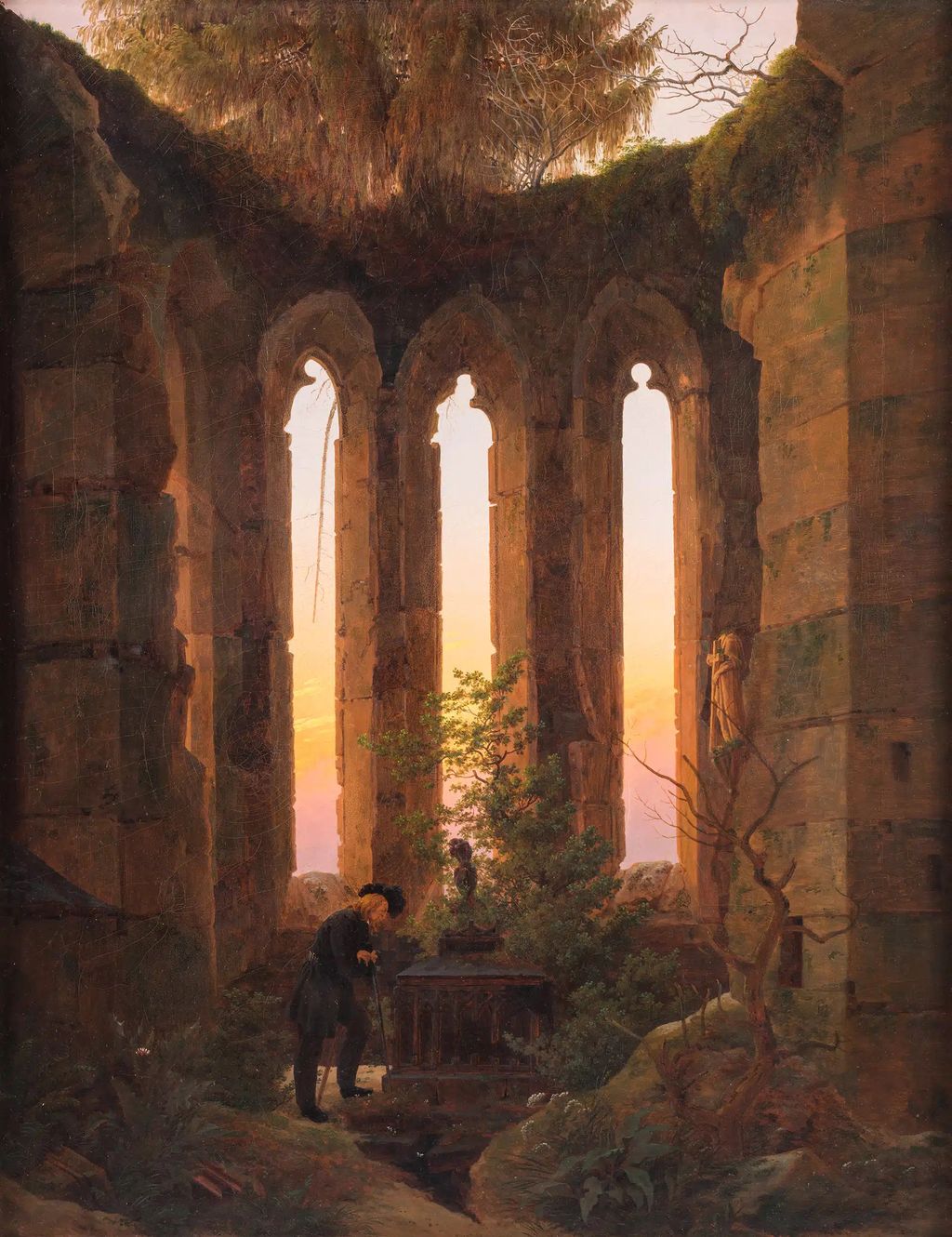
One way to see what that practice made possible is to look at Hutten's Grave, painted about 1823–24. Prange traces the architecture of that canvas to the same Oybin watercolour that supplied the earlier Ruins at Oybin. The Klassik Stiftung Weimar describes the tomb in the later work as an invention. Friedrich placed a sarcophagus commemorating the humanist Ulrich von Hutten within the overgrown church. The observed architecture makes a plausible setting for an act of remembrance that the painter constructed. The visitor who stands by the tomb also gives the ruin a particular use. His attention is directed toward a monument within it, while the man in The Dreamer looks out beyond the wall.[3][8]
That difference helps explain the usefulness of the window as a motif. In the early oil, windows help establish the shape of a space that includes an altar and devotional objects. In the Hutten painting, the ruin houses a monument that invites a visitor to stop. In The Dreamer, the ledge itself becomes the place where someone stops, and the building behind him occupies very little of his attention. Across these works, Gothic stonework can give a scene a strong vertical structure while leaving the painter room to change what a figure does inside it.[2][3][4][8]
Carus and the view through two windows
The Carus painting in Leipzig that figured in the attribution history has a useful counterpart at the Met. Gothic Windows in the Ruins of the Monastery at Oybin, made about 1828, grew out of a drawing Carus made during his own visit in August 1820. The Met identifies the two openings as windows on opposite sides of the ruined choir. They offer views toward a pale morning sky and a distant hill. Friedrich's picture gathers both of its tall openings within one window, so that a single slender support interrupts the view and the seated man occupies one side of it.[2][5][9]
Carus makes the architectural interior available for the viewer to imagine entering. The two windows give the eye separate destinations and establish the thickness of the ruined building around them. Friedrich makes the viewer's access to the landscape more personal by putting someone already at the opening. There is room for the eye to pass him and follow the trees, but his place on the sill also makes us aware of the distance between where he sits and where we seem to stand. Both painters exploit the dark stone against a lit sky. Morning in the Carus picture and evening in Friedrich's give that tonal relationship different settings, and the trees help distinguish the two landscapes.[2][9]
A window without a household
In Woman at a Window, Friedrich used another narrow upright canvas to show a figure looking out. The Berlin painting places the woman squarely before a working domestic window. Shutters and straight floorboards give the room a firm geometry, while the masts outside locate the opening beside the Elbe. The viewer sees part of that world over the woman's shoulders. In The Dreamer, the opening is taller, the edges of the wall are broken, and the man has shifted to one side. The lit space takes up more of the composition, even though trees crowd the lower part of it.[1][2][10]
The positions of the figures change what it means to share their view. The woman stands on the room's floor and leans toward the opening. Her position lends the vertical frame a human centre. The dreamer uses the depth of the ruin as a seat. His lowered leg shows the drop from the sill, and the ledge marks a physical boundary between the position he has reached and the space beyond. His view of the evening may be wide, but the painting gives us the evening as seen through stone, boughs and his own small silhouette.[1][2][10]
From the Anichkov Palace to the Hermitage
The Hermitage identifies The Dreamer as part of the personal collection of Empress Alexandra Feodorovna. It records that Luigi Premazzi depicted the painting in her study at the Anichkov Palace in 1853. That interior supplies a dated record of the painting’s presence in St Petersburg. The date of its arrival in Russia remains unknown. The Met’s 1990 catalogue records that the painting hung in Alexander II’s rooms at the palace until 1917. In 1918 the Hermitage received the painting from the Anichkov Palace.[1][2]
The palace setting belongs to a longer history of Russian interest in Friedrich. As Sergei Fofanov recounts for the Tretyakov Gallery, Alexandra and the future Nicholas I visited Friedrich’s studio in Dresden early in that history. The poet Vasily Zhukovsky, who taught Alexandra Russian, subsequently visited Friedrich and wrote to her about a seascape still in progress. Fofanov identifies it as the Hermitage’s Moonrise over the Sea, a work later acquired for the imperial collection. For The Dreamer, it is the much later Premazzi interior that gives the painting a specific place in the empress’s rooms.[1][7]
The setting of a private study suits a painting whose details emerge at close range. A single glance takes in the whole window. It takes longer to pick out the figure in the masonry and see how little separates his resting foot from the last of the evening light.
Annotated Details from The Dreamer
Use the numbered details to trace the forms and light in this work.
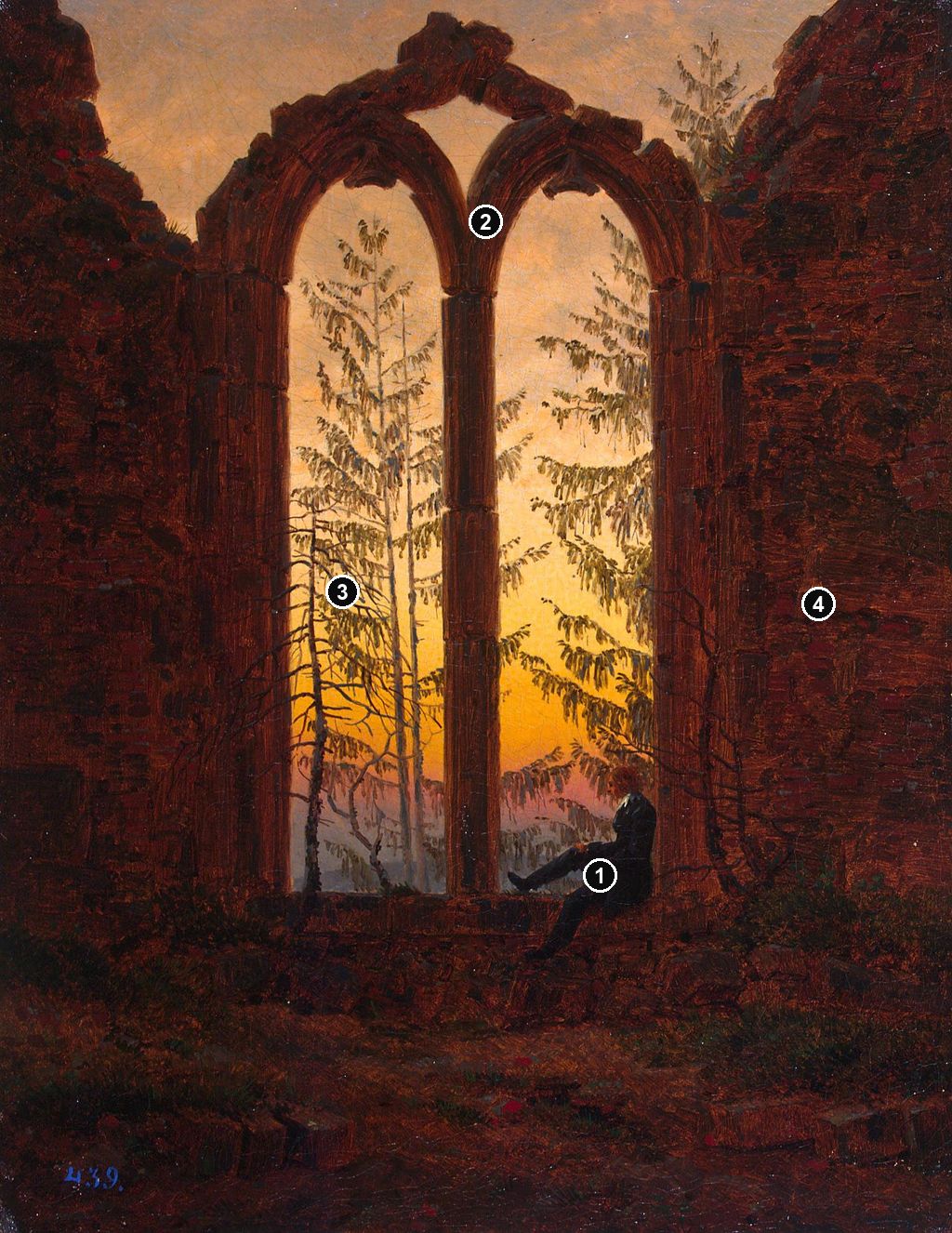
Details from THE DREAMER
The detail crops show parts of the work at a larger scale.
The seated figure
The young man sits in profile on the right, with his legs extending towards the opening.
The two pointed arches
The arches meet above the central stone support. Their edges stand out against the warmer sky.
Trees in the opening
The fine branches of conifers overlap the lit sky inside the opening.

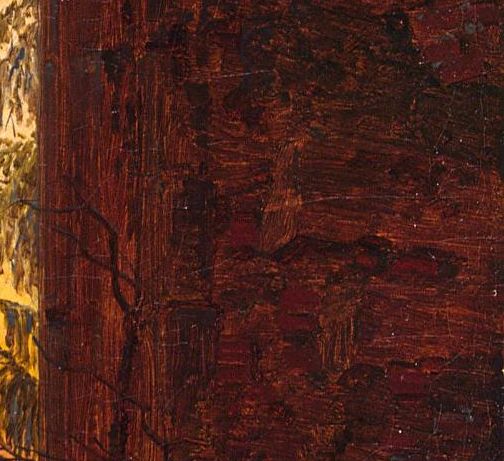
The dark masonry
The broad wall on the right frames the view and retains a mottled, reddish surface.
Frequently Asked Questions
Discussion
Reader insights are welcome, especially source-grounded observations about how Friedrich turns the Oybin ruin into a compact space of memory, architecture and inward attention.
Reader Insights
How does the seated figure change once you notice how tightly the ruin encloses him?
Where does the Gothic architecture feel like a real remembered place, and where does it become a threshold?
How does the late date alter your reading of Friedrich's return to the Oybin motif?
Does The Dreamer feel like a scene of solitude, memory, devotion or historical survival?
Join the Conversation
Share a source-grounded close reading of the figure, Gothic opening, ruined stonework, Oybin context or the late-period mood of the painting.
References
- State Hermitage Museum, Мечтатель (Руины монастыря Ойбин), ГЭ-1360, Russian collection record.
- Sabine Rewald, ed., The Romantic Vision of Caspar David Friedrich: Paintings and Drawings from the U.S.S.R., Metropolitan Museum of Art, 1990, pp. 78–81.
- Peter Prange, Klosterruine auf dem Oybin, Friedrich anniversary chronicle, German entry for Hamburger Kunsthalle 41101.
- Markus Bertsch, Ruins at Oybin, Friedrich anniversary chronicle, from the 2023 Hamburg exhibition catalogue, p. 144.
- Museum der bildenden Künste Leipzig, Caspar David Friedrich and the Düsseldorf Romanticists, including the museum’s Carus painting Friedhof auf dem Oybin.
- Clara Blomeyer, Seashore in Moonlight, Friedrich anniversary chronicle, from the 2023 Hamburg exhibition catalogue, p. 332.
- Sergei Fofanov, State Tretyakov Gallery, Вера, надежда, любовь Каспара Давида Фридриха в России, published in the 2021 Dreams of Freedom exhibition catalogue.
- Klassik Stiftung Weimar. Huttens Grab, around 1823–24.
- Metropolitan Museum of Art. Carl Gustav Carus, Gothic Windows in the Ruins of the Monastery at Oybin, 2007.192.
- Metropolitan Museum of Art. Caspar David Friedrich: The Soul of Nature, exhibition works.


