



 by Tom Gurney
Tom Gurney BSc (Hons) is an art history expert with over 20 years experience
Published on June 19, 2020 / Updated on October 14, 2023
Email: tomgurney1@gmail.com / Phone: +44 7429 011000
Caspar David Friedrich Biography: Introduction
Caspar David Friedrich was born in Greifswald on September 5, 1774, and died in Dresden on May 7, 1840. [1] [2] Between those dates he remade European landscape painting. His art did not treat nature as decorative scenery or as a stage for familiar stories. It turned mountains, coasts, ruins, trees, fog, ice, moonlight and solitary figures into places where inward life could be tested.
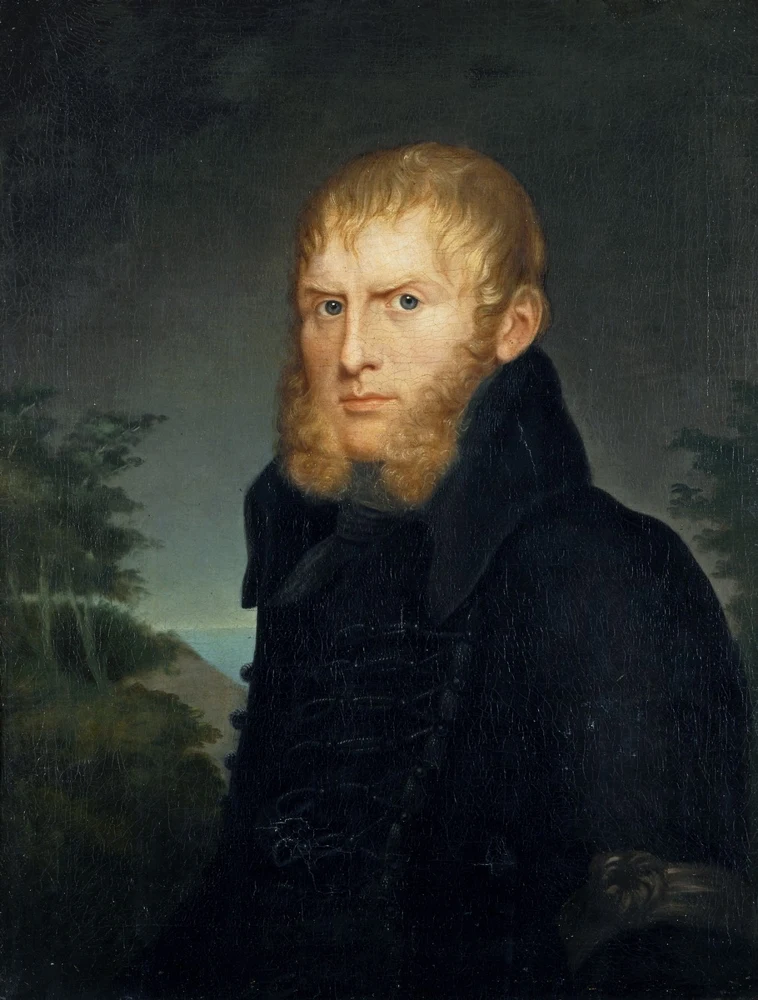
Friedrich studied at the Royal Danish Academy of Fine Arts in Copenhagen before settling in Dresden in 1798. [3] [4] He spent the rest of his career moving between the studio and remembered or observed landscapes: Greifswald and the Baltic coast, Rügen, Saxon and Bohemian Switzerland, the Giant Mountains, the Elbe near Dresden and the imagined spaces of polar ice and moonlit sea. The Metropolitan Museum of Art describes his achievement as a new kind of landscape art in which nature becomes the setting for profound spiritual and emotional encounters. [5]
His life should not be reduced to tragedy, even though bereavement and illness marked it deeply. Nor should his paintings be treated as simple illustrations of biography. Friedrich's real biography is the formation of a way of seeing. He learned to study nature closely, gather drawings from walks and journeys, and later rebuild those observations into images that feel at once precise and visionary.
At a Glance
- BornSeptember 5, 1774, Greifswald. [1]
- DiedMay 7, 1840, Dresden. [2]
- TrainingRoyal Danish Academy of Fine Arts in Copenhagen, 1794-98. [3]
- Main working cityDresden from October 1798. [4]
- Central placesGreifswald, Copenhagen, Dresden, Rügen, Saxon/Bohemian Switzerland, the Giant Mountains and the Baltic coast. [3] [4] [8] [9]
- Major breakthrough worksThe Cross in the Mountains (Tetschen Altar), Monk by the Sea and The Abbey in the Oakwood. [10] [11] [12]
- MarriageCaroline Bommer, January 21, 1818. [13]
- Later healthsuffered a stroke on June 26, 1835; died in 1840. [2] [14]
- Revivalhis art was strongly reintroduced to modern viewers at the 1906 German Centenary Exhibition in Berlin. [15]
Contents
- Introduction
- Early Life in Greifswald
- Copenhagen Training
- Dresden and the Turn from Study to Vision
- Walking, Drawing and the Made Landscape
- Religious Landscape and Public Controversy
- Marriage, Family and the Inward Studio Image
- Friends, Contemporaries and Artistic Networks
- Later Years, Illness and Death
- Rediscovery and Modern Reception
- Learning to Draw Around the Baltic
- The Market for Drawings and the Weimar Prize
- Public Recognition from Dresden to Berlin
- War, Travel and the Uses of a Dated Study
- Caroline Friedrich, Two Addresses and a Community of Artists
- The Russian Court and the Reach of a Dresden Studio
- Exhibiting and Writing as Tastes Changed
- Drawing After the Stroke
- Friedrich's Work After 1840
Early Life in Greifswald
Friedrich was born in Greifswald as the sixth of ten children. [1] His father ran a soap factory, and Friedrich remained close to several siblings throughout his life. [1] Greifswald was not only a birthplace. It became one of the emotional and visual anchors of his art.
The region mattered historically as well as personally. Western Pomerania, including Greifswald, belonged to Sweden during Friedrich's early life. [16] The Baltic coast, the low horizon, the city's skyline and the island of Rügen all shaped his later imagination. Friedrich's paintings of Greifswald and nearby landscapes are not tourist souvenirs. They show how native place could become a serious motif.
The Chronicle records a childhood marked by losses: his mother died in 1781; a younger sister died in 1782; in 1787 Friedrich witnessed his younger brother Johann Christoffer drown while ice-skating; and another sister died in 1791. [3] These events should be handled with care. They help explain why death, graves, winter and memory recur so powerfully in his work, but they do not mechanically explain every painting.
Around 1788-90, Friedrich received his first drawing lessons from Johann Gottfried Quistorp, a university lecturer in Greifswald. [3] This early training gave him a foundation in drawing before he left for more formal study. The combination of local attachment and disciplined observation would remain central to his art.
Copenhagen Training
From 1794 to 1798 Friedrich studied painting at the Royal Danish Academy of Fine Arts in Copenhagen. [3] Copenhagen mattered because it gave him academic training without fixing him permanently inside academic convention. The surviving Chronicle entries from the late 1790s show an artist making drawings of trees, springs, landscapes, pavilions and figures. [3]
These early works are important because they reveal how seriously Friedrich treated drawing. He was not yet the painter of famous Rückenfiguren and vast symbolic landscapes, but he was already learning how to observe natural forms closely. Trees, rocks, boulders and sky would later become the building blocks of much larger pictorial ideas.
Friedrich left Copenhagen around May 1798, returned to Greifswald, visited Berlin and then moved to Dresden from October of the same year. [3] [4] That sequence set the pattern of his adult life: northern origins, formal training, movement through artistic centres, and finally Dresden as the city in which his mature career unfolded.
The Copenhagen period also helps explain why Friedrich's later art is so controlled. His mature paintings can feel mysterious, but they are not vague. The spareness of a horizon, the placement of a figure, the weight of a tree trunk or rock, and the interval between foreground and distance all depend on discipline learned before the famous oil paintings appeared. Friedrich's biography is therefore not a story of an untaught visionary suddenly rejecting art-school culture. It is the story of an academically trained artist who redirected training toward a different purpose.
Dresden and the Turn from Study to Vision
Dresden became Friedrich's principal working city. He moved there in 1798 and participated in the Dresden Academy Exhibition for the first time in 1799. [4] The city offered access to artistic institutions, collections, colleagues and the landscapes of Saxony. It also gave him a base from which to walk, draw and transform observed places into imagined compositions.
In Dresden, Friedrich studied not only nature but also art. The anniversary exhibition material notes that he looked at old masters in Dresden's collections while contrasting academic traditions with sources he found in nature and on walks around Dresden and the wider Saxon countryside. [17] This tension between inherited art and personal observation is essential to his biography.
Friedrich's early Dresden years included sepias, drawings, printmaking and experiments with mountain, ruin and cross imagery. His 1805 success with two sepia drawings sent to Goethe, which brought unexpected prize money, belongs to this phase. [4] He was building a reputation before his great oil paintings became central to the story.
The turn from study to vision did not mean abandoning observation. It meant changing what observation could do. Friedrich used studies of trees, rocks, mountains and coasts as material for images that were not simply topographical. He learned to make nature carry philosophical, religious and emotional pressure.
Dresden also gave Friedrich a public rhythm. He was not painting only for himself or for later mythology. Academy exhibitions, patrons, critics and visitors to his apartment formed part of the environment in which his work developed. The city connected him to Berlin through exhibitions and royal collecting, to Hamburg through later collecting and rediscovery, and to the landscapes of Saxony through the walking routes that supplied his drawings. Biography, in his case, means holding these institutional and geographical settings together.
Walking, Drawing and the Made Landscape
Friedrich's working method depended on walking and drawing. He often gathered motifs outdoors, then recomposed them in the studio. This is clearest in paintings such as Wanderer above the Sea of Fog, where observed elements from Saxon and Bohemian Switzerland are combined into a landscape that does not correspond to one exact viewpoint. [18]
Rügen was another important place. Friedrich felt drawn to Rügen in 1806, returned to Greifswald and the Baltic coast at various moments, and travelled with Caroline Friedrich toward Greifswald, Wolgast, Stralsund and Rügen in 1818. [8] Chalk Cliffs on Rügen shows how these journeys could become a painting about viewing, danger and constructed landscape rather than a simple record of travel.
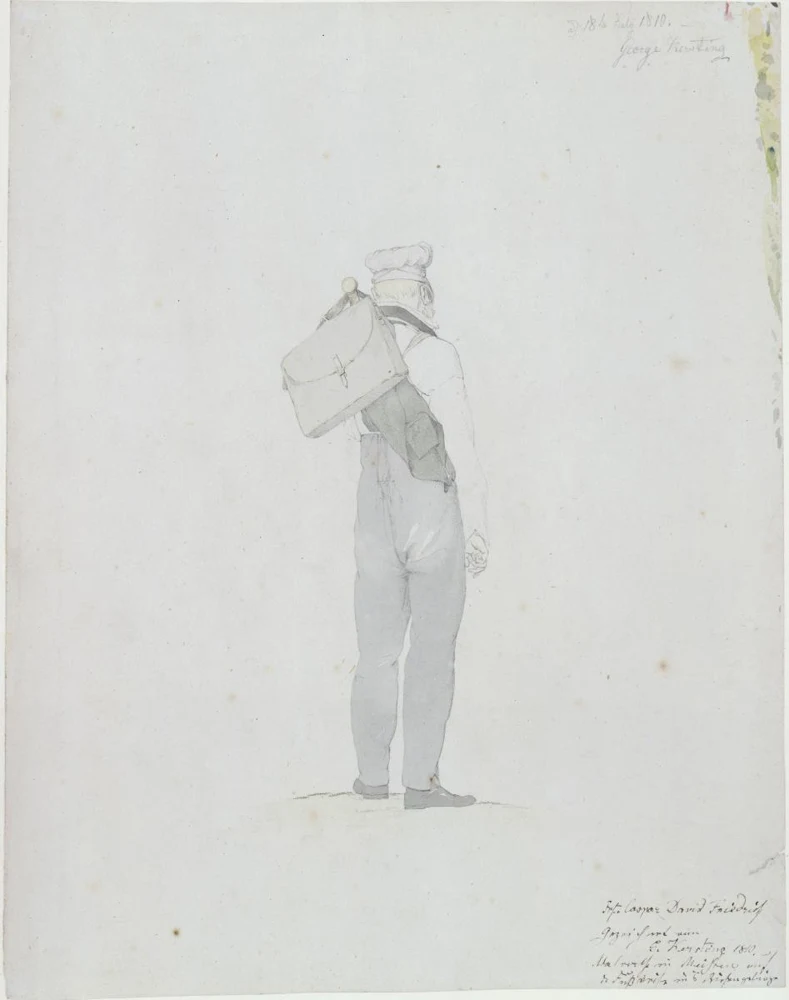
The Giant Mountains offered a different kind of source material. In July 1810 Friedrich set off on foot from Dresden with Georg Friedrich Kersting, crossing toward the Schneekoppe and recording impressions in sketches and drawings. [9] Years later, the experience still fed mountain paintings. Friedrich's memory and notebooks could hold a landscape for decades before it reappeared in paint.
Even The Sea of Ice depends on this method. Friedrich did not see polar ice directly, but he studied ice floes on the frozen Elbe near Dresden during the severe winter of 1820/21 and later transformed them into a polar wreck scene. [19] His biography is therefore partly a history of translation: from walk to sketch, from sketch to studio, from observed form to inner landscape.
This working method is one reason his landscapes can feel both local and unplaceable. A viewer may recognize Rügen, the Elbe, the Giant Mountains or the ruins near Dresden, but the finished painting often refuses the status of a literal view. Friedrich's life gave him places; his art turned them into structures of attention. That distinction keeps the biography from becoming a travel itinerary. The places matter because he repeatedly returned to them as problems of seeing.
Religious Landscape and Public Controversy
Friedrich's breakthrough depended on his willingness to make landscape carry religious seriousness. The Cross in the Mountains (Tetschen Altar) is the clearest early example. Made in 1807/08, it placed a crucifix within a mountain landscape and enclosed the painting in a carved and gilded frame by Christian Gottlob Kühn. [10]
When Friedrich showed the work in his Dresden apartment over Christmas 1808, it generated controversial reactions. [20] Basilius von Ramdohr criticized it, and Friedrich replied by defending his artistic principles. [20] The issue was not merely whether one critic liked a painting. The dispute concerned whether landscape could function as sacred art.
That question remained central to Friedrich's career. In Monk by the Sea, a small dark figure stands before shore, sea and sky. [11] In The Abbey in the Oakwood, a funeral procession approaches a ruined Gothic church in winter. [12] These works do not illustrate scripture, but they place human beings before nature, ruin and mortality in ways that are spiritually charged.
The Berlin Academy exhibition of 1810 brought Monk by the Sea and The Abbey in the Oakwood before a public audience. King Friedrich Wilhelm III bought the pair, and Friedrich's standing rose. [11] Public controversy and public recognition were therefore intertwined in his career.
This Berlin moment is important for biography because it shows Friedrich entering public cultural life through works that were difficult rather than reassuring. His career did not advance by making landscape easier to consume. It advanced, at key moments, because patrons and viewers recognized that his severity had force. Berlin was one of the cities where that force became visible to a wider audience, even as Dresden remained his working base.
Marriage, Family and the Inward Studio Image
Friedrich married Caroline Bommer on January 21, 1818, when he was forty-three and she was twenty-four. [13] The marriage did not simply interrupt his art. It entered the visual world of his paintings through domestic interiors, figures seen from behind and journeys to northern places.

That summer, Caspar David and Caroline Friedrich set off for Greifswald; the documented journey also took them to Wolgast, Stralsund and Rügen. [8] The trip has often shaped interpretations of Chalk Cliffs on Rügen, though the figures in that painting cannot be securely identified as portraits. [7]
Friedrich's inward studio images also matter here. Woman at a Window, painted in 1822, is often connected with domestic looking and the threshold between interior and outside world. In such works, the biography of marriage and household becomes part of a larger problem: how a human figure turns toward a world that remains partly withheld.
The family context should not soften Friedrich into a purely private painter. His domestic and figure images belong to the same wider project as his mountains and seascapes. They ask how bodies occupy spaces of looking, longing and separation.
Friends, Contemporaries and Artistic Networks
Friedrich's Dresden life was not isolated, even if many of his paintings use solitude as a central image. He knew and exchanged ideas with other artists and writers. Philipp Otto Runge belongs to the wider northern Romantic context. Georg Friedrich Kersting accompanied Friedrich to the Giant Mountains in 1810. [9]
Johan Christian Dahl became especially important after moving to Dresden in 1818. cdfriedrich.de records that Friedrich, who had lived in Dresden since 1798, showed Dahl the city shortly after his arrival; by December that year Dahl reported spending a morning conversing with him about art. [21] In 1820 the two exchanged paintings as a sign of friendship. [21]
Carl Gustav Carus was another significant friend and witness. His writings and recollections help preserve impressions of Friedrich's later years, including the effects of illness and decline. [22] Carus's 1840 response to Friedrich's death is not a neutral biography, but it shows how strongly the painter had marked his circle. [22]
These networks matter because Friedrich's art is sometimes treated as if it emerged from pure solitude. Solitude is a pictorial theme, not the whole life. Friedrich worked among artists, critics, collectors, writers, patrons and institutions.
His institutional life was also wider than Dresden alone. Berlin mattered through exhibitions, royal acquisition and the later 1906 rediscovery. Hamburg matters because the Hamburger Kunsthalle became one of the great modern homes of Friedrich's work, with holdings central enough to anchor anniversary exhibitions. [17] Dresden matters both as lived city and as collection city. The biography is therefore not a straight line from private experience to private symbol; it is a web of places, friendships, collections and publics.
Later Years, Illness and Death
Friedrich enjoyed success but also saw his art fall out of favor. [6] The Intro page for the 250th anniversary summarizes this arc directly: he started a family in Dresden, experienced a period of great success and then watched his art lose public favor. [6]
In the 1820s and 1830s he continued to make major works, including The Sea of Ice, The Watzmann, late moonlit seascapes, Neubrandenburg in Flames and The Stages of Life. [3] [19] These paintings show that the late career was not simply decline. It produced some of Friedrich's most severe images of distance, memory, age and natural extremity.
His health worsened after a stroke on June 26, 1835, which led to paralysis. [14] The Chronicle records convalescence in Teplitz later that year and worsening health in 1836. [3] Friedrich died in Dresden on May 7, 1840, aged sixty-five, and was buried in the Trinitatis Cemetery. [2]
It would be too simple to describe his final years only as failure. Illness, reduced activity and diminished favor were real. So was the continuing force of the work. The paintings he left behind made later viewers reconsider what nineteenth-century landscape could be.
Rediscovery and Modern Reception
Friedrich was not absolutely unknown after his death, but his reputation changed dramatically. cdfriedrich.de states that more than half a century after 1840 he was rediscovered at the 1906 German Centenary Art Exhibition in Berlin and celebrated as a pioneer of modern art. [6] [15]
The rediscovery depended on a changed idea of what mattered in painting. The cdfriedrich.de digital story on the 1906 exhibition explains that modern viewers were drawn to qualities such as surface, color, light and a new landscape sensibility. [15] Friedrich's drawings from nature could be understood as precursors to later outdoor study, while his spare compositions could appear strikingly modern.
The 2024/2025 anniversary renewed that attention. Hamburg, Berlin and Dresden, the three museums or museum associations with especially strong Friedrich collections, joined in major anniversary projects. [6] [17] The Met's 2025 exhibition in New York was the first comprehensive exhibition dedicated to Friedrich in the United States and presented about seventy-five works from every phase of his career. [5]
The modern geography of Friedrich's reception therefore mirrors the geography of his life while also extending it. Greifswald and Rügen mark origins and recurring memory. Dresden marks work, friendships and death. Berlin marks early public success and later revival. Hamburg marks the modern museum setting in which paintings such as The Sea of Ice became central to the public image of Friedrich. New York, through the Met exhibition and publication, shows how far that reception has travelled. [5] [23]
This modern reception should not make Friedrich our contemporary in a careless way. His art belongs to the politics, religion, artistic debates and landscape culture of early nineteenth-century Germany. But it continues to matter because it asks questions that remain alive: how do people look at nature, how does place shape inward life, and what happens when the visible world becomes a site of uncertainty rather than explanation?
Learning to Draw Around the Baltic
The route from Greifswald to Copenhagen helps place Friedrich's education in a setting that crosses the boundaries of later national art histories. He was born on 5 September 1774 in Swedish Pomerania. His father's work involved both soap and candles. Friedrich acquired his earliest instruction from Johann Gottfried Quistorp, whose university position linked drawing to a wider culture of practical and scholarly observation. Around four years of study in Denmark followed. A young artist from a Baltic town could learn a professional practice within an institution abroad and eventually make his career in Saxony. Each of those places had a different role in his education.[24][25]
The exercise of drawing a hand belongs to the same training as the study of a tree or a stone in one important respect. It asks the draughtsman to follow the relation of parts before deciding which details are needed to make the whole legible. A hand drawn as an outline still has to express where the fingers turn and overlap. A boulder can lose its weight if the draughtsman records its perimeter without noticing where the mass rests. Friedrich's early studies survive unevenly, but they make the professional work of observation more tangible than a description of innate sensitivity to landscape. The dates of Quistorp's instruction are approximate, and surviving objects offer a firmer ground for individual claims about what Friedrich learned to do.[24][26]
There are also very specific ways to establish that the teacher mattered after the period of lessons. The early etching of a farmhouse and hills, surviving as a trial proof pasted into a sketchbook, carries a dedication to Quistorp. Its survival joins several parts of the young artist's practice in one object. The printed impression comes from an image that had to be prepared for transfer and printing. The sketchbook gave the sheet a further place among personal working materials. The dedication records an identifiable relationship. A print like this makes it possible to speak about training without assuming that all its consequences have to be visible as a recognizably Friedrichian style.[3]
Copenhagen extended the scale of those connections. The Sächsische Biografie identifies Johann Ludwig Lund among Friedrich's fellow students and records the continued friendship. Lund's presence in this account is helpful because it keeps the academy from becoming merely a succession of instructors' names. Artists at similar stages of training could look at one another's work and carry a set of common references into later careers. The institutional source establishes the friendship. A more detailed assignment of any single feature of Friedrich's mature art to the exchange would need evidence from particular works or correspondence.[24]
The familiar accounts of Friedrich's childhood also belong to a history of transmission. The date of his brother Christoffer's death can anchor the event in a chronology. Accounts of how Friedrich himself was involved are told with different degrees of certainty. The death was one of several losses in a short period, and that pattern forms part of the family history. A frozen river in a painting or study made much later brings other evidence into view. It may be related to a specific winter, a dated drawing, the eventual buyer or the construction of a larger composition. Bringing those records together allows a biography to acknowledge bereavement without making each patch of ice a coded confession.[3][24][25]
The Market for Drawings and the Weimar Prize
The young Friedrich first exhibited at the Dresden Academy in 1799. The surviving account of his early income includes recognizable views of Dresden and nearby places. A view of an existing place gives a customer something to identify, and it gives the artist an opportunity to decide what information is necessary for that recognition. Which roofline survives in a wash, how much of the opposite bank to show, and how near an observer should seem to a window are choices even in a drawing whose subject can be named precisely. The early work can be understood as a period when those choices had an immediate professional use.[25][27]
The years around 1805 offer an unusually good point from which to see the scale of that ambition. The Weimar competition associated with Goethe gave Friedrich a prize for two works on paper. Berlin's exhibition chronology records a shared first place. Dresden was still his base, and the recognition came through a public competition elsewhere. The episode supplies a counterweight to treating his first major oils as a sudden discovery of an otherwise unknown painter. An artist presenting accomplished sepias was already able to make a persuasive claim for his work outside his immediate city.[4][25]
The large sheet now titled Eastern Coast of Rügen with Shepherd at the Met gives an idea of what a finished drawing could ask of an exhibition visitor. The museum dates it to 1805–06 and identifies both the underlying pencil and the ink and wash worked over it, with opaque white used in the image. In that order of materials, a draughtsman can begin with placements and outlines, build a spread of tone and then make selective changes of emphasis. The paper holds the different operations together. Recognition of the coast is one possible response, while an extended look can attend to the particular distribution of light, the open reaches of terrain and the disproportion between the large sheet and a very small person within it.[28]
The finished drawing was based on sketches made on Rügen. A group of studies from a journey can present a painter with a sequence of particular forms, each attached to a spot or a moment of attention. A finished work decides which of those relationships should be available together. That is a different kind of visual record from the sketchbook and involves different practical choices. A small sketch can rely on details its maker remembers beyond the edge. A publicly shown drawing has to carry what it needs on its own surface. The scale of the sheet and the spacing of its marks are evidence of the work Friedrich put into making the latter possible.[28]
Two drawings of the view from Friedrich's Dresden studio, now in the Belvedere, supply another example. Sabine Rewald's exhibition catalogue dates them around 1805–06 and discusses the relationship between the actual studio and the images. Each sheet uses the material structure of a window to establish where a viewer stands. The look out is one part of the subject. The frame, the dark surfaces close to the spectator and the different amounts of the river world admitted by an opening are also events in the picture. The familiar surroundings of a rented studio yielded more than a reliable view of what lay across the water.[29]
Putting those sheets alongside the Rügen drawing gives a more exact account of Friedrich's first decade in Dresden. He was already making art both from places reached on extended journeys and from an interior he could return to daily. Each kind of encounter supplied what the other could not. The coast encouraged decisions about how to gather an expanse into a single drawing. The studio window offered a fixed constraint within which slight changes of viewpoint mattered. The two challenges would remain available to the painter of coastal works and of Woman at a Window more than a decade later.[28][29]
Public Recognition from Dresden to Berlin
Friedrich's successes in Dresden and Berlin were bound up with different kinds of visibility. In Dresden the Christmas showing of the Cross in the Mountains took place in his rooms. An artist's apartment could become the setting in which invited viewers first encountered a work conceived on an ambitious scale. The carved frame was part of the ensemble. The event therefore involved decisions about the presentation of a religious object as well as its painted subject. The debate that followed reached beyond the people who had stood in the room.[10][20]
In Berlin the academy exhibition provided a different structure of attention. The Monk and Abbey appeared together in a public exhibition with other artists' work. The academy setting and the subsequent purchase gave them institutional histories that a studio showing by itself could never provide. Friedrich received membership in the Berlin academy in 1810, and the two works became part of the royal collection. The Prussian king bought Morning in the Giant Mountains and Garden Terrace two years later. Those purchases mark a continuing relationship with Friedrich's work and an interest in compositions beyond the remarkable 1810 pair.[11][12][25]
It helps to look at what varied from one picture to the next. In the Monk, a human being looks out along a low boundary with virtually no direction given for a journey. In the mountain painting a summit with a cross gives two small people a place to reach. In the garden painting built features make distance visible through a more orderly foreground. An audience following Friedrich through those purchases encountered a succession of answers to the problem of how a human figure can occupy a landscape. The connection between works lay partly in the way each tested the relation between a situated person and a much larger field of vision.
Official recognition arrived in stages. The Berlin election was followed by membership in the Dresden academy in 1816. His appointment as an extraordinary professor in Dresden in 1824 carried no teaching obligation, and he did not receive the vacant landscape chair after Johann Christian Klengel's death later that year. Those distinctions have consequences for the biography. An appointment confirms recognition by an institution. A regular teaching role can bring different income, responsibilities and daily contact with students. Friedrich could be acknowledged by an academy and continue to depend on other arrangements for the material conditions of his work.[24][25][30]
War, Travel and the Uses of a Dated Study
The years in which Friedrich's public reputation grew were years of repeated military and political change. The Berlin chronology places him away from Dresden for much of 1813 during the French occupation, in the Elbe Sandstone Mountains. The walks he took there formed part of a working life shaped by circumstances in the city. Staying away for months was a different matter from setting out from Dresden for a short excursion. The record of travel situates him within the war without requiring a viewer to assign a particular political statement to each study he made outdoors.[25]
Certain paintings make the connection between landscape and public affairs more direct. The figure in The Hunter in the Forest is seen in relation to woodland, snow and a prominent stump. His equipment and dress belong to the interpretation of the painting because they give a particular historical character to the body entering the scene. A viewer concentrating on the length of the forest barrier can still ask how that character changes the effect of the encounter. Friedrich could give a motif political force through the situation of a person within it. The painted forest also remains something to reckon with as an arrangement of forms.[24][31]
Other works raise a different question about time. The objects used in a composition can come from a period earlier than the occasion on which it was painted. A dated study can secure a moment when Friedrich was attending to a form and a place. It cannot by itself supply the occasion of every painting for which the form later proved useful. The gap between the dates is sometimes as interesting as their proximity. It suggests that an earlier observation survived as something he could rethink after his movements, his audience and his practice had changed.
The mountain journey with Kersting and the later use of mountain studies also separate knowledge gained while walking from knowledge organized in a picture. Two people may follow a route together and return with very different images. An uphill path presents a walker with a succession of partial views, with near rock repeatedly screening distant terrain. A painting can put distinct observations within a single field. The rearrangement does more than make travel legible for a viewer who was absent. It creates a vantage from which a spectator can try to hold features together that a walker would meet at different stages of a journey.[9][18]
Caroline Friedrich, Two Addresses and a Community of Artists
Friedrich married Christiane Caroline Bommer in 1818. The chronology of the family helps clarify how household history intersects with the chronology of work. The couple travelled north after their marriage. They later moved to An der Elbe 33, which became the setting of family life and work, and by 1823 Dahl's family had moved into the same building. As the address changed, the painted window also changed. The early drawings belong to Friedrich's previous studio. The oil of 1822 places a woman within a different arrangement of interior, window and river view.[13][25][29][32]
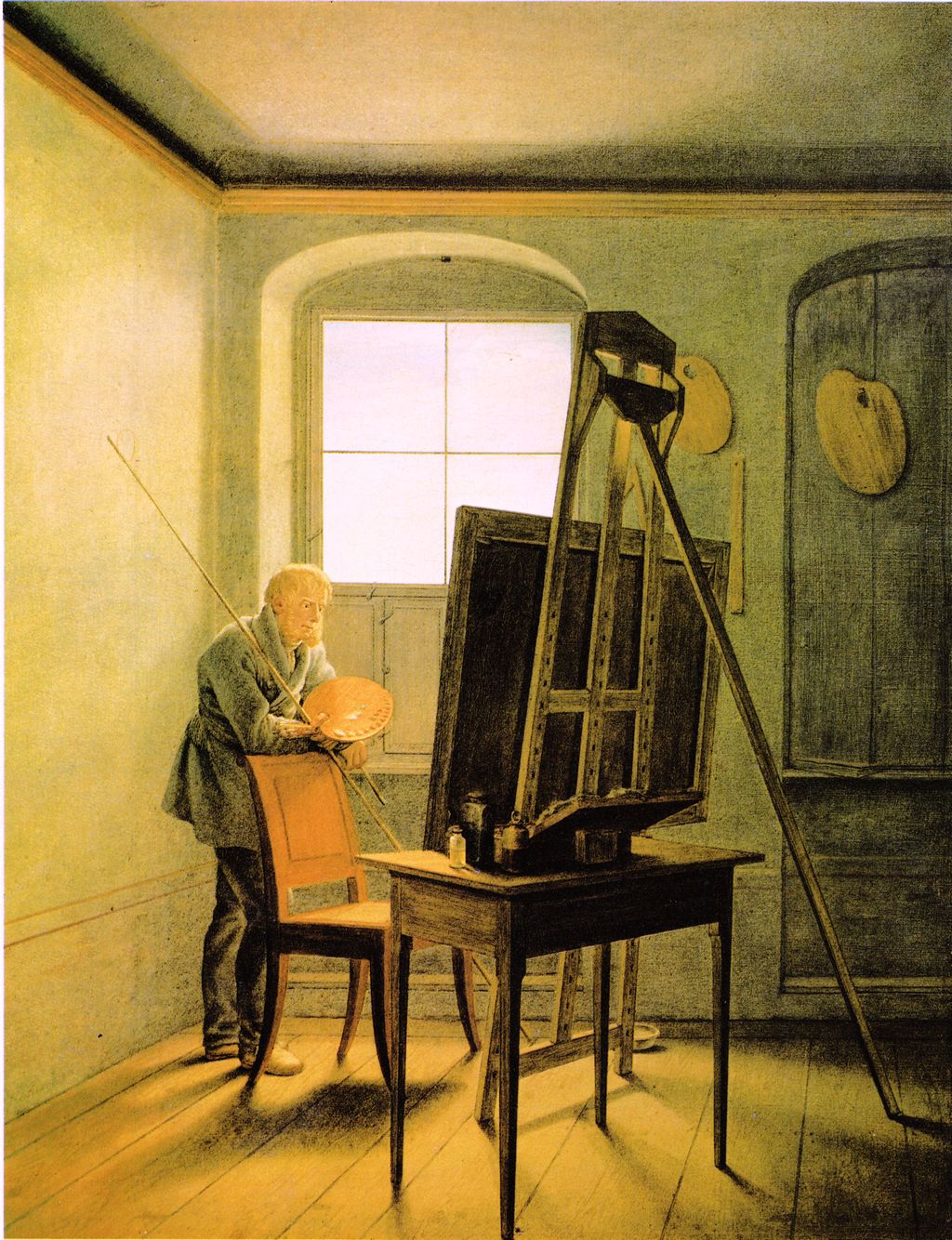
The change is easy to underestimate when the two studios are described simply as places by the Elbe. In the sepias the opening is the means by which the viewer encounters an interior and the world beyond. In the oil a person is already standing at the opening, and a spectator must negotiate the fact that the person is in a position to see something we cannot see from the same height or angle. The picture can be read as a work about the different access two people have to a shared view. The identity of the model gives the interior a connection to the Friedrich household. The painted relation between the person and the aperture is what makes the encounter intelligible to a stranger.[29]
The year of the move also brought Gerhard von Kügelgen's death. A portraitist and friend whom Friedrich had known in Dresden, he was killed in 1820. The closeness of the dates links several different kinds of evidence without turning them into an explanation for one another. There are records of the family's move, of changes in the artistic community and of the way works passed between those still living. The visibility of an individual in the documents can change abruptly. Drawings and paintings left in a household or given to a friend can continue to affect the lives of the people around them.[24][32][33]
Dahl's friendship offers a rare opportunity to follow that process into the objects themselves. The Dresden Two Men Contemplating the Moon passed to him, and the Met identifies the composition as a point of reference for Dahl's Two Men before a Waterfall at Sunset. The painted companions in the latter work look towards falling water from a materially different kind of ground. Their surroundings interrupt the look through directional marks and visible changes of level. The gift made Friedrich's painting available to a fellow painter who could answer it with a new treatment of two people sharing an experience outdoors.[34]
The contrast between those paintings also makes the artists' friendship easier to understand as a relationship between two distinct practices. A body can take up a similar posture in each without making the landscapes interchangeable. In Dahl's painting, the water is a source of visible movement within the field shared by the spectators. In Friedrich's earlier version, the sky and the bare branches set the terms of attention. Two neighbours could make recognizable allusions across their work while pursuing the consequences of a terrain particular to each picture.[34]
An episode preserved in the Met's provenance of its own Two Men Contemplating the Moon presents another form of exchange. The painting went to the physician Otto Friedrich Rosenberg, whose daughter received drawing lessons from Friedrich. The museum treats this picture as a later version of the moonwatchers, currently dated about 1825–30. Its early ownership is a useful corrective to imagining that every version moved through the same sequence of dealer, exhibition and collector. A related composition could be put into circulation again through a professional relationship in Dresden. The whereabouts of a particular version can therefore follow from a different aspect of Friedrich's life than the one that first gave the motif its public reputation.[35]
The Russian Court and the Reach of a Dresden Studio
A visit to Dresden by Grand Duke Nicholas, the future Russian emperor, in 1820 opened a stream of imperial purchases. The poet Vasily Zhukovsky visited Friedrich the following year. The extent of the court's involvement is visible in the later distribution of works. A person trying to understand where a painting could be seen after Friedrich's death needs to consider these decisions by purchasers during his lifetime, alongside the far more familiar royal purchases in Berlin. Boris I. Asvarishch reconstructs that relationship in the catalogue for the later loan exhibition from the Hermitage and the Pushkin Museum.[32][33]
A court purchase and a studio visit preserve different things for the biographer. The first can produce a record of a transfer that becomes part of the ownership history. The second is an encounter that may survive through the visitor's subsequent description or in a dated itinerary. Zhukovsky's position made it possible for observations about an artist's work in Dresden to travel into another cultural setting. A later exhibition makes it possible to reconstruct connections among paintings that might otherwise be consulted individually in very different collections. The visibility of Friedrich as an international artist therefore has several dates, depending on which kind of movement one is following.[33]
The acquisitions also had practical effects for Friedrich. The Met catalogue chronology connects the proceeds of Russian sales to his convalescence at Teplitz after the 1835 stroke. For the family, a purchase could affect an immediate decision about care. For the purchaser it could add a work to a collection, and for a later museum it could help determine the range of a loan exhibition. The same transfer sits at the intersection of private circumstances and public art history. It is one reason to keep a record of who acquired a work as part of the life of the artist, even when the acquisition does not account for the picture's subject.[33]
Exhibiting and Writing as Tastes Changed
The titles and dates of Friedrich's late exhibitions give the idea of declining fortune some needed precision. The Watzmann was shown at the Dresden Academy in 1825, and Friedrich exhibited it the next year at the first exhibition of the Hamburg Art Association, alongside the ice painting that the Berlin chronology calls The Arctic Ocean. The grouping put two large landscapes with sharply different kinds of elevation before the same public. In one, distance is worked out through rock formations reaching towards a summit. In the other, wreckage and angular ice bring the obstruction much closer to the viewer. The contrasts help explain why the exhibition record matters to a biography even where contemporary reviews are incomplete.[25]
Friedrich also exhibited beyond Dresden in the years around 1830, in Bremen, Hamburg and Königsberg. Exhibition, purchase and income moved at different rates. A record of works appearing in several cities measures the reach of the exhibition network. It says little by itself about the cost of work or the household's financial position. The chronology of mounting money problems belongs alongside the exhibition record because it explains how an artist with works in circulation could still face a precarious period. The continuing presence of a patron, friend or royal visitor may show that the painter's reputation survived within particular circles while his options narrowed elsewhere.[25]
The manuscript conventionally called Observations on Viewing a Collection of Paintings dates from about 1830 in the anniversary chronology. Its survival adds another kind of professional activity to the period. Friedrich could think through the principles by which a painting ought to be judged while continuing to submit pictures to the venues where judgments were actually made. A remark made about a painting has a different scope from an interpretation attached to a particular work by a later curator. The manuscript is especially valuable when read as evidence of an artist arguing about what pictures could do, within a culture that was continually making new comparisons among landscape painters.[32][36]
David d’Angers's November 1834 visit supplies a precise example of what a late visitor could see, and of what is difficult to recover. He described a group of finished drawings in which stages of life and the seasons were linked. The Hamburg catalogue compares his recorded particulars with those in its existing cycle and finds differences. A discrepancy as small as the number of children or the presence of blossom can matter when identifying a series. The encounter is documented, while the identity of every sheet remains open. For a biography this is a sharper result than saying simply that Friedrich still thought about the ages of life.[37]
It also offers a useful way to put the surviving late oil The Stages of Life beside the drawings. A series on separate sheets requires the viewer to move from one configuration to the next. In the oil different generations and ships can be compared within the same view. A spectator can keep a vessel on the water and a person on the shore within a single stretch of looking and can change the order in which the comparisons happen. The subject can persist across changes of medium while the process of reading it changes. Friedrich's late activity included thinking through the possibilities of those different formats.[37][38]
Drawing After the Stroke
The first stroke in June 1835 restricted the movements Friedrich needed for work. He travelled to Teplitz and retained some ability to work in watercolour and sepia. Sources differ in how decisively they describe the end of his activity in oils. The Berlin exhibition chronology places the likely final painting around this turning point, and the anniversary object chronology dates Seashore in Moonlight 1835–36. The surviving work and the medical chronology give a range within which to understand the transition. They provide a firmer footing than an exact assertion about the day on which he last took up oil paint.[14][24][25][32]
The Dresden sheet shown by the Morgan as Stony Beach at Moonrise (Stony Beach with Setting Sun) was made around 1835–37. The museum identifies an 1801 drawing from Rügen as a source and leaves open whether the bright body is the sun or moon. The span between the source study and the finished sheet is a concrete instance of the longevity of his working materials. A long-ago encounter with a beach could yield a usable disposition of stones, decades after the particular morning or afternoon when the marks were first put down.[39]
Drawing in wash offered its own possibilities during this period. The marks around the stones can make their spacing and individual shapes relatively definite, while a light in the sky can remain difficult to name. The resulting uncertainty concerns an aspect of the view that determines how much of it can be seen at all. A viewer can follow the nearer shapes with some assurance and then face a less secure identification farther away. The distance between a precisely observed object and an equivocal source of light gives the sheet a complexity that persists even if the viewer knows when and where the original study was made.[39]
The connection with the early Rügen drawing also changes the picture of Friedrich's career as a sequence of discarded media. Work on paper had provided his first major exhibition successes. It also remained a means of recovering earlier observations after his use of oil became difficult. A sheet produced under physical constraint could still put several periods of experience to work. This biographical connection is visible through the study and finished drawing, without needing a claim about what the artist privately thought about his younger self.[28][39]
Friedrich's Work After 1840
Friedrich died on 7 May 1840. In the same year the Dresden picture gallery bought Two Men Contemplating the Moon and Rest at the Hay Harvest. Those acquisitions give a precise example of institutional interest near the end of his life and its immediate aftermath. They can be held together with accounts of a long decline in public reputation. A work can have a history as part of a collection without remaining a centre of critical or public attention. The long interval before Friedrich's large display in Berlin in 1906 was made up of many particular circumstances of that kind.[22][32]
The works assembled in 1906 included both oils and drawings. The large gathering gave viewers and writers the opportunity to approach his practice across materials and periods. A person moving through an exhibition of this scale could compare the low horizon of one oil with the worked details of a sheet seen in a different room, or recognize a sustained preoccupation across images gathered from several owners. The exhibition was a historical change in the conditions for looking at Friedrich. It let a group of works do something that a painting seen on its own in a royal or private gallery could only suggest.[15][40]
Later displays also depended on the movement of objects between collections. In London in 1972 the Tate framed Friedrich within Romantic landscape painting in Dresden. The 1990–91 display in Chicago and New York brought together works from the Hermitage and the Pushkin Museum, making the Russian acquisitions newly visible in the United States. A visitor to the Met's 2001 Moonwatchers exhibition could compare a narrower family of compositions. These different exhibitions made different versions of the career possible to see. The 2025 retrospective in New York extended that history with loans covering the different stages of his work.[5][33][35][41]
An artist's posthumous reputation is built partly from such opportunities for comparison. The paintings and drawings were made at specific times for exhibitions, collectors and other people in Friedrich's life. Their presence in later museums gives the same objects different neighbours and audiences. The biography can account for both histories by following the records of training, places, exchanges and sales through to the occasions on which later viewers were able to see the work together.
Key Works Timeline
- 1807/08: The Cross in the Mountains (Tetschen Altar) challenges the boundary between landscape and sacred art. [10] [20] - 1808-1810: Monk by the Sea reduces landscape to shore, sea, sky and a solitary figure. [11] - 1809/10: The Abbey in the Oakwood pairs ruin, funeral procession and winter landscape with the Monk painting. [12] - 1817: Wanderer above the Sea of Fog turns the back-turned figure into one of Friedrich's defining visual devices. [18] - 1818: Chalk Cliffs on Rügen transforms a Rügen coastal motif into a painting about different ways of looking. [7] - 1822: Woman at a Window and related domestic images bring the problem of looking into an interior setting. - 1823/24: The Sea of Ice turns Elbe ice studies and polar imagination into a vision of wreckage and human limit. [19] - c. 1835: The Stages of Life returns to the coast as a meditation on age, time and departure.
Frequently Asked Questions
Discussion
Reader insights are welcome, especially source-grounded observations about Greifswald, Copenhagen, Dresden, Rügen, walking practice, friendship networks, illness, rediscovery and how those contexts clarify Friedrich's major paintings.
Reader Insights
Which place most changes your reading of Friedrich's landscapes?
How does walking and drawing alter the way the paintings feel?
Why did the 1906 rediscovery make Friedrich look newly modern?
Which part of Friedrich's life seems most important to the way his paintings imagine nature: Greifswald, Copenhagen, Dresden, Rügen, the Giant Mountains or the Baltic coast?
Join the Conversation
Share a source-grounded reading of how Friedrich's biography changes one of the paintings.
References
- Casper David Friedrich is born as the sixth of ten children in Greifswald on September 5, cdfriedrich.de Source
- Caspar David Friedrich dies on May 7, aged 65. He is buried in the Trinitatis Cemetery in Dresden, cdfriedrich.de Source
- Chronicle: Works and Biography, cdfriedrich.de Source
- Friedrich moves to Dresden, cdfriedrich.de Source
- Caspar David Friedrich: The Soul of Nature, Metropolitan Museum of Art exhibition page Source
- Intro, cdfriedrich.de, Caspar David Friedrich anniversary portal Source
- Chalk Cliffs on Rügen, cdfriedrich.de Source
- Caspar David and Caroline Friedrich set off for Greifswald, cdfriedrich.de Source
- The Giant Mountains, cdfriedrich.de Source
- The Cross in the Mountains (Tetschen Altar), cdfriedrich.de Source
- Monk by the Sea, cdfriedrich.de Source
- Abbey in the Oakwood, cdfriedrich.de Source
- Friedrich marries Caroline Bommer, cdfriedrich.de Source
- Friedrich suffers a stroke that leads to paralysis, cdfriedrich.de Source
- Centenary Exhibition of German Art: 1775-1875, Nationalgalerie Berlin - the art of Caspar David Friedrich is rediscovered, cdfriedrich.de Source
- King Gustav III of Sweden is assassinated - his son Gustav IV Adolf inherits the throne in 1796; Pomerania and Greifswald belong to Sweden at this time, cdfriedrich.de Source
- Anniversary Exhibitions, cdfriedrich.de Source
- Wanderer above the Sea of Fog, cdfriedrich.de Source
- The Sea of Ice, cdfriedrich.de Source
- Friedrich exhibits Cross in the Mountains in his apartment over Christmas - generating controversial reactions, cdfriedrich.de Source
- The painter Johan Christian Clausen Dahl moves to Dresden. He and Friedrich soon become friends, cdfriedrich.de Source
- "This May, a friend ... was taken from me: my old Friedrich!" - Carus, cdfriedrich.de Source
- 23. Alison Hokanson and Joanna Sheers Seidenstein, Caspar David Friedrich: The Soul of Nature, Metropolitan Museum of Art, 2025, https://www.metmuseum.org/de/met-publications/caspar-david-friedrich-the-soul-of-nature
- Institut für Sächsische Geschichte und Volkskunde, Caspar David Friedrich, Sächsische Biografie.
- Staatliche Museen zu Berlin, Caspar David Friedrich biography, Infinite Landscapes, 2024 exhibition chronology.
- Caspar David Friedrich in Greifswald, Künstlerischer Werdegang, including the early hand studies.
- Kunst Museum Winterthur, Caspar David Friedrich Digital, including the early Dresden views.
- Metropolitan Museum of Art, Eastern Coast of Rügen with Shepherd, object record.
- Sabine Rewald, Rooms with a View: The Open Window in the 19th Century, Metropolitan Museum of Art, 2011, catalogue entries 42–43 and the discussion of the 1822 oil.
- National Gallery, London, Caspar David Friedrich, artist biography.
- Markus Bertsch, The Chasseur in the Woods, Hamburger Kunsthalle exhibition catalogue entry, 2023.
- Caspar David Friedrich anniversary museums, The Chronicle, biographical and object entries.
- Sabine Rewald, ed., with Boris I. Asvarishch and Robert Rosenblum, The Romantic Vision of Caspar David Friedrich: Paintings and Drawings from the U.S.S.R., Metropolitan Museum of Art, 1990.
- Metropolitan Museum of Art, Johan Christian Dahl, Two Men before a Waterfall at Sunset, object record.
- Metropolitan Museum of Art, Caspar David Friedrich: Moonwatchers, 2001 exhibition research, and Two Men Contemplating the Moon, current object record.
- Metropolitan Museum of Art, Inside the Exhibition, Caspar David Friedrich: The Soul of Nature, 2025.
- Hamburger Kunsthalle, Frühling (Folge: Die Lebensalter, Blatt 2), catalogue research on the Hamburg sequence and the d’Angers testimony.
- Metropolitan Museum of Art, Caspar David Friedrich: The Soul of Nature, discussion of The Stages of Life.
- Morgan Library & Museum, Stony Beach at Moonrise (Stony Beach with Setting Sun), Dresden sheet and curator commentary.
- Birgit Verwiebe, Caspar David Friedrich in the Nationalgalerie, 2024 exhibition catalogue essay, pp. 14–19.
- Tate Archive, Caspar David Friedrich: Romantic Landscape Painting in Dresden, exhibition file TG 92/248/4, 1972.


