



 by Tom Gurney
Tom Gurney BSc (Hons) is an art history expert with over 20 years experience
Published on June 19, 2020 / Updated on October 14, 2023
Email: tomgurney1@gmail.com / Phone: +44 7429 011000
Man and Woman Contemplating the Moon: Introduction
A woman reaches across a narrow gap to rest her hand on a man’s shoulder. The sleeve of her dress catches the light, and for a moment that small patch of red is easier to see than the moon they have stopped to watch. It hangs low in the opening ahead of them, just above the exposed roots of an oak. Caspar David Friedrich painted Man and Woman Contemplating the Moon on a canvas only 44 centimetres wide, yet made room for the roughness of the climb, the closeness of the two walkers and a view that seems to extend well beyond their foothold. The Alte Nationalgalerie in Berlin dates the painting to about 1824. [1]
At a Glance
- Artist · Caspar David Friedrich
- German title · Mann und Frau in Betrachtung des Mondes
- Date · c. 1824
- Medium · Oil on canvas
- Dimensions · 34 × 44 cm (height × width)
- Collection · Alte Nationalgalerie, Staatliche Museen zu Berlin
- Inventory · A II 887
Contents
- Introduction
- Where the walk stops
- How the oak divides the light
- A pose made in the studio
- Berlin, Dresden and New York
- The same tree studies in another season
- Shared looking on land and at sea
- Looking at the three canvases together
- Who might the walkers be?
- Annotated Details
- Image Details
Where the walk stops
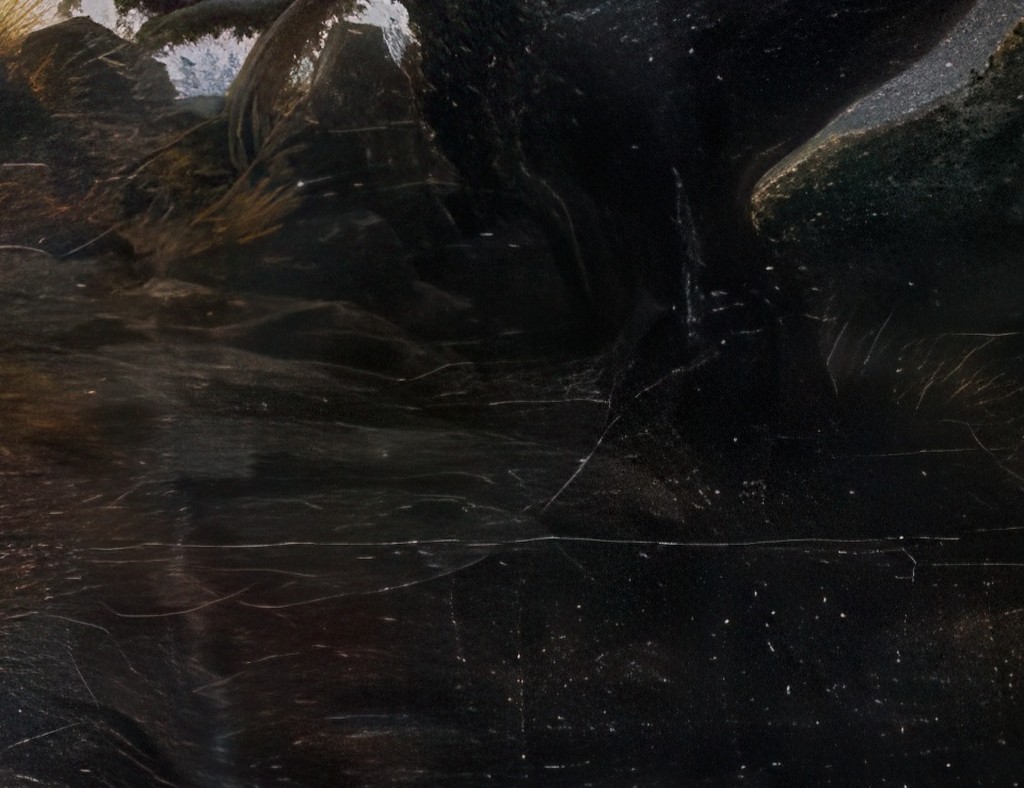
The path spreads across the dark lower foreground, then curves towards the figures. Its direction is easiest to pick out where brown earth passes the jagged stump on the left and leads to a patch of pale grass by the man’s feet. At that point the ground appears to level out. Behind the walkers we see the slope they have climbed. Ahead of them, the line of the ground gives way to the roots and sky. A few distant fir tops give us a sense of the drop without showing the land all the way down. The painting lets us judge the last steps quite well and leaves the depth of the view open. [1] [2]
The man stands nearer the middle, his dark cape flaring outward on the right. The woman’s long skirt falls in narrow folds. Her head covering descends in a dark triangle, and the fall of evergreen foliage behind her nearly absorbs its left edge. Her raised sleeve crosses a strip of light between her body and the cape. Follow the bend at the elbow and the contact becomes clear. Her upper body remains upright, and the two figures touch at a single point. A sliver of light remains visible below her elbow. [1]
Their clothes give that quiet moment a historical register. Birgit Verwiebe, writing for the Alte Nationalgalerie, identifies the man’s cape and cap with altdeutsche Tracht, the Old German dress promoted by the patriotic writer Ernst Moritz Arndt in 1814. Its medievalising forms acquired political associations and the dress was proscribed during the Restoration. Verwiebe cites the writer Karl Förster’s account of an 1820 studio visit, when Friedrich jokingly described the moonwatchers in the Dresden picture as engaged in demagogic activity. Förster’s anecdote gives us a sense of what the costume might have suggested to an early audience. In Berlin, the man still wears it, and the other walker’s red sleeve comes to rest against it. The gesture and the garment can carry different kinds of significance at once. [1] [2]
How the oak divides the light
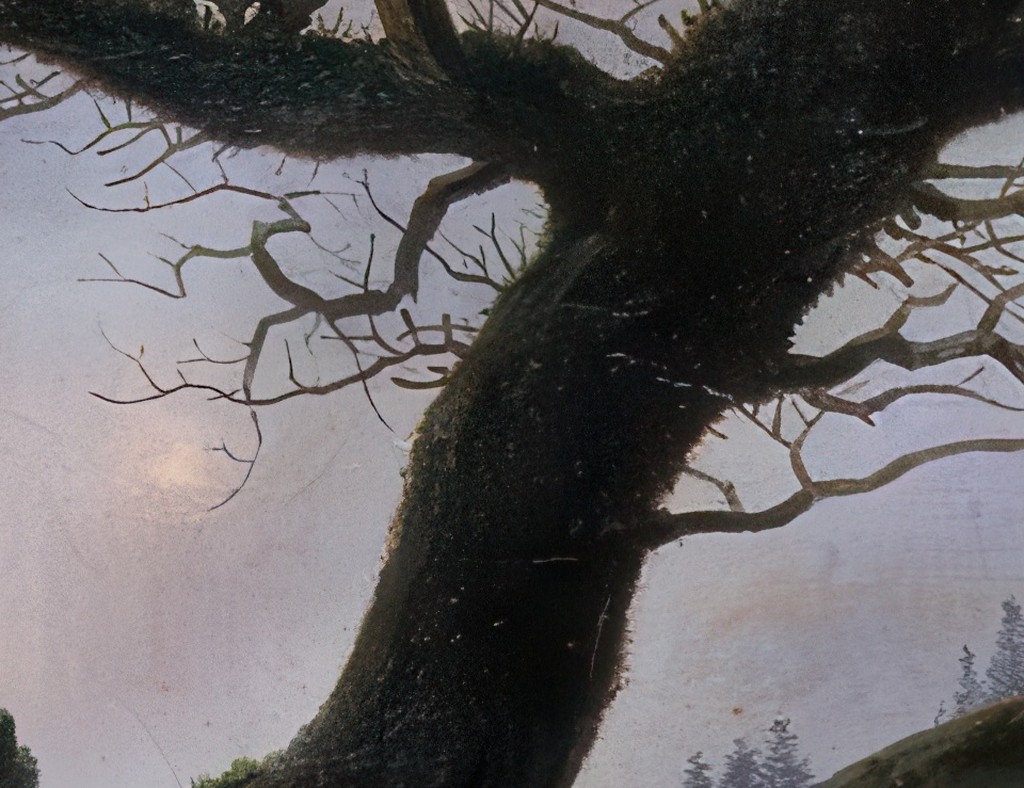
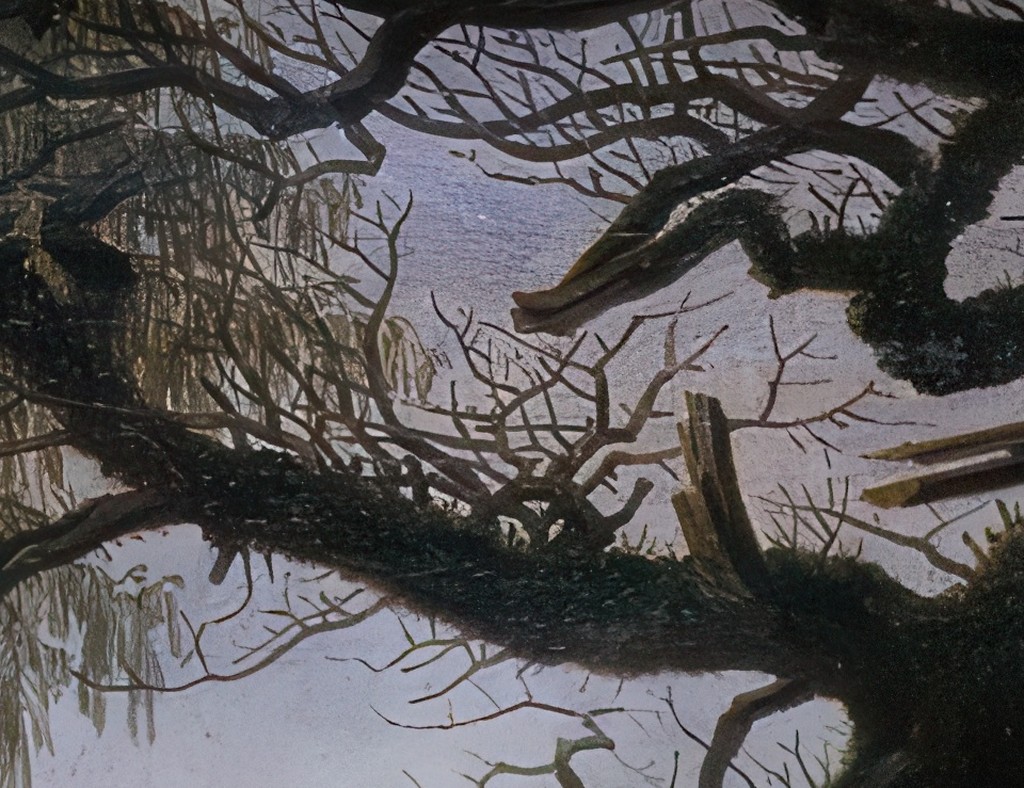
The oak occupies most of the right half of the canvas. Its base is wedged between a large rock and the open space beneath the crescent. A thick limb reaches almost horizontally left, gathering a finer network of twigs against the sky. Several ends are broken. At the bottom, clumps of growth hang from the exposed roots and give their edges a softer profile. The long branch above and the low roots below trace the same movement into the opening. Once you notice that repetition, the patch of sky between them begins to feel like a shape in its own right. [1] [2]
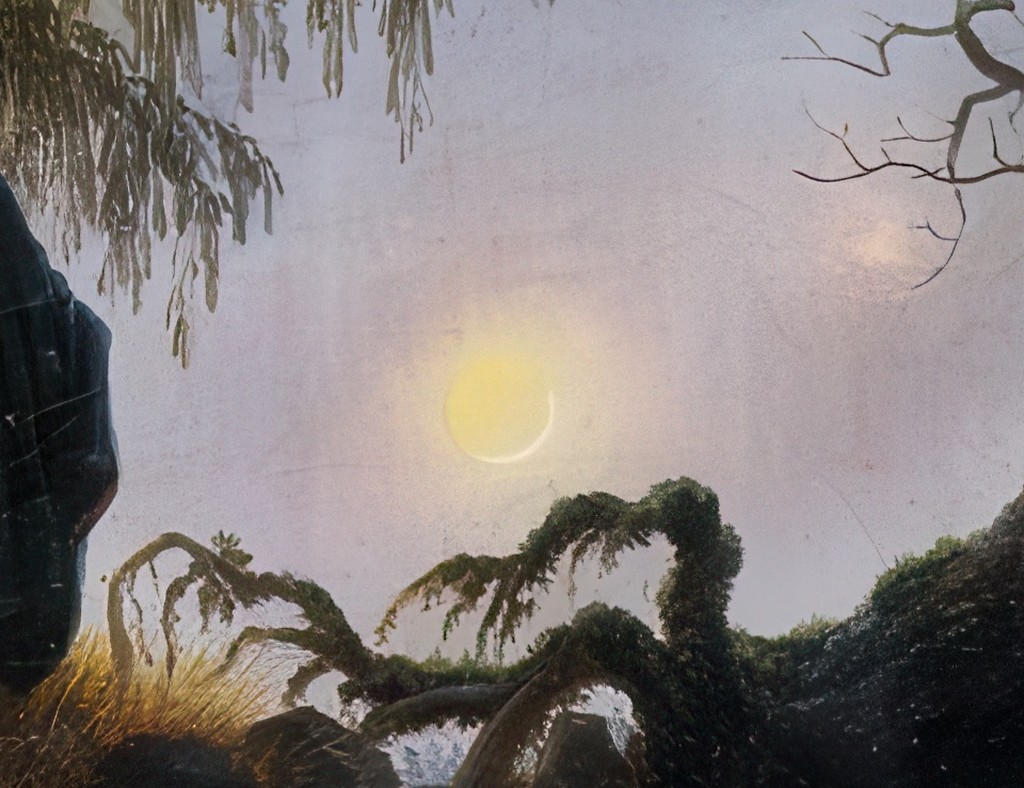
The low moon sits just to the left of the canvas’s centre, outlined by a bright arc that fades into a much wider glow. Above and to its right a faint point of light can be seen near the tip of a twig. Even at the far right, behind the oak and above the rock, there is enough light to distinguish the fine tips of distant trees. The forest can feel dense at the walkers’ backs and spacious beyond the foreground within the same glance. Verwiebe sees the moon as offering consolation in the darkness. The strength of the oak’s silhouette gives that reading some tension. The light opens a view and throws the damaged wood into sharper relief. [1] [2]
The Met curator Sabine Rewald traced the oak’s design to two graphite studies on a single sheet, made on successive days in April 1809 near Neubrandenburg. The lower study supplied the crooked trunk, and the upper one supplied the limb that stretches left. The two drawings help explain how the tree can feel closely observed and still fit the opening so exactly. Friedrich could choose the shape and angle of a branch from one study and set it against the curve of a trunk taken from another. In the Berlin painting, the join of those elements gives the watchers a canopy and leaves the moon visible just below it. [2]
A pose made in the studio
Friedrich also worked from a drawing for the woman. The Kupferstichkabinett in Berlin holds a pen-and-ink tracing titled Standing Woman Facing Right, Partially Visible from the Rear, which the Nationalgalerie exhibited with the painting in 2024. The exhibition explained that scholars had once thought Friedrich took such tracings from finished paintings. Infrared reflectography and the marks left on the backs of some sheets helped establish the opposite direction of transfer. Friedrich used a stylus to pass the contours onto primed canvas. The Nationalgalerie identifies this sheet as the source for the standing woman’s outline. [3] [4]
On its own, a contour can set the turn of a head or the angle of a bent arm. In the painting, the sleeve ends at the man’s shoulder, and the long skirt ends where the path passes into shadow. These relations give the outlined pose its purpose. The survival of the sheet tells us how Friedrich brought the woman into the scene. Her name is a separate question. [1] [3] [4]
Berlin, Dresden and New York
The Galerie Neue Meister’s Two Men Contemplating the Moon, Dresden Gal.-Nr. 2194, is dated 1819/20 by the Staatliche Kunstsammlungen Dresden. The museum’s anniversary account records that it was acquired from the painter Johan Christian Dahl in 1840. In that painting one of the men leans into his companion and their heads come close. The light follows a narrower, more sharply defined track uphill. A rust-brown haze ties the sky to the landscape, and the moon gathers much of that warmth into a single area. In Berlin the ground is harder to distinguish from the rocks at its edges. Against the rose-mauve sky, the oak’s smaller branches come into much sharper view. The woman’s sleeve makes the contact at the shoulder clear even with the heads farther apart. [1] [2] [5] [6]
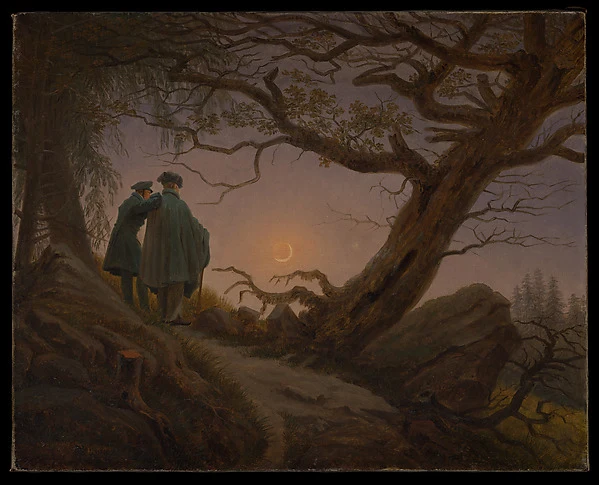
The Metropolitan Museum of Art’s Two Men Contemplating the Moon is another oil on canvas, accession 2000.51, dated about 1825–30 in its current record. It returns to the two men and the narrower path while keeping a lighter sky. A detached branch on the right appears in both versions with two men. In Berlin the area below the rock is largely in shadow. Rewald also noticed that the man’s arm under his cape is held in much the same position as in Dresden, where it is supported by a walking stick. In Berlin the stick is absent. Rewald took that detail as a clue that the painter had adapted the Dresden pose. It shows how one figure could carry traces of an earlier arrangement even as Friedrich changed his companion and their surroundings. [1] [2] [5] [7]
The same tree studies in another season
The sheet on which Friedrich drew the two trees in April 1809 has a longer history than the moonwatching pictures. The Met exhibited it in 2025 as Study of an Oak and Tree with Roots. In her earlier catalogue, Rewald traces the two studies to Winter Landscape of 1811 in Schwerin. There the two oaks remain distinct and stand among many stumps. The moonwatching paintings bring features of both studies together in a single tree. Rewald also identifies the crooked trunk from the lower study in Ruins in Twilight and in the unfinished Forest, Late Autumn. The pencil contours could still be called into service more than two decades after Friedrich drew them.[2][8]
The change from two trees to one affects how the eye follows the moonwatching composition. The lower trunk establishes the tree's weight, with roots spread across the right side. The long limb borrowed from the other drawing lets that weight reach almost horizontally into the sky. If we follow the branch back to its source, the join is visually convincing because the branch continues the twisting movement of the trunk. In Berlin its small leafless twigs are especially legible. Rewald notes green leaves on some branches in New York and traces of foliage in the Dresden picture. Even where Friedrich kept the basic construction, he could change how much light and open sky came through the crown.[1][2][7][8]
The oak also changes what the moon does within the picture. The Dresden moon gathers much of the colour and light around itself. In the Berlin painting the bright part of the sky is broad enough for the fine branch tips to compete with the crescent. The eye can go up to the little point of light beyond the moon, then follow the twigs down to the roots. On that circuit it passes from far distance to foreground several times. The relatively wide opening makes those shifts easy even though the dark path and the figures' feet remain difficult to see.[1][2][5]
Shared looking on land and at sea
The Berlin Moonrise over the Sea of 1822 puts three people on rocks at the water's edge. Verwiebe notes that Friedrich also transferred their outlines from tracing paper. The two Berlin paintings give a way of seeing how the same studio method could serve different arrangements. In the coastal scene, the figures make a low group near the centre, with their outlines set against water and sky. The hillside scene puts two upright figures on the left of a view partly enclosed by trees. Their raised shoulder and bent elbow create a brief connection at the level where the foreground vegetation begins to thin.[1][3][4][9]
Verwiebe reads the three coastal viewers and the returning ships as part of the seascape's consoling mood. The moon is partly concealed by cloud, and its reflected light travels across the water between the people and the ships. On the hillside there is no comparable reflective surface to lead from the walkers to the crescent. The path stops doing that work as soon as the ground falls away. We pick up the line of sight from the turn of the figures, then from the open patch between the roots and branches. Both pictures suggest that watching the evening can be shared. The water gives the coastal group a continuous view towards the horizon, while the oak gives the hillside couple a particular place to stand and a narrow field in which to look together.[1][9]
Looking at the three canvases together
The Met brought the Dresden, Berlin and New York canvases together for Moonwatchers in 2001. Their similar dimensions make small changes easy to compare at the scale Friedrich chose. In Berlin the evergreen at the left reaches farther towards the figures, the stump is splintered and the oak's bare crown takes up more of the clear evening sky. In New York the two men and the detached branch return, but the lighter sky remains. The exhibition made it possible to follow a single detail across the three paintings and watch its neighbours change. That is especially revealing with the figure on the left, whose position remains near the same tree even as the fall of clothing, the space between the heads and the way one person touches the other change the character of the pause.[1][2][7][10]
Who might the walkers be?
Eberhard Hanfstaengl, who acquired the painting for the Nationalgalerie, suggested in 1937 that it represented Friedrich and his wife Caroline. The museum’s 2024 exhibition repeated the identification as a possibility. Kasper Monrad, writing in the Met’s 2001 Moonwatchers catalogue, followed a different line of evidence. A letter from the Danish writer Peder Hjort to his fiancée Olivia Rasbech recounts how he described their walk past a limekiln near Copenhagen to Friedrich in 1817. Friedrich promised to paint the moonlit scene and send it to her. In a later letter, Hjort discussed a landscape Friedrich had sent and expressed surprise that anyone would expect the two figures to resemble him and Rasbech. Monrad proposed that the Berlin painting could be the gift, in which case it would date to the winter of 1817–18 and precede the Dresden painting. [1] [2] [3]
The letters establish an exchange between Hjort and Friedrich and the existence of a picture. The link to this particular canvas remains open. Monrad found no itemised record of which heir received Hjort’s Friedrich after his death in 1871. Rewald also points out that Dahl, writing to the Dresden gallery in 1840 about his own painting and its repetitions, made no mention of a preceding Berlin version. A much later date has been proposed on stylistic grounds. In his 1973 catalogue Helmut Börsch-Supan placed the picture around 1830–35, associating its smooth finish with Friedrich’s late work. The Alte Nationalgalerie’s current date of about 1824 sits between those proposals. [1] [2]
The museum’s published provenance begins with the Salomon art dealership in Dresden in 1922. It records a showing at Paul Cassirer’s in Berlin in 1932 and names the Lucerne collector Julius Wilhelm “Lulu” Böhler. The Nationalgalerie acquired the painting in an exchange with Galerie Fritz Nathan of St Gallen in 1936. The early gap is part of what has allowed such different accounts of the canvas to persist. The touch at the shoulder makes it easy to imagine a particular relationship. Friedrich gives that small gesture enough light to be legible, and leaves the faces turned towards the clearing. [1] [2]
Annotated Details from Man and Woman Contemplating the Moon
This annotated close reading follows six visible details in Friedrich's Berlin moonwatcher painting: the back-turned couple, the woman's linking hand, the low moon and pale sky, the leaning tree, the dark foreground threshold and the enclosing branch lattice. The notes keep the Berlin work distinct from the Dresden Two Men Contemplating the Moon and avoid turning the scene into generic moonlit romance.
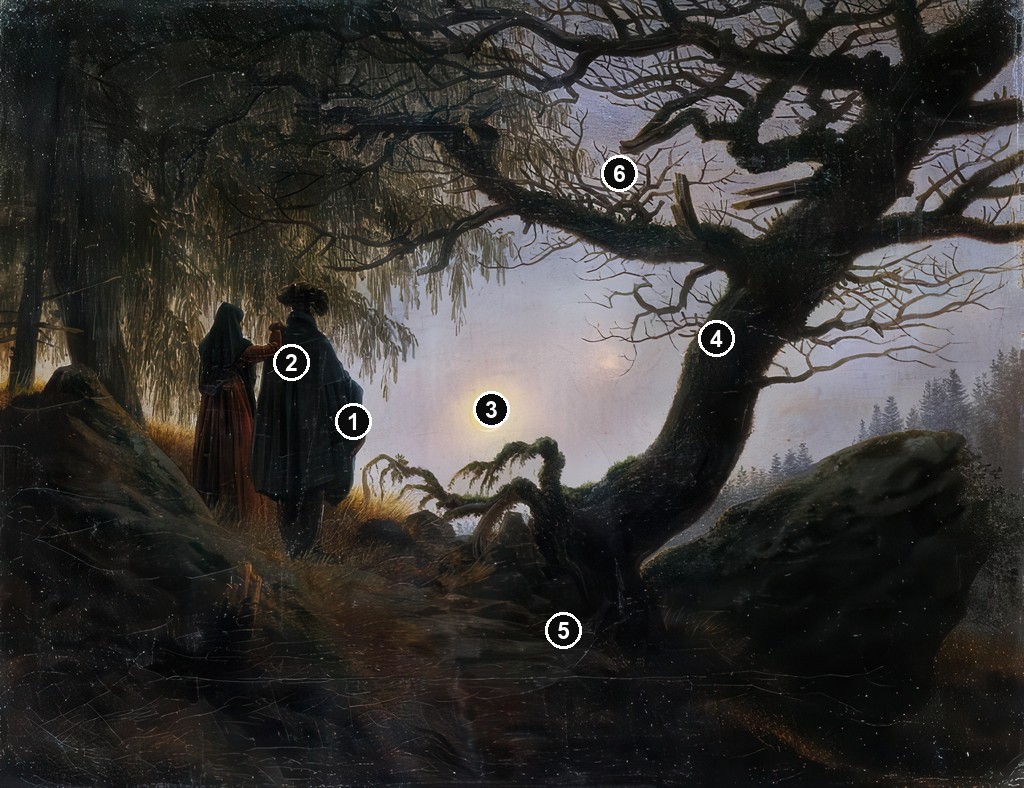
Details from MAN AND WOMAN CONTEMPLATING THE MOON
The details show the Berlin painting, with its close-standing pair beneath the leaning oak.
Back-turned couple
The two figures are seen from behind, so the viewer is asked to share their line of attention rather than read their faces.
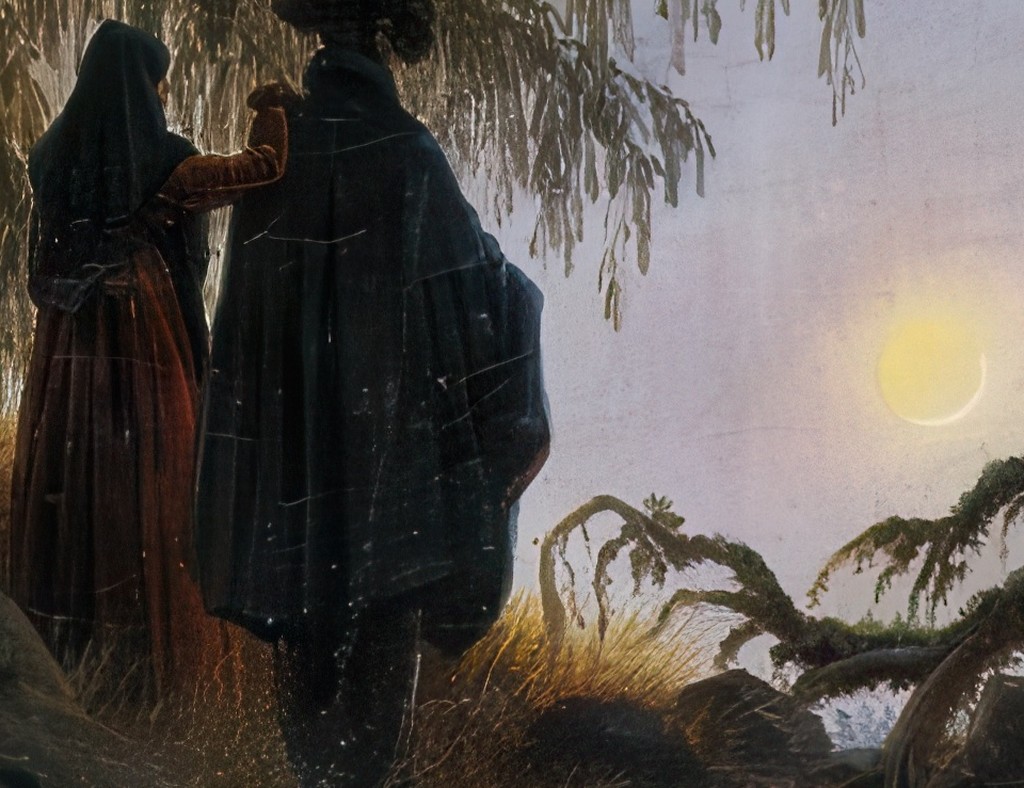
Linked arm and shared pause
The woman's hand at the man's arm makes contemplation a shared posture without turning the figures into confirmed portraits.
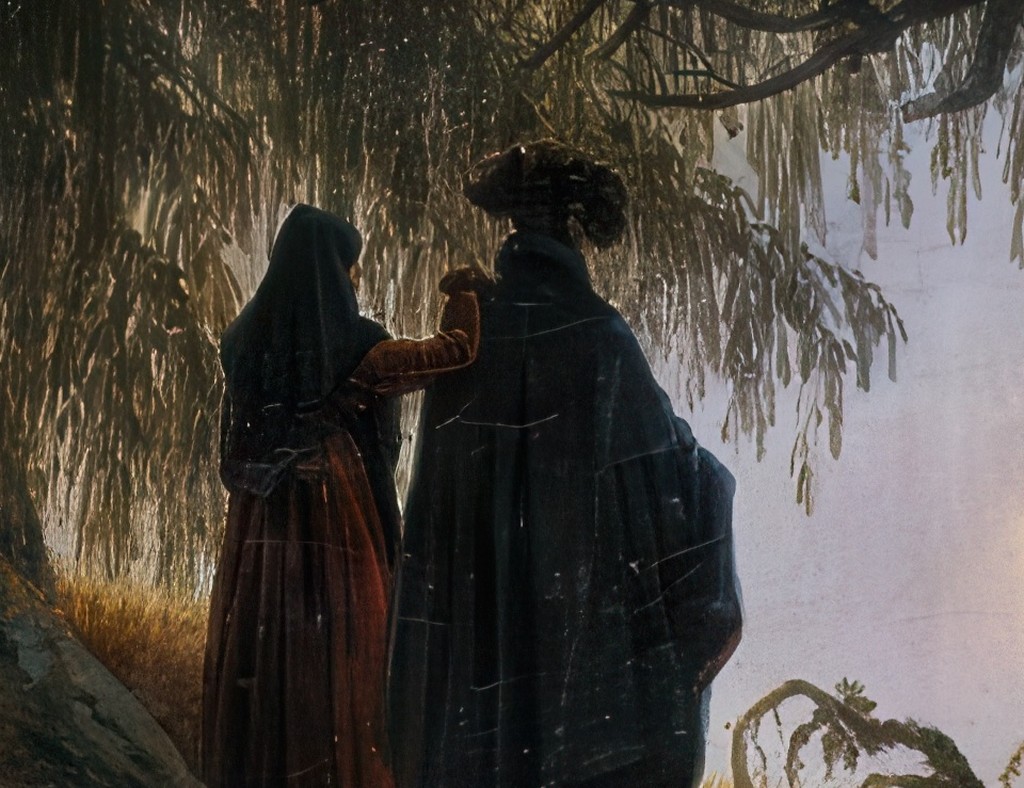
Low moon and pale opening
The moon is low and quiet, held inside a pale opening that gives the dark foreground its visual release.
Leaning tree and branch weight
The heavy leaning tree bends across the scene, turning the moonlit view into a threshold rather than an open panorama.
Dark foreground threshold
Rocks, roots and dark ground slow the eye before it reaches the moon, making the path outward feel compressed and uncertain.
Enclosing branch lattice
Bare branches cross the upper field, framing the pale sky and keeping the moonwatcher scene visually enclosed.
Frequently Asked Questions
Discussion
Reader insights are welcome, especially close-looking observations about how the couple, leaning tree, moon and related moonwatcher paintings shape the work's mood.
Reader Insights
How does the shared back-view change the mood of contemplation?
Where do the branches and roots make the scene feel enclosed?
How does the low moon shift the balance between darkness and release?
Does Man and Woman Contemplating the Moon feel most powerful as a couple image, a moonwatcher variation, or a threshold between darkness and light?
Join the Conversation
Share a source-grounded close reading of the figures, tree, moon or comparison with the Dresden two-men version.
References
- Birgit Verwiebe and the Alte Nationalgalerie, Mann und Frau in Betrachtung des Mondes, A II 887
- Sabine Rewald, with an essay by Kasper Monrad, Caspar David Friedrich: Moonwatchers, Metropolitan Museum of Art, 2001, pp. 16–18, 23–29 and catalogue entries 1–4, pp. 30–36
- Alte Nationalgalerie, Caspar David Friedrich: Infinite Landscapes, 2024 gallery texts, “Outlines of Figures” and “Versions. Copies. Losses”
- Alte Nationalgalerie, Caspar David Friedrich: Infinite Landscapes, 2024 exhibition checklist, nos. 94 and 123
- Staatliche Kunstsammlungen Dresden, Zwei Männer in Betrachtung des Mondes, Gal.-Nr. 2194
- Holger Birkholz and the Friedrich anniversary chronicle, Zwei Männer in Betrachtung des Mondes, Gal.-Nr. 2194
- The Metropolitan Museum of Art, Two Men Contemplating the Moon, 2000.51
- Metropolitan Museum of Art, Caspar David Friedrich: The Soul of Nature, exhibition works, including Study of an Oak and Tree with Roots.
- Birgit Verwiebe and the Alte Nationalgalerie, Mondaufgang am Meer.
- Metropolitan Museum of Art, Caspar David Friedrich: Moonwatchers, 2001 exhibition.


