 by
Tom Gurney
Tom Gurney BSc (Hons) is an art history expert with over 20 years experience
Published on June 19, 2020 / Updated on October 22, 2026
Email:
tomgurney1@gmail.com
/ Phone:
+44 7429 011000
Young Bull by Albrecht Dürer: Introduction
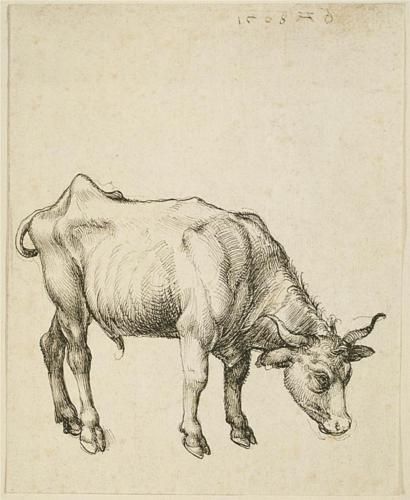
The animal lowers its head into the empty lower corner of the sheet. Its muzzle points towards a ground Dürer has left undrawn, while its back rises sharply at the other end, above a pair of narrow hind legs. Between these extremes hangs a substantial belly. The bull seems both bulky and angular: a living body whose weight we can feel, with projecting bones that prevent its outline from settling into a comfortable oval. The small curl of the tail completes the silhouette at the left. Almost everything that makes this an absorbing drawing happens within that irregular boundary.
The Art Institute of Chicago dates Young Bull to about 1496. This pen and black ink drawing on ivory laid paper measures 17.5 × 14 centimetres and belongs to its Clarence Buckingham Collection. The date 1508 at the top was added erroneously by another hand. [1]
That later inscription occupies an expanse of unused paper above the animal. Our attention, however, keeps returning to the crowded lower part of the sheet, where four legs, a lowered neck and the horns must fit around one another. The arrangement gives a clear view of the flank without presenting the animal as a flat profile. Its head turns towards us, and the two front legs stand apart sufficiently to suggest the breadth of the chest. The nearer shoulder rises as a broad, pale shape against the darker neck. This small turn through space makes the body available for inspection from several directions at once.
At a Glance
- Current date About 1496 [1]
- Materials Pen and black ink on ivory laid paper [1]
- Collection Art Institute of Chicago, Clarence Buckingham Collection [1]
This work across Albrecht Dürer’s career
Young Bull (current article)
c. 1496Young Hare
1502Praying Hands
1508Melencolia I
1514Four Apostles
1526Contents
- Building a body with lines
- A stance reconsidered
- From an entire animal to a fragment
- A drawing with a dispersed collection's history
- Frequently Asked Questions
Building a body with lines
Dürer sets different kinds of marks against one another. Along parts of the back, a thin, searching outline is enough. Below the belly, the strokes cross so densely that they approach a continuous dark patch. Across the flank they remain open, and the light paper between them becomes part of the animal's illuminated surface. Following a single curved stroke takes the eye around the body; following a crossing group makes the same surface seem to turn away from the light. The drawing's volume grows from these changes in direction and spacing.
The darkest areas are not spread evenly. They gather beneath the belly, behind the near front leg, under the jaw and between the hind legs. These passages separate overlapping parts that might otherwise become difficult to read. Beside them, long stretches of the near leg are nearly blank. The leg still feels solid because the darker body behind it supplies one boundary, while brief marks at the knee and hoof articulate its length. Dürer can make a pale area carry as much structural information as a densely worked one.
The flank offers a particularly good place to watch him balance the two. Curved lines descend towards the belly, becoming closer and more entangled as they reach its underside. Higher up, the paper opens out around the hip and shoulder. Some marks suggest hollows and ridges; others seem to follow the surface between them. The viewer receives enough information to sense the frame beneath the skin without being given a diagram of the skeleton. Even the uneven upper contour contributes: its small rises and dips make the back feel specific to this animal.
The head requires a different scale of attention. Tiny strokes gather around the eye, the muzzle is enclosed by a softer rounding contour, and the ears spread sideways beneath the horns. The horns turn out and up, their curved bands setting them apart from the short, prickling marks along the neck. These local changes keep skin, hair and horn legible within a single ink medium. At the same time, the dark eye and muzzle draw attention away from the broad flank towards the animal's immediate action of lowering its head.
Chicago's commentary relates Dürer's handling to Martin Schongauer's drawings and engravings. The comparison concerns a graphic language for describing form, without establishing a copied animal. An open contour and a woven passage of crosshatching do different work here. [1]
A stance reconsidered
Light outlines remain beside some of the heavier contours. Around the muzzle they describe a position outside the final mouth; above the back they make faint alternative routes; beside a hind hoof they extend the shape beyond its darker boundary. These are easiest to see when attention shifts away from the most finished passages. The Art Institute identifies revisions at the right hind foot, back, muzzle and horns, and interprets the earlier position as having an open mouth. It considers the drawing probably a study from nature. [1]
The remaining lines give the sheet a particular kind of animation. We see a settled pose together with traces of another possibility. They do not supply a continuous sequence of movement, and the reproduction cannot tell us exactly how long elapsed between marks. Their visible effect is to loosen the animal's apparent stillness. The lowered head has been arrived at through adjustment; the final contour gains definition because the lighter alternatives remain beside it. Dürer has concentrated the drawing without concealing all the work of finding its form.
The relationship between observation and preparation has also prompted disagreement. In 1931 Eduard Flechsig argued that the carefully worked pen drawing was made specifically for The Prodigal Son . He thought a moving animal an unlikely subject for such sustained work in pen, and proposed that Dürer had drawn on earlier nature studies. Flechsig placed the sheet late in 1495. That is a historical interpretation, distinct from Chicago's present dating and its qualified suggestion of direct study. Neither account gives us a documented drawing session. [13]
The useful question is how much the sheet can tell us about its own making. Its revisions show that a pose was reconsidered. Its detail shows sustained attention. Neither establishes whether every passage was completed in front of the animal. A drawing can preserve observations and develop them through further work, and this sheet contains both close description and deliberate organisation. The uncertainty about its immediate circumstances leaves those achievements fully visible.
From an entire animal to a fragment
The connection with The Prodigal Son gives the study a more specific place in Dürer's working practice. The National Gallery of Art dates the engraving to about 1496; its Rosenwald Collection impression is printed on laid paper. The subject comes from Luke's account of a son who spends his inheritance, suffers hunger during a famine and takes employment feeding pigs. Remembering the food available to his father's servants, he resolves to return home and confess his wrongdoing. Dürer shows him kneeling with clasped hands amid the feeding animals. [14] [15]
The engraving surrounds this moment with an extensive farmyard. High roofs fill the upper part of the composition, a trough crosses the foreground, and pigs crowd around the kneeling man. At the far left, below the large building, the hindquarters of a bovine animal enter the scene. Its front half lies beyond the picture's edge. The Louvre's catalogue identifies this detail with the Chicago drawing. The familiar curled tail and narrow legs now belong to a much smaller figure, seen at the edge of an inhabited space. [16]
The change of orientation matters. In the drawing the head lowers towards the right; in the printed scene the animal extends out beyond the left edge, leaving its rear visible. Looking from one to the other makes the reversal apparent, while the crop prevents a comparison of the complete bodies. What survives is enough to connect the study with the print, but the relationship is selective. Dürer has used the animal's hindquarters within a new arrangement, reducing the feature that occupied most of the drawing to a small contribution to the farmyard.
That reduction changes how the animal is encountered. Alone on its sheet, the bull receives sustained attention: the eye travels from its back to its belly, legs and face. In the engraving, its fragmentary body helps extend the yard beyond the frame. It belongs to the everyday life of a place in which the son's spiritual crisis unfolds. The viewer can understand the printed scene without recognising the drawing behind this detail. Knowing the connection reveals how much concentrated study can support a passage that the finished composition makes almost incidental.
The Louvre places the bull among several related drawings, including a study of the son, a boar and the overall composition. Technical research on that composition drawing, now in the British Museum, adds a further distinction. The Germanisches Nationalmuseum's ink-analysis project found different iron gall inks in its worked passages and revisions. The researchers could distinguish groups of marks associated with the youth, buildings and pigs, but the lightly drawn bull contained too little ink for a conclusion. These results concern the London sheet. They help establish a process of revision around the print without determining the ink composition or sequence of work in the Chicago study. [16] [17]
Taken together, the separate animal study and the changing arrangement of the narrative suggest a practice of selection. Looking closely at a body produced usable visual knowledge; composing the farmyard decided how much of that knowledge a particular picture needed. The bull's richly modelled shoulder and carefully turned head disappear from the final engraving. Their absence gives the surviving drawing an additional interest: it preserves a complete act of attention that the printed story required only in part.
A drawing with a dispersed collection's history
The sheet also has a history beyond Dürer's workshop. Flechsig discussed it as the young bull in Lemberg, the German name for Lviv. Martin Bailey's 1995 account identifies Chicago's Young Bull among the drawings dispersed from the Lubomirski Museum in that city. [13] [18]
In her 2023 study of the collection, Emilia Kłoda traces the Nazi seizure of its Dürer drawings in 1941, their recovery at Altaussee and their subsequent transfer to the collecting point in Munich. American authorities released the drawings to Jerzy Rafał Lubomirski in May 1950; sales then dispersed the group. Kłoda, a curator at the Lubomirski Museum in the Ossolineum, also describes later Polish and Ukrainian restitution claims and the conflicting positions surrounding them. Her account makes clear that this dispersed history has remained contested. [19]
Today the drawing can be studied as an individual work in Chicago, yet its separation from that earlier collection remains part of its history. The same sheet carries several different kinds of evidence: Dürer's forceful and hesitant pen lines, a date written by somebody else, and a collecting history reconstructed from documents. Looking closely begins with the animal, but it leads outward to the decisions that shaped an engraving and the later events that shaped the drawing's survival.
Frequently Asked Questions
Artworks directory
These 187 records include individual works, reverse sides, detail views, paired panels and reconstructed arrangements. Three additional catalogue images repeat works already listed. Related views are not counted as separate originals; qualified attributions and published dating are retained.
Discussion
Look again at the images and ideas explored in Young Bull by Albrecht Dürer. These editorial prompts invite your observations.
Reader Insights
Which detail or idea in Young Bull by Albrecht Dürer most changed your reading, and why?
How does the discussion of “Building a body with lines” affect your understanding?
What comparison would you bring to the discussion of “A drawing with a dispersed collection's history”?
Join the Conversation
Share a detail, comparison or question about Young Bull by Albrecht Dürer below.
References
- Art Institute of Chicago , Young Bull , 1965.408, current collection record and official collection API. English. Museum image also published as Young Steer on Google Arts & Culture. View source 1 . View source 2 . View source 3 .
- ALBERTINA, Selbstbildnis als Dreizehnjähriger, inv. 4839 (German). View source.
- Art Institute of Chicago, unsigned collection catalogue, Young Bull,1965.408 (Current API source_updated_at2026-09-28; checked2026-10-19) (English). View source.
- Metropolitan Museum, Four Horsemen from The Apocalypse, 19.73.209 (English). View source.
- Bayerische Staatsgemäldesammlungen, Selbstbildnis im Pelzrock, inv. 537 (German). View source.
- ALBERTINA, Feldhase, inv. 3073 (German). View source.
- ALBERTINA, Das große Rasenstück, inv. 3075 (German). View source.
- Metropolitan Museum, Adam and Eve, 19.73.1 (English). View source.
- ALBERTINA, Betende Hände, inv. 3113 (German). View source.
- Metropolitan Museum, Knight, Death, and the Devil, 43.106.2 (English). View source.
- Metropolitan Museum, Melencolia I, 43.106.1 (English). View source.
- Bayerische Staatsgemäldesammlungen, inventory 545: current collection record (German; descriptive citation). View source.
- Eduard Flechsig , Albrecht Dürer: sein Leben und seine künstlerische Entwickelung , volume 2, Berlin: G. Grote, 1931, p. 72, paragraph 5, “L. VI, 666, der junge Stier in Lemberg.” German. View source .
- National Gallery of Art , Washington, The Prodigal Son , 1943.3.3459, Rosenwald Collection. English. View source .
- Luke 15:11–20 , King James Version. Historical English translation. View source .
- Musée du Louvre , Département des Arts graphiques, L'Enfant prodigue , 533 LR/Recto, collection catalogue, updated 31 August 2023. French. View source .
- Germanisches Nationalmuseum , Dürer Tintenanalyse, “Der verlorene Sohn, London BM, 5218-173”, object discussion and analytical conclusions, last edited 7 March 2013. German and English. View source .
- Martin Bailey , “The Lubomirski Dürers: where are they now?”, The Art Newspaper , 30 April 1995. English. View source .
- Emilia Kłoda , “Utracone ‘Dürery’ z kolekcji Muzeum Lubomirskich”, Cenne Bezcenne Utracone , 1(102)–2(103), 2023, pp. 28–37. Polish. View source .
- Germanisches Nationalmuseum, Barbara Dürer (German and English). View source.
- Web Gallery of Art, Tucher–Rieter reverse (English). View source.
- National Gallery of Art, Portrait of a Clergyman (English). View source.
- Dürer Art, Portrait of a Man (English). View source.
- Hessen Kassel Heritage, Elsbeth Tucher (German). View source.
- Web Gallery of Art, Hans Tucher (English). View source.
- Germanisches Nationalmuseum, Emperor Maximilian I (German and English). View source.
- National Gallery of Art, Lot and His Daughters, reverse (English). View source.
- Bayerische Staatsgemäldesammlungen, Glim Lamentation (German). View source.
- Museo Nacional del Prado, Portrait of a Man (Spanish). View source.
- Bayerische Staatsgemäldesammlungen, Madonna of the Carnation (German). View source.
- Städel Museum, Job on the Dungheap (German). View source.
- Wallraf-Richartz-Museum, Piper and Drummer (German). View source.
- Italian Ministry of Culture / Uffizi, Head of Saint James (Italian). View source.
- Klassik Stiftung Weimar, Dresden Altarpiece (German). View source.
- Staatliche Museen zu Berlin, Girl with a Red Beret (German and English). View source.
- Dresden State Art Museums / Roland Enke, Bernhard von Reesen (German). View source.
- Royal Collection Trust, Burkhard von Speyer (English). View source.
- Dresden State Art Museums, Seven Sorrows of the Virgin (English). View source.
- Bayerische Staatsgemäldesammlungen, Mater Dolorosa (German). View source.
- Bayerische Staatsgemäldesammlungen, Lucretia (German). View source.
- Städel Museum, Young Woman with Her Hair Down (English). View source.
- ALBERTINA, Portrait of a Young Man (German). View source.