 by
Tom Gurney
Tom Gurney BSc (Hons) is an art history expert with over 20 years experience
Published on June 19, 2020 / Updated on October 22, 2026
Email:
tomgurney1@gmail.com
/ Phone:
+44 7429 011000
The Mass of the Angels (attributed to Dürer): Introduction
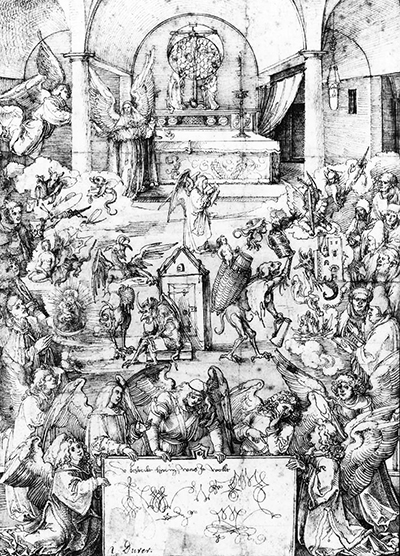
A church fills with creatures that its worshippers seem scarcely to notice. Angels gather around a great tablet, a priest stands before the altar, and small, improbable figures circulate between the monks. A house and a basket loom absurdly large among their bearers. In The Mass of the Angels , the difficulty of keeping one's thoughts on prayer becomes something that can be seen: the private thoughts of a congregation have crowded into the same room.
The drawing, dated about 1500 and currently attributed to Albrecht Dürer, belongs to the Musée des Beaux-Arts in Rennes. Brown pen and ink, watercolour and white gouache cover beige paper measuring 30.5 × 21.7 centimetres. [1]
At a Glance
- Date About 1500 [1]
- Attribution Attributed to Albrecht Dürer [1]
- Collection Musée des Beaux-Arts, Rennes [1]
- TypeDrawing [1]
This work across Albrecht Dürer’s career
Young Hare
1502Praying Hands
1508Melencolia I
1514Four Apostles
1526Contents
- A church full of competing images
- What happens during prayer
- The unfinished words on the tablet
- Whose drawing is it?
- Frequently Asked Questions
A church full of competing images
The first way through the composition is upwards. At the bottom, angels present a broad rectangular panel almost parallel to the picture surface. Above it, the church floor opens into a space occupied by the strange little visitors. Farther back, a standing figure faces the altar; steps lead towards a more settled arrangement of candlesticks and sacred furnishings. The Virgin and Child occupy the upper centre. This sequence gives the eye a destination, even when the activity on either side repeatedly pulls it away. [12]
The architecture helps hold the crowded sheet together. Two substantial columns divide the room, while arches rise over them and meet the curving vault. Behind the altar, an arched recess frames the central sacred image. At the right, a curtain hangs diagonally across an opening. The drawing makes the church intelligible through these large, simple shapes before filling it with smaller incidents. Its enclosing walls and overhead curves prevent the multitude from becoming a loose collection of figures on a blank page.
That framework is especially noticeable around the altar. Long horizontal edges establish the altar cloth and its platform; the tall candlesticks answer the verticals of the columns. An upright angel beside the altar extends its wings into the architecture. Below, a smaller winged figure inclines forward. The differences between standing, bowing and flying bodies make the sacred end of the room animated without giving it the restless, dispersing movement of the middle distance.
Along the sides, the monks are much more closely packed. Their hooded garments produce repeated slopes and hollows, interrupted by individual heads, hands and open books. On the right, a face near the lower edge of the group turns towards the space in front of it. Higher up, heads overlap in a dense sequence beside the column. The reader can follow the congregation as a group, then stop to examine its separate members, much as one might read individual faces in a crowded street.
The small intruders change that rhythm. A basket sits high on the back of a thin, striding creature near the centre. Nearby, a little building with a pitched roof stands among figures much too small for it. Elsewhere, vessels, birds and twisting bodies interrupt the intervals between the worshippers. Ordinary things have acquired the disproportion of a compelling thought: a household object can occupy as much attention as a person. Their scale and unstable movements make the church feel invaded by fragments of other lives.
At the bottom, the angels have a different physical presence. Their broad wings, flowing sleeves and bent knees frame the tablet on three sides. Feathers spread out towards the corners; hands grip or approach its upper edge. Several heads turn across the group, so that even this apparently formal presentation contains a web of glances. The tablet is unusually open and pale beside the dense drawing above it. It offers a pause, but the marks on its surface create another small puzzle.
What happens during prayer
Hartmut Scholz describes the subject as the recording of pious and sinful thoughts during choral prayer, giving the scene a moral and satirical purpose. [12]
Such imagery belongs to a long tradition of stories about failures of attention in church. In her study of the recording demon, Margaret Jennings distinguishes two recurring narratives. One concerns a devil who writes down churchgoers' idle words; another concerns a devil who collects omitted or carelessly shortened syllables of prayer in a sack. These stories make neglect tangible: something apparently fleeting becomes evidence that can be carried away and used against the worshipper. Jennings also finds that many Continental pictures of writing devils leave the creatures unnamed. That history helps explain the drawing's moral imagination without requiring every grotesque in Rennes to be assigned the name Tutivillus. [13]
The effect here is more unsettling than a simple procession of monsters. The monks remain in their places, recognisable as a community at worship, while the fantastical figures take possession of the spaces between them. Their disturbance does not need to demolish the church or overturn the altar. It operates within an outwardly ordered service. The disproportionate house and the burdensome basket catch our attention precisely because they are so specific. The viewer experiences something of the wandering attention that the image exposes, repeatedly leaving the altar to inspect another fascinating interruption.
The Rule of Saint Benedict supplies a useful point of comparison. Chapter 19 tells monks to remember that they sing before God and the angels, and ends by requiring agreement between mind and voice. Chapter 20 places the value of prayer in humility and purity of heart, rather than the quantity of speech. The drawing's visible angels and distracted congregation make that demand especially vivid. This comparison illuminates the tension in the image; it does not establish that the artist was illustrating those chapters directly. A monk's presence in church, his book and his part in the communal service cannot by themselves show where his mind has gone. [14]
The unfinished words on the tablet
The foreground panel draws that problem of attention towards the reader. Its ornamental flourishes include loops, crossings and repeated letter-like forms, some resembling monogram trials. They are quite different from the compact line of writing along the top. The legible instruction reads, in Scholz's transcription, “Do schreibt hrein was Ir wollt”: “Write in here whatever you want.” The contrast is striking. Angels solemnly display a place for an inscription, but the artist leaves its eventual wording to someone else. [12]
Laboratory analysis reported in the Rennes catalogue record found that the inscription's ink matched the drawing's ink; the record identifies the words as the draughtsman's own. [1]
Scholz argues that the instruction demonstrates intended execution by another hand. He relates the sheet closely to the Saint Benedict stained glass designs associated with Nuremberg's Egidien monastery, while cautioning that Friedrich Winkler's proposal of a stained glass destination for this composition remains unproved. A richly developed design could still reserve decisions for the next person who used it. [12]
The colour reproduction also rewards looking beyond the dark outlines. Restrained blue and green passages interrupt the prevailing warm brown, with colour appearing in scattered details rather than dividing the sheet into broad painted zones. Much of the architecture remains close to the paper's tone. Closely spaced pen strokes describe shadow, curved feathers and the folds of clothing; relatively bare intervals allow the floor and altar cloth to breathe. These changes of density keep the many different surfaces legible within a very small space.
Whose drawing is it?
The current attribution remains qualified. The Rennes record notes support for Dürer from Winkler in 1936 and Arlette Calvet in 1966, and for Hans von Kulmbach from Lisa Oehler in 1968 and Fritz Koreny in 2000. Stephanie Porras and, in 2011, Jaya Remond supported Dürer; Remond distinguished the sheet from a separate Kulmbach copy, shown on the art market in 2004, as the work of another hand. [1]
The sheet came from Christophe-Paul de Robien's collection. It entered state ownership through revolutionary seizure in 1791 and was deposited in Rennes in 1794. Its present inventory number is 794.1.2533; older literature uses C 110, 1. [1]
Uncertainty about authorship need not flatten the experience of looking. The sheet's particular invention lies in the way it keeps a solemn church service visible through an unruly traffic of competing images. Its crowded centre asks us to notice what the monks should resist; its angels hold up a space in which words still need to be chosen. Following those details brings us back to the same demanding subject: how outward participation in prayer can coexist with a mind occupied elsewhere.
Frequently Asked Questions
Artworks directory
These 187 records include individual works, reverse sides, detail views, paired panels and reconstructed arrangements. Three additional catalogue images repeat works already listed. Related views are not counted as separate originals; qualified attributions and published dating are retained.
Discussion
Look again at the images and ideas explored in The Mass of the Angels (attributed to Dürer). These editorial prompts invite your observations.
Reader Insights
Which detail or idea in The Mass of the Angels (attributed to Dürer) most changed your reading, and why?
How does the discussion of “A church full of competing images” affect your understanding?
What comparison would you bring to the discussion of “Whose drawing is it?”?
Join the Conversation
Share a detail, comparison or question about The Mass of the Angels (attributed to Dürer) below.
References
- Olivia Savatier , La Messe des anges , Joconde notice 02110002354, French Ministry of Culture, updated 11 May 2026. French. View source .
- ALBERTINA, Selbstbildnis als Dreizehnjähriger, inv. 4839 (German). View source.
- Metropolitan Museum, Four Horsemen from The Apocalypse, 19.73.209 (English). View source.
- Bayerische Staatsgemäldesammlungen, Selbstbildnis im Pelzrock, inv. 537 (German). View source.
- ALBERTINA, Feldhase, inv. 3073 (German). View source.
- ALBERTINA, Das große Rasenstück, inv. 3075 (German). View source.
- Metropolitan Museum, Adam and Eve, 19.73.1 (English). View source.
- ALBERTINA, Betende Hände, inv. 3113 (German). View source.
- Metropolitan Museum, Knight, Death, and the Devil, 43.106.2 (English). View source.
- Metropolitan Museum, Melencolia I, 43.106.1 (English). View source.
- Bayerische Staatsgemäldesammlungen, inventory 545: current collection record (German; descriptive citation). View source.
- Hartmut Scholz , “Zur Überlieferung des Benediktzyklus in den Kreuzgangsfenstern des Nürnberger Egidienklosters”, Dürer-Forschungen , 2 (2009), pp. 193–226, especially pp. 216–217, fig. 25 on p. 218, and notes 63–65 on p. 225. German, with English abstract. View source .
- Margaret Jennings , Tutivillus: The Literary Career of the Recording Demon , Studies in Philology , 74, no. 5 (December 1977), especially pp. 10–13 and 33. English. View source .
- Saint Benedict , The Rule of St. Benedict , English translation, preface by W. K. Lowther Clarke (London: S.P.C.K., 1931), chapters 19–20. English translation of Latin. View source .
- Germanisches Nationalmuseum, Barbara Dürer (German and English). View source.
- Web Gallery of Art, Tucher–Rieter reverse (English). View source.
- National Gallery of Art, Portrait of a Clergyman (English). View source.
- Dürer Art, Portrait of a Man (English). View source.
- Hessen Kassel Heritage, Elsbeth Tucher (German). View source.
- Web Gallery of Art, Hans Tucher (English). View source.
- Germanisches Nationalmuseum, Emperor Maximilian I (German and English). View source.
- National Gallery of Art, Lot and His Daughters, reverse (English). View source.
- Bayerische Staatsgemäldesammlungen, Glim Lamentation (German). View source.
- Museo Nacional del Prado, Portrait of a Man (Spanish). View source.
- Bayerische Staatsgemäldesammlungen, Madonna of the Carnation (German). View source.
- Städel Museum, Job on the Dungheap (German). View source.
- Wallraf-Richartz-Museum, Piper and Drummer (German). View source.
- Italian Ministry of Culture / Uffizi, Head of Saint James (Italian). View source.
- Klassik Stiftung Weimar, Dresden Altarpiece (German). View source.
- Staatliche Museen zu Berlin, Girl with a Red Beret (German and English). View source.
- Dresden State Art Museums / Roland Enke, Bernhard von Reesen (German). View source.
- Royal Collection Trust, Burkhard von Speyer (English). View source.
- Dresden State Art Museums, Seven Sorrows of the Virgin (English). View source.
- Bayerische Staatsgemäldesammlungen, Mater Dolorosa (German). View source.
- Bayerische Staatsgemäldesammlungen, Lucretia (German). View source.
- Städel Museum, Young Woman with Her Hair Down (English). View source.
- ALBERTINA, Portrait of a Young Man (German). View source.