 by
Tom Gurney
Tom Gurney BSc (Hons) is an art history expert with over 20 years experience
Published on June 19, 2020 / Updated on October 22, 2026
Email:
tomgurney1@gmail.com
/ Phone:
+44 7429 011000
Christ Taking Leave of His Mother (Life of the Virgin): Introduction
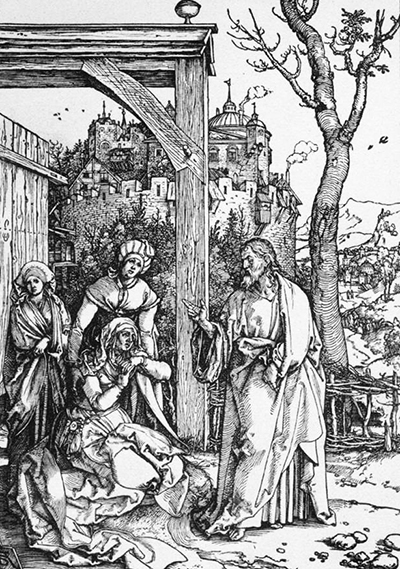
Mary has sunk to her knees, but her son is still standing. Between them, a heavy timber post divides the foreground, and their lifted hands draw attention to the interval between them. Albrecht Dürer makes the beginning of a journey feel like an almost insurmountable separation. Christ Taking Leave of His Mother , a woodcut dated about 1504–05 by the Cleveland Museum of Art, belongs to his Life of the Virgin . The series follows Mary's story, and here the approaching Passion is felt through the mother who must watch Christ depart. [1]
The design is catalogued as Bartsch 92 and Meder 204. These numbers identify the large Marian-cycle farewell, with its timber shelter and exposed tree. The National Gallery of Victoria dates its design about 1504 and records an impression printed before the text edition of 1511. That interval matters: the picture already had a life as a print before readers encountered it within the completed book. Dürer made another farewell for his Small Passion about 1509–11; the Edinburgh impression of that different woodcut measures only 12.5 × 9.6 centimetres. [2] [3]
At a Glance
This work across Albrecht Dürer’s career
Young Hare
1502Praying Hands
1508Melencolia I
1514Four Apostles
1526Contents
- A farewell imagined in devotion
- Hands, cloth and the space between them
- The place of the picture in the book
- One design, different sheets
- A subject other artists could change
- Frequently Asked Questions
A farewell imagined in devotion
The encounter does not illustrate a recorded conversation in the Gospels. It belongs to the devotional tradition that imagined the feelings, words and small actions surrounding the familiar events of Christ's life. An especially revealing example appears in the medieval Meditations on the Life of Christ , commonly cited as Pseudo-Bonaventure. Chapter 72, in W. H. Hutchings's English translation of 1881, openly presents the exchange as something to be imagined. Mary Magdalene wants Christ to remain with his friends for Passover. When he refuses, she appeals to his mother, who fears the dangers awaiting him in Jerusalem. Christ explains his obedience to the Father's will and consoles the women with the promise of his resurrection. [14]
The meditation asks its reader to attend to the sorrow of everyone present, including Christ's grief for his mother. This helps explain why an outwardly simple parting could sustain so much attention. A reader was invited to remain with an exchange that Scripture had not described, considering its emotional consequences. The text supplies a context for Dürer's subject without establishing which particular version he consulted or making his woodcut a literal illustration of every detail.
The location is made more specific by the words accompanying the published cycle. Cleveland's 1959 portfolio uses R. J. Schork's translations of the headings written by Benedictus Chelidonius, the poet responsible for the book's Latin verses. Its heading for this image describes Mary weeping as her son leaves Bethany for Jerusalem. The distant city consequently belongs to the story of the journey ahead. Its towers and clustered roofs make that destination visible while the foreground keeps attention on those who must part. [15]
Hands, cloth and the space between them
Mary's position gives the scene its downward pull. Her head turns upward towards Christ, and her joined hands rise close to her face. Below them, her clothing spreads over the earth in broad, broken folds. Some edges stand out sharply against white paper; others disappear into dense passages of black. The enormous expanse of fabric anchors her to the spot. Even before we consider her expression, the contrast between her low body and Christ's full standing height makes the difference in their situations clear.
Two women stand behind her. The nearer companion bends towards Mary, bringing bodily support into a scene organised around impending separation. The woman farther left turns inward towards the exchange. Their clustered figures make the space under the shelter feel occupied and close. Dürer gives Mary a human company within which to grieve, while Christ stands apart. Their clothing does not establish the companions' names or their position within a household; their visible role is to attend the distressed mother.
Christ's raised right hand answers Mary's hands with a blessing. His other hand gathers the garment at his waist. His head inclines towards her, so that the upright figure remains attentive to the woman below him. Long folds descend towards his feet, giving his clothing a more continuous vertical movement than the spreading, angular mass around Mary. His stillness has a practical pictorial function: it allows a small gesture and a slight turn of the head to carry the encounter.
Their hands do not meet. That small interval is one of the picture's most affecting details. Mary can address him, and he can bless her, but the gesture does not close the distance. Nor does Dürer show Christ already striding away. He holds the departure at the moment when mother and son are still looking at one another. The journey is imminent enough to determine the scene, yet delayed long enough for the viewer to dwell on the farewell.
Above them, the shelter has conspicuously worked surfaces. Long lines describe the grain of the horizontal beam; a diagonal brace meets the central upright. On the other side of Christ, the tree offers a different kind of structure. Its trunk twists, its bark is articulated by short curving marks, and thin branches spread into the open sky. Timber and living tree frame the people through contrasting patterns of line. The branching form also opens the upper right of the composition, where the shelter closes the upper left.
Beyond this foreground, fences, sloping ground and small buildings draw the eye into a wider inhabited landscape. The city rises behind the central post in a crowded accumulation of walls, roofs and towers. It is seen through and around the near structures, so that the eye repeatedly moves between the people and the world beyond them. These buildings can make the sacred narrative feel materially familiar without providing a documentary view of either Bethany or Jerusalem. Their narrative function is to give the departure somewhere to lead.
The place of the picture in the book
In the published sequence, the farewell is image seventeen when the title is counted, or the sixteenth narrative scene. It follows the twelve-year-old Christ among the doctors and precedes the death of the Virgin. That sequence makes a large leap through Christ's adult life. It brings together two moments when Mary's relationship with her son involves separation: finding him as a boy in the Temple and facing his departure towards his death as an adult. The farewell then leaves the reader with Mary before the story moves to the end of her own life. [16]
The absence of the Crucifixion from this particular sequence gives the leave-taking unusual weight. It allows the consequences of the Passion to enter the Marian story before the violence itself occurs. The Cleveland Museum describes the farewell as the cycle's most sorrowful episode. That judgement catches its emotional concentration: the viewer knows what lies ahead, while Dürer gives the present scene only four people, an exchange of gestures and a place beside a house. [1]
The cycle took shape over years. As Anna Scherbaum's catalogue essay explains, most designs were made before Dürer's second Italian journey, and the series was completed for publication in 1511. Its twenty illustrations comprise eighteen narrative scenes, a title image and a concluding devotional image. Individual woodcuts also circulated separately. The farewell could therefore be encountered as a self-contained scene or as one stage in a sustained account of Mary's life. [17]
The book added a further way of looking. Chelidonius's Latin poems appeared on the left of an opening, facing the corresponding full-page woodcuts on the right. The poems were set in the humanists' Roman type, Antiqua. Image and verse occupied distinct but coordinated spaces. A reader could move from the poet's account to the figures' gestures and then return to the words, bringing verbal reflection into the act of looking. [16]
Arwed Arnulf has argued that Dürer's books of 1511 should be understood as devotional publications shaped for readers with humanist literary interests. He also draws attention to the way the Life of the Virgin and the Large Passion complement one another: the Marian cycle passes from the farewell to Mary's death, while the Passion supplies the Crucifixion, Lamentation and Entombment. Seen in that setting, this print stands at an important junction between books. Within Mary's cycle it leaves the violence ahead unpictured; beside the Passion it becomes the human cost of the journey about to begin. [18]
One design, different sheets
The physical means of making the image are especially striking in its trees, timber and clothing. A woodcut is a relief print. The printable lines stand on the surface of a wooden block, while the areas around them are cut away. Ink on those raised surfaces transfers the design to paper. This differs from engraving on metal, where incised lines hold the ink. Dürer's precise participation in cutting his blocks remains a matter of scholarly discussion; the remarkable control of the design does not by itself identify the hand that carved it. [19]
Looking at the farewell with that process in mind makes its changes of texture more tangible. The thick contours around the figures must coexist with small twigs and closely grouped strokes. White openings between the lines allow Christ's robe to remain luminous, while tighter marks deepen the recesses around Mary's clothing. The sheet's light comes from the paper left visible. Different concentrations of black can consequently describe both a shadow beneath a fold and a patterned surface of bark.
Surviving impressions have individual dimensions and histories. The NGV's sheet, accession 3544.17-4, entered its collection through the Felton Bequest in 1956. Its printed image measures 29.7 × 21 centimetres, within a sheet measuring 34.2 × 24 centimetres. The distinction preserves the visible margin as part of that particular object. Cleveland's impression, accession 1959.99.17, belongs to the Dudley P. Allen Fund and is catalogued as Meder 204 a. Neither museum's record supplies a universal sheet size for every impression of the design. [2] [1]
Paper carries evidence beyond the printed scene. The NGV records a complete bull's-head watermark with a flower and triangle in its impression, classified as Meder 62 and Briquet 14875. Its catalogue lists related documentary occurrences between 1509 and 1544. A watermark originates in the shaped wire attached to the papermaking mould, which leaves the paper thinner in that area. The NGV's conservation account stresses that such evidence must be considered alongside catalogues and provenance. The broad documentary range is therefore evidence for comparison, rather than an exact date stamped into this sheet. It cannot be transferred to every surviving farewell. [2] [20]
A subject other artists could change
The farewell also offered artists different possibilities for arranging the relationship between mother and son. Correggio's painting of the subject, probably made before 1514 and now in London's National Gallery, places Christ kneeling on the left, while Mary sits on the right, supported by a companion. His bowed head and gathered hands bring him low before her; the blue-green distance opens behind him. The National Gallery reports that X-rays reveal an abandoned arrangement with Christ standing on the right and another holy woman included. It cautiously connects that earlier conception with a German tradition Correggio might have known through Dürer's prints. [21]
The comparison shows how much depends on posture. Correggio's finished painting makes the kneeling son seek his mother's blessing; Dürer's woodcut makes the kneeling mother receive her son's. Both find drama in a parting before the journey, but the direction of the gesture changes the encounter. In Dürer's print, Mary remains among the supporting women, with her clothing spread across the ground. Christ is still within reach of her voice. The space between their hands is already preparing us for his absence.
Frequently Asked Questions
Artworks directory
These 187 records include individual works, reverse sides, detail views, paired panels and reconstructed arrangements. Three additional catalogue images repeat works already listed. Related views are not counted as separate originals; qualified attributions and published dating are retained.
Discussion
Look again at the images and ideas explored in Christ Taking Leave of His Mother (Life of the Virgin). These editorial prompts invite your observations.
Reader Insights
Which detail or idea in Christ Taking Leave of His Mother (Life of the Virgin) most changed your reading, and why?
How does the discussion of “A farewell imagined in devotion” affect your understanding?
What comparison would you bring to the discussion of “A subject other artists could change”?
Join the Conversation
Share a detail, comparison or question about Christ Taking Leave of His Mother (Life of the Virgin) below.
References
- Cleveland Museum of Art. Christ Taking Leave of His Mother , c. 1504–1505, 1959.99.17. Collection record and curatorial description. English. View source .
- National Gallery of Victoria. Christ taking leave of His Mother , c. 1504; impression before the 1511 text edition, 3544.17-4. Collection record, measurements and watermark catalogue. English. View source .
- National Galleries of Scotland. Christ Taking Leave of His Mother (The Small Passion) , about 1509–1511, P 2693. Collection record, updated before 2020. English. View source .
- ALBERTINA, Selbstbildnis als Dreizehnjähriger, inv. 4839 (German). View source.
- Metropolitan Museum, Four Horsemen from The Apocalypse, 19.73.209 (English). View source.
- Bayerische Staatsgemäldesammlungen, Selbstbildnis im Pelzrock, inv. 537 (German). View source.
- ALBERTINA, Feldhase, inv. 3073 (German). View source.
- ALBERTINA, Das große Rasenstück, inv. 3075 (German). View source.
- Metropolitan Museum, Adam and Eve, 19.73.1 (English). View source.
- ALBERTINA, Betende Hände, inv. 3113 (German). View source.
- Metropolitan Museum, Knight, Death, and the Devil, 43.106.2 (English). View source.
- Metropolitan Museum, Melencolia I, 43.106.1 (English). View source.
- Bayerische Staatsgemäldesammlungen, inventory 545: current collection record (German; descriptive citation). View source.
- Pseudo-Bonaventure. The Life of Christ , translated and edited by W. H. Hutchings. London: Rivingtons, 1881, chapter LXXII, “How we may depict the Lord Jesus, revealing to His Mother His approaching Death.” English translation of the medieval Meditationes vitae Christi , reproduced by CapDox. View source .
- Cleveland Museum of Art. The Life of the Virgin . Cleveland , 1959, introductory text and plate XVII; translations of Chelidonius's headings by R. J. Schork. English; translated from Latin. View source .
- Universitätsbibliothek Regensburg. “Die Buchgestaltung des Marienlebens”. Virtual exhibition , Die Anbetung der Könige aus Albrecht Dürers Marienleben , 2012. German. View source .
- Anna Scherbaum. Catalogue essay on the Life of the Virgin , reproduced with Heimsuchung Mariae , inventory 3078. In Albrecht Dürer , edited by Klaus Albrecht Schröder and Maria Luise Sternath, ALBERTINA, Vienna, 2003, pp. 284–294. German. View source .
- Arwed Arnulf. “Dürers Buchprojekte von 1511: Andachtsbücher für Humanisten”. Marburger Jahrbuch für Kunstwissenschaft 31 (2004) , pp. 145–174, especially pp. 145 and 159–160. German. View source .
- Suzanne Boorsch and Nadine M. Orenstein. The Print in the North: The Age of Albrecht Dürer and Lucas van Leyden . The Metropolitan Museum of Art Bulletin 54 , no. 4 (Spring 1997), pp. 3–4 and 25. English. View source .
- National Gallery of Victoria. “Watermarks in the NGV's collection of prints by Albrecht Dürer”. Paper Conservation database and explanatory text , launched 2016. English. View source .
- National Gallery , London. Correggio, Christ taking Leave of his Mother , probably before 1514, NG4255. Collection record and in-depth account. English. View source .
- Germanisches Nationalmuseum, Barbara Dürer (German and English). View source.
- Web Gallery of Art, Tucher–Rieter reverse (English). View source.
- National Gallery of Art, Portrait of a Clergyman (English). View source.
- Dürer Art, Portrait of a Man (English). View source.
- Hessen Kassel Heritage, Elsbeth Tucher (German). View source.
- Web Gallery of Art, Hans Tucher (English). View source.
- Germanisches Nationalmuseum, Emperor Maximilian I (German and English). View source.
- National Gallery of Art, Lot and His Daughters, reverse (English). View source.
- Bayerische Staatsgemäldesammlungen, Glim Lamentation (German). View source.
- Museo Nacional del Prado, Portrait of a Man (Spanish). View source.
- Bayerische Staatsgemäldesammlungen, Madonna of the Carnation (German). View source.
- Städel Museum, Job on the Dungheap (German). View source.
- Wallraf-Richartz-Museum, Piper and Drummer (German). View source.
- Italian Ministry of Culture / Uffizi, Head of Saint James (Italian). View source.
- Klassik Stiftung Weimar, Dresden Altarpiece (German). View source.
- Staatliche Museen zu Berlin, Girl with a Red Beret (German and English). View source.
- Dresden State Art Museums / Roland Enke, Bernhard von Reesen (German). View source.
- Royal Collection Trust, Burkhard von Speyer (English). View source.
- Dresden State Art Museums, Seven Sorrows of the Virgin (English). View source.
- Bayerische Staatsgemäldesammlungen, Mater Dolorosa (German). View source.
- Bayerische Staatsgemäldesammlungen, Lucretia (German). View source.
- Städel Museum, Young Woman with Her Hair Down (English). View source.
- ALBERTINA, Portrait of a Young Man (German). View source.