 by
Tom Gurney
Tom Gurney BSc (Hons) is an art history expert with over 20 years experience
Published on June 19, 2020 / Updated on October 22, 2026
Email:
tomgurney1@gmail.com
/ Phone:
+44 7429 011000
Portrait of Jakob Muffel: Introduction
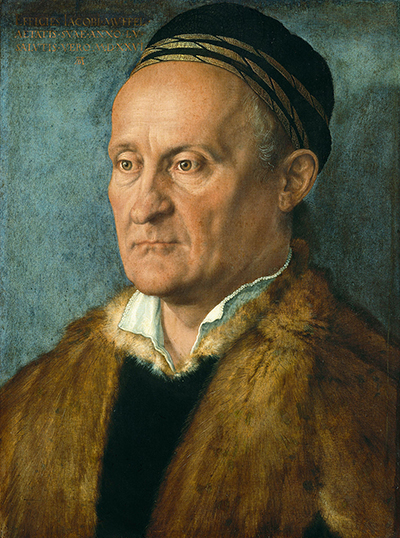
Jakob Muffel looks past us with wide, light-catching eyes. His head turns slightly towards the left, while the broad fur collar gives his body a settled, almost frontal weight. Above the forehead, gold bands sweep across a black cap; below the chin, a narrow white collar opens into a sharp point. These small accents hold together a portrait whose colours are otherwise quiet: warm brown, deep green and a pale blue-green background. Albrecht Dürer painted it in 1526. It belongs to the Gemäldegalerie in Berlin. [1]
At first the eyes seem to supply the whole picture's intensity. Looking longer reveals how carefully Dürer distributes that intensity. The strongly lit forehead forms a large, uninterrupted surface. The nose projects through much smaller changes of light and shadow. Fine wrinkles gather around the eyes, and a deep fold descends beside the mouth. Against these varied forms, the cap makes a dark, comparatively simple silhouette. The face has enough space around it to remain unmistakably the subject, although the expensive clothing occupies much of the painting.
At a Glance
This work across Albrecht Dürer’s career
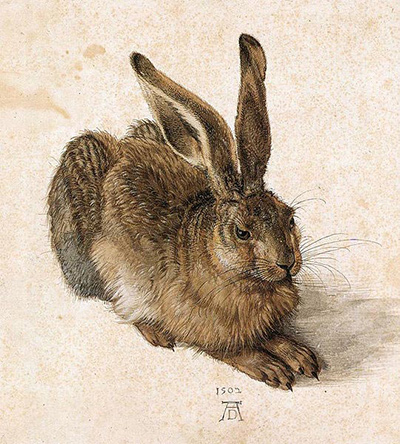
Young Hare
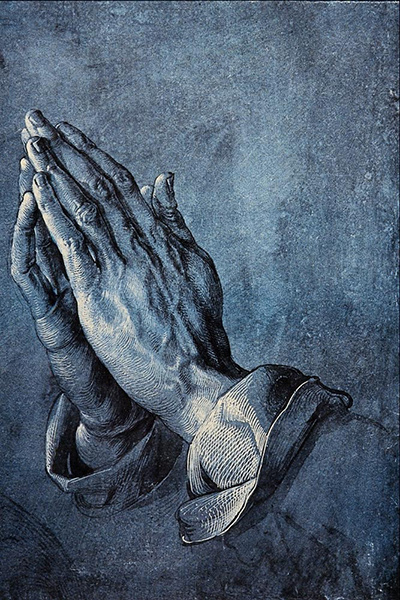
1502Praying Hands
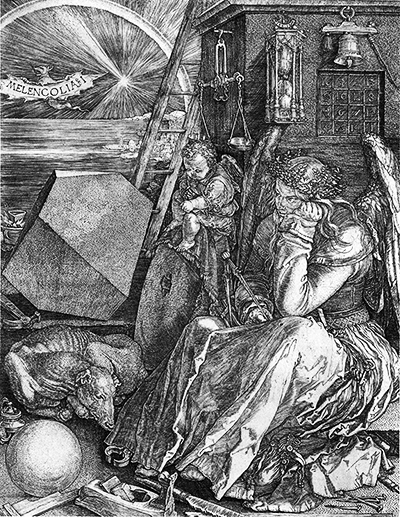
1508Melencolia I
1514Four Apostles
1526Contents
- A name and an age
- A civic figure and a personal acquaintance
- Fur, cloth and the modelling of a face
- The question of a drawing
- A painting with a changed support
- Frequently Asked Questions
A name and an age
The inscription in the upper left identifies the sitter as Jakob Muffel, gives his age as fifty-five and dates the image to the year of salvation 1526. Its Roman numerals are LV for the age and MDXXVI for the year. Dürer's AD monogram appears underneath. [1]
The lettering occupies the remaining space beside the cap. Its compact lines give the face a written identity without creating a separate label or tablet within the scene. Name, age and date become part of the same field of colour that surrounds the head. The portrait therefore asks us to see both an individual appearance and a particular moment in a life. We can examine every crease in the face, but the inscription provides the age; a viewer's impression of how old Muffel looks is a different matter.
There are no hands, implements of office or architectural surroundings to explain his occupation. His authority is carried by the close presentation of the head, the substantial clothes and the name above his shoulder. Dürer keeps the mouth firmly closed and directs the eyes beyond the picture's left edge. That arrangement can make Muffel seem preoccupied, yet the painting gives us no conversation or incident to account for the expression. Its reserve is part of the experience of looking, rather than reliable evidence of his private disposition.
A civic figure and a personal acquaintance
Muffel belonged to Nuremberg's governing patriciate. Friedrich Leitschuh's historical annotation to Dürer's Netherlands diary identifies him as a man educated at Ingolstadt who became mayor in 1502, senior mayor in 1514 and a member of the city's seven-man governing group in 1519. Leitschuh also records his marriage to Agatha Schlüsselfelder and his death on 19 April 1526. [12]
The diary supplies a smaller, more personal connection. In a list of gifts, Dürer records giving Jacob Muffel one ell of scarlet breastcloth. The neighbouring entries include presents for Pirckheimer and Hieronymus Holzschuher. Preserved in Leitschuh's edition, this brief notice places Muffel among the people Dürer remembered during his Netherlands journey. [12]
A length of coloured cloth is an appealing detail beside this richly dressed portrait. It brings the relationship down to the scale of an object selected, carried and given. The diary does not connect the gift to a portrait commission, and the scarlet cloth cannot be identified among the green, white and brown garments visible here. Its value for understanding the painting lies in the evidence of contact between artist and sitter, several years before the dated likeness.
Fur, cloth and the modelling of a face
Muffel's costume sets up several different kinds of surface. The gold bands on the cap run in long, clear curves, with darker interruptions that give their pattern a woven appearance. The fur spreads into a much less regular mass. Fine strokes break its outer edge against the background, while the broad collar contains shifting areas of yellow-brown and dark brown. The white shirt is comparatively crisp: its folded edges make short, angular shapes immediately beside the neck.
The dark green garment at the centre provides a pause between these brighter textures. It is easy to register it first as a nearly black shape, then notice the green near the collar. This deep central colour strengthens the lighter triangle of the exposed throat and face. Even where the fur fills the lower corners, its diagonal slopes lead back towards the head. The clothes give Muffel breadth, while their arrangement continually returns attention to his features.
The face itself is less evenly lit than the broad forehead initially suggests. One side of the nose catches a distinct light; the other falls into a narrow shadow. The cheek below the nearer eye is rounded, whereas the area around the mouth is drawn into tighter folds. Small highlights in the eyes sit within a much larger system of soft transitions. Dürer makes those minute bright points feel convincing because the head around them has such palpable volume.
Stephan Kemperdick describes the work as an example of Dürer's monumental late style. He infers that Muffel ordered the portrait shortly before his death in spring 1526. The sense of monumentality is visible in the composition's economy. A single head, a broad collar and an almost empty background occupy the picture; each has a clear weight and position. Small details remain available without breaking the figure into a collection of separate curiosities. [13]
The question of a drawing
How Dürer established the likeness has a more complicated history than the painted date alone suggests. Kemperdick's account proposes a portrait drawing that has not survived. An older discussion offers a specific historical lead. In 1882 Charles Ephrussi described a black-chalk portrait of Jakob Muffel in the Dumesnil collection, bearing the date 1517, a monogram and a barely legible name which he considered to be in Dürer's hand. His footnote identified this sheet as the basis for the 1526 oil portrait, then in the Narischkine collection in Saint Petersburg. [13] [14]
Ephrussi's description is useful evidence of what a nineteenth-century scholar believed he had identified. It does not establish the present location, authenticity or precise function of that drawing. Nor does a proposed dependence on an earlier study settle whether Muffel sat again in 1526. The painting's vivid presence and the circumstances of its production are separate questions: the former can be experienced directly, while the latter depends on surviving objects and documents. The nine-year interval proposed by Ephrussi makes that distinction especially clear.
The comparison with Dürer's portrait of Hieronymus Holzschuher, also dated 1526, is more immediate. Both faces turn slightly to the left above broad fur collars and pale backgrounds. Holzschuher meets the viewer with his eyes, his uncovered curls and spreading beard filling the area that Muffel's cap and smooth cheeks leave comparatively spare. Muffel's gaze travels away from us. Seen together, the two paintings show how strongly a change of hair, head covering and eye direction can alter a closely related arrangement. Their resemblance alone cannot establish a joint commission or an intended display together. [15]
A painting with a changed support
The object in Berlin has also undergone a substantial physical change. The museum's 1921 catalogue records that it remained in the Schönborn collection at Pommersfelden until 1867 and that, in 1870, it was transferred from wood to canvas in Petersburg. That catalogue gives dimensions of 48 by 36 centimetres. Today's museum record lists 49.7 by 37.2 centimetres with a strip included. The larger measurement explicitly includes an additional element, so the figures should be read with their different definitions in mind. [15] [1]
The transfer means that the present canvas is a later support for a painting originally made on wood. The catalogue supplies the place and year of the intervention, but it does not explain the treatment's method or motive. Its terse material description nevertheless changes how we understand the work. What looks like a continuous sixteenth-century image has a physical history extending beyond Dürer's original choice of support. [15]
Berlin acquired the portrait at the Narischkine auction in Paris in 1883. An official museum report published that October specifies April as the month of purchase. It compared Muffel with the Holzschuher portrait, preferring the latter's colouring and sitter but praising Muffel's exceptionally good preservation. Those remarks record a nineteenth-century response, including a revealing preference for one painted personality over another. They also show that the two portraits were being weighed against each other well before both had become familiar neighbours in accounts of Dürer's late work. [1] [16]
Frequently Asked Questions
Artworks directory
These 187 records include individual works, reverse sides, detail views, paired panels and reconstructed arrangements. Three additional catalogue images repeat works already listed. Related views are not counted as separate originals; qualified attributions and published dating are retained.
Discussion
Look again at the images and ideas explored in Portrait of Jakob Muffel. These editorial prompts invite your observations.
Reader Insights
Which detail or idea in Portrait of Jakob Muffel most changed your reading, and why?
How does the discussion of “A name and an age” affect your understanding?
What comparison would you bring to the discussion of “A painting with a changed support”?
Join the Conversation
Share a detail, comparison or question about Portrait of Jakob Muffel below.
References
- Staatliche Museen zu Berlin , Gemäldegalerie, Jakob Muffel (1471–1526) , inv. 557D, current collection record, updated 16 February 2026. German metadata and Latin inscription. View source .
- ALBERTINA, Selbstbildnis als Dreizehnjähriger, inv. 4839 (German). View source.
- Metropolitan Museum, Four Horsemen from The Apocalypse, 19.73.209 (English). View source.
- Bayerische Staatsgemäldesammlungen, Selbstbildnis im Pelzrock, inv. 537 (German). View source.
- ALBERTINA, Feldhase, inv. 3073 (German). View source.
- ALBERTINA, Das große Rasenstück, inv. 3075 (German). View source.
- Metropolitan Museum, Adam and Eve, 19.73.1 (English). View source.
- ALBERTINA, Betende Hände, inv. 3113 (German). View source.
- Metropolitan Museum, Knight, Death, and the Devil, 43.106.2 (English). View source.
- Metropolitan Museum, Melencolia I, 43.106.1 (English). View source.
- Bayerische Staatsgemäldesammlungen, inventory 545: current collection record (German; descriptive citation). View source.
- Albrecht Dürer , Albrecht Dürer's Tagebuch der Reise in die Niederlande , edited by Friedrich Leitschuh from Johann Hauer's transcript (Leipzig: F. A. Brockhaus, 1884), p. 77, gift list; p. 166, Leitschuh's annotation on Muffel. German. View source .
- Stephan Kemperdick , “Jakob Muffel,” cat. 99, Renaissance and Reformation: German Art in the Age of Dürer and Cranach (Munich: Prestel, 2016), published online by the participating museums through Google Arts & Culture. English text. View source .
- Charles Ephrussi , Albert Dürer et ses dessins (Paris: A. Quantin, 1882), p. 180 and note 1. French. View source .
- Staatliche Museen zu Berlin , Beschreibendes Verzeichnis der Gemälde im Kaiser-Friedrich-Museum , eighth edition (Berlin and Leipzig: Vereinigung Wissenschaftlicher Verleger, Walter de Gruyter & Co., 1921), p. 124, entries 557D and 557E. German. View source .
- Königliche Museen in Berlin , Gemäldegalerie, “Amtliche Berichte aus den Königlichen Kunstsammlungen,” Jahrbuch der Königlich-Preussischen Kunstsammlungen 4, no. 4 (1 October 1883), p. V, acquisition no. 2. German. View source .
- Germanisches Nationalmuseum, Barbara Dürer (German and English). View source.
- Web Gallery of Art, Tucher–Rieter reverse (English). View source.
- National Gallery of Art, Portrait of a Clergyman (English). View source.
- Dürer Art, Portrait of a Man (English). View source.
- Hessen Kassel Heritage, Elsbeth Tucher (German). View source.
- Web Gallery of Art, Hans Tucher (English). View source.
- Germanisches Nationalmuseum, Emperor Maximilian I (German and English). View source.
- National Gallery of Art, Lot and His Daughters, reverse (English). View source.
- Bayerische Staatsgemäldesammlungen, Glim Lamentation (German). View source.
- Museo Nacional del Prado, Portrait of a Man (Spanish). View source.
- Bayerische Staatsgemäldesammlungen, Madonna of the Carnation (German). View source.
- Städel Museum, Job on the Dungheap (German). View source.
- Wallraf-Richartz-Museum, Piper and Drummer (German). View source.
- Italian Ministry of Culture / Uffizi, Head of Saint James (Italian). View source.
- Klassik Stiftung Weimar, Dresden Altarpiece (German). View source.
- Staatliche Museen zu Berlin, Girl with a Red Beret (German and English). View source.
- Dresden State Art Museums / Roland Enke, Bernhard von Reesen (German). View source.
- Royal Collection Trust, Burkhard von Speyer (English). View source.
- Dresden State Art Museums, Seven Sorrows of the Virgin (English). View source.
- Bayerische Staatsgemäldesammlungen, Mater Dolorosa (German). View source.
- Bayerische Staatsgemäldesammlungen, Lucretia (German). View source.
- Städel Museum, Young Woman with Her Hair Down (English). View source.
- ALBERTINA, Portrait of a Young Man (German). View source.