 by
Tom Gurney
Tom Gurney BSc (Hons) is an art history expert with over 20 years experience
Published on June 19, 2020 / Updated on October 22, 2026
Email:
tomgurney1@gmail.com
/ Phone:
+44 7429 011000
Bird with Outstretched Wings (Draft for a Book Sign: Crane): Introduction
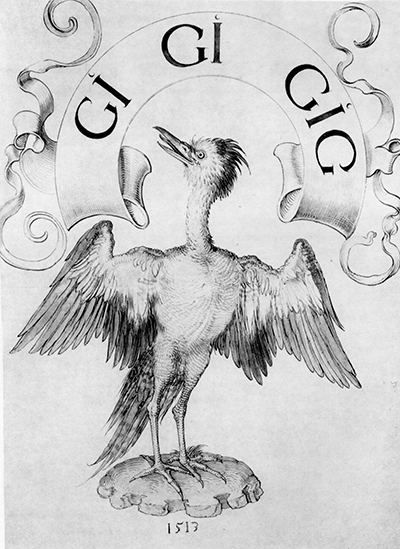
A long-beaked bird stands on a small island of rock, opens its wings and raises its voice. The sound takes an unexpectedly grand form: GI GI GIG, written across an enormous curling ribbon. Beneath the bird, the small date 1513 almost disappears beside the flourish above. Albrecht Dürer's drawing belongs to the British Museum, where it is described as a bird with outstretched wings. Its familiar alternative title, Draft for a Book Sign: Crane , introduces two questions that the picture leaves open: what sort of bird is this, and what was the design meant to become? [1]
On paper measuring 450 by 327 millimetres, Dürer combined pen and brown ink with blue, green, yellow, pink, grey and brown washes. Colour gives the creature a surprising lightness. Blue gathers around the back of the head and in the feathers beneath the wings; pink touches the shoulders, legs and ribbon. The breast remains comparatively pale. Against these small changes, the dark lettering has a weight and clarity that immediately commands attention. In a monochrome reproduction, the intricate feather drawing comes forward and the bird looks more uniformly grey. The colour image reveals a gentler, more fanciful balance between the animal and its ornamental setting. [1]
At a Glance
- Inscribed date 1513 [1]
- Collection British Museum, London [1]
- Subject Bird with outstretched wings and a lettered ribbon [1]
- TypeDrawing [1]
This work across Albrecht Dürer’s career
Young Hare
1502Praying Hands
1508Melencolia I
1514Four Apostles
1526Contents
A closer look
The bird faces us with its body but turns its head towards the upper left. That change of direction keeps the design from becoming rigidly frontal. Its long neck rises between the wings, then brings the open beak into the empty space beneath the first GI. One eye remains sharply visible against the little bristling crest. The spreading wings provide a broad base for this upward movement, while the thin legs carry the body down towards the rock. The whole figure narrows at the feet and opens again into the irregular ledge on which it stands.
Dürer makes the wings correspond without copying one side mechanically onto the other. The left wing reaches farther across the page; the other folds into a steeper, more compact outline. Long feathers overlap like narrow blades, with dark intervals separating their tips. Across the shoulders, shorter curved marks suggest softer plumage. These changes of line allow the surface to move from downy breast to layered flight feathers without losing the bird's overall silhouette. Looking closely rewards us with texture; looking from farther away gives us a single conspicuous shape.
The stance also combines movement with stability. Both feet rest on the rock, their long toes spreading over its surface. The tail descends diagonally behind the legs, adding a second direction beneath the broad wings. Nothing in the surrounding space supplies a riverbank, marsh or distant horizon. The rock is enough to support the creature, but too isolated to establish a habitat. This economical setting helps the bird read as a figure presented for attention. Its body has the detail of an animal, while its placement has the clarity of a sign.
Above it, the ribbon creates a second body of quite another kind. The broad writing surface curves into an arch, then turns over at its lower ends to reveal shaded undersides. Narrower extensions curl towards the corners of the sheet. Their loops echo the feather tips without sharing their orderly repetition. The ribbon seems to possess thickness, edges and a front and back; it can be read as a strip of material as well as a carrier of letters. Its pale pink shading also connects it visually with the bird below.
The inscription offers the most immediate connection between the two. The museum interprets GI GI GIG as presumably the bird's cry. In her study of pictured animal sounds, Danièle Alexandre-Bidon draws attention to the open beak pointing towards the first syllable and reads the capital letters as an indication of the call's force. This makes the ribbon an active part of the action: it gives visible extension to a noise that the drawing itself cannot produce. We can recognise that pictorial idea without deciding whether the syllables accurately imitate a particular species. [1] [12]
The lettering is unusually ceremonious for such a short utterance. Its large curved Gs and upright Is occupy a field much broader than the bird's head. Each group changes its angle as it follows the arch, so reading involves a sweep across the upper half of the picture. The repetition offers something simple to sound out, but the final added consonant interrupts perfect regularity. The bird's small open mouth and the expansive inscription operate at different scales. That discrepancy gives the image a comic edge: the creature seems capable of filling the space above it with its call.
Calling this a crane is convenient, although the long beak, neck and legs do not settle its zoological identity. The drawing's historical titles have preserved that uncertainty. Friedrich Winkler's catalogue index describes it as a book sign, with a question mark, containing a crane-like bird. The qualification matters. A recognisable animal could become the basis of an emblem without functioning as a precise species illustration. Here the raised wings, prominent cry and elaborate ribbon all contribute to the animal's public bearing. The strongest visual impression is of a creature displaying itself. [13]
A closely related drawing makes that designed character easier to see. Berlin's Kupferstichkabinett holds a sheet dated 1513, inventory KdZ 1269, which it calls Entwurf zu einem Buchzeichen , or Design for a Book Sign . It also joins an arched inscription, spreading wings, a central upright form and a small rocky base. In this case, however, the body between the wings is a rounded vessel standing on bird's legs, with a lion above it. The ribbon bears FORTES FORTUNA IUVAT: fortune favours the brave. The visual language can accommodate an impossible creature as readily as the London bird. [14]
The resemblance is particularly clear in the way the ribbons turn outwards beside the central forms. Both designs use these pale, curling surfaces to bring large dark letters into the composition. Both give their subjects a miniature platform, keeping them separate from a continuous landscape. Yet the effect of the words changes. The Latin sentence over the Berlin vessel offers a maxim for a human reader. GI GI GIG invites the reader to imagine a sound. Seen together, the sheets show how closely animal form, ornament and lettering could cooperate while producing very different kinds of address.
Berlin's drawing also retains a useful difference between finish and experiment. Its museum record identifies brown pen, watercolour and fleeting charcoal strokes extending the ribbon. A carefully coloured design could still contain an unresolved edge. That is worth remembering when looking at the London bird's elaborate presentation. A high degree of visual completion does not by itself reveal the next stage of an object's making. The sheet can look thoroughly worked out while leaving its eventual material, location and user uncertain. [14]
The older bookplate interpretation belongs to a substantial history of reading such images. In 1882, Moriz Thausing discussed the Berlin lion-and-vessel drawing among designs associated with books and Dürer's literary friends. His account moved between decorated coats of arms and freer allegorical inventions. That context helps explain why a fantastic creature and a motto could be understood as a mark for a book. It does not identify the London bird's intended owner. The absence of a personal name from its ribbon makes the question especially difficult: the letters attract attention, but do not announce whose possession the image might mark. [15]
A different possibility now appears in the British Museum's commentary. Summarising John Rowlands's 1993 catalogue, it proposes that the London and Berlin sheets were probably designs for devices used by jousters at tournaments. Their finish may have allowed prospective clients to approve the designs before execution, either by Dürer or another painter. Under this interpretation, the emphatic silhouette and conspicuous inscription become elements of a performed identity. The animal would give a contestant an arresting image through which to appear before others. [1]
The suggestion is persuasive as a way of looking, even though a particular commission remains unidentified. The bird has a frontal presence that can be grasped quickly, followed by details that invite closer attention. Its raised beak supplies an attitude, and its cry could give that attitude a memorable verbal equivalent. Those qualities suit an emblem intended to be recognised. They do not establish who adopted it, whether it was ever executed beyond the paper, or exactly how it would have been displayed.
The same museum commentary reports Winkler's alternative suggestion of glass painting, which Rowlands found less convincing. The coloured washes do allow us to imagine the motif in another medium, but no surviving glass panel is identified there. Bookplate, painted tournament device and glass design remain different explanations for the sheet's destination. What they share is the recognition that Dürer has brought the bird into a deliberately organised relationship with words and ornament. The design already communicates powerfully on paper, whatever further use may have been envisaged. [1]
An earlier description offers a useful point of continuity. Bernhard Hausmann's 1861 catalogue simply records a long-beaked bird in watercolour with a decorated band above it and transcribes GI. GI. GIG. The inscription was already a defining feature of the sheet for nineteenth-century readers. Even his short entry preserves its peculiar rhythm, bringing us back from questions of destination to the sound the image asks us to imagine. [16]
The British Museum lists Pieter Spiering van Silvercroon as a previous owner and records the sheet as part of Sir Hans Sloane's bequest. Their names document its later life as a collected drawing. Today, the sheet allows a slower encounter than a displayed device might have received: we can follow the small feather strokes, the thin toes and the folds of the ribbon before returning to its broad, animated shape. Dürer's bird holds that detailed scrutiny together with an almost audible declaration of its presence. [1]
Frequently Asked Questions
Artworks directory
These 187 records include individual works, reverse sides, detail views, paired panels and reconstructed arrangements. Three additional catalogue images repeat works already listed. Related views are not counted as separate originals; qualified attributions and published dating are retained.
Discussion
Look again at the images and ideas explored in Bird with Outstretched Wings (Draft for a Book Sign: Crane). These editorial prompts invite your observations.
Reader Insights
Which detail or idea in Bird with Outstretched Wings (Draft for a Book Sign: Crane) most changed your reading, and why?
How does the discussion of “A closer look” affect your understanding?
What comparison would you bring to the discussion of “A closer look”?
Join the Conversation
Share a detail, comparison or question about Bird with Outstretched Wings (Draft for a Book Sign: Crane) below.
References
- British Museum , Bird with wings outstretched, a scroll above inscribed “GI GI GIG” , SL,5218.84, current collection record, including its summary of John Rowlands, Drawings by German Artists and Artists from German-speaking Regions of Europe in the British Museum (1993), no. 186. View source .
- ALBERTINA, Selbstbildnis als Dreizehnjähriger, inv. 4839 (German). View source.
- Metropolitan Museum, Four Horsemen from The Apocalypse, 19.73.209 (English). View source.
- Bayerische Staatsgemäldesammlungen, Selbstbildnis im Pelzrock, inv. 537 (German). View source.
- ALBERTINA, Feldhase, inv. 3073 (German). View source.
- ALBERTINA, Das große Rasenstück, inv. 3075 (German). View source.
- Metropolitan Museum, Adam and Eve, 19.73.1 (English). View source.
- ALBERTINA, Betende Hände, inv. 3113 (German). View source.
- Metropolitan Museum, Knight, Death, and the Devil, 43.106.2 (English). View source.
- Metropolitan Museum, Melencolia I, 43.106.1 (English). View source.
- Bayerische Staatsgemäldesammlungen, inventory 545: current collection record (German; descriptive citation). View source.
- Danièle Alexandre-Bidon , “Au temps où les bêtes parlaient… Les signes visuels du cri animal (VIIIe–XVIe siècle)”, RursuSpicae 6 (2025), paragraph 36 and figure 29 caption. French. View source .
- Friedrich Winkler , Die Zeichnungen Albrecht Dürers , vol. 3: 1510–1520 (Berlin: Deutscher Verein für Kunstwissenschaft, 1938), collection index, London, British Museum, no. 702. German. View source .
- Staatliche Museen zu Berlin , Kupferstichkabinett, Entwurf zu einem Buchzeichen , KdZ 1269, current collection record, updated 6 August 2026. German. View source .
- Moriz Thausing , Albert Dürer: His Life and Works , vol. 2, translated from German, edited by Fred. A. Eaton (London: John Murray, 1882), pp. 121–123, especially p. 122. View source .
- Bernhard Hausmann , Albrecht Dürer's Kupferstiche, Radirungen, Holzschnitte und Zeichnungen (Hanover: Hahn, 1861), p. 109, British Museum list, no. 78. German. View source .
- Germanisches Nationalmuseum, Barbara Dürer (German and English). View source.
- Web Gallery of Art, Tucher–Rieter reverse (English). View source.
- National Gallery of Art, Portrait of a Clergyman (English). View source.
- Dürer Art, Portrait of a Man (English). View source.
- Hessen Kassel Heritage, Elsbeth Tucher (German). View source.
- Web Gallery of Art, Hans Tucher (English). View source.
- Germanisches Nationalmuseum, Emperor Maximilian I (German and English). View source.
- National Gallery of Art, Lot and His Daughters, reverse (English). View source.
- Bayerische Staatsgemäldesammlungen, Glim Lamentation (German). View source.
- Museo Nacional del Prado, Portrait of a Man (Spanish). View source.
- Bayerische Staatsgemäldesammlungen, Madonna of the Carnation (German). View source.
- Städel Museum, Job on the Dungheap (German). View source.
- Wallraf-Richartz-Museum, Piper and Drummer (German). View source.
- Italian Ministry of Culture / Uffizi, Head of Saint James (Italian). View source.
- Klassik Stiftung Weimar, Dresden Altarpiece (German). View source.
- Staatliche Museen zu Berlin, Girl with a Red Beret (German and English). View source.
- Dresden State Art Museums / Roland Enke, Bernhard von Reesen (German). View source.
- Royal Collection Trust, Burkhard von Speyer (English). View source.
- Dresden State Art Museums, Seven Sorrows of the Virgin (English). View source.
- Bayerische Staatsgemäldesammlungen, Mater Dolorosa (German). View source.
- Bayerische Staatsgemäldesammlungen, Lucretia (German). View source.
- Städel Museum, Young Woman with Her Hair Down (English). View source.
- ALBERTINA, Portrait of a Young Man (German). View source.