 by
Tom Gurney
Tom Gurney BSc (Hons) is an art history expert with over 20 years experience
Published on June 19, 2020 / Updated on October 22, 2026
Email:
tomgurney1@gmail.com
/ Phone:
+44 7429 011000
Allegory of Avarice: Introduction
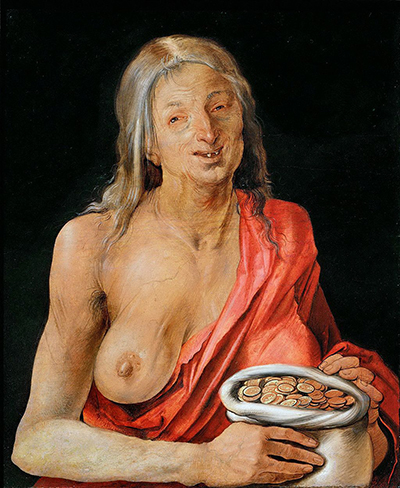
The woman holds her money where we can see it. The bag is open, its pale rim framing a heap of coins, while her long fingers close around its side. Above it, she looks out with narrowed eyes and a parted mouth. This encounter occupies the back of Albrecht Dürer’s Portrait of a Young Man , dated 1507, in Vienna’s Kunsthistorisches Museum. The two images share a poplar panel measuring only 35 × 29 centimetres. Turning from one face of the painting to the other replaces a composed young man with this disconcerting figure, usually called the Allegory of Avarice . [1]
Much of the reverse’s force comes from the way the body fills that small surface. The woman’s right forearm stretches almost across the entire lower edge. Her other hand appears at the far right, closing the composition around the purse. Her head sits high in the frame, leaving a broad expanse of exposed chest between face and money. Nothing in the black background competes with this arrangement. There is no room, landscape or companion to explain where she is or what has happened. We meet a body, a look and a possession.
At a Glance
- Date 1507 [1]
- Object Reverse of Portrait of a Young Man, on poplar [1]
- Collection Kunsthistorisches Museum, Vienna [1]
- TypePainting [1]
This work across Albrecht Dürer’s career
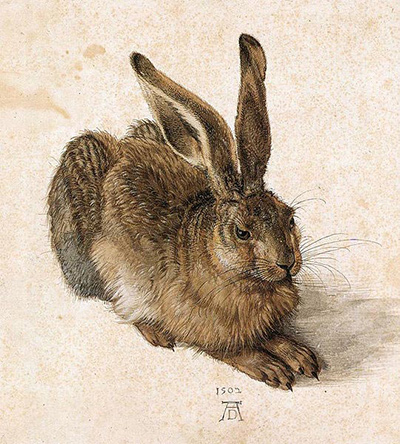
Young Hare
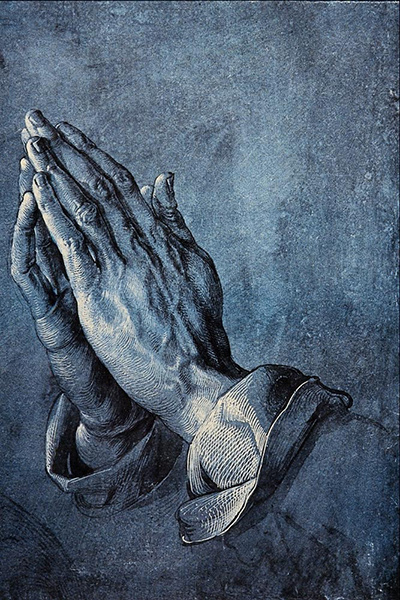
1502Praying Hands
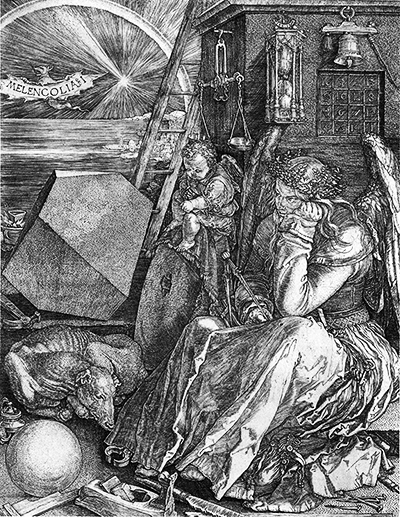
1508Melencolia I
1514Four Apostles
1526Contents
A closer look
The brilliant red drapery gives the picture its strongest colour. It rises over the woman’s left shoulder, falls diagonally across her chest and gathers into deep folds above her encircling arm. Against it, the uncovered skin looks pale and almost yellow in places. Loose strands of hair descend over both shoulders, crossing the boundary between flesh and cloth. Dürer varies the surfaces carefully: the rounded gleam of the coins, the softer pouch, the thin hair and the ridges around the eyes and throat all invite a different kind of looking.
Her expression is harder to settle. The mouth can suggest a grin, but it does not open into an uncomplicated laugh. The unevenness of the eyelids and the slight inclination of the head give the face an elusive, almost conversational quality. She seems aware that she is being observed. The money is displayed so openly that a straightforward account of secretive hoarding feels incomplete. Her hands embrace the bag, yet the wide opening offers its contents to our eyes. Possession becomes a performance: she holds something valuable and makes us look at her holding it.
That visible wealth gives the customary title its strongest foothold. Avarice means an excessive attachment to riches; here the purse supplies a material object for that attachment. Bodily ageing brings a second theme into view. Money remains in the woman’s grasp while the body bears the passage of time. The museum reads the reverse as a warning about the transience of earthly goods. On that reading, the coins promise a kind of security which they cannot finally provide. Nothing about the abundance of those bright little discs can halt ageing or guarantee life. [1]
The association of an old female body with moral failure also needs to be understood as a historical choice. Age itself supplies no evidence of greed. Dürer’s image combines exposed flesh, an unsettling expression and conspicuous money to construct a personification. Calling the woman Avarice assigns her a role; it does not identify a known individual or establish the character of an actual sitter. The breast makes the encounter more intimate and more uncomfortable, bringing bodily exposure into a picture about material possession. Such choices place the viewer’s response to her body within the allegory itself.
Renaissance images could direct particularly harsh humour at older women. In her National Gallery catalogue of Quinten Massys’s An Old Woman , Emma Capron examines the period’s satirical treatment of female age and sexuality. She also places Dürer and Giorgione within a possible field of artistic competition in representing older women: departures from prescribed beauty offered painters room to experiment and demonstrate their abilities. This is a useful setting for Dürer’s reverse, provided that an artistic possibility remains distinct from a documented commission. The woman’s body could carry a moral warning while also giving the painter difficult surfaces, expressions and proportions to explore. [12]
Looking at the young man on the other side changes the balance of the encounter. His dark cap forms a broad, quiet arc over his forehead. Reddish curls project on either side of his face, and a narrow moustache and light beard mark his chin and mouth. A white shirt appears between the dark edges of his coat and its warm fur lining. The clothing encloses him; the woman’s drapery exposes her. His hands are absent from the portrait, while hers dominate the lower part of the reverse. The most emphatic action in the whole object belongs to the figure holding money.
Both faces emerge from dark backgrounds, and both are turned enough to avoid the rigidity of a completely frontal pose. Yet their address differs. The man looks past us with his lips closed. The woman’s partly open mouth and tilted head seem to solicit a response. Seeing the two sides in succession moves between reserve and exposure, social presentation and allegorical provocation. Because the same piece of wood carries them, their relationship is unusually intimate. The warning is attached physically to the likeness which it asks us to reconsider.
A portrait can preserve an appearance while telling us little about conduct. The reverse adds a question about values to the young man’s visible identity. It might ask how he should live, what he should fear becoming or how a viewer should judge the attractions of prosperity. Those possibilities differ from treating the woman as an accusation that he was already greedy. A moral image accompanying a portrait could work as an aspiration to self-command, acknowledging a danger which its owner wished to resist.
Mateusz Mayer developed this instructional possibility in a paper presented at the 2024 Institute of Fine Arts and Frick Collection symposium. His published abstract notes interpretations of the woman as avarice, vanity or lust, before proposing that the sitter was a young mercantile apprentice, with the reverse warning him about the moral dangers of his profession. Mayer relates the painting to merchants’ use of portraits to express modesty, piety and upright conduct in the face of suspicions about commerce. The proposed occupation and apprenticeship remain an interpretation. Its value is to show how the disturbing reverse might have served the sitter’s own moral purposes, without requiring a quarrel between painter and patron. [13]
The man’s identity remains unknown. The Kunsthistorisches Museum associates him provisionally with the German merchants for whom Dürer painted portraits during his Venetian stay, while allowing that the picture may have been made after his return to Nuremberg. Neither the face nor the money on the reverse supplies a name. A merchant context makes the warning about riches especially pointed, but the image’s effect does not depend on proving that occupation. Anyone commissioning a lasting likeness could understand the uncomfortable gap between the wish to preserve a self and the instability of the life represented. [1]
The panel’s two-sided format makes looking part of that argument. A reproduction of the woman alone loses the young man; reproductions of both faces beside each other make their comparison easy, but alter the physical experience. On the actual object, the images occupy opposing surfaces. To move between them requires a change in the viewer’s position or in the presentation of the panel. We cannot reconstruct a particular original hanging or handling arrangement from that fact. We can recognise, however, that discovering the reverse could interrupt an encounter which began as ordinary portrait viewing.
Differences in finish do not by themselves explain why the second image was painted. In his National Gallery of Art catalogue, John Oliver Hand discusses Dürer’s surviving paintings with decorated backs and observes that the fronts are generally worked more carefully than the reverses. He cautions that a broader manner need not mean a different date. The distinction matters here. The handling of the woman’s flesh and red folds should not automatically turn the painting into an abandoned study, or establish that an unrelated picture was recycled. Degrees of completion could have belonged to the different tasks performed by the two faces of a panel. [14]
The most illuminating comparison is Giorgione’s La vecchia , in Venice’s Gallerie dell’Accademia. Its elderly woman also emerges from darkness with her mouth slightly open, but the visible objects redirect the encounter. A white head covering and shoulder cloth frame her face and mauve garment. Her hand moves towards her chest beside a small scroll carrying the words Col tempo , “with time”. Dürer places a purse between woman and viewer; Giorgione places a written prompt. One concentrates attention on what is held, the other on what happens over a lifetime. [15]
The Accademia’s interpretation allows the motto to move in two directions. It may remind the viewer of mortality and the passing of earthly things, or praise old age as a time when temporary passions can give way to spiritual concerns. That second possibility makes the comparison especially useful. An aged face need not deliver the same lesson in every painting. The relationship between gesture, clothing, inscription and accompanying objects determines how age becomes meaningful. Dürer’s conspicuous coins anchor his image to possession in a way that Giorgione’s scroll does not. [15]
Vienna’s 2021 Titian exhibition brought the paintings into an explicit comparison, distinguishing Giorgione’s meditation on time from Dürer’s caricatural warning about avarice. Their affinities invite comparison, but resemblance alone cannot establish which artist supplied the other’s idea. Nor should the comparison erase their differences in material presence: Giorgione’s canvas is substantially larger than Dürer’s small wooden panel. Dürer’s image acquires an additional pressure from sharing its support with a young man’s portrait. [16] [1] [15]
The Kunsthistorisches Museum records the panel in Vienna’s imperial collection in 1619. That secure point in its later history leaves the original owner and the circumstances of its making unresolved. The uncertainty keeps attention on what the object actually offers. A poised face and an exposed body survive together, joined by the wood between them. The coins catch the eye, but the man on the other side makes their lesson personal. Turning the panel brings a preserved appearance into contact with time, appetite and the uneasy question of what a life’s possessions are worth. [1]
Frequently Asked Questions
Artworks directory
These 187 records include individual works, reverse sides, detail views, paired panels and reconstructed arrangements. Three additional catalogue images repeat works already listed. Related views are not counted as separate originals; qualified attributions and published dating are retained.
Discussion
Look again at the images and ideas explored in Allegory of Avarice. These editorial prompts invite your observations.
Reader Insights
Which detail or idea in Allegory of Avarice most changed your reading, and why?
How does the discussion of “A closer look” affect your understanding?
What comparison would you bring to the discussion of “A closer look”?
Join the Conversation
Share a detail, comparison or question about Allegory of Avarice below.
References
- Kunsthistorisches Museum , Vienna, Brustbild eines jungen Mannes , with Allegorie des Geizes on the reverse, GG 849. Current collection record and images. German. View source .
- ALBERTINA, Selbstbildnis als Dreizehnjähriger, inv. 4839 (German). View source.
- Metropolitan Museum, Four Horsemen from The Apocalypse, 19.73.209 (English). View source.
- Bayerische Staatsgemäldesammlungen, Selbstbildnis im Pelzrock, inv. 537 (German). View source.
- ALBERTINA, Feldhase, inv. 3073 (German). View source.
- ALBERTINA, Das große Rasenstück, inv. 3075 (German). View source.
- Metropolitan Museum, Adam and Eve, 19.73.1 (English). View source.
- ALBERTINA, Betende Hände, inv. 3113 (German). View source.
- Metropolitan Museum, Knight, Death, and the Devil, 43.106.2 (English). View source.
- Metropolitan Museum, Melencolia I, 43.106.1 (English). View source.
- Bayerische Staatsgemäldesammlungen, inventory 545: current collection record (German; descriptive citation). View source.
- Emma Capron , with technical contributions by Marika Spring, Britta New and Rachel Billinge, An Old Woman (‘The Ugly Duchess’) , National Gallery, London, 2024, especially “A Comic Type” and “Patronage, Function and Date”. View source .
- Mateusz Mayer , “A Merchant’s Admonition: The Double-Sided Portrait of a Young Man by Albrecht Dürer”, published abstract for the Institute of Fine Arts and Frick Collection Symposium on the History of Art, 5 April 2024. View source .
- John Oliver Hand , with the assistance of Sally E. Mansfield, German Paintings of the Fifteenth through Seventeenth Centuries , National Gallery of Art, Washington, 1993, p. 56 and p. 59, notes 29–30. View source .
- Gallerie dell’Accademia di Venezia , La vecchia , Giorgione, catalogue 272. Current collection essay and image. Italian. View source .
- Kunsthistorisches Museum , Vienna, Tizians Frauenbild: Schönheit – Liebe – Poesie , exhibition booklet, 2021, “Vanitas”, entry 99. German. View source .
- Germanisches Nationalmuseum, Barbara Dürer (German and English). View source.
- Web Gallery of Art, Tucher–Rieter reverse (English). View source.
- National Gallery of Art, Portrait of a Clergyman (English). View source.
- Dürer Art, Portrait of a Man (English). View source.
- Hessen Kassel Heritage, Elsbeth Tucher (German). View source.
- Web Gallery of Art, Hans Tucher (English). View source.
- Germanisches Nationalmuseum, Emperor Maximilian I (German and English). View source.
- National Gallery of Art, Lot and His Daughters, reverse (English). View source.
- Bayerische Staatsgemäldesammlungen, Glim Lamentation (German). View source.
- Museo Nacional del Prado, Portrait of a Man (Spanish). View source.
- Bayerische Staatsgemäldesammlungen, Madonna of the Carnation (German). View source.
- Städel Museum, Job on the Dungheap (German). View source.
- Wallraf-Richartz-Museum, Piper and Drummer (German). View source.
- Italian Ministry of Culture / Uffizi, Head of Saint James (Italian). View source.
- Klassik Stiftung Weimar, Dresden Altarpiece (German). View source.
- Staatliche Museen zu Berlin, Girl with a Red Beret (German and English). View source.
- Dresden State Art Museums / Roland Enke, Bernhard von Reesen (German). View source.
- Royal Collection Trust, Burkhard von Speyer (English). View source.
- Dresden State Art Museums, Seven Sorrows of the Virgin (English). View source.
- Bayerische Staatsgemäldesammlungen, Mater Dolorosa (German). View source.
- Bayerische Staatsgemäldesammlungen, Lucretia (German). View source.
- Städel Museum, Young Woman with Her Hair Down (English). View source.
- ALBERTINA, Portrait of a Young Man (German). View source.