 by
Tom Gurney
Tom Gurney BSc (Hons) is an art history expert with over 20 years experience
Published on June 19, 2020 / Updated on October 22, 2026
Email:
tomgurney1@gmail.com
/ Phone:
+44 7429 011000
The Virgin and Child with an Angel Playing the Viol: Introduction
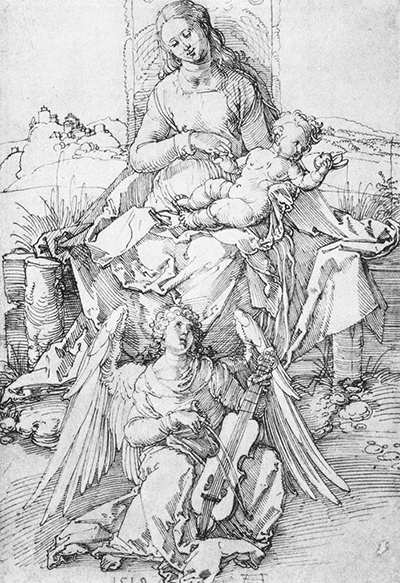
The angel sits almost at our feet. Its wings open behind a bowed instrument, and its face turns upwards towards the Virgin, who towers above it in a cascade of cloth. Across her lap, the Child stretches towards the right, absorbed in the fruit in his hand. These three figures give Albrecht Dürer's The Virgin and Child with an Angel Playing the Viol , probably drawn in 1519, a remarkably expansive presence on a small sheet. The Royal Collection drawing, RCIN 912180, measures 30.3 × 21.2 cm and is catalogued as pen and black ink with revisions in brown ink. [1]
The arrangement encourages a wandering eye. The instrument's neck leads upwards towards the Child; the Child's reclining body carries the gaze sideways; Mary's inclined head turns it down again towards the musician. Yet the figures never quite close into a self-contained knot. The angel faces out into our space even while looking upwards, and its spreading wings make the lower half of the sheet feel open. The little performance seems to be happening just in front of the viewer.
At a Glance
- Date Probably 1519 [1]
- Materials Pen and black ink, with brown-ink revisions [1]
- Collection Royal Collection; RCIN 912180 [1]
This work across Albrecht Dürer’s career
Young Hare
1502Praying Hands
1508Melencolia I
1514Four Apostles
1526Contents
- A seat between garden and throne
- The Child's fruit and the angel's music
- A pen that builds and revises
- Looking, dating and survival
- Frequently Asked Questions
A seat between garden and throne
Mary's setting combines a rough outdoor seat with an upright textile behind her. The current catalogue identifies the seat as planks and turf and the hanging as a cloth of honour, appropriate to an exalted person. Their shapes establish two different scales of looking. At either side, grass and the uneven ends of the seat keep the encounter close to the ground. Behind Mary's head, the tall, narrow hanging provides a ceremonial backdrop. She occupies an improvised throne within a landscape that remains accessible and ordinary. [1]
The bench is easiest to understand at its ends. On the left, a cut timber rises beside the gathered fabric; on the right, the seat projects beneath a sharply folded edge. Across the middle, drapery conceals the structure almost completely. One can follow the layers of material much more readily than the exact position of Mary's knees. Her upper body is relatively slender, but below the Child the clothing opens into a great spread of angular planes. This changing width gives her a monumental appearance without an architectural throne.
Beyond her shoulders, the landscape is lightly drawn. Buildings climb a hill on the left, while a lower ridge runs away to the right. Their small scale makes the foreground figures seem larger still. The background never becomes a second subject: the distant outlines leave substantial areas of paper clear, giving the eye a respite from the densely worked cloth. There is no need to identify this cluster of buildings with a particular town to appreciate its function. It establishes a world beyond the immediate meeting of mother, Child and angel.
The hanging has a further practical effect. Its straight sides continue behind Mary's hair and shoulders, framing the inclination of her head. Its surface carries lines without acquiring the dark weight of the foreground folds. The head thus remains easy to find amid an exceptionally busy design. Dürer balances the conspicuous wings below with this quieter vertical shape above.
The Child's fruit and the angel's music
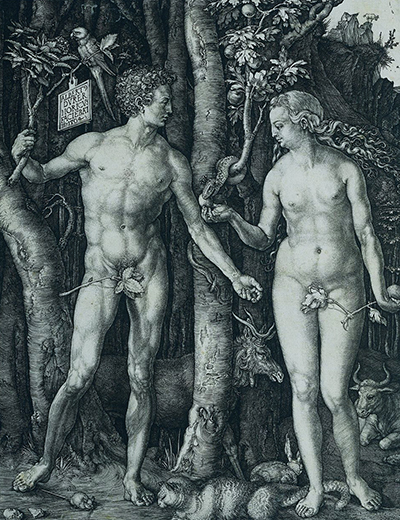
The Child leans backwards, his head tilted as he inspects an apple. The Royal Collection relates the apple to Adam and Eve. Such an association gives consequence to an otherwise familiar piece of infant behaviour. The object holds his attention as a thing that can be grasped and examined, while its religious meaning extends beyond the instant shown. Dürer lets those two kinds of attention coexist: the Child is both the centre of a devotional image and an active, curious baby. [1]
His body lies diagonally across Mary's lap, with bent legs at the left and the raised hand at the right. Her supporting hand emerges beneath him, its fingers making a small, firm barrier against his outward movement. The line of his exposed torso is much less interrupted than the folds surrounding it. This difference helps the figure remain legible: smooth stretches of skin stand out against cloth built from repeated creases and corners. The Child's rounded limbs also soften the pointed shapes of the seat and garments.
Below him, the angel's instrument occupies a strikingly prominent position. Its broad body rests low between the knees, while the neck rises beside the angel's turned face. One hand reaches along the neck and the other works the bow across the strings. Even in a monochrome reproduction, the pale soundboard and dark openings make the instrument immediately recognisable as a solid object. Its comparatively straight central axis steadies the surrounding movement of wings and folds.
The collection's title calls it a viol. A viol is a bowed string instrument played on the leg, as Elizabeth Weinfield explains in her account for the Metropolitan Museum of Art. Here the playing position is visible and contributes to the composition. The player bends around an upright instrument, allowing the head to turn freely towards Mary while the hands continue their task. Sound is suggested through a coordinated action of the whole body. [12]
Charles Ephrussi, describing the drawing in his 1882 study of Dürer's drawings, understood the curly-haired angel as singing while accompanying itself on the viol. The open mouth makes that an appealing reading. It remains a reading of the figure, however: the drawing supplies neither words nor a written musical part. The attentive upward glance, the bowing gesture and the mouth together are enough to make the silent sheet evoke a performance. [13]
The angel's large wings help carry that imagined music. Their long feathers sweep out behind the arms and instrument, forming a shelter around the player. Shorter marks distinguish the curled hair from these extended contours. In the face, only a few small strokes need to register the lifted eyes and parted lips. Dürer can move from a nearly empty cheek to the busy mass of curls without losing the direction of the head.
A pen that builds and revises
The extraordinary variety of the drawing becomes clearest when one compares neighbouring surfaces. At the left end of the bench, curved bands describe the rounded timber. Across the lower ground, longer strokes run obliquely past the angel. In the Virgin's clothing, groups of parallel lines change direction as one plane turns into another. A narrow crease may be marked with a dense, dark accent, while the face of an adjoining fold remains almost entirely open.
This is how the drawing produces light without coloured modelling. The paper supplies the lightest passages, and changes in the spacing and direction of the strokes suggest the turning forms. Mary's skirt is especially instructive. Broad unmarked areas can look brilliantly illuminated because small clusters of ink establish a shadow at their edges. Elsewhere, overlapping lines give the fabric a heavier, more deeply folded appearance. The pen continually moves between describing an edge and constructing a surface.
The current catalogue locates brown-ink revisions chiefly in the figures' hair and hands, and identifies delicate construction lines in Mary's face. These details make the sheet particularly rewarding to examine closely. The hands are crucial points of contact: Mary steadies the Child, the Child holds the fruit, and the angel handles the instrument. Adjustments occur within the very places where an action must become intelligible through small changes of contour. [1]
Friedrich Winkler's 1938 catalogue discussed horizontal lines above Mary's eyebrows and at the tip of her nose in relation to Dürer's studies of proportion. He also qualified the suggestion, allowing that artistic judgement may have guided the result. The distinction matters. Construction marks show a figure being worked out; they do not by themselves establish that an entire composition follows a recoverable mathematical formula. Here the lowered head and unequal spread of the drapery remain persuasive as expressive shapes, whatever measurements helped Dürer arrive at them. [14]
Winkler also emphasised the contrasting directions of the movements and pen strokes. That observation offers a useful way to look across the sheet. Lines that seem individually simple become animated through their neighbours: a wing descends beside an ascending instrument, a bowed head answers an upturned one, and the reclining Child crosses the upright Virgin. Much of the image's energy comes from these relationships, without requiring dramatic gestures from any of the figures. [14]
Looking, dating and survival
The drawing has also prompted disagreement about how its figures inhabit space. In his 1906 Geschichte des Dürerschen Marienbildes , Ernst Heidrich connected it with the central arrangement of Dürer's Feast of the Rosary . He admired its circulation of line and feeling, but found the Virgin's actual seated position difficult to reconstruct. The Child, too, seemed unusually free from weight in his account. These are useful questions to bring back to the drawing. The broad skirt allows Mary to rise above the musician with a presence that exceeds the modest bench visible at the sides. [15]
Heidrich's comparison draws attention to a combination of ceremonial display and intimate encounter. The hanging and musician can sustain a grand devotional arrangement, while the Child's absorption and Mary's bent head keep the scene personal. The precise mechanics of seating yield to the visual connection between the figures. That connection is especially strong from a little distance, when the larger shapes take precedence over individual fingers and folds.
The cut date and monogram at the lower edge require caution. Winkler called them autograph; today's owner considers the inscription probably another hand, in a different ink, while retaining 1519 as the likely date. The uncertainty concerns the inscription, rather than the drawing's attribution. The visible brown revisions and the added inscription should not be treated as one operation merely because both involve ink differing from the principal drawing. [1] [14]
The first Royal Collection inventory record dates to about 1800–1820. It establishes presence, rather than an exact acquisition date. Today the sheet preserves both the breadth of a complete devotional composition and traces of local reconsideration. The angel's absorbed performance, the Child's outward reach and Mary's answering inclination make those worked lines feel continuous with the life of the figures. [1]
Frequently Asked Questions
Artworks directory
These 187 records include individual works, reverse sides, detail views, paired panels and reconstructed arrangements. Three additional catalogue images repeat works already listed. Related views are not counted as separate originals; qualified attributions and published dating are retained.
Discussion
Look again at the images and ideas explored in The Virgin and Child with an Angel Playing the Viol. These editorial prompts invite your observations.
Reader Insights
Which detail or idea in The Virgin and Child with an Angel Playing the Viol most changed your reading, and why?
How does the discussion of “A seat between garden and throne” affect your understanding?
What comparison would you bring to the discussion of “Looking, dating and survival”?
Join the Conversation
Share a detail, comparison or question about The Virgin and Child with an Angel Playing the Viol below.
References
- Royal Collection Trust , The Virgin and Child with an angel playing the viol , RCIN 912180, current collection record, catalogue entry adapted from The Northern Renaissance: Dürer to Holbein (London, 2011). English. View source .
- ALBERTINA, Selbstbildnis als Dreizehnjähriger, inv. 4839 (German). View source.
- Metropolitan Museum, Four Horsemen from The Apocalypse, 19.73.209 (English). View source.
- Bayerische Staatsgemäldesammlungen, Selbstbildnis im Pelzrock, inv. 537 (German). View source.
- ALBERTINA, Feldhase, inv. 3073 (German). View source.
- ALBERTINA, Das große Rasenstück, inv. 3075 (German). View source.
- Metropolitan Museum, Adam and Eve, 19.73.1 (English). View source.
- ALBERTINA, Betende Hände, inv. 3113 (German). View source.
- Metropolitan Museum, Knight, Death, and the Devil, 43.106.2 (English). View source.
- Metropolitan Museum, Melencolia I, 43.106.1 (English). View source.
- Bayerische Staatsgemäldesammlungen, inventory 545: current collection record (German; descriptive citation). View source.
- Elizabeth Weinfield , “The Viol”, Heilbrunn Timeline of Art History , Metropolitan Museum of Art, June 2014. English. View source .
- Charles Ephrussi , Albert Dürer et ses dessins (Paris: A. Quantin, 1882), p. 192. French. View source .
- Friedrich Winkler , Die Zeichnungen Albrecht Dürers , vol. 3: 1510–1520 (Berlin: Deutscher Verein für Kunstwissenschaft, 1938), p. 17, no. 536. German. View source .
- Ernst Heidrich , Geschichte des Dürerschen Marienbildes (Leipzig: Karl W. Hiersemann, 1906), pp. 130–133. German. View source .
- Germanisches Nationalmuseum, Barbara Dürer (German and English). View source.
- Web Gallery of Art, Tucher–Rieter reverse (English). View source.
- National Gallery of Art, Portrait of a Clergyman (English). View source.
- Dürer Art, Portrait of a Man (English). View source.
- Hessen Kassel Heritage, Elsbeth Tucher (German). View source.
- Web Gallery of Art, Hans Tucher (English). View source.
- Germanisches Nationalmuseum, Emperor Maximilian I (German and English). View source.
- National Gallery of Art, Lot and His Daughters, reverse (English). View source.
- Bayerische Staatsgemäldesammlungen, Glim Lamentation (German). View source.
- Museo Nacional del Prado, Portrait of a Man (Spanish). View source.
- Bayerische Staatsgemäldesammlungen, Madonna of the Carnation (German). View source.
- Städel Museum, Job on the Dungheap (German). View source.
- Wallraf-Richartz-Museum, Piper and Drummer (German). View source.
- Italian Ministry of Culture / Uffizi, Head of Saint James (Italian). View source.
- Klassik Stiftung Weimar, Dresden Altarpiece (German). View source.
- Staatliche Museen zu Berlin, Girl with a Red Beret (German and English). View source.
- Dresden State Art Museums / Roland Enke, Bernhard von Reesen (German). View source.
- Royal Collection Trust, Burkhard von Speyer (English). View source.
- Dresden State Art Museums, Seven Sorrows of the Virgin (English). View source.
- Bayerische Staatsgemäldesammlungen, Mater Dolorosa (German). View source.
- Bayerische Staatsgemäldesammlungen, Lucretia (German). View source.
- Städel Museum, Young Woman with Her Hair Down (English). View source.
- ALBERTINA, Portrait of a Young Man (German). View source.