 by
Tom Gurney
Tom Gurney BSc (Hons) is an art history expert with over 20 years experience
Published on June 19, 2020 / Updated on October 22, 2026
Email:
tomgurney1@gmail.com
/ Phone:
+44 7429 011000
Dürer’s Sea Monster: Introduction
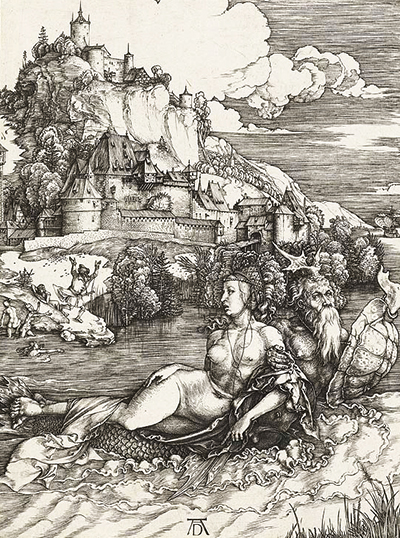
A tuft of reeds rises from the lower right corner of The Sea Monster . Its thin stems stand against pale water, close to a pointed fin and a tangle of foam. Far above, a spire crowns a hilltop tower. Between these small vertical accents, Dürer has fitted an astonishing succession of bodies, buildings, trees and clouds. The eye can climb through the print, following one form into another, or travel sideways across its broad bands of water and sky. [1]
Dated about 1498, the work is an engraving. The National Gallery of Art’s Rosenwald impression, 1943.3.3483, is on laid paper, trimmed to the plate mark, and measures 24.7 × 18.8 centimetres. Its catalogue number is Meder 66. [2]
At a Glance
- Date About 1498 [2]
- Process Engraving [2]
- Example impression National Gallery of Art, Rosenwald Collection; Meder 66 [2]
This work across Albrecht Dürer’s career
Young Hare
1502Praying Hands
1508Melencolia I
1514Four Apostles
1526Contents
- Looking closely at the figures
- Names without a settled story
- A coast built in layers
- How the cut line becomes a surface
- The print among Dürer’s goods
- The lives of separate sheets
- Frequently Asked Questions
Looking closely at the figures
Across the foreground, a nude woman lies on a scaly creature, her profile turned towards the shore. Her headdress is almost as intricate as the distant architecture. A row of round beads crosses her brow, with a second band curving over the crown of her head. A narrow upright decoration rises behind it. Locks gather into a knot at the back, then escape in individual curls: one extends leftwards beside her neck against a dark mass of foliage. Two fine chains descend over her chest. These tiny lines remain legible against the much broader, lightly shaded surfaces of the body. [17]
Her nearer hand hangs beside the edge of a fold, with its fingers pointing downwards. The other rests on the raised knee. Beneath the extended legs, cloth changes from a narrow strip into a broad, curling end at the left. Elsewhere it forms deep pockets of shadow and sharp triangular openings. Following this fabric is one way of separating the overlapping forms: it passes between pale flesh, patterned scales and the broken white rims of the waves. [17]
The monster’s head is full of small asymmetries. The eyes look out from beneath a heavy brow; a pointed ear projects through the curling hair. The beard divides into long tapering strands below the mouth, whereas the shorter hair around the ear makes tight loops. Above, the branching growths have blunt ends and rough contours. These different kinds of line allow the head to remain distinct from the densely worked trees immediately behind it.
The Michigan museum identifies a tortoise-shell shield and contrasts the woman’s apparent ease with her companions’ alarm. The grip on her upper arm and her lowered hands establish neither consent nor a particular feeling. Calling the scene an abduction leaves that uncertainty intact. [17]
Broad compartments fill the centre of the segmented object, with curved rows of short strokes running across them; a scalloped rim makes smaller divisions around the edge. A pale, forked shape projects above it, silhouetted against the water. The narrow gap between shell and beard is dark. Below, the foam turns around the lower edge of the group. There is remarkably little empty space between the separate parts of this foreground group.
Names without a settled story
Michigan’s 2012 commentary proposes classical abduction tales, a German legend about a Langobard queen, or a contemporary Adriatic report of a monster taking women. It compares the castle with Nuremberg’s. None of these possibilities securely identifies the woman. [17]
The National Galleries of Scotland favours an unidentified antique story, proposing a relationship with abduction compositions on sarcophagi and mosaics, mediated through Italian prints. It also records Dürer’s journal name, Meerwunder . The proposed visual ancestry and the artist’s descriptive label leave the precise narrative unresolved. Recognising a type of scene does not establish its heroine, motive or outcome. [18]
That uncertainty has a history of its own. In 1897, S. R. Koehler catalogued the print for the Grolier Club under The Rape of Amymone . His entry nevertheless assembled objections to the name. He reported Heller’s preference for a story of Glaucus and Syme, then rejected that solution as unsatisfactory. On the following page he considered Anton Springer’s attempt to identify the scene with Hercules and Deianira. Koehler found an obstacle in the diary’s separate marine title. A catalogue heading could sound decisive while the discussion beneath it exposed disagreement. [11]
These are records of interpretation, rather than additional witnesses to the event depicted. Koehler’s account does not turn Amymone into a documented sitter or establish that Dürer illustrated Heller’s proposed story. It is useful precisely because it shows how long readers have tried to fit the engraving to a named narrative. The old alternatives also make visible the consequences of naming: a particular woman and a particular bearer bring expectations about what should happen, against which the image may resist. [11]
A coast built in layers
Begin at the top left and follow the route down. The highest tower is surrounded by rounded rocks, a slender conifer and smaller buildings. A half-timbered gable stands near the edge of the summit. Below it, the cliff falls in pale, bulging faces, divided by darker cracks and narrow shelves. The rock does not descend as a single flat wall. One projection overlaps another, so the eye repeatedly meets a new edge before reaching the town.
The lower buildings have a different rhythm. Steep roof triangles crowd together behind an enclosing wall. At the left a broad round tower has a pointed roof; farther right, smaller towers interrupt the long horizontal fortification. Tiny regular strokes suggest masonry. At the far right of the town, an arch opens into darkness, and an oblique approach carries the eye down towards the trees. Doorways, windows and roof openings give the walls a scale beyond their outlines.
Dürer allows several kinds of whiteness to remain apart. The bright cliff is scored with uneven vertical strokes. The long town wall carries a much finer pattern of horizontal courses. The roofs darken through close parallel hatching, while their edges catch narrow pale strips. Light therefore does more than pick out the largest masses. It distinguishes surfaces that stand immediately beside one another, preventing the elaborate town from becoming an undifferentiated accumulation of detail.
The shoreline bends around the middle of the sheet. At the left, a low tongue of land projects into the water; the raised hands of a clothed figure appear against a relatively open slope. To the right, trees hide much of the bank. Their crowns consist of nested arcs and short strokes, with dense black intervals between trunks. Long vertical lines continue down into the water beneath them. The trees thus have both a solid upper mass and a much thinner, descending counterpart.
Near the left edge, the small bathers occupy several different levels. Two figures stand at the bank, another bends towards the projecting rock, and a head breaks the water nearby. Farther forward, a swimmer’s outstretched arm points across an open interval. Their size can be judged against the large foreground knee and head. The distance between these groups is made conspicuous by the comparatively plain water through which the eye has to pass.
There is an especially striking change at the right edge. Beyond the trees, a tiny vessel tilts its striped sail beside a low ridge. Its hull and rigging fit into a fraction of the space occupied by the shell below. Seen together, these forms prevent the foreground group from flattening against the background: one object is almost within reach, while the other belongs to a distant stretch of water. The sail also introduces an angular shape into a passage dominated by rounded foliage.
Overhead, horizontal strokes run almost without interruption across the upper right. White cloud masses intrude upon this darker field, their outlines swelling and narrowing. Some portions of the cloud remain nearly blank, while others carry short curved hatching along their underside. At the top centre, a small dark wedge reaches down from the border into an enormous pale cloud. Such abrupt changes between worked and open areas make the sky as carefully articulated as the town below.
The foreground water is drawn with more broken lines. Parallel lines bend into long shallow curves, then encounter the white, curling edges of the wake. Small dark tongues curl inside the foam. A triangular fin cuts across these loops below the woman’s hanging hand. Farther down, the waves become longer and less densely interwoven, leaving room for the AD monogram near the lower edge. The eye can follow a continuous surface from distant reflections to the nearest ripples, although its pattern changes repeatedly along the way.
How the cut line becomes a surface
Engraving asks the viewer to translate an inked mark back into a physical cut. Friedrich Lippmann’s Engraving and Etching , in the 1906 edition revised by Max Lehrs and translated by Martin Hardie, describes the burin as a steel tool pushed into a polished copper plate. The pressure comes through the hand holding its handle, while the plate can be turned to meet the tool. Metal displaced beside the cut is normally removed with a scraper. This is a method of making grooves capable of retaining ink. [19]
The transfer to paper involves another set of decisions. Lippmann explains that ink is spread on the plate, then wiped from its smooth areas while remaining in the incisions. Dampened paper passes with the plate through a press, under pressure, and is subsequently removed and dried. He emphasises the printer’s judgement in distributing the ink and wiping the surface. An engraved design and a particular printed sheet are therefore connected by a material operation with its own variables. [19]
In this engraving, that technical explanation helps us attend to what the lines actually do. Across the woman’s thigh, long curving strokes become shorter and more closely set towards the shaded edge. Much of the central surface remains open. Under her torso the hatching grows denser; in the hollow beside the cloth, crossing strokes make a deeper dark. The visible passage from white paper into grouped lines supplies the rounding that a painted body might develop through changes of colour. [19]
The scales below the legs repeat small crescent forms across a long, curved body. Their dark upper edges and pale centres create a rhythm quite unlike the stretched strokes on the thigh. The cloth adds another rhythm through long folds that abruptly turn or bunch together. Close to the lower border, the reeds reduce this variety to thin, separate lines. The same black ink can suggest a smooth expanse, a repeated covering, a crease or a stalk because the marks have been organised differently. [19]
Lippmann also distinguishes changes to a plate from the individual impressions pulled from it. Alteration of the engraved design can produce a different state, while repeated printing produces separate sheets. His discussion of wear is a reminder to look for evidence in the object before assigning it a place in a printing history. Nothing in the familiar composition alone supplies the date or condition of every surviving impression. Nor does the technical account tell us who printed a particular sheet of The Sea Monster . [19]
The print among Dürer’s goods
The diary offers a more direct encounter with Dürer’s handling of the image. In Rudolph Tombo’s 1913 translation, the second Antwerp stay of late 1520 includes a sale containing one Sea Monster . The surrounding account is full of ordinary business: household spending during Dürer’s absence, payment to his host, parchment purchased, currencies changed and meals with acquaintances. Within that sequence, the engraving enters a substantial mixed transaction. [1]
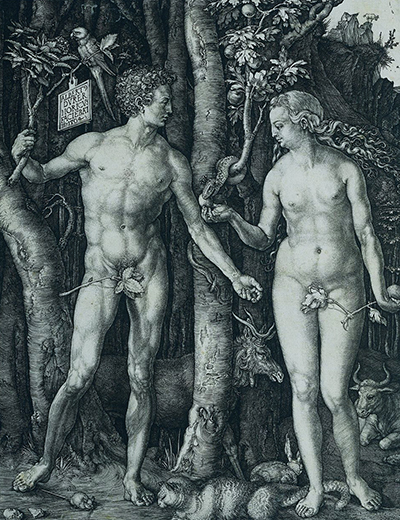
Dürer lists two Adam and Eves , one Jerome , one Knight , one Nemesis and one Saint Eustace , as well as the marine subject. He adds a whole sheet, seventeen etched pieces in Tombo’s wording, eight quarter-sheets, ten woodcuts, seven inferior woodcuts, two books and ten small woodcut Passions . The recorded eight florins covers the entire list. It cannot be divided into a documented price for The Sea Monster . Immediately afterwards, Dürer records exchanging three large books for cloth. [1]
The distinctions within the list are revealing even where its shorthand resists a modern inventory. Some items have individual image names; others are grouped by format, medium or book. Dürer also differentiates the inferior woodcuts. We need not assign every unnamed piece to a surviving work to recognise an assortment of goods with differing descriptions. The engraving’s brief title allows it to be counted and transferred without explaining its story. The c. 1498 design was still being sold in late 1520. [1] [2]
A report about a stranded whale follows on the same printed page and continues onto the next. Dürer records what people say about its extraordinary size and the difficulty of removing it. The subsequent Zeeland journey introduces cold, sea travel and an accident while landing. These entries belong to the circumstances of 1520. The whale report postdates the engraving’s approximate design by over twenty years. The diary brings the print and a reported marine marvel into the same traveller’s account at a much later moment. [1] [2]
The lives of separate sheets
Koehler’s Grolier entry also makes the work’s later circulation tangible. It lists two impressions and a reversed copy attributed, following Nagler, to Johannes Ladenspelder van Essen. Koehler distinguishes the two impressions through their ink and appearance. This is evidence of what a nineteenth-century catalogue displayed and compared; the attribution of the copy is reported there, rather than independently established by that listing. A copy in reverse and another impression from Dürer’s plate represent different ways an image could recur. [11]
For the NGA sheet, the recorded route runs through a Berlin sale and Charles Sessler to Rosenwald in 1929, then to the Gallery by gift in 1943. The catalogue separates its printed AD from later graphite on the reverse. These are details of this impression’s history, rather than the history of every sheet bearing the design. [2]
Paper offers another kind of evidence. The National Gallery of Victoria explains that laid and chain lines come from the wires of a papermaking mould; a shaped wire profile produces a watermark through differences in paper thickness. It recommends considering such evidence alongside catalogues and provenance. These marks require examination of the sheet. The engraved ripples visible in a reproduction do not reveal a watermark or settle that impression’s printing date. [20]
Return to the little reeds at the lower right. Some bend, some stand straight, and a fine feathery head crosses the pale curl of a wave. Behind them, the fin points downwards and the foam turns back upon itself. Beyond are the tiny sail, the treetops and the immense cloud. The engraving keeps rewarding these changes of focus: almost every small passage opens onto another, even when the whole picture has become familiar.
Frequently Asked Questions
Artworks directory
These 187 records include individual works, reverse sides, detail views, paired panels and reconstructed arrangements. Three additional catalogue images repeat works already listed. Related views are not counted as separate originals; qualified attributions and published dating are retained.
Discussion
Look again at the images and ideas explored in Dürer’s Sea Monster. These editorial prompts invite your observations.
Reader Insights
Which detail or idea in Dürer’s Sea Monster most changed your reading, and why?
How does the discussion of “Looking closely at the figures” affect your understanding?
What comparison would you bring to the discussion of “The lives of separate sheets”?
Join the Conversation
Share a detail, comparison or question about Dürer’s Sea Monster below.
References
- Albrecht Dürer , Records of Journeys to Venice and the Low Countries , edited by Roger Fry, translated by Rudolph Tombo (Boston: Merrymount Press, 1913), pp. 62–65. English translation from German. View source .
- National Gallery of Art , Sea Monster ("Das Meerwunder") , 1943.3.3483. English. View source .
- ALBERTINA, Selbstbildnis als Dreizehnjähriger, inv. 4839 (German). View source.
- Charles Ephrussi, Albert Dürer et ses dessins (Paris: A. Quantin, 1882), selected pp.2,14–16,20,78–80,107,109,120,153,178,188,298,302; index pp.399,403,405–406,409–410; additional selected pp. 86, 111–112, 152, 158 (footnote 1) and 202. Original French edition. View source.
- Metropolitan Museum, Four Horsemen from The Apocalypse, 19.73.209 (English). View source.
- Campbell Dodgson, Catalogue of Early German and Flemish Woodcuts Preserved in the Department of Prints and Drawings in the British Museum, vol. 1 (London: British Museum, 1903). Original English edition Selected pp. 246, 260, 262, 272, 274, 288, 290, 294–296, 299–300, 302, 307. View source.
- Bayerische Staatsgemäldesammlungen, Selbstbildnis im Pelzrock, inv. 537 (German). View source.
- ALBERTINA, Feldhase, inv. 3073 (German). View source.
- ALBERTINA, Das große Rasenstück, inv. 3075 (German). View source.
- Metropolitan Museum, Adam and Eve, 19.73.1 (English). View source.
- S. R. Koehler , A Chronological Catalogue of the Engravings, Dry-Points and Etchings of Albert Dürer, as Exhibited at the Grolier Club (New York: Grolier Club, 1897), no. 16, pp. 17–18. English. View source .
- ALBERTINA, Betende Hände, inv. 3113 (German). View source.
- Metropolitan Museum, Knight, Death, and the Devil, 43.106.2 (English). View source.
- Metropolitan Museum, Melencolia I, 43.106.1 (English). View source.
- Bayerische Staatsgemäldesammlungen, (entry description) collection record for the left panel of the 1526 pair, inventory 545 (German). View source.
- Albrecht Dürer, family chronicle and father’s death accounts, in William Martin Conway, Literary Remains of Albrecht Dürer (Cambridge University Press, 1889), pp. 34–35, 37, 40–41. Historical English translation; manuscript transcripts and notes by Lina Eckenstein. View source.
- University of Michigan Museum of Art , The Sea Monster , 1956/1.74, including Spring/Summer 2012 commentary. English. View source .
- National Galleries of Scotland , The Sea Monster , P 2499. English. View source .
- Friedrich Lippmann , Engraving and Etching , revised by Max Lehrs, translated by Martin Hardie (New York: Charles Scribner’s Sons, 1906), pp. 1–5, 10–15. English. View source .
- National Gallery of Victoria , “Watermarks in the NGV’s Collection of Prints by Albrecht Dürer”. English. View source .
- Heinrich Wölfflin, Die Kunst Albrecht Dürers, second enlarged edition (Munich: F. Bruckmann, 1908), pp. 110, 298. Original German edition. View source.
- Burlington Fine Arts Club, Exhibition of Early German Art (London: Burlington Fine Arts Club, 1906). Original English catalogue P.24, no.38. View source.
- Moriz Thausing, Albert Dürer: His Life and Works, translated from German, edited by Fred. A. Eaton, vol. II (London: John Murray, 1882), pp. 16–18. Original English edition. View source.
- Joseph Heller, Das Leben und die Werke Albrecht Dürer's, vol. II, part 1 (Bamberg: C. F. Kunz, 1827), p. 118, no. 138; pp. 160–162, Florence entry 13; pp. 196–197, Munich entry 17; additional selected pp. 230–231, no. 6 and p. 260, entry e. Original German edition. View source.
- Johann Carl Sigmund Kiefhaber, ed., Nachrichten zur ältern und neuern Geschichte der freyen Reichsstadt Nürnberg: ein Beytrag zur Geschichte der Reichsstädte in Teutschland, vol.1 (Nuremberg: Lechner, 1803), first quarter, pp.6–9,14–16. Original German historical edition of correspondence and inventory. View source.
- Maud Cruttwell, Andrea Mantegna, London: George Bell and Sons, 1901, pp. 110–112. View source.
- Moriz Thausing, Dürer: Geschichte seines Lebens und seiner Kunst (Leipzig: E. A. Seemann, 1876). Original German edition Selected pp.303, 306, 308–309. View source.
- T. Sturge Moore, Albert Dürer (London: Duckworth and Co.; New York: Charles Scribner’s Sons, 1905), part III, portrait discussion and caption of the 1500 Munich self-portrait; additional selected Part III, II Portraits, subsection III, Hans Tucher paragraph. Original English edition. View source.
- Hans W. Singer, Drawings of Albrecht Dürer (London: G. Newnes; New York: C. Scribner’s Sons, 1906), p. 8; Little Owl (Schönbrunner and Meder no. 829). Original English edition. View source.
- Germanisches Nationalmuseum, Katalog der im Germanischen Museum befindlichen Gemälde (Nürnberg: Verlag des Germanischen Museums, 1893), pp.34–35, nos.206–209. Original German catalogue. View source.
- Joachim von Sandrart, L’Academia Todesca della Architectura, Scultura & Pittura: oder Teutsche Academie der Edlen Bau- Bild- und Mahlerey-Künste (Nuremberg, 1675), II, book 3, p. 224; facsimile and transcription. View source 1. View source 2.
- Albrecht Dürer and Benedictus Chelidonius, Epitome in Divae Parthenices Mariae Historiam ab Alberto Durero Norico per figuras digestam cum versibus annexis Chelidonii (Nuremberg: Albrecht Dürer, 1511); Vatican Library, Cicognara.IX.2022, scans 7–46, including all twenty designs, facing texts and final imprint. Latin. View source.
- Stijn Alsteens and Freyda Spira, with Maryan W. Ainsworth, Dirk H. Breiding, George R. Goldner, Guido Messling, Marjorie Shelley and Joshua P. Waterman, Dürer and Beyond: Central European Drawings in The Metropolitan Museum of Art, 1400–1700 (New York: Metropolitan Museum of Art; New Haven and London: Yale University Press, 2012), p. 15, fig. 2, Three Studies of a Left Hand, ALBERTINA 26327. English. View source.
- Friedrich Winkler, Die Zeichnungen Albrecht Dürers, II (Berlin: Deutscher Verein für Kunstwissenschaft, 1937), no. 357, pp. 73–74. German. View source.
- National Gallery of Art, Annual Report 1974 (Washington: National Gallery of Art, 1975), p. 23; title and copyright pages. English. View source.
- Heinrich Weizsäcker, Catalog der Gemälde-Gallerie des Städelschen Kunstinstituts in Frankfurt am Main, Erste Abtheilung: Die Werke der älteren Meister vom vierzehnten bis zum achtzehnten Jahrhundert (Frankfurt am Main: Druckerei von August Osterrieth, 1900), nos. 83 and 85, pp. 91–98. Original German edition. View source.
- Hermann Knackfuß, Dürer, 12th edition (Bielefeld and Leipzig: Velhagen & Klasing, 1921), printed pp. 19–20, 24–26, 45–46, 58–60 and 138; plates 22, 30, 36 and 61. Original German edition. View source.
- Moriz Thausing, Albert Dürer: His Life and Works, translated from German, English edition edited by Fred. A. Eaton, vol. I (London: John Murray, 1882), pp. 119–120. Historical English edition. View source.
- The Metropolitan Museum of Art, Handbook of the Benjamin Altman Collection, with painting descriptions by Bryson Burroughs, other object descriptions by Durr Friedley and William M. Milliken, and introduction by Edward Robinson (New York: The Metropolitan Museum of Art; printed by The Gilliss Press, November 1914), no. 32, pp. 50–52; staff credits, pp. xiv–xv. Original English edition. View source.
- “Ein wiederaufgefundenes Gemälde von Albrecht Dürer”, Hamburgischer Correspondent, no. 473, Abend-Ausgabe (9 October 1900), p. 5, centre column (German). View source.
- Germanisches Nationalmuseum, Barbara Dürer (German and English). View source.
- Web Gallery of Art, Tucher–Rieter reverse (English). View source.
- National Gallery of Art, Portrait of a Clergyman, object 1952.2.17 (English). Associated catalogue: John Oliver Hand, with the assistance of Sally E. Mansfield, an illustrated collection catalogue of late medieval and early modern German painting (descriptive citation) (Washington: National Gallery of Art, with Cambridge University Press, 1993), pp. 61–66. View source.
- Dürer Art, Portrait of a Man (English). View source.
- Hessen Kassel Heritage, Elsbeth Tucher (German). View source.
- Web Gallery of Art, Hans Tucher (English). View source.
- Germanisches Nationalmuseum, Emperor Maximilian I (German and English). View source.
- National Gallery of Art, Lot and His Daughters, reverse (English). View source.
- Bayerische Staatsgemäldesammlungen, Glim Lamentation (German). View source.
- Museo Nacional del Prado, Portrait of a Man (Spanish). View source.
- Bayerische Staatsgemäldesammlungen, Madonna of the Carnation (German). View source.
- Städel Museum, Job on the Dungheap (German). View source.
- Wallraf-Richartz-Museum, Piper and Drummer (German). View source.
- Italian Ministry of Culture / Uffizi, Head of Saint James (Italian). View source.
- Klassik Stiftung Weimar, Dresden Altarpiece (German). View source.
- Staatliche Museen zu Berlin, (entry description) collection record for painting 557I (1507), object 870760 (German and English). View source.
- Dresden State Art Museums / Roland Enke, Bernhard von Reesen (German). View source.
- Royal Collection Trust, Burkhard von Speyer (English). View source.
- Dresden State Art Museums, Seven Sorrows of the Virgin (English). View source.
- Bayerische Staatsgemäldesammlungen, Mater Dolorosa (German). View source.
- Bayerische Staatsgemäldesammlungen, Lucretia (German). View source.
- Städel Museum, Young Woman with Her Hair Down (English). View source.
- ALBERTINA, Portrait of a Young Man (German). Embedded essay credited to Eva Michel, no. 48, p. 98, fig. 48, in Sabine Haag, Christiane Lange, Christof Metzger and Karl Schütz (eds.), Dürer – Cranach – Holbein. Die Entdeckung des Menschen: Das deutsche Porträt um 1500 (Munich: Hirmer, 2011), inv. 3122. View source.