by
Tom Gurney
Tom Gurney BSc (Hons) is an art history expert with over 20 years experience
Published on June 19, 2020 / Updated on October 22, 2026
Email:
tomgurney1@gmail.com
/ Phone:
+44 7429 011000
The Martyrdom of Saint John: Introduction
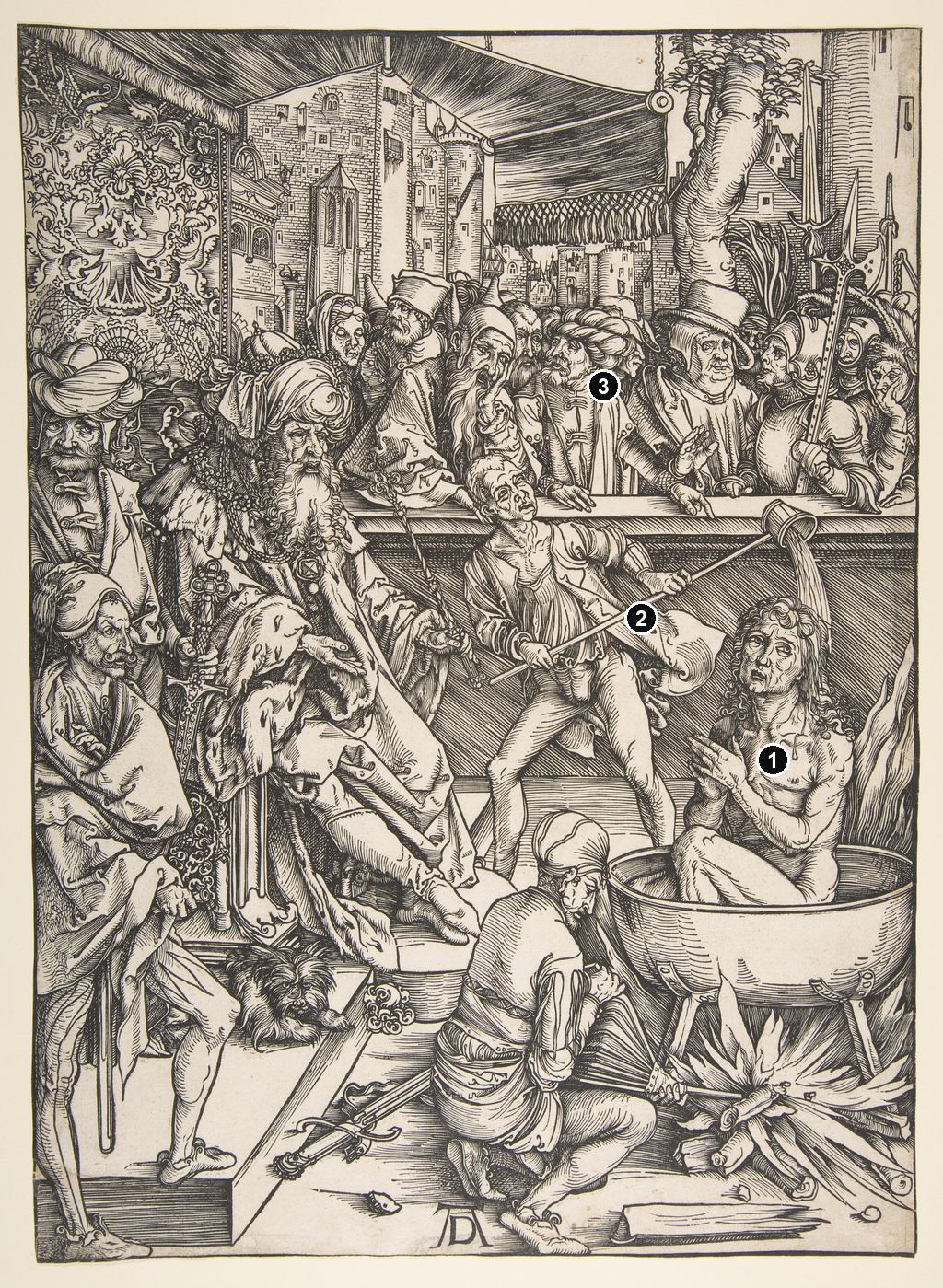
Saint John sits in a cauldron with his hands together, surrounded by people who seem determined to make the fire hotter. One attendant crouches beside the logs; another stands with his legs apart and pours liquid from a long-handled ladle over the saint's head. At the left, a richly dressed ruler watches from a raised seat. Behind a barrier, spectators press forward for a better view. Albrecht Dürer brings this extraordinary ordeal down to the level of a crowded public event, with tools, working bodies and an audience close enough to touch the action. [1]
The woodcut opens the narrative sequence of Dürer's Apocalypse , first published in 1498. Its design belongs to the preceding years: the Städel Museum dates it about 1496–1498, while a recent National Museum of Western Art catalogue proposes about 1496/97. Later impressions can carry a different date in museum catalogues. The Metropolitan Museum of Art's example, accession 19.73.149, is dated 1511, when Dürer issued the book again. That date identifies a printing of an existing image. [1] [2] [3]
At a Glance
- Design dates About 1496–1498; another catalogue gives about 1496/97 [1] [2]
- Process Woodcut [1] [2]
- Series Apocalypse; Met example is a 1511 printing [3]
This work across Albrecht Dürer’s career
The Martyrdom of Saint John (current article)
c. 1496–1498Young Hare
1502Praying Hands
1508Melencolia I
1514Four Apostles
1526Contents
- An ordeal John survives
- Work, authority and spectators
- A city made from lines
- The opening of a printed book
- Frequently Asked Questions
An ordeal John survives
The story comes from the saint's legend. In Jacobus de Voragine's medieval Golden Legend , John is taken to Rome under the emperor Domitian and placed in burning oil. He emerges unharmed and continues preaching; the emperor then sends him into exile on Patmos. The compilation's separate account of John at the Latin Gate locates the ordeal before that Roman gate and explains that Christians commemorated it as though it were the day of his martyrdom. The familiar title therefore names an attempted execution and an act of witness, with miraculous survival at its heart. [14]
The legend also supplies the bridge to the book that follows: in its life of John, he writes the Apocalypse during his island exile. Dürer's opening scene adopts the traditional identification of the apostle and evangelist with the visionary John. That is the devotional framework of the image, rather than proof settling the authorship of the biblical text. [14]
Revelation itself introduces a John who bears witness to what he has seen. In chapter 1, verse 9, he places himself on Patmos because of God's word and the testimony of Jesus; the following verses describe a voice commanding him to write. The cauldron episode supplies a preceding chapter from another kind of religious writing. Read in that sequence, the print introduces the person through whose experience the reader will encounter the visions. [15]
This helps explain the saint's remarkable composure. His body is exposed to the heat, and the stream of oil makes the threat explicit, but his hands retain their prayerful position. His head inclines and his gaze rises. Dürer allows the machinery of punishment to continue around a figure whose attention has moved beyond it. Knowing the legend makes that stillness legible as faith sustained through danger.
Work, authority and spectators
John occupies the lower right of the sheet, inside a round vessel supported above a vigorously burning fire. The cauldron's pale curved side gives the eye a resting place among the crowded folds and faces. It also makes the saint's confinement easy to grasp. His bent legs are contained by its rim, while his upper body rises into the open space above. The fire beneath repeats the upward movement in pointed tongues of flame.
The two attendants create a sequence of actions around him. The crouching man turns towards the fire with a pleated, fanlike implement held near the flames, described as bellows in museum records. His low position brings his head close to the cauldron's edge. Above him, the other man grips the ladle at two separated points, using its length to reach across to John. His broad stance and backward-leaning torso convey the effort of handling it. The oil falls in a narrow stream which the eye can follow from vessel to head. Each action has been made visible at the instant when it contributes to the ordeal. [1] [3]
The emperor occupies an altogether different kind of space. He is seated under a canopy, his feet supported above the ground on which the attendants work. A large patterned hanging rises behind him, and the breadth of his robe expands his figure into the surrounding area. His long beard, heavy sleeves and prominent turban give his head and shoulders exceptional weight. The little dog at his feet adds a sharply observed domestic presence to this ceremonial arrangement. Its small, shaggy body rests close to the ruler while the human body across from him is subjected to punishment.
Objects on the ground connect these zones. A long weapon lies diagonally beside the crouching attendant, and pieces of wood extend towards the lower edge. Dürer's monogram sits near the foreground, within the space occupied by the apparatus of the scene. These details keep the composition from becoming a simple opposition between two isolated principal figures. Authority, labour and the means of inflicting violence share one continuous floor.
The Metropolitan Museum identifies the ruler as Domitian and interprets his dress as that of a Turkish sultan. The image thus dresses an ancient Roman persecutor in a form associated with a much later political and religious world. The turban belongs to that act of representation; it does not establish the figure as a portrait of a named Ottoman ruler. The crowd offers further mixtures of headgear, facial hair, feathered hats and weapons. Such variety makes the event feel socially populated while keeping individual identities open. [3]
Many of the spectators have something to do with their hands. They lean on the barrier, touch their faces, hold weapons or turn towards neighbours. A central bearded man rests his cheek against his hand; nearby, another figure leans forward with both hands supported. At the right, a soldier holds a long weapon upright beside a cluster of faces. These gestures establish different degrees of engagement without providing a fixed moral label for every person. We can see who bends closer and who turns aside, but the woodcut leaves room to wonder what each has understood.
The barrier is essential to this effect. Its strong horizontal edge separates the spectators from the attendants, even where their heads and bodies overlap. It gives the audience a front row and the execution a defined arena. The viewer of the print stands on the exposed side of that division, close to the fire and the ruler's platform. We look at the watchers as well as at John, and their act of looking becomes part of the subject.
Annotated Details from The Martyrdom of Saint John
Follow the joined hands, the pouring vessel and the spectators gathered behind the rail.
Details from THE MARTYRDOM OF SAINT JOHN
Open these details to compare the crowded faces with the long lines of the worker’s tools.
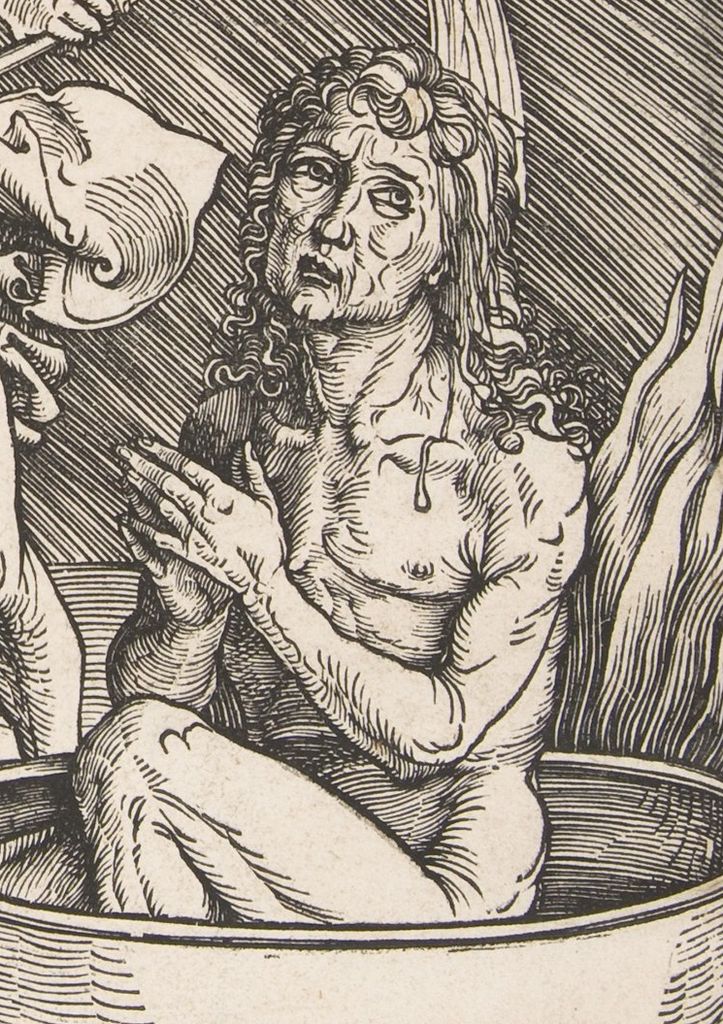
Hands above the rim
The seated figure presses his hands together above the rounded rim. Fine, closely spaced lines shade the hair and torso, while broader curves describe the large vessel.
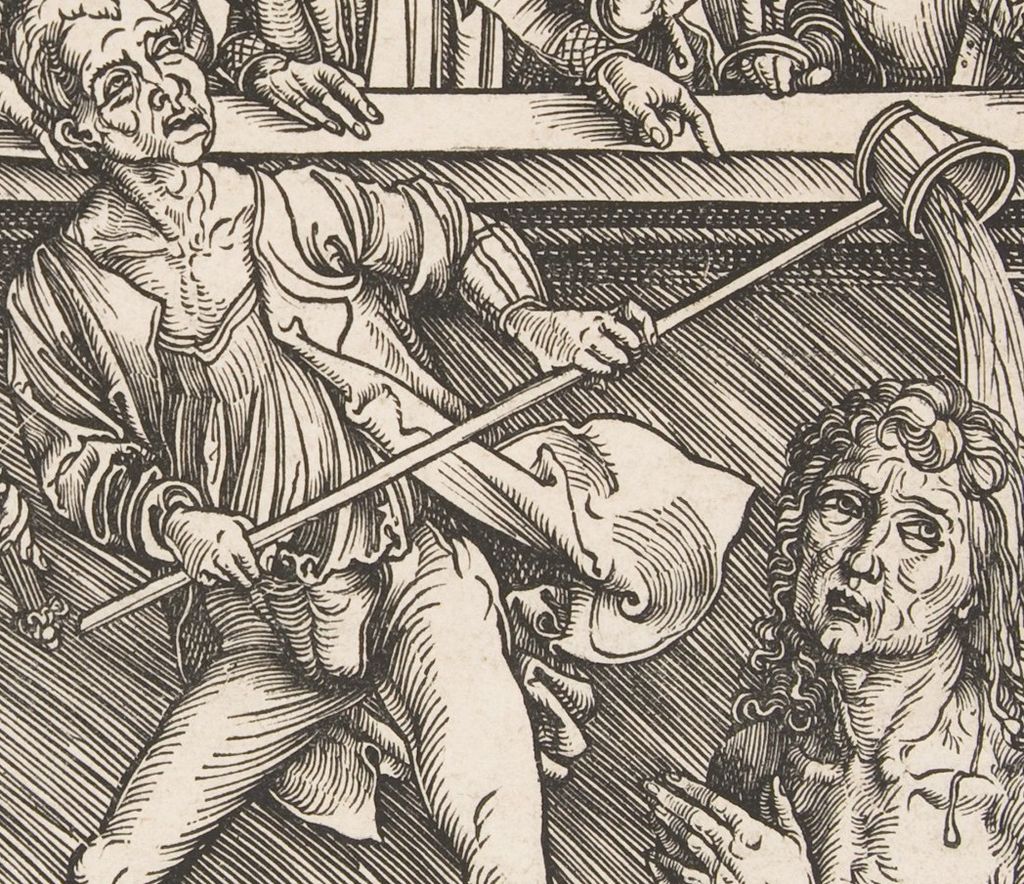
A stream from the ladle
A narrow stream descends from the tilted ladle towards the figure’s head. The long handle cuts diagonally across the worker’s clothes and the space between the two figures.
Faces along the rail
Faces turn in different directions behind the horizontal rail. Beards, hats and folded cloth produce distinct patterns within the tightly packed crowd.
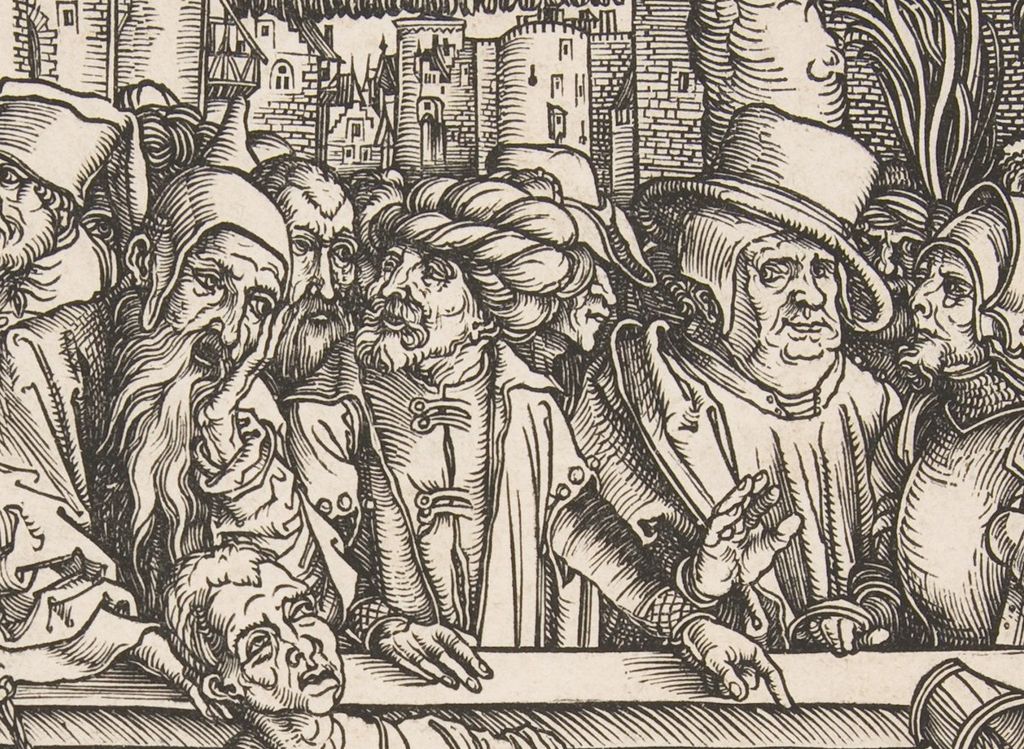
A city made from lines
Above the figures, the architecture opens another layer of space. Tall buildings, narrow windows and steep roofs fill the gap beyond the canopy. A tree rises beside the onlookers at the right, its trunk standing between the dense crowd and the distant buildings. There is enough recession to suggest a city continuing beyond this assembly, but the great cloth overhead holds the foreground together. The canopy's diagonal underside and hanging fringe enclose the group like a temporary ceiling.
The contrast between surfaces rewards looking at a larger reproduction. Short curls describe the dog's coat and the emperor's beard. Repeated shapes accumulate across the ornamental hanging. Long lines establish the underside of the canopy, while tighter hatching darkens the wall behind the attendants. The ladle handle, weapons and tree trunk cut more emphatic directions through this woven field. Dürer gives each object its own rhythm, making a crowded monochrome image surprisingly easy to navigate.
Woodcut produces those black lines by leaving the corresponding parts of a wooden block standing, so that they can receive ink; the surrounding areas are cut away. The Metropolitan Museum's The Print in the North explains this relief process and the continuing uncertainty over Dürer's personal role in cutting his early blocks. Here, the result asks us to notice both the force of a large contour and the delicacy of closely spaced marks. John’s shoulders and the rounded cauldron emerge from the same restricted materials as brocade, timber, flames and flesh. [16]
The saint's relative brightness depends on this distribution of lines. His chest carries enough hatching to turn the body, yet large areas remain open beside the dark barrier. The pale cauldron reinforces that lightness below. There is no need for a separate colour to detach him from the crowd. The arrangement of black and unprinted paper makes the distinction, while the falling oil joins the darker working area to his illuminated head.
Shinfuji Atsushi, writing about the Apocalypse in 2022, relates the series' vigorous gestures to the expressive energy of Italian Renaissance prints. In this opening scene, the ladle bearer provides a particularly clear point of entry into that argument. His stretched limbs and twisting body animate the middle of the picture; the crouching attendant turns that energy down towards the fire. John's close-held arms offer a quieter movement within the same space. [2]
The opening of a printed book
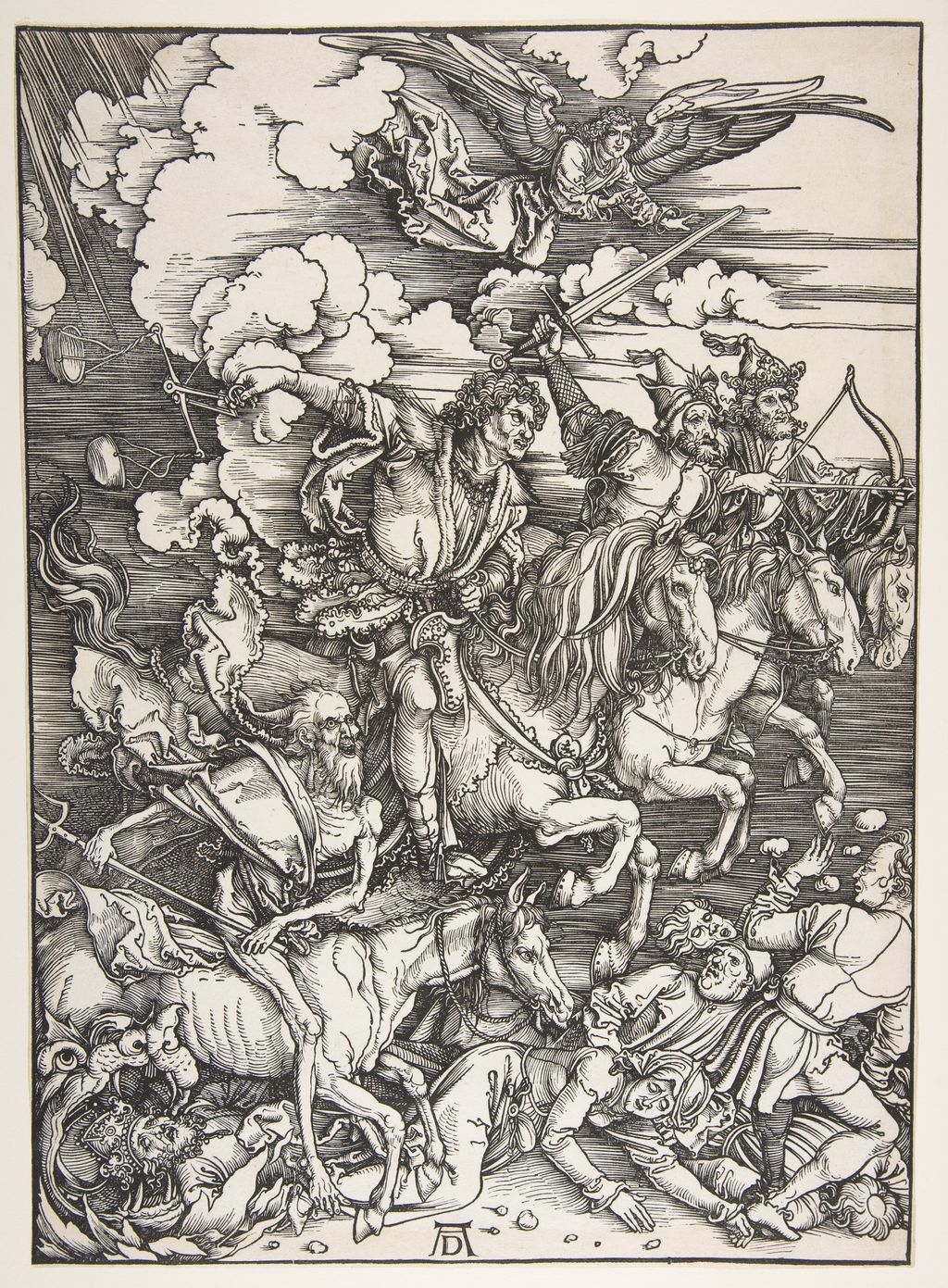
The Martyrdom serves as the prologue to the narrative pictures, with a separate title page preceding it. Fourteen images of Revelation follow it. The 1498 publication appeared with German and Latin texts; the 1511 Latin edition added a new illustrated title showing the Virgin appearing to John. Counting that title produces sixteen woodcuts, while the narrative sequence remains fifteen. The Society of Antiquaries' group of four 1498 prints preserves the beginning in order: the Martyrdom , the Seven Candlesticks , John with the elders in heaven, and the Four Horsemen . [2] [17]
Seeing those neighbours changes the scale of the opening episode. Here the public spectacle remains enclosed by buildings, cloth and a barrier. The following pictures carry John into visions whose reach exceeds that civic setting. The first sheet establishes his endurance before the sequence asks us to follow his sight.
Individual impressions now allow this crowded scene to be examined independently. The Met's 1511 sheet measures 39.1 × 28.3 centimetres and entered the museum as a gift from Junius Spencer Morgan in 1919. A surviving 1511 set in Tokyo offers another material perspective. Shinfuji describes its modern Morocco-leather binding and traces of mounting hinges, while arguing from watermarks and other evidence that the prints may have remained together historically. The single sheet and the gathered volume preserve different experiences of an image designed to lead onwards. [3] [2]
On its own, the woodcut holds attention through the closeness of the ordeal: hands at work, oil in motion, faces waiting behind a wall. Within the Apocalypse , that scrutiny becomes a preparation for everything John will see. The ruler has the raised seat, the canopy and the attendants. John has scarcely any space to move. Yet the prayerful figure in the vessel becomes the person the reader follows out of this crowded enclosure and into the visions.
Frequently Asked Questions
Artworks directory
These 187 records include individual works, reverse sides, detail views, paired panels and reconstructed arrangements. Three additional catalogue images repeat works already listed. Related views are not counted as separate originals; qualified attributions and published dating are retained.
Discussion
Look again at the images and ideas explored in The Martyrdom of Saint John. These editorial prompts invite your observations.
Reader Insights
Which detail or idea in The Martyrdom of Saint John most changed your reading, and why?
How does the discussion of “An ordeal John survives” affect your understanding?
What comparison would you bring to the discussion of “The opening of a printed book”?
Join the Conversation
Share a detail, comparison or question about The Martyrdom of Saint John below.
References
- Städel Museum , Martyrdom of John the Evangelist, from the series of the Apocalypse, original edition German 1498 , inv. 31501 D, current collection record, updated 10 August 2026. Object record and collection image. View source .
- Shinfuji Atsushi , “Albrecht Dürer, Apocalypsis cum figuris”, Annual Bulletin of the National Museum of Western Art , no. 55 (2022), pp. 12–14. Japanese and English; English translation by Martha J. McClintock. View source .
- Metropolitan Museum of Art , The Martyrdom of Saint John, from “The Apocalypse” , 1511, accession 19.73.149, current collection record. View source .
- ALBERTINA, Selbstbildnis als Dreizehnjähriger, inv. 4839 (German). View source.
- Metropolitan Museum, Four Horsemen from The Apocalypse, 19.73.209 (English). View source.
- Bayerische Staatsgemäldesammlungen, Selbstbildnis im Pelzrock, inv. 537 (German). View source.
- ALBERTINA, Feldhase, inv. 3073 (German). View source.
- ALBERTINA, Das große Rasenstück, inv. 3075 (German). View source.
- Metropolitan Museum, Adam and Eve, 19.73.1 (English). View source.
- ALBERTINA, Betende Hände, inv. 3113 (German). View source.
- Metropolitan Museum, Knight, Death, and the Devil, 43.106.2 (English). View source.
- Metropolitan Museum, Melencolia I, 43.106.1 (English). View source.
- Bayerische Staatsgemäldesammlungen, inventory 545: current collection record (German; descriptive citation). View source.
- Jacobus de Voragine , The Golden Legend , translated by William Caxton (1483), edited by F. S. Ellis, Temple Classics (1900): “The Life of S. John the Evangelist,” vol. II, and “The History of S. John, Port Latin,” vol. III, p. 82, historical English text. View source 1 . View source 2 .
- Revelation 1:1–11 , King James Version (1611), especially verses 9–11, historical English translation. View source .
- Suzanne Boorsch and Nadine M. Orenstein , The Print in the North: The Age of Albrecht Dürer and Lucas van Leyden , The Metropolitan Museum of Art Bulletin , 54, no. 4 (Spring 1997), introduction, pp. 3–4, and Samson woodblock entry, p. 25. View source .
- Society of Antiquaries of London , The Martyrdom of St John the Evangelist; St John's Vision of Christ and the Seven Candlesticks; St John and the Twenty-four Elders in Heaven; The Four Horsemen of the Apocalypse , KM255.1b–3a, current collection record. View source .
- Germanisches Nationalmuseum, Barbara Dürer (German and English). View source.
- Web Gallery of Art, Tucher–Rieter reverse (English). View source.
- National Gallery of Art, Portrait of a Clergyman (English). View source.
- Dürer Art, Portrait of a Man (English). View source.
- Hessen Kassel Heritage, Elsbeth Tucher (German). View source.
- Web Gallery of Art, Hans Tucher (English). View source.
- Germanisches Nationalmuseum, Emperor Maximilian I (German and English). View source.
- National Gallery of Art, Lot and His Daughters, reverse (English). View source.
- Bayerische Staatsgemäldesammlungen, Glim Lamentation (German). View source.
- Museo Nacional del Prado, Portrait of a Man (Spanish). View source.
- Bayerische Staatsgemäldesammlungen, Madonna of the Carnation (German). View source.
- Städel Museum, Job on the Dungheap (German). View source.
- Wallraf-Richartz-Museum, Piper and Drummer (German). View source.
- Italian Ministry of Culture / Uffizi, Head of Saint James (Italian). View source.
- Klassik Stiftung Weimar, Dresden Altarpiece (German). View source.
- Staatliche Museen zu Berlin, Girl with a Red Beret (German and English). View source.
- Dresden State Art Museums / Roland Enke, Bernhard von Reesen (German). View source.
- Royal Collection Trust, Burkhard von Speyer (English). View source.
- Dresden State Art Museums, Seven Sorrows of the Virgin (English). View source.
- Bayerische Staatsgemäldesammlungen, Mater Dolorosa (German). View source.
- Bayerische Staatsgemäldesammlungen, Lucretia (German). View source.
- Städel Museum, Young Woman with Her Hair Down (English). View source.
- ALBERTINA, Portrait of a Young Man (German). View source.