 by
Tom Gurney
Tom Gurney BSc (Hons) is an art history expert with over 20 years experience
Published on June 19, 2020 / Updated on October 22, 2026
Email:
tomgurney1@gmail.com
/ Phone:
+44 7429 011000
Knight on Horseback by Albrecht Dürer: Introduction
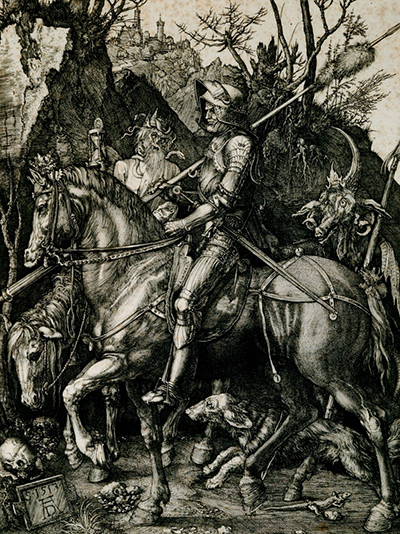
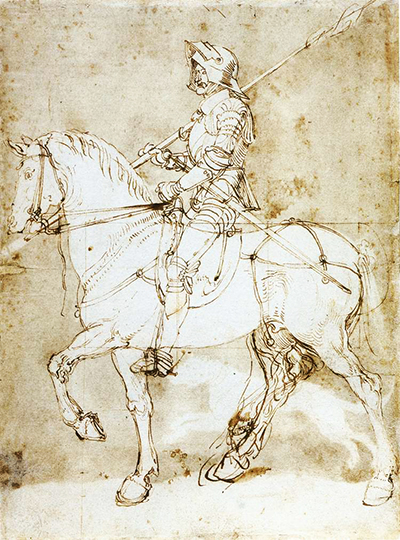
A horse lifts its foreleg while its armoured rider looks steadily ahead. His lance rises over his shoulder towards the upper corner, and a long sword makes a second diagonal across the horse's flank. The arrangement already has much of the authority of Albrecht Dürer's Knight, Death and the Devil , the engraving dated 1513. Here, however, the rider travels through an almost empty sheet. Without the threatening companions and rocky landscape of the print, the construction of horse and man becomes the subject of attention.
This Knight on Horseback is a drawing in the Biblioteca Ambrosiana, Milan, catalogued as the front of sheet F 264 inf. n. 25. The Ambrosiana's inventory-catalogue, prepared in cooperation with the University of Notre Dame, identifies it as a preparatory study for the engraving. It records pen and brown ink over black chalk, with squaring, on white paper measuring 246 × 185 millimetres. Another version occupies the reverse. The sheet lets us follow a design while its balance, movement and eventual appearance were still being worked out. [1]
At a Glance
- Materials Pen and brown ink over black chalk, with squaring [1]
- Collection Biblioteca Ambrosiana, Milan; F 264 inf. n. 25 recto [1]
This work across Albrecht Dürer’s career
Knight on Horseback (current article)
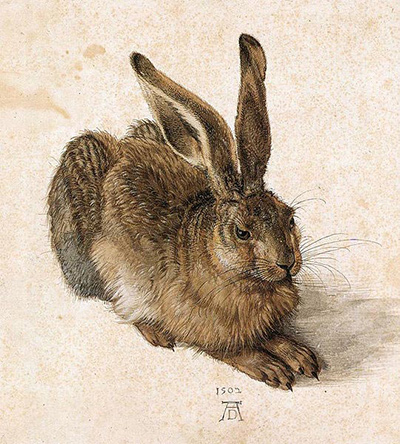
Date not securely establishedYoung Hare
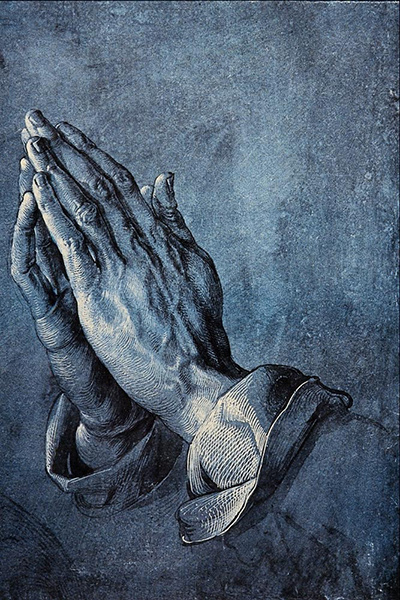
1502Praying Hands
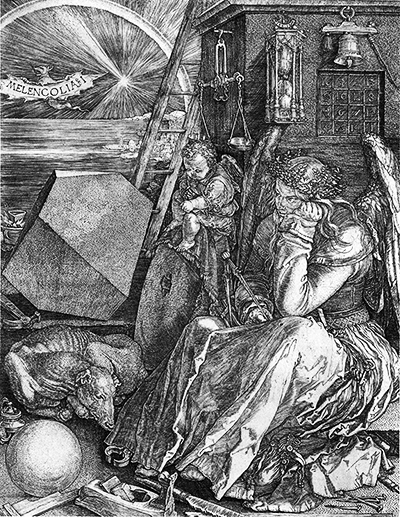
1508Melencolia I
1514Four Apostles
1526Contents
- Armour in motion
- A horse being worked out
- The other side of the paper
- An earlier rider in Vienna
- From a study to the engraving
- Frequently Asked Questions
Armour in motion
The rider's silhouette is compact. His upright back and firmly placed thigh hold the centre of the drawing, while his lower leg extends almost vertically towards the stirrup. The raised visor leaves his face visible. Above it, the helmet projects into a sharp peak; behind the neck, its lower edge points backwards. These angular shapes prepare the eye for the succession of ridges, overlapping plates and projecting edges below.
The armour is especially legible around the shoulder and elbow. Small scalloped forms spread over the upper arm, then give way to larger curved defences. At the knee, the artist interrupts the long line of the leg with a round joint and a pointed projection. Following these connections makes the armour seem capable of bending. The enclosing metal retains a sense of the body inside it.
Such details belong to the late Gothic vocabulary of armour. Surviving German or Austrian elements of about 1480–90 in the Metropolitan Museum of Art show overlapping sections and channelled surfaces; the museum explains that some fluting imitates gathered fabric. That comparison helps make sense of Dürer's combination of hard edges and almost pleated rhythms. The shoulder plates look elaborately folded, although they enclose and protect an arm. [12]
The reins add a different kind of tension. Thin, nearly horizontal lines connect the rider's low hand with the horse's mouth, cutting across the flowing mane and rounded neck. The other hand supports the lance. Between them, the hands quietly organise the composition: one gathers the lines of control, the other carries the long diagonal. The rider's authority is built through the relationship between these small gestures and the animal's much greater bulk.
A horse being worked out
The horse's body occupies most of the width. Its arched neck rises in front of the rider, its belly forms a broad curve below him, and its rounded hindquarters support the descending sword. Short, repeated pen marks turn around the upper hind leg and rump. They give selected parts volume while leaving much of the body comparatively open. The drawing has no need to describe every hair to make the animal feel substantial.
Movement becomes most complicated below the belly. One foreleg bends sharply and lifts its hoof clear of the ground; the other provides a long, relatively straight support. Behind them, several overlapping outlines gather around a hind hoof. These competing contours are among the sheet's most revealing features. They preserve alternatives within the image, so the viewer can see that the placement of a foot remained a problem even after much of the rider had been settled.
Faint straight lines cross the horse. The inventory's identification of squaring is useful here: beneath the armour, harness and anatomical curves lies a framework for comparing positions and dimensions. The straight lines and lively contour belong to the same process. The grid makes relationships available for checking; the pen tests how those relationships will look as an animal carrying a man. [1]
Dürer's own proposed writing on art gives this interest a wider setting. In a surviving outline for a book, he listed the proportions of a horse alongside those of children, men and women, followed by architecture, light, colour and composition. The plan survives in the manuscript material transcribed by Lina Eckenstein and published in William Martin Conway's Literary Remains of Albrecht Dürer in 1889. Horses belonged within his attempt to make artistic knowledge teachable. The framework on this sheet therefore has a practical connection with a larger intellectual ambition. [13]
The projected horse treatise was never completed. Writing after the artist's death, Joachim Camerarius said that Dürer had begun making measurements but had left no finished book on the subject. His account helps explain why the careful ordering of this animal mattered beyond the immediate task of filling a print. [14]
The other side of the paper
Turning the sheet changes both direction and effect. On the reverse, the horse and rider face right, accompanied by a running dog. The catalogue records pen, brush and brown ink. A broad dark field surrounds the pale figures. Where the front allows the eye to wander into vacant paper, the reverse presses the horse's outline against darkness. [15]
The experiment is particularly effective around the animal's head, the rider's helmet and the lance. Each emerges as a light shape against the ground. Dark spaces between the legs help separate their movements, and the dog fills part of the area beneath the horse. Its lower, stretched body introduces another rhythm below the mounted man. These are decisions about how a group will read at a glance as well as about individual details.
The two sides also caution against treating preparation as a single tidy stage. The front preserves the measured, revised structure; the reverse explores the group's direction and its contrast with a dark setting. A sketch can isolate one question while another version pursues a different one. Their relationship makes the sheet more informative than either side seen alone.
An earlier rider in Vienna
Dürer had already made a carefully coloured drawing of an armoured horseman in 1498. That larger sheet, now in the Albertina, Vienna, is a separate work: the horse stands with its hooves down, and an inscription above records the armour then worn in Germany. The Albertina suggests that the inscription may have been added when Dürer returned to the design around 1513; that timing remains a hypothesis. [16]
Technical examination adds a useful distinction. The Germanisches Nationalmuseum's ink project found carbon ink in the date and monogram, iron gall ink in the horse's mane, and a different iron gall ink in the upper inscription. These differences identify materials; they do not supply a calendar date for the added words. The Vienna drawing records equipment with remarkable particularity, while the Ambrosiana sheet shows horse and rider undergoing a further process of construction. [17]
The family resemblance is easy to see in the open helmet, shoulder defences, lance and sword. The earlier example offers a store of observed forms that could be reconsidered years later. The Royal Collection's armour commentary explicitly identifies the 1498 drawing among the sources used fifteen years afterwards for Knight, Death and the Devil . The Ambrosiana study belongs closer to the making of that print, with its moving horse and visible adjustments. [18]
From a study to the engraving
In the finished engraving, the horse and rider again face left. The lance and sword retain their strong crossing diagonals, but the animal's surface becomes densely modelled. Light travels over its neck and flank, and the armour shines amid the darker passage. Death approaches on a second horse, a strange creature follows behind, and rocks, roots and branches enclose the group. [19]
Against that crowding, the main horse remains unusually clear. Looking back at the study shows how much of this clarity depends on the underlying profile: the sweep of the neck, the broad body and the carefully separated limbs. The dark-ground experiment on the reverse makes the eventual contrast between illuminated figures and shadowed surroundings especially interesting. The sheet opens up this part of the print's development while leaving the surrounding scene to be explored elsewhere.
Even the apparent corrections have attracted different readings. In 1905 Heinrich Wölfflin discussed the Milan drawing's alternative hind-leg positions and questioned its attribution to Dürer. His judgment belongs to the history of scholarship: the Ambrosiana's partner catalogue now lists both sides under Dürer's name. The disagreement is a reminder that working marks require interpretation. A cluster of outlines can be observed directly; determining their sequence or another hand's involvement needs further evidence. [20] [1]
The catalogue records the sheet's provenance as Federico Fagnani, 1841. Its survival preserves a particularly absorbing encounter between discipline and adjustment. The grid is still present, the rider is already composed, and the hoof remains unsettled. Before landscape and allegorical figures surround him, this knight gives us access to the decisions that make a horse and rider convincing together. [1]
Frequently Asked Questions
Artworks directory
These 187 records include individual works, reverse sides, detail views, paired panels and reconstructed arrangements. Three additional catalogue images repeat works already listed. Related views are not counted as separate originals; qualified attributions and published dating are retained.
Discussion
Look again at the images and ideas explored in Knight on Horseback by Albrecht Dürer. These editorial prompts invite your observations.
Reader Insights
Which detail or idea in Knight on Horseback by Albrecht Dürer most changed your reading, and why?
How does the discussion of “Armour in motion” affect your understanding?
What comparison would you bring to the discussion of “From a study to the engraving”?
Join the Conversation
Share a detail, comparison or question about Knight on Horseback by Albrecht Dürer below.
References
- Robert Randolf Coleman , Inventory-Catalog of the Drawings in the Biblioteca Ambrosiana , University of Notre Dame in cooperation with the Biblioteca Ambrosiana, “Knight on Horseback, Facing Left,” ND 804, F 264 inf. n. 25 recto. View source .
- ALBERTINA, Selbstbildnis als Dreizehnjähriger, inv. 4839 (German). View source.
- Metropolitan Museum, Four Horsemen from The Apocalypse, 19.73.209 (English). View source.
- Bayerische Staatsgemäldesammlungen, Selbstbildnis im Pelzrock, inv. 537 (German). View source.
- ALBERTINA, Feldhase, inv. 3073 (German). View source.
- ALBERTINA, Das große Rasenstück, inv. 3075 (German). View source.
- Metropolitan Museum, Adam and Eve, 19.73.1 (English). View source.
- ALBERTINA, Betende Hände, inv. 3113 (German). View source.
- Metropolitan Museum, Knight, Death, and the Devil, 43.106.2 (English). View source.
- Metropolitan Museum, Melencolia I, 43.106.1 (English). View source.
- Bayerische Staatsgemäldesammlungen, inventory 545: current collection record (German; descriptive citation). View source.
- Metropolitan Museum of Art , Elements of an Armor , German or Austrian, about 1480–90, 26.92.2a–g. View source .
- Albrecht Dürer , proposed contents of a book on art, in William Martin Conway, Literary Remains of Albrecht Dürer , with manuscript transcripts and notes by Lina Eckenstein (Cambridge University Press, 1889), p. 170. English translation of German primary text. View source .
- Joachim Camerarius , preface to his Latin translation of Dürer's books on human proportion, in Conway, Literary Remains , p. 140. English translation of Latin primary text. View source .
- Coleman , Inventory-Catalog , “Knight on Horseback, Facing Right, with a Dog,” ND 805, F 264 inf. n. 25 verso. View source .
- Albertina , Der Reiter , 1498, inv. 3067, including catalogue texts by Matthias Mende (2003) and Christof Metzger (2012). In German. View source .
- Germanisches Nationalmuseum , Dürer Tintenanalyse project, “Reiter, Wien Alb, Nr. 3067,” version of 7 March 2013. German and English technical conclusions. View source .
- Royal Collection Trust , “A Knight, Death and the Devil,” RCIN 800104, European Armour in the Royal Collection . View source .
- Albertina , Ritter, Tod und Teufel , 1513, DG1930/1550. In German. View source .
- Heinrich Wölfflin , Die Kunst Albrecht Dürers (Munich: F. Bruckmann, 1905), “Die Meisterstiche und Verwandtes,” pp. 186–191. In German. View source .
- Germanisches Nationalmuseum, Barbara Dürer (German and English). View source.
- Web Gallery of Art, Tucher–Rieter reverse (English). View source.
- National Gallery of Art, Portrait of a Clergyman (English). View source.
- Dürer Art, Portrait of a Man (English). View source.
- Hessen Kassel Heritage, Elsbeth Tucher (German). View source.
- Web Gallery of Art, Hans Tucher (English). View source.
- Germanisches Nationalmuseum, Emperor Maximilian I (German and English). View source.
- National Gallery of Art, Lot and His Daughters, reverse (English). View source.
- Bayerische Staatsgemäldesammlungen, Glim Lamentation (German). View source.
- Museo Nacional del Prado, Portrait of a Man (Spanish). View source.
- Bayerische Staatsgemäldesammlungen, Madonna of the Carnation (German). View source.
- Städel Museum, Job on the Dungheap (German). View source.
- Wallraf-Richartz-Museum, Piper and Drummer (German). View source.
- Italian Ministry of Culture / Uffizi, Head of Saint James (Italian). View source.
- Klassik Stiftung Weimar, Dresden Altarpiece (German). View source.
- Staatliche Museen zu Berlin, Girl with a Red Beret (German and English). View source.
- Dresden State Art Museums / Roland Enke, Bernhard von Reesen (German). View source.
- Royal Collection Trust, Burkhard von Speyer (English). View source.
- Dresden State Art Museums, Seven Sorrows of the Virgin (English). View source.
- Bayerische Staatsgemäldesammlungen, Mater Dolorosa (German). View source.
- Bayerische Staatsgemäldesammlungen, Lucretia (German). View source.
- Städel Museum, Young Woman with Her Hair Down (English). View source.
- ALBERTINA, Portrait of a Young Man (German). View source.