 by
Tom Gurney
Tom Gurney BSc (Hons) is an art history expert with over 20 years experience
Published on June 19, 2020 / Updated on October 22, 2026
Email:
tomgurney1@gmail.com
/ Phone:
+44 7429 011000
Christ on the Mount of Olives (Large Passion): Introduction
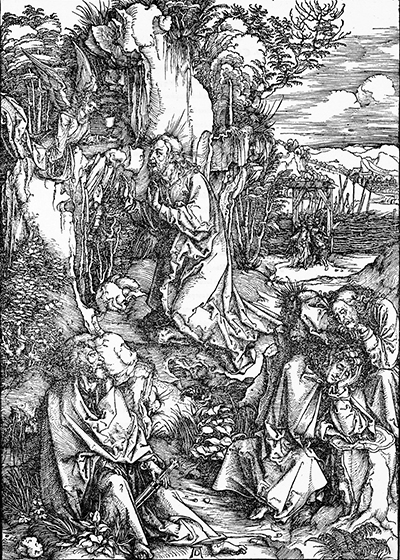
Christ prays alone in the middle of a crowded landscape. Below him, three disciples have sunk into sleep; behind him, armed men are already approaching. Albrecht Dürer's Christ on the Mount of Olives , also called Agony in the Garden , makes these different states of awareness visible within a single upright image. Christ's lifted hands answer the angel who appears at the upper left, while the sleepers' hands support heads and exhausted bodies. Designed around 1496–97, this woodcut belongs to the early group of images subsequently brought together in the Large Passion of 1511. Its catalogue numbers, Bartsch 6 and Meder 115, distinguish it from Dürer's other treatments of the subject. [1]
The setting is Gethsemane, where Jesus prays before his arrest. In Matthew's account, he takes Peter and the two sons of Zebedee away from the other disciples and asks them to keep watch. He then withdraws farther, praying that the cup of suffering might pass from him, while submitting to his Father's will. Three times he prays; repeatedly he finds his companions asleep. The episode brings fear, obedience and human exhaustion into immediate contact. Dürer gives each a different physical expression, allowing the viewer to understand the situation before identifying every figure. [2]
At a Glance
This work across Albrecht Dürer’s career
Young Hare
1502Praying Hands
1508Melencolia I
1514Four Apostles
1526Contents
- Prayer above sleeping bodies
- The arrest already on its way
- Making light with a woodblock
- An early design in a later book
- Frequently Asked Questions
Prayer above sleeping bodies
Christ kneels on uneven ground, his body turned towards the left and his head lifted. The open hands make the prayer feel unresolved and urgent. His robe falls in angular folds from the waist and spreads across the ledge beneath him, anchoring a figure whose attention is directed upwards. Behind his head rises a pale wall of rock. Its broad exposed surface helps separate his face and hands from the surrounding tangle of vegetation. The figure remains distinct even where the landscape appears almost overgrown with marks.
The angel occupies a small opening beside the rock. Its cup gives tangible form to the suffering named in the prayer. Luke's account supplies another element: an angel comes from heaven to strengthen Christ during his agony. Luke also describes the disciples as sleeping from sorrow. The image draws these narrative possibilities together. The cup makes the coming ordeal visible, while the angel gives the prayer a visible answering presence. We see the gesture and the object, but the decision they represent remains inward. [13]
That inward concentration is surrounded by bodies yielding to their own weight. At the lower left Peter sits with his head tilted back and his sword held across the space before him. On the right the other two disciples form an interlocking group of bowed heads, bent limbs and gathered cloth. Te Papa's interpretation identifies them as John and James and reads Peter as beginning to wake. His raised face introduces a different angle into the group, although his heavy posture still belongs to its general exhaustion. Dürer gives sleep several shapes rather than repeating one emblematic bowed head. [14]
The folds make this contrast particularly clear. Christ's robe draws the eye down through a succession of sharp turns; the foreground drapery spreads into broad, occupied masses. The sleepers seem settled into hollows in the ground, while Christ holds himself upright. They are physically near enough to help him, yet their attention has withdrawn. The gaps between them acquire emotional weight: no disciple meets Christ's gaze, and no human hand reaches towards his lifted hands. The large foreground figures bring this failure of companionship close to the viewer.
Peter's sword adds a more troubled kind of readiness. It is present and available while its owner can barely remain alert. In the Gospel narrative, the arrest will bring a violent response from one of Christ's companions, followed by Christ's command to put the weapon away. Within this image the sword stays still. Its conspicuous diagonal belongs to a man who has failed at the less spectacular task of watching. The viewer can recognise the approaching danger before the disciples respond to it. [2]
The arrest already on its way
At the right, beyond Christ, a fence and gateway open towards a small procession of armed men. Spears rise above their heads. The Museumsquartier Osnabrück identifies their leader as Judas, carrying a purse and directing the party. The figures are small and compressed, but their gathering movement is legible. The vertical weapons make an emphatic pattern against the more open distance. A narrow route connects this activity with the secluded place of prayer. [15]
The scene consequently contains more than one tempo. The disciples' sleep seems to suspend time. Christ's prayer concentrates it into an urgent present. The approaching party promises that the interval will end. Matthew moves directly from the final summons to rise into Judas's arrival with an armed crowd. Dürer allows the crowd to enter the landscape while the prayer continues, drawing the next event into the background of the current one. The result is a suspense that depends on looking across the whole sheet, from the nearest sleeping face to the distant spearheads. [2]
The landscape sustains that suspense. Rock faces and tree trunks rise steeply around Christ, while branches reach across the upper field. Below, leaves, roots and broken ground crowd the spaces between the figures. On the right, a banded sky and distant buildings offer a partial opening, yet the fence and armed group occupy the route towards it. The garden provides shelter without security. Its irregular barriers separate the people in the image, but cannot prevent the intrusion already under way.
This is also how Dürer avoids making a quiet prayer into a static arrangement. Curving foliage, fractured stone and sharply changing folds keep the surface active. The eye moves through many small incidents while returning to the comparatively clear face and raised hands. The night of the biblical story is suggested within a print that still makes bodies and ground readily visible. Dark passages under plants and around the sleepers deepen the enclosure; pale rock, cloth and sky keep the action readable.
Making light with a woodblock
The variety of surfaces comes from a single printing colour working against an unprinted support. In a woodcut, material is removed around the lines that will carry ink, leaving those printable lines standing in relief. This differs from engraving, where ink is held in incisions in a metal plate. The distinction helps explain the extraordinary demands of this design: small curls of foliage, thin strokes across cloth and compact groups of parallel marks all have to survive as printable elements. [16]
Look at how differently those marks behave. Short, broken strokes roughen the stones. Repeated curves give foliage a restless, springing rhythm. Longer lines follow the direction of a fold and then gather more closely where the fabric turns into shade. A white interval can become a ridge of cloth, an exposed cheek or a lit face of rock according to the black shapes around it. Dürer does not require a separate grey ink to establish intermediate tones; the density and spacing of lines create them for the eye.
The pale areas also prevent the image from closing into an undifferentiated thicket. Christ's sleeve and skirt, Peter's face and the bright folds at the lower right form a loose chain of openings through the darker work. They allow attention to travel between the prayer and the sleepers even when the minute detail is hard to resolve. At a distance the composition can be read as a few bodily masses and gestures. Closer inspection breaks those masses into an intricate network of marks, each helping to describe material, light or direction.
An early design in a later book
The woodcut's history adds another layer to its position between events. Seven of the Large Passion designs were made during the years around 1496–1500. Four further narrative woodcuts followed in 1510, and a title page completed the publication. The cycle issued in Nuremberg in 1511 contains eleven narrative images and that title page. The date of the book therefore records the assembly of a sequence developed over years. [17]
Sabine Siemer observes that the early group begins with the prayer on the Mount of Olives and ends with the Entombment, concentrating on Christ's suffering and death. The later additions extend that range. For this particular image, the change is easy to grasp: in the completed book the Last Supper precedes it, and the Betrayal of Christ follows. What had stood at the beginning of the early group becomes a passage from the shared meal to the arrest. Its background procession already carries the eye towards that next scene. [18] [17]
Individual impressions continued to give the design different material lives. The Pushkin Museum records its sheet Г-2378 as an impression of the 1511 Latin edition, with text on the reverse. Its Г-2379 has no text and is dated to the 1570s with the aid of a paper watermark; a further late impression, Г-5342, is printed on silk. These are separate surviving objects made from the same design. The silk example is especially striking because a composition so familiar through paper could also be transferred to a textile support. Its intended use is not established by the brief catalogue description. [1]
Scale also belongs to the physical print. Houston's 1511 Latin-edition impression has a block measurement of 39.1 by 27.7 centimetres and a larger sheet measuring 45.2 by 30.5 centimetres. The surrounding paper was part of the object a reader handled. At that scale, the large bodies in front and the tiny arriving figures can reward different kinds of attention. The image holds the viewer between them: close to the companions who cannot keep watch, yet able to see the danger they have not noticed. [19]
Frequently Asked Questions
Artworks directory
These 187 records include individual works, reverse sides, detail views, paired panels and reconstructed arrangements. Three additional catalogue images repeat works already listed. Related views are not counted as separate originals; qualified attributions and published dating are retained.
Discussion
Look again at the images and ideas explored in Christ on the Mount of Olives (Large Passion). These editorial prompts invite your observations.
Reader Insights
Which detail or idea in Christ on the Mount of Olives (Large Passion) most changed your reading, and why?
How does the discussion of “Prayer above sleeping bodies” affect your understanding?
What comparison would you bring to the discussion of “An early design in a later book”?
Join the Conversation
Share a detail, comparison or question about Christ on the Mount of Olives (Large Passion) below.
References
- Pushkin State Museum of Fine Arts , “Agony in the Garden,” circa 1496–1497, Bartsch 6, Meder 115; impressions Г-2378, Г-2379 and Г-5342. English. View source .
- Gospel according to Matthew , 26:36–56, King James Version. English primary translation, 1611. View source .
- ALBERTINA, Selbstbildnis als Dreizehnjähriger, inv. 4839 (German). View source.
- Metropolitan Museum, Four Horsemen from The Apocalypse, 19.73.209 (English). View source.
- Bayerische Staatsgemäldesammlungen, Selbstbildnis im Pelzrock, inv. 537 (German). View source.
- ALBERTINA, Feldhase, inv. 3073 (German). View source.
- ALBERTINA, Das große Rasenstück, inv. 3075 (German). View source.
- Metropolitan Museum, Adam and Eve, 19.73.1 (English). View source.
- ALBERTINA, Betende Hände, inv. 3113 (German). View source.
- Metropolitan Museum, Knight, Death, and the Devil, 43.106.2 (English). View source.
- Metropolitan Museum, Melencolia I, 43.106.1 (English). View source.
- Bayerische Staatsgemäldesammlungen, inventory 545: current collection record (German; descriptive citation). View source.
- Gospel according to Luke , 22:39–46, King James Version. English primary translation, 1611. View source .
- Museum of New Zealand Te Papa Tongarewa , “Christ on the Mount of Olives. From: The large Passion,” 1869-0001-131. English. View source .
- Museumsquartier Osnabrück , “Christus am Ölberg,” L 153/12-3. German. View source .
- Suzanne Boorsch and Nadine M. Orenstein , The Print in the North: The Age of Albrecht Dürer and Lucas van Leyden , The Metropolitan Museum of Art Bulletin 54, no. 4 (Spring 1997), pp. 3–4. English. View source .
- Pushkin State Museum of Fine Arts , “The Large Passion,” series introduction and sequence. English. View source .
- Sabine Siemer , Die Passionsdarstellungen von Albrecht Dürer: Theologie und Rezeptionsästhetik (Heidelberg: arthistoricum.net, 2023), section 2.3.1, p. 34. German. View source .
- Museum of Fine Arts , Houston, “Christ on the Mount of Olives,” 39.93, circa 1496–1497; Latin edition published 1511. English. View source .
- Germanisches Nationalmuseum, Barbara Dürer (German and English). View source.
- Web Gallery of Art, Tucher–Rieter reverse (English). View source.
- National Gallery of Art, Portrait of a Clergyman (English). View source.
- Dürer Art, Portrait of a Man (English). View source.
- Hessen Kassel Heritage, Elsbeth Tucher (German). View source.
- Web Gallery of Art, Hans Tucher (English). View source.
- Germanisches Nationalmuseum, Emperor Maximilian I (German and English). View source.
- National Gallery of Art, Lot and His Daughters, reverse (English). View source.
- Bayerische Staatsgemäldesammlungen, Glim Lamentation (German). View source.
- Museo Nacional del Prado, Portrait of a Man (Spanish). View source.
- Bayerische Staatsgemäldesammlungen, Madonna of the Carnation (German). View source.
- Städel Museum, Job on the Dungheap (German). View source.
- Wallraf-Richartz-Museum, Piper and Drummer (German). View source.
- Italian Ministry of Culture / Uffizi, Head of Saint James (Italian). View source.
- Klassik Stiftung Weimar, Dresden Altarpiece (German). View source.
- Staatliche Museen zu Berlin, Girl with a Red Beret (German and English). View source.
- Dresden State Art Museums / Roland Enke, Bernhard von Reesen (German). View source.
- Royal Collection Trust, Burkhard von Speyer (English). View source.
- Dresden State Art Museums, Seven Sorrows of the Virgin (English). View source.
- Bayerische Staatsgemäldesammlungen, Mater Dolorosa (German). View source.
- Bayerische Staatsgemäldesammlungen, Lucretia (German). View source.
- Städel Museum, Young Woman with Her Hair Down (English). View source.
- ALBERTINA, Portrait of a Young Man (German). View source.