by
Tom Gurney
Tom Gurney BSc (Hons) is an art history expert with over 20 years experience
Published on June 19, 2020 / Updated on October 22, 2026
Email:
tomgurney1@gmail.com
/ Phone:
+44 7429 011000
Adam and Eve: Dürer’s Engraving of 1504: Introduction
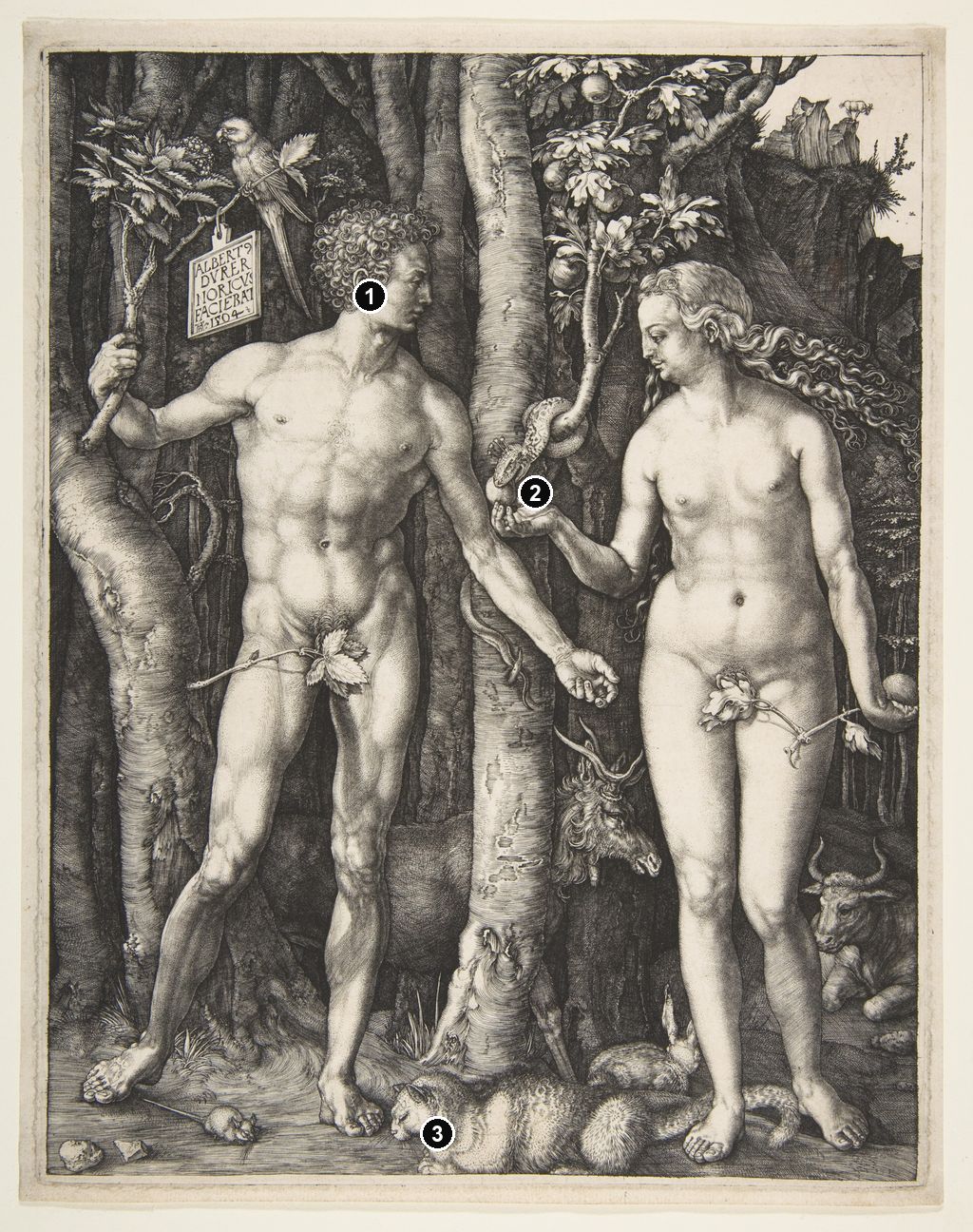
A serpent offers fruit between two pale, motionless figures. Adam extends his empty palm towards Eve, while she receives fruit from above and holds another piece behind her. Between their bodies, a tree rises like a third participant. The exchange is small, but its consequences give this still forest its extraordinary tension.
Dürer dated this engraving 1504. The Metropolitan Museum’s impression 19.73.1 has current listed dimensions of 25.1 × 20 centimetres; its 1997 catalogue specifies a 24.9 × 19.5 centimetre plate and calls this impression fourth state of five. [5]
The picture asks to be approached slowly. Its pale figures register first; the dark spaces around them take longer to disclose their inhabitants. An animal’s face appears below Eve’s wrist, another between her legs and the right edge. Above, a bird sits near a conspicuously lettered tablet. The image never becomes a simple division between two important people and an incidental background: the surrounding life continually interrupts that first impression.
At a Glance
This work across Albrecht Dürer’s career
Young Hare
1502Praying Hands
1508Melencolia I
1514Four Apostles
1526Contents
- Temptation through hands and eyes
- The problem of a beautiful body
- Figures assembled, hands reconsidered
- Cutting darkness and leaving light
- Seeing the plate before it was finished
- The creatures around the couple
- The maker’s name inside Eden
- Frequently Asked Questions
Temptation through hands and eyes
Adam faces towards Eve, whose attention turns to the serpent. His lowered arm carries the eye diagonally into the central gap; her bent arm answers it from the other side. Their fingers remain separate. Above them, the serpent curls down from its branch, bringing its head close to her raised hand. Farther right, the fruit in Eve’s other hand almost touches the border. Dürer distributes the action across the width of the picture, from Adam’s outward grip on a branch to Eve’s backward-reaching hand.
The biblical sequence gives those gestures their stakes. Genesis describes a garden containing both the Tree of Life and the Tree of Knowledge of Good and Evil. The prohibition concerns the latter. In chapter 3, the serpent contradicts the threatened death and promises opened eyes; the woman eats and gives fruit to her husband. Awareness of nakedness, concealment, judgment and expulsion follow. Dürer concentrates the encounter around the offered fruit, allowing the viewer’s knowledge of what follows to press upon a scene that contains no visible punishment. [11]
Genesis does not name the forbidden fruit as an apple. It does name fig leaves when the couple make coverings after eating. In the engraving, leafy branches already screen their bodies while their faces remain composed. Image and text therefore need not be aligned as if the print illustrated a single second with documentary precision. The leaves make the bodies presentable to the viewer; the serpent and reaching hands keep the temptation active. Several aspects of the story occupy the same poised encounter. [11]
The setting heightens this suspension. Trunks press up behind the bodies, leaving little open ground around their feet. At the upper right, however, a small wedge of distant space opens around a rocky summit. The contrast is striking: the foreground is crowded and sheltered, while that remote ledge seems exposed. The eye can escape the woodland only through this narrow opening, before returning to the larger human forms below.
The problem of a beautiful body
Both figures stand with one leg carrying their weight and the other relaxed, the arrangement called contrapposto. Adam’s bent leg opens outwards; Eve’s turns towards the centre. The tilt of each pelvis meets a different movement in the shoulders. Their poses correspond without becoming identical. In Adam, the divisions of chest and abdomen are emphatic; in Eve, the long illuminated surfaces change more gradually. The pair make comparison possible while retaining different physical characters.
The classical comparison has a long critical history. In his 1897 catalogue, S. R. Koehler discussed Adam’s relationship to the Apollo Belvedere and reproduced a sequence of related figures. He also considered the possibility that Italian works mediated the antique model. The ALBERTINA retains the Apollo-type comparison but says no exact Venus prototype for Eve has been established. A resemblance can be convincing without supplying a documented journey from a particular statue to this copperplate. [1] [12]
Proportion had occupied Dürer before this engraving. Freyda Spira’s discussion of Fortuna in a Niche , dated 1498, places that drawing within his early investigation of the female nude and geometrical construction. The earlier sheet matters here because it makes the 1504 pair part of a continuing inquiry, rather than an isolated experiment prompted by the biblical subject. [13]
Dürer later described a decisive stimulus in his own words. Jacopo de’ Barbari had shown him measured figures of a man and woman, but had withheld the underlying method. Dürer recalled wanting that knowledge more than a kingdom. He then pursued his own investigation and read Vitruvius. The account survives in a draft dedication, translated in William Martin Conway’s original 1889 Literary Remains . It is a recollection of an intellectual beginning, not a complete record of how the two engraved figures were constructed. [14]
What interested him was a teachable relationship between parts. A head, hand or foot could be considered in relation to a whole figure, rather than copied independently and hoped to fit. Yet his later writing also admits the difficulty of deciding what beauty is. In Conway’s translation he writes, “What Beauty is I know not,” and discusses two bodies, one stout and one thin, whose different proportions might both be beautiful. He advises assembling desirable features from many observed people. [14]
That combination of measurement and uncertainty makes the engraving more interesting. These finished bodies can look like the answer to a calculation, but Dürer’s own reflections leave room for comparison, choice and revision. His written schemes were proposals that others might improve. He warned against an artist’s personal preference becoming the sole judge and welcomed criticism that could help correct a work. The authority of the finished image belongs beside the openness of the continuing inquiry. [14]
The books came later. The measurement manual’s title gives 1525; the Four Books on Human Proportion bears an imprint of 31 October 1528, at the expense of Dürer’s widow. Pirckheimer’s closing statement says that death had prevented the artist from revising all four books. Even the eventual publication preserved an interrupted project. The engraving belongs to its earlier development, rather than illustrating treatises already published in 1504. [14]
Annotated Details from Adam and Eve: the 1504 engraving
Follow the faces, the exchange around the tree and the small animals at the figures’ feet.
Details from ADAM AND EVE: THE 1504 ENGRAVING
Open the details to compare the changing lines across hair, hands, bark and fur.
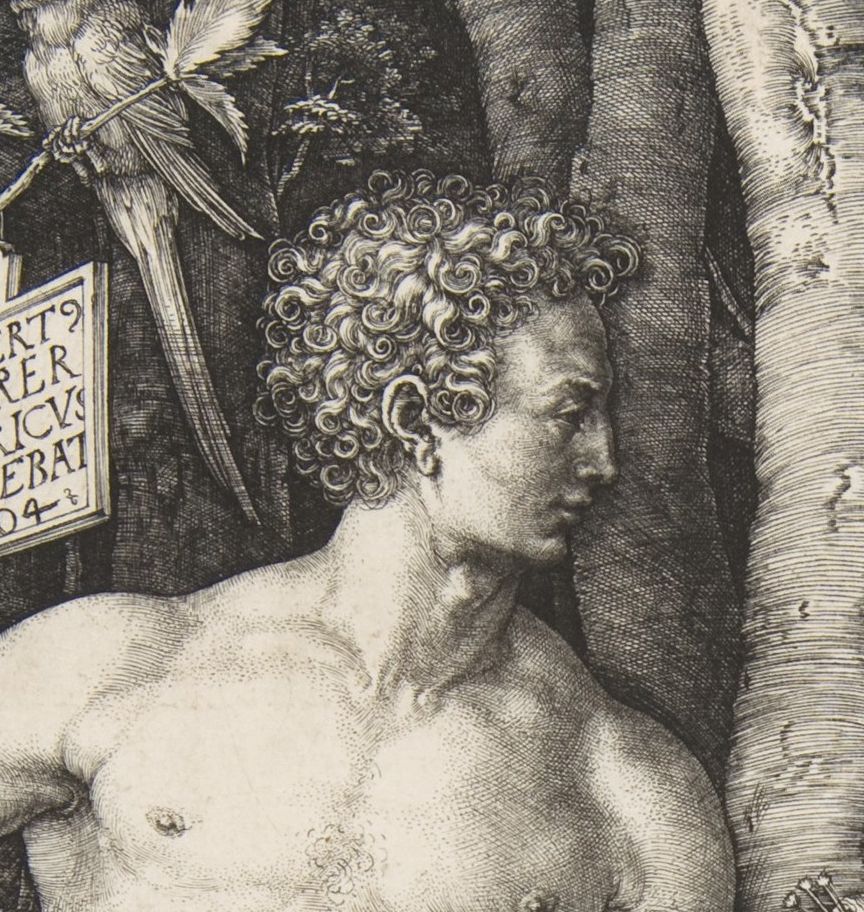
Adam’s curls and turned face
Tightly curved locks crowd the crown of the head. The face turns towards the right, where the nose and parted lips stand against the dark trunk.
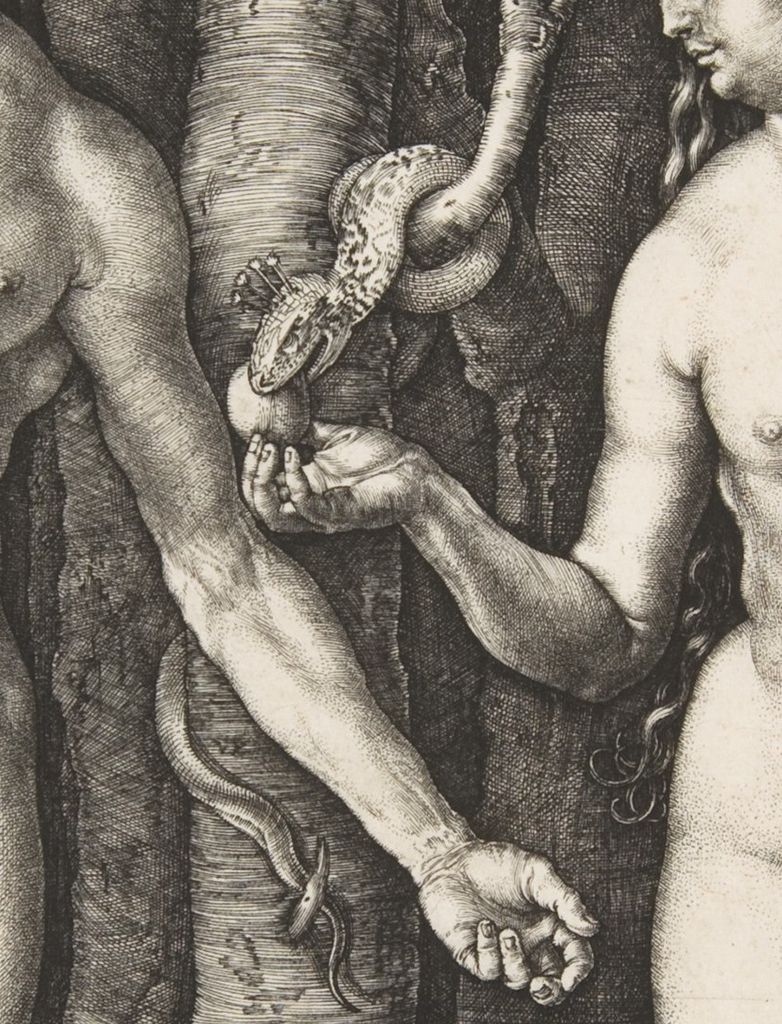
Hands, fruit and the coiled serpent
The serpent loops around the upright trunk above the raised hand. Lower down, an open palm reaches across the bark. Pale fingers and fruit interrupt the surrounding dark lines.
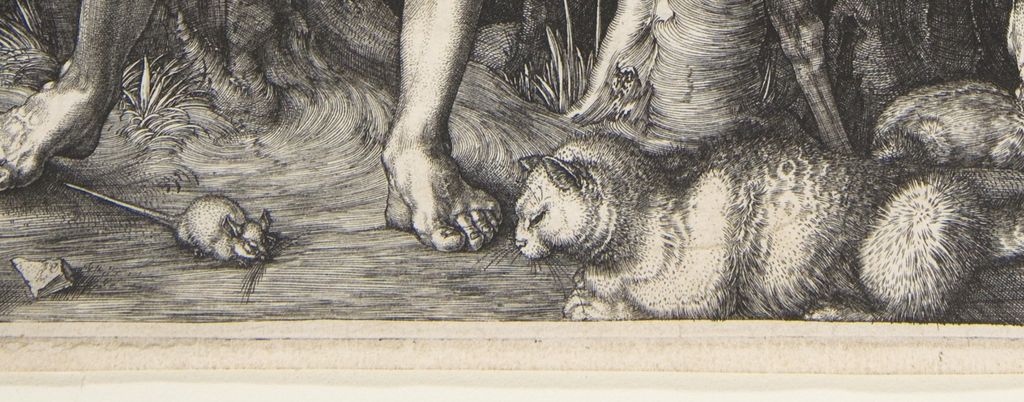
A cat facing a small mouse
The cat crouches close to the lower border, its head turned towards the mouse on the left. Fine curving strokes give way to broader dark patches across its coat.
Watch: Adam and Eve, 1504 Engraving
A film to accompany this article.
ClarkArtInstitute. Watch on YouTube.
Figures assembled, hands reconsidered
The Morgan Library & Museum’s drawing I, 257d, dated 1504 and measuring 24.2 × 20.1 centimetres, physically joins the pair. Two trimmed figure drawings were united with a third strip; brown wash unifies the background, and white gouache supplies corrections. Adam still holds fruit. The Morgan regards a further transfer drawing as likely because the engraving changes the fruit exchange and makes Adam appear taller. The composite is evidence of revision, with no guarantee that it was the last design. [15]
The British Museum’s sheet SL,5218.181, also dated 1504, concentrates on Adam’s arms and hands. The museum identifies the central left-hand study and the right arm at the upper left as close to those used in the engraving, though reversed; the raised arm holds a stick instead of the final branch. Other hands test holding the apple. A rock study follows the engraving’s direction. Reversal and selection were therefore separate decisions: the sheet preserves alternatives, not one uniformly oriented transfer pattern. [16]
ALBERTINA 3080 places proportional construction, measurements and compass marks on the recto and a modelled Adam on the verso. Its AD monogram is by another hand. Despite the museum’s 1504 date, scholars disagree whether the sheet precedes or follows the engraving, partly because of its possible pairing with a related Eve. The later sequence can lead towards the 1507 paintings. [12]
Cutting darkness and leaving light
Engraving makes a picture through recesses cut into metal. A burin is pushed through the copper, opening a channel that will hold ink. The line printed on the sheet corresponds to that ink-bearing incision. Friedrich Lippmann’s illustrated handbook, in Martin Hardie’s 1906 translation of the edition revised by Max Lehrs, shows the cutting tool and the turnable support that lets the engraver move the plate beneath it. Curves depend on controlled movement of copper and hand together. [17]
The same handbook explains the complementary work of scraper and burnisher: unwanted roughness can be removed, and worked areas smoothed or reduced. Engraving therefore permits correction, though revising metal is a different undertaking from changing a drawing. For printing, ink is applied and the smooth surface wiped; damp paper receives the ink from the recesses under pressure. The printer’s handling of the ink helps determine the resulting impression. The pale bodies depend on the paper showing through, with surrounding strokes shaping their light. [17]
Eve’s hair offers a particularly clear invitation to follow the marks. At the crown it lies in relatively broad, orderly bands. As it streams rightwards, it separates into loops and corkscrew curls, with dark centres and narrow pale ridges. It finally meets the border as a dense tangle. This movement links a small area of finely modelled skin to the forest’s intricacy without letting the edge of the head disappear.
The serpent has a different surface. Its narrow body bends around the branch and changes direction sharply as the head descends. Small patterned marks run across that turn, while the nearby fruit offers a rounder, less interrupted surface. Leaves spread into flatter shapes, their pointed edges and branching veins catching light. Within a short distance, the marks suggest coiling, swelling and spreading: three kinds of form, each asking the eye to move differently.
Across the bodies, tiny dots and short strokes soften transitions that would become hard if rendered with strong outlines alone. Koehler drew particular attention to the fine dotting used to model flesh. Close looking makes this delicacy visible around the abdomen and across the neck. The darkest contours remain selective. Adam’s shoulder can appear solid against the trees without every internal division receiving an equally heavy boundary. [1]
The central trunk presents an almost opposite effect. Across its lower portion, bands of marks travel around the wood; knots interrupt their direction and open into irregular pale shapes. At the base, these organised curves meet a more broken patch of ground. The tree’s surface appears continuous even though the eye can still distinguish the marks that describe it. Such passages allow a viewer to enjoy both the represented material and the labour of representing it.
Seeing the plate before it was finished
Koehler’s 1897 catalogue describes and reproduces two unfinished trial stages. In the earlier, only one of Adam’s legs is finished; the next has both. It also notes the absent cat and the incompletely worked right side. The surviving later proof makes an extraordinary comparison with the completed image. Modelled legs support an almost empty upper body; Eve’s outline waits beside darkly worked trees. The tablet is still blank. ALBERTINA DG1930/1450 is catalogued as Meder’s second trial proof, a unique impression. [1] [12]
The disparity between neighbouring passages makes the process unusually legible. In the proof, the woodland behind Adam already closes around his silhouette, whereas the area behind Eve is much less developed. An empty human shape and a densely worked trunk can share a border. The later work must give that body volume while preserving its brightness against the setting. This is what the historical descriptions and the actual unfinished image together allow us to see. [1]
Printing a trial sheet allowed the developing pattern to be judged in the material in which it would finally be encountered. Lippmann explains working proofs as a means of assessing a plate during its making. A pale, reserved area could look different once marks were introduced; the relationship between body and forest had to survive those changes. The unfinished sheet gives access to a series of decisions that the smooth surfaces of a completed impression largely conceal. [17]
A state describes a distinguishable stage of a plate; an impression is an individual printing from it. Lippmann’s account distinguishes alterations made while work is progressing from changes to completed plates. The terminology requires care here because historical catalogues organise the evidence differently. Koehler lists unfinished trials separately from two states of the completed composition. His second finished state has an added rift in the tree beneath Adam’s left armpit, which he interprets as a means of strengthening the arm’s relief. [17] [1]
Numbers in different classifications consequently need their catalogue context. They do not automatically describe separate editions or campaigns in different years. Equally, a state does not determine every aspect of an impression’s appearance. Koehler describes two fine sheets of the same finished state, one delicate and the other fuller in effect. Cutting the matrix and printing from it are connected activities, each leaving evidence in the sheet. [1]
The creatures around the couple
According to the Met, cat, rabbit, ox and elk correspond respectively to choleric, sanguine, phlegmatic and melancholic temperaments in historical humoral theory. Adam’s mountain ash signifies the Tree of Life, Eve’s fig the Tree of Knowledge. These specific readings leave the rest of the forest open. The motionless cat and nearby mouse add suspense to the human encounter. [5]
Higher up, the parrot is held against a dark trunk by its pale breast and hooked profile. It sits beside pointed leaves and clustered berries, with its tail descending towards the tablet. At the opposite corner, the distant cliff animal needs a search of the upper edge. The ALBERTINA identifies it as a chamois. [12]
Dürer’s own later introduction to his artistic teaching mentions the four temperaments when discussing the variety of human figures. That passage shows temperament theory within his intellectual vocabulary, though it does not identify this engraving’s individual animals. It is a useful distinction: a historical framework can be relevant without becoming an artist’s written explanation of every detail of a particular work. [14]
The maker’s name inside Eden
The hanging tablet carries the expanded Latin Albertus Durer Noricus faciebat 1504 : “Albrecht Dürer of Nuremberg was making this, 1504.” The forename is visibly abbreviated. Noricus supplies the Nuremberg identification, and faciebat has the continuing sense “was making.” Koehler transcribes the inscription and associates its conspicuous presence with the artist’s satisfaction in the engraving. The lettering makes a claim of authorship within the scene itself, alongside the fruit, foliage and living creatures. [1]
Its visual position matters as much as its wording. The tablet hangs slightly askew, with a small hole and loop giving it the character of a suspended object. Its rectangular face concentrates straight strokes and evenly organised letters amid branching growth. Adam’s lifted hand, the parrot and the tablet form a compact group above his shoulder. The artist’s name consequently catches the eye along a route that already belongs to the composition.
The print also acquired a history of argument about its poised bodies. Koehler defended their apparent freedom against a critical tradition that found the measured poses forced. His catalogue goes much further, describing a liberation of the flesh under antique influence. That is an interpretation shaped by nineteenth-century concerns. For a present viewer, the immediate question can remain more open: do these carefully arranged figures look at ease, or does their very perfection make the suspended action feel more fragile? [1]
Dürer returned to the subject in the monumental painted panels of Adam and Eve of 1507, now in the Prado. Here, the small engraved world keeps its own intimacy, drawing the eye from conspicuous bodies into barely visible marks. [15]
Frequently Asked Questions
Artworks directory
These 187 records include individual works, reverse sides, detail views, paired panels and reconstructed arrangements. Three additional catalogue images repeat works already listed. Related views are not counted as separate originals; qualified attributions and published dating are retained.
Discussion
Look again at the images and ideas explored in Adam and Eve: Dürer’s Engraving of 1504. These editorial prompts invite your observations.
Reader Insights
Which detail or idea in Adam and Eve: Dürer’s Engraving of 1504 most changed your reading, and why?
How does the discussion of “Temptation through hands and eyes” affect your understanding?
What comparison would you bring to the discussion of “The maker’s name inside Eden”?
Join the Conversation
Share a detail, comparison or question about Adam and Eve: Dürer’s Engraving of 1504 below.
References
- S. R. Koehler , A Chronological Catalogue of the Engravings, Dry-Points and Etchings of Albert Dürer (Grolier Club, 1897), no. 34, pp. 37–42. English; original historical catalogue. View source .
- Charles Ephrussi, Albert Dürer et ses dessins (Paris: A. Quantin, 1882). French original edition; selected catalogue entries and illustrations. View source.
- Campbell Dodgson, Catalogue of Early German and Flemish Woodcuts Preserved in the Department of Prints and Drawings in the British Museum, vol. I (London: British Museum, 1903). Original English edition; selected Dürer book and print entries. View source.
- Heinrich Wölfflin, Die Kunst Albrecht Dürers, second enlarged edition (Munich: F. Bruckmann, 1908). German original edition; selected works and printed p. 298. View source.
- Metropolitan Museum of Art , Adam and Eve , 19.73.1; Suzanne Boorsch and Nadine M. Orenstein, The Print in the North: The Age of Albrecht Dürer and Lucas van Leyden (Metropolitan Museum of Art, 1997), p. 31. English. View source 1 . View source 2 .
- Bayerische Staatsgemäldesammlungen, Selbstbildnis im Pelzrock, inv. 537 (German). View source.
- ALBERTINA, Feldhase, inv. 3073 (German). View source.
- ALBERTINA, Das große Rasenstück, inv. 3075 (German). View source.
- Moriz Thausing, Albert Dürer: His Life and Works, vol. II, translated from the German, edited by Fred. A. Eaton (London: John Murray, 1882), pp. 16–18. Historical English edition. View source.
- Bayerische Staatsgemäldesammlungen, Vier Apostel: Hll. Johannes Ev. und Petrus, 1526, inventory 545. German collection record and shared paired-panel commentary.. View source.
- Genesis , chapters 2–3, historical King James text. English translation; narrative comparison. View source .
- ALBERTINA , Adam und Eva , DG1930/1450, and Adam (Reinzeichnung) , 3080 verso. German/English; embedded 2003 catalogue discussions by Berthold Hinz. View source 1 . View source 2 .
- Stijn Alsteens and Freyda Spira, Dürer and Beyond: Central European Drawings in The Metropolitan Museum of Art, 1400–1700 (The Metropolitan Museum of Art, 2012), p. 15, fig. 2, and Freyda Spira, Fortuna in a Niche, no. 7, pp. 17–19. English.. View source.
- William Martin Conway , Literary Remains of Albrecht Dürer , with transcripts and notes by Lina Eckenstein (Cambridge, 1889), pp. 165, 177–180, 211, 229, 253–254. Historical English translations and German transcripts of Dürer’s manuscripts. View source .
- Morgan Library & Museum , Adam and Eve , I, 257d. English institutional drawing record. View source .
- British Museum , studies for Adam and Eve , SL,5218.181. English collection description and curatorial commentary. View source .
- Friedrich Lippmann , Engraving and Etching , third German edition revised by Max Lehrs, translated by Martin Hardie (New York, 1906), pp. 1–3, 10–15. Original historical English edition. View source .
- National Gallery of Art, Annual Report 1974 (Washington, 1975), printed p. 23 (PDF p. 25). English. View source.
- Max J. Friedländer, Die Zeichnungen von Matthias Grünewald (Berlin, 1927), printed pp. 9–11, catalogue no. 26 and plate 26. German. View source.
- Moriz Thausing, Dürer: Geschichte seines Lebens und seiner Kunst (Leipzig: E. A. Seemann, 1876), pp. 303–309. German original edition. View source.
- Burlington Fine Arts Club, Exhibition of Early German Art (London, 1906), p. 24, no. 38. Original English exhibition catalogue. View source.
- Friedrich Winkler, Die Zeichnungen Albrecht Dürers, Band II (Berlin, 1937), catalogue no. 431, printed pp. 111–112. German. View source.
- Friedrich Winkler, Die Zeichnungen Albrecht Dürers, Band II (Berlin, 1937), catalogue no. 357, printed pp. 73–74. German. View source.
- Friedrich Winkler, Die Zeichnungen Albrecht Dürers, Band III (Berlin, 1938), catalogue no. 512, printed pp. 7–8. German. View source.
- Germanisches Nationalmuseum, Barbara Dürer (German and English). View source.
- Web Gallery of Art, Tucher–Rieter reverse (English). View source.
- National Gallery of Art, Portrait of a Clergyman (English). View source.
- Dürer Art, Portrait of a Man (English). View source.
- Hessen Kassel Heritage, Elsbeth Tucher (German). View source.
- Web Gallery of Art, Hans Tucher (English). View source.
- Germanisches Nationalmuseum, Emperor Maximilian I (German and English). View source.
- National Gallery of Art, Lot and His Daughters, reverse (English). View source.
- Bayerische Staatsgemäldesammlungen, Glim Lamentation (German). View source.
- Museo Nacional del Prado, Portrait of a Man (Spanish). View source.
- Bayerische Staatsgemäldesammlungen, Madonna of the Carnation (German). View source.
- Städel Museum, Job on the Dungheap (German). View source.
- Wallraf-Richartz-Museum, Piper and Drummer (German). View source.
- Italian Ministry of Culture / Uffizi, Head of Saint James (Italian). View source.
- Klassik Stiftung Weimar, Dresden Altarpiece (German). View source.
- Staatliche Museen zu Berlin, Girl with a Red Beret (German and English). View source.
- Dresden State Art Museums / Roland Enke, Bernhard von Reesen (German). View source.
- Royal Collection Trust, Burkhard von Speyer (English). View source.
- Dresden State Art Museums, Seven Sorrows of the Virgin (English). View source.
- Bayerische Staatsgemäldesammlungen, Mater Dolorosa (German). View source.
- Bayerische Staatsgemäldesammlungen, Lucretia (German). View source.
- Städel Museum, Young Woman with Her Hair Down (English). View source.
- ALBERTINA, Portrait of a Young Man (German). View source.