 by
Tom Gurney
Tom Gurney BSc (Hons) is an art history expert with over 20 years experience
Published on June 19, 2020 / Updated on October 22, 2026
Email:
tomgurney1@gmail.com
/ Phone:
+44 7429 011000
A Greyhound: Introduction
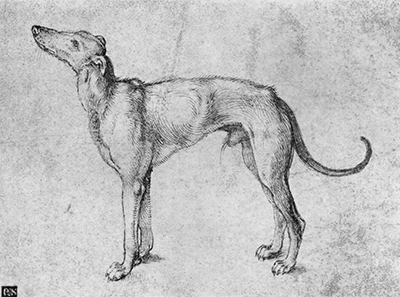
The greyhound stands with its nose lifted, looking towards something beyond the edge of the paper. Its chest projects over long, straight forelegs; behind, the belly draws sharply upwards and the tail swings into a loose hook. Dürer gives this slim animal an unusually substantial presence. The sheet, in the Royal Collection, dates from about 1500–01 and measures 14.8 by 19.8 centimetres. Its medium is brush and ink, with outlines indented by a stylus. [1]
At first the body seems to be assembled from a few continuous curves. Following the marks more closely reveals a succession of small decisions. Along the back, short strokes break out above the main contour, interrupting its smoothness. Around the shoulder, the lines turn and gather into a dark band. Across the flank they spread into broad arcs, leaving the paper comparatively open over the ribs. The animal acquires both a surface and a structure: the same marks suggest the lie of the hair and the way the body rounds beneath it.
The head rewards especially close attention. A dark nose anchors the far end of the long muzzle. Below it, a narrow line divides the closed mouth, with a few fine whiskers extending into the empty space. The visible eye is set within a small, carefully articulated surround. Behind it, the folded ear becomes a complicated arrangement of pale pockets and dark edges. The upward angle of the head stretches the throat, so that a relatively small movement alters the entire front of the body. This is an alert pose whose energy comes from looking, while the feet remain planted.
Each part receives a different density of drawing. On the chest, broad areas of untouched paper sit beside long, descending strokes. The underside of the belly is more emphatic, with closely packed marks that sharpen its rise towards the hindquarters. The rear legs require another turn of the brush: curves follow the large upper muscles, then narrow beside the joints and extend down towards the paws. Looking from the pale chest to the dark underside makes the rounded body almost turn in space. There is no continuous wash spreading over the whole animal. Much of the modelling depends on the interval between one line and the next.
The paws also prevent the greyhound from becoming a flat silhouette. The farther feet appear beside the nearer ones, and small differences in their placement give the stance depth. Toes are indicated with compact loops and dark separations. A few slanting strokes beside the feet provide just enough contact with a surface. Above them, the tail makes a much larger, freer curve, carrying the eye away from the close work of the legs. Its heavy lower edge contrasts with the sparse marks along the upper back. These changes of scale and pressure keep a potentially rigid profile supple.
The surrounding paper matters too. Almost nothing competes with the animal: no handler, leash, kennel or landscape supplies an explanation for its raised head. The space in front of the muzzle invites us to imagine an object of attention, yet leaves it unspecified. That openness gives the study a particular intimacy. We can spend time with the shape of one ear or the construction of one paw without having to follow a story. The drawing offers ample evidence of Dürer's attention to the animal, while leaving its name, owner and the circumstances of the encounter unknown.
At a Glance
- Date About 1500–1501 [1]
- Materials Brush and ink, with stylus-indented outlines [1]
- Collection Royal Collection [1]
This work across Albrecht Dürer’s career
A Greyhound (current article)
c. 1500–1501Young Hare
1502Praying Hands
1508Melencolia I
1514Four Apostles
1526Contents
- From brush drawing to engraving
- Observation held for later use
- A drawing with a partly recorded history
- Frequently Asked Questions
From brush drawing to engraving
The sheet also preserves evidence of practical use. According to the Royal Collection, its reverse was rubbed with black chalk or charcoal and its outlines traced with a stylus to transfer them to another sheet. The greyhound is about sixty per cent larger than its counterpart in Dürer's engraving Saint Eustace , and the contours still differ when reduced to the same scale. The owner therefore infers an intervening freehand reduction. [1]
In the engraving, made about 1501, the related dog stands near the centre of the foreground and faces right. Its raised muzzle and steeply drawn-up belly make it recognisable, although the orientation is reversed. Above it, the hunt has come to a halt: the man kneels before a stag bearing a crucifix between its antlers. The subject is the legendary conversion of the Roman general who became Saint Eustace. Dürer places the revelation within an extraordinarily crowded natural setting, giving the viewer many possible paths through the image. [12]
The greyhound's posture now works within a group. Another dog stands farther left; a reclining animal stretches across the lower foreground; two more occupy the space beneath and beside the horse. Their heads turn in different directions. The raised profile of the central dog stands out against these varied attitudes, but its gaze is no longer the only focus of the composition. The horse's long legs and substantial body establish a much larger scale immediately behind it. Seen there, the greyhound's slim build makes a quick, clear interval between foreground and horse.
The comparison also changes how we read the drawing's empty background. On its own sheet the dog seems almost to command the whole available world. In the engraving it becomes one distinct presence among many. The unoccupied spaces around its body are filled by ground, stones, plants and neighbouring forms. Its individuality survives that crowding because the lifted head, narrow waist and bent hind legs form such a readily understood arrangement. Dürer could make the animal useful to a larger design without surrendering the particularity that makes the study engaging.
Observation held for later use
Dürer's later writing supplies a useful context for this movement between concentrated study and invention. In a passage translated in William Martin Conway's Literary Remains of Albrecht Dürer , he connects an artist's ability to create figures with knowledge gathered through sustained study. A practised artist, he argues, can draw upon that accumulated experience instead of copying every separate figure directly from life; further observation can still improve the result. Written in the context of his discussion of human proportion, this is no account of the greyhound's making. It does, however, help us understand how close attention to nature and the reuse of a motif could belong to the same artistic practice. [13]
That usefulness continued beyond Dürer's workshop. In the Metropolitan Museum's 2012 catalogue Dürer and Beyond , Freyda Spira discusses Virgil Solis's A Greyhound in Profile Facing Left of 1549 as a borrowing from Saint Eustace . She suggests that Solis might also have known Dürer's preparatory drawing, while leaving that possibility unproven. Solis's sheet, now at the Met, is a separate work in pen and brown ink over graphite. [14] [15]
Placed beside Dürer's drawing, it shows how freely the motif could be remade. Solis lowers the muzzle towards a more horizontal position and gives the dog a collar with a hanging ring. The tail expands into a conspicuous flourish of long, curved strands. Beneath the paws, a strip of ground carries sprays of grass and curling plants. These additions frame the dog as a complete little scene. Dürer's sheet has stronger differences between open paper and dense passages of line; Solis distributes his marks in a more regular pattern along the back and body. The broad resemblance makes the changes easy to see. A pose can pass between artists while its surface, setting and emphasis take on another character.
Solis also made an etching, Six Dogs , in which Spira identifies five animals as reversed borrowings from Dürer's engraving. In that print, the pack almost fills the small horizontal field. A seated dog faces outwards at the left, standing animals overlap across the middle, and reclining bodies occupy the lower edge. The landscape and the saint have disappeared. This is another way of extracting possibilities from the original composition: several poses become an assembly of animal forms, which can be studied together. The greyhound's pose thus belongs to a larger process of selecting and rearranging forms disseminated through Dürer's print. [14]
A drawing with a partly recorded history
The Royal Collection traces the sheet through Paul Sandby, probably his 1812 sale, Sir Thomas Lawrence and the dealer Samuel Woodburn, who sold it in 1836. It was in the Royal Collection by 1926; its route there remains unknown. Woodburn described its print connection as Saint Hubert , reflecting the historical confusion between two saints associated with a stag and crucifix. [1]
That gap leaves part of the sheet's journey open, but its earlier working life is unusually tangible. The brush drawing, indented outlines and related engraved figure allow us to follow an animal image through different uses. Returning from the print and Solis's adaptation to the original brings the smallest features back into focus: the taut mouth, the turning ear, the closely spaced toes. The greyhound's continuing appeal rests in that combination of an immediately readable whole and details that keep asking us to look again.
Frequently Asked Questions
Artworks directory
These 187 records include individual works, reverse sides, detail views, paired panels and reconstructed arrangements. Three additional catalogue images repeat works already listed. Related views are not counted as separate originals; qualified attributions and published dating are retained.
Discussion
Look again at the images and ideas explored in A Greyhound. These editorial prompts invite your observations.
Reader Insights
Which detail or idea in A Greyhound most changed your reading, and why?
How does the discussion of “From brush drawing to engraving” affect your understanding?
What comparison would you bring to the discussion of “A drawing with a partly recorded history”?
Join the Conversation
Share a detail, comparison or question about A Greyhound below.
References
- Royal Collection Trust , A Greyhound , RCIN 912177, c.1500–01. Current object record, description, provenance and physical properties; description adapted from Holbein to Hockney: Drawings from the Royal Collection . View source .
- ALBERTINA, Selbstbildnis als Dreizehnjähriger, inv. 4839 (German). View source.
- Metropolitan Museum, Four Horsemen from The Apocalypse, 19.73.209 (English). View source.
- Bayerische Staatsgemäldesammlungen, Selbstbildnis im Pelzrock, inv. 537 (German). View source.
- ALBERTINA, Feldhase, inv. 3073 (German). View source.
- ALBERTINA, Das große Rasenstück, inv. 3075 (German). View source.
- Metropolitan Museum, Adam and Eve, 19.73.1 (English). View source.
- ALBERTINA, Betende Hände, inv. 3113 (German). View source.
- Metropolitan Museum, Knight, Death, and the Devil, 43.106.2 (English). View source.
- Metropolitan Museum, Melencolia I, 43.106.1 (English). View source.
- Bayerische Staatsgemäldesammlungen, inventory 545: current collection record (German; descriptive citation). View source.
- Cleveland Museum of Art , Saint Eustace , 1958.109, c.1501. Object record, description and engraving image. View source .
- Albrecht Dürer , extract from the third book on human proportion, in William Martin Conway, Literary Remains of Albrecht Dürer , Cambridge University Press, 1889, pp.247–248. English translation. View source .
- Freyda Spira , catalogue entry 37, “Virgil Solis: A Greyhound in Profile Facing Left,” in Stijn Alsteens and Freyda Spira, Dürer and Beyond: Central European Drawings in The Metropolitan Museum of Art, 1400–1700 , Metropolitan Museum of Art, 2012, pp.80–82. View source .
- Metropolitan Museum of Art , Virgil Solis, A Greyhound in Profile Facing Left , 2001.497, 1549. Object record and drawing image. View source .
- Germanisches Nationalmuseum, Barbara Dürer (German and English). View source.
- Web Gallery of Art, Tucher–Rieter reverse (English). View source.
- National Gallery of Art, Portrait of a Clergyman (English). View source.
- Dürer Art, Portrait of a Man (English). View source.
- Hessen Kassel Heritage, Elsbeth Tucher (German). View source.
- Web Gallery of Art, Hans Tucher (English). View source.
- Germanisches Nationalmuseum, Emperor Maximilian I (German and English). View source.
- National Gallery of Art, Lot and His Daughters, reverse (English). View source.
- Bayerische Staatsgemäldesammlungen, Glim Lamentation (German). View source.
- Museo Nacional del Prado, Portrait of a Man (Spanish). View source.
- Bayerische Staatsgemäldesammlungen, Madonna of the Carnation (German). View source.
- Städel Museum, Job on the Dungheap (German). View source.
- Wallraf-Richartz-Museum, Piper and Drummer (German). View source.
- Italian Ministry of Culture / Uffizi, Head of Saint James (Italian). View source.
- Klassik Stiftung Weimar, Dresden Altarpiece (German). View source.
- Staatliche Museen zu Berlin, Girl with a Red Beret (German and English). View source.
- Dresden State Art Museums / Roland Enke, Bernhard von Reesen (German). View source.
- Royal Collection Trust, Burkhard von Speyer (English). View source.
- Dresden State Art Museums, Seven Sorrows of the Virgin (English). View source.
- Bayerische Staatsgemäldesammlungen, Mater Dolorosa (German). View source.
- Bayerische Staatsgemäldesammlungen, Lucretia (German). View source.
- Städel Museum, Young Woman with Her Hair Down (English). View source.
- ALBERTINA, Portrait of a Young Man (German). View source.