by
Tom Gurney
Tom Gurney BSc (Hons) is an art history expert with over 20 years experience
Published on June 19, 2020 / Updated on October 22, 2026
Email:
tomgurney1@gmail.com
/ Phone:
+44 7429 011000
Dürer’s Rhinoceros: Introduction
Albrecht Dürer’s Rhinoceros seems almost too large for its frame. Its hindquarters press towards one edge, its great nasal horn towards the other. Between them, the body swells above short legs and broad feet. The animal stands quietly, yet its surfaces are wonderfully restless: rings, scallops, scales, long ribs and tiny pits compete for attention. A little twisted horn rises above its shoulders. The longer we look, the less ordinary any part of this seemingly solid creature becomes. [1]
Dürer designed the woodcut in 1515, without seeing the living rhinoceros. Complete broadsheets combine the image with a separately printed German account. The National Gallery of Art’s impression, accession 1964.8.697, is woodcut and letterpress on laid paper, measuring 23.5 × 29.8 centimetres. Those dimensions identify that particular sheet; other impressions preserve different margins and presentations. [2]
At a Glance
- Design date 1515 [2]
- Process Woodcut; complete broadsheets also carry letterpress [2]
- Example impression National Gallery of Art, 1964.8.697 [2]
This work across Albrecht Dürer’s career
Young Hare
1502Praying Hands
1508Melencolia I
1514Four Apostles
1526Contents
- News of an extraordinary animal
- A body built from patterns
- Drawing, woodblock and printed sheet
- Reading the rhinoceros
- Burgkmair’s alternative
- The image travels into books
- Later impressions and other copies
- Frequently Asked Questions
News of an extraordinary animal
The rhinoceros reached Lisbon on 20 May 1515. Sultan Muzaffar II of Gujarat had given it to Afonso de Albuquerque, governor of Portuguese India, who forwarded it to King Manuel I. Manuel subsequently sent it towards Rome for Pope Leo X, but it drowned when the vessel was wrecked in early 1516. Its journey joined Indian and Portuguese diplomacy to the display of rare animals at European courts. L. C. Rookmaaker’s historical study distinguishes this itinerary from later, contradictory accounts of the wreck. [18]
Dürer worked in Nuremberg from information transmitted about the animal. The British Museum suggests a newsletter sent by the Lisbon printer Valentin Ferdinand to Nuremberg merchants as a likely connection. The surviving evidence does not identify the exact combination of report and sketch that reached Dürer. His own 1515 drawing in pen and brown ink, now in the British Museum, SL,5218.161, measures 27.4 × 42 centimetres. It is a separate object from the woodcut. [19]
Susan Dackerman also records Jim Monson’s proposed Vatican drawing as a possible model. She regards reports that the drowned animal was stuffed and reached the Vatican as inconclusive. [20]
Within the woodcut’s border there is no ship, keeper, enclosure or tether. The rhinoceros occupies a shallow space almost entirely its own. Its feet meet a little stony ground; its body fills the paper above. That isolation concentrates attention on the creature’s shape. There is little to measure it against except the modest grass tufts and pebbles below its muzzle. The frame itself becomes a measure of its bulk: the animal seems to have expanded until it can scarcely fit. [1]
A body built from patterns
Start with the large flank. Long curving ridges descend across it, separated by narrow channels of pale paper. They reach down towards the belly, where several directions of hatching cross and gather into darkness. Higher up, scattered bundles of short strokes leave the surface comparatively open. The transition gives this busy region a rounded volume. We can follow individual ribs and patches while still seeing a single enormous mass behind them.
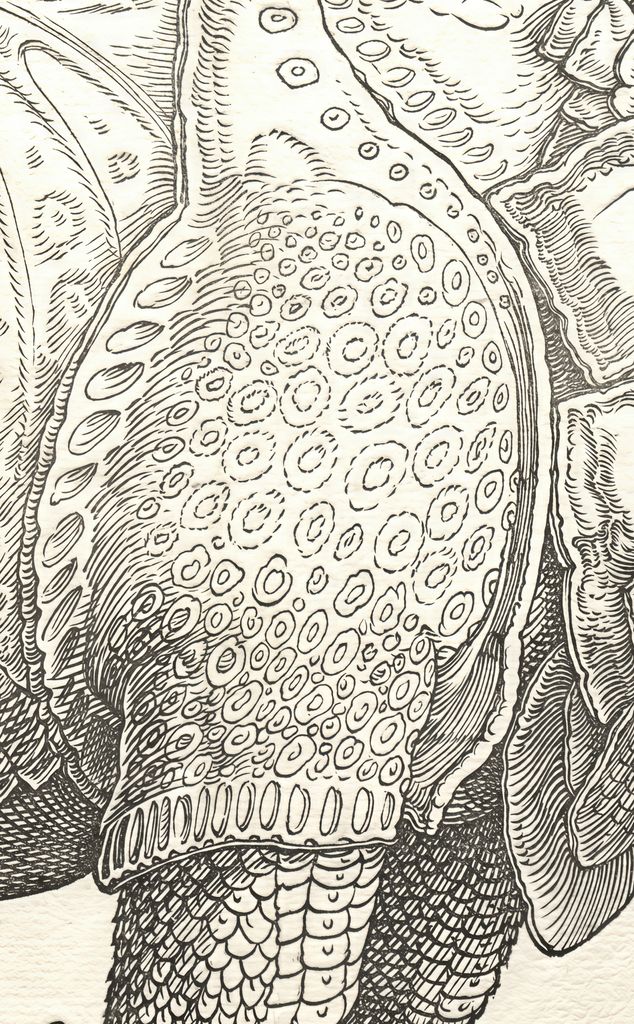
The shoulder has a different organisation. A broad covering hangs over the foreleg, edged with elongated ovals and filled with rings and small clusters of dots. Its lower corner projects beyond the leg, giving the edge an apparent thickness. Some circles contain a dark spot; others remain open. Their irregular sizes save the pattern from looking completely mechanical, although its distribution is far more orderly than the tangled wrinkles around the head.
Over the hindquarters, the lines turn again. A rising ridge near the back leads into sweeping bands and a broad, ring-patterned covering. The tail descends beside the rear contour in a thin, lightly fringed strip. Below, a dark gap separates the upper forms from the leg. Overlap makes this difficult body readable. One rim passes in front of another; a shadow opens between adjoining surfaces; the edge of a covering becomes visible against the texture underneath.
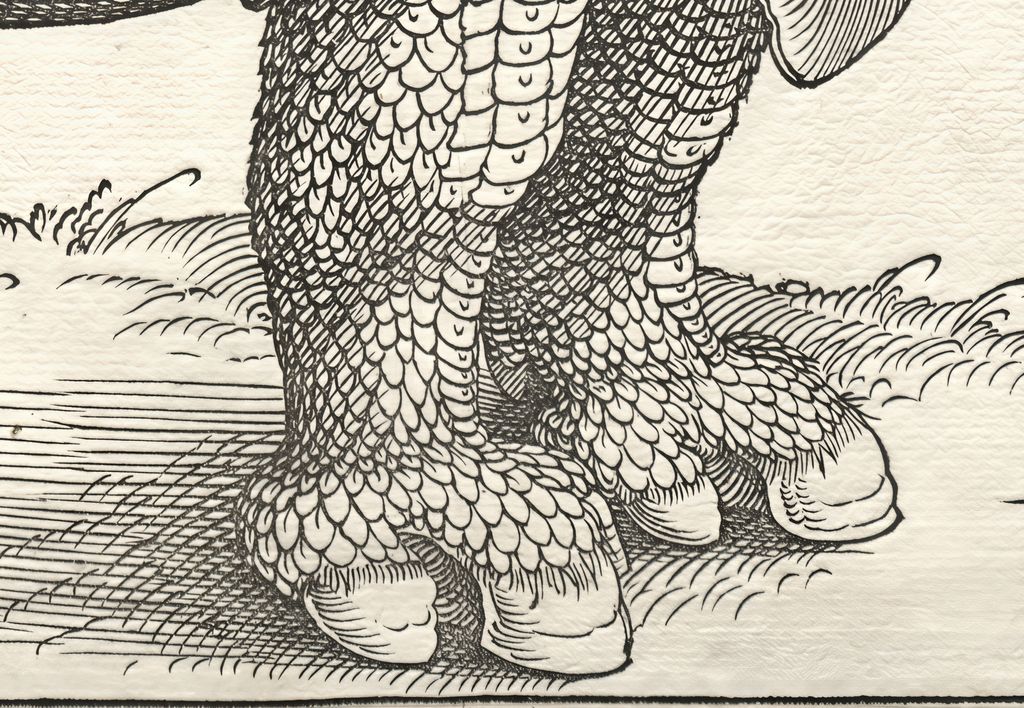
The legs are wrapped in rows of little rounded scales. Their repetition gives them a different texture from both the shoulder’s circles and the flank’s ribs. Near the ground, the patterns end in broad, pale toes. These smooth areas are a relief after the dense decoration above, and they make the feet appear substantial. The more distant feet remain partly visible beside the nearer pair. Their staggered placement gives depth to an animal shown predominantly in profile.
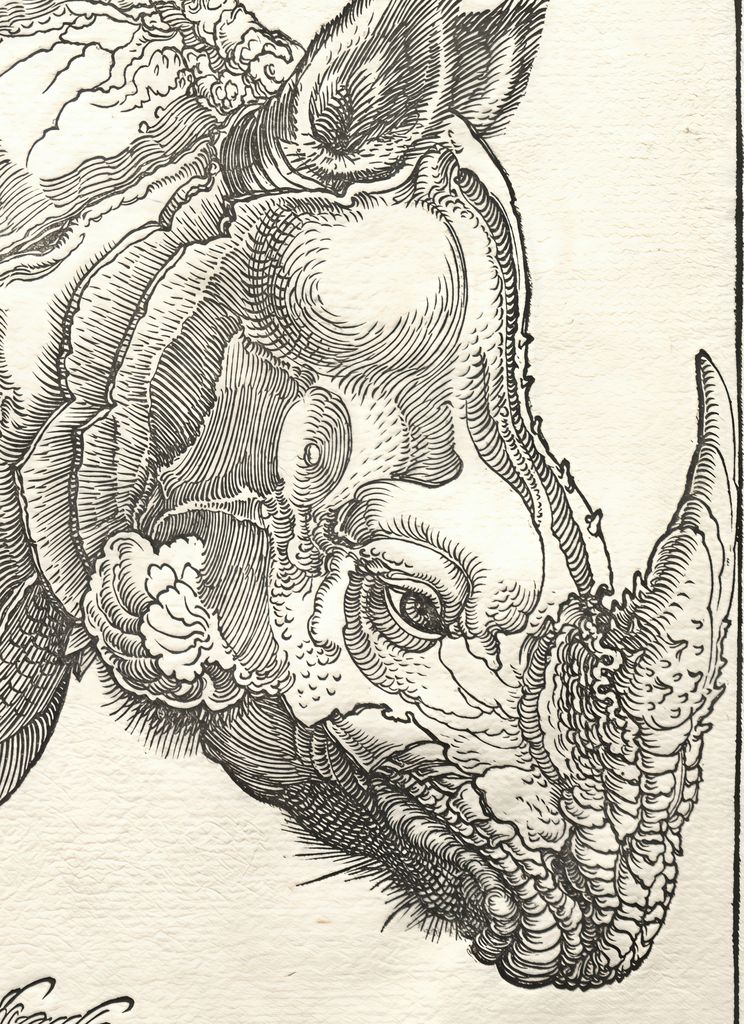
At the head, almost every turn introduces another kind of mark. Branching furrows spread over the cheek; small curling contours surround the eye; thick folds gather beneath the jaw. The muzzle hangs in a rounded mass, fringed with fine strokes. The large ear opens towards us like a dark funnel, its edge bristling with hair. These delicate fringes matter because they offer a softer sensation beside the emphatic rims and heavy coverings elsewhere.
The nasal horn supplies the strongest upward thrust. Its broad base belongs to the heavy head, while its narrow tip approaches the right border. The small shoulder horn has another shape: slender, twisted and perched above the folds. Looking back and forth between them makes their difference apparent. The larger horn extends the head’s forward movement; the little one breaks the long upper silhouette and occupies the open paper beneath the lettering.
The ground is economical. Parallel strokes spread beneath the belly and feet; individual stones sit farther forward; a few tufts interrupt the low horizon. A broad opening remains beneath the lowered head. This pocket of light keeps the muzzle clear of the ground and allows its weight to register. Dense detail needs these quiet intervals. Without them, the animal’s underside would become one unbroken knot of black.
Above the shoulder and head sit the date 1515, the title RHINOCERVS and the AD monogram. Their straight, open forms contrast with the curling and packed marks of the hide. The image therefore offers several different rhythms at once: the level border, the upright letters, the great sagging body and the small repeated shapes across its surface. Even at a distance, the print’s spaces and dark accents keep those competing rhythms in balance. [1]
The National Gallery’s anatomical comparison recognises Indian-rhinoceros skin folds, three toes and funnel-shaped ears behind Dürer’s inventions. The rigid coverings, reptilian scales and elaborately fissured head exaggerate those features. It identifies the shoulder horn as an error: the Indian rhinoceros normally has one nasal horn. This is a more precise problem than simply counting two horns; the added projection stands above the shoulders, away from the nose. [21]
Annotated Details from Rhinoceros
Compare the head, the patterned shoulder and the marks covering the feet.
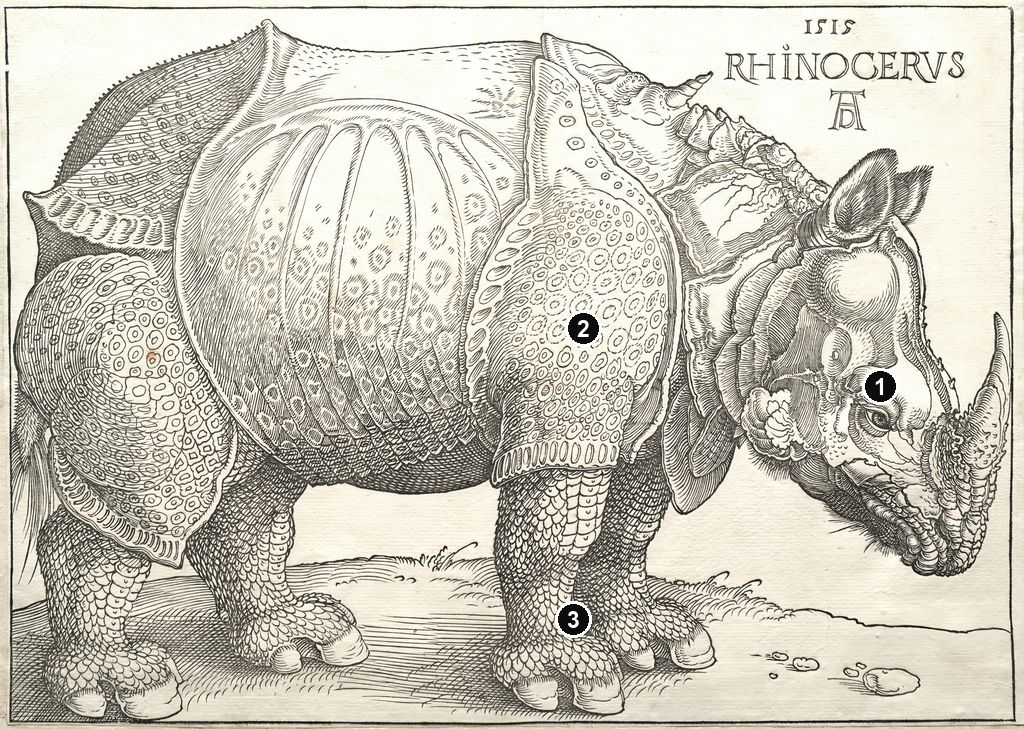
Details from RHINOCEROS
Open the details to follow changes between circles, scales and curved hatching.
The horn, eye and folded cheek
The small eye sits beneath a curving ridge. Long folds descend beside it towards the cheek, while dense short marks gather around the base of the upward-pointing horn.
Rings across the shoulder
Rows of uneven rings cover the broad shoulder shape. Along its lower edge, upright oval marks make a border above the smaller, overlapping forms on the leg.
Overlapping marks above the toes
Rows of small curved shapes cover the two front legs. Dark crossing lines gather where the limbs overlap; broad pale toes have only a few short marks near their edges.
Drawing, woodblock and printed sheet
Dürer’s drawing faces left. Its finer lines leave more open paper between the textures, and the animal looks less densely packed than in the print. The major divisions are already present: the shoulder covering, the long flank, the ringed hindquarters and the hanging head. In the woodcut, however, edges become heavier and the dark underside more continuous. Reversal is immediately noticeable, but the change in direction accompanies a substantial adjustment in visual weight. [1]
The head is a useful place to compare them. In the drawing, small strokes cluster around a relatively pale cheek. In the woodcut, dark hollows, curling ridges and strongly bordered folds make the same area much harder to penetrate. The shoulder’s rings also stand out more forcefully in print. The effect is cumulative: repeated dark rims give the whole creature a more emphatic exterior. These are differences between two surviving images, whatever the appearance of any earlier model. [1]
Their writing changes as well. The German inscription beneath the drawing speaks in a personal voice: the animal’s marvellous character prompts someone to send its likeness. It calls the ruler ‘our king’ and distinguishes the Greek and Latin name from the Indian gomda . Friedrich Winkler published a German transcription. [22]
The printed account above the woodcut takes another approach. It names the powerful Portuguese king, announces the animal brought to Lisbon from India and immediately directs the reader to the likeness displayed here. The personal exchange has become a presentation to anyone holding the sheet. A living creature is introduced, named and described, then given a sequence of supposed actions. The rows of type form a compact narrative above the much larger body. [2]
Woodcut is a relief process: the printable lines remain raised while the spaces around them are cut away. Ink passes from those raised surfaces to the paper, reversing the design. Engraving instead prints ink held in incised metal lines. The Print in the North explains these distinctions and leaves Dürer’s own role in cutting his blocks open. His authorship of the design does not establish who carved this particular block. The broadsheet’s letterpress adds a separate arrangement of printable type beside the image. [23]
Seen at close range, the shoulder’s circles continually alternate black boundaries with pale centres. Elsewhere, white slivers run between adjacent strokes, and isolated light shapes separate adjoining masses. Those intervals are as carefully arranged as the dark marks. The relatively open flank, the busy shoulder and the compressed networks below the belly each demand a different pace of looking. Enlarging the image reveals how little the textures depend on a uniform repetition of one mark.
Reading the rhinoceros
The account gives the arrival date as 1 May 1513, although 1515 stands within the image. Its colour comparison is with a speckled tortoise; the next phrase describes a covering of thick Schalen , shells or plates. It compares the creature’s size with an elephant’s but gives it shorter legs. The description repeatedly returns to protection and strength, preparing the reader for the attack that occupies much of the remaining paragraph. Its claims belong to an early modern account of the animal, not to a present-day anatomy lesson. [2]
Rookmaaker identifies the broadsheet’s 1513 arrival year as erroneous and supports 20 May 1515. A date printed on an old sheet can therefore be evidence of a transmitted mistake. It should not move the woodcut’s design back to 1513. [18]
The narrative describes the rhinoceros sharpening its horn on stones, rushing beneath an elephant’s forelegs and tearing open its belly. The elephant is made helpless before this heavily defended enemy. Finally, the wording changes register: the closing sentence reports what ‘they say’ about the animal’s speed, boldness and cunning. That small signal of hearsay is easily overlooked beside the force of the preceding assertions. The paragraph mixes naming, description, dramatic storytelling and reported reputation within a few lines. [2]
The elephant story has an ancient counterpart in Pliny’s Natural History , Book Eight. In the 1855 translation by John Bostock and H. T. Riley, the rhinoceros prepares for combat by whetting its horn on rocks and aims at the elephant’s soft belly. Pliny also compares their length while stressing the rhinoceros’s shorter legs. These details closely match the broadsheet’s sequence of size, legs, horn and attack. [24]
Read beside the picture, the old account supplies an imagined future for the still animal. The lowered head can become the beginning of a charge; the great horn has a vulnerable target; the coverings promise defence against retaliation. Nothing in the image shows a fight, yet the accompanying story changes how its equipment may be understood. The ancient passage also places rhinoceroses in Roman spectacles. Its subject was already an animal watched, described and made remarkable for an audience long before the Lisbon arrival.
The drawing’s colour comparison is with a toad, whereas the broadsheet specifies a speckled tortoise. Both use the language of thick outer coverings, but the familiar creature invoked to help readers imagine the unfamiliar one has changed. We need not pretend the black ink records an observed skin colour. The comparisons operate through words, asking readers to supply an association that the monochrome picture cannot literally deliver. They are part of the description’s construction, alongside its comparisons of size and movement. [22] [2]
Burgkmair’s alternative
Hans Burgkmair the Elder also produced a Rhinoceros in 1515. The ALBERTINA’s woodcut, DG1934/123, measures 22.4 × 31.7 centimetres. [25]
His animal faces left, its horn approaching the margin and its body spreading heavily behind. Broad folds overlap, but their transitions look softer. Short, irregular strokes move across the skin without gathering into Dürer’s sharply divided fields of ornament. A fringe follows the neck. The great flank curves down into the shaded belly, while its upper edge settles into the back. No prominent twisted horn rises above the shoulders. [1]
The forelegs are restrained. Bands encircle them, joined by a heavy length of rope that curves across the ground. A chain runs towards the lower corner. These details change the encounter: Burgkmair’s rhinoceros is visibly an animal being held. The large pale toes, the heavy muzzle and the firmly planted legs still give it weight, but the restraints connect that body to something beyond the frame. Dürer leaves his feet unencumbered and the surrounding ground clear.
The contrast is useful without turning the pictures into a contest for a single prize of accuracy. A softer-looking surface does not by itself establish a sighting of the living beast. Nor can two dates reading 1515 settle the order in which the artists worked. What the images do make available is a comparison of decisions: hair against scales, yielding folds against hard rims, visible restraint against an isolated stance. The same unfamiliar subject could sustain markedly different printed bodies.
African rhinoceroses’ two horns are nasal, unlike Dürer’s shoulder projection. Dackerman proposes that Dürer’s exaggerated plates evoke printmaking materials, while the shoulder horn directs attention to title, date and monogram. This is an interpretation of artistic intention, not a documented explanation by Dürer. [20]
The image travels into books
Sebastian Münster’s Cosmographia of 1544 gives a particularly revealing early example of reuse. In the ETH Library copy, a large rhinoceros appears on an inserted leaf after page 630, turned sideways to occupy the page. The animal faces left. Its ringed shoulder, ribbed flank, scaly legs and upper horn clearly repeat Dürer’s construction. The broadsheet’s rectangular frame, date and AD monogram are absent; a short German caption identifies the animal. The creature has been fitted to the format of a book. [26]
The adjoining text on page 631 places it after a discussion and illustration of elephants. Its heading explains that the name could be rendered in German as ‘nose-horn’. The section describes two horns: a large one at the nose and a smaller, strong one between back and neck. Here the conspicuous feature of the picture is also asserted in prose. The reader encounters a creature whose visible equipment appears to agree with the verbal account. The text prepares readers to find both horns in the picture. [26]
Münster repeats the arrival in Lisbon on 1 May 1513, the comparison with a speckled tortoise and the thick protective covering. He again tells the story of the attack beneath the elephant. Yet the surrounding account allows the elephant a possible defence with its tusks. Reuse has involved more than reducing an image: the familiar body now sits within a longer discussion, alongside altered wording and other claims about how the two animals meet. The erroneous year has travelled with much of the description. [26]
Conrad Gessner’s Historiae animalium , volume one of 1551, makes its debt unusually explicit. The introduction to the rhinoceros entry on page 952 credits the picture to Albrecht Dürer, praises his representation and identifies the animal brought from Cambay to Manuel in Lisbon in 1515. On the next page, a large sideways illustration repeats the characteristic plates, rings and dorsal projection. The book names the artist while removing the original arrangement of title, date and monogram from the image. [27]
This version also faces left. Its great horn points towards the upper edge when the volume is held normally; to examine the creature as a standing animal, the reader must turn the book or tilt the head. Seen horizontally, the shoulder’s oval border and spotted surface are immediately recognisable. The flank has been shortened into a compact central mass, and the legs crowd beneath it. The peculiar body remains legible after a change of direction, scale and surroundings. Its patterns make particularly durable identifiers. [27]
Gessner’s text shows what could happen when an illustration entered a learned argument. On page 954, he describes the larger nasal horn and a very small upper one, calling the latter useless because the beast cannot employ it. He explicitly points to the picture. The inconspicuous or unusable second growth helps him reconcile the image with language describing a one-horned animal. The printed body has become something to reason from, alongside the named ancient authors gathered in the entry. [27]
That does not mean Gessner accepts every animal story indiscriminately. On page 955, he rejects the confusion of the rhinoceros with the unicorn captured through the presence of a virgin, referring that tale to a different creature. The entry’s questions include names, textual disagreement and the relation between descriptions and pictures. The entry brings together scrutiny of written authorities and trust in a particular image. One account could question a legend while retaining Dürer’s extraordinary shoulder projection. [27]
The attribution on page 952 matters for another reason. The picture is recognised as the work of a particular artist, yet used within an account of an animal. Those two identities coexist. Gessner does not need to erase Dürer’s name to make the image useful to natural history. Conversely, knowing the artist’s identity does not tell a reader which of the creature’s features came from a living model. The book makes the source visible without resolving all the problems of the likeness. [27]
Later impressions and other copies
The ALBERTINA catalogues its DG1934/509 as the fourth edition in Meder’s classification, with a 21.2 × 29.6 centimetre image on a 24.7 × 30 centimetre sheet. Its later DG1934/512 is a green two-block impression associated with Willem Janssen in Amsterdam after 1620. The museum traces repeated printing and a developing crack, and notes the later sheet’s missing letterpress paragraph. The date 1515 within that image belongs to the design; this particular impression was printed much later. Such a sheet preserves both the original composition and a later publisher’s intervention. An impression from the old block and a copy made on a new printing surface have different relationships to Dürer’s work. The familiar animal alone cannot identify the physical history of every sheet. [28] [29]
Enea Vico’s reversed engraving of 1548 carries his own identification in place of Dürer’s monogram. It transfers the creature into another maker’s print and another medium. [21]
Dackerman also discusses a Liefrinck copy surrounded by impressions taken from plants: the sheet combines an animal transmitted through pictures with botanical forms recorded through direct contact. Her account of Philip Galle’s 1586 inscription disputing earlier likenesses supplies another limit to the woodcut’s authority. Copying and criticism coexisted; its repeated use does not establish universal agreement about its accuracy. [20]
Return finally to the animal’s face. The small eye, fine hairs and densely folded cheek invite scrutiny of something intimate within the great mass. Move away and they become part of a commanding silhouette. That movement between near and far is the woodcut’s enduring pleasure. Its elaborate surfaces keep the eye occupied, while the broad stance and lowered head hold the creature together. Beside its strange little shoulder horn, the body’s sheer weight remains astonishingly persuasive. [1]
Frequently Asked Questions
Artworks directory
These 187 records include individual works, reverse sides, detail views, paired panels and reconstructed arrangements. Three additional catalogue images repeat works already listed. Related views are not counted as separate originals; qualified attributions and published dating are retained.
Discussion
Look again at the images and ideas explored in Dürer’s Rhinoceros. These editorial prompts invite your observations.
Reader Insights
Which detail or idea in Dürer’s Rhinoceros most changed your reading, and why?
How does the discussion of “News of an extraordinary animal” affect your understanding?
What comparison would you bring to the discussion of “Later impressions and other copies”?
Join the Conversation
Share a detail, comparison or question about Dürer’s Rhinoceros below.
References
- Campbell Dodgson, Catalogue of Early German and Flemish Woodcuts Preserved in the Department of Prints and Drawings in the British Museum, vol. 1 (London: British Museum, 1903). Original English edition. View source.
- National Gallery of Art , The Rhinoceros , 1515, 1964.8.697. Metadata and original German inscription. English. View source .
- Charles Ephrussi, Albert Dürer et ses dessins (Paris: A. Quantin, 1882). Original French edition. View source.
- Heinrich Wölfflin, Die Kunst Albrecht Dürers, second enlarged edition (Munich: F. Bruckmann, 1908), pp. 110, 298. Original German edition. View source.
- S. R. Koehler, A Chronological Catalogue of the Engravings, Dry-Points and Etchings of Albert Dürer (New York: Grolier Club, 1897). Original English edition. View source.
- Moriz Thausing, Albert Dürer: His Life and Works, edited by F. A. Eaton, vol. II (London: John Murray, 1882), pp. 16–18. English edition. View source.
- William Martin Conway, ed. and trans., Literary Remains of Albrecht Dürer (Cambridge: Cambridge University Press, 1889), “Extract from the Third Book,” printed p. 247. Historical English translation of Dürer’s writing on human proportion. View source.
- ALBERTINA, Selbstbildnis als Dreizehnjähriger, inv. 4839 (German). View source.
- Metropolitan Museum, Four Horsemen from The Apocalypse, 19.73.209 (English). View source.
- Bayerische Staatsgemäldesammlungen, Selbstbildnis im Pelzrock, inv. 537 (German). View source.
- ALBERTINA, Feldhase, inv. 3073 (German). View source.
- ALBERTINA, Das große Rasenstück, inv. 3075 (German). View source.
- Metropolitan Museum, Adam and Eve, 19.73.1 (English). View source.
- ALBERTINA, Betende Hände, inv. 3113 (German). View source.
- Metropolitan Museum, Knight, Death, and the Devil, 43.106.2 (English). View source.
- Metropolitan Museum, Melencolia I, 43.106.1 (English). View source.
- Bayerische Staatsgemäldesammlungen – Alte Pinakothek München, Vier Apostel: Hll. Johannes Ev. und Petrus, 1526, inv. 545 (German).. View source.
- L. C. Rookmaaker , “Captive Rhinoceroses in Europe from 1500 until 1810”, Bijdragen tot de Dierkunde 43 (1973), pp. 39–44. English. View source .
- British Museum , Rhinoceros , drawing, SL,5218.161. English. View source .
- Susan Dackerman , “Dürer’s Indexical Fantasy: The Rhinoceros and Printmaking”, FREIGHTED (2025), pp. 55–63; reprint of her 2011 essay. English. View source .
- National Gallery of Art , “Horns, Scales, and Armor”, 29 December 2025. English. View source .
- Friedrich Winkler , Die Zeichnungen Albrecht Dürers , III (1938), no. 625, pp. 64–65. German transcription of the drawing’s inscription. View source .
- Suzanne Boorsch and Nadine M. Orenstein , The Print in the North , Metropolitan Museum of Art Bulletin 54/4 (1997), pp. 3–4, 25. English. View source .
- Pliny , Natural History , VIII, chapter 29 (20), John Bostock and H. T. Riley translation (1855). English. View source .
- ALBERTINA , Hans Burgkmair, Das Rhinozeros , 1515, DG1934/123. German. View source .
- Sebastian Münster , Cosmographia (Basel, Heinrich Petri, 1544), image leaf after p. 630 and rhinoceros section p. 631; ETH Library, Rar 5716. German. View source .
- Conrad Gessner , Historiae animalium , I (Zurich, Christoph Froschauer, 1551), pp. 952–955. Latin. View source .
- ALBERTINA , Rhinocerus , DG1934/509. German and English. View source .
- ALBERTINA , Rhinocerus , Janssen impression, DG1934/512. German and English. View source .
- Moriz Thausing, Dürer: Geschichte seines Lebens und seiner Kunst (Leipzig: E. A. Seemann, 1876). Original German edition. View source.
- Burlington Fine Arts Club, Exhibition of Early German Art (London: Burlington Fine Arts Club, 1906). Original English catalogue. View source.
- Joseph Heller, Das Leben und die Werke Albrecht Dürer’s, vol. 2, part 1 (Bamberg: C. F. Kunz, 1827), pp. 98–99, imperial/Albert collection; pp. 117–118, nos. 134, 138, Vienna hare and owl; p. 131, item c, Hoffmann’s signed copy in Grünling’s collection. German historical catalogue; English paraphrases are the present writer’s. Historical identifications are distinguished from current museum attribution. View source.
- Johann Carl Sigmund Kiefhaber, ed., Nachrichten zur ältern und neuern Geschichte der freyen Reichsstadt Nürnberg, first quarter, Nuremberg: Lechner, 1803, pp. 6–9, 14–16. German historical edition of correspondence and inventory. View source.
- Adam von Bartsch, Le peintre graveur, 13. Volume (Vienne: Imprimerie de J. V. Degen, 1811), p. 240, no. 20. View source.
- T. Sturge Moore, Albert Dürer (1905), Munich self-portrait discussion. English. View source.
- Germanisches Nationalmuseum, Barbara Dürer (German and English). View source.
- Web Gallery of Art, Tucher–Rieter reverse (English). View source.
- National Gallery of Art, Portrait of a Clergyman (English). View source.
- Dürer Art, Portrait of a Man (English). View source.
- Hessen Kassel Heritage, Elsbeth Tucher (German). View source.
- Web Gallery of Art, Hans Tucher (English). View source.
- Germanisches Nationalmuseum, Emperor Maximilian I (German and English). View source.
- National Gallery of Art, Lot and His Daughters, reverse (English). View source.
- Bayerische Staatsgemäldesammlungen, Glim Lamentation (German). View source.
- Museo Nacional del Prado, Portrait of a Man (Spanish). View source.
- Bayerische Staatsgemäldesammlungen, Madonna of the Carnation (German). View source.
- Städel Museum, Job on the Dungheap (German). View source.
- Wallraf-Richartz-Museum, Piper and Drummer (German). View source.
- Italian Ministry of Culture / Uffizi, Head of Saint James (Italian). View source.
- Klassik Stiftung Weimar, Dresden Altarpiece (German). View source.
- Staatliche Museen zu Berlin, Girl with a Red Beret (German and English). View source.
- Dresden State Art Museums / Roland Enke, Bernhard von Reesen (German). View source.
- Royal Collection Trust, Burkhard von Speyer (English). View source.
- Dresden State Art Museums, Seven Sorrows of the Virgin (English). View source.
- Bayerische Staatsgemäldesammlungen, Mater Dolorosa (German). View source.
- Bayerische Staatsgemäldesammlungen, Lucretia (German). View source.
- Städel Museum, Young Woman with Her Hair Down (English). View source.
- ALBERTINA, Portrait of a Young Man (German). View source.