by
Tom Gurney
Tom Gurney BSc (Hons) is an art history expert with over 20 years experience
Published on June 19, 2020 / Updated on October 22, 2026
Email:
tomgurney1@gmail.com
/ Phone:
+44 7429 011000
The Crucifixion (1508 engraving) by Albrecht Dürer: Introduction
Saint John's clasped hands rise towards Christ, but the women on the other side of the cross seem to sink into the ground. Between these contrary movements hangs the long, slender body of Jesus. Dürer's Crucifixion of 1508 brings a whole range of responses to suffering into a print little more than thirteen centimetres high. Its date and AD monogram appear on a small tablet at the bottom, where the rocky foreground meets the viewer's space. The Art Gallery of South Australia identifies the engraving as Bartsch 24 and Meder 23: useful distinctions for an artist who returned repeatedly to this subject. [1]
This is an individual engraving, separate from the Crucifixion of 1511 in Dürer's Engraved Passion . Erwin Panofsky explicitly distinguishes the single print when discussing the engravings of 1508. Knowing that it stands outside that narrative sequence helps us approach its unusual concentration. The image holds us beneath the cross, among a small company of mourners. A small title at the summit bears the letters INRI, while the distant landscape opens beyond the figures below. [2] [3]
At a Glance
This work across Albrecht Dürer’s career
Young Hare
1502Praying Hands
1508Melencolia I
1514Four Apostles
1526Contents
- Grief around the cross
- A landscape made from lines
- The lives of the printed sheets
- Frequently Asked Questions
Grief around the cross
The Gospel of John supplies a particularly intimate context for these figures. It places Jesus's mother, other women and the beloved disciple beside the cross, and describes Jesus entrusting his mother and the disciple to one another. It also recounts the inscription above him and the bowing of his head at death. Dürer's image gathers the human relationships of this account into a tightly connected group. The two other crucified men, the soldiers dividing Christ's clothing and the later removal of his body, all present in John 19, fall outside this composition. [14]
At the right, John looks upward in profile. His elbows project towards the cross, and the sleeves around his raised arms make a large, pale angle against the sky. His parted lips and tilted head give prayer the urgency of an appeal. The rest of his figure is heavily clothed: long folds fall nearly to the ground, turning below into a complicated gathering of fabric. His hands consequently seem to rise from a substantial weight of drapery. Their smallness within that mass makes the gesture more exposed.
The women occupy a much lower and broader area. A standing, veiled figure brings a fold of cloth towards her face. Farther left, another woman kneels with her head bent down. In front, two figures form an especially close knot: one leans back while the other bends over her, supporting her with an arm. Their overlapping shoulders, heads and garments make it difficult to detach one person from the other. Dürer gives this physical dependence its own shape, spreading it across the bottom of the print.
In his 1808 catalogue, Adam Bartsch identified the woman receiving help as the fainting Virgin, assisted by a holy woman, with two further women behind them. That reading focuses attention on the support being offered in the foreground. The standing woman remains a separate figure, her face partly withdrawn into the veil. What the image makes unmistakable is the difference between upright, withdrawn sorrow and a grief that requires another person's embrace. [15]
The figures do more than illustrate separate emotions. Their arrangements determine how we look. John's raised forearms draw the eye up towards Christ's hands; the women's bent bodies return it towards his feet. The standing veiled figure creates an intermediate height between the horizontal foreground group and the elevated body. The result is a circuit of attention around the cross. We move between the person suffering and the people who must witness that suffering, repeatedly finding a gesture or an inclined head that redirects the eye.
Christ's body interrupts this movement with a stark vertical. The arms stretch steeply upwards, while the head falls to the left beneath the crown of thorns. The loincloth gathers into a compact knot at the right hip, leaving the torso and legs exposed. Small changes of shading articulate the ribs, abdomen and knees. Against the enveloping clothes of the mourners, the narrowness of the bare body is particularly apparent. The timber above him remains rough and substantial, with an uneven end to the crossbeam. Its physical solidity makes the strain on the body beneath it harder to overlook.
A landscape made from lines
Almost the entire sky is worked with closely spaced horizontal strokes. Across that dark field, Dürer opens lighter intervals which become bands of cloud or distant illumination. The pale areas do not settle into a single bright background behind Christ. Instead, dark and light run across the whole width, passing behind the cross, the tree and John's lifted arms. Darkness becomes part of the space occupied by the figures.
The left-hand landscape is unexpectedly expansive. A tall tree rises beside a settlement, and a winding stretch of open ground draws us towards its clustered buildings. These tiny structures require a different kind of looking from the large gestures in the foreground. They suggest a world continuing beyond the immediate gathering. Yet the tree also echoes the upright cross, while its broken canopy answers the irregular masses of cloth below. The distance remains woven into the design, even where it seems to offer relief from the mourners' closeness.
Engraving makes these tonal distinctions through lines cut into a metal plate. Suzanne Boorsch and Nadine M. Orenstein explain the difference between this incised process and woodcut, in which the printable lines stand above the areas removed from a wooden block. Here the cuts give Dürer a vocabulary flexible enough for almost every surface. Long parallel strokes make the sky; shorter, turning strokes model flesh; angular networks deepen the folds of clothing. Bare patches of paper become highlights, so the unprinted surface contributes as actively as the ink. [16]
Look at the meeting of John's sleeve and the sky. Both are made from black strokes on paper, but their directions and spacing create different sensations. The sleeve appears to bend around a forearm; the sky extends laterally behind it. Lower down, repeated changes in direction make the robe gather, break and fall. The viewer can follow individual marks and still see a continuous body beneath the fabric. This oscillation between line and represented substance gives the small engraving much of its density.
Panofsky placed the print among Dürer's dark, atmospheric engravings of 1508, describing them as nocturnes. He also connected John with the corresponding figure in Mantegna's engraved Entombment , while stressing Dürer's transformation of the pose and its emotional force. The comparison is illuminating when the two prints are seen together. In the Metropolitan Museum's impression of Mantegna's composition, dated before 1475, John stands at the far right with clasped hands held closer to his chest. Dürer brings the hands higher and projects the elbows towards Christ. The broad, horizontal burial scene becomes a narrow encounter with the cross, and a figure at the edge of a crowded procession acquires a commanding share of the picture. [2] [17]
The Petit Palais proposes another comparison, identifying a formal and spiritual relationship with Grünewald's Small Crucifixion in Washington. In that painting, John's interlocked hands also make grief visible through a strained gesture. Christ's arms form a wide, upward-reaching shape against a dark sky, while a standing woman and a kneeling mourner occupy the left. The similarities are striking, although Grünewald uses colour, wounds and the bending crossbeam to create a different physical presence. The National Gallery of Art currently dates the panel approximately 1511–1520. [3] [18]
That date matters when considering influence. John Oliver Hand's catalogue discussion records opposing scholarly proposals about which artist influenced the other, within a much wider disagreement over the painting's date. The comparison therefore works best as a way of looking closely at two expressive solutions to the same subject. It does not establish that Dürer saw this particular painting before making his engraving, or turn the mourners into evidence of an undocumented meeting between the artists. [19]
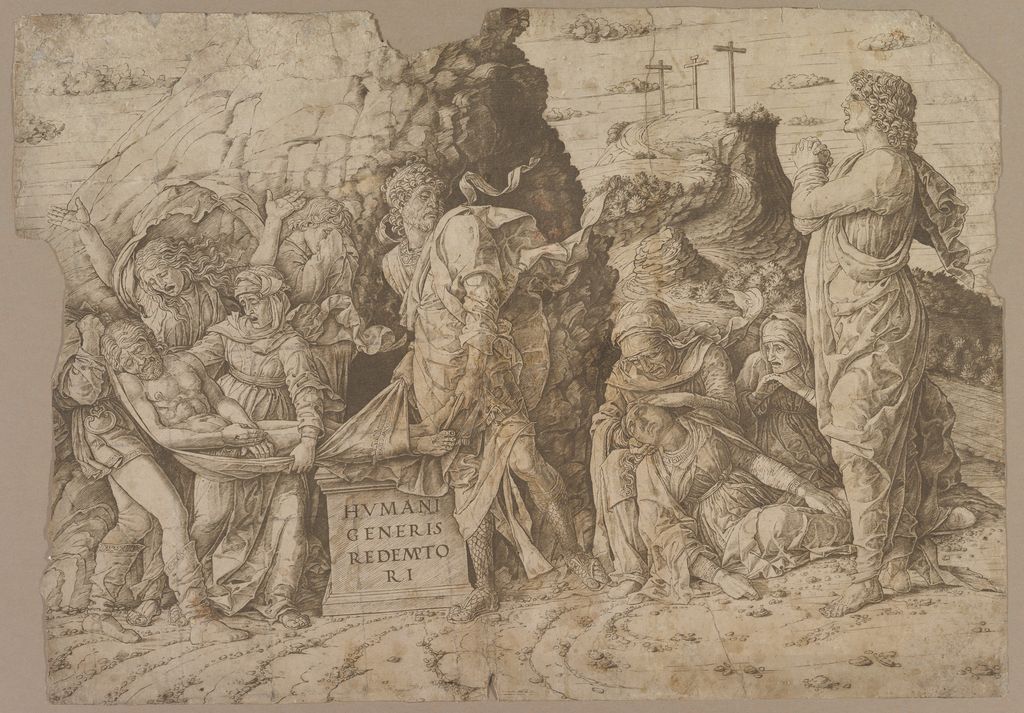
Andrea Mantegna, The Entombment of Christ, before 1475. Metropolitan Museum of Art, 37.42.30. A comparison engraving.
The lives of the printed sheets
The design survives through individual impressions, each with its own material history. Washington's National Gallery of Art owns a sheet trimmed to the plate, measuring 13.2 × 9.8 centimetres. Its recorded owners include Ralf Leopold von Retberg and Lessing J. Rosenwald; the latter acquired this impression in 1928, and his gift brought it to Washington in 1943. These facts belong to that sheet. They describe the collecting life of a particular piece of paper carrying Dürer's image. [20]
Other impressions preserve slightly different dimensions and histories. The National Gallery of Victoria records an image of 13.5 × 9.8 centimetres on a sheet measuring 13.6 × 10 centimetres, acquired through the Felton Bequest in 1956. Adelaide's impression measures 13.3 × 9.8 centimetres and entered its collection through the Morgan Thomas Bequest Fund in 1962. The Petit Palais sheet, 13.3 × 9.7 centimetres, bears the Dutuit collection mark and came with the Dutuit bequest in 1902. Together these records show the same composition dispersed through several collections, with the surviving paper and its ownership documented separately in each case. [21] [1] [3]
Repetition also extended beyond impressions from Dürer's plate. Bartsch described an anonymous copy so close to the original that he directed collectors towards three small stones near the left edge as a distinguishing detail. The Rijksmuseum today catalogues an anonymous sixteenth-century copy after the design, identifying its AD monogram as false. Such records give the little tablet at the bottom an added interest. A signature could travel with a copied composition; identifying a print requires attention to the whole object and its catalogue history. [15] [22]
For the viewer, that history leads back to the engraving's demanding scale. From a distance the cross and the pale sweep of John's sleeve hold the composition together. Close up, the settling folds, lowered faces, thin branches and tiny buildings require sustained attention. The people gathered beneath Christ offer several ways into the scene: prayer, withdrawal, collapse and the act of holding someone else. Dürer gives each response enough physical particularity to be felt, while keeping them joined within the narrow space of a single sheet.
Frequently Asked Questions
Artworks directory
These 187 records include individual works, reverse sides, detail views, paired panels and reconstructed arrangements. Three additional catalogue images repeat works already listed. Related views are not counted as separate originals; qualified attributions and published dating are retained.
Discussion
Look again at the images and ideas explored in The Crucifixion (1508 engraving) by Albrecht Dürer. These editorial prompts invite your observations.
Reader Insights
Which detail or idea in The Crucifixion (1508 engraving) by Albrecht Dürer most changed your reading, and why?
How does the discussion of “Grief around the cross” affect your understanding?
What comparison would you bring to the discussion of “The lives of the printed sheets”?
Join the Conversation
Share a detail, comparison or question about The Crucifixion (1508 engraving) by Albrecht Dürer below.
References
- Art Gallery of South Australia , The Crucifixion , 1508, accession 627G47. English. View source .
- Erwin Panofsky , The Life and Art of Albrecht Dürer , fourth edition (Princeton University Press, 1955), pp. 145–147. English. View source .
- Petit Palais , Paris Musées, Le Christ en Croix (Bartsch 24) , 1508, inventory GDUT3956. French. View source .
- ALBERTINA, Selbstbildnis als Dreizehnjähriger, inv. 4839 (German). View source.
- Metropolitan Museum, Four Horsemen from The Apocalypse, 19.73.209 (English). View source.
- Bayerische Staatsgemäldesammlungen, Selbstbildnis im Pelzrock, inv. 537 (German). View source.
- ALBERTINA, Feldhase, inv. 3073 (German). View source.
- ALBERTINA, Das große Rasenstück, inv. 3075 (German). View source.
- Metropolitan Museum, Adam and Eve, 19.73.1 (English). View source.
- ALBERTINA, Betende Hände, inv. 3113 (German). View source.
- Metropolitan Museum, Knight, Death, and the Devil, 43.106.2 (English). View source.
- Metropolitan Museum, Melencolia I, 43.106.1 (English). View source.
- Bayerische Staatsgemäldesammlungen, inventory 545: current collection record (German; descriptive citation). View source.
- Gospel according to John , 19:16–42, King James Version. English translation. View source .
- Adam Bartsch , Le peintre graveur , vol. 7 (Vienna: J. V. Degen, 1808), no. 24, pp. 46–47. French. View source .
- Suzanne Boorsch and Nadine M. Orenstein , The Print in the North: The Age of Albrecht Dürer and Lucas van Leyden , The Metropolitan Museum of Art Bulletin 54, no. 4 (Spring 1997), pp. 3–4. English. View source .
- Metropolitan Museum of Art , Andrea Mantegna, The Entombment of Christ , before 1475, accession 37.42.30. English. View source .
- National Gallery of Art , Matthias Grünewald, The Small Crucifixion , c. 1511/1520, accession 1961.9.19. English. View source .
- John Oliver Hand , with Sally E. Mansfield, German Paintings of the Fifteenth through Seventeenth Centuries (National Gallery of Art and Cambridge University Press, 1993), pp. 71–74, especially p. 74. English. View source .
- National Gallery of Art , The Crucifixion , 1508, accession 1943.3.3496. English. View source .
- National Gallery of Victoria , Crucifixion , 1508, accession 3442-4. English. View source .
- Rijksmuseum , Kruisiging , anonymous after Albrecht Dürer, 1508–1599, accession RP-P-OB-115.914. Dutch description and English metadata. View source .
- Germanisches Nationalmuseum, Barbara Dürer (German and English). View source.
- Web Gallery of Art, Tucher–Rieter reverse (English). View source.
- National Gallery of Art, Portrait of a Clergyman (English). View source.
- Dürer Art, Portrait of a Man (English). View source.
- Hessen Kassel Heritage, Elsbeth Tucher (German). View source.
- Web Gallery of Art, Hans Tucher (English). View source.
- Germanisches Nationalmuseum, Emperor Maximilian I (German and English). View source.
- National Gallery of Art, Lot and His Daughters, reverse (English). View source.
- Bayerische Staatsgemäldesammlungen, Glim Lamentation (German). View source.
- Museo Nacional del Prado, Portrait of a Man (Spanish). View source.
- Bayerische Staatsgemäldesammlungen, Madonna of the Carnation (German). View source.
- Städel Museum, Job on the Dungheap (German). View source.
- Wallraf-Richartz-Museum, Piper and Drummer (German). View source.
- Italian Ministry of Culture / Uffizi, Head of Saint James (Italian). View source.
- Klassik Stiftung Weimar, Dresden Altarpiece (German). View source.
- Staatliche Museen zu Berlin, Girl with a Red Beret (German and English). View source.
- Dresden State Art Museums / Roland Enke, Bernhard von Reesen (German). View source.
- Royal Collection Trust, Burkhard von Speyer (English). View source.
- Dresden State Art Museums, Seven Sorrows of the Virgin (English). View source.
- Bayerische Staatsgemäldesammlungen, Mater Dolorosa (German). View source.
- Bayerische Staatsgemäldesammlungen, Lucretia (German). View source.
- Städel Museum, Young Woman with Her Hair Down (English). View source.
- ALBERTINA, Portrait of a Young Man (German). View source.