 by
Tom Gurney
Tom Gurney BSc (Hons) is an art history expert with over 20 years experience
Published on June 19, 2020 / Updated on October 22, 2026
Email:
tomgurney1@gmail.com
/ Phone:
+44 7429 011000
View of the Arco Valley in the Tyrol by Albrecht Dürer: Introduction
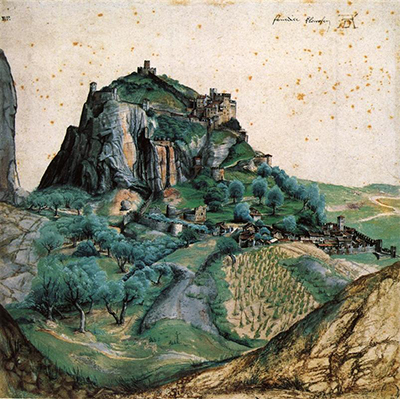
A fortress climbs a rock, and a town spreads out beneath it. Between the viewer and those buildings, the ground dips into hollows, rises into cultivated slopes and disappears among pale blue-green trees. Albrecht Dürer's View of the Arco Valley in the Tyrol makes this small landscape feel surprisingly extensive. Its buildings offer countless places for the eye to stop, while the paths and folds of earth keep drawing it onward. The Louvre dates the sheet to about 1495 and records its dimensions as 22.3 × 22.3 centimetres. Within that square, Dürer gives the castle an imposing presence without allowing it to occupy the whole picture. We approach through the country around it. [1]
At a Glance
This work across Albrecht Dürer’s career
Young Hare
1502Praying Hands
1508Melencolia I
1514Four Apostles
1526Contents
- A fortress growing out of the rock
- Trees, paths and cultivated ground
- Finding Arco beneath an old name
- Fine detail and open passages
- How precisely can it be dated?
- Frequently Asked Questions
A fortress growing out of the rock
The principal rock stands left of centre, with its steepest exposed face turned towards us. Long grey planes descend almost vertically, interrupted by dark fissures and narrow patches of warmer colour. Above them, the hill becomes green and rounded. Masonry follows that change of surface: towers and walls sit on ledges, cross the slope and gather into a compact group of buildings on the right. At the very top, a small tower rises against the empty sky. Our eye can trace the ascent from the low defences to this final, distant point.
The relationship between building and ground is especially clear where the walls run across bare stone. Their comparatively regular edges interrupt the cliff's irregular fractures, yet their colour brings them close to the rock beneath. Pale walls, grey outcrops and brown roofs belong to the same restrained range. The fortress appears embedded in its setting. Its many divisions remain legible because Dürer alternates illuminated surfaces with tiny dark openings and recesses. These marks are small enough to merge at a distance; up close, they break the mass into habitable structures.
Farther down, the town forms a horizontal counterweight to the summit. Roofs jostle together above a long boundary wall. A taller, open-looking structure punctuates the cluster, and the enclosing line reaches towards the right edge. These repeated little verticals have a different rhythm from the cliff. Their scale helps us imagine how high the rock rises, even without a conspicuous human figure to measure it. The settlement supplies a human order to a scene whose largest forms are geological.
The left edge has another role. A narrow, much nearer rock enters abruptly from outside the square. We see only a slice of it, so its full size remains beyond the frame. On the opposite side, the bare foreground slope sweeps diagonally upward. Together these fragments place us among hills. The view feels encountered through an opening in the terrain, with the castle occupying the space beyond.
Trees, paths and cultivated ground
A pale track bends through the lower left and turns towards the middle of the sheet. Other divisions thread between trees and across the slopes. Following them is a slower experience than looking straight at the castle. A grey trunk stands against a patch of light earth; a rounded crown conceals part of a wall; a roof appears through a gap in the foliage. Dürer keeps changing the size and kind of mark, so that the landscape remains varied even where its colours are closely related.
The trees are particularly effective at joining near and far. In the lower left their trunks separate into visible branches, with leafy masses suspended above them. Higher up, the crowns overlap in softer clusters. Their cool colour recurs around the foot of the castle hill and beside the town. Gerstenberg identified olive trees at the foot of the castle hill. This repetition ties the agricultural foreground to the built centre. The rock, though dominant, is surrounded by a continuous fabric of vegetation and worked land. [12]
On the broad slope below the town, rows of short, upright strokes cover the pale ground. Their irregular spacing gives the field a texture distinct from the surrounding tree canopies. The rows turn with the hillside, helping to describe its rounded surface. At its base, a dark green strip curls around the hollow. The transition between this shaded edge and the lighter planted surface makes the depression readable without a sharply drawn enclosing contour. Winkler singled out the vine stocks among the sheet's distinctive details. Nearby, smoother patches of earth give the eye a rest from the crowded marks. [13]
These small changes matter to the movement of the whole picture. The foreground is not a flat platform from which to inspect a distant monument. It has its own rises and falls, obstructions and openings. We look down into it before looking up towards the fortress. The landscape acquires depth through these changes in direction as much as through the shrinking size of individual objects.
Finding Arco beneath an old name
At the upper right is Dürer's inscription, “fenedier klawsen”; the adjacent AD monogram was added by another hand. The label did not make the location immediately obvious to later scholars. In 1910 Kurt Gerstenberg identified the view as Arco, north of Lake Garda, by comparing the drawing with a photograph. He distinguished Dürer's southwestern aspect from the photograph's western one and emphasised the recognisable sequence of fortified structures climbing the hill. His published plate allows the two images to be compared directly. [1] [12]
Gerstenberg also recognised deliberate changes. He argued that Dürer steepened the left outline, enlarged details of the battlements and suppressed the mountainous background to strengthen the isolated hill. His identification therefore rested on a distinctive arrangement of land and buildings, alongside an acknowledgement of artistic transformation. That combination remains useful when looking at the sheet: the site can be recognisable even though the image has its own priorities. [12]
The open sky makes those priorities immediately visible. It occupies a large area and surrounds the summit with uninterrupted light. The upper contour is easy to follow, from the steep left shoulder to the gentle descent towards the right. The fortress could have become lost in a dense background; here, even its smallest projecting tower has room around it. Across the lower half, by contrast, one form repeatedly overlaps another. This difference between a clear upper silhouette and a densely layered foreground gives the picture much of its energy.
Hélène Grollemund's Louvre commentary interprets the landscape as an assembly of different viewpoints, arguing against its execution entirely before the motif. This is a reading of how the image was constructed. It invites us to consider the labour of selection behind its apparent immediacy: what to reveal, what to conceal and how to make separate parts cohere within a small square. [1]
Fine detail and open passages
The Louvre describes brown pen and ink, watercolour, brown heightening and reinforcement in black ink. In the image, minute dark accents articulate roof edges, openings, tree branches and breaks in the rock. Broad colour passages establish the larger masses. The two scales of attention coexist: a handful of dark touches can distinguish a building within a wash, while a thin line can carry the course of a wall across a green slope. [1]
The foreground is much less densely coloured than the trees around the castle. On the lower right, brown strokes follow a rough, exposed surface, with pale spaces left between them. A few tufts interrupt the slope. This comparatively open handling makes a tactile approach to the more intricate country beyond. The eye crosses a dry-looking bank before entering the cooler vegetation, where overlapping crowns and shadows conceal much of the ground.
Friedrich Winkler, writing in 1936, thought the foreground might have been added later to close the composition, noting a difference in colour and a drier manner of execution. He also drew attention to broad green strokes at the middle of the right edge, while leaving uncertain whether these were late additions or remnants of an unfinished first stage. His observations preserve questions about the sheet's making; they do not establish a securely dated sequence of work. [13]
Looking along that right edge, detail does indeed loosen as the scene opens towards the distance. The concentrated roofs and walls give way to low, softly coloured ground. A pale winding line recedes across it, and shapes become difficult to separate. This passage allows the land to continue beyond the built centre without competing with it. Elsewhere the cliff's hard divisions hold our attention; here the eye moves through a quieter, less definite space.
How precisely can it be dated?
The Louvre associates the watercolour with a spring 1495 return through Trent and Innsbruck. The history of its dating is more complicated. Gerstenberg accepted an attribution to the second Italian journey, while conceding that the castle's building history could not decide the question. Winkler defended spring 1495 and quoted a local painter's impression that the greenery suggested spring and the lighting a morning. Such impressions explain a longstanding response to the picture, but cannot identify a particular day's conditions. [1] [12] [13]
The wider chronology also remains debated. The ALBERTINA's extended discussion of the Innsbruck views proposes a return around 1496–97 on architectural grounds, even though its current label for Innsbruck from the North says about 1495. That argument concerns those drawings. It provides a reason for caution about turning the whole group of travel landscapes into a precisely dated diary; it does not supply a replacement date for Arco. [14]
The sheet's later history is firmer. It entered the French royal collection from Everhard Jabach in 1671. The Louvre records surviving traces of its gilded border and marks from Jean Prioult's 1690 inventory check. The Napoleonic inventory gives 22.5 × 22 centimetres, a historical measurement of the same drawing. These marks and traces belong to the sheet's history as a collected drawing. [1]
Within it, the view still alternates between invitation and obstruction. Paths suggest a way forward, trees hide the next stretch, and walls turn up the slope towards buildings too small to enter with the eye. Dürer makes us feel the terrain's extent through these successive discoveries. The castle announces the subject from across a room; the changing ground rewards the much closer attention that a watercolour of this size can sustain.
Frequently Asked Questions
Artworks directory
These 187 records include individual works, reverse sides, detail views, paired panels and reconstructed arrangements. Three additional catalogue images repeat works already listed. Related views are not counted as separate originals; qualified attributions and published dating are retained.
Discussion
Look again at the images and ideas explored in View of the Arco Valley in the Tyrol by Albrecht Dürer. These editorial prompts invite your observations.
Reader Insights
Which detail or idea in View of the Arco Valley in the Tyrol by Albrecht Dürer most changed your reading, and why?
How does the discussion of “A fortress growing out of the rock” affect your understanding?
What comparison would you bring to the discussion of “How precisely can it be dated?”?
Join the Conversation
Share a detail, comparison or question about View of the Arco Valley in the Tyrol by Albrecht Dürer below.
References
- Musée du Louvre , Vue du val d'Arco dans le Tyrol méridional , INV 18579, recto, current collection record, including Hélène Grollemund's commentary from Un Allemand à la cour de Louis XIV (2013), no. 3, and transcriptions of the Jabach and Musée Napoléon inventories. French. View source .
- ALBERTINA, Selbstbildnis als Dreizehnjähriger, inv. 4839 (German). View source.
- Metropolitan Museum, Four Horsemen from The Apocalypse, 19.73.209 (English). View source.
- Bayerische Staatsgemäldesammlungen, Selbstbildnis im Pelzrock, inv. 537 (German). View source.
- ALBERTINA, Feldhase, inv. 3073 (German). View source.
- ALBERTINA, Das große Rasenstück, inv. 3075 (German). View source.
- Metropolitan Museum, Adam and Eve, 19.73.1 (English). View source.
- ALBERTINA, Betende Hände, inv. 3113 (German). View source.
- Metropolitan Museum, Knight, Death, and the Devil, 43.106.2 (English). View source.
- Metropolitan Museum, Melencolia I, 43.106.1 (English). View source.
- Bayerische Staatsgemäldesammlungen, inventory 545: current collection record (German; descriptive citation). View source.
- Kurt Gerstenberg , “Dürer in Arco”, Monatshefte für Kunstwissenschaft , 3 (1910), pp. 434–435, with plate 98. German. View source .
- Friedrich Winkler , Die Zeichnungen Albrecht Dürers , vol. I: 1484–1502, no. 94, pp. 70–71, Berlin: Deutscher Verein für Kunstwissenschaft, 1936; continuation on p. 71. German. View source 1 . View source 2 .
- ALBERTINA , Innsbruck von Norden , inv. 3056, collection record and extended text from Eva Michel and Maria Luise Sternath, eds., Kaiser Maximilian I. und die Kunst der Dürerzeit (Vienna, 2012), pp. 140–141. German. View source .
- Germanisches Nationalmuseum, Barbara Dürer (German and English). View source.
- Web Gallery of Art, Tucher–Rieter reverse (English). View source.
- National Gallery of Art, Portrait of a Clergyman (English). View source.
- Dürer Art, Portrait of a Man (English). View source.
- Hessen Kassel Heritage, Elsbeth Tucher (German). View source.
- Web Gallery of Art, Hans Tucher (English). View source.
- Germanisches Nationalmuseum, Emperor Maximilian I (German and English). View source.
- National Gallery of Art, Lot and His Daughters, reverse (English). View source.
- Bayerische Staatsgemäldesammlungen, Glim Lamentation (German). View source.
- Museo Nacional del Prado, Portrait of a Man (Spanish). View source.
- Bayerische Staatsgemäldesammlungen, Madonna of the Carnation (German). View source.
- Städel Museum, Job on the Dungheap (German). View source.
- Wallraf-Richartz-Museum, Piper and Drummer (German). View source.
- Italian Ministry of Culture / Uffizi, Head of Saint James (Italian). View source.
- Klassik Stiftung Weimar, Dresden Altarpiece (German). View source.
- Staatliche Museen zu Berlin, Girl with a Red Beret (German and English). View source.
- Dresden State Art Museums / Roland Enke, Bernhard von Reesen (German). View source.
- Royal Collection Trust, Burkhard von Speyer (English). View source.
- Dresden State Art Museums, Seven Sorrows of the Virgin (English). View source.
- Bayerische Staatsgemäldesammlungen, Mater Dolorosa (German). View source.
- Bayerische Staatsgemäldesammlungen, Lucretia (German). View source.
- Städel Museum, Young Woman with Her Hair Down (English). View source.
- ALBERTINA, Portrait of a Young Man (German). View source.