 by
Tom Gurney
Tom Gurney BSc (Hons) is an art history expert with over 20 years experience
Published on June 19, 2020 / Updated on October 22, 2026
Email:
tomgurney1@gmail.com
/ Phone:
+44 7429 011000
Walrus by Albrecht Dürer: Introduction
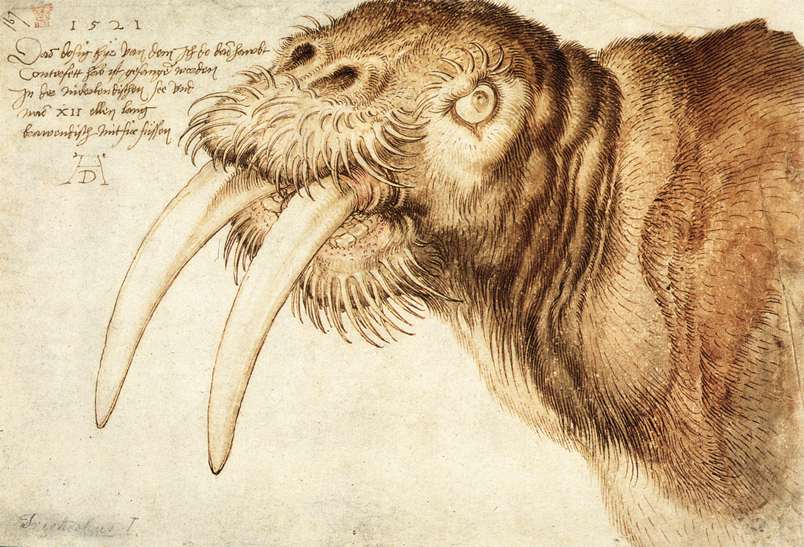
The tusks reach so far down the sheet that they seem almost to pull the walrus's head after them. Above their pale curves, whiskers spring in every direction around a muzzle crowded with folds and bristles. One round eye looks outward from the mass. Albrecht Dürer's Walrus , dated 1521, gives this unfamiliar creature an arresting presence, although the circumstances of its making remain uncertain. The British Museum holds the drawing: pen and brown ink with watercolour on paper, measuring 21.1 × 31.2 centimetres. [1]
The head enters from the right, filling most of the available space. Its muzzle points towards the upper left while the neck slopes away towards the lower right. The animal seems close enough to touch, yet there is no ground beneath it and no sea behind it. Its isolation makes looking unusually concentrated. We can follow individual hairs, the rims of the nostrils and the small teeth visible behind the tusks without being distracted by a larger scene. At the same time, the abrupt arrival of the neck from beyond the paper leaves the rest of the creature unresolved.
Dürer makes much of the difference between the tusks and everything surrounding them. Their long surfaces have comparatively little internal marking. Fine outlines establish their swelling roots and narrowing tips; a little shading helps each turn in space. Against these almost empty shapes, the short strokes covering the head look exceptionally dense. The two tusks also differ in length and angle as they appear on the sheet. They create an uneven, open interval between them, through which the pale paper remains visible.
The whiskers demand another kind of line. Some curl back towards the face; others sweep out from the muzzle in separate hooks. Beneath the mouth, longer hanging strands mingle with the short marks that model the jaw. Around the eye, curved strokes form a conspicuous fringe, making that small area compete with the tusks for attention. The eye's light centre and dark outline give it a glassy, almost staring quality. That appearance is part of the drawing's effect; it cannot tell us whether a living animal was looking back at the artist.
Along the neck, close hatching gathers into dark bands and then loosens into exposed patches of paper. Individual lines often follow the bends of the surface, so that texture also explains volume. The brown colour works through this network without concealing its structure. In the darkest areas the neck seems thick and corrugated; towards the lower edge the strokes grow more scattered and the form begins to dissolve. There is a striking difference between the compact, intricate face and the less firmly contained extremity of the study.
At a Glance
- Date 1521 [1]
- Materials Pen and brown ink with watercolour [1]
- Collection British Museum, London [1]
This work across Albrecht Dürer’s career
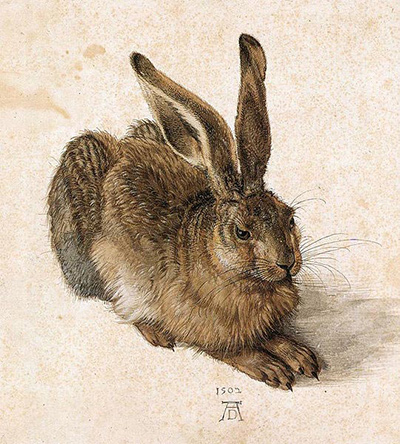
Young Hare
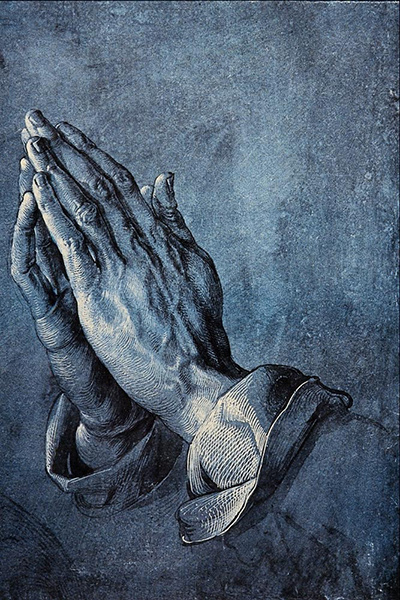
1502Praying Hands
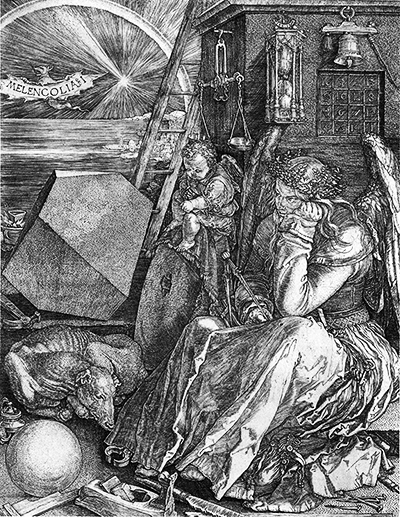
1508Melencolia I
1514Four Apostles
1526Contents
- What the inscription tells us
- A journey towards marine curiosities
- A real head and an invented body
- The walrus becomes a dragon
- Frequently Asked Questions
What the inscription tells us
At the upper left Dürer places a date and several lines of German writing, with his AD monogram beneath. Jean Michel Massing transcribes the inscription in the catalogue Circa 1492 . Its substance is that the animal whose head Dürer has portrayed was caught in the Netherlandish sea, measured twelve Brabant ells in length, and had four feet. The words “XII ellen lang” are plainly a statement about the whole animal, although the drawing shows only its head and part of its neck. [12]
That division between picture and report matters. A reader can inspect how the artist describes a nostril or the direction of a whisker. The length and the four feet must be accepted as information supplied in words. The inscription does not say that Dürer measured the animal himself. Nor does it name the creature. The modern title supplies a confident identification that the writing on the sheet does not attempt.
Twelve Brabant ells would amount to a little over eight metres, an excessive length for a walrus. The British Museum notes the discrepancy and considers a dead, possibly preserved specimen the likely subject. A head separated from its body could offer the artist abundant detail while leaving him dependent on someone else's account of the creature's dimensions. That possibility explains the kind of knowledge preserved here, but it does not establish a particular encounter. The unusually narrow neck and staring eye can encourage questions about the model without providing a record of where, when or how it was obtained. [1]
The writing also changes the rhythm of the composition. Its short horizontal lines occupy the otherwise empty corner beside the much larger head. The date stands apart above them, while the monogram anchors the group below. Tusks, text and face have room around them, even though the animal crowds the opposite edge. The sheet therefore remains readable both as an image and as a record: the viewer moves between a body intensely examined and a body described but largely unseen.
A journey towards marine curiosities
Dürer's Netherlandish diary contains no walrus encounter. It does, however, preserve a revealing episode involving another sea animal. Before his December 1520 excursion to Zeeland, he recorded news of an enormous stranded whale at Zierikzee. The account emphasised its reported size, the difficulty of processing its body and local fears of the smell. When he reached the place, the tide had already taken the whale away. [1] [13]
The surrounding entries make the pursuit tangible. Dürer describes the cold of a night at anchor without food or drink, his passage through the watery landscape and a frightening accident at Arnemuiden. Another ship struck his boat as passengers were landing; its rope broke and the wind drove the remaining people back out to sea. They managed to raise a small sail and return towards shore, where help finally reached them. This is a vivid record of the effort involved in travelling to look, even when the desired sight escaped him. [13]
The diary also records small, portable pieces of the natural world moving between people. Lazarus of Ravensburg gave him shells, dried fish, coral and a large fish scale in exchange for books. Such entries make it easier to imagine how an artist might meet an animal through its separated parts. They do not identify the model for Walrus . They show a setting in which a specimen, a verbal account and a drawing could each carry knowledge farther than the animal itself travelled. [13]
A real head and an invented body
A later printed source allows us to see that problem being discussed explicitly. In his Nomenclator aquatilium animantium , published in Zurich in 1560, Conrad Gessner included a tusked creature under the heading Rosmari . The woodcut on page 178 supplies an elongated body with limbs, claws, a broad fin-like form and a divided tail. Its head is tilted sharply upwards, so that the tusks point towards the top of the page. The caption connects the image with a representation on cloth displayed in the town hall at Strasbourg. [14]
Gessner's accompanying Latin text qualifies the evidence. He reports that only the head in that representation was based on a real head's skeletal structure; the remainder of the body had been added through conjecture or description. He also discusses the direction of the tusks and the difficulty of interpreting the appendages of large aquatic creatures. The German verse printed below the image and continued overleaf speaks in the animal's own voice. It associates the head with a bishop of Nidaros and Pope Leo, and explicitly names Strasbourg. [14]
This is a different image from Dürer's sheet, and the relationship between the surviving head study and the papal specimen has been disputed. The British Museum considers it unlikely that Dürer drew the particular head sent by Archbishop Erik Walkendorf. The Gessner pages nevertheless offer a valuable comparison in method. They distinguish what could be inspected from what had to be reconstructed, even as the illustration joins those different kinds of evidence into one continuous animal. [1]
Historian Erling Sandmo uses such walrus accounts to examine how images, objects and narratives combined to produce knowledge in the sixteenth century. His discussion is especially useful for understanding why a natural-history book might preserve both an anatomical reservation and a speaking animal's story. Dürer's drawing is more restrained in what it pictures. Its accompanying words extend beyond the visible fragment, but the artist leaves the missing feet and body undrawn. The sheet allows that gap to remain open. [15]
The walrus becomes a dragon
Dürer found another use for the head in 1522. In a design for a Virgin and Child surrounded by saints and music-making angels, now in the Musée Bonnat-Helleu at Bayonne, it reappears as the head of Saint Margaret's dragon. The National Gallery's catalogue supplement identifies the pen-and-brown-ink sheet as inventory 1275/1504, measuring 40.1 × 30.7 centimetres. [12] [16]
In the composition, the Virgin and Child occupy an elevated central throne. Standing saints flank them, while seated figures and musicians fill the lower zone. Near the bottom edge, the animal head lies at an oblique angle. Its round eye, projecting muzzle and spreading whiskers remain recognisable in the much quicker drawing. The isolated study's compact modelling has become a handful of mobile outlines within a crowded assembly. [17]
This change of scale and treatment is revealing. In the 1521 sheet, the head monopolises attention: its textures provide the subject. In the Bayonne design it becomes one element among many, contributing an unusual shape to the foreground and helping identify a saint. Dürer could retain the animal's conspicuous features while giving them a new narrative function. Close study supplied material for invention.
The larger painting associated with these designs appears never to have been executed. As Stijn Alsteens explains in Dürer and Beyond , the project survives through drawings of different types and degrees of finish; its commission remains poorly documented. The dragon therefore belongs to a developing composition, rather than to a surviving completed altarpiece. Its presence does not prove that the walrus study was originally made for that purpose. It shows that the head remained available for reuse. [18]
The sheet itself later entered another setting devoted to animals. It belonged to Sir Hans Sloane's collection, acquired by the British Museum in 1753, and was formerly in an album of 167 quadruped drawings. The album transferred from Manuscripts to Prints and Drawings in 1886; the number describes the album's contents, not a series made by Dürer. That collecting history gave the head a place among other animal records. Its earlier transformation at Bayonne reveals another life: the strange creature carefully preserved on paper could also enter the imagined world of a religious picture. [1]
Frequently Asked Questions
Artworks directory
These 187 records include individual works, reverse sides, detail views, paired panels and reconstructed arrangements. Three additional catalogue images repeat works already listed. Related views are not counted as separate originals; qualified attributions and published dating are retained.
Discussion
Look again at the images and ideas explored in Walrus by Albrecht Dürer. These editorial prompts invite your observations.
Reader Insights
Which detail or idea in Walrus by Albrecht Dürer most changed your reading, and why?
How does the discussion of “What the inscription tells us” affect your understanding?
What comparison would you bring to the discussion of “The walrus becomes a dragon”?
Join the Conversation
Share a detail, comparison or question about Walrus by Albrecht Dürer below.
References
- British Museum , The head of a walrus , SL,5261.167, current collection record and curator's commentary. View source .
- ALBERTINA, Selbstbildnis als Dreizehnjähriger, inv. 4839 (German). View source.
- Metropolitan Museum, Four Horsemen from The Apocalypse, 19.73.209 (English). View source.
- Bayerische Staatsgemäldesammlungen, Selbstbildnis im Pelzrock, inv. 537 (German). View source.
- ALBERTINA, Feldhase, inv. 3073 (German). View source.
- ALBERTINA, Das große Rasenstück, inv. 3075 (German). View source.
- Metropolitan Museum, Adam and Eve, 19.73.1 (English). View source.
- ALBERTINA, Betende Hände, inv. 3113 (German). View source.
- Metropolitan Museum, Knight, Death, and the Devil, 43.106.2 (English). View source.
- Metropolitan Museum, Melencolia I, 43.106.1 (English). View source.
- Bayerische Staatsgemäldesammlungen, inventory 545: current collection record (German; descriptive citation). View source.
- Jean Michel Massing , “Head of a Walrus,” catalogue 207, pp. 300–301, and “The Quest for the Exotic: Albrecht Dürer in the Netherlands,” p. 116 and p. 118, notes 20–25, in Jay A. Levenson, ed., Circa 1492: Art in the Age of Exploration , National Gallery of Art, 1991. English; German inscription transcribed. View source .
- Albrecht Dürer , Records of Journeys to Venice and the Low Countries , translated by Rudolph Tombo, 1913: diary passages preceding and under “Visit to Zeeland,” and the beginning of “At Antwerp (December, 1520–April, 1521).” English translation of German primary text. View source .
- Conrad Gessner , Nomenclator aquatilium animantium: Icones animalium aquatilium , Zurich: Christoph Froschauer, 1560, pp. 178–179. ETH-Bibliothek Zürich, Rar 9734:1. Latin and German primary text. View source .
- Erling Sandmo , “Circulation and monstrosity: The sea-pig and the walrus as objects of knowledge in the sixteenth century,” in Johan Östling et al., eds., Circulation of Knowledge: Explorations in the History of Knowledge , Nordic Academic Press, 2018, pp. 186–189 and notes 17–37, pp. 195–196. View source .
- Christof Metzger , “Dürer's Drawings from the Netherlandish Journey,” Dürer's Journeys: Travels of a Renaissance Artist—Catalogue Supplement , National Gallery Company, 2021, p. 65: Virgin and Child Enthroned, Eight Saints and Music-making Angels , Bayonne 1275/1504, Winkler 855, Strauss 1522/1. View source .
- *Studies for a large picture of Mary: Mary with the Child , Saints and Angels Playing Music*, reproduction of the dated 1522 Bayonne composition. View source .
- Stijn Alsteens , catalogue entries 10–11, pp. 24–27, in Stijn Alsteens and Freyda Spira, with Maryan W. Ainsworth, Dürer and Beyond: Central European Drawings, 1400–1700 , Metropolitan Museum of Art, 2012. View source .
- Germanisches Nationalmuseum, Barbara Dürer (German and English). View source.
- Web Gallery of Art, Tucher–Rieter reverse (English). View source.
- National Gallery of Art, Portrait of a Clergyman (English). View source.
- Dürer Art, Portrait of a Man (English). View source.
- Hessen Kassel Heritage, Elsbeth Tucher (German). View source.
- Web Gallery of Art, Hans Tucher (English). View source.
- Germanisches Nationalmuseum, Emperor Maximilian I (German and English). View source.
- National Gallery of Art, Lot and His Daughters, reverse (English). View source.
- Bayerische Staatsgemäldesammlungen, Glim Lamentation (German). View source.
- Museo Nacional del Prado, Portrait of a Man (Spanish). View source.
- Bayerische Staatsgemäldesammlungen, Madonna of the Carnation (German). View source.
- Städel Museum, Job on the Dungheap (German). View source.
- Wallraf-Richartz-Museum, Piper and Drummer (German). View source.
- Italian Ministry of Culture / Uffizi, Head of Saint James (Italian). View source.
- Klassik Stiftung Weimar, Dresden Altarpiece (German). View source.
- Staatliche Museen zu Berlin, Girl with a Red Beret (German and English). View source.
- Dresden State Art Museums / Roland Enke, Bernhard von Reesen (German). View source.
- Royal Collection Trust, Burkhard von Speyer (English). View source.
- Dresden State Art Museums, Seven Sorrows of the Virgin (English). View source.
- Bayerische Staatsgemäldesammlungen, Mater Dolorosa (German). View source.
- Bayerische Staatsgemäldesammlungen, Lucretia (German). View source.
- Städel Museum, Young Woman with Her Hair Down (English). View source.
- ALBERTINA, Portrait of a Young Man (German). View source.