 by
Tom Gurney
Tom Gurney BSc (Hons) is an art history expert with over 20 years experience
Published on June 19, 2020 / Updated on October 22, 2026
Email:
tomgurney1@gmail.com
/ Phone:
+44 7429 011000
Madonna with the Swaddled Infant: Introduction
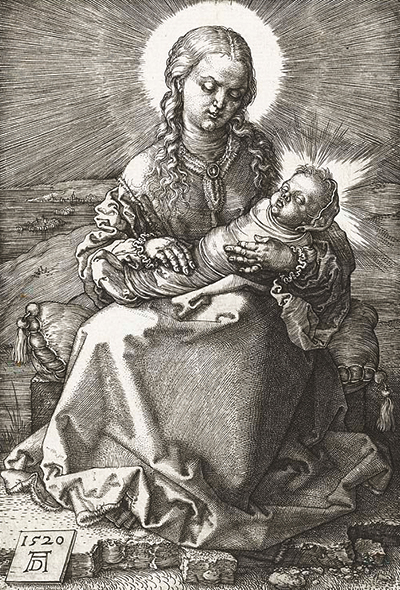
Albrecht Dürer's Madonna with the Swaddled Infant of 1520 concentrates a vast radiance around a quiet act of holding. Mary sits on a cushion, looking down at the sleeping Christ, whose wrapped body lies across her lap. Her hands make his weight tangible; the light spreading behind their heads declares the sacred identity of this apparently familiar pair. The work is an engraving, printed on paper from a metal plate. One impression in the Metropolitan Museum of Art, titled The Virgin with the Swaddled Child , measures just 14.2 × 9.6 centimetres. Within that small area, Dürer gives the figures a presence that nearly fills the sheet. [1]
The date and the familiar AD monogram appear together on a tablet at the lower left. Print catalogues identify the design as Bartsch 38 and Meder 40; these numbers help distinguish it from Dürer's many other images of the Virgin and Child, whose English titles can sound very similar. Its defining feature is the infant's swaddling: an elongated bundle, with only the head emerging, supported across the mother's arms. [2]
At a Glance
This work across Albrecht Dürer’s career
Young Hare
1502Praying Hands
1508Melencolia I
1514Four Apostles
1526Contents
- Holding the child
- Light, line and distance
- Swaddling and devotion
- Different impressions, different responses
- Frequently Asked Questions
Holding the child
The child slopes upwards from left to right, interrupting the broad triangle of Mary's body and skirt. His head turns slightly towards her, with closed eyes and a relaxed mouth. The wrapping replaces the usual opportunities to display tiny limbs with a compact succession of overlapping bands. Near the feet, the cloth gathers into soft, irregular folds; towards his shoulders it becomes a smoother enclosing sheath. Even without the movement of arms and legs, the infant has a distinct bodily presence. His head seems particularly exposed beside the firm wrapping below it.
Mary's hands answer that change of texture. The hand on the left rests across the lower part of the bundle, its fingers separate and gently curved. The hand on the right spreads beneath his upper body, beside a frilled cuff. Dürer makes these fingers prominent against the relatively pale cloth. Looking from one hand to the other, the viewer can follow how the infant is held. The grouping feels composed and secure, while the small shifts of the fingers keep it from becoming a rigid emblem.
Mary's head inclines towards the child, and her lowered eyelids repeat his closed eyes. Their faces have different angles, so this resemblance does not become a simple mirror image. Her long hair falls in curls down both shoulders, framing the neck and a jewelled clasp. Beneath it, the pleated neckline and decorated edge of her clothing introduce fine, closely spaced details. These make the broad surfaces below seem larger: her skirt opens into a great area of fabric, stretching over the knees before breaking into angular folds at the ground.
The cushion is equally particular. Its rounded ends project beyond Mary's body, with cords and tassels hanging beside the stone seat. A tassel on either side gives the central group a loose symmetry, although the child's diagonal and Mary's inclined head prevent perfect balance. The softness of the cushion meets the roughness of the bench and the scattered stones below. Dürer lets each material have its own contours, from the tightly twisted cushion end to the chipped edge of a foreground block.
Light, line and distance
Behind Mary's head is a circular reserve of pale paper. Rays run outwards from its edge, reaching almost every part of the upper background. The effect is immediate: the halo reads as a clear disk against a field of restless marks. Yet her face is delicately shaded, particularly around the eyes and under the chin. The pale surround makes that modelling especially distinct.
Christ's halo has a different structure. Three broad groups of rays project around his head, standing out against the surrounding hatching. One reaches upwards beside Mary's hair; another stretches towards the right edge; the third descends behind his shoulder. The two systems of radiance intersect at the most intimate part of the composition, where the mother's face bends towards the infant's. Light therefore enlarges the reach of a relationship expressed through lowered eyes and careful hands.
A narrow opening at the left leads past the figures to water and a distant town. The buildings are tiny, with a low shoreline beyond them. This level distance cuts across the spreading rays and the sloping ground beneath Mary's seat. For a moment the eye can leave the close, densely described foreground and travel to a much more open space. The town remains unobtrusive: none of its small details competes with the infant's face. The view gives the seated pair a world around them without turning their encounter into a busy narrative.
Engraving makes these distinctions through incised marks. A burin cuts grooves into a metal plate; ink held in the grooves transfers to damp paper under pressure. Closely grouped lines create darker passages, while wider intervals allow more paper to show through. Wiping the plate before printing also affects the resulting tone. In this image, rays, curls, cloth and stone all emerge from lines, but the lines behave differently. Long, direct strokes carry light across the sky. Shorter, changing marks turn around the contours of fabric and flesh. [13]
Look especially at the knee beneath the child. A broad pale highlight meets a dark fold, then passes into a finely hatched middle tone. The skirt acquires volume through these transitions. Further down, the folds become sharper and more crowded. Their changes of direction hold the eye close to the surface, while the distant water offers a horizontal release. The apparent calm of the subject depends on an extraordinarily active arrangement of marks.
Swaddling and devotion
The wrapping has a clear biblical connection. In Luke's account of Christ's birth, Mary swaddles her firstborn son and places him in a manger. Swaddling clothes return in the angel's announcement to the shepherds as a sign by which they will recognise the child. The shepherds subsequently find Mary, Joseph and the infant together. Dürer's engraving removes the manger, Joseph and the visitors. It preserves the recognisable condition of the newborn while giving Mary and Christ an outdoor setting entirely their own. [14]
That concentration leaves room for contemplation beyond the events at Bethlehem. Angela Hass, in her study of Dürer's devotional images, connects this engraving with the Madonna Nursing of 1519 and the Madonna Crowned by One Angel of 1520. She treats them as a loosely related group whose different maternal presentations invite different forms of devotion. Her reading of the swaddled infant reaches forward to the Pietà, the image of Mary holding the dead Christ, and therefore to the relationship between Christ's birth and his sacrifice. This is an interpretation of the grouping, rather than a meaning established by swaddling alone. The sleeping face and the quiet support of the body can sustain that association, while the radiance keeps the image firmly within a vision of sacred infancy. [15]
The engraving's small dimensions also matter to the encounter it offers. The minute folds, fingers and distant roofs reward attention from nearby. Mary's gaze remains directed towards the child; neither figure looks out to acknowledge the spectator. The viewer is brought close to an absorbed pair, with time to trace their relationship through the physical details. The intense halo expands their presence, but the infant's vulnerability continues to draw attention back to the arms that hold him.
Dürer's travel records give these Marian prints a life beyond the studio. In August 1520, while in Antwerp, he recorded sending three new images of Mary, along with other engravings, to the sculptor Master Conrad in Lady Margaret's service. Nearby entries describe gifts to Portuguese contacts which also included three new Virgins. Hass associates the three recent Marian engravings with these grouped gifts. The diary itself uses brief subject descriptions rather than a list of their modern catalogue titles. Even with that limit, it supplies valuable evidence of new Marian images circulating together through Dürer's personal and artistic connections. A work inviting solitary looking could also become part of an exchange between people. [16] [15]
Different impressions, different responses
The printing of the design has attracted unusually close attention. In his 1897 Grolier Club catalogue, S. R. Koehler described two impressions of the swaddled Virgin whose effects differed through the handling of ink. In one, the deepest shadows at the lower right retained a heavy tint, while the principal lights and much of the distant landscape were wiped clearer. In the other, more extensive tinting produced a richer unity but reduced the sense of open distance. He considered both fine impressions. His account shows why a print's appearance cannot be understood from the engraved lines alone. The degree of ink left on the plate could strengthen shadows or bring the background perceptually forward. [17]
Each surviving sheet also has its own history. The Met impression, accession 68.793.46, entered the museum as a gift from Mrs George Khuner in 1968, from the George Khuner Collection. That information identifies a particular object, not the whole design's passage through time. Other impressions preserve the composition in other collections, with their own dimensions, condition and ownership records. A reproduction allows the arrangement to be studied; it cannot communicate every difference between the physical sheets. [1]
The subject's very familiarity has divided critics. In the 1905 edition of Fine Prints , Frederick Wedmore defended the engraving against an assessment by C. H. Middleton-Wake which he quoted as finding little charm or dignity in a scene drawn from bourgeois life. Wedmore accepted the connection with ordinary life and valued it. He admired the work's naturalness and singled out the small stretch of water and distant town. His defence makes a revealing question visible: should a devotional image separate its sacred figures from everyday experience, or can their recognisable humanity help make the image compelling? [18]
Wedmore's response also returns attention to the landscape. His suggestion of a Venetian recollection was tentative, and the shoreline need not be identified as a particular place to appreciate its role. The distant town opens the composition at the left, just as the infant's halo opens it at the right. Between them Mary remains substantial and still. The engraving's intimacy comes from this combination of reach and concentration: a sky filled with rays, a far shore, and the closely observed pressure of hands around a sleeping child.
Frequently Asked Questions
Artworks directory
These 187 records include individual works, reverse sides, detail views, paired panels and reconstructed arrangements. Three additional catalogue images repeat works already listed. Related views are not counted as separate originals; qualified attributions and published dating are retained.
Discussion
Look again at the images and ideas explored in Madonna with the Swaddled Infant. These editorial prompts invite your observations.
Reader Insights
Which detail or idea in Madonna with the Swaddled Infant most changed your reading, and why?
How does the discussion of “Holding the child” affect your understanding?
What comparison would you bring to the discussion of “Different impressions, different responses”?
Join the Conversation
Share a detail, comparison or question about Madonna with the Swaddled Infant below.
References
- Metropolitan Museum of Art , The Virgin with the Swaddled Child , 1520, accession 68.793.46. View source .
- British Museum , Virgin with the swaddled Child , 1520, museum number E,4.77, including Bartsch and Meder catalogue references. View source .
- ALBERTINA, Selbstbildnis als Dreizehnjähriger, inv. 4839 (German). View source.
- Metropolitan Museum, Four Horsemen from The Apocalypse, 19.73.209 (English). View source.
- Bayerische Staatsgemäldesammlungen, Selbstbildnis im Pelzrock, inv. 537 (German). View source.
- ALBERTINA, Feldhase, inv. 3073 (German). View source.
- ALBERTINA, Das große Rasenstück, inv. 3075 (German). View source.
- Metropolitan Museum, Adam and Eve, 19.73.1 (English). View source.
- ALBERTINA, Betende Hände, inv. 3113 (German). View source.
- Metropolitan Museum, Knight, Death, and the Devil, 43.106.2 (English). View source.
- Metropolitan Museum, Melencolia I, 43.106.1 (English). View source.
- Bayerische Staatsgemäldesammlungen, inventory 545: current collection record (German; descriptive citation). View source.
- Metropolitan Museum of Art , “Engraving,” Materials and Techniques , 21 December 2018. View source .
- Luke 2:1–20 , King James Version. View source .
- Angela Hass , “Albrecht Dürer's devotional images of the Virgin and Child”, Art Bulletin of Victoria 35 (1994), pp. 21–34; republished online 13 June 2014. View source .
- Albrecht Dürer , Records of Journeys to Venice and the Low Countries , Tombo translation, 1913, Netherlandish diary, Antwerp entries preceding the August 1520 visit to Brussels. View source .
- S. R. Koehler , A Chronological Catalogue of the Engravings, Dry-Points and Etchings of Albert Dürer, as Exhibited at the Grolier Club , New York, 1897, no. 95, pp. 80–81. View source .
- Frederick Wedmore , Fine Prints , new and enlarged edition, Edinburgh, 1905, chapter VII, especially p. 143. View source .
- Germanisches Nationalmuseum, Barbara Dürer (German and English). View source.
- Web Gallery of Art, Tucher–Rieter reverse (English). View source.
- National Gallery of Art, Portrait of a Clergyman (English). View source.
- Dürer Art, Portrait of a Man (English). View source.
- Hessen Kassel Heritage, Elsbeth Tucher (German). View source.
- Web Gallery of Art, Hans Tucher (English). View source.
- Germanisches Nationalmuseum, Emperor Maximilian I (German and English). View source.
- National Gallery of Art, Lot and His Daughters, reverse (English). View source.
- Bayerische Staatsgemäldesammlungen, Glim Lamentation (German). View source.
- Museo Nacional del Prado, Portrait of a Man (Spanish). View source.
- Bayerische Staatsgemäldesammlungen, Madonna of the Carnation (German). View source.
- Städel Museum, Job on the Dungheap (German). View source.
- Wallraf-Richartz-Museum, Piper and Drummer (German). View source.
- Italian Ministry of Culture / Uffizi, Head of Saint James (Italian). View source.
- Klassik Stiftung Weimar, Dresden Altarpiece (German). View source.
- Staatliche Museen zu Berlin, Girl with a Red Beret (German and English). View source.
- Dresden State Art Museums / Roland Enke, Bernhard von Reesen (German). View source.
- Royal Collection Trust, Burkhard von Speyer (English). View source.
- Dresden State Art Museums, Seven Sorrows of the Virgin (English). View source.
- Bayerische Staatsgemäldesammlungen, Mater Dolorosa (German). View source.
- Bayerische Staatsgemäldesammlungen, Lucretia (German). View source.
- Städel Museum, Young Woman with Her Hair Down (English). View source.
- ALBERTINA, Portrait of a Young Man (German). View source.