 by
Tom Gurney
Tom Gurney BSc (Hons) is an art history expert with over 20 years experience
Published on June 19, 2020 / Updated on October 22, 2026
Email:
tomgurney1@gmail.com
/ Phone:
+44 7429 011000
The Madonna with the Iris: Introduction
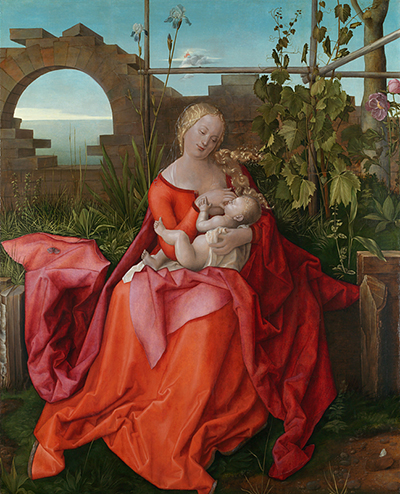
Mary's red clothing spreads across the garden as expansively as the plants around her. The Child lies across her lap, his feet lifted, his head supported close to her breast. Above them, an iris reaches into the sky. The National Gallery in London identifies this large painting, NG5592, as Workshop of Albrecht Dürer with Hans Baldung Grien , possibly 1503–08. It is painted in oil on limewood and measures 149.2 × 117.2 centimetres. [1]
The combination of intimate action and generous space makes the picture absorbing before its disputed authorship enters the discussion. Mary inclines her head towards her son, while the folds of her dress carry the eye down towards the foreground. The garden gathers around this small exchange of looks and touch. Yet the architecture opens onto a distant, almost empty sea, allowing the closeness of the figures to coexist with an unexpectedly extensive world.
At a Glance
- Current attribution Workshop of Albrecht Dürer with Hans Baldung Grien [1]
- Date Possibly 1503–1508 [1]
- Collection National Gallery, London; NG5592 [1]
- TypePainting [1]
This work across Albrecht Dürer’s career
Young Hare
1502The Madonna with the Iris (current article)
Possibly 1503–1508Praying Hands
1508Melencolia I
1514Four Apostles
1526Contents
- A garden built around an embrace
- Flowers and future sorrow
- The garden and the drawing collection
- Layers beneath the surface
- Why the attribution mattered
- Frequently Asked Questions
A garden built around an embrace
The figures occupy the centre, but their surroundings are deliberately unequal. On the left, the broken arch creates a large opening, its blocks exposed against the blue sky. On the right, a tree and a thick curtain of leaves close the space. The iris stands between Mary's head and the arch; the vine grows beside her flowing hair. These vertical forms keep the figure from seeming isolated against the wall. They also lead upwards from the broad red base of the composition towards the comparatively narrow strip of sky.
The garden's carpentry is much plainer than its vegetation. Upright boards retain the earth of the bench, while long poles carry the vine above the figures. Their horizontal and vertical lines make a light framework around Mary's head. The arch is heavier and less regular: its broken crest interrupts the upper outline, while the open curve frames water and a low horizon. Looking from the foreground to the distance means passing through several different kinds of boundary—wood, plants, masonry and, finally, the rim of the sea.
Mary's clothing creates another kind of landscape. The orange-red dress descends in long slopes; the deeper red mantle bunches into hollows and sharp turns. A pale pink lining opens out over the bench at the left and falls across her knees. The cloth changes direction so often that its edges seem almost to move while her body remains still. Small blades of grass cross its lower margins. The resulting meeting between textile and vegetation is particularly effective: the cloth occupies the garden, yet the garden continues to grow around it.
The Child's lifted legs and bent arms give his body a rounded, compact energy. Mary's supporting hand answers that movement, her fingers spread along his side. The pale skin of both figures forms a small, luminous group within the red clothing. Her lowered eyes, his turned head and the curve of the supporting arm draw attention towards the act of feeding. The picture asks the viewer to linger over the weight and dependence of an infant.
Flowers and future sorrow
The Gallery interprets the enclosure as Mary's virginity, the sword-shaped iris as her sorrow, and the vine as the Eucharist. These associations connect the garden's present abundance with events beyond the moment represented. [1]
The biblical imagery is bodily and sensuous. The Song of Solomon compares its speaker to a rose and a lily (2:1). Later, the beloved becomes a garden, a sealed spring and a source of living water; the surrounding verses evoke fragrance, fruit, honey and milk (4:9–16). In the painting, vegetation shelters a mother who gives nourishment. The parallel is suggestive without requiring every plant to correspond to a separate line of scripture. The garden's richness can be experienced as a whole, while individual forms sharpen particular meanings. [12]
The iris supplies the most pointed example. Its long leaves rise beside the vulnerable bodies of mother and child. In Luke's account of the Presentation, Simeon blesses them, then tells Mary that a sword will pierce her own soul. Read through the Gallery's interpretation, the leaves introduce that prospect into the peaceful scene. Their upright edges differ markedly from the soft curls of hair and the Child's rounded limbs. The plant contributes to the composition through the very shape that makes its religious association intelligible. [13]
Above Mary's shoulder, the vine's leaves hang at different angles, some showing a pale underside and others turning dark. Its wiry tendrils extend beyond the larger foliage. Close looking repeatedly shifts scale: from the whole enclosing canopy to an individual leaf, from the leaf to a curling thread. The image rewards that movement between abundance and minuteness. Its devotional setting remains physically particular, with supports, stems, cut edges and uneven masonry.
The garden and the drawing collection
The relationship to Dürer's nature studies becomes especially clear beside the Blue Flag Iris in Bremen, dated about 1503. On that narrow sheet, long stems divide towards separate flower heads, while pointed leaves gather near the bottom. In the painting, the same general organisation rises from behind the bench. Against the study's pale background, each stem can be followed without interruption; in the garden, the wall, poles and other plants compete with it. The flower has acquired a different visual task, marking a transition between Mary's sheltered space and the open sky. [14]
Schongauer's Studies of Peonies , about 1472–73, offers another revealing comparison. The Getty sheet presents an open flower from the front, another from behind and a closed bud. Its different views make the flower's structure unusually legible. At the painting's right edge, the peonies likewise turn in different directions, their pink petals set against green leaves and blue sky. Seen together, the works suggest how closely studied forms could become part of a much larger arrangement. The Gallery connects these flowers with Schongauer's study, which Dürer probably owned. [15] [1]
The Great Piece of Turf provides a different point of comparison. Its mass of interwoven grasses rises from visible soil, with broad leaves opening among the finer stems. The left side of the painting similarly combines a dense thicket of narrow growth with a few more conspicuous leaves. The drawing gives the plants the entire field of attention. Here, their fine, tangled rhythms accompany the much larger rhythms of drapery. A viewer can recognise a shared interest in differentiated growth without treating the whole garden as a mechanically assembled copy of one sheet. [6]
Layers beneath the surface
The examination published by Paul Ackroyd and colleagues in 2000 found eight vertical lime planks, wooden inserts replacing knots and fibre reinforcement. Infrared imaging revealed detailed figure drawing, a cancelled rose and a repositioned iris; the arch, further plants and God the Father developed during painting. The panel's distorting 1945 cradle was removed in the 1996 treatment. [16]
The false AD monogram lies over copal-containing repaint of the eighteenth or nineteenth century. The earlier 1508 date lies over varnish, as do the veil and butterfly. The researchers considered these additions potentially close to the first campaign; copies thought to be sixteenth-century already include veil and butterfly. Period materials support an early origin, but cannot establish Dürer's hand. Purchased as a Dürer in 1945, the painting was relabelled in 1948 and classified by Michael Levey in 1959 as an imitator's work. The 2000 study reopened the workshop argument. [16]
The red clothing has also changed. Kirby, Spring and Higgitt's later pigment study distinguishes a lower lake layer containing mainly madder from an upper layer containing mainly kermes. Protein and organic sulphur in the lower pigment suggest extraction of its dye from wool. The 2000 examination found stronger red preserved beneath overlapping paint, evidence of fading elsewhere. [17] [16]
These findings make the present colour relationships especially interesting. The pink expanses at the left and across Mary's lap now contrast strongly with the orange-red dress and dark mantle. Their current appearance should not be mistaken for a perfectly preserved original colour scheme. Even so, the arrangement of light and dark folds remains readily visible. The picture's material history and its formal organisation can be considered together, without a speculative reconstruction of exactly how every passage once looked.
Why the attribution mattered
Recorded in Felsenberg's Vienna collection by 1821, the painting was later offered unsuccessfully to the National Gallery by Peter Hubert Desvignes in 1872. Sir Francis Cook acquired it in 1892; the Gallery bought it through the National Art-Collections Fund in 1945. Long before that purchase, critics were arguing over the relationship between the imposing composition and its execution. [1]
In 1905, the poet and artist T. Sturge Moore admired the design while hesitating to accept the Cook picture as Dürer's own handiwork. He thought its handling heavy and inactive, allowing that restoration might have affected it. Yet he defended the profusion of drapery against Campbell Dodgson's criticism, regarding its great mass as central to Dürer's imagination. His response remains useful because it locates an actual visual tension: a very quiet group is carried by exceptionally restless cloth. The clothing can dominate a first impression, although the mother and child occupy its centre. [18]
Charles Ricketts reached a different conclusion in his review of the Burlington Fine Arts Club exhibition in 1906. He assigned the painting to Baldung, then often called Grien or Grün, pointing to its colour and conspicuous yellow hair. He praised it highly under that attribution. His argument shows that doubt about Dürer's personal execution did not always mean dismissal of the work's quality. Looking again at the cascade of golden curls beside the Child, one can understand why a critic might make such a vivid passage carry considerable weight. The difficulty lies in turning that perception into a secure division of authorship across the entire panel. [19]
Discussion has continued into recent scholarship. In Albrecht Dürer: Die Sprache seiner Gewänder (2022), Reinhard Liess makes this Madonna central to his discussion of turf-bench Virgins and seeks to strengthen the case for Dürer's authorship through its formal and expressive qualities. That declared aim differs from the Gallery's current attribution. It also demonstrates the continuing importance of the drapery to the debate: folds can be considered evidence of invention as well as objects of technical investigation. [20]
The painting offers ample reason to keep looking while those distinctions remain qualified. The broken arch opens the garden towards distance; the trellis draws its branches back around the figures. The iris stands tall beside a bowed head. Across the lower half, a great spread of cloth supports an infant small enough to rest in one arm. These relationships give the work its particular character, and remain visible through the changes of surface and judgement that have shaped its history.
Frequently Asked Questions
Artworks directory
These 187 records include individual works, reverse sides, detail views, paired panels and reconstructed arrangements. Three additional catalogue images repeat works already listed. Related views are not counted as separate originals; qualified attributions and published dating are retained.
Discussion
Look again at the images and ideas explored in The Madonna with the Iris. These editorial prompts invite your observations.
Reader Insights
Which detail or idea in The Madonna with the Iris most changed your reading, and why?
How does the discussion of “A garden built around an embrace” affect your understanding?
What comparison would you bring to the discussion of “Why the attribution mattered”?
Join the Conversation
Share a detail, comparison or question about The Madonna with the Iris below.
References
- National Gallery , The Virgin and Child ('The Madonna with the Iris') , NG5592, current collection record, overview, in-depth account and provenance extract from Susan Foister, The German Paintings before 1800 (2024). English. View source .
- ALBERTINA, Selbstbildnis als Dreizehnjähriger, inv. 4839 (German). View source.
- Metropolitan Museum, Four Horsemen from The Apocalypse, 19.73.209 (English). View source.
- Bayerische Staatsgemäldesammlungen, Selbstbildnis im Pelzrock, inv. 537 (German). View source.
- ALBERTINA, Feldhase, inv. 3073 (German). View source.
- ALBERTINA , Das große Rasenstück , 3075. German. View source .
- Metropolitan Museum, Adam and Eve, 19.73.1 (English). View source.
- ALBERTINA, Betende Hände, inv. 3113 (German). View source.
- Metropolitan Museum, Knight, Death, and the Devil, 43.106.2 (English). View source.
- Metropolitan Museum, Melencolia I, 43.106.1 (English). View source.
- Bayerische Staatsgemäldesammlungen, inventory 545: current collection record (German; descriptive citation). View source.
- Song of Solomon , 2:1 and 4:9–16, King James Version. English translation. View source 1 . View source 2 .
- Luke 2:25–35 , King James Version. English translation. View source .
- Kunsthalle Bremen , Blue Flag Iris , collection presentation on Google Arts & Culture. English. View source .
- J. Paul Getty Museum , Studies of Peonies , 92.GC.80, collection presentation on Google Arts & Culture. English. View source .
- Paul Ackroyd , Susan Foister, Marika Spring, Raymond White and Rachel Billinge, “A Virgin and Child from the Workshop of Albrecht Dürer?”, National Gallery Technical Bulletin 21 (2000), pp. 28–42. English. View source .
- Jo Kirby , Marika Spring and Catherine Higgitt, “The Technology of Red Lake Pigment Manufacture: Study of the Dyestuff Substrate”, National Gallery Technical Bulletin 26 (2005), pp. 71–87, especially pp. 77–78 and Table 1, p. 86. English. View source .
- T. Sturge Moore , Albert Dürer (1905), Part III, “Dürer's Pictures,” section VII. English. View source .
- Charles Ricketts , “Early German Art at the Burlington Fine Arts Club, III: Dürer and His Successors”, The Burlington Magazine 9 (1906), pp. 264–68, especially p. 267. English. View source .
- Reinhard Liess , Albrecht Dürer: Die Sprache seiner Gewänder (Petersberg: Michael Imhof Verlag, 2022), publisher's selected preview, especially p. 88. German. View source .
- Germanisches Nationalmuseum, Barbara Dürer (German and English). View source.
- Web Gallery of Art, Tucher–Rieter reverse (English). View source.
- National Gallery of Art, Portrait of a Clergyman (English). View source.
- Dürer Art, Portrait of a Man (English). View source.
- Hessen Kassel Heritage, Elsbeth Tucher (German). View source.
- Web Gallery of Art, Hans Tucher (English). View source.
- Germanisches Nationalmuseum, Emperor Maximilian I (German and English). View source.
- National Gallery of Art, Lot and His Daughters, reverse (English). View source.
- Bayerische Staatsgemäldesammlungen, Glim Lamentation (German). View source.
- Museo Nacional del Prado, Portrait of a Man (Spanish). View source.
- Bayerische Staatsgemäldesammlungen, Madonna of the Carnation (German). View source.
- Städel Museum, Job on the Dungheap (German). View source.
- Wallraf-Richartz-Museum, Piper and Drummer (German). View source.
- Italian Ministry of Culture / Uffizi, Head of Saint James (Italian). View source.
- Klassik Stiftung Weimar, Dresden Altarpiece (German). View source.
- Staatliche Museen zu Berlin, Girl with a Red Beret (German and English). View source.
- Dresden State Art Museums / Roland Enke, Bernhard von Reesen (German). View source.
- Royal Collection Trust, Burkhard von Speyer (English). View source.
- Dresden State Art Museums, Seven Sorrows of the Virgin (English). View source.
- Bayerische Staatsgemäldesammlungen, Mater Dolorosa (German). View source.
- Bayerische Staatsgemäldesammlungen, Lucretia (German). View source.
- Städel Museum, Young Woman with Her Hair Down (English). View source.
- ALBERTINA, Portrait of a Young Man (German). View source.