 by
Tom Gurney
Tom Gurney BSc (Hons) is an art history expert with over 20 years experience
Published on June 19, 2020 / Updated on October 22, 2026
Email:
tomgurney1@gmail.com
/ Phone:
+44 7429 011000
Three Studies of a Helmet: Introduction
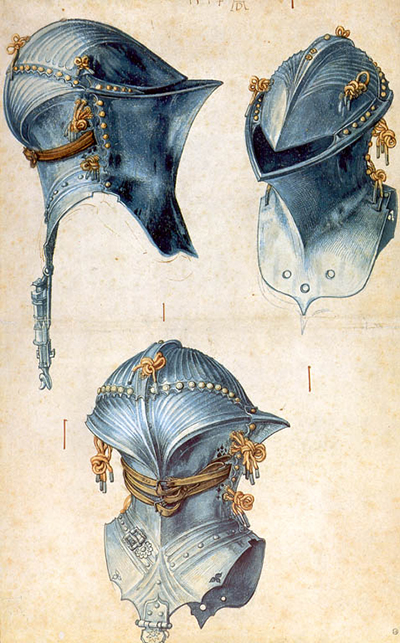
A metal helmet can be surprisingly difficult to understand from a single view. Its rim projects beyond its shell; openings cut into the surface; straps disappear around the back. In Three Studies of a Helmet , Albrecht Dürer turns the same complicated object through three positions, allowing one view to explain another. Blue-grey metal fills much of the sheet, enlivened by warm, golden-brown ties. The Louvre dates this drawing to about 1498–1500 and records its medium as brown pen and ink with watercolour, on a sheet measuring 42.1 × 26.6 centimetres. [1]
There is enough empty paper between the studies to keep each silhouette distinct. The two upper views sit close together, while the third occupies the lower half. Dürer gives the object room to be looked around. A projecting edge which seems sharp and narrow from one position broadens into a sweeping curve from another; a small fitting becomes intelligible when it appears against a different background. The arrangement makes the viewer perform a modest act of reconstruction, joining three flat images into an imagined solid object.
The upper-left study establishes the helmet's profile. The dark faceplate rises to a strong outward lip, above which the rounded crown slopes backwards. Closely spaced ridges travel across the dome, and a line of small, light rivet heads follows its lower boundary. The opening beneath the lip is very dark. Farther down, a large curved cutaway leaves an area of bare paper where the metal ends, with a narrow fastening hanging below. Dürer keeps the outline decisive even where the interior is crowded with hatching and small changes of tone.
The upper-right view opens out the broad plate below the sight slit. Three circular holes punctuate its pale lower portion, arranged above a pointed central tip. The near edge is bright, while the main surface darkens towards the slit. Along the right side, the tied loops and hanging ends catch the eye because their colour differs so strongly from the metal. These small details also help us follow the object's turn: the helmet is recognisable through its fittings as well as through its overall shape.
In the lower study, bands encircle the back of the crown and meet near the centre. Buckles, tied cords, overlapping plates and a small fastening at the bottom become especially conspicuous. The dome fans outward from a central ridge, with thin pale lines running across darker blue. Here the helmet feels assembled from connected parts. Its appearance depends on seams, edges and attachments, each of which must retain its position as the object turns. Looking between the three views gradually reveals this network of relationships. [1]
At a Glance
- Date About 1498–1500 [1]
- Materials Brown pen and ink with watercolour [1]
- Collection Louvre, Paris [1]
This work across Albrecht Dürer’s career
Three Studies of a Helmet (current article)
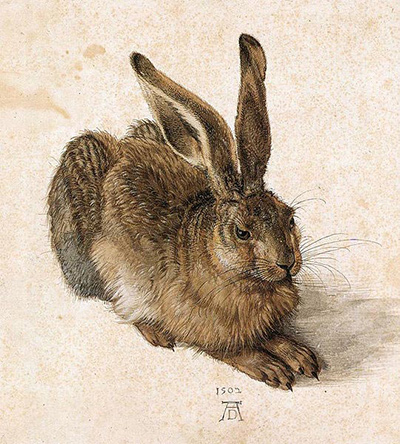
c. 1498–1500Young Hare
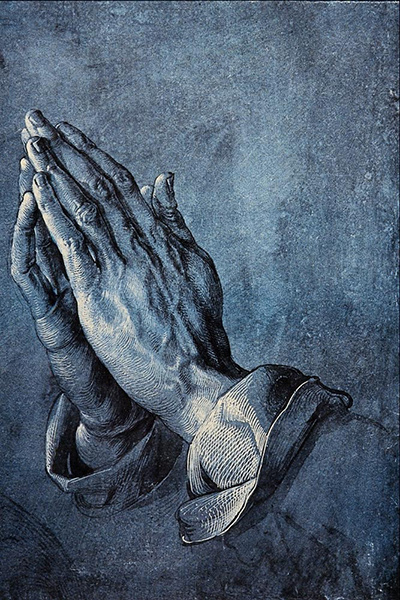
1502Praying Hands
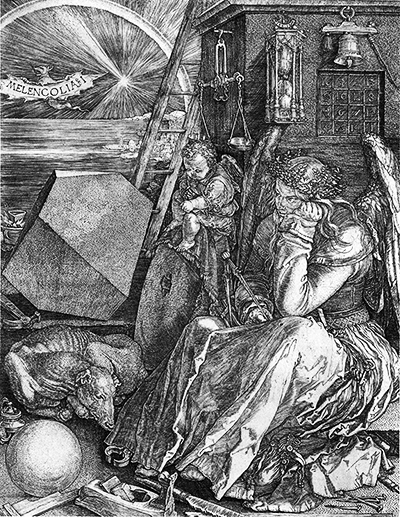
1508Melencolia I
1514Four Apostles
1526Contents
- Armour made for a particular task
- Making metal out of colour and lines
- Dating the sheet and following its later uses
- Frequently Asked Questions
Armour made for a particular task
The helmet belongs to the type known in German as a Stechhelm , often called a frog-mouth helm in English. The name evokes the narrow opening above its projecting lower face. Such equipment was specialised for jousting. A surviving example in the Art Institute of Chicago, dated about 1480, helps explain the practical demands: its heavy front deflected a lance, a hinged steel strap secured it to the breastplate, and internal padding helped restrain the wearer's head. That particular helm weighs more than twenty pounds. These are the Chicago object's documented properties, rather than measurements of the helmet Dürer drew. [12]
This context gives the projecting lip and broad lower plates a purpose. They belong to a protective structure which continued down towards the body. Dürer includes enough of the attachments to suggest how the headpiece could connect with other equipment, but he leaves it isolated. There is no rider, breastplate or tournament setting to complete the explanation. We encounter armour as an object to be examined at close quarters. Its visual elegance remains inseparable from the difficulty of making a rigid shell accommodate a human head.
The ties introduce a different kind of movement. They bend, loop and hang against surfaces that appear hard and resistant. A cord can cross a ridge without sharing its shape; a strap can draw a broad horizontal line around the crown. Dürer's attention moves between these different behaviours. The helmet's construction gives him several drawing problems within one subject: the continuous curve of a shell, the regular repetition of rivets, the thinness of an edge and the irregular knotting of flexible material.
Making metal out of colour and lines
Blue unifies the three studies, but it never settles into a flat local colour. Some areas approach black; others open into broad pale reflections. Bright edges can be followed until they disappear into shadow. Across the crown, repeated curved strokes describe both the ridged surface and its swelling volume. On the faceplate, shorter marks and deeper patches change the rhythm. The apparent weight of the object comes partly from these differences: light slides over the upper shell, while darkness gathers around openings and beneath projecting forms.
In his 1936 catalogue, Friedrich Winkler paid particular attention to the sheet's working process. He identified an initial use of the pen in the upper-left study, followed by an increasing reliance on the brush, and noted opaque white highlights in the lower view. His description also distinguished the colouring of cords, straps and small fittings. It presents the drawing as an evolving technical experiment, with Dürer adjusting his means as he proceeded across the sheet. [13]
Daniel Hess developed this aspect in his contribution to the 2012 Early Dürer exhibition catalogue. He contrasted the freer handling of the first view with the more systematic parallel and crossed hatching of the second, seeing the third as a reconciliation of approaches. For Hess, the studies exemplify Dürer's investigation of how to represent material surfaces convincingly. The interpretation directs attention to something easily missed in a small reproduction: changing the viewpoint also gives the artist an opportunity to change the treatment. [14]
The sheet consequently rewards two different kinds of looking. We can follow the depicted object, asking where a plate joins another or where a strap passes behind the shell. We can also follow the marks which create that object. A small pale dash becomes a raised rivet; closely grouped strokes become a recess; a long curved line becomes the boundary between planes. The transformation remains legible even when the helmet's illusion of solidity is persuasive.
Dating the sheet and following its later uses
The faint date 1514 and monogram at the top of the page cannot settle its chronology: the Louvre identifies those additions as apocryphal. The museum separately records a trace of a blue monogram at the lower left. Its present dating instead places the drawing around 1498–1500. Winkler had already argued for about 1498, comparing its steel-blue colouring with Dürer's Rider in Vienna. The ALBERTINA dates that drawing to 1498 and records the same broad combination of brown pen and watercolour. [1] [13] [15]
Seen together, the two sheets make the comparison understandable. In the Rider , pale linear accents articulate the armour around the shoulder, arm and thigh. Brownish clothing interrupts the cooler metal, just as the warm ties interrupt the helmet studies. The rider wears a different form of head protection, with a raised visor and his face exposed. The relationship concerns Dürer's handling of equipment and coloured surfaces; the drawings show different headpieces serving different pictorial situations. [15]
Two engravings offer a more direct continuation. The Louvre relates the upper-right helmet to the Coat of Arms with a Lion and a Cock , and the upper-left profile to the Coat of Arms with a Skull . The latter bears the date 1503. The cock engraving is undated; the National Gallery of Art places it in 1502/1503. These connections explain why an early study of the helmet matters beyond the boundaries of its own sheet. [16] [17] [18]
In the cock engraving, the helmet occupies the centre of a tall heraldic arrangement. A rooster spreads its wings above it, a lion rises on the shield beneath, and curling ornament fills the sides. The broad, perforated lower plate is particularly useful for comparison with the upper-right drawing. The helmet retains its projecting mouth and pointed lower edge, but the dark ink now has to supply effects previously achieved through blue colour and pale highlights. Its polished surfaces sit among feathers, fur and tightly curling forms, each made distinct through engraved lines. [16]
In the skull engraving, the helmet turns into profile above a large shield carrying a death's head. Huge wings rise from its crest, while a woman and a hairy male figure stand to the left. The headpiece has acquired an elaborate setting, yet its lip and curved lower outline remain recognisable. The profile faces in the opposite direction: the drawing’s lip projects right, the engraved helmet’s left. Comparing the broad contours is more revealing than expecting every fastening to recur unchanged. Following that outline back to the study sheet reveals how a closely examined piece of equipment could become part of a much more inventive composition. The studies supplied a form that could be selected, turned and given new companions. [17]
The surviving drawing later belonged to the painter and collector Léon Bonnat before entering the Louvre through his bequest. Its independent appeal is readily apparent. Even without the engravings, the three views offer an absorbing encounter with an intricate object. Dürer lets its hardness, curvature and flexible attachments emerge through repeated examination. Returning from the prints to the coloured sheet makes the stages of that examination visible again: a helmet takes shape through the patient coordination of outlines, marks and light. [1]
Frequently Asked Questions
Artworks directory
These 187 records include individual works, reverse sides, detail views, paired panels and reconstructed arrangements. Three additional catalogue images repeat works already listed. Related views are not counted as separate originals; qualified attributions and published dating are retained.
Discussion
Look again at the images and ideas explored in Three Studies of a Helmet. These editorial prompts invite your observations.
Reader Insights
Which detail or idea in Three Studies of a Helmet most changed your reading, and why?
How does the discussion of “Armour made for a particular task” affect your understanding?
What comparison would you bring to the discussion of “Dating the sheet and following its later uses”?
Join the Conversation
Share a detail, comparison or question about Three Studies of a Helmet below.
References
- Musée du Louvre , Trois études d'un heaume , RF 5640 recto. French. Current object record, image, materials, dating, inscriptions and provenance; includes Pierrette Jean-Richard's catalogue commentary. View source .
- ALBERTINA, Selbstbildnis als Dreizehnjähriger, inv. 4839 (German). View source.
- Metropolitan Museum, Four Horsemen from The Apocalypse, 19.73.209 (English). View source.
- Bayerische Staatsgemäldesammlungen, Selbstbildnis im Pelzrock, inv. 537 (German). View source.
- ALBERTINA, Feldhase, inv. 3073 (German). View source.
- ALBERTINA, Das große Rasenstück, inv. 3075 (German). View source.
- Metropolitan Museum, Adam and Eve, 19.73.1 (English). View source.
- ALBERTINA, Betende Hände, inv. 3113 (German). View source.
- Metropolitan Museum, Knight, Death, and the Devil, 43.106.2 (English). View source.
- Metropolitan Museum, Melencolia I, 43.106.1 (English). View source.
- Bayerische Staatsgemäldesammlungen, inventory 545: current collection record (German; descriptive citation). View source.
- Art Institute of Chicago , Jousting Helm (Stechhelm) , 1982.2445. Object description and technical information, also available through the museum's collection API. View source 1 . View source 2 .
- Friedrich Winkler , Die Zeichnungen Albrecht Dürers , volume I (1936), no. 177, pp. 118–119, with the continuation on p. 119. German. View source 1 . View source 2 .
- Daniel Hess , “Die Natur als vollkommene Lehrmeisterin der Kunst”, in Daniel Hess and Thomas Eser, eds., Der frühe Dürer (2012), pp. 117–131, especially p. 129. German. View source .
- ALBERTINA , Der Reiter , 3067. German. Current object record and extended catalogue texts. View source .
- Musée du Louvre , Les armoiries du coq , 596 LR recto. French. Object record, image and Pierrette Jean-Richard's commentary. View source .
- Musée du Louvre , Les armoiries à la tête de mort , 597 LR recto. French. Object record, image and Pierrette Jean-Richard's commentary. View source .
- National Gallery of Art , Coat of Arms with a Lion and a Cock , 1949.1.13. Current dating and medium. View source .
- Germanisches Nationalmuseum, Barbara Dürer (German and English). View source.
- Web Gallery of Art, Tucher–Rieter reverse (English). View source.
- National Gallery of Art, Portrait of a Clergyman (English). View source.
- Dürer Art, Portrait of a Man (English). View source.
- Hessen Kassel Heritage, Elsbeth Tucher (German). View source.
- Web Gallery of Art, Hans Tucher (English). View source.
- Germanisches Nationalmuseum, Emperor Maximilian I (German and English). View source.
- National Gallery of Art, Lot and His Daughters, reverse (English). View source.
- Bayerische Staatsgemäldesammlungen, Glim Lamentation (German). View source.
- Museo Nacional del Prado, Portrait of a Man (Spanish). View source.
- Bayerische Staatsgemäldesammlungen, Madonna of the Carnation (German). View source.
- Städel Museum, Job on the Dungheap (German). View source.
- Wallraf-Richartz-Museum, Piper and Drummer (German). View source.
- Italian Ministry of Culture / Uffizi, Head of Saint James (Italian). View source.
- Klassik Stiftung Weimar, Dresden Altarpiece (German). View source.
- Staatliche Museen zu Berlin, Girl with a Red Beret (German and English). View source.
- Dresden State Art Museums / Roland Enke, Bernhard von Reesen (German). View source.
- Royal Collection Trust, Burkhard von Speyer (English). View source.
- Dresden State Art Museums, Seven Sorrows of the Virgin (English). View source.
- Bayerische Staatsgemäldesammlungen, Mater Dolorosa (German). View source.
- Bayerische Staatsgemäldesammlungen, Lucretia (German). View source.
- Städel Museum, Young Woman with Her Hair Down (English). View source.
- ALBERTINA, Portrait of a Young Man (German). View source.