



 by Tom Gurney
Tom Gurney BSc (Hons) is an art history expert with over 20 years experience
Published on June 19, 2020 / Page Updated on November 5, 2026
Email: tomgurney1@gmail.com / Phone: +44 7429 011000
Introduction
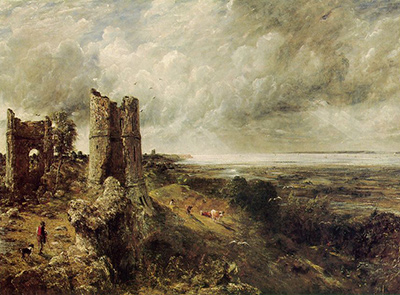
John Constable's paintings are often loved before they are understood. Their fields, rivers, cottages, clouds, mills and cathedral views seem immediately familiar, as though they preserve a natural England that has simply waited for viewers to recognise it. Yet Constable's art is more deliberate, more ambitious and more experimental than that first familiarity suggests. His paintings were built from study, memory, revision, local knowledge and professional struggle. They do not merely show pleasant countryside. They argue that the landscape of Suffolk, Hampstead, Salisbury, Brighton and the Dorset coast could carry the emotional and artistic weight once reserved for more elevated subjects.
The National Gallery summarises the central tension well: Constable made many open-air sketches, but used them as the basis for large exhibition paintings worked up in the studio.[1] That distinction is crucial across his paintings. A finished Constable may feel as if it has captured weather in a single moment, but it is often the result of years of looking and recomposition. An old tree, a river bend, a lock, a cottage wall or a particular cloud effect could pass from sketch to study to full-scale preparation to finished canvas. His paintings feel alive because they hold both immediacy and deliberation.
Constable's subjects were strongly local, but his ambitions were not modest. He wanted landscape painting to matter. He studied earlier painters, especially Dutch landscape artists, Claude, Rubens and Gainsborough, yet he insisted that the English places he knew could sustain a new kind of seriousness.[1] His finest paintings are therefore not simply rural views. They are works of art about belonging, labour, weather, memory, observation and the difficult transformation of experience into paint.
At a Glance
- ArtistJohn Constable
- Life1776–1837 [1]
- TrainingRoyal Academy Schools from 1799 [1]
- Core placesThe Stour Valley, Hampstead, Salisbury, Brighton and Weymouth [2]
- Working methodOpen-air studies developed into studio exhibition paintings [1][4]
- Major sequenceSix large River Stour scenes [2]
- FlagshipThe Hay Wain, exhibited in 1821 [5]
- Preparatory practiceFull-size oil sketches retained the energy of smaller studies [2][5]
- WeatherSky, cloud, light and atmosphere act as structural subjects [2][9]
- ReceptionImportant success in Paris despite slower English recognition [1][5]
Contents
- Introduction
- Browse John Constable Paintings
- Observation, Sketch and Studio
- The Stour Valley Paintings
- The Six-Footers and Royal Academy Ambition
- The Hay Wain as Flagship, Not Shortcut
- Skies, Clouds and Weather
- Salisbury, Cathedral and Late Meaning
- Coast, Brighton and Weymouth
- How to Look at Constable's Paintings
Early Paintings and the Making of a Landscape Painter
Constable did not arrive fully formed as the painter of The Hay Wain. His early paintings and drawings show a long formation. Born in East Bergholt in 1776, he grew up inside the working world of the River Stour, where his father Golding Constable's business involved corn, coal, mills, barges and water transport.[2] That world gave his later paintings a practical vocabulary: towpaths, locks, millponds, barges, posts, banks, horses and buildings with a reason to stand where they do.
Graham Reynolds's The Early Paintings and Drawings of John Constable is especially important because it traces the works produced between 1790 and 1816, before the great Stour exhibition paintings brought Constable's mature ambition into public view.[3] The early works show an artist learning how to make local knowledge pictorial. They also show that drawing and painting were intertwined from the beginning. Constable's later canvases depended on habits of looking already developed through sketches, studies and repeated returns to familiar places.
This early development matters because it prevents a sentimental reading of Constable as a painter who simply followed instinct. He was instinctive, but he was also patient and analytical. He entered the Royal Academy Schools in 1799, exhibited from 1802, and learned from both academic practice and older landscape traditions.[1] The young painter's task was not merely to record what he loved. It was to discover how the landscape of East Bergholt, Dedham and Flatford could become large, structured and publicly compelling.
The early Stour works are therefore the roots of the later achievement. A small oil sketch or drawing may look casual, but it often contains a motif, light effect or compositional problem that reappears in more ambitious form. Constable's paintings developed cumulatively. The great canvases are not isolated masterpieces but mature concentrations of a long practice of seeing.
This cumulative habit also helps explain why the paintings often feel so densely remembered. Constable could return to a place without repeating it. A mill might be seen from another angle, a river crossing might become more monumental, or a familiar bank might be reorganised around a new fall of light. Early studies gave him a repertoire of facts, but the mature paintings transform those facts into relationships. Water, buildings, trees, animals, people and sky are made to depend on one another.
The early works also show the breadth that remained within him. Constable's reputation rests on landscape, but his formation included portraits, figure studies, watercolours and drawings as well as oils. That variety matters because it kept his landscape art from becoming purely topographical. The best paintings combine structural design with observed detail, and that balance was learned slowly.
Browse John Constable Paintings

Observation, Sketch and Studio
Constable is inseparable from outdoor observation, but it is misleading to imagine his major paintings as simple plein-air records. The V&A explains that his sketches included studies from nature, first thoughts for compositions and full-size studio sketches for exhibition pictures.[4] Some studies were made directly outdoors on fragments of canvas, millboard or paper. Others were revised later. Still others tested large compositions at nearly finished scale.
This working process gives Constable's paintings their unusual rhythm. A finished canvas may contain passages that feel almost meteorological in their freshness, yet the whole composition is carefully constructed. The V&A describes his open-air oil sketches as records of transient light and weather, made with impasto, glazes, dry-brush effects, dots of colour and touches of pure white.[4] Those methods trained the eye and hand. They also gave Constable a storehouse of visual experience from which the large paintings could be built.
The full-scale sketch is one of his most distinctive inventions. For The Hay Wain, Constable made a large preparatory oil sketch before completing the final National Gallery painting.[5] The V&A identifies this process as part of his method for coordinating motifs, colour, light and shade while retaining the freshness of smaller studies.[2] A full-size sketch allowed him to think at exhibition scale without freezing the image too early. It let uncertainty remain visible while the painting found its structure.
That is why Constable's paint surfaces matter. They are not merely a style. They record a working intelligence. Broken touches, exposed grounds, white flicks, thickened highlights and rough passages can suggest light, moisture, foliage, cloud or reflection, but they also reveal the struggle to make painted matter behave like weather and atmosphere. His paintings are convincing not because they hide their making, but because their making feels responsive to what they show.
The studio was therefore not the enemy of nature in Constable's art. It was the place where nature was tested against composition. Outdoor work gave him facts of light, weather and form; studio work gave those facts scale, sequence and pictorial order. When a finished canvas feels fresh, that freshness has usually survived a demanding process of selection. Constable's originality lies partly in preserving the energy of sketching inside works that had to stand in public exhibitions.
The Stour Valley Paintings
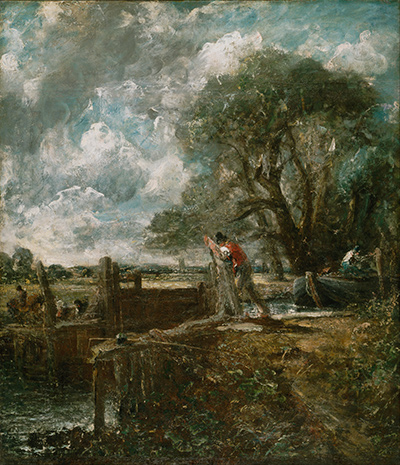
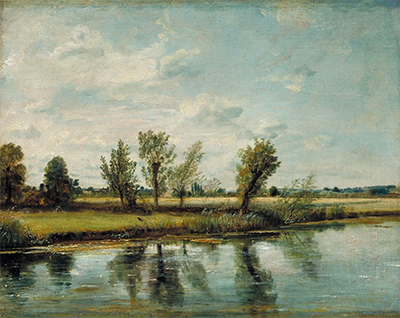
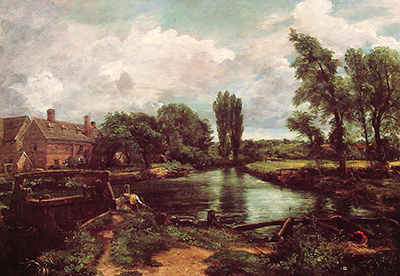
The Stour Valley stands at the centre of Constable's painted world. It was the landscape of childhood, family business, memory and practical work. The National Trust's Flatford material helps clarify the physical setting: locks, mills, barges, dry docks and river transport shaped the environment around Constable's most famous subjects.[6] These were not abstract rural scenes. They were working places, and Constable knew how their structures and rhythms belonged together.
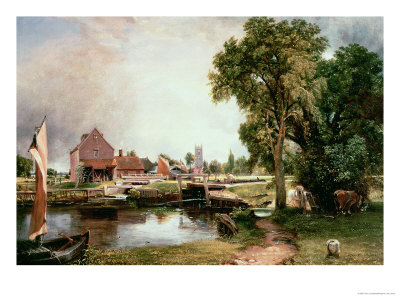
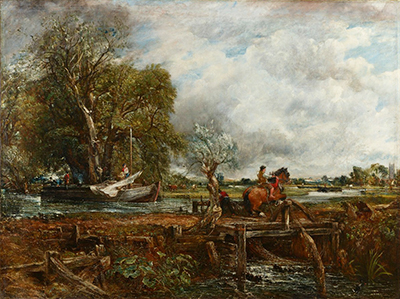
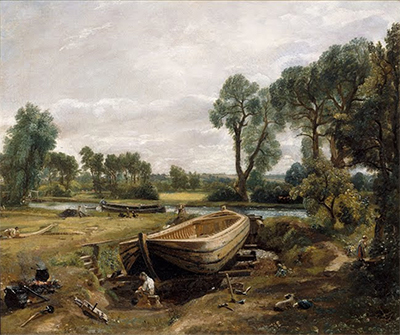
The Stour pictures include some of the paintings most associated with his name: Flatford Mill, Boat-Building near Flatford Mill, Stratford Mill, The Hay Wain, The Leaping Horse, The Lock, Dedham Lock and Mill and related views. They form a network of motifs rather than a loose group of picturesque scenes. Mills, willows, barges, lock gates, horses, boats and cottages recur because Constable returned to the same world from different angles and with changing ambition.
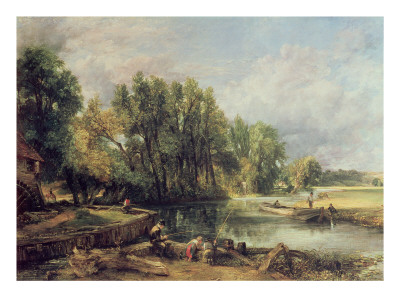
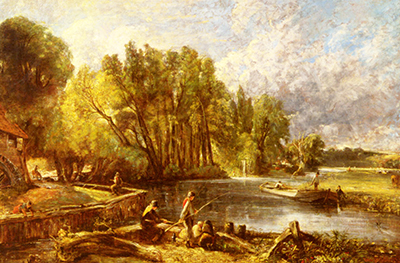
Stratford Mill, now in the National Gallery, shows how these subjects became monumental. The Gallery identifies it as the second of the large Stour landscapes Constable exhibited at the Royal Academy between 1819 and 1825.[7] It depicts a water-powered paper mill on the River Stour near East Bergholt, with the mill in shadow, shafts of light, figures by the water and the river winding through the composition.[7] The painting is calm, but its calm is active. It contains fishing, mooring, shade, light and the slow movement of water.
The Stour paintings show Constable turning local experience into public ambition. A viewer who treats them only as nostalgic rural images misses their challenge. Constable was asking the Royal Academy audience to grant serious attention to a river, a mill, a field and a lock. He was also asking paint to carry the dampness, brightness and movement of the place. The result is a kind of landscape painting in which the ordinary is enlarged without being falsified.
This is why the Stour subjects can sustain close looking even when their narratives are slight. A barge may be moored, a boy may fish, a wagon may cross water, or a horse may pull against a towline, yet the true subject is the whole system of place. The viewer is invited to understand how labour, water, trees, weather and buildings fit together. Constable's Stour is not an empty pastoral stage. It is a working landscape remembered with affection and built with pictorial intelligence.
The Six-Footers and Royal Academy Ambition
Constable's so-called six-footers are the great public declaration of his mature landscape art. The V&A describes six large River Stour scenes, including The Hay Wain and The Leaping Horse, for which he used full-size preparatory sketches to solve compositional problems while preserving the vitality of smaller studies.[2] These works were not private meditations. They were exhibition pictures, designed to compete for attention in the Royal Academy's crowded rooms.
The six-foot scale changed the status of the subject. A river landscape at that size could no longer be dismissed as a small topographical view or a pleasant record of country life. It had to be encountered physically. Constable's decision to paint the Stour on this scale was therefore aesthetic and institutional at once. He was elevating the landscape he knew by giving it the size, complexity and finish expected of ambitious art.
Scale also altered the viewer's relation to detail. In a small sketch, a lock gate, willow or cart can function as a quick notation. In a six-foot painting, such things must hold their place within a larger orchestration of light and movement. Constable's challenge was to prevent enlargement from becoming stiffness. The full-size sketches helped him keep the large works open and responsive, so that the finished paintings could feel both spacious and particular.
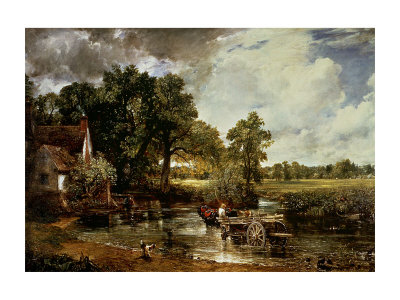
The Hay Wain is the best-known of these paintings, but it should be understood inside the sequence rather than isolated from it. The National Gallery explains that it was the third large landscape set around the River Stour exhibited at the Royal Academy between 1819 and 1825.[5] It shows the millpond at Flatford, Willy Lott's house and the empty wagon crossing shallow water, yet it was made in London from many earlier studies.[5] Its fame rests partly on its serenity, but its importance rests on its process: local memory, preparatory work, large-scale composition and later reception all meet within it.
Other Stour works carried related ambitions. Stratford Mill presented a river scene as a complex study of shade, work and memory.[7] The Leaping Horse pushed the Stour subject into greater movement and compositional drama, with preparatory drawings showing Constable's willingness to adjust topography for pictorial force.[8] These paintings do not repeat a formula. They test how far a familiar landscape could be made varied, ambitious and emotionally resonant.
The Hay Wain as Flagship, Not Shortcut
No discussion of Constable's paintings can avoid The Hay Wain, but its fame can become a shortcut. It is not simply “the Constable painting”. It is a concentrated example of several large themes: Flatford, studio construction, remembered labour, full-scale preparation, Dutch and Flemish echoes, French reception and later national mythology.
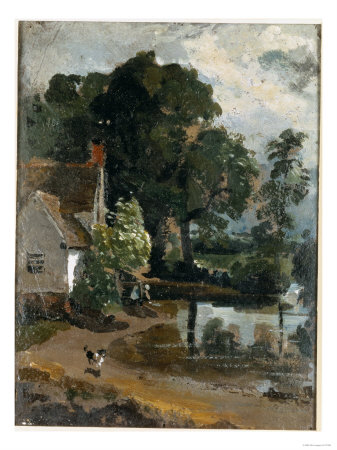
The National Gallery's account is especially valuable because it pulls the painting away from easy myth. The view is of the millpond at Flatford on the River Stour. Flatford Mill was operated by the Constable family, while the house at the left was occupied by tenant farmer Willy Lott.[5] The wagon, or wain, moves through shallow water toward the meadow where haymakers are at work.[5] Yet the painting was created in the studio from open-air sketches made over several years, including studies of Willy Lott's house and the hay wagon, followed by a full-scale oil sketch.[5]
That combination explains why the painting feels both real and composed. It is rooted in a place Constable knew deeply, but it is not a casual view. Details have been selected and balanced. Motifs from earlier studies return. The boat on the right, for example, belonged to a wider pattern of reuse in Constable's work.[5] The image is not less true because it is constructed. Its truth lies in the way observation, memory and composition reinforce one another.
The later life of The Hay Wain also belongs to its importance. It failed to sell when first shown in London, but its Paris exhibition helped strengthen Constable's reputation abroad.[5] Its modern status as a national image came later. The painting now feels almost inevitable, but its early history was uncertain. That uncertainty should remain visible, because it reminds us that Constable's most familiar painting was once part of a risky artistic campaign.
For this reason, The Hay Wain is best approached as a centre of gravity rather than a substitute for the whole career. It gathers many of Constable's strengths, but the paintings around it show the range of those strengths under different pressures. Stratford Mill is darker and more enclosed. The Leaping Horse is more animated. Salisbury gives cathedral and weather a different kind of tension. The coastal works open the air and horizon. The flagship matters more, not less, when it is seen among these neighbouring achievements.
Skies, Clouds and Weather
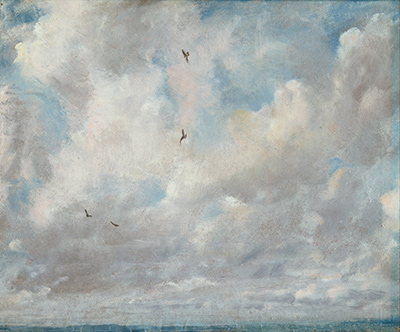
Constable's paintings cannot be understood if the sky is treated as empty atmosphere above the real subject. For him, sky was structure, light source, scale, weather, mood and pictorial problem. The V&A records his view that the sky was a crucial aid to landscape composition.[2] Mark Evans's Constable's Skies gives this concern its full weight, connecting his sky paintings and sketches to meteorology, dated observation and the expressive role of weather.[9]
The Cloud Studies deserve their own major treatment, but their relevance extends across the paintings. Constable's Hampstead studies from the early 1820s sharpened his ability to register passing effects. The V&A notes that many sketches were made outdoors and that Constable transformed oil sketching into a means of capturing transient light and weather.[4] These studies helped him make skies active in finished works, not decorative additions.
In the paintings, skies often determine the emotional temperature. A bright opening in cloud can animate a field. A dark mass can weigh on a cathedral or coast. Moving cloud can make a river scene feel temporary, as though the whole landscape exists within a passing interval. This is why the clouds above Constable's fields are never simply pleasant. They make the land legible by controlling light, shadow and atmosphere.
Weather also prevents his paintings from becoming static heritage images. A mill or cottage may endure, but the sky changes. That change gives the painting its present tense. The viewer senses not only what a place looks like, but what is happening to it now: light shifting, rain threatening, air clearing, wind moving through foliage. Constable's painted world is remembered, but it is also always in weather.
The sky also controls scale. Low horizons allow clouds to dominate, while shafts of light can pull the eye across a meadow or river. In many paintings the land is understood through what the sky permits us to see. This is one reason Constable's landscapes do not feel like coloured drawings with atmosphere added at the end. Light is built into their organisation. The sky governs the ground.
Salisbury, Cathedral and Late Meaning
Salisbury gave Constable a different kind of subject from the Stour. It brought cathedral architecture, ecclesiastical friendship, river meadows, commission, spiritual association and later emotional intensity. The danger is to treat all Salisbury paintings as one mood. They are more varied than that.
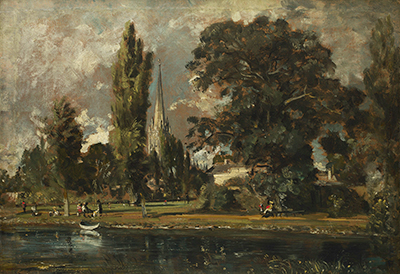
The National Gallery's Salisbury Cathedral and Leadenhall from the River Avon is a useful anchor because it is a sketch made during Constable's six-week visit to Salisbury in 1820.[10] The view looks across the River Avon toward the Cathedral and the Close, with Leadenhall on the right, where Constable and his family stayed with Archdeacon John Fisher.[10] The Gallery emphasises the sketch's open-air character, visible ground and fresh handling.[10] This is not the same artistic problem as the more formal cathedral compositions.
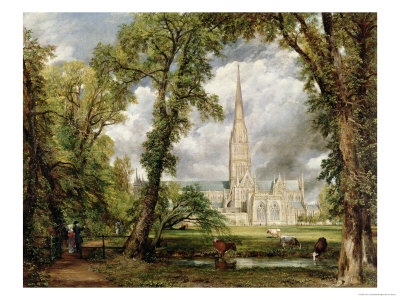
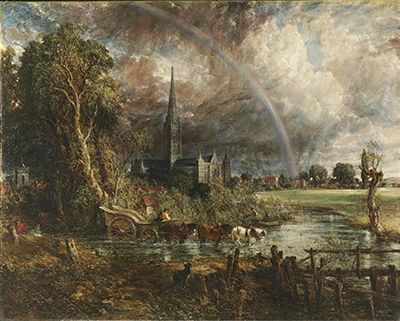
Salisbury Cathedral from the Bishop's Grounds and Salisbury Cathedral from the Meadows require separate handling. The former grew from commission and viewpoint; the latter, painted after Maria Constable's death, has often been read through grief, storm, rainbow and religious anxiety. Those readings can be powerful, but they should not be transferred backwards to every Salisbury scene. Constable's cathedral subjects include friendship, patronage, architecture, weather and feeling in different proportions.
The Salisbury paintings also show how Constable could make architecture behave like landscape. The cathedral is not isolated as a monument. It is seen through trees, across water, under changing skies, within meadows and social relationships. Stone, air and foliage interact. The spire gives vertical force, but weather gives emotional movement. Constable's Salisbury is a place where building and atmosphere continually answer each other.
This interaction between architecture and weather is one of the richest parts of his later painting. A cathedral might seem to promise permanence, but Constable refuses to detach it from passing conditions. Trees obscure and reveal it. Clouds press around it. Water reflects and interrupts it. Such paintings make the built world vulnerable to atmosphere, which is part of their emotional charge.
Coast, Brighton and Weymouth
Constable's coastal paintings extend his weather language beyond river and field. Weymouth, Osmington and Brighton offered cliffs, beaches, fishermen, ships, surf, sea wind and brilliant light. They also belonged to specific moments in his life: the 1816 honeymoon at Osmington and later Brighton stays connected with Maria's health.[2]
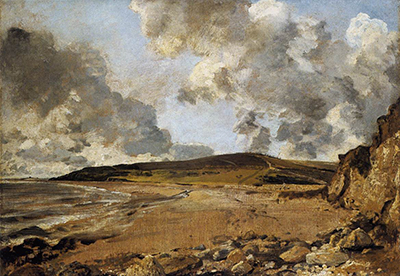
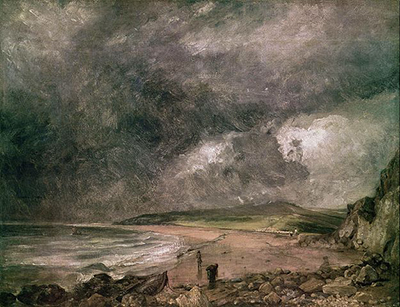
The National Gallery's Weymouth Bay: Bowleaze Cove and Jordon Hill shows how carefully such subjects must be distinguished. It depicts Bowleaze Cove in Dorset looking west from Osmington, with the Jordon stream, Furzy Cliff and Jordon Hill beyond.[11] The Gallery also explains that the National Gallery painting is one of three oil versions of the view, related to a smaller V&A sketch and a larger Louvre picture exhibited at the British Institution.[11] A coastal subject can therefore involve version history as well as place.
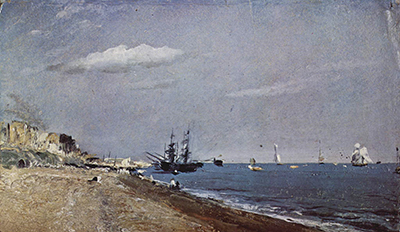
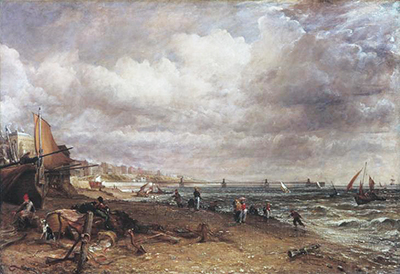
Brighton brought a different set of conditions. The V&A notes Constable's fascination with Brighton during the family's stays there and describes notes on the reverse of Brighton Beach With Colliers concerning cliff, light and a dark grey sky effect.[2] This is a painter still thinking through observed weather, but now under sharper marine conditions. The coast gives him stronger contrasts: white light, dark cloud, wet shore, moving boats, exposed figures and sea horizon.
These marine and coastal paintings prevent the Constable corpus from narrowing into inland pastoral. They show him responding to exposed weather and modern seaside life. The sea is less intimate than the Stour, but it gives him another way to study atmosphere. It also places his art closer to the world of Turner, while preserving Constable's own preference for observed place, weather notation and grounded motif.
The coastal works also sharpen his handling. Surf, shingle, wet sand, cloud shadow and sea wind require a different touch from foliage or still inland water. The paint often has to suggest brightness and abrasion at once. In these works Constable's interest in weather becomes less sheltered. The air is harsher, the horizon more open and the human figures more exposed.
Hampstead, Gardens and Home Ground
Hampstead matters because it gave Constable a high, open sky near London. It was not Suffolk, but it allowed him to study cloud and weather with extraordinary concentration. In the paintings and sketches associated with Hampstead, the sky often dominates. Land becomes a platform for atmospheric experiment. Cloud, wind and light become the true events.
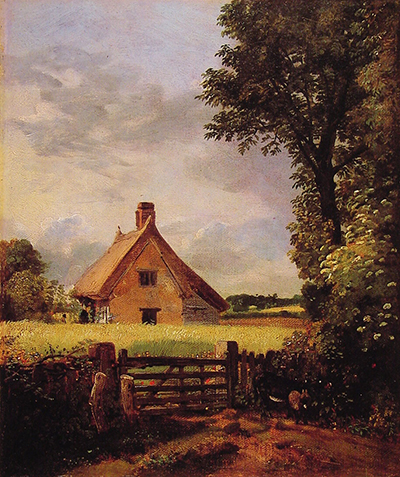
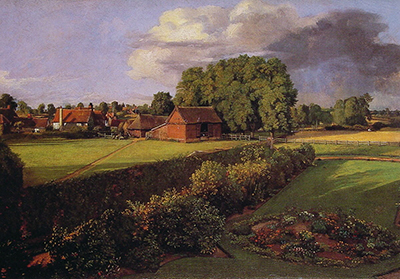
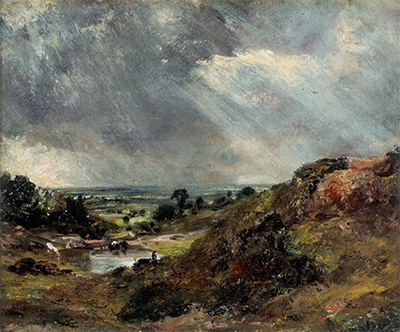
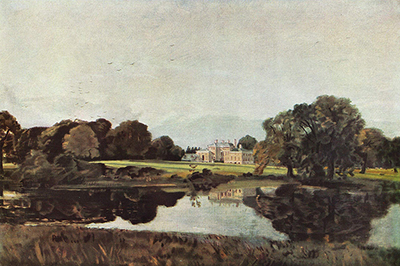
The existing Constable group also includes more intimate subjects such as Branch Hill Pond, Hampstead, A Cottage in a Cornfield, Golding Constable's Flower Garden, Golding Constable's Vegetable Garden and Malvern Hall. These works should not be treated as minor merely because they lack the fame of the six-footers. They help show the range of Constable's attention: family property, garden spaces, estate views, ponds, fields and domestic associations.
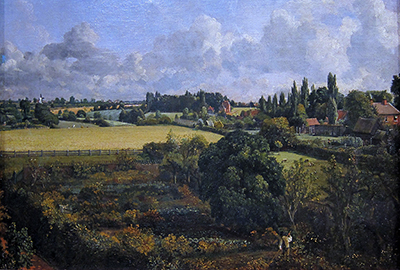
The Golding Constable garden subjects are especially useful for understanding the relation between home, cultivation and memory. Garden paintings can look gentle, but they belong to a larger world of family identity, land use and cultivated order. They also widen the idea of Constable's landscape from river labour to household ground. The same artist who made the Stour monumental could also attend to the smaller structures of family space.
Such works help correct the idea that Constable painted only a handful of canonical views. His paintings include grand exhibition canvases, oil sketches, family-linked subjects, coastal studies, memorial landscapes, portraits and late works of heightened atmosphere. The paintings are best understood as a field of connected concerns rather than a short list of famous images.
They also reveal a painter attentive to different scales of attachment. The Stour paintings carry the weight of region and career. Garden subjects can carry the intimacy of family ground. Hampstead skies turn a nearby suburb into an arena of meteorological study. A portrait or memorial brings personal and artistic loyalties into view. Constable's paintings are strongest when these scales overlap: the private becomes pictorial, and the local becomes public.
Memorial, Portrait and Historical Subjects
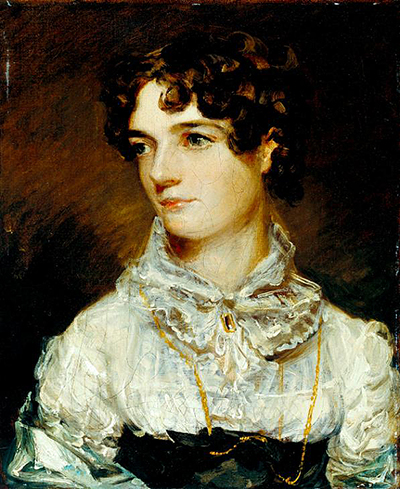
Constable was primarily a landscape painter, but his paintings also touch portraiture, memorial imagery and historical association. Portrait of Maria Bicknell belongs to the intimate human story behind the work. It must be approached with care because Maria's life and death have often coloured interpretations of Constable's later paintings. The portrait should remain a work of art and a personal image, not merely an illustration of biography.
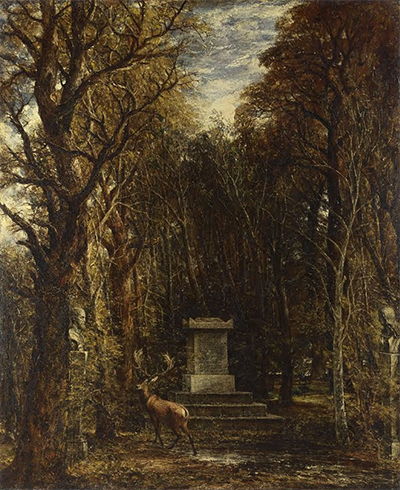
Cenotaph to the Memory of Sir Joshua Reynolds opens another side of Constable. The National Gallery identifies the subject as a memorial built by Sir George Beaumont in the grounds of Coleorton Hall.[1] It links Constable to artistic memory, patronage and the British painting tradition. A landscape containing a memorial to Reynolds is also a statement about artistic inheritance. Constable's respect for earlier art did not disappear when he turned to direct observation of nature.
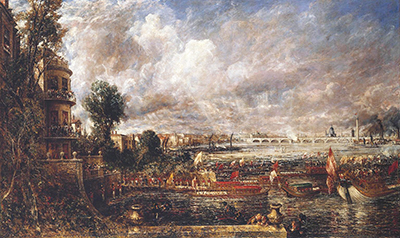
The Opening of Waterloo Bridge likewise complicates a purely rural Constable. Its urban, ceremonial and public subject sits near the territory more often associated with Turner and metropolitan spectacle. It needs object-specific treatment later, but even in a broad guide it reminds us that Constable's painting was not confined to quiet Suffolk water. He could approach public modernity, even if his deepest language remained grounded in landscape and weather.
These less typical works are important because they keep the painter from becoming too tidy. Constable's central achievement lies in landscape, but his landscapes are not isolated from people, institutions, patrons, memorials, exhibitions and national history. Even when no figure dominates the scene, human structures and cultural memory are usually present.
The presence of people in Constable's paintings is often understated. Figures fish, walk, work, water animals, tend boats or appear as small points of scale. They rarely turn the landscape into anecdote, yet they prevent it from becoming empty scenery. Human life is woven into the land without always taking command of it. That balance is one of Constable's quiet strengths.
Paintings, Prints and Reception
Constable's paintings reached viewers not only through exhibition but also through reproduction, sale, criticism and later collection histories. This is especially important for works later engraved by David Lucas and for the broader project of English Landscape Scenery. Prints could extend the reach of his compositions, but they also changed titles, emphasis and reception. For example, the National Gallery notes that Stratford Mill was later engraved by Lucas and published after Constable's death under the title The Young Waltonians.[7]
That distinction matters because the current fame of Constable's paintings is partly a history of reproduction and naming. A title can stick after the fact. A painting that failed to sell can become canonical. A studio work made from studies can later be received as a direct emblem of rural England. Constable's paintings have lived multiple lives: working studies, exhibition pictures, unsold works, engraved images, museum objects and national symbols.
French reception also changed the story. The Hay Wain did not sell in London when first exhibited, but its Paris showing helped secure Constable's international significance.[5] The National Gallery artist account notes that Constable was not especially well received in England during his lifetime, though he had considerable success in Paris.[1] That contrast gives his paintings a productive irony. The artist now treated as a painter of Englishness first found some of his strongest recognition abroad.
The modern museum setting has changed the paintings again. The National Gallery, V&A, Tate, National Gallery of Art and other collections now allow viewers to see finished canvases, full-scale studies, oil sketches, drawings and related works as parts of a working process. The paintings are no longer isolated images. They are evidence of a method.
This has altered the kind of greatness viewers now see in Constable. Earlier admiration often centred on finished rural images and national feeling. Modern study has made the unfinished, preparatory and experimental works just as important. The paintings now appear less like a set of polished views and more like the visible record of an inquiry: how to make landscape truthful, ambitious and emotionally alive.
How to Look at Constable's Paintings
A useful way to approach Constable's paintings is to begin with place, then ask how the painting has been made. Where is this: Flatford, Dedham, Stratford, Hampstead, Salisbury, Brighton, Weymouth, Wivenhoe, Coleorton? What kind of place is it: working river, family ground, public exhibition subject, coastal study, cathedral view, memorial landscape? What kind of painting is it: outdoor sketch, full-scale study, finished exhibition canvas, later version, intimate portrait, or work known through reproduction?
Then look at the sky. In Constable, weather is rarely neutral. Cloud masses organise scale and mood. Light falls unevenly. A field may glow because a cloud has opened. A cathedral may appear more charged because the sky darkens above it. Mark Evans's Constable's Skies helps explain why these effects are central rather than decorative.[9] The sky is not afterthought but architecture.
Next, look for labour and structure. Mills, barges, locks, fences, paths, fields and gardens are not generic rural signs. They give the painting its lived logic. Constable's landscapes often appear natural because they are full of human use. The countryside is beautiful, but it is also worked, inherited, managed and remembered.
Finally, look for time. Constable's paintings often contain more than one time at once: the instant of weather, the memory of childhood, the years of preparatory study, the exhibition moment, the later title, the museum afterlife. That layered time is part of their power. A Constable painting may look like a scene. It is also a history of attention.
Legacy of the Paintings
Constable's paintings helped transform the status of landscape art. The V&A states that his work transformed the genre and helped shape the enduring popular image of the English countryside.[2] That legacy is real, but it should not make the paintings too comfortable. Their greatness lies not in providing a finished myth of England, but in showing how landscape can become a serious form of thought and feeling.
The paintings remain compelling because they hold contradictions together. They are local and ambitious, observed and composed, affectionate and unsentimental, traditional and experimental. They can be intensely beautiful, but their beauty is often made from unstable weather, rough handling and signs of work. Constable's art gives the ordinary landscape dignity without smoothing away its complexity.
The later fame of The Hay Wain may have made Constable a household name, but the full range of his paintings is richer than any single image. The Stour subjects show local knowledge raised to exhibition scale. The cloud studies and weather-filled works show disciplined attention to change. The Salisbury and coastal paintings widen the emotional and geographical field. The gardens, portraits and memorial subjects keep the human story close.
To look well at Constable's paintings is to see landscape as a living relation between place, weather, memory and paint. His art begins with familiar things: a river, a house, a field, a cloud. It ends by making them feel inexhaustible.
That inexhaustibility is why the paintings can survive their own popularity. Familiarity has not emptied them. If anything, it has made careful looking more necessary. Behind the famous names are subtle decisions about scale, weather, memory, labour and surface. Constable's paintings reward the viewer who moves past the postcard image and attends to the work of painting itself.
Frequently Asked Questions
Discussion
Which painting most changes your understanding of John Constable's range?
Reader Insights
Where do mills, locks, barges, gardens or coasts make landscape feel used rather than decorative?
Which sky most strongly changes the scale, light or emotional pressure of the scene below?
How does knowing about sketches and full-size studies alter the apparent immediacy of a finished canvas?
Join the Conversation
Share your reading below.
References
- National Gallery, “John Constable (1776–1837),” https://www.nationalgallery.org.uk/artists/john-constable
- Victoria and Albert Museum, “John Constable – an introduction,” https://www.vam.ac.uk/articles/john-constable-an-introduction
- Graham Reynolds, The Early Paintings and Drawings of John Constable, Paul Mellon Centre / Yale University Press, 1996, bibliographic record: https://www.paul-mellon-centre.ac.uk/publications/browse/9780300063370
- Victoria and Albert Museum, “John Constable's sketches,” https://www.vam.ac.uk/articles/john-constables-sketches/
- National Gallery, “John Constable, The Hay Wain,” https://www.nationalgallery.org.uk/paintings/john-constable-the-hay-wain
- National Trust, “History of Flatford,” https://www.nationaltrust.org.uk/visit/suffolk/flatford/history-of-flatford
- National Gallery, “John Constable, Stratford Mill,” https://www.nationalgallery.org.uk/paintings/john-constable-stratford-mill
- British Museum, “Study for the painting ‘The Leaping Horse’,” https://www.britishmuseum.org/collection/object/P_1888-0215-72
- Mark Evans, Constable's Skies: Paintings and Sketches by John Constable, V&A / Thames & Hudson, 2018, bibliographic record: https://www.thamesandhudson.com/products/constables-skies-victoria-and-albert-museum
- National Gallery, “John Constable, Salisbury Cathedral and Leadenhall from the River Avon,” https://www.nationalgallery.org.uk/paintings/john-constable-salisbury-cathedral-and-leadenhall-from-the-river-avon
- National Gallery, “John Constable, Weymouth Bay: Bowleaze Cove and Jordon Hill,” https://www.nationalgallery.org.uk/paintings/john-constable-weymouth-bay-bowleaze-cove-and-jordon-hill