 by Tom Gurney
Tom Gurney BSc (Hons) is an art history expert with over 20 years experience
Published on June 19, 2020 / Page Updated on November 5, 2026
Email: tomgurney1@gmail.com / Phone: +44 7429 011000
Introduction
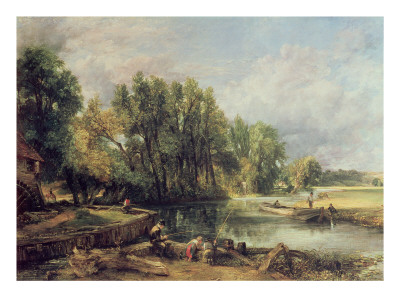
John Constable's Stratford Mill is one of the central paintings in his campaign to make the River Stour a subject worthy of major exhibition art. Painted in 1820 and now in the National Gallery, London, it is the second of the great Stour landscapes often called the six-footers.[1] The work belongs to the same ambitious sequence as The White Horse, The Hay Wain and The Leaping Horse, yet it has its own atmosphere: quieter than a heroic landscape, denser than a simple view, and animated by the mingled presence of water, children, fishing, labour and weather.
At first glance the scene seems relaxed. A boy kneels by the river with a fishing line, a girl looks on, another angler bends toward his catch, and an unladen barge moves near the far bank. The paper mill itself sits in shadow at the left, partly withheld from immediate attention.[1] But the painting's calm is deceptive. Constable is not simply staging a rural afternoon. He is building a large exhibition picture out of local knowledge, earlier sketches and a deliberate claim for the seriousness of Suffolk landscape.
At a Glance
- ArtistJohn Constable (1776–1837)
- TitleStratford Mill
- Date1820 [1]
- CollectionNational Gallery, London
- InventoryNG6510 [1]
- MediumOil on canvas [1]
- Dimensions127 × 182.9 cm [1]
- PlaceStratford St Mary on the River Stour
- ExhibitedRoyal Academy, 1820 [1]
- SeriesSecond of the six monumental Stour landscapes [1]
Contents
- Introduction
- Object Identity
- Stratford St Mary and the River Stour
- The Second Stour Six-Footer
- What the Painting Shows
- A Paper Mill, Not a Family Mill
- From Small Study to Exhibition Picture
- The Yale Full-Scale Sketch
- The Young Waltonians
- Why Stratford Mill Matters
Object identity
The National Gallery identifies the painting as Stratford Mill, inventory number NG6510, made in 1820, oil on canvas, measuring 127 by 182.9 centimetres.[1] It entered the National Gallery in 1987 through the acceptance-in-lieu procedure.[1] The subject is the water-powered paper mill at Stratford St Mary, on the River Stour near East Bergholt in Suffolk. This is not Flatford Mill, and it should not be folded into Constable's other mill subjects simply because they share the Stour Valley.
The local identity issue is important because the painting later acquired the title The Young Waltonians, a posthumous name connected with Izaak Walton's fishing classic The Compleat Angler and David Lucas's mezzotint after the picture.[1] That title matters as reception history, but it is not the current National Gallery title. For this article, Stratford Mill remains the controlling name, while The Young Waltonians is treated as a later afterlife.
The painting is also distinct from the full-scale preparatory sketch now at the Yale Center for British Art. The Yale work, also titled Stratford Mill, dates to about 1819-20 and is a working oil sketch rather than the finished National Gallery picture.[3] The existence of that large sketch helps explain Constable's method, but the finished object under discussion is NG6510.
Stratford St Mary and the River Stour
Stratford Mill stood at Stratford St Mary, about two miles west of East Bergholt, where Constable was born.[1] Unlike Flatford Mill, which belonged to the Constable family economy, Stratford Mill was a water-powered paper mill on a small island in the Stour.[1] That difference matters. The painting belongs to the broader Stour world of mills, water, bridges, barges and river labour, but it is not a direct portrait of the family mill.
The Stour provided Constable with more than scenery. It gave him a structure of life: working waterways, rural labour, small industries, banks, trees, weather and repeated local views. The Museum of Fine Arts, Houston's discussion of a related Flatford sketch emphasises how unusual Constable was among British landscape painters in returning so persistently to the scenes of his childhood, especially the Stour landscape around East Bergholt and Flatford.[6] Stratford Mill extends that attachment slightly upriver while remaining within the country he knew intimately.
The National Trust's account of Constable at Flatford also stresses how his daily movements between East Bergholt, Dedham and the surrounding countryside gave him deep familiarity with the Suffolk landscape.[7] This matters for Stratford Mill because the painting's authority comes from repeated knowledge rather than picturesque discovery. Constable did not arrive as a tourist looking for a charming mill. He came as an artist whose eye had been trained by years of moving through the Stour Valley.
The second Stour six-footer
The National Gallery calls Stratford Mill the second of the monumental Stour landscapes that Constable sent to the Royal Academy across the decisive years after 1819.[1] These six-footers were his most ambitious public statements about the landscape of his native region. They allowed him to treat rural Suffolk on a scale usually reserved for more elevated or conventional subjects. The first was The White Horse in 1819; Stratford Mill followed in 1820; The Hay Wain came next.[1][5]
This sequence matters because it shows Constable thinking systematically about Stour subjects. He was not producing isolated views. He was creating a body of large landscapes that could carry his artistic identity before the Royal Academy. In them, the river becomes a recurring stage for different kinds of rural life: navigation, crossing, fishing, labour, weather, buildings and memory. Each painting has its own emphasis, but together they form Constable's great argument for the Stour.
Stratford Mill is sometimes overshadowed by The Hay Wain, but that should not lead us to treat it as a lesser rehearsal. Its mood is different. The scene is more enclosed, the mill is more obscured, and the human activity centres on fishing rather than carting or navigation. It is less iconic but more intimate, less publicly famous but richly structured. It shows Constable testing how a seemingly modest riverside subject could sustain monumental scale.
The six-footer format also altered what counted as a serious landscape. A small oil study could feel like private observation, but a canvas of this breadth had to compete in a crowded exhibition setting. Constable's choice was bold because the subject was not conventionally grand. He did not enlarge a mythological episode or a celebrated monument. He enlarged a Stour mill scene and trusted that light, water, weather, figures and memory could supply sufficient weight. That confidence is one of the painting's quiet radicalisms.
What the painting shows
The paper mill appears on the left, held in shadow rather than set out as an architectural showpiece. Sunlight falls between trees and touches a narrow wooden gate beside the meandering river.[1] A dying willow leans over the glassy water, and a distant farmhouse catches light beyond the darker foreground.[1] The Stour carries the eye into the picture, while dark clouds in the distance suggest showers elsewhere.[1]
The figures are small but vivid. Near the mill, a girl watches a kneeling boy cast his line. To their left, another angler appears to have hooked a fish.[1] The National Gallery's image data also notes a boy letting his horse drink and a barge advancing along the river.[2] These details make the landscape feel inhabited without turning it into anecdotal theatre. Human activity is woven into the riverside world rather than imposed upon it.
The painting's balance is subtle. The mill gives the subject its title, but the fishing children command much of the emotional attention. The river gives the composition its movement, but the trees and shadow give it depth. The distant farmhouse brightens the scene, yet the darker clouds prevent a simple reading of summer leisure. Constable's achievement lies in holding these elements together: play and work, shade and light, local fact and large pictorial structure.
A paper mill, not a family mill
Because Constable painted so many mills, it is easy to let them merge. Stratford Mill resists that. The mill at Stratford St Mary was water-powered and used for paper manufacture.[1] Its presence in the painting is important, but it is not presented as the dramatic centre. Instead, it sits half-hidden, absorbed into the broader riverside environment. That partial concealment may be one reason the picture later lent itself to the fishing title The Young Waltonians.
The difference from Flatford is revealing. In Flatford Mill (Scene on a Navigable River), the title directs attention toward the working Stour as a navigable system and to the family business around milling and transport. In Stratford Mill, the industrial fact is quieter. The paper mill matters, but the painting emphasises a more layered experience of place: childhood recreation, local industry, river movement and weathered trees.
The result is not escapist. A paper mill on the Stour is still part of a working landscape. But Constable allows the mill to become one element among many rather than the sole subject. He turns a specific industrial building into the anchor of a broader meditation on rural activity and recollection.
The National Trust's history of Flatford, though centred on a different mill, helps explain the kind of world these Stour mills belonged to. It describes water power, mill buildings, granaries, locks and local prosperity tied to river movement and agricultural processing.[8] Stratford's paper mill had its own identity, but it shared the same broader landscape logic: water was a working force, not merely a reflective surface. In Stratford Mill, Constable softens that industrial reality without erasing it. The mill is shaded and partially hidden, yet the whole scene depends on the river's usefulness.
This is one of the reasons the painting can feel more complex than its fishing motif suggests. The children by the water may dominate the viewer's first response, but behind them is a landscape of production. Paper-making, water control, barges, horses, banks and gates all belong to the visual field. Constable's skill lies in allowing recreation and work to coexist. The scene is leisurely, but it is not idle.
From small study to exhibition picture
The National Gallery states that the composition for Stratford Mill developed from an oil sketch now known as Anglers at Stratford Mill, made in the summer of 1811.[1] Constable took that small study with him when he settled in London in 1817 and later returned to details drawn in Suffolk and Essex in 1813 sketchbooks.[1] This long gestation is crucial. The 1820 painting was not a simple fresh transcription of a single moment.
Instead, it was built from memory and stored observation. Constable returned to an earlier plein-air motif, reconsidered it from London, roughed in a smaller compositional version, and then made a full-scale preparatory sketch.[1][3] That sequence shows how local immediacy and studio ambition worked together. The finished painting preserves the freshness of outdoor looking, but it is the result of years of development.
The National Gallery image data adds that details such as lilies and timber in the foreground came from Constable's 1813 sketchbook.[2] That kind of borrowing matters. It shows him composing from a stock of remembered and recorded facts. He was not inventing a generic river scene. He was assembling fragments of real looking into a large, coherent painting.
Reynolds's work on Constable's early paintings and drawings provides the larger scholarly framework for this kind of development.[9] The importance of the 1811 and 1813 material is that it places Stratford Mill within a long habit of returning to the same river environment. Constable's later public canvas grows from small-scale acts of attention: an angler, a timber, water plants, a river bend, a bank, a tree. The finished work depends on those earlier acts without looking like a stitched-together compilation.
This makes Stratford Mill especially useful for understanding Constable's mature method. He is often praised for directness, but directness in the large exhibition pictures is mediated by memory, selection and revision. The old sketch does not merely supply information; it keeps the finished picture emotionally tethered to a time before London and before the public pressure of the Royal Academy. The result is both a new work of 1820 and a return to the Suffolk of 1811.
The Yale full-scale sketch
The Yale Center for British Art's full-scale Stratford Mill is one of the strongest pieces of evidence for Constable's working method. Yale describes it as a preparatory sketch for the National Gallery painting, measuring 51 1/2 by 72 1/2 inches, and notes that its scale can make it seem like a finished painting.[3] It was not meant for public exhibition in the same way as the final picture, but as a working document.[3]
This large sketch shows how Constable adapted his method as his ambitions grew. A small outdoor study could preserve first-hand sensation; a full-scale sketch allowed him to test how that sensation might survive on exhibition scale. Yale's account emphasises that such sketches may have served as aids to recollection or working documents, revealing an expressive and material dimension carried into the finished paintings.[3]
That distinction matters because it helps explain why Constable's finished landscapes feel both observed and constructed. The final Stratford Mill is polished enough for public display, but beneath it lies the freer handling and experimentation of the preparatory sketch. The public picture keeps the authority of the private process without showing all of its roughness.
Royal Academy and reception
Stratford Mill was selected for the Great Room at the Royal Academy exhibition of 1820.[1] That placement was significant: Constable wanted recognition for these large Stour landscapes, and the Royal Academy remained the central public stage for artistic reputation. The painting received generally good reviews, but it did not sell at the exhibition.[1]
Its eventual sale came through Archdeacon John Fisher, one of Constable's most important friends and supporters. Fisher had bought The White Horse after the 1819 Royal Academy exhibition, and he asked to purchase Stratford Mill as a gift for his solicitor, John Pern Tinney.[1] Constable agreed to sell it for 100 guineas, a price Fisher considered too low.[1] The episode shows both the value Fisher placed on Constable and the still uncertain market for these ambitious landscapes.
Even after the sale, Constable did not simply let the picture go. The National Gallery records that he continued to work on it after it returned from the Royal Academy, that Tinney eventually received it in 1821, and that Constable later borrowed it back several times, including to adjust its tone, to show it at the British Institution and, after Tinney's death, for engraving by David Lucas.[1] The painting remained alive for him as a work to revisit.
The Young Waltonians
After Constable's death, Stratford Mill became known as The Young Waltonians, a title referring to Izaak Walton's The Compleat Angler of 1653.[1] The name was reinforced by David Lucas's mezzotint, published in 1840 after Constable's death under that title.[1] The fishing children at the centre of the composition make the connection understandable.
But the after-title should be handled carefully. The Young Waltonians draws attention to the children and to a literary tradition of angling, but it can also narrow the painting. Constable's picture is not only about youthful fishing. It is about a mill, a river, Stour Valley memory, weather, composition and the status of landscape painting. The later title is charming, but it is not complete.
The separate treatment of The Young Waltonians therefore requires its own later resolution. For Stratford Mill, the best approach is to treat the Waltonian name as reception history: a posthumous way of reading the picture through fishing and literature, not the foundation of the original 1820 exhibition identity.
That reception history is still valuable. The Waltonian title tells us how strongly the fishing figures shaped later viewers' memory of the work. It shifts attention from the mill to the children, from industry to leisure, from a Stour six-footer to a literary pastoral association. Such shifts are not wrong in themselves, but they are partial. They show how a painting can be renamed by its most emotionally accessible detail.
Returning to Stratford Mill as the primary title restores the whole composition. The fishing remains important, but the mill, river, barge, trees and weather regain their equal force. The painting becomes less like an illustration of youthful angling and more like a complete Stour landscape, where angling is one form of life among many.
Light, shadow and weather
One reason Stratford Mill holds attention is its orchestration of light. The mill is shadowed; sunlight breaks between trees; a farmhouse gleams in the distance; the river surface carries reflected brightness; and darker weather gathers far off.[1] Constable creates atmosphere through contrasts that are controlled rather than spectacular.
The dying willow is particularly important. It leans over the water with yellowing leaves, both graceful and fragile.[1] Along with the uprooted trunk in the foreground, it gives the scene a note of decay. This is not a flawless summer paradise. The painting includes broken wood, shadow, damp ground and unsettled skies. Its beauty is therefore grounded in change.
The Yale Center's broader exhibition framing of Constable stresses his concern with skies, light, seasons and atmosphere as central subjects of his art.[4] Stratford Mill fits that account without needing the dramatic sky studies of the 1820s to dominate it. Here atmosphere is woven into the entire scene. Weather is not a separate subject; it is the condition under which river, mill, figures and trees are seen.
The darker weather is especially useful because it prevents the scene from becoming merely pretty. The distant clouds suggest passing or approaching showers, while the sunlight brings local brilliance to selected forms.[1] This kind of weather is not the subject in the way a cloud study is the subject; it is an organising pressure. It gives the painting a temporal feeling. The river scene is not frozen in ideal calm, but held within changeable conditions.
That changeability was central to Constable's larger landscape project. Yale's current exhibition framing presents him as an artist who made atmosphere and direct experience central to the transformation of landscape painting.[4] Stratford Mill demonstrates that transformation in measured form. It is not a storm picture, yet it makes weather part of meaning.
The handling of light also helps separate Stratford Mill from more formulaic pastoral images. The sun does not bathe everything equally. It appears in intervals, caught on water, timber, leaves and distant architecture, while other passages remain deliberately withheld. This selective brightness gives the composition a lived rhythm. It resembles the experience of looking across a river valley when cloud and sunlight are moving at different speeds. Constable's landscape therefore feels less like a finished arrangement of attractive motifs than a record of perception under pressure. The viewer senses that the scene might change a minute later, and that awareness gives the painting its quiet urgency.
Fishing and attention
The fishing figures give the painting a special kind of stillness. Fishing is an activity of waiting, watching and sensitivity to small movements. That makes it pictorially useful for Constable. The figures are active, but not noisy. Their attention to the water becomes a model for the viewer's own attention to the painting.
The girl watching the kneeling boy, the angler with a possible catch, and the quiet horse near the water create a sequence of small focal points.[1][2] None overwhelms the landscape. Instead, each helps slow the eye. The viewer is invited to notice the slight drama of a line cast, a fish taking bait, a barge moving slowly, light shifting across trees.
This helps explain why the later Waltonian title took hold. The fishing motif is memorable because it concentrates the painting's mood. Yet fishing is only one form of attention in the work. Constable's own attention is broader: to water, light, shade, memory, local industry and compositional balance.
The fishing also changes the pace of the picture. A barge implies slow movement; fishing implies patient stillness. Between them, Constable creates a rhythm of almost imperceptible action. Nothing dramatic happens, but everything is poised. A line is cast, a fish may have bitten, a horse drinks, a barge advances, clouds gather. The painting asks the viewer to recognise significance in small movements.
That is part of its modern appeal. Constable does not need a grand event to hold a large canvas together. He trusts attention itself. The painting's drama lies in looking carefully enough for an ordinary riverside afternoon to become full. Its scale rewards patience rather than spectacle, which is precisely why its quietness lasts.
Why Stratford Mill matters
Stratford Mill matters because it shows Constable developing a public language for the Stour Valley. He had long known the region through childhood, walking, drawing and outdoor sketching. In this painting he makes that knowledge large enough for the Royal Academy, without abandoning its intimacy. The result is a landscape that feels remembered, observed and carefully built.
It also clarifies the role of preparation in his art. The path from the 1811 oil study to the 1813 sketchbook details, the small compositional sketch, the Yale full-scale sketch and the finished National Gallery painting shows a long arc of revision.[1][2][3] Constable's naturalism was not simple immediacy. It was a disciplined process of returning to things seen and remaking them at scale.
Finally, the painting reminds us that Constable's great Stour project was varied. Flatford Mill (Scene on a Navigable River) foregrounds a working river; The Hay Wain became the national icon; Stratford Mill offers a quieter, shadowed meditation on fishing, paper-making, water and memory. Its power lies in that quietness. It turns a specific place on the Stour into a major landscape without forcing it to become grand in the old sense. Constable's grandeur is local, attentive and alive.
Frequently Asked Questions
Discussion
What gives Stratford Mill its lasting force: the fishing figures, working-river setting, shifting weather or the long process behind the finished canvas?
Reader Insights
How does Constable make a quiet riverside scene sustain the breadth of a six-footer?
Notice how paper-making, barges, horses and fishing coexist without one becoming the whole subject.
Where can you sense the stored observations and freer preparatory work beneath the public painting?
Join the Conversation
Share your reading below.
References
- National Gallery, Stratford Mill, https://www.nationalgallery.org.uk/paintings/john-constable-stratford-mill
- National Gallery image/data record, Stratford Mill, https://cima.ng-london.org.uk/collection/search.php?crop=false&sortby=ObjectAlphaSort&sqllimit=+AND+FileGroup_id+in+%2814%29+&val=1107&what=details&whichdb=externalIIP&whichtable=Image
- Yale Center for British Art, Stratford Mill, https://interactive.britishart.yale.edu/critique-of-reason/354/stratford-mill
- Yale Center for British Art, “John Constable: The Landscape Reimagined,” https://britishart.yale.edu/exhibitions-programs/john-constable-landscape-reimagined
- National Gallery catalogue, The Hay Wain, https://www.nationalgallery.org.uk/paintings/catalogues/egerton-2000/the-hay-wain
- Anne Lyles, Museum of Fine Arts, Houston, A View on the Banks of the River Stour at Flatford, https://emuseum.mfah.org/catalogues/the-stuart-collection/objects/127652/a-view-on-the-banks-of-the-river-stour-at-flatford
- National Trust, “John Constable at Flatford,” https://www.nationaltrust.org.uk/visit/suffolk/flatford/john-constable-at-flatford
- National Trust, “History of Flatford,” https://www.nationaltrust.org.uk/visit/suffolk/flatford/history-of-flatford
- Graham Reynolds, The Early Paintings and Drawings of John Constable, Paul Mellon Centre / Yale University Press, 1996, https://www.paul-mellon-centre.ac.uk/publications/browse/9780300063370