 by Tom Gurney
Tom Gurney BSc (Hons) is an art history expert with over 20 years experience
Published on June 19, 2020 / Page Updated on November 5, 2026
Email: tomgurney1@gmail.com / Phone: +44 7429 011000
Introduction
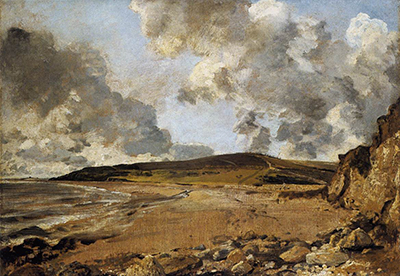
John Constable's Weymouth Bay: Bowleaze Cove and Jordon Hill carries his landscape art away from the Stour and into sea weather. The painting is still recognisably Constable: it is rooted in a known place, alive to moving cloud, and built from the pressure of direct observation. Yet the coast changes everything. Water is no longer canal, river or millpond. It is open sea, rolling into a Dorset beach beneath a restless sky.
The painting is in the National Gallery, London, as NG2652. The Gallery dates it to 1816-17, gives the medium as oil on canvas, and records its dimensions as 53 by 75 centimetres.[1] The view is Bowleaze Cove in Dorset, looking west from Osmington. The Jordon stream crosses the sand, Furzy Cliff and Jordon Hill lie beyond, and the Downs slope toward the cove and sea.[1] The scene looks simple at first, but it sits at a crucial point in Constable's career: just after his marriage to Maria Bicknell, during the Osmington honeymoon, before the Stour six-footers made his public reputation.
This is not a sentimental honeymoon souvenir. It is a serious coastal experiment. Constable had spent years learning how water, weather and labour shaped inland landscape; at Weymouth Bay, he faced a different scale of exposure. The shore gives him broad sky, angled cliff, open horizon, surf, beach and storm-shadow. The painting matters because it shows Constable learning how his existing language of weather could survive contact with the sea.
At a Glance
- ArtistJohn Constable (1776–1837)
- TitleWeymouth Bay: Bowleaze Cove and Jordon Hill [1]
- Date1816–17 [1]
- CollectionNational Gallery, London [1]
- InventoryNG2652 [1]
- MediumOil on canvas [1]
- Dimensions53 × 75 cm [1]
- AcquisitionSalting Bequest, 1910 [1]
- ViewBowleaze Cove looking west from Osmington [1]
- VersionThe middle canvas in a three-oil sequence [1]
Contents
- Introduction
- Object Identity
- Osmington and the Honeymoon
- Beach, Stream and Hill
- Sky, Waves and Exposed Ground
- Three Versions of the View
- Lucas and the Storm Afterlife
- Weymouth, Not Brighton
- Why the Painting Matters
Object identity
The National Gallery's title is precise: Weymouth Bay: Bowleaze Cove and Jordon Hill.[1] The spelling “Jordon” follows the Gallery's record and should be kept for the painting's title, even though modern local usage may vary. The work entered the National Gallery through the Salting Bequest in 1910 and is part of the Main Collection.[1]
The object facts establish a middle scale. At 53 by 75 centimetres, the canvas is larger than a small oil sketch but far smaller than the later exhibition landscapes that dominate Constable's fame. That size suits its role. It has the freshness of an observed coastal subject, yet enough breadth to organise beach, sea, cliff, hill and sky into a coherent landscape.
The National Gallery also records that the painting was unsold in Constable's lifetime and appeared in the estate sale after his death, probably as Weymouth Bay, a sketch.[1] That history is telling. The picture now looks central to our understanding of Constable's coastal vision, but it did not begin as a polished public triumph. Its value lies partly in the unresolved energy that earlier viewers might have associated with sketch-like handling.
The local visual match is strong: a rocky beach in the foreground, surf entering from the left, a dark low sweep of hill beyond the sand, cliff at the right edge, and thick broken clouds moving through the sky. The painting holds land and weather in a tense balance. No single element is allowed to settle into calm.
The V&A's broader account of Constable is useful here because it presents him as a painter whose originality came from returning to familiar and closely observed places rather than chasing grand invented scenery.[6] Weymouth Bay briefly became one of those known places. It did not replace Suffolk in his imagination, but it expanded the conditions under which his art could operate. The same seriousness he brought to mills and inland weather is applied to sand, cliff, surf and coastal cloud.
Osmington and the honeymoon
Constable became familiar with this Dorset coast during the six weeks of his honeymoon from mid-October to December 1816.[1] He had married Maria Elizabeth Bicknell at the age of forty, after years of emotional and family difficulty. John Fisher, Constable's friend and ally, married the couple at St Martin-in-the-Fields and invited them to stay at his vicarage in Osmington, near Weymouth.[1]
Fisher's role should not be reduced to a pleasant biographical detail. He helped make the painting possible. The National Gallery records his description of the area as “wonderfully wild and sublime” and his assurance that the house offered a “singularly beautiful view”.[1] Those phrases are brief, but they catch why Osmington appealed to Constable: it offered both intimacy and scale, a friend's hospitality beside a landscape large enough to test him.
The Weymouth visit also widened Constable's geography at an important moment. He had already painted Suffolk mills, locks, riverbanks and family places. Osmington offered coves, cliffs, open water and paths down to the beach and fishing village of Osmington Mills.[1] The National Gallery notes that he made many oil sketches and about twenty drawings and watercolours of the smaller coves within Weymouth Bay and nearby views.[1] This was not one isolated glance at the sea, but a sustained campaign of coastal looking.
The honeymoon context gives the painting warmth, but not softness. Constable does not transform the bay into domestic idyll. The sky is too unsettled, the shore too exposed, the sea too active. If anything, the painting gains emotional depth because personal happiness is set against a landscape of wind, cloud and change.
Reynolds's early catalogue context also matters because the Weymouth material belongs at the edge of Constable's early development rather than among the later Brighton works.[5] The visit came before the fully public authority of the Stour six-footers, and before the Hampstead cloud studies sharpened his weather language into something almost systematic. That timing gives the National Gallery canvas a special freshness. Constable is not repeating a settled coastal formula; he is finding one.
Beach, stream and hill
The view is organised around the meeting of beach, stream and sea. The Jordon stream trickles over the sand before reaching the water, a small moving line within a much larger coastal system.[1] Constable had long understood how modest watercourses could structure a landscape. Here, the stream gives the eye a path across the foreground while the sea pulls attention outward.
Furzy Cliff and Jordon Hill shape the distance.[1] They do not form a picturesque backdrop in the easy sense; they make the cove feel enclosed on one side and exposed on the other. The land slopes down toward the beach, while the sky seems to press and move above it. Constable builds the scene from diagonals of land and weather rather than from a neat horizontal seascape formula.
The foreground rocks matter because they keep the viewer physically close to the shore. They are not decorative debris. They establish texture, scale and footing. One can feel the difference between the solid stones, the damp sand, the shallow stream and the broken line of surf. Constable's coast is an experienced surface, not a distant panorama.
The sea enters from the left with dark horizontal energy. It does not dominate the whole composition, but it changes the air of the painting. Inland water often reflects, channels or sustains movement; this sea arrives, withdraws and returns. Constable suggests waves rolling in with thick grey and white streaks of paint, echoing the cloud tones above.[1] The shore becomes the place where sky and sea answer one another.
The cliff at the right gives the composition a physical edge. Its warm brown and chalky tones prevent the view from dissolving into sea and sky alone. Constable uses it almost like a hinge: one side of the painting opens out toward water and distance, while the other presses close to stone, earth and the immediate beach. The viewer is held between openness and enclosure.
Human presence is minimal. The National Gallery says that in Constable's views of the bay the only figures tend to be fishermen, a few walkers on the sands, or an occasional shepherd on the Downs.[1] In this painting, the landscape is not empty, but it is not staged around anecdote. The real event is weather passing over a beach.
Sky, waves and exposed ground
The sky is the painting's engine. Thick clouds move across a bright winter sky while the Downs slope toward the cove and sea.[1] Constable had not yet made the Hampstead cloud studies of the early 1820s, but his sensitivity to cloud structure is already evident. The clouds are not a ceiling placed above the view. They determine the whole emotional rhythm of the canvas.
The National Gallery points to the relationship between the waves and the clouds: grey and white paint in the surf mirrors the sky above.[1] This is one of the painting's strongest coastal insights. Sea weather is not divided neatly into upper and lower zones. Cloud, wind, light and water form one system. The brushwork makes that system visible.
The pinkish-buff ground is also crucial. The National Gallery notes that it shows through the thinly painted foreground and in places through the sky, helping express the colour of Dorset sand and giving weight to the clouds.[1] This is not an incidental technical residue. Constable uses the ground as an active colour, allowing the prepared surface to belong to the beach and air.
That exposed ground gives the picture its spontaneous character.[1] It lets the painting breathe. Areas of thin paint sit beside thicker strokes of wave and cloud, so the viewer senses the quickness of decision. Constable is not polishing the coast into smooth finish; he is allowing the coast's changing conditions to remain visible in the handling.
This handling also keeps the beach from becoming inert foreground. Sand is notoriously difficult in painting because it can become a flat brown interval between more exciting things. Constable avoids that by allowing the ground colour, thin paint and broken accents to do several jobs at once. They describe Dorset sand, carry reflected light, and keep the viewer aware of the painted surface.
The V&A's account of Constable's sketch practice helps explain this energy. When working outdoors, he used fragments of canvas, millboard or homemade paper, and in 1825 described oil sketches done in the lid of his painting box on his knees.[2] The V&A also stresses his varied handling: impasto, glazes, bright dots, touches of pure white and dry-brush effects that let underlying colour show through.[2] The National Gallery canvas may not be the first small outdoor sketch, but it keeps that sketching intelligence alive.
Three versions of the view
The National Gallery painting is one of three oil versions of this Weymouth view.[1] That sequence is essential. It prevents the canvas from being treated either as a single casual beach image or as the final exhibition statement. Constable returned to the subject through different sizes, degrees of finish and weather emphasis.
The first version may be the small stormy oil sketch now in the Victoria and Albert Museum, which the National Gallery describes as almost certainly painted outdoors from nature.[1] It was a little millboard work that would have fitted into the lid of Constable's outdoor painting box.[1] That object belongs especially to the immediacy of beach weather: quick, compact, exposed to the conditions it records.
The National Gallery canvas is twice the size of that millboard sketch and may have been painted back at the vicarage, about half a mile from the beach.[1] This distinction is important. The painting carries the feel of outdoor observation, but it is not safe to claim that the whole canvas was completed on the shore. It stands between direct coastal encounter and later studio organisation.
Constable changed the imagery as he moved between versions. The National Gallery notes that a distant plume of smoke or water in the stormy sketch became a shepherd with his flock in the National Gallery painting.[1] That alteration matters because it shows him turning a volatile coastal sign into a quieter pastoral incident. The sea remains restless, but the land receives a more legible human note.
The third and larger version is the Louvre picture, La baie de Weymouth à l'approche de l'orage, dated 1818/1819 by the Louvre and recorded as RF 39.[3] The Louvre gives its dimensions as 0.88 by 1.12 metres and notes that Constable himself enlarged the canvas at the top and left before David Lucas reproduced it in its later proportions.[3] This larger work is the more developed, stormier public culmination of the view.
The National Gallery says it was probably the Louvre version that Constable exhibited at the British Institution in 1819 as Osmington Shore, near Weymouth.[1] That corrects a tempting but misleading simplification: the National Gallery painting is not the whole story of the Weymouth subject. It is the middle, transitional canvas in a chain that runs from outdoor sketch to developed exhibition painting.
Lucas and the storm afterlife
The Weymouth subject did not end with the oils. David Lucas made a mezzotint of the scene titled Weymouth Bay, Dorsetshire for Constable's English Landscape Scenery in 1830, mainly from the Louvre version.[1] The National Gallery records that Constable suggested alternative titles, “Tempestuous Afternoon” or “Tempestuous Evening”.[1] Those titles show how strongly the subject had become associated with storm weather by the time of the print project.
The National Gallery of Art in Washington holds a Lucas Weymouth Bay from 1830, identifying it as David Lucas after John Constable.[4] Its visual description emphasises a low horizon, vast sky, turbulent clouds, expressive waves and figures along the rocky shore.[4] That monochrome afterlife clarifies one of the subject's strengths: even when colour is removed, the drama of sky, coast and weather remains legible.
Mezzotint was well suited to this kind of coastal atmosphere. Its dark tonal range could translate cloud weight, sea movement and approaching storm more naturally than a linear engraving. For Constable, the print series was not simply reproduction. It was a way of extending his ideas about landscape, weather and light into another medium.
For the National Gallery painting, the Lucas connection should stay secondary. The 1816-17 canvas is less storm-driven than the later Louvre and Lucas forms of the subject. It has heavy clouds and active surf, but it also preserves the open clarity of the Dorset beach. Its power lies in transition: between honeymoon study and exhibition ambition, between direct observation and later print drama.
Weymouth, not Brighton
Constable's coastal art is not all one thing. Weymouth and Brighton need to be kept apart. Weymouth belongs to the Osmington honeymoon of 1816, Fisher's hospitality and the first serious coastal expansion of Constable's art. Brighton belongs mainly to the later 1820s, Maria's health, lodgings by the sea, marine commerce, colliers, piers and a different social environment.
This Weymouth painting is therefore not a prelude to Brighton in a simple linear sense. It is its own coastal encounter. The Dorset shore gave Constable open cliffs, coves and winter sky, but without the dense modern resort atmosphere that would shape the Brighton works. Bowleaze Cove is quiet, rough and spacious. Brighton would be busier, more public, and more entangled with contemporary seaside life.
The distinction also matters within Batch 6's sequence. The next Weymouth subject, Weymouth Bay with Approaching Storm, will need to lean harder into storm version-control and the V&A/Louvre relationship. This National Gallery canvas has a different balance. It is storm-aware, but not swallowed by storm. Its sky is active, its surf responsive, and its beach still open to light.
The painting also sits apart from the Stour works that surround Constable's early fame. In the Stour pictures, working waterways connect mills, locks, barges and rural labour. At Weymouth, the labour is lighter and more occasional: fishermen, walkers, shepherd, beach paths. The main labour belongs to the painter's eye, measuring how land, sea and cloud hold together.
Why the painting matters
Weymouth Bay: Bowleaze Cove and Jordon Hill matters because it shows Constable testing his landscape method against the coast before his great public Stour sequence had fully unfolded. It is not an escape from his familiar concerns. It is an expansion of them. Water remains central, sky remains governing, and local knowledge still matters, but the whole scale of experience changes.
The painting also matters as a record of a happy but unsentimental moment. The Osmington honeymoon is present in the background, and Fisher's friendship gives the subject its immediate occasion. Yet Constable does not paint private bliss. He paints weather. That restraint is one of the canvas's strengths. Personal feeling enters through attention rather than through narrative.
The version sequence deepens the work's importance. The small V&A sketch, the National Gallery canvas, the Louvre picture and the Lucas mezzotint show Constable returning to the same Dorset coast through repeated transformations. The subject moves from direct encounter to enlarged exhibition painting and then into printed storm atmosphere. The National Gallery canvas stands at the centre of that movement, carrying both freshness and organisation.
Its surface is equally important. The exposed pinkish-buff ground, grey-white surf, broken clouds and thinly painted foreground keep the painting alive as an act of making. Constable does not hide the decisions by which the coast becomes image. He lets the viewer see how sand, cloud and paint can share the same colour and pressure.
In the end, the picture shows a painter changing climates without changing principles. Constable remains committed to observed place, but the sea gives him new terms: breadth, exposure, cliff, surf and weather arriving from beyond the horizon. Weymouth Bay becomes more than a honeymoon view. It is where Constable's inland naturalism meets the open coast and discovers that sky over sea can be as structurally serious as sky over meadow, mill or river.
Frequently Asked Questions
Discussion
Where does the painting's coastal force lie most strongly: in the broken sky, exposed ground, surf, cliff edge, or version history?
Reader Insights
How do the waves and cloud strokes turn the whole coast into one moving system?
What does Constable gain by making weather, rather than private happiness, the painting's event?
How does NG2652 change when seen between the small V&A sketch and the developed Louvre canvas?
Join the Conversation
Share your reading below.
References
- National Gallery, Weymouth Bay: Bowleaze Cove and Jordon Hill, https://www.nationalgallery.org.uk/paintings/john-constable-weymouth-bay-bowleaze-cove-and-jordon-hill
- Victoria and Albert Museum, “John Constable's sketches,” https://www.vam.ac.uk/articles/john-constables-sketches/
- Louvre, La baie de Weymouth à l'approche de l'orage, https://collections.louvre.fr/ark:/53355/cl010063041
- National Gallery of Art, Washington, David Lucas after John Constable, Weymouth Bay, https://www.nga.gov/artworks/55387-weymouth-bay
- Graham Reynolds, The Early Paintings and Drawings of John Constable, Paul Mellon Centre for Studies in British Art, Yale University Press.
- Victoria and Albert Museum, “John Constable – an introduction,” https://www.vam.ac.uk/articles/john-constable-an-introduction