 by Tom Gurney
Tom Gurney BSc (Hons) is an art history expert with over 20 years experience
Published on June 19, 2020 / Page Updated on November 5, 2026
Email: tomgurney1@gmail.com / Phone: +44 7429 011000
Introduction
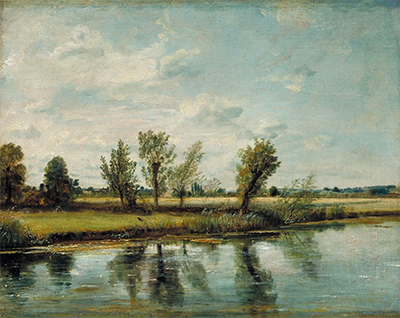
John Constable's Water Meadows near Salisbury is one of the quietest Salisbury pictures in his career, and that quietness is the point. There is no theatrical cathedral rising out of storm, no monumental six-foot canvas, no rainbow carrying the emotional weight of a late exhibition painting. Instead, Constable gives us water, sky, meadow and a low fringe of trees, with the eye held close to the surface of the landscape. The result is a picture of Salisbury in a gentler register: green, airy, reflective and almost stubbornly unspectacular.
The work is held by the Victoria and Albert Museum and is identified in the V&A's Google Arts & Culture record as Water-meadows near Salisbury, by John Constable, dated 1820 or 1829.[1] That uncertainty of date is useful, because the painting belongs less to a single famous public moment than to Constable's repeated attachment to Salisbury and to the friendship that drew him there. It shows a view in the grounds of John Fisher's home. Fisher, a canon of Salisbury Cathedral, was one of Constable's closest friends and most important supporters.[1]
The painting's reputation has often been pulled toward one memorable phrase. At the Royal Academy, critics condemned it as “a nasty green thing”, and Constable withdrew it.[1] The phrase is amusingly brutal, but it should not be allowed to flatten the work. The green is not a mistake of taste; it is the painting's argument. Constable was looking at a working wet landscape whose beauty lay in moisture, pasture, growth and atmosphere rather than in grand architectural display.
At a Glance
- ArtistJohn Constable (1776–1837)
- TitleWater Meadows near Salisbury [1]
- Date1820 or 1829 [1]
- CollectionVictoria and Albert Museum, London [1]
- MediumOil paint [1]
- SettingThe grounds of John Fisher's home near Salisbury [1]
- CompositionReflective water, a low meadow and tree band, and an expansive sky [2]
- Landscape typeEngineered pasture irrigation rather than accidental flooding [3]
- Hidden systemThe carriers and drains are not visible from Constable's viewpoint [2]
- ReceptionCriticised at the Royal Academy as “a nasty green thing” and withdrawn [1]
Contents
- Introduction
- Object Identity
- Fisher and Salisbury
- A Low and Reflective Composition
- What a Water Meadow Was
- Hidden Labour and Visible Calm
- The Royal Academy Rejection
- Apart from the Cathedral Pictures
- Why the Painting Matters
Object identity
The V&A record gives the title as Water-meadows near Salisbury and places the painting in London within the museum's collection.[1] Older and related cataloguing gives the work as an oil on canvas of modest dimensions, around 45.7 by 55.3 centimetres. It is therefore a small Salisbury image when set beside the large cathedral canvases, but it has a concentration that rewards slow looking.
The title needs careful handling. “Water meadows” can sound like a poetic description of damp fields, but in the Wiltshire context it refers to a particular agricultural system. These were not simply low meadows that happened to flood. They were engineered pastures designed to carry a controlled shallow flow of water across grass at selected times of year.[2][3] Constable's title therefore points to a landscape shaped by labour, not merely to a picturesque river view.
This matters for the way we read the picture. The painting does not parade rural work through prominent figures or machinery. The V&A blog notes that water and sky dominate the canvas, with trees and meadows between them, and that the actual channels of the water-meadow system are not visible from Constable's viewpoint.[2] The painting's subject is partly hidden in plain sight: an agricultural intelligence lying beneath the calm surface of the scene.
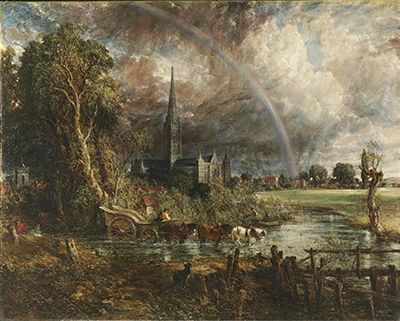
The work also needs separating from Constable's other Salisbury paintings. It is not Salisbury Cathedral from the Bishop's Grounds, the formal commission connected with Bishop Fisher. It is not Salisbury Cathedral from the Meadows, the late 1831 six-footer with storm, rainbow and heavy symbolic pressure. It is not the National Gallery's Salisbury Cathedral and Leadenhall from the River Avon, where the cathedral and Leadenhall are both clearly named within the view. Water Meadows near Salisbury stands apart because it lowers the drama and asks the viewer to attend to land, water and weather.
Fisher and Salisbury
Constable's Salisbury works are inseparable from John Fisher. Fisher performed the marriage ceremony for John and Maria Constable, encouraged the painter's ambitions and helped make Salisbury into one of the artist's recurring adult landscapes. The V&A object note for Water Meadows near Salisbury places the view in the grounds of Fisher's home, so the painting belongs to a world of hospitality as well as scenery.[1]
That context gives the image a private steadiness. Constable was not arriving as a detached tourist looking for a cathedral view to consume. He was returning to a place connected with friendship, clerical life, family visits and artistic support. Salisbury offered him a different kind of landscape from Suffolk: a cathedral city with rivers, water meadows, chalk-country light and the presence of Fisher's household. Yet he approached it through habits formed in the Stour Valley. He looked for water, air, growth and local use.
The Salisbury Museum's recent account of Constable's local connections describes his strong association with the city, the Fisher family, the River Avon, the water meadows and the Harnham ridge during a productive early-1820s period.[4] That broader geography helps explain why a small, green view can matter. Constable's Salisbury was not only the cathedral seen from a privileged angle. It was a network of river approaches, meadows, houses, friendships and working ground.
In this painting, the cathedral is not asked to dominate. If anything, the picture resists the obvious temptation of Salisbury. The V&A's wider introduction to Constable emphasises how strongly his art returned to places he knew and studied closely, which helps explain why a familiar river edge could matter as much as a famous monument.[5] A lesser painter might have pushed the spire into full command of the view. Constable keeps attention nearer to earth and water. He lets Salisbury become a place of atmosphere rather than a single landmark.
A low and reflective composition
The composition is built around horizontal calm. The foreground water holds the eye before it crosses to the low band of meadow and trees. Above them, the sky expands with more authority than any building or figure. The painting feels wide even at a modest scale because Constable gives so much of the pictorial field to air and reflection.
The water is not a decorative strip. It creates distance, light and delay. Before the viewer reaches the land, the scene has already been doubled, softened and disturbed by the reflective surface. Constable often used rivers as active pictorial agents, and here the water sets the emotional temperature. It slows everything down.
The meadow band is correspondingly restrained. Trees and pasture sit low, their forms made to feel embedded in moisture rather than crisply outlined. This is one reason the picture could provoke hostile reaction. Its greenness is not ornamental foliage placed at the edge of a grand subject; it is the very condition of the image. Green becomes atmosphere, not accessory.
The sky brings the painting its openness. Constable had long understood that a landscape's upper half could control the lower half's emotional meaning. In Water Meadows near Salisbury, the sky is not violently dramatic. It is pale, shifting and breathable. It makes the low land feel expansive, while the water below gives the sky a second life in reflection.
This delicacy distinguishes the work from the late cathedral pictures. The 1831 Meadows canvas turns weather into burden and revelation. Here, weather is quieter and more ambient. The painting's drama is not a storm breaking over Salisbury, but the almost invisible negotiation between damp ground, reflective water and moving air.
What a water meadow was
The title's plainness hides a sophisticated agricultural history. The Harnham Water Meadows, between West Harnham and Salisbury, sit at the confluence of the River Avon and the River Nadder, and the surviving historic system covers around 100 acres in various states of preservation.[3] They are among England's best-known meadow irrigation systems, part of a wider Wessex tradition of engineered river landscapes.[3]
A true water meadow was watered at the discretion of the farmer and a skilled specialist worker known as a drowner.[3] In the bedwork system used at Harnham, water was diverted from the river into carriers, ran along carefully constructed ridges, trickled through the grass at a shallow depth, and then returned through drains and a tail drain back to the river.[3] The point was control, not accidental flooding.
This controlled flow had practical value. Winter or early spring floating helped warm the grass and bring nutrients and oxygen into the soil, encouraging earlier growth. The Harnham account explains that this could give livestock an early bite of grass and support additional hay production.[3] The V&A blog similarly describes carefully made water channels maintaining a thin layer of water over grass stems, preventing freezing and encouraging growth that fed larger flocks, whose manure in turn supported corn farming.[2]
That cycle matters for Constable's painting because it turns the apparent stillness of the view into a working economy. What looks at first like a peaceful green margin was part of a managed agricultural machine. The machinery was not iron and smoke, but hatches, ridges, carriers, drains, timing and local expertise.
Constable's eastern childhood landscape around the Stour had its own mills, locks, barges and river labour. Salisbury offered a different watery technology. The V&A blog points out that water meadows were not characteristic of Constable's East Anglian home ground, but were widespread in Salisbury and southern England, where they helped the corn-and-sheep economy.[2] The painting therefore expands his river imagination. It is not Suffolk repeated in Wiltshire; it is a new watery system absorbed through familiar eyes.
Hidden labour and visible calm
One of the most interesting facts about the painting is that the water-meadow channels are not visible from Constable's viewpoint.[2] This does not weaken the title. It sharpens it. Constable shows the look of a landscape whose working structure is partly concealed by distance, grass and water. The viewer sees the effect before seeing the mechanism.
This hiddenness gives the picture its unusual modernity. The painting is not a social documentary, but it is not empty nature either. It records a shaped environment in which human intervention has become visually quiet. Water appears natural because generations of work have made its movement legible to those who know how to read the ground.
The figure of the drowner, named in the Harnham account as the skilled worker who maintained and operated the meadows, is absent from the image but present in its logic.[3] Constable does not need to depict the worker in order to paint the work. The entire field of green depends on knowledge: when to open water, how much to let through, how long to maintain the flow, and how to keep irrigation even.
That makes the painting a subtle companion to the Stour Valley subjects. In the Flatford pictures, labour often appears through boats, locks, mills, horses and men. In Water Meadows near Salisbury, work is quieter and more dispersed. It is a landscape of maintenance rather than event.
The result is a kind of agricultural abstraction before abstraction. Constable reduces the visible scene to water, green land and sky, yet the reduced view remains full of use. The eye is invited to enjoy serenity, then to realise that serenity has been made by design, habit and labour.
The Royal Academy rejection
The Royal Academy reaction is the painting's sharpest anecdote. Critics called it “a nasty green thing”, and Constable withdrew it.[1] The phrase has survived because it is vivid, but it also reveals how vulnerable Constable's kind of truth could be. A painting so dependent on green tonality, damp air and unheroic pasture could look awkward beside more polished or conventionally composed exhibition pictures.
The insult probably tells us as much about expectation as about the painting. Viewers who wanted landscape to provide balanced scenery, noble distance or clear architectural incident may have found this image frustrating. It refuses the easy hierarchy. The sky is large, the water insistent, the land low, and the most important human work is not readily visible.
Constable's withdrawal should not be read as proof that the picture failed. It shows that the work occupied a difficult zone between sketch-like freshness, local observation and public display. What the hostile phrase dismissed as excessive greenness is exactly what now makes the painting compelling. It gives the viewer a Salisbury not arranged for grandeur, but experienced as wet, living land.
There is also an ethical dimension to the green. Constable does not beautify agriculture by turning it into theatrical labour or rustic costume. He paints the environmental condition that made the system work. The meadow is green because it has been watered; the water is present because the river has been managed; the calmness is inseparable from use.
That is why the rejection can be held lightly but not ignored. It marks a clash between public taste and Constable's willingness to make an ordinary-looking stretch of productive land the centre of attention. The painting's quietness was not neutral. It asked viewers to value a kind of landscape that did not announce its importance in the expected terms.
Apart from the cathedral pictures
The Salisbury sequence can easily become overpowered by the cathedral. Constable's later and larger cathedral paintings invite symbolic readings, and they deserve them. But Water Meadows near Salisbury benefits from being kept away from that gravitational pull. Its subject is not the cathedral as institution, monument or spiritual emblem. Its subject is a watery agricultural landscape near Salisbury, seen through atmosphere.
This distinction is especially important beside Salisbury Cathedral from the Meadows. That 1831 work is large, late and storm-laden. It belongs to a different emotional and pictorial ambition. Water Meadows near Salisbury is smaller, lower and more reticent. It has no need for the rainbow language often attached to the later canvas.
Nor is it the Bishop's Grounds picture in miniature. The Bishop's Grounds works involve a formal cathedral view, patronage, tree-framed architecture and the Fisher commission. Water Meadows near Salisbury has Fisher context, but it does not turn that context into a grand architectural statement. Fisher helps explain why Constable was there; he does not make the painting a portrait of clerical power.
The National Gallery's River Avon and Leadenhall sketch offers another useful boundary. That work names the cathedral and Leadenhall directly and includes a clearer urban-domestic relationship across the river. Reynolds's catalogue context for the later paintings and drawings is valuable here because Salisbury contains several neighbouring but distinct Constable subjects, each with its own date, purpose and visual emphasis.[6] Water Meadows near Salisbury is more atmospheric and less topographically explicit. It is about ground and water before buildings.
Once these boundaries are kept clear, the painting gains force. It no longer appears as a lesser Salisbury cathedral image. It becomes a distinct experiment in how little overt incident a landscape needs in order to carry meaning. Constable lets the working green world speak quietly.
Why the painting matters
Water Meadows near Salisbury matters because it shows Constable treating agricultural infrastructure as atmosphere. He does not diagram the system, foreground its workers or explain its mechanics pictorially. He paints the felt result: wet land, reflective water, low meadow, sky and green light. The image is calm because the labour behind it has been absorbed into the landscape.
It also matters within the larger Salisbury group. The painting gives the sequence a quieter centre of gravity. Without it, Constable's Salisbury can seem to move too quickly from hospitable friendship to cathedral symbolism. This work restores the environmental middle ground: the river systems, meadows and local practices that made Salisbury more than a view of a spire.
The “nasty green thing” criticism has lasted because it is memorable. The painting has lasted because the criticism missed the deeper achievement. Constable found visual seriousness in a low, green, watery landscape, and he allowed that seriousness to remain modest. He did not rescue the view by adding drama. He trusted its dampness, its greenness and its air.
That trust feels central to Constable's best art. Again and again, he returned to landscapes made meaningful by use: mills, locks, towpaths, fields, gardens, coastlines, commons and skies. Water Meadows near Salisbury belongs to that world. It is not a grand declaration, but it is a precise act of attention to a place where water, agriculture and weather worked together.
In the end, the painting asks for a slower kind of looking. At first glance, it may seem almost too quiet. Stay with it, and the quiet becomes complex. The river holds the sky; the meadow holds the history of controlled water; the green carries both beauty and labour. Constable's Salisbury is not only a cathedral city. Here, it is a living wet landscape, made memorable by the very quality that offended its first critics.
Frequently Asked Questions
Discussion
What gives this quiet painting its force: reflective water, insistent green, hidden agricultural work, or the breadth of the sky?
Reader Insights
How does knowing about carriers, drains and the skilled drowner change the apparently natural scene?
Does the Royal Academy insult clarify what was radical about the painting's narrow wet-green register?
What becomes visible once this view is kept distinct from Constable's cathedral paintings?
Join the Conversation
Share your reading below.
References
- Google Arts & Culture / Victoria and Albert Museum, Water-meadows near Salisbury, https://artsandculture.google.com/asset/water-meadows-near-salisbury-john-constable/NwEcT5_TECHtJg?hl=en
- Victoria and Albert Museum Blog, Ruth Hibbard, “Wade around in John Constable's Water Meadows,” https://www.vam.ac.uk/blog/museum-life/wade-around-in-john-constables-water-meadows
- Harnham Water Meadows Trust, “The history of the Harnham Water Meadows,” https://www.salisburywatermeadows.org.uk/history/
- Salisbury Museum, “John Constable oil painting to be displayed at The Salisbury Museum for the first time in 200 years,” https://salisburymuseum.org.uk/john-constable-oil-painting-to-be-displayed-at-the-salisbury-museum-for-the-first-time-in-200-years/
- Victoria and Albert Museum, “John Constable – an introduction,” https://www.vam.ac.uk/articles/john-constable-an-introduction
- Graham Reynolds, The Later Paintings and Drawings of John Constable, Paul Mellon Centre for Studies in British Art, Yale University Press.