 by Tom Gurney
Tom Gurney BSc (Hons) is an art history expert with over 20 years experience
Published on June 19, 2020 / Page Updated on November 5, 2026
Email: tomgurney1@gmail.com / Phone: +44 7429 011000
Introduction
John Constable's life is often told through a handful of beloved landscapes: The Hay Wain, the Stour Valley pictures, the cloud studies, the Salisbury Cathedral views and the late storm-filled works. Yet the life behind those paintings was not simply a pastoral story. Constable was born into a working Suffolk family business, entered art slowly, struggled for recognition, married after years of opposition, raised a large family, depended on friendships and patrons, and built a career around the difficult claim that landscape painting could carry serious feeling.
The National Gallery identifies him as a painter famous for landscapes rooted mostly in the Suffolk countryside where he was born and lived, while also stressing that his open-air sketches usually became the basis for large studio-made exhibition paintings.[1] That is a useful way into the biography. Constable's life was shaped by places he knew intimately, but his art was not an unmediated outpouring of rural affection. It was a disciplined, ambitious and often frustrated effort to turn memory, weather, labour and observation into public painting.
The V&A's account of Constable gives the human outline: born at East Bergholt in Suffolk in 1776, son of Golding and Ann Constable, first involved in the family business, trained gradually through local encouragement and the Royal Academy Schools, married Maria Bicknell in 1816, worked between London, Hampstead, Suffolk, Salisbury and Brighton, and achieved full Royal Academy membership only late in life.[2] Within that outline is a more revealing story: a painter who refused to abandon the local landscape of his affections, even when the art world made that loyalty professionally difficult.
At a Glance
- Born11 June 1776 [2]
- BirthplaceEast Bergholt, Suffolk [2]
- ParentsGolding and Ann Constable [2]
- Early workThe family corn, coal, mill and transport business [2][3]
- TrainingRoyal Academy Schools from 1799 [2]
- MarriageMaria Bicknell, 1816 [2]
- FamilySeven children [2]
- Key placesSuffolk, London, Hampstead, Salisbury, Brighton and Weymouth
- Royal AcademicianFull membership in 1829 [2]
- Died31 March 1837 [1]
Contents
- Introduction
- East Bergholt and the Family Business
- The Royal Academy and London
- Maria Bicknell and Personal Struggle
- Marriage, London and Hampstead
- The Six-Foot Paintings
- Recognition in England and France
- Grief, Late Work and Experiment
- Death and Posthumous Reputation
- Legacy of the Life
East Bergholt and the Family Business
John Constable was born on 11 June 1776 at East Bergholt, a Suffolk village close to the River Stour. He was the fourth child of Golding and Ann Constable.[2] The family was prosperous, but not aristocratic. Golding Constable's business dealt in corn, coal, mills and river transport, and the young Constable grew up near the practical infrastructure that would later become central to his paintings: mills, barges, locks, towpaths, fields, water and working buildings.
The National Trust's Flatford history helps make that world concrete. Flatford Lock and other Stour locks increased local prosperity, including that of Golding Constable, who owned corn mills, a windmill, lighters and Thames barges.[3] This was the environment that formed Constable's eye. The Stour Valley was beautiful, but it was also useful. Its river traffic, grain business, mills and dry docks belonged to everyday economic life.
This background is important because Constable's later landscapes are sometimes softened into pure nostalgia. They are nostalgic in part, but not empty. When he painted Flatford Mill, Dedham, a lock, a boatyard or a Stour barge, he was drawing on a practical knowledge of how that world worked. He knew the look of damp banks, timber, brick, millponds and tow horses not as picturesque inventions but as lived structures.
In 1792, according to the V&A, Constable began work in the family business.[2] He did not immediately become a professional painter. That delay may have deepened his attachment to the landscape he later painted. He had known it as a son, worker, observer and local inhabitant before he made it into art. The paintings of the Stour are therefore never only views. They are also acts of return.
The family business also gave Constable a double inheritance. On one side was comfort, social standing and the possibility of support while he found his way as an artist. On the other was expectation. A son of Golding Constable was not born into idleness. He belonged to a household that understood labour, accounts, transport and responsibility. When he turned toward art, he was not escaping a vague rural childhood but moving away from a recognisable commercial path. That tension helps explain the mixture of tenderness and urgency in his later relationship to Suffolk.
East Bergholt itself remained more than an origin point. It gave him a network of roads, fields, churches, mills and families that shaped his imagination. The Stour divided and connected counties; paths led toward Dedham; barges moved goods downstream; church towers offered points of recognition across land and water. Constable's later landscapes often feel spacious, but they are built from such intimate co-ordinates. He painted open air, yet the air belonged to known ground.
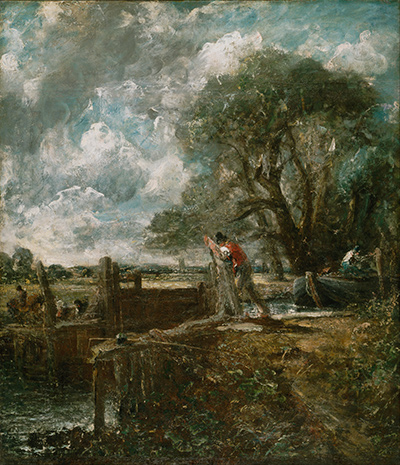
This early world also gave him a lifelong resistance to theatrical exaggeration. He could admire grand landscape traditions, but he returned repeatedly to river edges, working mills and ordinary trees. The seriousness of the paintings depends on that loyalty. Constable learned to see grandeur without needing the Alps, antiquity or dramatic catastrophe. A familiar lock, watched closely enough, could become the centre of a major painting.
First Artistic Encouragement
Constable's first artistic guidance came locally. The V&A notes that he took up painting and drawing under the encouragement of John Dunthorne, a local amateur artist.[2] This early beginning suited his temperament. He was not launched into art as a prodigy. He developed through looking, copying, sketching and conversation, slowly turning a rural familiarity into pictorial purpose.
A major turning point came in 1795, when Constable met Sir George Beaumont, an amateur painter, collector and later patron. Beaumont's collection exposed him to Old Master landscape and to a wider world of artistic ambition.[2] This matters because Constable was never simply a painter of instinctive nature. He wanted to enter serious art, and he studied the traditions he hoped to renew.
He also benefited from the intellectual encouragement of figures such as John Thomas Smith and John Cranch, who helped direct his reading and thinking about art.[2] Such influences gave Constable a foundation in art history as well as observation. He could admire Claude, Rubens, Ruisdael and Gainsborough while still insisting that his own Suffolk landscape had authority.
Graham Reynolds's The Early Paintings and Drawings of John Constable remains a key scholarly authority for these formative decades.[4] Reynolds's catalogue of the works from 1790 to 1816 shows a young artist passing through experiments, studies, early portraits, watercolours, drawings and local landscapes before arriving at the mature language of the great Stour paintings. The biography makes more sense when this long preparation is kept visible. Constable did not discover himself all at once. He worked himself into clarity.
The gradual nature of that formation is one of the most attractive parts of Constable's life. He was not a dazzling young rebel who overturned landscape painting overnight. He was a persistent observer who slowly made his affections more rigorous. Early drawings and paintings allowed him to test what could be carried by line, tone, colour and composition. They also trained him to recognise which details mattered. A trunk, a bank, a cluster of roofs or a cloud break could be enough if it was seen with intensity.
Beaumont's influence should also be understood as more than social advantage. Exposure to Old Master painting helped Constable see that landscape could be constructed, balanced and argued over. He did not reject artifice in favour of raw nature. He learned from artifice and then tried to make it answer to the landscapes he knew. That is why his biography belongs to both East Bergholt and the museum world: the river gave him subjects, but earlier painting gave him a language of ambition.
The years before his marriage were therefore years of artistic assembly. Local instruction, Academy training, Old Master study, early commissions, family pressure and private longing all moved together. By the time the Stour Valley became the subject of his greatest public works, it had been filtered through more than memory. It had passed through a long apprenticeship in looking and making.
The Royal Academy and London
In 1799 Constable entered the Royal Academy Schools in London.[2] This move did not erase Suffolk from his imagination, but it changed the scale of his ambition. The Royal Academy offered training, exhibition opportunity and access to the professional art world. It also placed him in a culture where landscape painting still had to fight for status.
The National Gallery places his public exhibition career from 1802 onward, first in the Royal Academy orbit and later also in Paris.[1] These exhibitions were essential to his career, but they did not bring quick success. Landscape was not the easiest path to professional stability. Portraits could pay. History painting carried prestige. Constable's chosen subject, the familiar English landscape, required patience, conviction and a certain stubbornness.
London was both necessary and uncomfortable. It gave Constable access to patrons, exhibitions, collections and artistic society, but his deepest imaginative resources remained tied to Suffolk. This tension between career centre and emotional ground runs through the biography. He needed London to become a painter; he needed East Bergholt, Dedham and Flatford to know what to paint.
His time in London also sharpened his sense of difference. Constable's paintings often look back toward the countryside, but they were made for urban exhibition rooms. The rural world enters his art partly because he was away from it. Distance did not weaken memory. It made it more active, giving him the need to reconstruct familiar places through studies, sketches and studio work.
The Royal Academy years also forced Constable to confront hierarchy. Landscape could be admired, but it did not automatically command the prestige of history painting or the income of portraiture. Constable's decision to persevere with landscape was therefore not simply a matter of taste. It was a professional choice with consequences. He had to persuade patrons, critics and institutions that a river scene could deserve sustained attention.
London supplied another paradox. Constable disliked aspects of urban life, yet the city allowed him to turn Suffolk into art. In London he could study collections, meet artists, show pictures, seek buyers and measure himself against the expectations of the Academy. The countryside of his paintings was not made outside history. It was reconstructed inside the modern art world, for viewers whose distance from rural labour may have made those images newly attractive and newly difficult.
This tension continued through his career. When he painted a millpond in a London studio, he was not betraying the original scene. He was making it communicable. The work of memory required separation. The professional painter had to leave the place in order to return to it with pictorial force.
Suffolk as Artistic Foundation
Constable's early mature art grew from a landscape he described, painted and remembered repeatedly: East Bergholt, Dedham, Flatford, Stratford St Mary, Langham and the River Stour. The V&A notes that Constable's biographer C. R. Leslie called his life work a history of his affections, and that Constable had a deep attachment to the countryside of his youth.[2] That attachment was emotional, but it was also visual and practical.
The Stour Valley gave him motifs that would stay with him for decades: willows, mills, barges, church towers, locks, brickwork, old banks, posts, fields and cloudy skies. These motifs were not decorative. They formed a vocabulary. A lock could stand for navigation, labour and memory; a mill could hold family history; a cloud could change the emotional register of an entire scene.
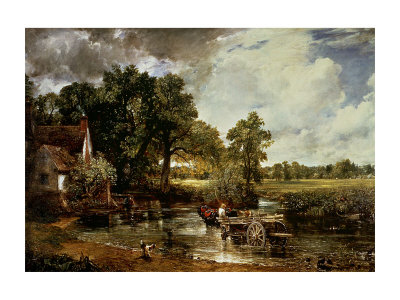
The National Gallery's account of The Hay Wain shows how long this memory could remain active. The painting's view is of the millpond at Flatford, near Constable's birthplace, with Willy Lott's house on the left and the family-associated mill just beyond the visible scene.[5] Yet the finished painting was made in London from studies accumulated over years.[5] This is Constable's biography in miniature: Suffolk known intimately, London used professionally, memory organised through painting.
It would be too simple to say that Constable painted only what he knew. He also transformed what he knew. The familiar landscape was not copied passively. It was selected, reassembled and enlarged into exhibition art. His emotional loyalty to Suffolk did not make him provincial. It gave him the ground from which to make an original contribution to British landscape painting.
This is one reason the Stour remained fertile for so long. Constable did not exhaust it because he did not treat it as scenery alone. The same region could provide childhood memory, agricultural labour, family business, topographical study, artistic challenge and emotional return. A lock might matter because of its function, its shape, its relation to water and its memory within the painter's life. A painting could hold all of these at once without explaining them aloud.
The Suffolk foundation also shaped his sense of time. Constable watched places change, and he painted many of them from memory as much as from direct presence. His art often carries the feeling that the landscape is both immediate and already passing away. This is not simply nostalgia. It is the recognition that a lived landscape changes as families, economies, weather and personal circumstances change.
His paintings of Suffolk are therefore biographical even when no portrait appears. They show how a life can become embedded in recurrent motifs. To understand Constable's biography is to see why certain visual facts mattered to him so deeply: the line of the Stour, the white face of a cottage, the weight of trees, the dampness of water meadows, the dark understructure of a cloud.
Maria Bicknell and Personal Struggle
Constable first met Maria Bicknell in 1809 while she was visiting her maternal grandfather, the Reverend Dr Durrande Rhudde, rector in East Bergholt.[6] The National Trust describes the relationship as one that deepened despite strong family resistance, especially from Maria's grandfather, who doubted Constable's financial prospects and disapproved of his associations.[6] Their eventual marriage was delayed for years.
This long opposition belongs to the emotional centre of Constable's life. It also belongs to the practical story of his career. Marriage required income, and income was difficult for a landscape painter who had not yet secured stable success. Constable's art was not made in a vacuum of pure feeling. It was made under pressure: family expectation, uncertain sales, the need for professional recognition and the longing for domestic life.
Constable and Maria married in 1816.[2] The marriage gave him emotional stability, but it also brought the responsibilities of a growing family. The V&A notes that financial pressures made the commercial success of the large Stour paintings increasingly important.[2] This fact helps correct the myth of the unworldly painter of fields. Constable was deeply attached to nature, but he also needed his art to sell, persuade and support a household.
Maria should not be treated merely as a tragic figure in Constable's biography. She was the woman he loved, the centre of a family life he had fought to secure, and part of the emotional world in which he worked. Her later illness and death mattered profoundly, but the biography should not reduce her to an explanation for storms and late skies. Constable's art had always been interested in weather and feeling. Grief intensified that language; it did not invent it.
The marriage also changed the rhythm of Constable's working life. Domestic responsibilities, children, money and health became part of the practical conditions under which paintings were made. The heroic image of the solitary landscape painter is too simple for him. Constable's art was produced amid family pressures and often in response to them. His large paintings were acts of ambition, but they were also attempts to secure a life.
Maria's own family story kept the early years emotionally charged. The long resistance to the marriage had made love inseparable from patience and frustration. When the marriage finally took place, it brought fulfilment after delay rather than easy romantic triumph. That history matters because Constable's later art often carries a deep sense of things long desired, remembered or nearly lost. The emotional patience of the life and the compositional patience of the paintings are not the same thing, but they belong to the same temperament.
The surviving image of Constable as a painter of gentle rural feeling can obscure this strain. His biography includes anxiety, resistance, grief and responsibility. The tenderness in the paintings is not weakness. It is something he continued to make under pressure.
Marriage, London and Hampstead
After their marriage, Constable and Maria established a life connected to London, where his career required him to be. The V&A places them in Bloomsbury from 1817, before the family eventually made Hampstead, then outside London, the more congenial base.[2] Hampstead became one of the crucial places of Constable's mature life.
Hampstead offered healthful air, distance from the city and a wide sky. It also became a laboratory for weather. In the early 1820s Constable embarked on intensive studies of clouds and atmospheric effects there.[2] These studies were not hobbies beside the main career. They became central to his understanding of landscape. Mark Evans's Constable's Skies gives this part of the work its proper weight, connecting Constable's sky studies to weather observation, meteorology and the expressive structure of landscape painting.[7]
The biography of Hampstead is therefore both domestic and artistic. It was a place where the family could live, where Maria's health could be considered, and where Constable could study the changing sky with unusual discipline. In Hampstead, landscape became more vertical. The ground mattered, but the sky took command.
This period also reveals Constable's unusual blend of observation and feeling. He could record wind, time and weather while also treating the sky as emotionally powerful. For him, accuracy and feeling did not cancel each other. A cloud carefully studied could become more expressive, not less. The biography of the painter is partly the biography of this belief: that the closer one looked at nature, the more feeling it could sustain.
Hampstead also changed his daily relation to landscape. Suffolk had been the landscape of origin; Hampstead was a place of residence, study and repeated observation near the metropolis. It allowed him to keep painting from nature while remaining close to the professional world of London. This combination suited the divided shape of his adult life. He could be near the city without surrendering the sky.
The cloud studies from this period are often discussed as works in themselves, but they also reveal how Constable organised his attention. He was not waiting for grand subjects. He was willing to study what most people would treat as passing background. A cloud formation, a wind direction or a change of light could become worthy of sustained effort. That habit of attention fed back into the major paintings.
Maria's health makes the Hampstead and Brighton years more poignant, but again the point is not to turn every study into private code. Illness, family life and weather study overlapped. Constable's genius was to keep looking outward even when inward pressures were intense. The sky gave him a form through which change could be observed, endured and painted.
The Six-Foot Paintings
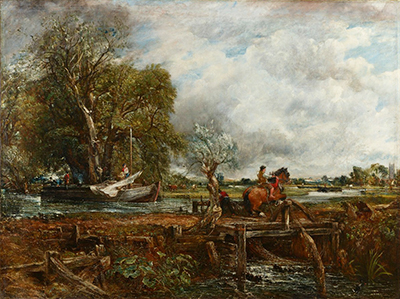
Between 1819 and 1825 Constable made his most ambitious public case for landscape painting through the large Stour canvases often called the six-footers. The V&A presents the group as a sequence of major River Stour subjects and stresses that full-size preparatory oil sketches helped him organise motif, light, colour and shade.[2] These paintings were a decisive stage in his career.
The first of the great Stour works, The White Horse, was exhibited in 1819. Stratford Mill followed in 1820, The Hay Wain in 1821, and The Leaping Horse in 1825. The exact sequence matters less here than the ambition behind it. Constable wanted the landscape of his youth to occupy the large format of serious exhibition painting. He wanted rivers, locks, horses, mills and fields to stand before the public with authority.
The National Gallery identifies Stratford Mill as the second of these monumental Stour landscapes, a water-powered paper mill scene on the River Stour near East Bergholt.[8] The painting shows how Constable could make familiar geography complex: shade, fishing, water, moored barges, figures and moving light all held together inside a large composition. This was not rural illustration. It was landscape as structured public art.
The Hay Wain became the most famous of the group, but in Constable's own lifetime its success was not immediate. The National Gallery notes that the painting was shown at the Royal Academy in 1821 and later sent to Paris, where it helped create a sensation and contributed to Constable's French recognition.[5] The now-beloved picture began as an uncertain professional gamble. That uncertainty is essential to the biography. Constable's fame was hard won.
The six-footers also show Constable turning personal geography into a sustained public project. Each large Stour painting was more than an isolated attempt. Together they formed an argument across several Royal Academy exhibitions: that the English landscape he knew could support grandeur, complexity and feeling. He was not merely painting his home ground because it was convenient. He was returning to it because it offered the deepest test of his art.
The use of full-size preparatory sketches reveals his seriousness. These were not casual enlargements of small studies. They were working arenas in which light, structure, motif and scale could be tried before the final canvas. The V&A's emphasis on this process helps explain why the finished pictures preserve a sense of movement rather than freezing into polish.[2] Constable wanted ambition without deadness.
The six-foot paintings also intensified the pressure of exhibition. They were large, costly and time-consuming, and they had to compete with many other works in public. Their partial success and frequent failure to sell kept Constable in a state of professional uncertainty. Yet he persisted, which is one of the clearest signs of how completely he believed in landscape as a serious art.
John Fisher and Salisbury
John Fisher, Archdeacon of Salisbury, was one of Constable's closest friends and most important correspondents. Fisher's friendship brought encouragement, patronage, conversation and access to Salisbury. The V&A notes that Constable frequently painted Salisbury, where Fisher lived, and that Dr John Fisher invited him to stay in the Bishop's Palace in Salisbury in 1811.[2]
Salisbury opened a different kind of landscape for Constable. It was not the family ground of Suffolk, but it became personally charged through friendship and religious architecture. The cathedral, meadows, river and Close offered subjects in which building, weather, patronage and feeling could combine. Fisher's role also reminds us that Constable's career depended on relationships. He was not sustained by market success alone.
The National Gallery's Salisbury Cathedral and Leadenhall from the River Avon describes a six-week visit in 1820, when Constable was staying with the Fisher family at Leadenhall.[9] The picture looks across the River Avon toward the cathedral and the houses of the Close, and its loose handling preserves the character of an oil sketch.[9] Such works show Constable responding to Salisbury directly, before later cathedral subjects took on more formal and symbolic weight.
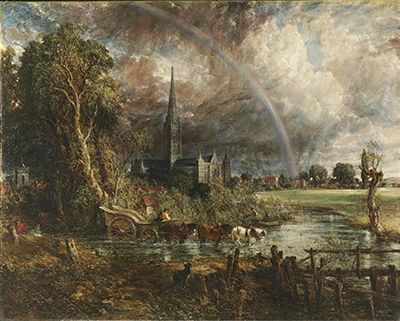
Salisbury also became important after Maria's death. Later cathedral images, especially Salisbury Cathedral from the Meadows, are often discussed through bereavement, storm, rainbow and spiritual tension. Such interpretations require care. Constable's friendship with Fisher, the church setting and the losses of his later life all matter, but each Salisbury painting has its own circumstances. The biography should illuminate them without flattening them into one mood.
Fisher also gave Constable something more than hospitality. He was a sympathetic reader of the artist's ambitions. For a painter who often felt under-recognised, such friendship mattered. Letters, commissions, purchases and encouragement helped sustain the belief that landscape painting could be more than a marginal pursuit. Fisher's presence in the biography is therefore both personal and professional.
The Salisbury works also broadened the emotional register of Constable's art. Suffolk carried childhood and family business; Salisbury carried friendship, church authority, architecture and later bereavement. The cathedral could stand firm while weather moved around it, making it an ideal subject for a painter increasingly interested in the relation between permanence and change. This relation would become more charged in the late work.
Salisbury was also where Constable could bring together several parts of his life: domestic travel, friendship, patronage, sketching, architecture, water and sky. That mixture explains why the cathedral subjects recur without becoming repetitive. Each return adjusted the balance between place, weather and feeling.
Brighton, Weymouth and the Coast
Constable's life and art also moved toward the coast. His 1816 marriage to Maria was followed by time at Osmington near Weymouth, where he painted views of the Dorset coast. The National Gallery's Weymouth Bay: Bowleaze Cove and Jordon Hill places the subject at Bowleaze Cove looking west from Osmington and connects the area with Constable's honeymoon stay.[10] The coast brought a different atmosphere from the Stour: open sea, cliff, beach, wind, fishing figures and fast-moving weather.
Brighton entered the biography through Maria's health. The V&A notes that the family took lodgings in Brighton from 1824 until 1828, the year of Maria's death.[2] During these stays, Constable made drawings and oil sketches that recorded his fascination with the shore, cliffs, light and sea weather.[2] The move was practical and personal, but it also widened his art.
The Brighton and Weymouth works show how Constable's attention to weather adapted to marine conditions. Clouds over the Stour move across a remembered inland world; clouds over Brighton and Weymouth meet sea light, surf, shingle and horizon. The biography of the painter is therefore also a biography of changing air. Constable carried his observational discipline from Suffolk to coast, from river valley to open sea.
This coastal work also places him nearer to the broader nineteenth-century transformation of landscape and marine painting. It does not make him Turner, nor should the comparison be overplayed, but it shows that Constable's world was wider than “Constable Country”. His fidelity to familiar places did not prevent him from responding to harsher, more exposed and more modern environments.
The coast also offered a visual problem different from the enclosed Stour. There were fewer sheltering trees and more open horizon. Light could be glaring, wind more insistent, figures smaller against sea and sky. Constable's handling in these subjects often has to suggest movement, brightness and abrasion. The painter of millponds became, for periods, a painter of exposed air.
Brighton was not only a picturesque resort in this biography. It was tied to health, family anxiety and the modern seaside. The paintings and sketches made there belong to a life trying to manage illness while continuing to work. They also show Constable refusing to let personal difficulty narrow his observation. The world remained visually demanding, even when domestic circumstances were hard.
Weymouth and Brighton together prove that Constable's art was not locked inside one remembered childhood landscape. The Stour gave him his deepest grammar, but the coast expanded the vocabulary. Sea weather, chalky light, boats, collier traffic, cliffs and shore figures gave him different materials through which to explore the same lifelong concern: the relation between observed nature and feeling.
Recognition in England and France
Constable's career was marked by a striking imbalance between the modern certainty of his reputation and the difficulty of his lifetime recognition. The National Gallery stresses that the paintings now enjoy enormous popularity, although English audiences and institutions were slow to receive them warmly during his life, while Paris proved more responsive.[1] That contrast shaped his professional life.
The French response mattered deeply. The Hay Wain and related works attracted attention in Paris in the 1820s, helping Constable become important to French artists who were seeking a fresher relation to nature.[5] He influenced the Barbizon School and French Romanticism, according to the National Gallery's artist account.[1] The painter now seen as a central image-maker of English rural identity gained some of his strongest early validation abroad.
In England, the path was slower. Constable became a full Royal Academician only in 1829, when he was already in his fifties.[2] This late election mattered, but it came after decades of effort. His ambitions had long been clear, yet the institutions he addressed were slow to accept the full seriousness of his landscape art.
This struggle should not be romanticised into a simple story of misunderstood genius. Constable had patrons, friends, collectors and moments of success. But the biography is still one of persistence against resistance. He was trying to make landscape do something that many viewers and institutions were not yet ready to value fully. His later fame can make that effort invisible unless the chronology is kept in view.
His English difficulty also shaped the tone of his ambition. Constable did not abandon landscape for safer work, even though portraiture and other commissions could have offered steadier income. He continued to send large landscapes into public exhibitions, knowing they might not sell. That persistence makes the career morally as well as artistically compelling. He kept asking for recognition on the terms of the art he believed in.
French enthusiasm did not solve every problem, but it confirmed that his paintings could speak beyond local association. French viewers did not need childhood memories of the Stour to recognise the freshness of his landscapes. That fact is important. Constable's art begins in local intimacy, but its force does not depend on local familiarity. Weather, light, labour and compositional vitality gave it a wider language.
This international reception also complicates the later idea of Constable as purely English heritage. His paintings helped shape that heritage, but they also contributed to European landscape modernity. The painter who looked so persistently at Suffolk helped other artists rethink how nature could be painted.
Grief, Late Work and Experiment
Maria Constable died in 1828 after years of ill health.[2] Constable was left with seven children and a life marked by grief, responsibility and continued artistic labour. The death of his wife is one of the defining events of his later biography, but it should be handled without melodrama. His late art does become darker, freer and more emotionally charged, yet it remains grounded in the same lifelong concerns: weather, memory, place and the expressive power of landscape.
After 1829, the V&A notes, Constable turned increasingly toward watercolour for outdoor work.[2] His later drawings and watercolours often show a vigorous experimental handling of material, weather and mood. This late freedom should not be treated as decline. It is part of the continuing restlessness of his art.
The late works also revisit earlier places and subjects under changed emotional conditions. Salisbury, ruins, storms, rainbows and turbulent skies become more prominent. Yet the late Constable is not only a grieving widower painting darkness. He is an experienced artist pressing landscape into more expressive forms, using weather and material handling to carry a wider range of feeling.
His lectures on landscape in the 1830s further show that he remained intellectually engaged with the meaning of his art.[2] Constable was not simply painting from habit. He continued to think about landscape as a tradition, a practice and a language of feeling. The late career combines personal loss with professional reflection.
The later work can feel rougher and more unsettled because Constable allowed material urgency to remain visible. Watercolour, drawing and oil sketching gave him ways to pursue effects that might have seemed too restless for earlier exhibition finish. This does not mean that he stopped caring about structure. Rather, he became increasingly willing to let weather and handling carry emotional force directly.
Fatherhood also changed the late years. After Maria's death, Constable was not only bereaved; he was responsible. The life of the artist continued within the life of a widowed parent. That fact should steady any interpretation of the late work. Grief was deep, but the world did not pause. There were children, finances, exhibitions, friendships, lectures and unfinished artistic problems.
The late Constable is therefore moving because he does not retreat into one mood. He continues to paint, think, revise and teach. The stormy skies and expressive handling belong to a life under pressure, but also to a painter still alive to experiment. His art grows darker without becoming inert.
Turner, Rivalry and Landscape Ambition
Constable's biography inevitably touches J. M. W. Turner. They were near contemporaries, both central to British landscape painting and both connected to the Royal Academy. Turner achieved institutional recognition much earlier, while Constable became a full Academician only late in life.[2] The difference sharpened later accounts of rivalry, but the comparison should be kept careful.
The Royal Academy's Constable, Turner and the Royal Academy treats their relationship through exhibition rivalry and the much-retold 1832 Varnishing Day episode, while keeping the anecdotal tradition under control.[11] Amy Concannon's edited Turner and Constable: Rivals and Originals offers a broader modern account of two distinct but equally transformative visions of landscape.[12] For Constable's biography, the comparison matters because it shows the artistic field in which he worked.
Turner and Constable did not merely compete as personalities. They represented different possibilities for modern landscape painting. Turner ranged widely through travel, history, light, sea and modern spectacle. Constable returned again and again to known ground, observed weather and the transformation of local memory into paint. Both expanded the status of landscape. Their difference helps reveal the particular courage of Constable's choice: to make the familiar landscape bear the weight of ambition.
The comparison deserves its own full treatment, but the biography should make one thing clear. Constable was not a smaller Turner. He was pursuing a different answer to the same problem: how could landscape painting become emotionally and artistically serious in the modern world?
The difference between them also clarifies Constable's courage. Turner's brilliance often moves outward, toward travel, history, elemental force and modern spectacle. Constable's strength moves inward through repeated attention to known places. The world he painted was smaller in geographical range, but not smaller in implication. He made concentration itself a form of originality.
Their rivalry also belonged to institutions, not just temperament. The Royal Academy, exhibitions, critics, sales and public reputations shaped how both men were seen. Constable's later place beside Turner in British art history should not obscure how uneven their careers felt in real time. Turner enjoyed earlier recognition; Constable's authority accumulated more slowly.
That slow accumulation is part of why his paintings now feel so earned. They are not the works of an artist swept smoothly into fame. They are the works of someone who kept faith with a demanding idea of landscape across decades of uncertainty.
Death and Posthumous Reputation
John Constable died on 31 March 1837.[1] By then he had not enjoyed the settled fame that later generations would grant him. His work had been admired, criticised, purchased, rejected, reproduced and debated, but the full public certainty of his greatness came later. That delay is part of the pathos of the biography.
In the same year as his death, The Cornfield entered the National Gallery after being purchased by a committee of friends and admirers and presented as a tribute.[13] The gesture is telling. Constable's standing was not absent in his lifetime, but it required advocates. His paintings needed people willing to argue for them.
The later preservation of his sketches transformed his reputation. The V&A records that Isabel Constable, his last surviving child, gave the South Kensington Museum a large body of works, including drawings, watercolours, oil sketches, easel paintings and sketchbooks.[2] That gift profoundly shaped modern understanding of the artist. It allowed viewers to see not only the finished paintings but the processes of looking, testing and revising behind them.
Today Constable is famous enough to seem inevitable. His paintings help shape the popular image of the English countryside, as the V&A observes.[2] Yet the biography behind that fame remains full of struggle, discipline and complexity. He was a local painter with international consequences, a slow-developing artist of enormous ambition, and a man whose affection for place became a new language for landscape.
The posthumous story also changes the emotional shape of the life. Works that had been hard to sell became cherished. Sketches that might once have seemed preparatory became central to modern admiration. The same roughness that could trouble period expectations later became evidence of vitality. Constable's reputation did not simply grow; it changed character as viewers learned to value the process behind the finish.
Isabel Constable's preservation of the family holdings is therefore a vital part of the legacy. Without that body of material, the modern viewer would know a more limited Constable: the maker of famous finished landscapes. With it, the artist appears as a working mind, testing clouds, trees, water, paper, canvas, oil and wash. The biography extends through the survival of those materials.
Legacy of the Life
Constable's life matters because it explains why the paintings are both intimate and ambitious. He knew the Stour as family ground and working environment. He knew London as necessity. He knew Hampstead as sky and health. He knew Salisbury through friendship and cathedral commission. He knew Brighton and Weymouth through marriage, illness, travel and weather. The art emerges from the movement among these places.
His biography also explains why the paintings should not be reduced to nostalgia. Constable loved remembered places, but he was not merely preserving them. He was building a serious art from them. His life gave him the materials: mills, barges, fields, cloud, family, grief, friendship, professional difficulty and institutional ambition. His art gave those materials form.
The result is a career that still feels unusually human. Constable did not paint landscape from a detached height. He painted it as something lived, worked, lost, remembered and studied. His life was not easy, and his recognition was not swift. But out of that difficulty came paintings that make familiar places feel inexhaustible.
Constable's biography is therefore not simply the story of a man who painted the countryside. It is the story of an artist who believed the countryside could contain the whole seriousness of art: observation, memory, labour, love, weather, loss and feeling. That belief remains the force of his work.
His life also shows that artistic originality does not always announce itself through novelty of subject. Constable's subjects could seem old, humble or familiar: a lane, a mill, a church, a field, a cloud. His originality lay in the intensity with which he treated them and the scale of feeling he believed they could hold. He made the known world newly demanding.
That is why his biography still matters for readers who already know the images. The famous paintings are not merely illustrations of a rural life. They are the outcome of choices made under pressure: to leave and return, to study and remember, to persist with landscape, to balance family and ambition, to let weather become meaning. Constable's life gives the paintings their human depth, and the paintings give the life its enduring form.
Frequently Asked Questions
Discussion
Which part of Constable's life most changes how you read his landscapes?
Reader Insights
How does knowing the family mill and river business change the meaning of Constable's Suffolk scenes?
Where do domestic responsibility and professional uncertainty become visible in the career?
What does the contrast between slow English recognition and Parisian success reveal about his originality?
Join the Conversation
Share your reading below.
References
- National Gallery, “John Constable (1776–1837),” https://www.nationalgallery.org.uk/artists/john-constable
- Victoria and Albert Museum, “John Constable – an introduction,” https://www.vam.ac.uk/articles/john-constable-an-introduction
- National Trust, “History of Flatford,” https://www.nationaltrust.org.uk/visit/suffolk/flatford/history-of-flatford
- Graham Reynolds, The Early Paintings and Drawings of John Constable, Paul Mellon Centre / Yale University Press, 1996, bibliographic record: https://www.paul-mellon-centre.ac.uk/publications/browse/9780300063370
- National Gallery, “John Constable, The Hay Wain,” https://www.nationalgallery.org.uk/paintings/john-constable-the-hay-wain
- National Trust, “John Constable at Flatford,” https://www.nationaltrust.org.uk/visit/suffolk/flatford/john-constable-at-flatford
- Mark Evans, Constable's Skies: Paintings and Sketches by John Constable, V&A / Thames & Hudson, 2018, bibliographic record: https://www.thamesandhudson.com/products/constables-skies-victoria-and-albert-museum
- National Gallery, “John Constable, Stratford Mill,” https://www.nationalgallery.org.uk/paintings/john-constable-stratford-mill
- National Gallery, “John Constable, Salisbury Cathedral and Leadenhall from the River Avon,” https://www.nationalgallery.org.uk/paintings/john-constable-salisbury-cathedral-and-leadenhall-from-the-river-avon
- National Gallery, “John Constable, Weymouth Bay: Bowleaze Cove and Jordon Hill,” https://www.nationalgallery.org.uk/paintings/john-constable-weymouth-bay-bowleaze-cove-and-jordon-hill
- Royal Academy of Arts, Constable, Turner and the Royal Academy, https://shop.royalacademy.org.uk/jan-constable-turner
- Amy Concannon, ed., Turner and Constable: Rivals and Originals, Tate Publishing, 2026, bibliographic record: https://www.abramsbooks.com/product/turner-and-constable_9781849769846/
- National Gallery, “John Constable, The Cornfield,” https://www.nationalgallery.org.uk/paintings/john-constable-the-cornfield