 by Tom Gurney
Tom Gurney BSc (Hons) is an art history expert with over 20 years experience
Published on June 19, 2020 / Page Updated on November 5, 2026
Email: tomgurney1@gmail.com / Phone: +44 7429 011000
Introduction
John Constable's cloud studies are among the most startlingly modern works in his career. They can seem modest at first: small sheets, swift oil handling, weather notations, often little or no land. Yet they open one of the deepest questions in his art. How can painting hold something that changes as quickly as a cloud? How can observation become feeling without losing accuracy? How can a sky be studied scientifically and still remain emotionally alive?
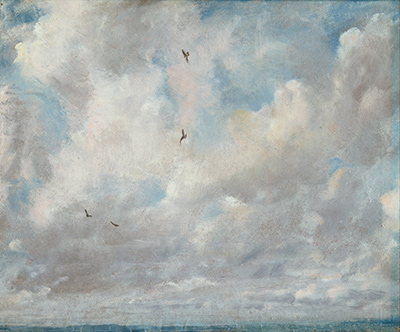
The inherited title Cloud Study points to a single object, but Constable's cloud studies are best understood as a concentrated body of work. The Yale Center for British Art records one 1821 Cloud Study as oil on paper mounted on board, measuring 24.8 by 30.2 centimetres, in the Paul Mellon Collection.[1] That work can anchor the discussion, but it should not be made to stand for every sky picture Constable made. The broader subject includes pure cloud studies, studies with treetops or a low horizon, stormy skies, dated weather inscriptions, and the finished landscapes whose atmosphere depends on this research.
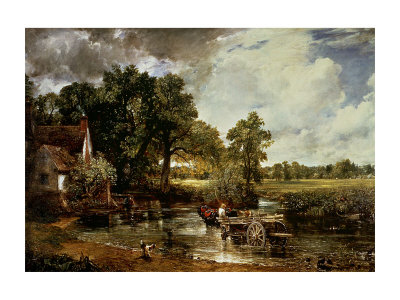
These works matter because they show Constable thinking with the sky. They are not pretty scraps beside the famous Stour paintings. They are a disciplined attempt to understand light, movement, cloud form, air and weather as central facts of landscape painting. If The Hay Wain made a working Suffolk scene monumental, the cloud studies made the unstable sky worthy of sustained attention.
At a Glance
- ArtistJohn Constable
- Primary settingHampstead in the early 1820s [3][6]
- Anchor objectCloud Study, 1821, Yale Center for British Art [1]
- Anchor mediumOil on paper mounted on board [1]
- Anchor dimensions24.8 × 30.2 cm [1]
- Working practiceSkying: repeated outdoor observation and painting [1]
- Recorded conditionsDate, time, wind direction and weather [1][6]
- Meteorological contextLuke Howard and Thomas Forster [6][8]
- Original roleWorking studies, not public exhibition pictures [1]
- RangePure skies, low horizons, treetops and storm effects [1][6]
Contents
- Introduction
- Why Clouds Became Central
- Hampstead and the Practice of Skying
- The Yale Cloud Study
- Not Snapshots, but Sustained Looking
- Weather Notes and Meteorology
- Cloud Form and Painted Matter
- Pure Sky and the Edge of Landscape
- The Courtauld Cloud Study
- Stormy Sunset and Emotional Weather
Why clouds became central
Constable had been painting directly from nature long before the famous Hampstead studies, but the early 1820s brought a new intensity to his attention to skies. The V&A records that in the early 1820s, while in Hampstead, he began a series of works depicting clouds and atmospheric effects.[3] Hampstead mattered because it gave him height, open air and a broad view near London. It was close enough to his urban life to be practical, yet open enough to make the sky a daily subject.
The sky was never just background for Constable. The V&A introduction connects his Hampstead cloud work with his belief that the sky was a material part of landscape composition.[3] That idea changes the status of the studies. They are not decorations or detached curiosities. They are investigations into the power that governs light across the whole landscape.
In many earlier landscape traditions, the sky could become a convention: a luminous opening, a storm effect, a framing atmosphere, a borrowed formula. Constable's studies push against that inherited ease. He wanted to know what clouds did, how they formed, how they moved, how they held and released light, and how their changes altered the emotional register of the land below.
This ambition also makes the cloud studies different from picturesque scenery. They are not designed to charm by presenting a pleasant view. Many contain very little that an older viewer would have called a subject. Some give almost the whole support to cloud mass, brightness and motion. Their subject is not a place in the ordinary sense but a changing condition of seeing.
Hampstead and the practice of skying
Constable's own term skying has become attached to this practice. It is a wonderfully compact word because it treats the sky not as a passive object but as an activity. To go skying was to look, wait, paint, compare and return. It was a way of making the sky into a painter's daily discipline.
The Yale Center for British Art notes that Constable produced more than one hundred sketches of the sky outdoors and that he began, in 1821, to make pure cloud studies in oil that omitted the horizon altogether.[1] That last point is crucial. Once the horizon disappears, the viewer cannot rely on ordinary landscape structure. No cottage, river, meadow or road steadies the image. The eye must meet cloud as cloud.
This was a radical narrowing and enlargement at the same time. Narrowing, because Constable removed much of the familiar landscape world. Enlargement, because the sky became sufficiently important to carry the entire work. A cloud formation could now be treated with the attention that another painter might give to a figure, a building or a historical event.
Hampstead gave this practice physical conditions. It was a village north of London, elevated and open, with heathland that made the sky more visible. The National Gallery of Art describes Hampstead as a place whose height and openness made Constable especially aware of changing sky effects.[6] That setting helped turn observation into routine. The sky was not an occasional backdrop; it was a subject continually available and continually different.
Hampstead also changed the scale of Constable's attention. In Suffolk, sky belonged to river, mill, field and memory. At Hampstead, it could become a more independent field of study. The heath allowed him to look upward and outward without the dense pictorial demands of the Stour compositions. That does not mean he abandoned landscape. It means he isolated one of landscape's governing forces and gave it concentrated labour.
There is also a domestic dimension to Hampstead. Constable's years there were tied to family life, health and movement between city and outskirts. The cloud studies should not be imagined as the work of an artist wandering in complete detachment from daily life. They belong to a practical rhythm: carrying materials, watching weather, painting when conditions allowed, returning to a subject that could change by the minute.
The Yale Cloud Study
The Yale Cloud Study of 1821 is a useful anchor because it condenses many of the issues that make the group important. It is small, made in oil on paper mounted on board, and connected to the Paul Mellon Collection.[1] Its format immediately separates it from the grand public canvases. This is not exhibition scale; it is study scale, portable and responsive.
Yale's account places it within the beginning of Constable's pure cloud studies, possibly among the earliest examples in which the horizon is omitted.[1] That absence changes everything. The work does not ask the viewer to identify a landscape. It asks the viewer to recognise a weather event, a motion of air and light, a shape that is forming and dissolving as it is painted.
The Yale record also stresses that Constable often noted season, time of day, wind direction and weather conditions on the backs of such studies.[1] These inscriptions matter because they show a mind moving between art and record. Constable wanted more than a general impression. He wanted conditions: when, where, wind, weather, sometimes cloud type. The cloud becomes an observed event in time.
Yet the same record warns against treating the studies as simple preparatory designs for individual finished paintings. It notes that although clouds are prominent in exhibition pictures, these studies were not made for particular compositions and were not intended for public display.[1] That distinction protects their meaning. They were working knowledge, not miniaturised versions of future canvases.
The Yale example also shows how small scale can intensify ambition. A sheet just under thirty centimetres wide does not allow narrative or grand topography. It requires concentration. Every decision has to serve cloud relation: dense against thin, blue against grey, lit against shadowed, formed against dissolving. The limited size makes the sky more present rather than less.
The object's material history is also part of its meaning. Oil on paper mounted on board gives the work a hybrid character: more substantial than a loose drawing, more immediate than a large finished canvas. The paper carries the speed of encounter; the later mounting gives the study a durable objecthood. The result is both fragile and authoritative.
Not snapshots, but sustained looking
The cloud studies can look like snapshots before photography, but that is misleading. Google Arts & Culture's Yale label notes that Constable made these studies during a concentrated burst while living in Hampstead in the early 1820s, and that some inscriptions suggest they took at least an hour to paint.[2] A cloud can change dramatically in an hour. The painting cannot be a mechanical capture of one instant.
This is one of the subtler truths of the cloud studies. They record transience, but they are not passive transcriptions. The painter had to hold a formation in memory as it changed, decide which relations mattered, and continue painting after the original arrangement had already shifted. The result is an encounter between observation and recollection compressed into a small surface.
Yale's label also suggests that the studies should be seen as the result of long contemplation of skies rather than straightforward renderings of passing formations.[2] This is a crucial corrective. Constable's immediacy was trained. He could paint quickly because he had looked repeatedly. The rapid mark is supported by accumulated knowledge.
This helps explain why the studies feel both empirical and poetic. They have the authority of direct weather, yet they do not read as diagrams. Their forms are unstable, luminous, sometimes abrupt. They make the viewer feel the difficulty of catching what cannot be held. The cloud study is therefore not just a record of weather; it is an image of attention under pressure.
The idea of sustained looking also helps guard against a romantic myth of effortless inspiration. Constable's skies may appear spontaneous, but spontaneity here is the surface of labour. He had to know how to simplify without falsifying, how to keep a moving form coherent, and how to work fast while still judging colour and tonal relation. The cloud studies are quick, but they are not casual.
This is why their smallness should not be confused with slightness. A cloud study may look less finished than an exhibition painting, but it can be more demanding in another way. It gives the painter almost nothing to hide behind. There is no story, no architecture, no famous view. There is only the relation between perception and paint.
Weather notes and meteorology
Constable's cloud studies belong to a period when the scientific study of weather was becoming more systematic. The National Gallery of Art connects his practice with contemporary meteorology, including Luke Howard's cloud classification and Thomas Forster's writings on atmospheric phenomena.[6] The Met Office likewise identifies Howard's 1803 work on cloud modification as a basis for cloud classification still in use, and notes its influence on Constable and Turner.[8]
This scientific context should be used carefully. Constable was not replacing art with meteorology. He was using scientific attention to make painting more truthful. Cloud names, wind direction and weather notes helped him see more exactly. They gave the eye a vocabulary for difference: cirrus, cumulus, direction, time, humidity, change.
The National Gallery of Art states that Constable often annotated his studies with the date, time of day, wind direction and Howard's scientific nomenclature for cloud formations.[6] Such annotations turn each study into more than an attractive image. They make it a weather event with coordinates. The act of inscription tells us that the painting belongs to a sequence of observations, not a single decorative impulse.
The V&A's Study of Cirrus Clouds provides a good example of this relationship between art and weather science. A Google Arts & Culture record for the V&A work notes that Constable inscribed cirrus on the reverse and owned Thomas Forster's Researches about Atmospheric Phaenomena.[9] The term cirrus is not incidental. It shows that Constable was looking through a developing language of clouds.
Still, the studies should not be flattened into scientific illustrations. Their interest in weather classification supports the painting, but it does not exhaust it. A labelled cloud is still a painted cloud: colour, touch, edge, density, speed, light and feeling all remain active.
The inscriptions also create a double temporality. The painted surface gives an immediate visual encounter, while the written notes pin that encounter to date, hour and condition. The viewer therefore sees both the cloud and the record of cloud watching. That double structure is one reason the studies feel so vivid today. They are at once image and evidence.
Meteorology gave Constable a discipline of difference. A generic sky could be beautiful, but it would not satisfy his need to observe. The cloud studies ask the painter to recognise that not all whiteness is the same, not all greyness is the same, and not all movement is the same. Classification sharpened visual discrimination, which then fed back into painting.
Cloud form and painted matter
The cloud studies forced Constable to make paint behave like air. That is a strange demand. Paint is material, sticky, coloured and slow compared with vapour. Clouds are moving accumulations of moisture and light, seen from below and reshaped by wind. Constable's achievement lies in finding painterly equivalents for that instability.
The National Gallery of Art describes Cloud Study: Stormy Sunset as freely and quickly executed, with wet paint worked into wet paint, and as vividly conveying light, atmosphere and movement in the western sky after a stormy day.[6] That wet handling matters. It allows forms to merge, soften and shift, so that the surface can suggest cloud edges without freezing them.
Paper was important too. The National Gallery of Art notes that Constable usually painted these works in oils on paper and that paper allowed a fluid working method while drying more quickly than canvas.[6] The support therefore shaped the result. A small paper surface could receive swift decisions. It was well suited to weather study because it encouraged speed and concentration.
The Courtauld's 1822 Cloud Study gives another kind of technical evidence. It records the work as oil on superimposed sheets of wove paper laid down on a third sheet, dated 21 September 1822.[7] The label notes that the study was painted on a windy day and that Constable, despite working quickly in thin, fluid paint, did not finish the middle bank of cloud, which remains blue.[7] The unfinished passage is not a flaw to hide. It reveals the difficulty of the task.
That difficulty is part of the meaning. A cloud study is always a race against change. The painter works quickly, but weather moves faster. The resulting surface may preserve both success and incompletion: the form caught, the form missed, the moment held, the moment gone.
This is where Constable's handling becomes especially expressive. A softened edge can suggest vapour thinning. A loaded touch can make a cloud seem to thicken. A pale opening can become a break in weather. A blue passage left partly unresolved can show both sky and unfinished labour. The study is not convincing because it hides paint; it is convincing because paint is made to act like atmosphere.
The material contradiction is beautiful. Cloud is weightless to the eye, but oil paint has body. Constable uses that body without letting it become heavy. Even dense passages can feel buoyant if they are placed in the right relation to thinner ones. The viewer senses mass in air, not mass on a table.
Pure sky and the edge of landscape
Some of Constable's cloud studies remove the land almost entirely. Others keep a strip of treetops, a low horizon or a small earthly cue. This difference matters because it changes the viewer's orientation. A horizon turns cloud into landscape. No horizon turns cloud into a near-abstract field of weather.
The Yale record stresses the importance of pure cloud studies that omit the horizon.[1] These works are daring because they ask the viewer to accept atmosphere as enough. The absence of land does not make them empty. It makes cloud structure more visible. The eye follows swelling, thinning, darkening, brightening and movement across the support.
Studies with treetops or a narrow band of land do something different. They measure the sky against earth. The National Gallery of Art notes that Constable made sketches of the sky itself and of sky set against dark foliage.[6] In those works, trees or land can anchor the scale of cloud and intensify brightness by contrast. A dark treetop can make a pale cloud feel more luminous; a low horizon can show how vast the sky is.
This range prevents the cloud studies from becoming repetitive. Constable was not painting the same idea over and over. He was testing relations: sky alone, sky over trees, sky as weather event, sky as light source, sky as emotional pressure. The studies form a vocabulary of atmosphere.
The presence or absence of land also changes emotional distance. A pure cloud study can feel almost disembodied, as though the viewer has been lifted into weather. A study with treetops keeps the body on the ground, looking upward. A low horizon introduces scale and place. These small compositional choices alter the psychological experience of the sky.
This is why the cloud studies should be seen as a group rather than as interchangeable examples. Their differences matter. Some are analytical, some lyrical, some storm-laden, some almost serene. Together they show Constable repeatedly asking how little land is needed for landscape to remain landscape, and how much sky a painting can bear.
The Courtauld Cloud Study
The Courtauld's Cloud Study of 21 September 1822 is especially useful because its record preserves date, medium, inscription and interpretive context. The work is not currently on display, and it belongs to the Courtauld Gallery's Samuel Courtauld Trust collection.[7] Its inscription records date, direction of view, wind and time of day: a compact weather event on the reverse.[7]
The label states that Constable undertook several campaigns of cloud painting from Hampstead Heath over the summers and autumns of 1820-23, usually noting date, time and weather conditions.[7] That range broadens the subject beyond a single year. The famous 1821-22 concentration sits within a larger pattern of returning to Hampstead skies.
The Courtauld label is also helpful because it refuses a purely scientific reading. It says that Constable's interest in clouds was surely fuelled by meteorological studies, but was not purely scientific; he regarded sky as the emotional organ of landscape.[7] That balance is exactly right. The cloud studies are works of observation and feeling at once.
The partially unresolved middle bank of cloud in the Courtauld work gives the viewer a rare sense of pressure. Constable was not controlling a studio subject that would sit still. He was trying to meet a windy afternoon with thin, fluid paint. The study preserves the encounter between intention and weather.
The Courtauld work is also a reminder that incompletion can be historically eloquent. If a cloud bank remains partly unresolved, that may tell us more about the conditions of making than a fully smoothed surface would. The study lets the struggle remain visible. It shows that the cloud moved, the light altered, the hand continued, and the painting stopped before the world did.
Because the inscription fixes the work to 21 September 1822, the painting also resists timelessness. It is not a general cloud. It belongs to a particular afternoon, a particular direction of wind, a particular act of looking. That specificity deepens rather than narrows its appeal. The more exact the observation, the more alive the sky becomes.
Stormy Sunset and emotional weather
The National Gallery of Art's Cloud Study: Stormy Sunset extends the subject into more dramatic atmospheric territory. The object is dated 1821-1822, made in oil on paper on canvas, and measures 20.3 by 27.3 centimetres overall.[6] Its visual description emphasises grey and white clouds, a pale blue sky, a dark cloud tower and a red sun partly obscured by cloud.[6]
This is not the same mood as a pure pale cloud study. It is an evening image after storm, with colour and darkness working together. The National Gallery of Art describes it as typical of Hampstead cloud sketches, yet also notes its vivid treatment of light, atmosphere and movement after a stormy day.[6] It shows how wide the cloud-study category can be.
The same record makes an important distinction between empirical use and expressive later meaning. It notes that such sketches served as field material for finished studio pictures, while also observing that Constable increasingly came to value sky as an expressive force in landscape.[6] That distinction helps avoid a false choice. The studies trained naturalism, but they also deepened feeling.
In Stormy Sunset, the sky is not merely a classification problem. It is an emotional event. The red sun, grey masses and lower rays create a sense of after-weather, of a sky still unsettled by what has passed. Constable's cloud studies are often discussed as science and observation, but they also belong to the history of mood.
The sunset example also shows why colour matters in the cloud studies. Blue, grey, white and red are not simply local notes. They create atmosphere, temperature and emotional direction. A red sun partly veiled by cloud has a different force from a midday cumulus form. It implies lateness, weather after disturbance, light at the edge of disappearance.
Constable's stronger skies often depend on this kind of transition. They are not only skies of form but skies of change: after storm, before rain, under shifting wind, at a specific hour. The cloud studies make visible the fact that landscape is never only land. It is land under conditions, and conditions are often written in the sky.
Clouds and finished landscapes
The cloud studies were not made as direct designs for particular finished works, yet they transformed the way Constable painted landscapes. This is the subtle point. A given cloud study may not map onto a single exhibition canvas, but the practice changed his understanding of sky, light and composition. It gave him knowledge he could carry into larger work.
The Yale record states that the studies were not conceived for particular compositions.[1] The National Gallery of Art, meanwhile, describes such studies as empirical field material that would inform the naturalism of finished exhibition pictures made in the studio.[6] Both statements can be true. The studies were not one-to-one preparatory cartoons, but they enlarged the painter's command of atmosphere.
In finished landscapes, the sky governs scale and mood. In The Hay Wain, the sky is changeable but moderate, holding the scene in breathable summer weather. In the later Salisbury and coastal works, cloud can become more dramatic and emotionally charged. The cloud studies help explain how Constable learned to let weather structure the entire image.
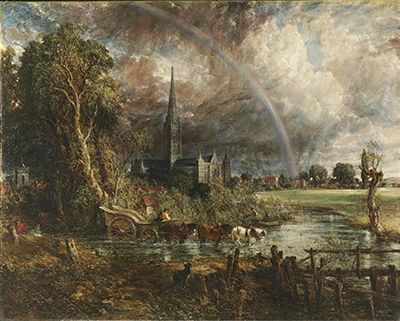
Mark Evans's Constable's Skies is central here because it treats skies as essential components across the landscapes, from The Hay Wain and Salisbury Cathedral from the Meadows to the cloud studies on Hampstead Heath.[10] The point is not that every finished painting borrows a cloud from a study. It is that sky became one of Constable's chief organising principles.
This is why the cloud studies belong near the centre of Constable's achievement. They show the painter isolating a problem that affects every landscape: where light comes from, how weather changes colour, how cloud controls emotion, and how a scene's lower world depends on the air above it.
The connection to finished landscapes should therefore be understood as structural rather than merely iconographic. A cloud study may not reappear as a recognisable cloud in a later canvas, but it teaches the painter how a sky can organise everything below it. It trains judgement about proportion, emphasis, illumination and mood. In that sense, the studies are part of the grammar of Constable's mature art.
They also clarify why his finished landscapes so often feel alive rather than arranged. A landscape with a convincing sky is never static. Weather creates duration. It makes the viewer sense that the scene existed before the painted moment and will continue changing after it. The cloud studies gave Constable a way to make that duration visible.
Science and feeling together
The most rewarding way to understand the cloud studies is to refuse a split between science and feeling. Constable's notes, nomenclature and weather conditions show genuine empirical interest. His paint handling, light, rhythm and later use of skies show feeling. The two are not enemies. Observation gave feeling more force because it gave it form.
This matters because Constable is sometimes reduced either to a naturalist recorder or to a romantic man of feeling. The cloud studies show both tendencies braided together. A dated inscription can sit behind a surface that feels almost breathless in its movement. A cloud type can be named, yet still be painted as a living presence.
The Met Office's account of Luke Howard helps explain the wider historical moment. Howard's cloud classification gave names to forms that had seemed difficult to grasp, and his work influenced artists including Constable and Turner.[8] Classification did not make clouds less poetic. It made them more available to sustained looking.
For Constable, weather science served art because it sharpened attention. Knowing the difference between cloud forms could help a painter avoid generic skies. Recording wind and time could help connect what was seen to the conditions that produced it. The result was not dry accuracy, but a more precise kind of wonder.
Feeling without observation can become vague; observation without feeling can become inert. Constable's cloud studies avoid both failures. They are exact enough to belong to weather and open enough to belong to poetry. This is why they still feel fresh. They do not choose between knowing and wonder.
That synthesis is also why the cloud studies sit so naturally within Romantic-era landscape without being merely romantic. They share the period's fascination with nature's changeability, but they do so through repeated empirical discipline. Constable's emotion is earned through looking.
Why they were not public pictures
The cloud studies now sit comfortably within modern ideas of artistic originality, but Constable did not make them as public exhibition pictures. Yale's account states plainly that they were not intended for public display.[1] This fact should not reduce their importance. It should make their survival more fascinating.
In Constable's own world, the public still expected finished works, often with more polish and conventional completeness. The V&A's sketch article notes that open-air sketches now valued for freshness were made in a period when public expectation favoured highly finished studio painting.[4] A small cloud study, rapidly worked and perhaps inscribed on the back, occupied a different category of artistic labour.
That category is exactly why modern viewers find them so compelling. They feel close to the act of looking. They show Constable before public finish has fully intervened. They also reveal an artist who was willing to study what might seem too passing, too shapeless or too minor for major art.
Their private or working status also makes them unusually intimate. A finished exhibition canvas presents a public argument. A cloud study preserves a working encounter. It is a record of the painter asking the sky a question and answering it in paint before the answer changed.
This private character changes the viewer's relation to the artist. In the large paintings, Constable addresses the public with a completed image. In the cloud studies, the viewer feels closer to his process of recognition. The works do not explain themselves through narrative or grand subject matter. They allow the act of looking to become the subject.
That is one reason they have aged so well. Modern viewers are often drawn to evidence of process, material immediacy and the unfinished edge of thought. Constable did not make the studies to satisfy that later taste, but their working quality now feels central to their beauty.
Modern value
Modern viewers often respond to the cloud studies because they seem to anticipate later art. Their isolated skies, loose handling and restricted subjects can look surprisingly close to modern abstraction or plein-air experiment. But their modernity should not be detached from their nineteenth-century purpose. They were made by a landscape painter trying to solve landscape problems.
The V&A collection overview is important in this respect because it links Constable's inventiveness to the survival of drawings, oil sketches, watercolours and sketchbooks, especially through Isabel Constable's gift.[5] Without such materials, the modern view of Constable would be narrower. We might know the famous finished paintings but miss the daily investigations that made them possible.
The cloud studies also help restore risk to Constable's reputation. A painter who is too familiar through reproductions of The Hay Wain can seem safe. The cloud studies are not safe. They are searching, unstable, sometimes unresolved. They ask what painting can do when the subject refuses to stay still.
Their value today lies partly in that honesty. They do not pretend to master weather completely. They show the attempt. The small scale makes the ambition more vivid, not less. A tiny cloud study can contain a whole theory of landscape: the world is moving, the painter must look quickly and deeply, and feeling begins with attention.
They also broaden the idea of what counts as a major work. A small oil study can be major not because it is large, polished or famous, but because it changes how we understand the artist's central problems. Constable's cloud studies do that. They make the sky visible as a field of research, not a background convention.
This modern value does not diminish the finished landscapes. It enriches them. The more seriously the cloud studies are taken, the more seriously the skies in the large works must be taken. The famous paintings become less like charming countryside and more like complete weather systems.
How to look at Constable's cloud studies
A useful way to look at these works is to begin with orientation. Is there land, or only sky? Are there treetops, a horizon, birds, or no earthly markers at all? If the land is absent, notice how the cloud forms create their own structure. If land remains, notice how little is needed to make the sky feel vast.
Then look at the direction of movement. Clouds are not static masses. Constable often suggests drift, lift, thickening, thinning or rolling. Brushstrokes can move sideways, swell upward or break apart. The viewer should read the surface as weather in action rather than as a fixed arrangement of shapes.
Next, consider light. In many cloud studies, light does not simply illuminate from outside; it seems to emerge through cloud. Pale edges, blue openings, grey masses and warm undertones create a moving architecture of brightness. The sky becomes the source and regulator of the whole visual event.
Finally, remember that the studies are both records and meditations. The notes on date, wind and weather root them in observed reality. The painted surfaces make that reality felt. Constable's cloud studies are compelling because they keep both truths alive: the sky can be studied, and it can never be fully possessed.
It also helps to look for what the painter has refused. He often refuses anecdote, picturesque architecture, grand event and easy finish. That refusal concentrates attention. With so little narrative support, a grey edge, a warm opening or a darkening mass becomes decisive. The cloud study teaches slow looking precisely because its subject moves fast.
A final useful habit is to compare several studies rather than isolate one. The differences between pure sky, stormy sunset, cirrus notation and wind-blown Hampstead cloud reveal the breadth of the project. Constable's clouds are not decorative variations. They are separate acts of inquiry within a sustained practice.
Clouds as Constable's central problem
The cloud studies reveal Constable at his most concentrated. They take a feature that many landscape painters treated as support and make it the central subject. They bring together Hampstead, direct observation, weather science, portable supports, rapid paint, private study and later expressive power. They show an artist trying to make the most changeable part of nature central to serious painting.
They also sharpen the way we see the rest of his art. After the cloud studies, the skies in The Hay Wain, the Salisbury pictures, the coastal scenes and the late storm-filled works look less like atmosphere added above a landscape. They become active structures: source of light, measure of scale, condition of feeling.
Constable's cloud studies are therefore not side-notes to his famous paintings. They are one of the keys to them. They show how a painter of mills, fields and rivers became a painter of air. In those small surfaces, cloud ceases to be background and becomes a form of thought.
Frequently Asked Questions
Discussion
Which cloud study most clearly turns close observation into emotional weather?
Reader Insights
How does removing the horizon change your sense of scale and orientation?
Do the dated weather records make the painted surface feel more empirical or more intimate?
Which edge, colour or movement makes atmosphere become emotion?
Join the Conversation
Share your reading below.
References
- Yale Center for British Art, “John Constable, Cloud Study,” https://interactive.britishart.yale.edu/critique-of-reason/355/cloud-study
- Google Arts & Culture / Yale Center for British Art, “John Constable, Cloud Study,” https://artsandculture.google.com/asset/cloud-study-john-constable-1776%E2%80%931837-british/RwFHZRYmL2zD0Q
- Victoria and Albert Museum, “John Constable – an introduction,” https://www.vam.ac.uk/articles/john-constable-an-introduction
- Victoria and Albert Museum, “John Constable's sketches,” https://www.vam.ac.uk/articles/john-constables-sketches/
- Victoria and Albert Museum, “John Constable,” collection overview, https://www.vam.ac.uk/collections/john-constable
- National Gallery of Art, Washington, “John Constable, Cloud Study: Stormy Sunset,” https://www.nga.gov/artworks/104243-cloud-study-stormy-sunset
- Courtauld Gallery, “John Constable, Cloud Study,” https://gallerycollections.courtauld.ac.uk/object-p-1952-rw-69
- Met Office, “On The Modification Of Clouds,” https://www.metoffice.gov.uk/research/library-and-archive/archive-hidden-treasures/on-the-modification-of-clouds-1803
- Google Arts & Culture / Victoria and Albert Museum, “John Constable, Study of Cirrus Clouds,” https://artsandculture.google.com/asset/study-of-cirrus-clouds-john-constable/7wERtxNEH8AnaA
- Mark Evans, Constable's Skies: Paintings and Sketches by John Constable, V&A / Thames & Hudson, 2018, https://www.thamesandhudson.com/products/constables-skies-victoria-and-albert-museum