 by Tom Gurney
Tom Gurney BSc (Hons) is an art history expert with over 20 years experience
Published on June 19, 2020 / Page Updated on November 5, 2026
Email: tomgurney1@gmail.com / Phone: +44 7429 011000
Introduction
John Constable's Brighton Beach with Colliers is a small picture with a surprisingly modern subject. It is not the rural coast of the Weymouth paintings, nor the charged storm world of the Louvre's Weymouth Bay with Approaching Storm. It is Brighton as Constable found it in the 1820s: a place of sea air, health, crowds, commerce, working boats, cliff light and unsettled feeling.
The work is connected with the Victoria and Albert Museum's Constable collection, where V&A material identifies Brighton Beach, with Colliers as an 1824 oil painting by John Constable, museum no. 591-1888.[1] The object is modest in scale. Secondary object summaries give it as oil on paper, 14.9 by 24.8 centimetres, in the V&A.[4] The inherited dimensions attached to the older local description are not reliable, but the smallness of the work is beyond doubt. This is an oil sketch, not a large exhibition canvas.
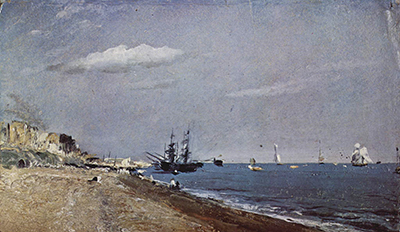
That smallness is part of its force. Constable looks along Brighton's shore, with cliffs receding at the left, beach in the foreground, blue water to the right and dark vessels offshore. The colliers are not romantic fishing boats. They are coal carriers, signs of the working coast and of the town's everyday dependence on maritime supply. Constable does not turn them into a moral lecture. He lets them sit inside a scene of weather, light and distance.
At a Glance
- ArtistJohn Constable (1776–1837)
- V&A titleBrighton Beach, with Colliers [1]
- Route titleBrighton Beach with Colliers
- Date1824 [1]
- CollectionVictoria and Albert Museum, London [1]
- Museum number591-1888 [1]
- Medium/supportOil painting; secondary object summaries identify oil on paper [1][4]
- Dimensions14.9 × 24.8 cm [4]
- ViewLooking eastward along Brighton beach [1]
- Reverse noteA lovely evening with cliff light, a dark grey sky effect and a white-golden background [1]
Contents
- Introduction
- Object Identity
- Brighton and Maria's Health
- A Working Beach
- Cliffs, Sea and Sky
- The Reverse Note
- Oil-Sketch Intelligence
- Apart from Weymouth and Chain Pier
- Why the Painting Matters
Object identity
The V&A article Constable's oil sketches identifies the picture as Brighton Beach, with Colliers, an oil painting by John Constable from 1824, with museum no. 591-1888.[1] The title sometimes appears without the comma, but the subject is clear: Brighton beach, seen with coal-carrying vessels offshore.
The local image matches that identity. A pale strip of beach runs across the foreground, the sea opens toward the right, cliffs and buildings recede at the left, and several dark vessels mark the horizon and middle distance. The sky occupies much of the scene, carrying a light, coastal atmosphere rather than a dramatic storm. It is a beach picture, but not a holiday picture in the modern sense.
The work should be kept separate from other Brighton subjects in Constable's output. V&A material discusses other Brighton Beach sketches from 1824, including works with different grounds and weather effects.[1] Chain Pier, Brighton belongs to a more public and structural kind of coastal subject. Brighton Beach with Colliers is quieter and more observational: beach, ships, shore activity and the very particular evening light noted on the reverse.
Reynolds's later catalogue context is helpful because Brighton generated a cluster of small works rather than one single definitive image.[6] The local coast appears through beaches, boats, piers, shipping, windmills, chalk cliffs and patches of weather. That makes exact object identity especially important. A Brighton oil sketch can easily be misread if treated only as a generic seaside view.
Brighton and Maria's health
Constable's Brighton period was shaped by Maria Constable's illness. The V&A introduction places the family's Brighton stays between 1824 and 1828, connecting them with Maria's declining health and with a body of drawings and oil sketches made during extended visits to the town.[2] Brighton was not chosen because Constable loved fashionable seaside life. It was chosen for health, sea air and practical need.
This context should be handled carefully. The painting is not a medical document and should not be reduced to domestic sadness. Still, Maria's health explains why Constable was there and why Brighton became a repeated subject. His familiar worlds of Suffolk, Hampstead and Salisbury were joined by an exposed, socially crowded coastal town.
The National Gallery of Australia archive gives a useful broader frame for Brighton in 1824. Constable took his family there for the summer for his wife's health, at a time when Brighton was promoted as a health resort and sea air was considered beneficial for consumption.[3] The same account stresses his mixed feelings about the place. He could be sharply critical of Brighton's crowds and famously called it “Piccadilly by the sea-side”.[3]
That phrase should not dominate the painting, but it helps explain its freshness. Constable did not approach Brighton as a picturesque idyll. He found much of the town irritating, crowded and socially artificial. Yet he responded strongly to the visual facts of sea, sky, cliffs and constantly changing light.[3] Brighton Beach with Colliers belongs to that tension: dislike of the resort, fascination with the shore.
A working beach
The colliers make the picture more than a marine view. A collier was a coal-carrying vessel, and the dark ships in the water tie the beach to supply, labour and coastal trade. Brighton depended on the sea not only for health and leisure, but for fuel and goods. Constable's painting admits that practical reality.
It would be easy to overstate the industrial point. The vessels do not turn the picture into a grand statement about modernity. They are small within the composition, and Constable treats them as visual facts rather than symbols. But their presence prevents the beach from becoming merely scenic. The town's shore is active, commercial and contemporary.
This is one of the differences between Brighton and Weymouth in Constable's art. The Weymouth paintings are rooted in the 1816 Osmington honeymoon and in a Dorset coast of coves, cliffs and storm memory. Brighton is busier and more public. It is a resort, a health destination and a working maritime place. The colliers belong to that more complicated world.
The beach itself is painted with broad economy. The foreground is not crowded with detail, but it has enough texture to suggest shingle, sand and the edge of wet shore. The eye moves from that pale land into the blue sea and then to the ships. Constable's handling keeps the view open, airy and swift.
The ships also affect the painting's rhythm. Their dark hulls and masts interrupt the horizontal calm of sea and sky, setting small vertical accents against the broad blue distance. They are not numerous enough to make the beach feel congested, but they prevent it from becoming empty. Constable gives Brighton the feeling of a shore where looking, labour and transport overlap.
Their darkness also sharpens the delicacy of the surrounding colour, making the pale beach and cool sky feel more luminous.
The painting's left-to-right movement is especially important. The cliff and inhabited shore at the left draw the viewer into the scene, while the water opens to the right and the vessels carry attention outward. The result is a compact but expansive design. In a very small format, Constable creates the sensation of a coast continuing beyond the frame.
Cliffs, sea and sky
The left side of the painting is anchored by cliffs and shore buildings. They recede into the distance, leading the eye along the coast. This diagonal movement gives the small sketch spatial depth without requiring heavy architectural description. Brighton is present, but it does not overwhelm the beach.
The sea is calm compared with the stormier Weymouth works. Its blue surface is broken by boats, sails and small changes of tone. Constable does not make the water a dramatic force here. Instead, it acts as a plane of light and movement, carrying vessels and reflecting the evening atmosphere.
The sky is the largest emotional field. It is not theatrical, but it is active. A cloud hovers over the shore, and the air has a cool clarity that suits the reverse note's emphasis on cliff light, dark grey sky effect and white-golden background.[1][2] Constable is looking at a precise evening condition rather than a generic seaside sky.
The V&A's discussion of his oil sketches helps explain the surface. Constable often worked on small paper or card supports with coloured grounds, allowing those grounds to show through and help create atmosphere.[1] Even without handling the object directly, the image reads as a rapid, economical observation. Colour, support and exposed light work together.
Mark Evans's Constable's Skies is relevant here because this Brighton sketch belongs to the same wider investigation of weather, atmosphere and observed sky that runs through the artist's 1820s work.[5] The subject may be ships on a beach, but the upper air controls the whole effect. The white cloud, cool blue field and grey tonal note make the beach's ordinary traffic feel momentary and weather-bound.
The reverse note
The most valuable evidence attached to the painting is on its reverse. The V&A records that on the back Constable described the scene as a very lovely evening, looking eastward, with cliffs and light against a dark grey sky effect and a very white and golden background.[1] The V&A introduction also summarises this note in connection with Brighton Beach With Colliers.[2]
The note matters because it confirms the painting's attentiveness to a particular visual event. Constable is not simply naming Brighton. He is recording direction, light, weather and tone. “Looking eastward” fixes the act of observation. The dark grey sky and white-golden background explain why the small painting feels both calm and charged.
There is also a personal element. The V&A oil-sketch article says that the reverse includes the beginning of a note to John Fisher, referring to Constable's daughter's birthday.[1] This connects the sketch to friendship and family, but in a quieter way than the Weymouth honeymoon material. It is a picture of outward observation with an intimate inscription behind it.
That double character is very Constable. The front gives us shore, vessels, light and sky. The back gives us time, direction, weather words and family association. The small sheet becomes both image and memory aid. It carries the event of looking and the social world into which the sketch was sent or preserved.
The reverse note also protects the painting from vague praise. Rather than saying simply that Constable painted a beautiful beach, we can see what he himself noticed: the light from the cliffs, the dark-grey effect, the white and golden distance. The painting's beauty is analytical. It comes from attention to conditions.
That attention to conditions also explains why the sketch feels neither purely topographical nor purely atmospheric. Constable records enough of Brighton to make the place recognisable, but the note tells us that he was tracking a light effect more than a landmark. The colliers, beach and cliffs give the scene its subject; the evening effect gives it its reason for being.
Oil-sketch intelligence
The V&A describes Constable's small oil sketches as works that captured changing light and movement quickly and freely.[1] It notes his use of coloured grounds, rapid brushwork and alla prima handling, with colours blended on the sketch to seize a momentary effect.[1] Brighton Beach with Colliers belongs to that world of quick concentration.
This matters because the picture's apparent slightness is deceptive. A small beach sketch can look casual if one expects only major exhibition canvases to carry serious thought. Constable's Brighton oils show the opposite. The small format lets him respond quickly to light, weather and human activity without forcing the scene into a polished composition.
The colliers are especially well suited to this method. They are dark, compact forms against water and sky. A few strokes can make them legible, while their masts and hulls animate the horizon. Constable does not need narrative elaboration; he needs placement, tone and proportion.
The sketch also shows how Constable adapted his inland habits to the coast. In Suffolk, he studied barges, locks, mills, towpaths and working riverbanks. At Brighton, he finds analogous material in shore traffic, coal vessels and the meeting of sea and town. The subject changes, but the principle remains: observed landscape includes work.
The change of support and scale matters as well. A small oil on paper invites a different kind of decision from a studio canvas. Marks can remain open, forms can be abbreviated, and the eye can accept a higher degree of compression. Constable uses that freedom to suggest rather than describe everything. The ships are legible without being laboriously detailed; the beach is broad without being blank; the sky is airy without needing a dramatic storm.
Apart from Weymouth and Chain Pier
Brighton Beach with Colliers should not be folded into the Weymouth group. Weymouth was tied to the 1816 honeymoon, John Fisher's Osmington vicarage and the three-version sequence from storm sketch to National Gallery canvas to Louvre enlargement. Brighton belongs to the later 1820s, to Maria's health, resort culture and repeated lodgings by the sea.
Nor should it be treated as Chain Pier, Brighton in miniature. The Chain Pier became one of Brighton's great modern structures and will require a separate account of engineering, public spectacle and coastal weather. In Brighton Beach with Colliers, the pier is not the governing subject. The emphasis falls on ordinary shore, ships, light and sky.
The National Gallery of Australia archive rightly notes that, apart from Osmington and Weymouth, Constable's Brighton and Hove visits were the main occasions when he concentrated on sea painting.[3] That makes the Brighton works important, but not interchangeable. Each sketch answers a different visual problem: a beach, a boat, a pier, shipping, a storm effect, a cliff-light condition.
This particular work is valuable because it is neither a spectacular storm nor an architectural view. It is a small, clear, working seascape. The colliers, cliffs and reverse note give it enough specificity to stand on its own.
The separation from Weymouth is also emotional. The Weymouth paintings are tied to arrival, marriage and Fisher's hospitality in 1816. Brighton is later, sharper and more ambivalent. The family came for health, yet the painter found the town visually difficult and socially unattractive. That friction gives the Brighton sketches their edge. Constable had to find beauty without pretending the place was pastoral.
Why the painting matters
Brighton Beach with Colliers matters because it shows Constable accepting a difficult modern coast on its own terms. He did not love Brighton as he loved the Stour Valley, and he did not idealise the town into rural poetry. He found subjects where he could: shore light, dark ships, cliff, sea, sky and passing evening.
The painting also matters as part of his sky practice. The reverse note's concern with dark grey sky and white-golden light belongs to the same mind that made cloud and weather central to landscape. The subject is modest, but the perception is exact.
Its social world is equally revealing. Brighton was a place of health seeking, crowded leisure and maritime work. The colliers quietly hold that complexity. They bring coal and commerce into a view that might otherwise be read as a simple seaside sketch.
The result is one of Constable's most concise coastal observations. In a small space, he brings together family circumstance, a resort he mistrusted, a working beach he could believe in, and an evening light he cared enough to describe on the reverse. It is not grand, but it is alive. Brighton becomes, for a moment, a place where modern shore life and atmospheric truth meet.
Frequently Asked Questions
Discussion
What gives this small Brighton sketch its strongest sense of place: the working colliers, pale beach, cliff line, evening light, or reverse note?
Reader Insights
How do the coal-carrying vessels keep Brighton from becoming a merely picturesque beach?
How do the dark-grey sky and white-golden distance organise the sketch's atmosphere?
What can the compressed oil-on-paper format preserve that a polished exhibition canvas might lose?
Join the Conversation
Share your reading below.
References
- Victoria and Albert Museum, “Constable's oil sketches,” https://www.vam.ac.uk/articles/constables-oil-sketches
- Victoria and Albert Museum, “John Constable – an introduction,” https://www.vam.ac.uk/articles/john-constable-an-introduction
- National Gallery of Australia archive, Brighton Beach with shipping and a gig, https://digital.nga.gov.au/archive/exhibition/constable/detail.cfm%3Firn%3D142226%26bioartistirn%3D18283%26mystartrow%3D49%26realstartrow%3D49%26mnuid%3D2.html
- WikiArt, Brighton Beach with Colliers, https://www.wikiart.org/en/john-constable/brighton-beach-with-colliers-1824
- Mark Evans, Constable's Skies: Paintings and Sketches by John Constable, V&A.
- Graham Reynolds, The Later Paintings and Drawings of John Constable, Paul Mellon Centre for Studies in British Art, Yale University Press.