 by Tom Gurney
Tom Gurney BSc (Hons) is an art history expert with over 20 years experience
Published on June 19, 2020 / Page Updated on November 5, 2026
Email: tomgurney1@gmail.com / Phone: +44 7429 011000
Introduction
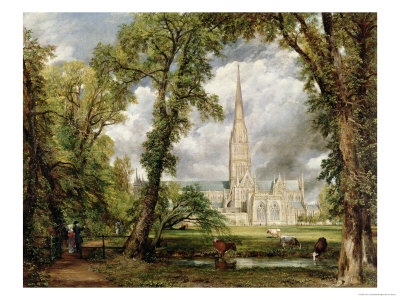
John Constable's Salisbury Cathedral from the Bishop's Grounds is one of his clearest demonstrations that architecture could become landscape. The cathedral is the obvious subject, but Constable does not isolate it as a monument. He makes it appear through trees, across grass and water, under moving sky, within the private grounds of a friend and patron. Stone, air, foliage, cattle, human figures and weather all become part of the same visual argument.
The principal version for this discussion is the Victoria and Albert Museum painting of 1823, Salisbury Cathedral from The Bishop`s Ground, Museum no. FA.33[O].[1] The V&A identifies it as an oil painting made in England in 1823 and notes its importance within the Sheepshanks collection that helped form the museum's early Constable holdings.[1][2] It was not a casual cathedral view. It grew from Constable's friendship with Bishop John Fisher and from a commission that asked him to turn a view from the Bishop's grounds into a finished public painting.
This is also one of the Constable subjects where version control matters. There are sketches, a finished 1823 painting, a later 1826 Frick version, and a Metropolitan Museum full-scale study connected with that later version.[3][4][5] These related works belong together, but they are not interchangeable. The 1823 V&A painting is the darker, more charged Royal Academy picture; the 1826 Frick painting opens the sky and softens the atmosphere in response to Fisher's objections.[4][5]
At a Glance
- ArtistJohn Constable (1776–1837)
- TitleSalisbury Cathedral from the Bishop's Grounds [1]
- Date1823 [1]
- CollectionVictoria and Albert Museum, London [1]
- Museum numberFA.33[O] [1]
- MediumOil on canvas [1]
- Dimensions87.6 × 111.8 cm [7]
- CommissionBishop John Fisher, 1822 [4]
- ExhibitedRoyal Academy, 1823 [4]
- Related versionsc.1825 Met full-scale study and 1826 Frick painting [3][4]
Contents
- Introduction
- Object Identity and Versions
- Salisbury and the Fisher Friendship
- A Cathedral Seen Through Trees
- Bishop, Family and Grounds
- The 1823 Sky
- The 1826 Frick Version and the Met Study
- Cathedral, Meadow and Weather
- Relationship to Other Salisbury Paintings
- Why the Painting Matters
Object identity and versions
The V&A 1823 work is the anchor for the original Bishop's Grounds composition.[1] It measures 87.6 by 111.8 centimetres according to National Gallery of Australia exhibition records, is signed and dated lower left, and entered the V&A through the gift of John Sheepshanks in 1857.[7] Its subject is the cathedral seen from the Bishop's grounds, framed by trees and animated by figures, cattle, meadow and sky.
The Frick Collection's 1826 version is closely related but distinct. In the Frick account of the reunited Salisbury canvases, Constable produced three oil sketches and three finished paintings of the cathedral from the south side between 1820 and 1826.[4] The 1826 Frick painting was completed after Bishop Fisher objected to the storm cloud in the 1823 version and requested a calmer sky.[4][5] It is a second finished version, not simply a replica without consequences.
The Metropolitan Museum of Art holds a c.1825 full-scale study for the Frick picture.[3] The Met states that Constable opened the tree canopy and added a sunny sky to frame the cathedral's medieval spire, and that Bishop Fisher appears at lower left in both the study and the Frick painting.[3] That study helps explain how Constable revised the composition after the V&A picture, but it should not be confused with the 1823 Royal Academy canvas.
Keeping these versions separate is not pedantry. The differences tell us what the painting was asked to do. The first version expresses a more dramatic relation between building, cloud and tree. The later version answers a patron's wish for serenity. Between them lies a negotiation over what a cathedral landscape should feel like.
Graham Reynolds's catalogue of Constable's later paintings and drawings is useful here because the Salisbury group belongs to a mature phase in which version, sketch and exhibition canvas have to be read together rather than as loose duplicates.[9] The 1823 V&A painting, the 1825 Met study and the 1826 Frick canvas form a sequence of decisions. Each one adjusts the balance between architectural clarity, tree framing, patronage and weather.
That sequence also explains why this subject can feel more formal than Constable's Stour paintings without becoming less personal. A commissioned cathedral view required a different discipline from a river mill or lock, but Constable did not abandon his own pictorial language. He brought to Salisbury the same habit of reworking, testing and holding a place in memory until it could bear a larger meaning.
Salisbury and the Fisher friendship
Constable's Salisbury paintings began in friendship before they became public art. The V&A notes that Dr John Fisher invited Constable to stay in the Bishop's Palace in Salisbury in 1811, and that Fisher would later commission Salisbury Cathedral from the Bishop's Grounds.[1] Salisbury was therefore not simply a destination for picturesque architecture. It was a place of hospitality, conversation, patronage and emotional connection.
The Fisher relationship had two generations. Bishop John Fisher was the commissioner of the cathedral picture, while his nephew, Archdeacon John Fisher, became one of Constable's closest friends, patrons and correspondents. Christie's account of the Salisbury sketch tradition stresses how important the younger Fisher was to Constable's visits, even noting his promise of painting materials and studio support.[6] The cathedral views grew from this unusually intimate clerical and artistic network.
This matters because the painting's viewpoint is not neutral. Constable is not standing in a public street, presenting Salisbury Cathedral as an architectural specimen. He is looking from the Bishop's grounds, a private and ecclesiastical space shaped by friendship. The cathedral is seen from within the Bishop's world, but it is also transformed by Constable's landscape imagination.
The personal context also helps explain the inclusion of figures at lower left. The Bishop is shown with his wife in the grounds, and the National Gallery of Australia archive identifies Dorothea Fisher approaching along the path.[7] These figures do not dominate the painting, but they locate the view socially. The cathedral is not detached from human relationships. It belongs to a household, a commission and a lived environment.
The commission also shows how Constable's art depended on confidence between painter and patron. Fisher did not ask a stranger for a neutral architectural likeness. He asked an artist he knew, one who had stayed in Salisbury and absorbed its local atmosphere. That intimacy made the commission possible, but it also made disagreement possible. Fisher could admire Constable's work and still resist the emotional force of the darker sky.
This gives the painting an unusually rich social texture. It is public enough for the Royal Academy, private enough to include family, ecclesiastical enough to centre a cathedral, and rural enough to include grazing cattle. Constable had to satisfy all of these demands at once. The painting's harmony is therefore a hard-won balance between hospitality, patronage, architecture and landscape invention.
A cathedral seen through trees
The most striking feature of the composition is the tree frame. Constable does not place Salisbury Cathedral in an open architectural elevation. Instead, he makes the viewer look through trunks, branches, leaves and shadow. The spire rises into the sky, but the trees mediate the view. They turn the cathedral from an object into an encounter.
This framing is not accidental naturalism. The Met notes that in developing the later version Constable opened the canopy and used the sunnier sky to frame the cathedral's spire.[3] The same underlying problem is already present in the 1823 painting: how much should the trees conceal, how much should they reveal, and how should their living forms answer the Gothic architecture behind them?
The effect is to make architecture behave almost organically. The spire rises like a vertical continuation of the trees, while the buttresses and windows are softened by foliage and air. The cathedral remains legible, but it is not coldly isolated. Constable gives medieval stone a natural setting that changes its emotional register.
The tree arch also controls scale. Without the foreground trees, the cathedral might appear remote and diagrammatic. With them, the viewer stands inside a shaded edge of the Bishop's grounds, looking outward toward light. The great building is not diminished, but it is made accessible through the immediate world of bark, grass, water and leaves.
The trees also change the cathedral's theology of appearance. A direct frontal view might have emphasised institutional certainty. Constable's filtered view makes the building dependent on changing nature. The spire is still authoritative, but the viewer meets it through foliage and cloud. This is one reason the painting feels modern within its apparently traditional subject: the cathedral is not outside nature, supervising it from a distance. It is immersed in nature's conditions.
The large trunk at the right edge, the denser shadow at the left, and the foliage gathered above the nave create a kind of natural architecture around the Gothic architecture. Constable is not just decorating the cathedral with trees. He is making two structures answer one another: the masonry frame of the church and the living frame of the grounds.
Bishop, family and grounds
The human figures at the lower left are small but meaningful. Bishop Fisher's presence makes the commission visible within the picture itself. He is not merely the owner who paid for a view; he becomes part of the landscape through which the cathedral is seen. This is one reason the painting is more than a record of Salisbury architecture.
The Bishop's wife and daughterly presence, as recorded in the National Gallery of Australia archive, deepen this domestic reading.[7] The cathedral is framed by family and garden as well as by trees. Constable's landscape becomes a scene of ecclesiastical household life, where private affection and public religious architecture occupy the same space.
The cattle in the meadow sharpen that mixture. They prevent the cathedral close from becoming purely ceremonial. The grounds are green, lived, grazed and atmospheric. The cathedral may be one of England's great medieval buildings, but Constable places it beside ordinary rural activity. That decision is characteristically his: grandeur is never allowed to float free from land.
The painting therefore presents several forms of authority at once. There is the authority of the cathedral, the authority of the Bishop, the authority of inherited landscape conventions and the authority of observed nature. Constable binds them together without making any single one absolute. The building is powerful, but trees and weather change the way it is seen.
The cows matter for the same reason. Their presence in the Bishop's grounds might seem picturesque, but it keeps the painting from becoming too solemn. They return the scene to meadow, body, appetite and everyday rhythm. Their grazing is a quiet counterweight to the cathedral's vertical aspiration. In Constable's hands, sacred architecture does not cancel rural life; it rises out of it.
This is also a deeply English kind of juxtaposition, though the point should not be reduced to patriotic cliché. The painting joins medieval church, cultivated grounds, domestic figures, cattle, mature trees and variable weather. It presents tradition not as an abstract idea, but as a landscape arrangement in which social, religious and agricultural worlds overlap.
The 1823 sky
The sky is the key to the painting's history. The V&A version contains the darker weather that troubled Bishop Fisher. The National Gallery notes that the Bishop did not share his nephew's enthusiasm for Constable's emotionally expressive landscapes and disliked the storm cloud in the original version.[8] The Frick exhibition history similarly records that Fisher was troubled by the cloud around the spire and later asked for alteration.[4]
This disagreement is revealing. For Constable, sky was never merely background. It governed light, mood, structure and meaning. A cloud above Salisbury Cathedral could change the painting's whole emotional field. To Fisher, the darker cloud may have seemed inappropriate for a commissioned view of his cathedral. To Constable, it likely gave the building greater pictorial force.
The tension between painter and patron makes the work more interesting. The 1823 picture is not an obedient topographical commission. It is a negotiated image in which Constable's desire for expressive weather presses against Fisher's desire for a serene ecclesiastical view. The later version did not simply correct a mistake. It translated the same subject into another emotional key.
The darker sky also gives the spire its drama. Against cloud, the pale stone becomes more active. The building appears less as an inert monument than as a structure standing within weather. This was Constable's great Salisbury insight: the cathedral could be made vivid not by removing atmosphere, but by letting atmosphere test it.
The Bishop's objection helps us see how daring that insight was. To a patron hoping for a reassuring view of his cathedral, a storm cloud could suggest unease or impropriety. To Constable, it offered contrast, depth and emotional truth. His sky did not attack the building; it gave the building something to stand against. The disagreement was therefore not simply about taste. It was about whether landscape painting should soothe or intensify.
This is why the 1823 version deserves attention in its own right. The darker sky is not a rejected mistake on the way to the Frick picture. It is a fully meaningful solution, even if the patron wanted another. It preserves Constable's belief that weather could carry feeling without turning the scene into melodrama.
The 1826 Frick version and the Met study
The 1826 Frick painting shows how Constable responded to Fisher's request. Google Arts & Culture's Frick record describes the later version as sunnier and more open, with the Bishop, his wife and daughter walking along the path at left.[5] The Met's full-scale study documents the process of opening the tree canopy and framing the spire with a brighter sky.[3]
This second version should not be treated as merely weaker or safer. It solves a different problem. The earlier V&A painting emphasises weathered tension; the Frick version gives the cathedral a more serene public presence. The changes in sky and canopy adjust the relation between nature and architecture, making the scene more spacious and less emotionally clouded.
The Met study is especially valuable because it shows the revision at near-final scale.[3] Constable did not simply repaint a small copy. He worked through the structure of the picture again, testing how a changed sky, altered foliage and more open framing could remake the subject. That method belongs to the same discipline visible across his larger landscapes: he used studies as serious thinking tools.
The Frick exhibition account notes the poignant fact that Bishop Fisher died in 1825 and did not live to see the completed 1826 painting.[4] That detail adds a quiet shadow to the serene version. The picture made to satisfy Fisher's wish for calmer weather arrived too late for the patron who had requested it.
The difference between the Met study and the Frick canvas also shows how carefully Constable treated a commissioned revision. A lesser painter might have lightened the sky and stopped there. Constable reconsidered the whole frame: canopy, spire, path, figure group and open air. The revised composition does not simply remove darkness; it redistributes attention. The cathedral becomes clearer, the space opens, and the family group sits within a more gracious landscape.
That care explains why both the V&A and Frick versions remain compelling. They are not a before-and-after demonstration in which one cancels the other. They are parallel interpretations of the same commission. The V&A picture is richer in tension; the Frick version is more ceremonious and serene. Together, with the Met study between them, they reveal Constable's responsiveness without making him merely compliant.
Cathedral, meadow and weather
The visual richness of Salisbury Cathedral from the Bishop's Grounds comes from the meeting of unlike materials. The cathedral is vertical, pale and built; the meadow is horizontal, green and grazed; the trees are irregular, dark and alive; the sky is changeable and atmospheric. Constable's task was to make these elements belong to one world.
He does this through light. The cathedral is not described as an isolated architectural diagram. It is seen through humid air, under cloud, beyond the shaded foreground. Light touches stone, foliage and grass differently, but the differences are held together by the overall weather of the picture. The result is a view in which the cathedral seems to breathe with its surroundings.
The water meadow is crucial to this effect. It keeps the composition low and open beneath the cathedral's vertical rise. It also ties Salisbury to Constable's broader landscape practice. Even in a commissioned cathedral picture, he is still a painter of ground, pasture, cattle, water and sky. The sacred building becomes part of a landscape ecosystem.
This is why the painting feels more convincing than a simple picturesque formula. Trees framing architecture could easily become a decorative convention. Constable makes the convention alive by loading it with observed weather, uneven foliage, grazing animals and human presence. The painting's form is carefully staged, but its atmosphere feels lived.
The cathedral itself is handled with enough precision to remain recognisable and dignified, yet Constable resists turning the canvas into architectural display. The building's surface is subordinated to the conditions of seeing: distance, light, intervening leaves, passing cloud and the scale of the meadow. This is a landscape painter's treatment of architecture. The cathedral is understood through air.
That treatment is particularly important because Salisbury's spire could easily dominate any view. It is tall, famous and visually commanding. Constable lets it command, but he also places it in relation. The spire rises, yet the trees climb too; the stone gleams, yet foliage flickers; the building is permanent, yet the sky keeps changing. The painting's intelligence lies in those relations.
Relationship to other Salisbury paintings
The Bishop's Grounds painting must be kept distinct from Constable's other Salisbury works. Salisbury Cathedral and Leadenhall from the River Avon, now in the National Gallery, is an open-air sketch from the 1820 Salisbury visit, seen across the River Avon toward the Cathedral and the Close.[8] It belongs to a different artistic problem: direct outdoor handling, Fisher's household at Leadenhall, and the river view.
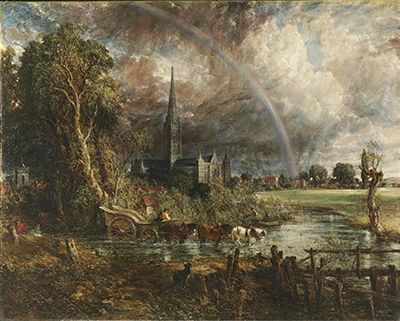
Salisbury Cathedral from the Meadows belongs to yet another moment. It is the later, storm-charged composition often discussed through Maria Constable's death, religious anxiety, rainbow symbolism and late feeling. Those meanings should not be carried backward wholesale into the 1823 Bishop's Grounds commission. The Bishop's Grounds painting has its own pressure: patronage, friendship, architectural framing and the debate over sky.
The V&A, Met and Frick sequence also differs from Water Meadows near Salisbury. That subject belongs more closely to river, meadow and open landscape, with the cathedral as part of a broader Salisbury environment. In the Bishop's Grounds composition, the cathedral is the central architectural actor, though Constable refuses to detach it from nature.
Seen together, the Salisbury works show Constable returning to the cathedral not because he lacked new subjects, but because the subject kept changing. From garden, river, meadow and storm, the cathedral could mean different things. JC023's task is to understand the Bishop's Grounds version on its own terms.
The sequence also protects the Bishop's Grounds painting from being read through the later emotional weather of the Meadows composition. The 1823 painting belongs before Maria Constable's death and before the late rainbow subject. Its central drama is not widower grief, but the tension between commissioned serenity and expressive sky. That is a different kind of pressure, quieter perhaps, but artistically decisive.
The River Avon and Leadenhall sketch likewise belongs to another register. It shows Constable working swiftly and directly during the 1820 visit, using Fisher's setting and materials in a more immediate way.[8] The Bishop's Grounds painting translates that Salisbury familiarity into a finished commission. It is less spontaneous, but more socially and pictorially complex.
Why the painting matters
Salisbury Cathedral from the Bishop's Grounds matters because it makes a commissioned architectural subject into a serious landscape. Constable accepted the cathedral's grandeur, but he did not surrender to architectural correctness. He made the building answer to trees, sky, meadow and human presence.
It also matters because it exposes the delicate relationship between artist and patron. Fisher wanted a beloved cathedral view. Constable gave him a landscape full of weather and expressive tension. The later request for a more serene sky shows how closely feeling, theology, taste and ownership could meet inside a single commission.
The painting expands Constable beyond Suffolk without breaking his method. His deepest loyalty remained to observed nature, but Salisbury gave that loyalty a different subject: church architecture, episcopal friendship, garden view and sacred authority. He found a way to make stone as weather-sensitive as trees.
It is easy to admire the painting for its calm beauty and miss the difficulty behind that calm. Constable had to make a great medieval building visible through landscape without losing either the building or the landscape. He had to honour a patron while preserving his own sense of weather. He had to balance topography, family likeness, ecclesiastical meaning and painterly freedom. He also had to make a familiar Salisbury view feel freshly discovered. The picture succeeds because those demands remain visible but controlled.
That is the painting's enduring achievement. The cathedral stands firm, yet the whole scene is alive with air. The spire belongs to Gothic history, but it is seen through leaves and cloud. The Bishop's grounds are private, yet the painting became a public statement of what English landscape could hold. Constable turned Salisbury Cathedral into a landscape of friendship, architecture and weather, and made each part depend on the others.
Frequently Asked Questions
Discussion
What most transforms this commission into landscape: the tree frame, the 1823 storm sky, the Fisher figures, or the meadow beneath the cathedral?
Reader Insights
How do trunks, foliage, meadow and cloud alter the cathedral's scale and authority?
Where does Fisher's wish for a cathedral view meet Constable's insistence on expressive weather?
What becomes clearer when the 1823 V&A painting, Met study and 1826 Frick version remain distinct?
Join the Conversation
Share your reading below.
References
- Victoria and Albert Museum, “John Constable – an introduction,” https://www.vam.ac.uk/articles/john-constable-an-introduction/
- Victoria and Albert Museum, John Constable collection page, https://www.vam.ac.uk/collections/john-constable
- Metropolitan Museum of Art, Salisbury Cathedral from the Bishop's Grounds, https://www.metmuseum.org/art/collection/search/435922
- Frick Collection, “Constable's Salisbury Cathedral: Two Versions Reunited,” https://www.frick.org/exhibitions/constable_salisbury_cathedral
- Google Arts & Culture / Frick Collection, Salisbury Cathedral from the Bishop's Garden, https://artsandculture.google.com/asset/salisbury-cathedral-from-the-bishop-s-garden-john-constable/SQHNHPBhfP7FBg?hl=en
- Christie's, “What this oil sketch of Salisbury Cathedral tells us about the life and art of John Constable,” https://www.christies.com/en/stories/how-constable-found-happiness-and-inspiration-in-salisbury-7f1796ffa7df4dd3b2b77f80ed6ac6f7
- National Gallery of Australia archive, Salisbury Cathedral from the Bishop's Grounds, https://digital.nga.gov.au/archive/exhibition/constable/detail.cfm%3Firn%3D143752%26bioartistirn%3D18283%26audio%3D16k%26viewid%3D1%26mnuid%3D1.html
- National Gallery, Salisbury Cathedral and Leadenhall from the River Avon, https://www.nationalgallery.org.uk/paintings/john-constable-salisbury-cathedral-and-leadenhall-from-the-river-avon
- Graham Reynolds, The Later Paintings and Drawings of John Constable, Paul Mellon Centre / Yale University Press, 1984, https://yalebooks.co.uk/book/9780300031515/the-later-paintings-and-drawings-of-john-constable/