 by Tom Gurney
Tom Gurney BSc (Hons) is an art history expert with over 20 years experience
Published on June 19, 2020 / Page Updated on November 5, 2026
Email: tomgurney1@gmail.com / Phone: +44 7429 011000
Introduction
The Young Waltonians is one of the most revealing titles attached to John Constable's Stour landscape. It is attractive, memorable and slightly misleading. The underlying finished painting is now controlled by the National Gallery as Stratford Mill, NG6510, an 1820 oil on canvas and the second of Constable's great Stour six-footers.[1] Yet after Constable's death the work became known as The Young Waltonians, a name linked to fishing, childhood and Izaak Walton's seventeenth-century classic The Compleat Angler.[1]
That later title deserves its own attention because it changes how the picture is read. Stratford Mill directs the eye to place, industry and the River Stour near Stratford St Mary. The Young Waltonians directs the eye to the children at the water's edge, to angling, leisure and literary memory. The two names belong to the same visual world, but they pull meaning in different directions.
At a Glance
- Route titleThe Young Waltonians — a later posthumous title [1]
- Underlying paintingStratford Mill [1]
- Original exhibition titleStratford Mill, Royal Academy 1820 [1]
- Finished painting date1820 [1]
- Finished painting collectionNational Gallery, London [1]
- Inventory numberNG6510 [1]
- Finished mediumOil on canvas [1]
- Finished dimensions127 × 182.9 cm [1]
- Print afterlifeDavid Lucas mezzotint, published 1840 [1]
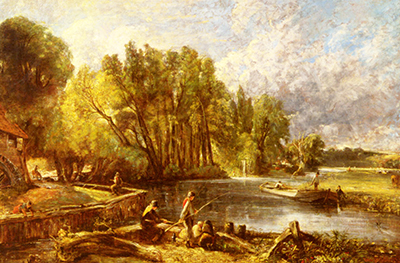
- Displayed image anchorYale full-scale sketch, c. 1819–20, B1983.18 [4]
Contents
- Introduction
- A Title with a History
- The Stratford Mill Foundation
- The Local Image and the Yale Sketch
- Children, Fishing and Izaak Walton
- David Lucas and the Printed Afterlife
- Why the Later Title Stuck
- Sketch, Print and Finished Painting
- Relationship to Stratford Mill
- Why The Young Waltonians Matters
A title with a history
The National Gallery states clearly that the painting became known as The Young Waltonians after Constable's death.[1] That distinction matters. Constable exhibited the finished work at the Royal Academy in 1820 as Stratford Mill, not under the later Waltonian name.[1] The later title emerged from reception and reproduction, especially from David Lucas's mezzotint after the painting, published in 1840.[1]
This makes The Young Waltonians less a separate finished oil painting than a title-afterlife. It is a way of seeing the Stratford Mill composition through one of its most charming details: young people fishing beside the river. The title narrows the work, but it also reveals something important. It shows how a large landscape could be remembered through a small human action.
The Government Art Collection preserves this title history in print form. One mezzotint is recorded simply as The Young Waltonians, by John Constable and David Lucas, with subjects including fisherman, river bank, boy, girl, mill, barge or canal boat and anchor.[2] Another is titled Stratford Mill (The Young Waltonians), explicitly holding the place-name and the later fishing title together.[3] Those records show the two identities coexisting rather than replacing one another.
The Stratford Mill foundation
The finished painting behind the Waltonian title is the National Gallery's Stratford Mill. It shows the River Stour at Stratford St Mary, where a water-powered paper mill stood on an island in the river.[1] Constable places the mill in shadow at the left, with the river moving outward to the right, a barge in the distance, children and anglers near the foreground water, trees, timber, reeds and a changing sky.
That subject is larger than the later title suggests. The children are important, but they are not the whole painting. The mill, the barge, the Stour, the shaded bank, the sunlit distance and the weather all belong to the meaning of the work. The National Gallery places the painting second in Constable's sequence of large Stour exhibition canvases, the group through which he sought serious Royal Academy recognition for local landscape.[1] The picture therefore belongs to an ambitious public campaign, not merely to a gentle fishing anecdote.
The Stratford location also keeps the image tied to industry. The National Gallery identifies the mill as a water-powered paper mill, now demolished, on the River Stour near East Bergholt.[1] That fact matters for the Waltonian title because the later name draws the eye away from manufacture and toward leisure. In the painting itself, both are present. The young anglers occupy the bank, but the mill gives the place its economic identity. Constable's landscape holds childhood recreation and working infrastructure in the same field of vision.
For that reason, The Young Waltonians should be read with caution. It captures one delightful part of the image, but it can obscure the larger structure. The title turns the painting toward literature and youthful leisure; the original title keeps it grounded in place, labour and the Stour landscape.
The local image and the Yale sketch
The image associated with The Young Waltonians in the local Constable group has the rougher, more luminous character of the Stratford Mill study family rather than the smoother finish of the National Gallery painting. The safest controlled anchor for that visual identity is the Yale Center for British Art's full-scale Stratford Mill sketch, dated about 1819-20, oil on canvas, 130.8 by 184.2 centimetres, in the Paul Mellon Collection under B1983.18.[4]
Yale describes that work as a preparatory sketch for the National Gallery painting, large enough to be mistaken for a finished picture but functioning as a working document.[4] This is crucial. A full-scale sketch is not a small private note, yet it is not the public exhibition painting either. It occupies an in-between state: large, serious, materially alive, and still open to change.
The Yale account explains that the composition derives from a smaller plein-air oil study made in 1811, when Constable was in his native Suffolk, and that the full-size sketch belongs to the later London phase in which he worked toward ambitious large landscapes.[4] This helps explain why the Young Waltonians image can feel both immediate and expansive. The rougher handling preserves the pressure of study, while the scale points toward exhibition ambition.
That distinction is especially useful for this subject because the Waltonian title encourages intimacy. The full-scale sketch reminds us that intimacy could exist inside a very large pictorial problem. Constable was not merely enlarging a pleasant memory of children fishing. He was testing how foreground action, shadowed trees, receding water, the hidden mill and the open distance could be held together across a canvas of public scale. The later title may be charming, but the making of the image was rigorous.
Children, fishing and Izaak Walton
The Waltonian title depends on the foreground figures. Near the water, a girl watches a boy cast his line; another angler seems to have caught or felt something at the line.[1] These figures are small in relation to the whole landscape, but they are psychologically magnetic. They give the viewer a human point of entry into the river scene.
The reference to Izaak Walton's The Compleat Angler brings a literary layer to that activity. Walton's book, first published in 1653, made fishing into more than a practical pastime; it associated angling with contemplation, conversation, rural life and moral calm. The later title The Young Waltonians therefore asks the viewer to see Constable's children as heirs to an English angling tradition, not simply as staffage in a mill landscape.
That reading is charming, but it must be kept in proportion. Constable's image is not an illustration of Walton. It is a Stour landscape in which fishing is one strand among many. The title gives the children a literary glow, but the painting's force still depends on water, trees, mill, barge, light and weather.
The children are effective precisely because Constable does not isolate them. They are absorbed into the riverbank, close to timber, reeds, water and shadow. Their fishing line connects them physically to the Stour, while the barge and mill connect the same water to work and transport. The Waltonian reading softens the scene, but Constable's arrangement keeps it from becoming merely sentimental. The young anglers belong to a living river system.
The word Waltonian also suggests continuity. It turns the children into inheritors of an older English culture of angling, one associated with patience, observation and rural conversation. That is why the title has such appeal. It lets the viewer imagine the children not only as figures in a Suffolk landscape, but as participants in a national literary memory. Yet this is an afterlife created by naming and print culture, not the original exhibition identity of the painting.
David Lucas and the printed afterlife
David Lucas was central to the afterlife of Constable's landscapes. The Metropolitan Museum of Art describes the Lucas collaboration as beginning in 1827 and stresses the closeness of the working relationship, with mezzotint suited to translating Constable's concerns with light and dark in nature.[5] Lucas did not simply make reproductive illustrations. His prints helped shape how later viewers encountered Constable.
In this case, the print title mattered. The National Gallery notes that Lucas's mezzotint was eventually published in 1840, after Constable's death, under the title The Young Waltonians.[1] The Government Art Collection records confirm the title's survival in mezzotint form, both as The Young Waltonians and as Stratford Mill (The Young Waltonians).[2][3]
Mezzotint was a powerful medium for this kind of translation. It could carry tonal atmosphere, shadowed banks, reflective water and dark tree masses more persuasively than a simple line engraving. But it also changed the work's public identity. A title printed below an image can guide memory strongly. Once the Stratford Mill composition circulated as The Young Waltonians, the foreground fishing figures gained interpretive authority.
The Government Art Collection subjects attached to the prints show how the image was understood in this medium: angling figures, a river bank, young people, the mill, a vessel on the water and related Stour details.[2][3] That range is revealing because it does not choose between angling and the larger landscape. The print afterlife preserved both the charming human motif and the practical Stour setting. The title may foreground Waltonian leisure, but the visual evidence still carries mill, boat and river work.
Why the later title stuck
The title stuck because it gives the viewer a story. Stratford Mill is accurate and topographical; The Young Waltonians is evocative. It invites affection. It turns children at a river into the emotional centre of the picture. It also connects Constable's local Stour landscape to a longer English literary tradition of angling and rural contemplation.
There is a risk in that sweetness. The title can make the painting seem softer and narrower than it is. The Stour in Constable's six-footers is not a purely decorative river. It carries work, weather, memory, transport and artistic ambition. In Stratford Mill, the water-powered paper mill and the slowly moving barge matter as much as the anglers. The later title should deepen the painting, not domesticate it too much.
Still, The Young Waltonians is not a false title in the ordinary sense. It arises from visible features within the composition and from the printed history of the work. It records how nineteenth-century viewers could turn a large landscape into an image of youthful angling. That act of naming is itself part of the painting's history.
The title also shows how posthumous reputation can simplify an artist. Constable's six-foot Stour landscapes were ambitious arguments for the seriousness of local English scenery. A title such as The Young Waltonians makes one of those arguments easier to love, but also easier to underestimate. The task is to keep both truths in view: the title is historically meaningful, and the picture is larger than the title.
Sketch, print and finished painting
The evidence points to three related but distinct things. First, there is the National Gallery's finished Stratford Mill, exhibited in 1820 and now NG6510.[1] Second, there is the Yale full-scale preparatory sketch, a large working canvas connected to the finished painting but not identical with it.[4] Third, there are Lucas mezzotints that helped popularise the later Young Waltonians title.[2][3]
Keeping those forms separate prevents confusion. A sketch can show process; a finished painting can show public ambition; a print can shape reception. The same composition may pass through all three states, but each state changes the viewer's relationship to it. The local Young Waltonians subject is strongest when it acknowledges that layered history rather than pretending there is only one simple object.
This also explains why the rougher visual family is so valuable. The Yale sketch makes the composition feel provisional and alive. The National Gallery painting gives the public statement. The Lucas print supplies the later title and an entry into Victorian and posthumous reception. Together they show Constable's landscape moving from observation to exhibition to memory.
The three forms also pull against one another in productive ways. The sketch emphasises making: the large surface still feels open, worked, searched through. The finished painting emphasises authority: it gathers the Stour scene into an exhibition object with a stable title and public ambition. The print emphasises circulation: it turns the image into something that can travel, be collected, renamed and remembered. The Young Waltonians belongs most strongly to that third life, even when the image looks back to the sketch and the finished painting.
Relationship to Stratford Mill
The relationship to Stratford Mill is unavoidable, but the emphasis can be different. A full article on Stratford Mill must explain the paper mill, the 1820 Royal Academy exhibition, the Stour six-footer sequence, Fisher and Tinney, the reworking of the canvas and the painting's current National Gallery identity. A focused article on The Young Waltonians can ask a narrower question: how did one portion of that painting come to define its afterlife?
The answer lies in the children and in the print. The children give the viewer a motif of innocence, leisure and attention. Lucas's mezzotint gives that motif a title. Izaak Walton gives the title a literary ancestry. The result is a reception layer that sits on top of the Stratford Mill identity without erasing it.
This is why The Young Waltonians should not be treated as a rival title in the ordinary sense. It is not a correction of Stratford Mill. It is a historically meaningful after-title, a way the image lived after Constable's death.
That after-title also helps explain why the subject remains attractive today. It gives a human handle to a complex landscape. Viewers can enter through the children before discovering the mill, the working river, the barge and the larger Stour programme. The title is therefore a doorway, not the whole house. Used carefully, it can make the painting more approachable without making it smaller.
Why The Young Waltonians matters
The Young Waltonians matters because it shows how titles can reshape looking. Without the Waltonian name, a viewer may begin with the mill, river and Stour setting. With it, the eye moves first to the children and the fishing line. The same composition becomes more intimate, more literary and more nostalgic.
It also matters because it shows the power of reproduction. Lucas's mezzotint did not merely repeat Constable's painting. It helped transmit a particular understanding of it. Through print, the Stratford Mill composition entered a wider visual world under a title that emphasised angling and youth.
Finally, the title matters because it reminds us that Constable's paintings did not remain fixed at the moment of exhibition. They changed through ownership, criticism, engraving, memory and naming. The Young Waltonians is part of that change. It is not the original name of the finished painting, but it is a real part of the work's life.
Handled this way, the title becomes a guide to reception rather than a confusion of objects, preserving both the charm of the young anglers and the seriousness of Constable's Stratford landscape as a whole.
Frequently Asked Questions
Discussion
Which part of The Young Waltonians' afterlife most changes your reading: the fishing children, Izaak Walton association, Yale sketch or Lucas mezzotint title?
Reader Insights
Where does the Waltonian name make your eye begin, and what larger parts of the Stour landscape does it risk hiding?
How does the same composition feel different as a working sketch, finished exhibition painting and mezzotint?
Can the children's intimate fishing episode coexist with the scale and public seriousness of a Stour six-footer?
Join the Conversation
Share your reading below.
References
- National Gallery, Stratford Mill, https://www.nationalgallery.org.uk/paintings/john-constable-stratford-mill
- Government Art Collection, The Young Waltonians, https://artcollection.dcms.gov.uk/artwork/6206/
- Government Art Collection, Stratford Mill (The Young Waltonians), https://artcollection.dcms.gov.uk/artwork/7161/
- Yale Center for British Art, Stratford Mill, https://interactive.britishart.yale.edu/critique-of-reason/354/stratford-mill
- Metropolitan Museum of Art, David Lucas after John Constable, A Mill, https://www.metmuseum.org/art/collection/search/680811