 by Tom Gurney
Tom Gurney BSc (Hons) is an art history expert with over 20 years experience
Published on June 19, 2020 / Page Updated on November 5, 2026
Email: tomgurney1@gmail.com / Phone: +44 7429 011000
Introduction
John Constable's Flatford Mill from a Lock on the Stour belongs to the dense early group of Flatford studies in which he learned how to make his native river country carry pictorial weight. Painted around 1811, the subject brings together the mill owned by his father, the lock on the River Stour, the towpath viewpoint, the receding waterway and the changing Suffolk sky.[1][4] It is a small work, but it sits at the heart of Constable's development. Here, the Stour is not yet the monumental arena of the later six-footers. It is a place of experiment.
The picture matters because of its viewpoint. Constable looks from the lock toward Flatford Mill and along the river, using the water to pull the eye into space. The lock is not merely a foreground detail. It is the point from which the whole composition is organised. By choosing this position, Constable made the practical structure of river navigation into the foundation of a landscape.
At a Glance
- ArtistJohn Constable (1776–1837)
- Public subjectFlatford Mill from a Lock on the Stour
- DateAround 1811 [1][4][5]
- V&A contextMuseum no. 135-1888; given by Isabel Constable [1]
- Related Royal Academy versionGiven by Isabel Constable [4]
- V&A versionOil on canvas; about 25 × 30 cm [2]
- Royal Academy versionOil on paper laid on canvas; 26 × 35.5 cm [4]
- ViewpointTowpath beside Flatford Lock, looking downstream [4][5]
- PreparationA Water-Mill: Flatford Mill, Suffolk, exhibited 1812 [4][5]
- Family settingGolding Constable's mill and working Stour landscape [1][7]
Contents
- Introduction
- Object Identity
- The View from the Lock
- Flatford Mill and Golding Constable's World
- The 1810–11 Sketch Campaign
- Preparing A Water-Mill
- Sky, Water and Handling
- Maria, Memory and Restraint
- Boundaries with the Other Flatford Works
- Why Flatford Mill from a Lock on the Stour Matters
Object identity
The title Flatford Mill from a Lock on the Stour is attached to more than one closely related early work. A V&A context article identifies Flatford Mill from a Lock on the Stour as a work by Constable from 1811, given by Isabel Constable and associated with museum number 135-1888.[1] Web Gallery of Art describes a V&A version as an oil on canvas of about 25 by 30 centimetres.[2]
There is also a related Royal Academy version recorded in the National Gallery of Australia's archived Constable exhibition material as Flatford Mill from a lock on the Stour, c.1811, oil on paper laid on canvas, 26 by 35.5 centimetres, given by Isabel Constable.[4] The existence of these closely related versions is not a problem to hide. It is part of the meaning of the subject. Constable was trying the Flatford Mill and lock view repeatedly, changing format, support and emphasis as he worked toward a larger exhibition picture.
This article therefore treats Flatford Mill from a Lock on the Stour as an early lock-view subject within that 1810-11 Flatford sequence. It is not the 1816-17 Tate Flatford Mill (Scene on a Navigable River), not the 1824 The Lock, not the broader early Flatford Mill subject, and not the dry-dock picture Boat-Building near Flatford Mill. It is a focused view from the lock toward the mill and along the Stour.
Graham Reynolds's catalogue of Constable's early paintings and drawings is useful for this kind of boundary work because it treats the young artist's Suffolk subjects not as isolated anecdotes but as a sustained body of related experiments.[10] The repetition of Flatford titles can look confusing until it is understood as evidence of process in the old artistic sense: Constable was sorting a local motif into viable pictorial forms. The lock view was one solution within that broader campaign, compact enough to preserve the immediacy of study, but serious enough to point toward public exhibition ambition.
The view from the lock
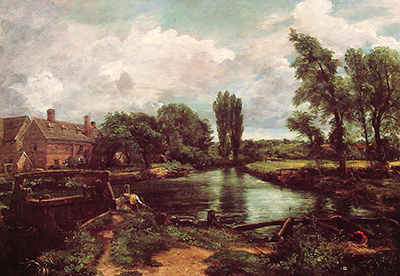
The National Gallery of Australia account places Constable's vantage point on the towpath at Flatford Lock: the river opens away from the viewer, the mill occupies the left side of the view, and the water meadows lie across to the right.[4] That description is crucial because it explains the structure of the painting. The lock gives the foreground its human-made edge, while the river leads the eye into the landscape.
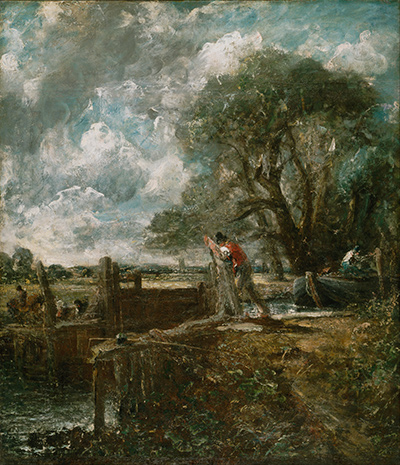
The local image associated with this subject shows the same basic logic: mill buildings to the left, a lock structure at the left foreground, a seated or working figure near the lock, open water in the centre, and trees and sky beyond. The viewer stands at the point where water is managed, not at a neutral scenic overlook. The Stour is seen as a shaped and working river.
This viewpoint gives the painting its quiet tension. The foreground is practical and near; the distance is luminous and open. Constable uses the receding river to join those zones. The eye moves from lock gate and bank into water, reflection, meadow and sky. The result is small in scale but wide in implication.
The National Trust's account of Flatford's history helps clarify why this point on the river mattered.[8] Flatford was not a picturesque accident beside still water. It was part of a navigated landscape in which milling, transport, towpaths, locks and river management met. Constable's composition benefits from that practical geography. The lock does not intrude upon nature from outside; it is one of the devices by which the place works. That is why the painting's foreground has such authority. It is not decorative furniture but the hinge between human use and the river's onward movement.
Flatford Mill and Golding Constable's world
Flatford Mill belonged to Golding Constable, the artist's father, and formed part of a larger family economy of milling and river transport.[1][7] The mill complex included structures for grinding, storage, hoisting and loading, while barges or lighters moved goods along the Stour.[7] The painting's subject was therefore personally familiar and economically specific.
This context matters because Flatford Mill from a Lock on the Stour is not simply a pleasant mill view. Constable is painting a working landscape that he knew from the inside. The lock, mill and river traffic belonged to the daily operations of the place. Even when no heavy labour dominates the picture, the scene is built around the infrastructure of labour.
The V&A blog places the painting within Constable's Suffolk settings, stressing the importance of Golding's mills and barges and the personal associations of the Stour landscape.[1] That personal connection should not be sentimentalised too far. Its strength lies in the meeting between memory and observation. Constable knew the place intimately, but he still had to solve it as a picture.
That double knowledge gives the painting its unusual tone. Many artists could have admired a mill beside a river; Constable understood how the river served the mill and how the mill shaped life around the river. His father was not merely a biographical footnote attached to the subject. Golding Constable's business made the setting legible to his son as a system of movement: grain, water, barges, banks, gates, ropes, sheds and working people. In the painting, these pressures are quiet rather than theatrical, but they make the view feel inhabited even when the visible action is slight.
The 1810-11 sketch campaign
The Huntington links its related Flatford Mill from the Lock to a small summer campaign of oil studies from 1810-11, undertaken as Constable worked toward the larger Flatford water-mill composition exhibited in 1812.[5] The National Gallery of Australia archive makes the same larger point for the Royal Academy version, connecting it to the 1812 exhibition picture.[4]
This repeated sketching is central to understanding the subject. Constable did not discover Flatford Mill in one glance. He approached it from different positions, testing what the lock, mill, water and sky could do within a composition. Some versions emphasised the lock gates; others opened the view downriver; some explored weather and reflection more strongly.
Such repetition was not indecision. It was method. Constable's mature naturalism grew from returning to a place until he understood its pictorial possibilities. In this case, the lock supplied a vantage point from which the working river could become a carefully structured landscape.
The later history of related Flatford material confirms how long this problem stayed alive for him. Christie's discussion of Flatford Mill from the tow path places that work among Constable's recurrent investigations of the same Stour setting, extending the sequence beyond the first lock studies and showing how the motif continued to be reworked in the years after the 1812 Royal Academy picture.[6] This continuity matters. Constable did not leave Flatford behind once he had found a single successful arrangement. He kept testing how altered viewpoint, distance, weather and scale could change the emotional and pictorial pressure of the same familiar ground.
Preparing A Water-Mill
The early lock-view studies led toward Constable's 1812 Royal Academy picture, usually identified by the water-mill title attached to Flatford, Suffolk, and also known through the lock-view formulation.[4][5] That larger painting is now in a private collection, but the preparatory studies preserve the process by which Constable worked out the subject.
The National Gallery of Australia account notes that Constable used the sharply receding lines of the river to lead into the composition.[4] That is one of the key lessons of the lock view. The river is not a flat strip of water. It is a compositional engine, carrying the eye past the foreground and into the depth of the scene. The lock gives the starting point; the water gives the movement.
The 1812 exhibition context also matters because Constable was trying to bring a local Suffolk subject into the public arena of the Royal Academy. The painting grew out of small studies, but the ambition was not small. The lock-view sketches show him searching for a way to make a familiar place persuasive beyond private memory.
That search helps explain the balance between exactness and selection. Constable did not need to invent an exotic subject, yet he did need to transform a known working view into a compelling public landscape. The lock offered order; the river supplied recession; the mill carried personal and economic significance; the sky gave animation. The challenge was to make these elements read as one pictorial argument rather than as a cluster of observed facts. The compact lock-view paintings are valuable because they show that argument being assembled.
Sky, water and handling
Web Gallery of Art describes the V&A version as one of Constable's oil sketches, marked by rapid handling and thickly loaded paint.[2] The National Gallery of Australia account draws attention to the expressive sky and sparkling reflections on the water.[4] These qualities are essential. The painting is not only topographical. It is atmospheric.
Constable's handling allows the scene to remain fresh. Buildings and lock structures are present, but they do not become dry architectural inventory. The sky changes the mood; the water catches light; foliage holds the banks together. The subject is a working river, but the paint makes the work part of a living atmosphere.
This is one reason the early Flatford sketches still feel powerful. They are not finished in the later exhibition sense, yet they are complete as acts of looking. Constable catches the place before it hardens into formula. The small scale gives the work urgency, as if the whole problem of mill, lock, river and sky had to be solved quickly.
The sky is especially important because it prevents the lock view from becoming merely linear. The river leads the eye back, but the weather opens the space upward. Reflections on the water link those two movements, carrying light across the horizontal surface while the clouds loosen the composition above. Constable's later reputation as a painter of changing skies can make these early works seem like preliminary chapters in a familiar story, yet the achievement here is already precise. Sky and water are not embellishments laid over the view. They are active forces in the painting's structure.
Maria, memory and restraint
East Bergholt Society records the tradition that Constable told Maria Bicknell in November 1811 that he had tried Flatford Mill again from the lock.[3] The detail is valuable because it ties the subject to personal memory and courtship, but it needs restraint. The painting should not be reduced to biography.
What matters is that the lock view held emotional force for Constable. It was a place he returned to, physically and imaginatively, while building his early landscape language. The personal association did not replace observation. It intensified it. He painted the lock, mill and river because they were both seen and felt.
This balance between feeling and structure is one of Constable's deepest strengths. A purely sentimental view would collapse into nostalgia; a purely topographical view would remain factual but inert. Flatford Mill from a Lock on the Stour works because it joins the two: remembered place and compositional intelligence.
Print afterlife
The National Library of New Zealand records a David Lucas mezzotint after Constable titled Flatford Mill, dated around 1830-31, with another title given as Scene of a navigable river. Flatford Mill from a lock on the Stour.[9] That print afterlife shows how the subject continued to circulate beyond the small early oil sketches.
The print is useful because it confirms the importance of the lock-and-Stour view within Constable's broader visual world. But it should remain secondary here. The article is about the early painting subject, not about Lucas or the print series. The later mezzotint belongs to the afterlife of the image, not to the original act of observation.
Even so, the print title is revealing. It links Flatford Mill with a navigable river, a phrase that also matters for the later Tate painting. Constable's Flatford subjects repeatedly ask viewers to see the Stour as a managed, useful river as well as a beautiful one.
That phrasing also points back to the importance of the lock. Navigation is not abstract in Constable's Flatford world; it is made visible through banks, towpaths, gates and the measured handling of water. The print's afterlife therefore does more than preserve a composition. It preserves a way of naming the place, one that keeps utility and beauty together. For Constable, that union was never a minor detail. It was one of the conditions that made the Stour landscape artistically fertile.
Boundaries with the other Flatford works
The Flatford group can easily blur if the titles are handled loosely. Flatford Mill concerns the broader early study subject around mill, lock and river. Flatford Mill (Scene on a Navigable River) is the later large Tate exhibition picture of 1816-17. Boat-Building near Flatford Mill centres on the dry dock and a barge under construction. The Lock is the 1824 vertical six-footer about the mechanics of passing a boat through a lock.
Flatford Mill from a Lock on the Stour has a different role. It is about a viewpoint and a preparatory problem. The lock provides the position; the mill gives the personal and economic anchor; the river creates depth; the sky and reflections test atmosphere. It is one of the early works in which Constable learned how to build a landscape from the exact pressure of a familiar place.
Keeping those boundaries clear helps the painting stand on its own. It is not merely a smaller rehearsal for later fame. It is an independent record of the moment when Constable's Stour art was beginning to find its structure.
Why Flatford Mill from a Lock on the Stour matters
Flatford Mill from a Lock on the Stour matters because it shows Constable discovering how much could be done with a single local viewpoint. The painting has no grand event, yet it contains the essential ingredients of his early art: family place, river work, open-air looking, atmosphere, water and compositional experiment.
It also matters because it reveals the Stour before it becomes monumental. Later paintings would enlarge the river into great exhibition statements. Here, Constable is still close to the ground, working out the relationship between lock, mill and water in a compact format. That closeness gives the work its special charm and seriousness.
Finally, the painting matters because it shows why Flatford remained inexhaustible for Constable. The same mill, lock and river could generate early oil sketches, an 1812 exhibition picture, later major Stour landscapes and eventual prints. The place was small, but artistically abundant. In Flatford Mill from a Lock on the Stour, we see that abundance beginning to take form.
Frequently Asked Questions
Discussion
What gives this early lock view its greatest force: the working foreground, the receding river, its family associations or the changing sky and reflections?
Reader Insights
How does the lock turn a practical position on the towpath into the starting point for pictorial depth?
Where does intimate knowledge of Golding Constable's mill sharpen the scene without reducing it to biography?
Which parts of the compact oil sketch already suggest the ambition of the 1812 Royal Academy picture?
Join the Conversation
Share your reading below.
References
- V&A Blog, “Constable's Country: Inspired by Suffolk Settings,” https://www.vam.ac.uk/blog/constable-the-making-of-a-master/constables-country-inspired-by-suffolk-settings
- Web Gallery of Art, Flatford Mill from a Lock on the Stour, https://www.wga.hu/html_m/c/constabl/flatfory.html
- East Bergholt Society, Flatford Mill from a lock on the Stour, https://www.ebsoc.org.uk/constable-painting/flatford-mill-from-a-lock-on-the-stour/
- National Gallery of Australia archived exhibition, Flatford Mill from a lock on the Stour, https://digital.nga.gov.au/archive/exhibition/constable/detail.cfm%3Firn%3D143220%26bioartistirn%3D18283%26mnuid%3D1.html
- Huntington, Flatford Mill from the Lock, https://www.huntington.org/collections/mus-4780
- Christie's, John Constable, Flatford Mill from the tow path, https://www.christies.com/en/lot/lot-6411958
- Flatford and Constable, “Flatford Mill under the Constables,” https://www.flatfordandconstable.org.uk/flatford-mill/flatford-mill-under-the-constables/
- National Trust, “History of Flatford,” https://www.nationaltrust.org.uk/visit/suffolk/flatford/history-of-flatford
- National Library of New Zealand, David Lucas after John Constable, Flatford Mill, https://natlib.govt.nz/records/23208379?search%5Bpath%5D=items
- Graham Reynolds, The Early Paintings and Drawings of John Constable, Paul Mellon Centre / Yale University Press, 1996, https://www.paul-mellon-centre.ac.uk/publications/browse/9780300063370